One of the big benefits of Bristol Creative Industries membership is the ability to self-publish content on our website. We’ve seen lots of great content published in 2021 including some brilliant business advice. Here are the 20 most popular posts of the year.
Chase Design Group examines the legacy that COVID-19 will leave for brands, and what newly adopted trends and ways of communicating should stay with us. Read the post here.
Having a strong organisational structure in place is key to growing your digital agency. Janusz Stabik explains your options and how to know which structure will guarantee employee and customer satisfaction and allow you to scale your marketing agency. Read the post here.
Carnsight Communications is one of the most prolific BCI bloggers so it’s no surprise that the business has made the top 10. In this great post, company founder Jessica Morgan outlines what her previous career in marketing taught her about public relations. Read the post here.
After the couple of years we’ve all had, the mental wellbeing of employees is increasingly concerning. Armadillo explains how the approach to mental health in the workplace needs a culture change. Read the post here.
Janusz Stabik makes his second appearance in the top 10 with tips on how digital marketing agencies can attract high-quality clients. Read the post here.
In another post from Carnsight Communications, learn five key things to remember when looking to secure engagement on LinkedIn. Read the post here.
Looking for your business to make headlines? OggaDoon shares top tips on how to write the perfect press release. Read the post here.
Brands can’t lead the conversation on social media, says AMBITIOUS in this great post. Read the post here.
“As joint leader of an independent agency, 2020 meant sleepless nights. But it provided opportunities to inspire others and galvanise our team,” says Andy Brown, chief financial officer at Armadillo, in this post outlining leadership tips for 2021 that will also serve us well in 2022. Read the post here.
How can an entrepreneur attract the perfect investor? Gravitywell outlines six qualities investors look for in tech startups. Read the post here.
Want to post your own content on the Bristol Creative Industries website? Become a member.
Some B2B brands find social media a challenge but there’s lots that you can do as this post by AMBITIOUS shows. Read the post here.
The winning agencies will be the ones with an uncompromising focus on their culture, looking at how they can support their people to be their best selves and do era-defining work, says Tonic Creative Business Partners. Read the post here.
If there’s anyone who knows about being successful at blogging, it’s Helen Savage from Blog Write Ltd. She shares some great tips. Read the post here.
OggaDoon shares a list of 10 essential features you didn’t know you could use with Google Ads. Read the post here.
Sparro House Creative Ltd outlines three tips to improve your content marketing. Read the post here.
If your primary audience is other businesses, then case studies are the perfect tool for creating authority, building trust and delivering social proof. George Devane shares some tips. Read the post here.
The phrase ‘SEO; now covers optimisation strategies and techniques on a wide range of different websites including Instagram. Varn outlines how to improve your SEO on the social media platform. Read the post here.
Leaders and managers have often received little to no training in how to have a ‘difficult’ conversation and so we end up avoiding the situation altogether until it becomes really serious. That can mean getting into performance management, grievance procedures or even worse. Jonathan Rees shares advice. Read the post here.
Chris Thurling from Armadillo provides his advice on what to consider when seeking out a marketing agency that’s suitable for your business. Read the post here.
As you prepare to hit send on your latest business mailing, ask yourself whether it would pass the ‘hover test’. Here are five easy ways, shared by Carnsight Communications, to make sure it does. Read the post here.
Please respond to our new survey about the creative industries in Bristol and Bath. It will help us design – and advocate for – future support for the creative economy in our region.
The creative industries help make Bristol and Bath amazing places to live and work.
But what would it take for them to grow and prosper even more?
Where are you now? Where do you want to go next?
And are you able to take a few minutes to think about these questions?
Over the past two years, the creative industries have experienced both challenges and opportunities. We’d like to invite you to participate in a survey to reflect on where you and your organisation are right now – and consider what you might need to develop further.
To take part, just follow this link.
Feel free to share the link with contacts within your network who also work in the creative industries – the more responses we get, the richer the resulting data and insights.
By participating, you will help us to understand more about creative organisations and the creative economy in the area. This research will help Bristol Creative Industries to design – and advocate for – future support for the creative economy in the Bristol area.
This research is being conducted by The Audience Agency on behalf of BCI. If you have any questions about the survey or the research, please contact [email protected].
Thanks for your continued and valued support.
Anne Thistleton, the founding partner of LIGHT Consulting who has spent over 20 years as a marketing practitioner in the field of mind science, joined us from South Africa for an online event where she shared fascnating insights about how understanding the way the human mind works can help creatives build more effective campaigns. Dan Martin summarises her brilliant advice
Anne opened her talk with the story of the 2007 experiment which saw world-renowned violinist Joshua Bell pose as a busker in a Washington DC subway. Despite usually being able to command audiences paying thousands of dollars to see him play, out of 1,097 people that passed by, just 27 gave him money, and only seven stopped and listened for any length of time. In total, he made $52.17, $20 of which was from one person who did recognise him.
You are currently viewing a placeholder content from YouTube. To access the actual content, click the button below. Please note that doing so will share data with third-party providers.
So why did that happen? “People didn’t hear him because we don’t hear with our ears,” Anne said. “We listen with our ears, but we hear with all of our senses. They are constantly sending information into our mind, enabling us to connect the outside world with our memory and make sense of the world…influencing how we act and how we react.”
The people in the subway, Anne explained, were getting clues about what was going on at an unconscious level. They were telling them that they were in the subway and connecting with memories of seeing past performers who they passed by and didn’t have time to stop and listen to. Joshua Bell was just another busker.
Anne shared more examples of mind science in action:
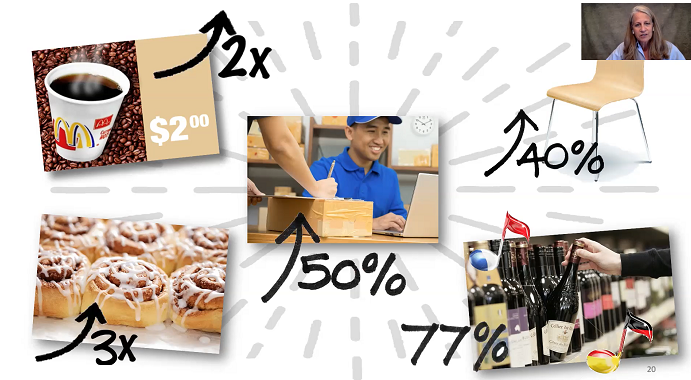
In Australia, Mcdonald’s increased the price of a cup of coffee from $1 to $2 and sales doubled. A colleague of Anne’s visited and said the “coffee even tasted better.”
A study of a Cinnabon store found when someone was close enough to take in the aromas of the bakery products, they were three times more likely to help someone with a problem or question compared to customers in other parts of the shopping centre.
In a print ad for a delivery company, a clock was put on the wall in the image. It was “a clock that no one can consciously recall but when asked to describe what they remember from the print ad, expectations of speed and service increased by 50%”.
During a two week experiment in a supermarket, French music was played for the first week and 77% of wine sales were French wine. The next week they played German music and sales of German wine increased by 73%.
A study by a team of Yale professors showed that when an offer price by a customer to pay for a new car was rejected by the salesperson, buyers sitting in a soft chair at a car showroom increased their offer by 40% compared to those sat on a hard chair.
Why did all that happen?
“While we as marketers have been stuck in the dark ages of decision making, the good news is that there has been a complete explosion in mind science and how the brain works,” Anne said. “And the undeniable headline is humans are not rational decision makers. We’re not even rational thinkers.”
Take the example below. If you were asked out of the two tables which one you’d like to take a nap on and which you’d prefer to eat pizza from, you’re likely to pick the one on the left for the first question and the one right table for the second. But as the image shows, they are exactly the same size.

This file is licensed under the Creative Commons Attribution-Share Alike 4.0 International license.
“Even though the image shows the tables are the same size, you still can’t see it,” Anne said. “It demonstrates that in many instances we are still unable to see things in a logical, rational manner.
“Our mind is the most complex system in the world. But with just a few basics, I believe it can materially change how you look at communication.”
The science behind why the above results occurred can be explained by mind science. Watch this video with Anne outlining it in detail:
You are currently viewing a placeholder content from YouTube. To access the actual content, click the button below. Please note that doing so will share data with third-party providers.
Now we know how the science works, here’s why the results above in the five examples occurred:
McDonald’s $2 cup of coffee: “Over time, our minds have been trained to know that a high price means high quality and vice versa. And at that point in time $2 was an abnormally high price for a cup of coffee in McDonald’s, but not in Starbucks. As the “Starbucks node” has already been created in the mind of the audience, where expensive coffee means good coffee, then the $2 primes them for a good cup of coffee. McDonald’s can’t sell a bad cup of coffee, make it expensive and pass it off for a great cup of coffee, but they can make a good cup of coffee that can become a great cup of coffee because of the cues that they’re priming their audience with.
Cinnabon: “Aromas of fresh baked goods lights up powerful memories of home and family which makes you feel good. So when someone asks you for help with something, you’re going to do it because you’re already in a much better mood.”
Delivery company print ad: “In Western society, clocks have become associated with timeliness. The clock implicitly lights up this idea and the core message of speed and service, which is exactly what the company is trying to do with that print ad. Even the background items, the ones you can’t recall, are picked up by our non-conscious processor and can have a significant impact on the message.”
Wine sales: “Just like the clock on the wall was bypassing the customers’ conscious visual processor, the French and the German music wasn’t consciously registering either but it was lighting up those ideas via people’s auditory processor. French or German-related memories were guiding customers to those specific shelves.”
Car buying: “We take on information through our sense of touch all the time, whether actively as we’re touching something or passively such as being seated in a chair. It turns out that the hard chair equals a hard heart. It triggers feelings of duty, stability and toughness. For your next salary negotiation, may I suggest you look for that hard chair so that you don’t give it too easily.”
Anne concluded: “The important thing for all of this is that it’s the non-conscious processor that’s wielding the enormous influence. That’s what’s driving so much of our decision making. That’s where the power lies.”
So what steps can you take to use mind science to improve your marketing and creative campaigns?
For every piece of communication you send out, ask what are you lighting up and do it from all of the five senses. Do a sensory audit, Anne said. “Think through every single single sense and it’ll be amazing what it will eliminate.”
Although an exaggerated example, Anne said say you were running a condom brand. Your options for a message on the front of the packaging are ‘5% failure rate’ or ‘95% success rate’. “If you ask the question of what are you lighting up, do you want to be lighting up failure or do you want to be lighting up success?”.
“Focus groups, online mobile surveys, brand tracking. The problem is these traditional methodologies are all talking to the conscious processor because we thought that’s what drove action. But remember, when you talk to the conscious processor and you ask people who’ve just bought either French or German wine did music influence your choice, 86% are going to say no. But that’s isn’t the case because you monitored the behaviour and the only thing that changed between one and two was the music.”
Examples of research which led to failures include Heinz’s green ketchup. The company failed to understand how colour influences a decision, Anne said.
‘New Coke‘, a new recipe for Coca Cola, is another example. “It was the most highly researched new product of its time; 40,000 interviews and $4m spent. It was an incredible disaster because they didn’t realise they were talking to the conscious mind. The brand is so much more than just what is inside the can and defined by a taste test.”
Anne said methodologies that can help you surface what’s happening in the non-conscious processor include metaphor elicitation, implicit association testing, biometrics, eye tracking and facial coding.
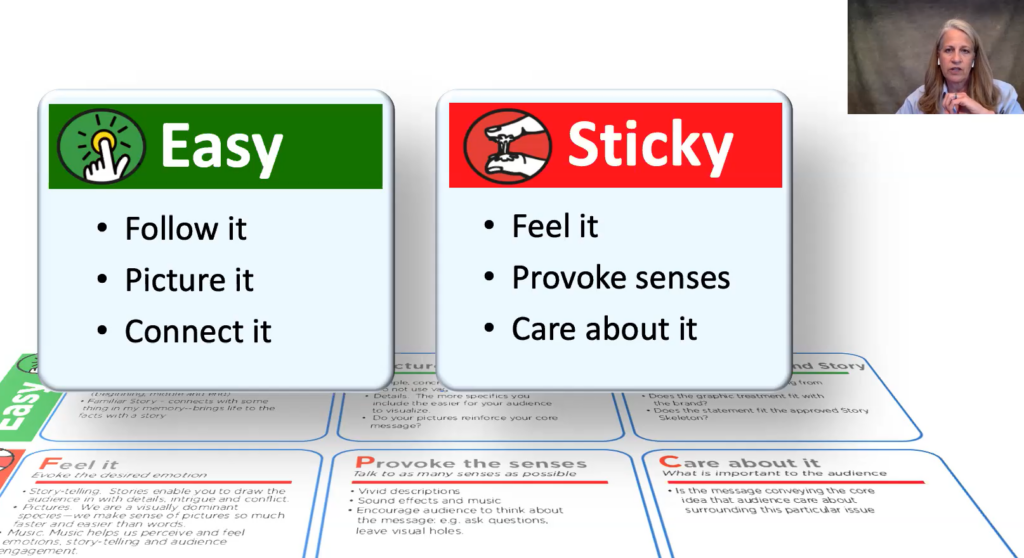
The first principle for connecting is that it must be easy, tell simple stories and don’t make them hard to understand. “Stories are the glue of our memories,” Anne said. “It is how knowledge was transferred before the written word. Stories speak to the rhythm and the patterns of our mind.”
Secondly, it must be sticky. Make it memorable. “It’s got to get into long term memory to drive behaviour,” Anne said.
Thirdly, you must then repeat and repeat until it makes a strong connection.
An example of an advert that follows the principles above is this one:
You are currently viewing a placeholder content from YouTube. To access the actual content, click the button below. Please note that doing so will share data with third-party providers.
“The ad tells a story,” Anne said, “but they also weren’t afraid to leave things out and because they did that we can co-create, we can picture ourselves in it and we can feel it.”
Marketers and creatives should harness the power of their own non-conscious processor because that’s where your creativity and your imagination lies.
Anne said: “You have got to find your mental playground. Find a consistent time and place with no phones, no music, no friends, just you so you can cultivate your creativity and your imagination. That’s the core of your livelihood.
“One thing you don’t want to do is brainstorms. They go so quickly that you’re only tapping into your conscious processor. That’s not where your power for ideas lies. Also, a typical rule of brainstorming is no criticism. You actually want criticism. I know this almost sounds like sacrilege, but you want criticism because you’re trying to expand your mind. You’re trying to get to the parts of the mind that don’t often get tapped into.
“You need to use criticism because when you hear something, it lights up a different part of your mind, it fires in new ideas, and you start to connect that to what you already know.”
Taking us back to the first story at the start of her amazing talk, Anne concluded: “We are all Joshua Bells. We all need to be heard and mind science provides that powerful learning to enable us to be heard.
The creative industries contribute to making Bristol and Bath amazing places to live and work. But how can they grow and prosper? Tell us in our survey here.
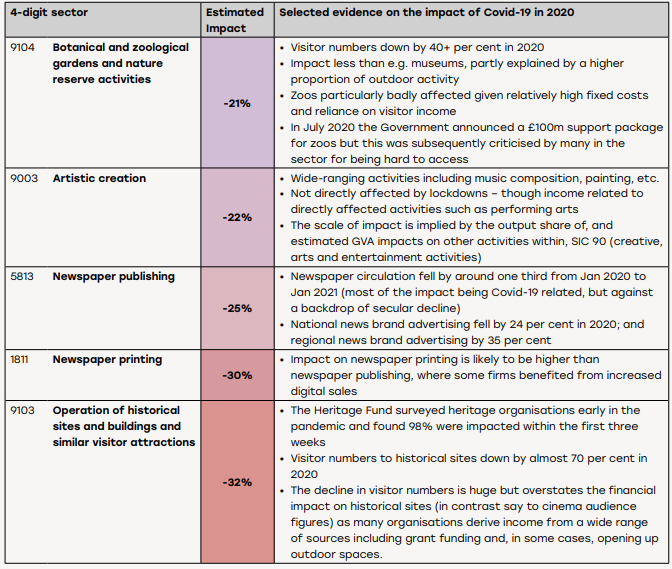
Social distancing rules and lockdowns during the coronavirus pandemic had a “catastrophic” and “devastating” impact on Britain’s arts, culture and heritage organisations, with output falling by 60% over the past 18 months.
That’s the finding of a major new report by researchers at the University of Sheffield which analysed how COVID-19 has affected museums, galleries, cinemas, theatres and other arts and cultural organisations.
As the pandemic took hold in March 2020, the impact on the sector was immediate. Annual gross valued added (GVA) output fell dramatically with a decline of around a third from the second quarter of 2019 to the same period last year in real terms.
Businesses categorised as “creative, arts and entertainment activities” along with libraries, archives and museums were worst hit with declines of 63% and 45% respectively.
Few businesses saw an increase although with millions of people locked down at home and looking for entertainment, computer games companies experienced a 18% rise in output, while book publishing firms increased output by 2%.
At the other end of the scale, with theatres shuttered during lockdown and then facing limits on audiences, output among performing arts organisations declined 60%, while it fell 70% at cinemas.
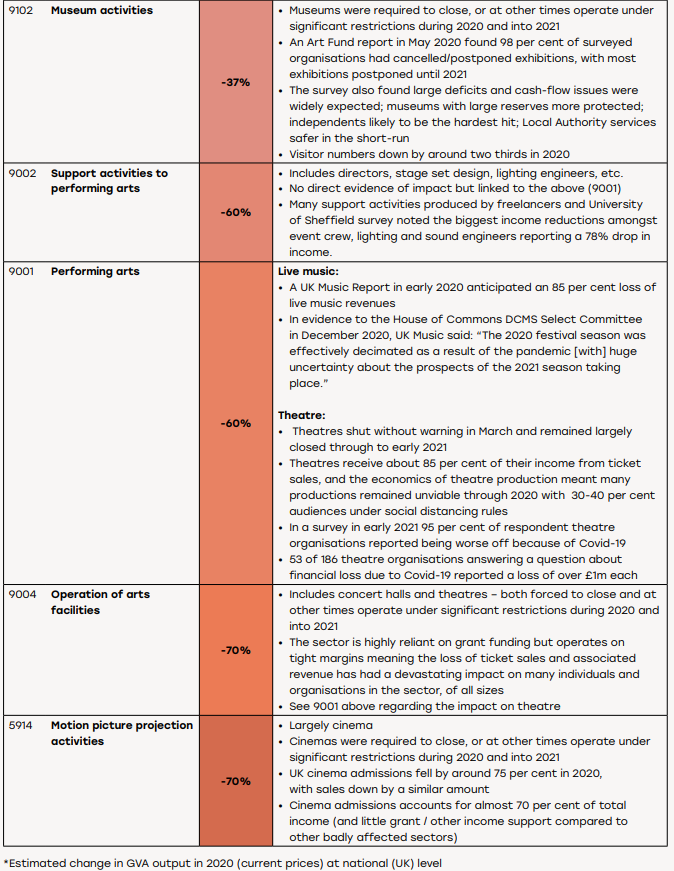
Government funding has been vital for the survival of arts, culture and heritage businesses during the pandemic. The study found that 55% of employees in the sector were furloughed through the Coronavirus Job Retention Scheme. That’s the second highest sector behind accommodation and food.
At its peak in May 2020, 450,000 arts, entertainment and recreation employees were furloughed, falling to 150,000 by the end of May 2021.
Freelancers were hard hit too, given the high number employed by arts and culture organisations. They made more than 80,000 claims for grants through the Self-Employment Income Support Scheme (SEISS), 68% of the UK’s eligible population.
The funding was not without its problems though. For the fourth round of SEISS, 181,000 self-employed people in the arts sector were assessed for eligibility, the research revealed, but only 54% were deemed eligible – compared to 67% across all sectors.
“There is substantial evidence to suggest that a large number of people in the sector failed to claim under either the SEISS scheme or the furlough scheme, due to their strict eligibility criteria,” the report said.
“Many creatives move between employment and self-employment or do both at the same time – a reflection of the dynamism of the sector – meaning they’ve not qualified for either SEISS
or furlough, or only been able to claim small amounts of support.
“Others have their own companies for work purposes which were seen to fall between the two schemes. In short, there has been insufficient support for a large number of self-employed people in the CAH sector.”
Please respond to our new survey about the creative industries in Bristol and Bath. It will help us design – and advocate for – future support for the creative economy in our region.
The £1.5bn Cultural Recovery Fund (CRF) was another vital scheme. It was set up by the Department for Culture, Media and Sport in July 2020 in response to data gathered during the first lockdown which suggested 65% of arts and culture organisations had stopped trading and over 30% would run out of cash by September 2020.
The University of Sheffield report said the success rate of applicants for revenue grants was 69% and 70% for capital grants.
The amount of funding received through CRF varied between regions but the study said it “includes a handful of very large grants/loans which distorts the overall picture”.
Among those areas was Gloucestershire, Wiltshire and Bath/Bristol due to a £23m loan to English Heritage based in Swindon and a £6m capital grant to Bristol Beacon (formerly Colston Hall) which is currently undergoing refurbishment.
The report also highlighted some local authority schemes set up to help creative businesses deal with the impact of the pandemic. The examples cited include the West of England Combined Authority’s Creative Sector Growth Programme. Find details in our creative industries funding guide.
The report includes a specific focus on the experiences during the pandemic of freelancers in the arts and culture sector in South Yorkshire. The findings are likely to ring true for thousands of other self-employed people in other parts of the UK.
More than three quarters of freelancers said their mental wellbeing was worse since the start of lockdown. Male respondents, under-30s, and those with a diagnosed mental health condition experienced even greater levels of distress.
The main causes of stress and worry were personal finances, unemployment and the ability to cover overheads. Anxiety over these issues was much higher amongst freelancers than the general population.
South Yorkshire freelancers also reported lower levels of wellbeing and happiness and higher levels of anxiety than the general public. With their mental health impacted, the report said the pandemic led “to a sense of lost identity, skills and motivation”.
Event crew, lighting and sound engineers reported greater worsening of mental health than respondents in other roles, with 53.8% saying that their mental health was “much worse” compared to 25.5% on average.
Professor Vanessa Toulmin, director of city and culture and chair in early film and popular Entertainment at the University of Sheffield, said:
“The COVID-19 pandemic has had a devastating impact on the UK’s arts, culture and heritage sector. This landmark report reveals how social distancing and lockdowns over the past 18 months have had a catastrophic effect on the finances of people who work in the sector, as well as businesses and venues.
“People have lost their jobs, businesses and venues have closed and this economic impact has severely affected the mental health and wellbeing of people who work in the sector across the UK. People in the sector have been losing sleep and have had much higher levels of anxiety due to how the pandemic has affected their personal finances and uncertainty about the future.”
The creative industries contribute to making Bristol and Bath amazing places to live and work. But how can they grow and prosper? Tell us in our survey here.
Andy Nairn, who has been named the UK’s number one brand strategist for the past three years, joined us for a fascinating and entertaining event to share insights from his new book, Go Luck Yourself: 40 ways to stack the odds in your brand’s favour.
In the book, Andy explains how the history of marketing and advertising is full of brands that stumbled across great ideas by accident or turned misfortunes into huge successes. During the event, the co-founder of advertising agency Lucky Generals highlighted some examples and outlined the lessons for creative companies. Dan Martin summarises his insights.
Opening his talk, Andy Nairn explained that we have a strange relationship with luck in the UK. “Other parts of the world find it completely natural to talk about luck and it’s a perfectly acceptable part of business conversation,” he said, “In the West, we’re a bit snooty about the whole thing. We think of it as a bit primitive and not to be trifled with.”
The negativity around luck was cemented in Victorian times, Andy said. The Industrial Revolution and the Protestant work ethic created the belief that if you were rich, you were successful because you had worked really hard for your money and God had smiled upon you, but if you were poor, it meant you hadn’t tried hard enough, you were work-shy and you should try harder.
That attitude around only hard work can generate good results still prevails, shown by the blurring of work and personal lives during the pandemic, Andy said.
“We can all think of situations where working an extra hour hasn’t given us a creative breakthrough and it can actually sometimes make it worse. Working hard means we’re stuck in the middle of it and what we really need is to get some fresh air and space around us.
“The book says yes, hard work is a good thing but you also need a bit of luck. The more you think about luck and the more you’re conscious of it, the more you can do to increase the chance of it coming your way. If you just deny that luck exists, it’s very hard for you to do that.”
There are 40 tips in Andy’s book that fit under the following four themes:
You might not realise it but you are highly likely to have assets in your business that you are not taking full advantage of. Andy used three non-business examples to illustrate his point:
Many businesses are guilty of not appreciating what they’ve got, Andy said. Brand history, heritage and provenance are often neglected by brands but talking about the history of your business, where it’s from and why it’s called what it is could be a valuable benefit to your marketing and other business activities.
Other examples include the data your business holds and the window display in your business’ offices.
And what about your logo? Could that be used in a different way?
Andy’s business, Lucky Generals, was asked to come up with an advertising campaign for Amazon that worked in multiple countries. The answer turned out to be a simple but very powerful one that was inspired by the company’s existing smile-shaped logo. As the Lucky Generals website says: “We hit upon the simple idea of heroing Amazon’s iconic packages and the epic journeys they make, to put a smile on the faces of people around the world.”
You are currently viewing a placeholder content from Default. To access the actual content, click the button below. Please note that doing so will share data with third-party providers.
To illustrate this point, Andy highlighted a 10-year study into the nature of luck by Professor Richard Wiseman. As part of it, he gave a group of people a newspaper and asked them to count the number of photographs. The unlucky people took around two minutes whereas the lucky people took just three seconds. The reason was that on the second page of the newspaper was the message: “Stop counting. There are 43 photographs in this newspaper.”
The study concluded that lucky people are good at constantly looking for opportunities beyond what they’re working on or the thing they’ve been told to do.
This can also be illustrated by the world of science, Andy said. Several important discoveries have been made accidentally and of the most famous is Alexander Fleming who discovered penicillin after spotting some mould that had accidentally developed on a plate.
Diversity of teams is important here too. It’s easy to recruit people who are the same as you but that can mean you’ll just come up with the same ideas. However, if you take on people from different cultures, backgrounds and experiences, “it gives you a much better chance of striking it lucky” and spotting opportunities you might never have discovered.
There are many examples of businesses converting a bad experience into a good one. One brilliant one is Oswald the Lucky Rabbit, an early character created by Walt Disney in 1927. It was popular but a contract dispute with his producer led to Disney quitting work on the cartoons. On the train home from a meeting, he came up with a new idea. It developed into Mickey Mouse, the most successful cartoon character of all time.
“We’ve all experienced our ideas being pulled, budgets being cut, timings being changed and clients changing their minds, but what we have to do is go again and come up with something that is even better, like Walt Disney did,” Andy said.
“The best companies don’t just deal with a bit of bad luck, it’s almost like they go running towards the bad luck. There’s a good energy that comes out of that.”
Steve Jobs was known for killing off his own products (the iMac killed the Macintosh and the iPhone killed the iPod) because, as Andy said, “his attitude was, if I don’t kill them off, someone else will.”
There are also some brands that take on taboos and talk about them directly. Bodyform and periods is an example.
Others take what could be seen as an annoying product flaw and turn it into a positive. Think of Guinness and “good things come to those who wait”.
When working with a big brand, Andy said he goes to the “darkest corners of social media” to find the negative conversation about that brand. “The jokes and nasty comments often have a truth and by acknowledging them, you can own the joke, turn it on its head and turn against those people.”
Andy’s last point is about deliberately building luck into your processes. He illustrated it with examples from music.
What similar techniques can you build into your business processes so you constantly generate ideas?
Be lucky!
The next Bristol Creative Industries online keynote is with Anne Thistleton, marketing veteran and former strategy lead for The Coca-Cola Company in South Africa. She will share easy and practical lessons from mind science to make sure your audience really hears you. BCI members get £15 off tickets. Book your place here for the event on 21 October.
The Social Mobility Commission (SEC) has launched a new sector-specific toolkit to encourage socio-economic diversity and inclusion in the creative sector workforce.
It aims to widen access to the creative industries for people from working class backgrounds in an attempt to tackle a “class crisis” in the sector.
The socio-economic diversity and inclusion: toolkit for the creative industries, developed by the Social Mobility Commission in partnership with creative industries businesses, offers practical support and guidance to creative employers on how to identify and remove invisible barriers that arise at every stage of the employee journey.
According to new research, just 27% of the creative industries workforce comes from a working class background, compared with 39% of the wider UK workforce. For the advertising and marketing and music and performing arts sub-sectors, the percentage of the workforce from a working class background falls to just 23%.
The SEC said that “the unique structures of the creative industries workforce are driving this imbalance, with factors including the high numbers of ‘professional’ jobs within the sector, an entrenched reliance on freelance workers as well as an abundance of unpaid internships creating additional barriers to entry for those from low socio-economic backgrounds.
“Disproportionate numbers of those in senior roles who attended private school or Oxbridge may also have served to perpetuate understandings of cultural ‘fit’ and accepted behavioural codes within the creative industries, presenting an additional barrier to those from low socio-economic backgrounds.”
Those who have contributed or endorsed the toolkit include the BBC, BFI, UK Screen Alliance, Youth Music British Fashion Council, Museums Association, British Institute of Interior Design and the Publishers Association.
Culture secretary Nadine Dorries said:
“A working class background should never be a barrier to a successful career in the creative Industries. We want to increase access to opportunities across the board as part of our plan to level up. This new toolkit will help support creative firms become more inclusive and give people the chance to forge a successful career in these exciting sectors.”
Caroline Norbury, CEO at Creative Industries Federation, said:
“If creativity is to shape a better future for all, then it has to reflect the diversity and breadth of experience found across the country. Ensuring opportunities exist for creative individuals to thrive, no matter their background, is an important step towards achieving this. The Social Mobility Commission’s toolkit is a critical resource for addressing the unacceptable imbalance of socio-economic backgrounds found in the UK’s creative industries.”
Farrah Storr, social mobility commissioner and editor-in-chief at Elle UK, said:
“It’s been great to see so many within the industry collaborate on the development of this toolkit. For the whole creative sector to remain vibrant, it is vital that we tap into the full potential of the whole population, not just a privileged few.
“The creative industries create the culture of the nation, which in turn necessitates full participation from the entire nation. As organisations adopt the actions set out within this toolkit to make socio-economic inclusion a reality, we will become an industry that is both rich in diverse viewpoints, experiences and stories as well as an industry that is built to last.”
Heather Carey from the Creative Industries Policy and Evidence Centre and Work Advance said:
“As we rebuild following the Covid-19 pandemic, it is vital that we widen access to opportunities created in high-growth, high-skill parts of the UK economy, like the Creative Industries. Our research provides definitive evidence on the causes of class imbalances and sets out an ambitious and wide-ranging programme of change to enhance social mobility into the Creative Economy. Government and Industry must seize this moment, as we emerge from an unprecedented crisis, to address the long-standing inequalities in the Creative sector and to grasp the potential offered by diverse talent in the UK to cement our creative excellence and competitive advantage, globally.”
The Social Mobility Commission is hosting a public launch event on Monday 11 October, chaired by Farrah Storr, SMC commissioner and editor-in-chief of Elle, and featuring a discussion with industry insiders: Jamie Gill, CEO of ROKSANDA and executive board, British Fashion Council; Della Hill, creative lead at Literature Wales and Emily Jones, senior producer at Sage Gateshead. Register for the event at SocialMobilityWorks.org
Heather Carey will present the findings of PEC’s new research report: Social mobility in the creative economy: Rebuilding and levelling up?
Bristol Technology Festival (BTF) has unveiled a packed schedule for its tech showcase event, taking place during the week of October 11-15.
Now into its third edition, BTF is an annual celebration designed to bring together events, people and communities to share, learn and explore technology developments in the southwest region. Events will encompass a range of sectors from green and sustainable technology to legal and finance.
This year’s schedule includes a number of highly anticipated events, of which there are more than 50 spread across five packed days.
The theme which wraps around many of the events through the week is ‘changing the face of tech’, with the emphasis on taking tangible action beyond simply talking about a lack of diversity and inclusion. As well as demonstrating the best of what the area’s tech space has to offer, BTF 2021 aims to bring together like-minded organisations ready to inspire wide-reaching change.
It is not too late to get involved. For individuals and organisations interested in attending or hosting an event, there is still time to book tickets and submit proposals.
Softcat headlines busy BTF 2021
BTF 2021 would like to thank Headline Partner Softcat for its indispensable support of BTF 2021.
Looking ahead to the event, Rob Parkinson, CIO at Softcat, commented: “We are delighted to be involved in the 2021 Bristol Technology Festival. Bringing together local technology communities and shining a light on all the innovation the region has to showcase is an important way to drive collaboration and industry growth.
“The last 18 months have been tough for many industries, but technology has come through as an enabler and has made many re-think how they interact and do business. As the impact of technology continues to grow, forums like the Bristol Technology Festival have never been more important and we are pleased to be supporting it.”
Event organisers are also grateful to Deloitte for sponsoring the Bristol Technology Festival Launch Event, on Thursday October 7 which will be held at Engine Shed.
Here, the exclusive launch evening will be a chance for senior leaders and technology influencers from across the region to network, share ideas and see each other in person, with speaker contributions coming from the likes of Moneyhub, Deloitte and Softcat.
Changing the face of tech
Among the many highlights of this year’s festival is a fireside keynote chat with Antonia Forster.
Antonia is a Unity/C# games and software developer, specialising in immersive experiences such as AR, VR and XR. In 2017, her record-breaking TEDxBristol talk was delivered to a live audience of 2,000 people and has since gained over 92,000 views online.
A year later, Antonia was nominated and shortlisted for Nature’s John Maddox Prize, in recognition of her work as an LGBTQ+ speaker and activist. She has also been named one of Bristol’s Top Nine “Women to Watch” in STEM, and has appeared in numerous magazine, radio and television features.
The talk with Antonia is scheduled for Monday October 11th, 12:00-14:00, at Engine Shed.
It is expected to be one of many events held throughout the week that inspire both more women to pursue careers in the tech sector, and organisations to provide greater opportunities and promote diversity.
What else to expect at BTF 2021
Diversity is the name of the game when it comes to the group of volunteers helping to coordinate the festival.
Among them are representatives from Hargreaves Lansdown, Newicon, TechSPARK, and Engine Shed, with events throughout BTF being crowdsourced from organisations across the city of Bristol.
These include tech companies, public bodies, schools, community interest groups and charities, with events open to a huge variety of guests – from tech professionals and businesses to individuals wanting to know more about the area’s digital industries.
Between them, a huge variety of discussions and other activities will be open to attendees:
This year’s Bristol Technology Festival will also witness the launch of the Festival Community Partner initiative. Here, businesses have the opportunity to become one of 50 community partners, with all funds invested helping to secure the long-term future of the festival.
For more information and to view the schedule for BTF 2021, visit www.bristoltechfest.org
To submit an event proposal, complete the form here.
Join us on Thursday 21st October for a lunchtime Keynote with marketing veteran Anne Thistleton.
We all know that our mind governs the way we see, understand and interact with the world. But until recently we didn’t know how we actually processed all of the incoming data to make sense of the world. Instead, we learned to accept the fact that sometimes we made useful connections and sometimes not.
With the invention of brain scanners in the 1980s and their extensive use for that past several decades, experts have now gained insight into how our mind truly works, how we process information and how we make decisions. Consequently, new marketing concepts from Neuroscience, Behavioural Economics, Neuromarketing, etc. are becoming plentiful. And books, articles, videos, talks, blogs, even neuromarketing consulting and research companies abound. But very few are explaining the basics in simple terms, and very few are clear on the implications for us. What should I do tomorrow to apply this new knowledge to deliver better impact and results for my clients?
Tickets are priced at £30+VAT for BCI members and £45+VAT for non-members.
Anne Thistleton is the Founding Partner of LIGHT Consulting and has spent over twenty years as a Marketing Practitioner in the field of Mind Science. While leading strategy for The Coca-Cola Company in South Africa, she pioneered this work to first re-vitalise relationships (and the business) in the South Africa townships then to provide the foundation to the Open Happiness campaign. Since then, she has worked across the world and across industries, developing specific marketing-focused Mind Science applications, and then testing and improving them with multi-national companies, advertising agencies, foundations, even political parties.
Over the years, Anne has worked with many of the world’s leading cognitive psychologists, neuroscientists and behavioural economists all focused on what does it mean to marketers and creatives, and how can we apply it now. By using her expansive marketing experience, she has been able to identify and make practical the most relevant and valuable aspects of Mind Science for consumer and B2B marketers.
Book your ticket to the event with Anne Thistleton here.
Workforces in the creative industries are at risk of becoming more unequal unless efforts are made to improve diversity and inclusion.
That’s the warning by the All-Party Parliamentary Group for Creative Diversity following an 18-month research project with King’s College London and the University of Edinburgh.
The resulting report, Creative Majority, publishes a framework of five guiding principles which it says will lead to immediate and long-lasting change. It also makes a series of recommendations to the government and businesses.
The UK’s creative industries remain unrepresentative of the population as a whole, the report says.
Straight, able-bodied, white men living in London are only 3.5% of the UK population, it highlights, but “this small minority still dominates the creative sector, and in particular occupy a vast number of the most senior creative roles”.
Chi Onwurah MP, co-chair of the APPG for Creative Diversity, said the coronavirus pandemic has deepened this issue with fewer creative organisations and job opportunities for diverse talent.
Disabled people, younger workers, those not engaged in higher education and mothers are among the employees hardest hit by the pandemic. Individuals from a minoritised racial group have also been hit hard. Employment in the arts and entertainment sectors for women in those groups has fallen by 44%, more than any other group in any industry.
“Without action, we risk exacerbating inequalities further in the creative industries and an entire generation of talent – the future of the sector – could be lost,” Onwurah warned.
As part of the research, roundtables were conducted to gather evidence about diversity and inclusion in the creative industries. Among those participating were Sam Friedman, associate professor of sociology at London School of Economics and commissioner at the Social Mobility Commission, who said:
“In most of these industries there’s a kind of historical legacy of who’s done this kind of work in the past and how they’ve been able to embed, even institutionalise, their own ways of being that still, in the present, are able to shape taken-for-granted ideas about who is appropriate to promote and progress, and that’s basically the legacy of white, privileged men in this country in almost every elite industry.
“What’s being valued is a misrecognition of merit that tilts in favour of behavioural codes and forms of self-presentation that dominant groups and yes, people from privileged backgrounds but also this is hugely racialised and gendered, around acceptable ways of being in the workplace.”
Robert Adediran, EDI consultant and former executive director at London Music Masters, said:
“There’s a strong sense that everyone who is at the top is there because they are the best people for the role and that’s very damaging because it prevents us from looking for talent elsewhere.
“In music, particularly classical, there’s a sense that the art form has reached a pinnacle, that it could not possibly get any better than it already is. Again, that is very dangerous because it robs one of the key drivers for diversity and inclusion, which is to make the art form better. There isn’t the drive to bring new people in to change things and to push a more creative output or a better creative output.”
Miranda Wayland, BBC head of creative diversity, said:
“We can’t really be effective until we tackle the question of what ‘good’ really looks like. I can sit here and come up with different metrics about how diversity of thought and diversity of inclusion in our recruitment practices are really at the heart of it, but if those people who are making decisions aren’t really thinking about what good looks like, no initiative, no scheme, no target that we’ve all been imbedded in supporting over the last 10, 15, 30 years, is going to make a difference.
“We need to break the illusion that ‘good’ only comes in a certain package, from a certain background, with a certain title and a certain destination.”
The report said the creative industries have many lessons to learn from how society has adapted to big changes in the way people work.
Working from home, collaborating remotely and new safety measures show that “change, on a massive scale, is possible in a short time frame”, the report said. “The same momentum now needs to be applied to equity, diversity and inclusion (EDI).”
The report publishes five principles as a framework for good and effective practice that it says should act as benchmarks for anyone wanting to see results in EDI.
The five principles are:
Read more detail about the framework in the full report.
The report also makes a series of recommendations to policymakers and creative organisations.
It says: “This report represents a challenge and represents a demand. It offers a chance for policymakers, along with organisations and businesses, to step up and to lead.
“We need bold and visionary leadership to support diversity in the creative economy. As our report shows, the challenges are great. Yet, bold and visionary leadership will reap the rewards of a diverse workforce and audience. It is a challenge to which we need policymakers to rise.”
The recommendations to government include:
The recommendations to creative industry businesses and organisations include:
This event is a practical series of five virtual sessions to set you on the right track with your diversity & inclusion (D&I) efforts. It will help you make sense of what D&I means for your business, why it matters, and how to turn the conversation into action. You’ll get insights, tools and techniques to help you overcome any fears and obstacles, before starting to develop a plan.
The first session has already taken place but book the remaining four sessions by 9.30am on 6 October and you’ll be sent a recording of the first session along with the presentation slides.
Sign up here. Bristol Creative Industries members get £75 off the ticket price.
Venue: boomsatsuma, Thursday 21 October, 5pm at Tobacco Factory, Bristol
With the aim of giving 17 to 21 year-olds the opportunity to network with creative employers in Bristol, Bristol Creative Industries is launching a new collaborative initiative called the Talent Network
Teaming up with boomsatsuma for the first event, with plans to roll out the initiative in partnership with Bristol’s education providers, the first event, ‘Ask Us Anything’, allows young people to find out what skills creative employers are looking for – now and in the future – and to ask the questions they’ve always wanted to ask: how do I get a job in TV? What skills should I focus on? How can I turn gaming into a career?
Experts from across the creative industries will be on hand to help young people learn how to network and make the most of the opportunity, showcase their talents and talk to employers.
Young people will also be able to sign up as ‘new talent members’ of Bristol Creative Industries for free. As the city’s major networking organisation, with over 550 professional and business members, ranging from Aardman Animations to cxpartners, Bristol Creative Industries’ new talent network will connect young people to the South West’s main creative industries employers enabling them to showcase their skills for free and take their first steps towards a professional career.
This event capitalises on a fantastic collaboration between specialist creative education providers, boomsatsuma and the region’s largest networking organisation for the creative sector, Bristol Creative Industries. With both organisations focusing on the development of amazing young talent to fill industry gaps and build a diverse and robust workforce into the future, Ask Us Anything provides a platform to not only nurture young people, but to establish realistic education pathways.
If you’re aged between 17 and 21 and looking to secure a role in the creative industries when you leave education, you can register to attend the event by emailing lorin@boomsatsuma.com.
If you’re a creative industries employer and would like to get involved, please contact [email protected].
You need to load content from reCAPTCHA to submit the form. Please note that doing so will share data with third-party providers.
More Information