The first ever Bristol and Bath Screen Summit, showcasing the city region as a leading global production community, takes place in Bristol on 2 and 3 November.
The UWE Bristol event, hosted by broadcaster Carol Vorderman and The Outlaws’ Gamba Cole, will celebrate the significant cultural and economic contribution of the screen industry to the area, as well as exploring the action needed to further boost its development and expansion.
The creation of the Screen Summit is a key recommendation from research by UWE Bristol’s Digital Cultures Research Centre (DCRC); it found that while the screen industry in the city-region is booming, more could be done to overcome the political and economic challenges its facing.
The event, held over two days at Arnolfini, begins on Wednesday 2 November with a series of compelling panel discussions featuring programme makers behind some of the world’s biggest brands. The speakers will reflect on current issues but also on the city region’s future as a screen centre: how the industry can become more sustainable, reduce its carbon footprint, improve its inclusive talent pipeline and secure more funding.
There will be expert insight from speakers including Grant Mansfield, founder and CEO of Plimsoll Productions (recently appointed Visiting Professor at UWE Bristol), who’ll be in conversation with Julian Bellamy, managing director, ITV Studios.
Exploring ‘Are we still world beaters?’ will be Wendy Darke, founder of production company True to Nature, alongside Jo Shinner, executive producer at BBC Studios Natural History Unit, plus Vanessa Berlowitz, co-founder and chief creative officer of Wildstar Films, Huw Cordey, executive producer at Silverback Films, and James Honeyborne, creative director at Freeborne Media.
Other sessions include ‘The Future for Creative Technologies’ with experts from the UK’s leading animation and VFX studios, and ‘A view of scripted and non-scripted productions’ with speakers from regional and national television production companies.
Tickets for Wednesday 2 November cost from £10 per person and are available via Eventbrite.
Day two of the Summit on Thursday 3 November (not open to the public), will bring together academics from UWE Bristol’s Digital Cultures Research Centre, the University of Bristol, and regional and national policy makers and industry leaders to explore potential interventions needed to sustain clean inclusive growth in the city region’s production community.
In particular, they will discuss ways of supporting and extending the emerging indigenous film and television drama in the area, considering the benefits of creating a ‘regional production fund’ and access to investment packages, either to companies already based here or to those looking to bring productions to the area.
Speakers from other regional screen agencies, including Liverpool City Regional Production Fund, will share best practice and provide an insight into its key learnings and successes.
With attendees including representatives from the West of England Combined Authority, Bristol City Council, the BFI, and Screen Skills, the aim will be for a working party to oversee both how funding might be leveraged and how it could be used most beneficially once the resources were in place.
Lynn Barlow, Assistance Vice-Chancellor Creative and Cultural Industries Engagement, said: “We’re delighted to launch this inaugural Screen Summit and I’d like to thank the highly-respected industry experts who have come together to consider the future of the sector.
“While the industry is bouncing back to pre-pandemic* levels and there are exciting developments underway, including the opening of the Bottle Yard’s three new sound stages, the Summit offers an opportunity for us to collaborate and find solutions to create an even brighter and sustainable future for the screen sector and wider creative industries in the city region.”
If you live in or regularly visit Bristol you will have noticed an explosion in film and TV production over recent years. Well, the popularity of the city as a location for shows on the big and small screen generated £20.8m in 2021/22 for the local economy. That’s the highest figure for a decade.
We’d love to know your favourite Bristol filmed movie or TV show. Tweet us at @Bristol_CI.
The Outlaws, Chloe, Showtrial and The Girl Before are just some of the screen hits made in Bristol which contributed towards the record high in revenue. It compares with the pre-pandemic figure of £17m in 2019/20.
According to the data from Bristol Film Office, the amount of filming in Bristol rose 10% in 2021/22. There were 1,067 filming days at The Bottle Yard Studios and/or on location, with 709 licenses issued for filming on council-owned streets, properties and green spaces.
An example of a location is Bristol Creative Industries member Origin Workspace which was used in Stephen Merchant’s The Outlaws.
Some Doctor Who filming action in Bristol 🎥 #dwsr @BristolBID @BrisFilmOffice #Bristol #DoctorWho pic.twitter.com/3r1P0R83Sw
— Bristol Creative Industries (@Bristol_CI) June 15, 2022
Laura Aviles, the senior film manager who oversees Bristol Film Office and The Bottle Yard Studios, said:
“These figures paint an extremely healthy picture for Bristol’s thriving film and TV sector. £20.8 million is the highest economic contribution generated by film and high-end TV production that we’ve seen in a decade, since the BBC took the decision to move Casualty’s production to Cardiff in 2011.
“The numbers were no surprise to our Film Office and Bottle Yard staff. We knew that production had kicked back into gear quickly after the production pause during the first lockdown in 2020.
“Since then, our teams have been busier than ever supporting productions on the ground. The skilled crew, companies and facilities we work alongside, all play a vital role in making Bristol one of the most film-friendly cities in the UK. With The Bottle Yard’s new TBY2 facility opening this Autumn, Bristol’s capacity for production is increasing significantly and we look forward to supporting more titles in the year ahead.”
The Fence, an independent movie set in 1980s Bristol, is showing in local Showcase cinemas for a week from today 🎥
Watch it and support #Bristol filmmakers!
Here’s the trailer: https://t.co/S2R2NRfPut@jaydeadams @TheFence_film pic.twitter.com/M0Yob0oykr
— Bristol Creative Industries (@Bristol_CI) September 2, 2022
Am I Being Unreasonable?, a new comedy starring Daisy May Cooper, is the latest Bristol filmed show to air on BBC One.
Executive producer Shane Allen said:
“Bristol proved a terrific choice for many practical reasons and in giving the show its identity. Aside from the well-run Bottle Yard base, there is a wealthy array of city and rural location options within a relatively short radius.
“There’s something of the soul of the West Country in Am I Being Unreasonable? which was creatively important to co-creator and co-writer Daisy May Cooper.
“Bristol is a very film friendly place, from cityscapes to bucolic beauty nearby, its versatility is impressive. Bristol is fast becoming the destination for shows and films with its advanced production infrastructure, experienced crews and superb locations.”
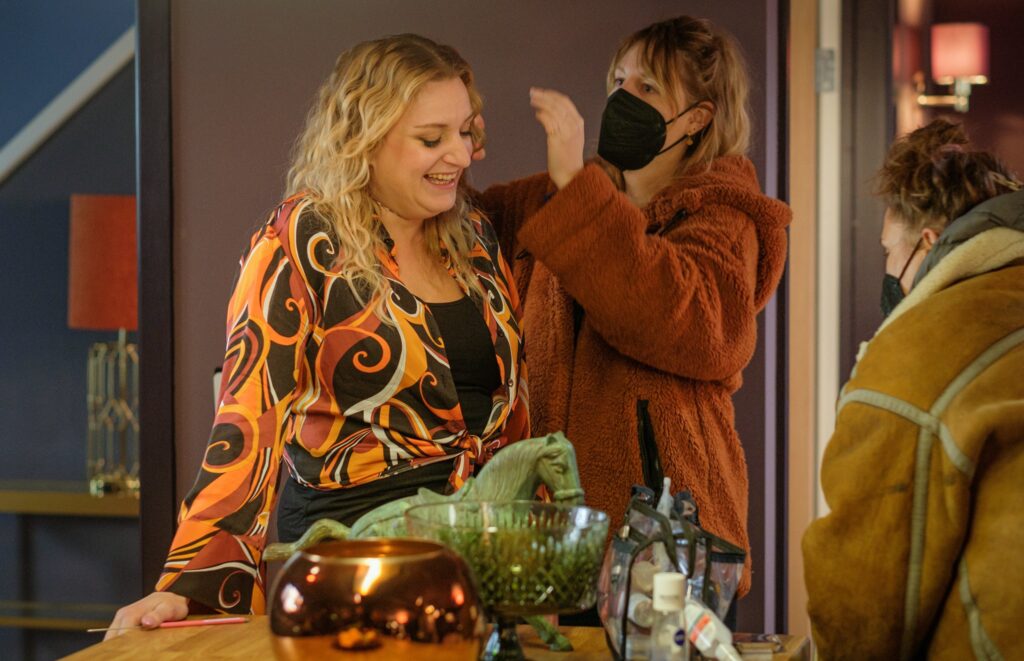
Daisy May Cooper on the set of Am I Being Unreasonable? (image: BBC/Boffola Pictures/Alistair Heap)
Councillor Craig Cheney added:
“Bristol’s film and TV sector is a valuable contributor not only to the city’s fiscal economy but to our social economy too. Despite the industry continuing to recover to its full strength post-pandemic, it’s clear to see the value brought to Bristol through the hundreds of productions supported this year.
“I’m delighted to see the sector continue to go from strength to strength and applaud the continued efforts of the Bristol Film Office and The Bottle Yard Studios in supporting this sector growth and continuing to meet our ambitions as a UNESCO City of Film.”
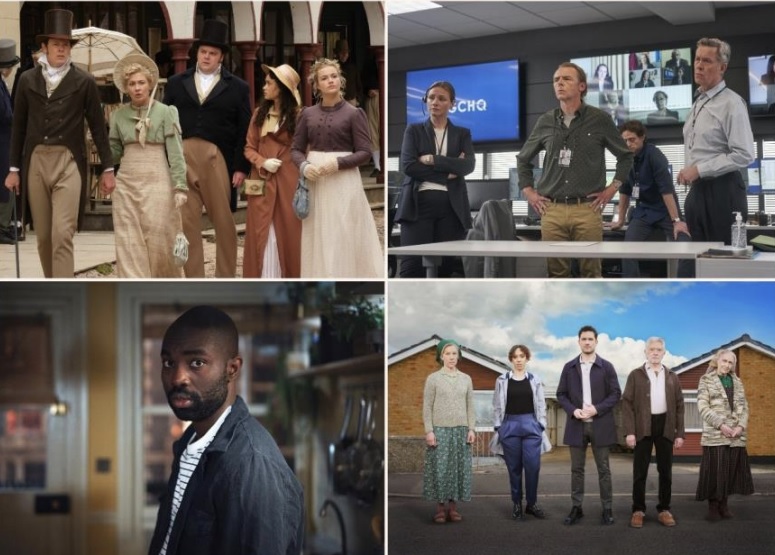
Filmed on location with assistance from Bristol Film Office in 2021/22 (clockwise from top left): Sanditon (BritBox UK/Masterpiece); The Undeclared War (Channel 4/Peacock); The Lazarus Project (Sky Max); The Long Call (ITV)
The new Bristol Film Office figures follows other data released last year which showed how film and TV benefits the economy as a whole.
The Bristol Creative Industries year in review for 2021 outlined how the UK economy was been boosted by over £132m between 2019 and 2021 as a result of Netflix productions created in the South West of England.
We’d love to know your favourite Bristol filmed movie or TV show. Tweet us at @Bristol_CI.
Find brilliant Bristol-based production companies in the Bristol Creative Industries member directory.
Top image credit: The Outlaws series two (BBC One/Amazon Prime Video)
We are delighted to launch a major new report which highlights how creative businesses in Bristol and the south west region need more support than ever before to help them to compete on the global stage.
The ‘Creative Force’ study follows our commissioning of The Audience Agency to conduct research of Bristol Creative Industries members and the wider creative sector to understand how creative businesses in the region are faring and to determine the level of support they want and need as the industry continues to recover from the impact of COVID-19.
The report shows that:
– Accessing talent with the right skillsets is the biggest challenge facing more than a third (36%) of creative businesses in the south west.
– Increasing diversity and inclusion is a significant priority for six in 10 (59%) creative firms, but 21% admit that they are struggling to recruit talent from diverse backgrounds. Nearly half (48%) of creative businesses want more help finding diverse talent from under-represented groups.
– Most creative firms have embraced digital ways of working but research and development (R&D) spending throughout the region is low with 62% admitting to spending nothing on R&D. The take up of new, breakthrough technologies such as AI, 3D printing, and robotics is also minimal.
– Securing the funding needed to grow and develop is an issue for Bristol’s creatives. The variety of business support programmes and financial grants available is creating confusion with many of the region’s businesses unsure about what it is relevant to them and whether they are eligible.
Focus group surveys with local creative businesses and freelancers found that while there is no shortage of programmes and grants available to encourage innovation and business growth in Bristol and the wider area, the multiplicity of options can be overwhelming and there is a need for more help navigating the support available.
Chris Thurling, chair of Bristol Creative Industries, said:
“The creative industry is an engine for driving economic growth and job creation throughout our region. After an incredibly challenging two years, creative businesses are bouncing back and the future looks bright, but our latest research shows that creative firms and freelancers need more targeted support than ever before to really scale up and take advantage of emerging growth opportunities in the wake of the pandemic.
“Bristol has long been considered a great place for businesses – after all, it is vibrant, dynamic, thriving, and multicultural – but our research shows that location is no longer considered the be all and end all for creatives. For them, place is neither an advantage nor a disadvantage. It begs the question ‘has Bristol been resting on its laurels?’
“As we grapple with getting growth plans back on track at a time of economic and political uncertainty, there is no time for complacency. We all need to do more to support our creative and cultural businesses by working in partnership with city and combined local authorities, education providers and other business support organisations to ensure we create an environment where creative firms and freelancers can thrive.”
The UK creative sector is a vital part of the UK economy which contributed £115.9bn to UK GDP before the pandemic[i]. It is now expected to grow 20% faster than the rest of the economy and has the potential to create 300,000 new jobs over the next three years, stimulating growth and recovery throughout the UK.
Responding to the Creative Force report, West of England Metro Mayor Dan Norris said:
“This report is timely and welcome. Bristol, Bath and the wider West of England is rich with creative talented people, but the pandemic hit many working in the sector hard.
“It’s why under my leadership as Metro Mayor of the West of England Authority we have invested £3m to help over 700 freelancers – abandoned by the government during the pandemic – and creative businesses get back on their feet and face the future with a renewed confidence and purpose. I welcome the recommendations in this timely report.
“The West of England is a region of innovation and creativity, and I’m determined that the right support is in place to allow our region to flourish.”
BCI’s Creative Force report includes a comprehensive set of key recommendations for tackling the issues brought to light by the research findings and is intended to be used as a catalyst, convenor, and advocate for change and action to fuel the south west creative sector’s development and growth.
As we have shown in this post, UK businesses are currently experiencing rising costs. The Bristol City Office is conducting research into the impact of the rising cost of living on businesses and other organisations. We would like to invite members of the Bristol Creative Industries community to take part.
Please consider the following questions:
1. What is the anticipated cost to your organisation/sector in the financial year 2022-23 as a result of rising utility costs and how is your organisation/sector managing this (e.g. does this need to be made up from existing budgets/impact on service provision)?
2. What is your current position regarding recruitment and staff retention? Are you struggling to recruit/retain staff and what impact is this having on staffing costs?
3. Your supply chain – where are the pinch points of rising costs and/or issues with supply and how are you responding to this?
4. What actions are you are taking (or would like to take/explore) to support your workforce – in terms of information sharing, wellbeing activity through to direct financial support?
5. Are there any key points you feel as a city it would be beneficial to collectively advertise to government and/or city residents through the council and other organisations’ collective channels?
Please send comments to [email protected].
Businesses across the UK are facing soaring costs. Dan Martin asked Bristol Creative Industries members how they are coping, their advice for other creative companies and what the government should do to help.
Jason Smith, managing director, Fiasco Design:
“As a small business we feel more vulnerable to these turbulent economic times. We’ve experienced a rise in studio rental costs and overheads, whilst simultaneously seeing cashflow become more volatile compared to previous years. We made the decision to increase salaries across our whole team (and rightly so), but it means we have to be mindful of operating with increased costs and the implications that come with them.
“We’re using the opportunity to get our house in order; looking at previous and current spending habits to make smart savings where possible. It’s also worth putting time aside to research what financial help is out there, for example South Bristol Enterprise Support offers some great schemes. Having support like that could be a vital lifeline for some.
“Much like the height of the pandemic, we’re trying to help keep the creativity community alive, offering comfort and support where we can to other businesses. Not to mention, of course, our own team who are going through this in their own way.
“Some ideas on what the government should do to help:
A reduction in business rates could be a good idea, and reconsidering business improvement district schemes.
Introduce the option to defer a single VAT payment if needed which would help take pressure off potential cash flow issues.
Look into ways SMEs could be supported with reducing corporation tax, National Insurance payments or offering help with employment assistance programmes.
Offer corporation tax relief for companies that can prove they’ve increased (all) employee salaries by a minimum of 5-10%.”
See Fiasco Design’s Bristol Creative Industries profile here.
Sarah Woodhouse, director, Ambitious:
“We are carefully monitoring rising costs. We are still very much in growth mode so it’s a balance. To ensure prudent financial governance we’ve labelled our planned expenses for the year as ‘must haves’ and ‘nice to haves’. We’ve pushed any big spend into the second half of the year so we can see how the year plays out.
“In terms of advice, forecast your expenses and have a system to avoid any surprises. Have a contingency fund in place for unforeseen costs. Avoiding all spend is impossible, sometimes you do have to speculate to accumulate and if the spend helps you win new business or grow a profitable area of the business then it’s an investment in the future of your business.
“Don’t stop communicating, marketing, and investing in PR. Use this opportunity to get ahead of the competition and gain share of voice (and in time, market share). Use the time to build traction in services and sectors that are bucking market trends and performing well.”
See Ambitious’ Bristol Creative Industries profile here.
Piers Tincknell, co-founder, Atomic Smash:
“Rising costs are affecting us across the board, from rent to salaries and beyond. It means that more than ever we need to be on top of our numbers and measuring productivity internally.
“In digital, it’s a very difficult balance offering competitive prices to clients whilst also paying ever rising industry standard salaries. We look to compensate our team in more ways than just salaries, through health insurance, access to coaching, 35 hour weeks instead of 37.5 which is usually standard, learning and development budgets, volunteering days and more.
“The government could really help businesses by subsidising business rates, stepping in and capping rent increases from landlords, capping energy costs and topping up National Insurance contributions for businesses.”
See Atomic Smash’s Bristol Creative Industries profile here.
Paul Honey, managing director, Strange:
“To help our staff we have a work from home bonus scheme. We started it during lockdown and it has always been a great benefit to have, but this year we decided to integrate it with our B-Corp impact assessment. Through an auditable process, we have documented the estimated electrical, gas and water usage for each staff member. We then use this data and current utility tariff data to calculate utility costs and CO2 emissions at an employee level. We then pay each staff member a quarterly work from home bonus and at the same time offset their CO2 emissions.
“Our people are prioritised over profit, so we’re always looking for ways that we can help. Whilst staff officially benefit from a hybrid work set up, we only gather physically if it really makes sense as commuting and working in an office can be expensive. A flexi-time system allows people to work the hours that best suit their circumstances and can help reduce costs such as childcare.
“There are other things that have helped to. For example, we’ve made sure everyone has good up to date technology at home which is much more energy efficient, and we’ve made sure the quarterly work from home bonus not only helps fund utility bills, but also helps contribute to other costs.
“I think the government could do a lot to help SMEs. Of course, they could look at measures like temporary cuts in the VAT repayable to HMRC (a little like they did to support tourism and hospitality during COVID) to help the industry, but really their primary focus should be ensuring energy markets function properly, avoid an energy market failure at all costs and get control of inflation.”
See Strange’s Bristol Creative Industries profile here.
Jessica Morgan, founder, Carnsight Communications:
“Rising costs are very much on my radar – we’re talking about them at work, we’re seeing them in practice and we’re wondering how much we can absorb for how long. Unfortunately, the government seem largely absent from conversations around what can be done to help – particularly for those who are most squeezed.
“As a small business owner, I’m focusing on ensuring I can keep in annual payrises in light of unprecedented inflation rises and also trying to help the team in small ways that are affordable and sustainable. The pandemic has definitely changed the way I look at my business finances and what to invest in (and not).”
See Carnsight Communication’s Bristol Creative Industries profile here.
Claire Ladkin, founder, All About the Cooks:
“It’s the uncertainty, the air of doom, gloom and despondency and not knowing where we stand which makes things most difficult. Optimism is what an early stage start up thrives on.
“Having just raised investment we are planning for growth – recruiting and investing in our people and processes. Obviously we want to reap the benefit of that landing in buoyant times. Should we soldier on regardless? Instinct tells me yes, although we should be prepared to be dynamic and pro-active.
“Times of change can work both ways. We suspect that more home-cooks will want to supplement household income by monetising their talents. We can really help them do that and that feels very satisfying. And maybe the ‘hunkering down’ mindset will make people more inclined to socialise at home, which might also benefit us.”
See All About the Cooks’ Bristol Creative Industries profile here.
Janusz Stabik, managing partner, GDYA:
“We’re seeing agencies doing recession planning. Pre-pandemic, a lot of creative businesses carried on working until the s**t hit the fan, and then they were forced to make a change. Now they’ve been through the pandemic and they had to make changes really quickly. They had to cut costs, they had to go through the P&L and they potentially had to pivot the brand and the proposition of the business really quickly just to survive.
“Then they saw that they were sat on a successful business and now with all the news in the media about a recession they’re ahead of the curve.
“Many of them are preparing and thinking what should we do when a recession hits? How should we pivot the business? What can we do with our costs? What can we do with our pricing? Which industries are going to be hard hit if there is a recession? Which industries are going to flourish?
“Our advice is to workshop it with everybody in the team. Where are the risks within the business? Where are the risks in terms of the marketing, delivery and costs?
“Equally, where’s the opportunity? There is an opportunity with recession. A lot of agencies pivoted into e-commerce during the pandemic because everybody was stuck at home buying stuff.
“Have a one page plan for what you’re going to do. Execute it with the confidence that you did when you implemented the changes during the pandemic that made your business thrive during that downturn.”
See Janusz Stabik’s Bristol Creative Industries profile here.
Joanna Xenofontos, founder, JX Branding:
“I’m not able to take on an office due to the high cost of rent and bills. As a self-employed individual and having just moved to Bristol. I find it hard to meet other creatives and it’s impossible to launch my business in a physical manner to help me build a team. It means I have to outsource to other creatives, often in other parts of the world where they charge less. This makes it challenging to grow a business.
“To deal with the challenges, I’m using co-working spaces some of the time. This allows me to be around other creatives and cuts the cost of offices and meeting rooms.
“Another way is working on contracts rather than freelance projects. This way I work with a team, the contract jobs pay well and I don’t have to do all the admin. I’m still self employed but with fewer management tasks.
“This does have disadvantages though; less flexibility and because I usually work in confidence, I’m not able to share the work for more exposure and to attract new clients.
“I think the government should provide more funding to start-ups in the creative industry. A solution could be that the government builds office spaces that are available to be shared and rented from creative agencies or individuals. Rather than renting directly from an independent party, the government provides the space so the rent and bills are lower.
“The government should better embrace creatives who want to launch their own business in the UK. This can be beneficial for the government as they are making less through freelancers (taxes etc) than companies that have a team.
“That’s the reason that many of us stay in freelancing. It’s very hard to have a sustainable business due to high costs.”
See Joanna Xenofontos’ Bristol Creative Industries profile here.
Simon Winter, founder, Winter Design:
“We’ve well and truly adopted “better than hybrid” working. Our team all work from home all of the time (part of our updated climate strategy) and it works so well for us. We now don’t have the burden of rising office space costs and because none of us have to commute, we’re not being hit as hard by rising fuel costs.
“Healthy cashflow is so important in times like these. A cashflow forecast helps you to plan for potential bumps in the road; when we first did one of these it was like somebody had switched a light on, such helpful visibility. It might not work for all businesses, but for us working from home 100% of the time has been a total game changer.”
See Winter Design’s Bristol Creative Industries profile here.
Simon Lodge, founder, Ubuntu Studio:
“Like most business owners, my company is driven by rudimental economics: bring in equal (preferably more) money than goes out. Naturally, there’s always a push-pull effect going on, however over the years, costs have risen in places I believe to be positive—from wages reflecting respect for people, to equitable taxation based on success.
“The crux of today’s issues, however, lies in the areas that have long been ill-managed by governments and businesses alike: energy, real-estate, and the treatment of suppliers, to name but a few. Until we address these head-on, we will remain in a perpetual state of ‘crisis’.
“This is a complex topic because it goes to the heart of one of the biggest issues facing businesses and consumers alike: we’ve created a society expectant that things will cost less than they’re worth to produce.
“We see it across industries—from agriculture (where I can buy meat cheaper than a cup of coffee) to energy (where until recently, the true cost of burning fossil fuels was paid for by our planet rather than our wallets). Until we address the systemic issues that past governments have simply papered over, this won’t be the last cost of living crisis we face.”
See Ubuntu Studio’s Bristol Creative Industries profile here.
If you’re a Bristol Creative Industries member and you’d like to add a comment on the cost of doing business, email Dan.
The West of England’s first-ever Good Employment Charter has been launched by Metro Mayor Dan Norris as part of a push to develop good jobs, deliver opportunities for workers to progress and help local and regional employers succeed.
First to sign up is the world famous, four times Academy Award winning animation studio Aardman. Others already pledging their support include Visit West as well as Bristol’s Wake the Tiger, Bath’s Storm and Stoke Gifford’s Service Robotics.
The Charter has been designed by trade unions, employers and employees from across Bristol, Bath and South Gloucestershire.
Local firms big and small will be supported by the West of England Combined Authority, led by the Metro Mayor, to raise standards across a number of areas, including regarding recruitment and worker engagement, with a two-tier approach to help them progress.
The two tiers of the West of England Good Employment Charter are:
Tier 1: Supporters – working with aspiring organisations to help them take steps to improve their own practices, including through a personalised action plan, workshops and other events, raising employment standards across the whole region, to meet the requirements of accreditation.
Tier 2: Membership – requiring employers to demonstrate excellent practice in key characteristics of employment practice. These are:
Businesses receiving funding through the West of England Combined Authority’s investment funds will also now be required to become Charter supporters, confirmed the Metro Mayor.
Currently more than 15% of West of England workers take home less pay than the Real Living Wage, while an estimated 111,000 in the wider South West are on zero-hours contracts.
Metro Mayor Dan Norris said: “I’m delighted to see this manifesto pledge fulfilled. No matter what job you do, everyone deserves dignity at work, fair pay and secure work in a safe workplace with clear opportunities to progress and develop. I want to praise the brilliant employers we have in our region such as Aardman.
“Recognising those good employers and seeking to persuade everyone else to do the right thing is what this is all about. We know that employers who are best at properly supporting their employees are usually the most successful. So this a win-win for employers and employees. I welcome the employers ego have started the journey with us today, and I’ve no doubt that many, many more will join them soon.”
Aardman Managing Director Sean Clarke said: “We’re really pleased to support the Good Employment Charter and feel that improving employment standards is crucial for staff wellbeing, retention, engagement and productivity. Many policies such as the Real Living Wage and Secure Work have been in place for some time, which has already made a positive impact to the business.
“As an employee-owned business we are always looking to expand and improve engagement with the ‘partners’ in the studio and have various forums for partners to have a voice on the how the studio is managed and our business planning and priorities. Aardman is committed to providing a workplace where people and their ideas can really thrive.
“We believe that implementing these standards helps us to nurture our most important asset – our people – and ensures we are well placed to attract and retain our talent in an increasingly competitive talent market.”
Employers interested in signing up to the West of England Good Employment Charter should email [email protected]
Seven Bristol Creative Industries members feature in a list of 50 of the most innovative entrepreneurial companies in the south west region.
The latest edition of EntreLeague was announced at the recent EntreConf event for entrepreneurs. Organisers MediaClash said:
“This diverse range of companies indicates how thriving the entrepreneurial scene is, covering multiple sectors from tech to media, property, health, ecommerce, sustainability, cosmetics, finance, data, food and much, much more.”
The businesses were chosen by a diverse range of experts from organisations including Bristol Creative Industries, Citrus HR, Invest in Bristol and Bath, Portobello Brewery, Rocketmakers, SetSquared, Storm Consultancy, University of Bath and Vidcomms.
“One day it will be possible to buy delicious, authentic home-cooked food from local people, wherever you are in the world. We are already doing this in Bristol and plan to launch in six new cities in the coming year.
“Living amongst us, in our communities, talented people are making extraordinary food in their own homes. All About The Cooks is an online marketplace which enables them to share that delicious food, and the stories that go with it, with people near them and make some money too.”
See All About The Cooks’ BCI profile here.
————————————————————–
“From our humble beginnings back in 2008 we have always stayed true to our belief that happiness comes from loving what you do. This ethos has resulted in a thriving, award winning creative agency working with some of the biggest clients within the video games and entertainment sectors.
“Diva is packed with amazing people, who combine their professional talents with their favourite pastimes and we believe that every day should be filled with fun and games.”
————————————————————–

“We use technology and creativity to help startups blossom and achieve their goals. Every project is different so we’ve built a set of tools and sub-processes that we employ efficiently for each situation.
“We believe in original thinking, clear communication and simple action. Working closely with you to inspire, guide, create and grow your ideas.”
See Gravitywell’s BCI profile here.
————————————————————–

“Launch is a paid media agency that delights ambitious businesses by achieving challenging growth forecasts. As a Google Premier Partner (the top 3% of agencies in Europe), we leverage the latest tools and techniques to maximise results for our clients with paid media.
“Our Conversion Rate Optimisation service ensures users are more likely to take key actions once they reach a website, and our data expertise provides in-depth insights to inform the wider marketing strategy – as well as ensuring compliance with the latest privacy laws.”
See Launch’s BCI profile here.
————————————————————–

“Plimsoll is an ambitious global content company. Our premium shows entertain and thrill audiences around the world. We value excellence and kindness and promote creativity, inclusivity and diversity.
“We are passionate about ensuring our opportunities are accessible to a wide range of people. We believe that diversity of thought, experience and talent are key elements of the creative process and always promote equality, respect and inclusivity across the company.”
See Plimsoll Productions’ BCI profile here.
————————————————————–

“StatsBomb was founded in January 2017 to provide football data and analytics to clubs, media and gambling companies. StatsBomb continually undertake new research and are well known in the analytics industry for providing unique insights into the game.
“We have developed our own proprietary, industry leading data collection and analytics software with a user-friendly high-vis front end.”
See StatsBomb’s BCI profile here.
————————————————————–

“Yuup is a new digital marketplace for local experiences in Bristol. We help curious customers discover unique and brilliant Bristol experiences.
“We are a small friendly team, with big ambition based in Bristol. Our mission is to champion small businesses and independent hosts, whilst building a supportive community and of course, deliver amazing Bristol experiences.”
————————————————————–
Not yet a member? Join Bristol Creative Industries from only £4.50 a month.
We have a jam-packed events agenda in July so we thought we’d summarise the education and inspiration you can enjoy.
All Bristol Creative Industries-run events are free for BCI members. If you’re not a member, sign up from only £4.50 a month.
1 July, 8.30am. Free for BCI members only.
Wake Up Call is our online event exclusively for BCI members that’s delivered by BCI members. It features a 30 minute practical presentation and Q&A every other Friday at 8.30am.
First up in July is copywriting expert Rin Hamburgh from Rin Hamburgh & Co.
On 1 July at 8.30am, Rin will look at the different types of blog post you might use to engage your audience at each stage of their buyer journey and guide them one step closer to doing business with you.
5 July, 12.30pm. Free for members, £25 for non-members.
Women over 50 are the fastest growing demographic in the workforce, and a significant percentage are likely to be in senior/leadership roles, plus on the front line of client relationships. 25% of menopausal woman say it can have a ‘debilitating’ effect on their ability to do their job, but unfortunately due to lack of awareness and societal shame, this is issue is not acknowledged enough in the workplace.
What can you do if you manage a team that includes women who could be heading towards menopause if you know nothing about it, and wouldn’t have much of a clue how to tackle a conversation about it?
In this online session, executive coach Fi Craig and Kinneir Dufort’s Tamsin Chambers discuss why this menopause is such a relevant topic for the workplace, why is it not spoken about enough, and what business leaders can do to address it.
14 July, 12.30pm. Free for BCI members, £25 for non-members.
In this online workshop, recruitment Liz Gadd will cover the affects of the pandemic, Brexit, the ‘Great Resignation’ of 2021, the gig economy and how they’ve have contributed to businesses’ current recruitment challenges.
She will suggest solutions and ideas on how you can better recruit including perfecting your recruitment process, advertising the roles, using job boards, working with recruiters, and much more.
15 July, 8.30am. Free for BCI members only.
This online session will demonstrate how you can drive lead quality through the roof and bid more efficiently using value-based bidding.
Harriet Barter, from paid media agency Launch, will guide you through what value-based bidding is, how it works and how to start using it right away, so you can target the conversions that mean the most to your business.
Running your own event? Submit details here for listing on the website.
All Bristol Creative Industries-run events are free for BCI members. If you’re not a member, sign up from only £4.50 a month.
Bristol Creative Industries board member Heather Wright joined a fascinating event discussing the future of south west business. Dan Martin summarises the conversation.
Heather Wright spent 22 years at Bristol Creative Industries member Aardman Animations and now runs Springboard Creative. She joined the Bristol Creative Industries board in January 2021.
Heather was part of a panel of founders and experts at ‘The future shape of south west business’, an event run by Insider Media. You can replay a live stream of the full event here.
Also on the panel was:
Event host Christian Annesley started by asking the panellists what most excites them about the south west economy. Dominic Mills, who has just raised almost £1m via crowdfunding for the Yuup experiences marketplace said:
“The thing that excites me most about Bristol and the south west is the sheer amount of activity that’s going on. We’ve just completed a fundraise and getting into that ecosystem again felt more vibrant. When you look at the stats around how much has been raised in the south west, it’s hugely exciting and, for me, very indicative of all of the cool things that are happening in the region, but also the appetite to support them.”
Recent figures back up his comment about the appetite for supporting businesses. Data from the British Business Bank showed that the south west saw the UK’s biggest increase in equity investment among SMEs last year. Finance deals in the region rose 49% in 2021, more than in any other part of the UK. The value of investments increased by more than 350%, reaching £821m.
Speaking on behalf of the creative industries, Heather Wright said the sector “is absolutely thriving right now”. She added:
“The big national figures are that the creative industries contribute like £115bn to the national economy and in the south west, it contributes around £2bn to the region economy.
“There’s a huge army of largely small and micro businesses driving it. 72% of Bristol Creative Industries members are businesses with 0 to 4 employees and only 6% have 250 workers.
“Nationally we’re recognising the role of the creative industries beyond traditional art, marketing and advertising to now being multidisciplinarity. VR is being used in the medical industry, 3d modelling and digital twinning is being used for city planning and engineering and the connections between creativity, technology, and other sectors are becoming completely embedded.
“The creative industries are also the tool by which we can influence behaviour change in society. If you want to convince people about health, net zero or sustainability and communicate why it’s important, it’s the creative industries that are going to help you do it. The importance of the creative industries to society and the economy are becoming even more pronounced.”
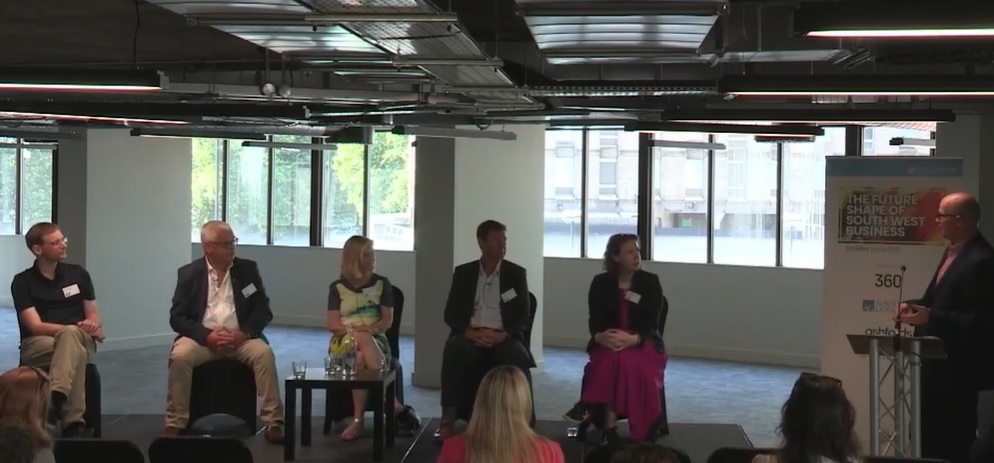
All the panellists agreed the battle for talent is a big issue for south west businesses.
Dominic Mills has spent 20 years working in tech. He said while there has been lots of changes during that time, the one consistent that has never gone away is the demand for tech talent. He added:
“Over the last five or so years, we’ve seen the exodus of talent from London to the West Country. In my agency days, we went from being a agency with only a Bristol office to also having a London base. That facilitated people being able to leave London and relocate to Bristol because they were at the point in their lives where that made sense in terms of lifestyle but they didn’t need to leave the company to do it.
“During the pandemic we saw that people could work from anywhere and many began to question how they wanted to live their lives. I think a lot of the rules around where you need to be to do things have changed and therefore from a talent acquisition point of view, it presents a big opportunity for businesses in the south west.”
Responding to a question about whether the reputation of the south west being a nice place to live is a “game changing opportunity” for the region when it comes to attracting talent, Tim Atkins said we still face challenges from the likes of Manchester for encouraging young tech talent.
“The south west has got work to do because we are competing against places which from a diversity point of view are stronger. We’ve got to step up our game to work together to promote ourselves to young people.
“If we really want to attract the brightest minds in the next generation, we’ve got to think about what the south west looks like. For example, Cheltenham has a brilliant offer in digital, tech and cyber but for a 22-year-old, is moving to Cheltenham going to be their first move? We are great at attracting people with young families but I think there’s a gap for attracting others.”
Heather Wright said attracting more diverse employees into the creative industries is a recognised problem.
“We’ve been very white and middle class for a long time. There are organisations like Bristol Creative Industries member Babbasa that’s doing amazing work getting apprenticeships up and running for people from diverse backgrounds and BeOnBoard that’s encouraging younger people as board members.
“It’s about looking at what those younger employees are looking for. They have a different value set to us who are older. They are looking for personal development and flexibility. They’re looking for hybrid working and their whole life isn’t about work. It’s about balance and fulfiling their purpose in life.”
In Cornwall, Mike Atkins said the region is a great place to live but one of the key factors impacting the ability to attract and retain talent is the availability of somewhere to live. “We’ve got a very distorted housing market because holiday lets are having a huge impact on the availability of housing,” he said.
Dominic Mills agreed on the housing point but added that it’s “so important that we celebrate everything we have in the south west.”
“I’ve spent a lot of time over the last few months in other regions as part of preparing for our platform expansion and I’ve found that a lot of civic and leaders in other regions look to Bristol and the south west as a pathfinder. They aspire to be like us.
“We absolutely should do more and strike to be better and to achieve more as a region, but I also think we should celebrate everything that we have.
“One of my biggest learnings from the last 18 months is the importance of engaging with all communities in Bristol because the talent that is already here in our city is phenomenal. I think we often overlook local communities. We need to find different ways of accessing it. Babbasa is a brilliant example of an organisation that can help us access talent that very often gets overlooked right here on our doorstep.”
Read top tips for how to attract Generation Z talent to your business.
Universities also have a role to play in attracting new talent to the south west. Dr Joanna Jenkinson from the GW4 Alliance, which brings together the universities of Bath, Bristol, Cardiff and Exeter, said:
“The role and position of universities has fundamentally shifted in that they all take their civic mission really seriously. They are very much embedded in their communities and work with local authorities.
“We have apprenticeship programmes that are jointly run with small businesses. Apprenticeship programmes are really important for the technical community within our universities. We support the technicians in our universities to raise their profile. They are the lifeblood of a lot of the work that happens in universities.
“Another opportunity for universities to do things a differently is entrepreneurship programmes. If you look at Bristol University’s programme, 45% of the start-up founders are women and 24% are from a black, Asian or ethnic minority background. If you put a supportive environment around people, then you can do things differently.”
Heather Wright said colleges in Bristol are playing a key role in future creative industries talent.
“One of the reasons why Bristol is successful in the creative industries is because we have a good system of colleges and universities doing film courses etc. There are fantastic courses at both the University of Bristol and the University of the West of England. There’s also education providers like Boomsatsuma.
“I think there is still an issue with people coming out of college being work ready. As employers we can do more to build links and partnerships with colleges and universities. When I worked at Aardman Animations, if we had a big feature film or TV series we needed to crew up for and the crew didn’t exist, we would set up a special training course so people could apply for it. I think that organisations and industries that have the ability to give that finessing from when people leave university to being fully professional and fully employable in an income earning role is something that we should all take responsibility for.”
Read our in-depth guide to creative industries-related further and higher education in Bristol and Bath.
As Generation Z (aka Gen Z) talent becomes an increasingly important part of future-proofing your business, so does the conversation around how and where to find them.
At a recent BCI keynote event, Mae Yip and Sam Hornsby, co-founders of career guidance platform ERIC, shared strategies for attracting and recruiting Gen Z employees. Dan Martin summarises their brilliant advice.
Gen Z is the generation of people who were born between 1997 and 2012.
Having grown up with digital technologies, they are the internet and smartphone generation. They will make up 27% of the workforce by 2025.
The first step to attracting Gen Z talent is doing your research on who they are.
Sam shared some stats:
“You will never be able to attract young people if you have no idea what they’re thinking,” Sam said. “You need to deep dive into understanding this generation because your Gen Z strategy will be dictated by how well you know them.”
To help with your research, ERIC has a resources hub with stats and studies about Gen Z.
If you ask a 16-year-old what would be their dream employer, they are likely to name companies such as Netflix, Apple, Google and TikTok. “They are aware these brands exist from a very young age through advertising,” Sam said. “They end up becoming superfans who would give their right arm to work for them. That is the kind of employee spirit we’re all looking for.”
You may not be a massive consumer brand that directly appeals to young people but you can still attract their interest by harnessing similar creative messaging.
“Employer branding is showing young people that working for your company is an aspiration and a desirable thing to do,” Sam advised. “You need to communicate that your jobs aren’t just jobs, they are lifestyle choices.”
One brand that does this very well is Heineken. It has created a careers website with humorous videos of employees that communicate the personality of the business. Here’s an example:
You are currently viewing a placeholder content from YouTube. To access the actual content, click the button below. Please note that doing so will share data with third-party providers.
Among your greatest assets for recruiting young people are your existing Gen Z employees. “Get your Gen Z staff to create recruitment content and share it on social media for engagement from other Gen Z people,” Sam said.
There’s more advice on employer branding on the ERIC website.
Sam argued that businesses shouldn’t just focus their recruitment on university graduates.
“Gen Z are active learners regardless of whether or not they went to university,” she said.
“Their natural instinct is to self-teach through Google, YouTube and TikTok which means that university no longer separates the wheat from the chaff. They’ve been trained by technology to consume large amounts of information at hyperspeed whenever they want.
“Unless a job really requires a degree, think about the skills that you actually want a candidate to show. Do you want them to demonstrate a thirst to learn? They can demonstrate that through learning on YouTube.
“Do you want them to have to ability to apply themselves? Self-teaching three different coding languages in a summer break could be seen as more of a demonstration of an ability to apply oneself than learning throughout a three year degree.”
In the past 10 years, we’ve seen the launch of Snapchat, Uber, Twitch, Amazon Alexa, 4G, TikTok and many more. These are the tools and platforms that Gen Z use because they have grown up with them.
The platforms that you might be using to try and recruit Gen Z, such as LinkedIn, are more than double the age of the platforms that Gen Z are using.
As mentioned above, only 4% of Gen Z use LinkedIn which means, Sam said, “you are not using your recruitment budget effectively.”
You need your recruiters to reflect the talent you are looking for so to reach Gen Z talent, use Gen Z platforms. As well as ERIC, examples include Otta and BYP Network.
Research has shown Gen Z to be the most curious generation, they prefer learning from YouTube rather than books and they value personal development over pay.
“Young people are telling us not just how we can attract them but how we can make them happy and keep them”, Sam said. “Be the employer that nurtures curiosity and prioritises personal development.
“You could provide online therapy services, an investment fund for them to play around with, confidence workshops or side hustle lessons.”
46% of Gen Z have applied for an internship or job via a mobile device so you need to make sure your application process is ready for that.
Test your job application experience and make sure it’s mobile friendly.
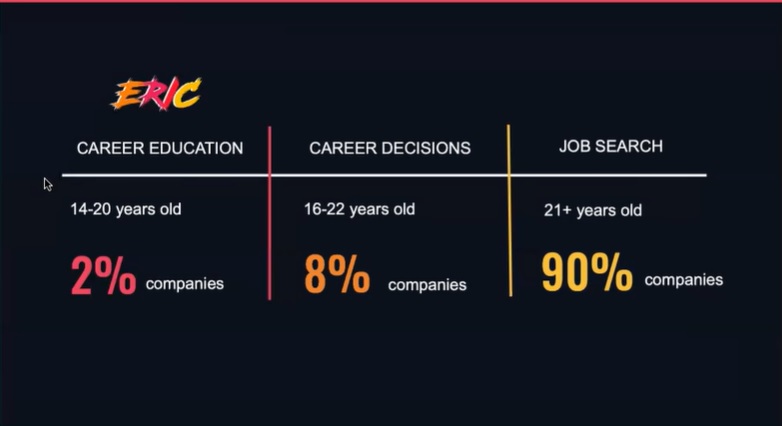
The career journey doesn’t start when young people first apply for jobs, it starts in schools when they are choosing their GCSEs aged 13.
“Young people want more companies to tell them that about their business as a career option,” Sam said.
“Don’t underestimate how little they know about the world of work. It is up to you to put your industry and your company on the map with young people as early as possible.
“The companies that appear earlier have the best chance of getting the best talent. If you are only appearing at the last hurdle, you’re not just competing against your direct competitors, but every company in every industry.
“To get young people’s attention and interest, you have to give them a reason to connect with you. You have to invest in being part of their career education.”
To sign up for future Bristol Creative Industries events, visit our events diary.
You need to load content from reCAPTCHA to submit the form. Please note that doing so will share data with third-party providers.
More Information