The Bristol Creative Industries Internship Programme, in partnership with Babbasa as part of the OurCity2030 initiative, is a stellar example of how BCI members can come together to fund and deliver a complex programme of internships and training to support some of the region’s most underrepresented young people.
After a successful pilot over the past few months with 14 brilliant agencies, we are now looking for more creative businesses to join our mission.
They will support the second cohort of interns during the next phase of this innovative project in 2024.
Agencies pay a one-off fee which covers:
✅ Onboarding to the programme including guidance and templates around internship structure/workplan.
✅ ED&I, mental health and neurodiversity training with a focus on working with young people from underrepresented groups.
✅ HR support and mentoring from Bristol Creative Industries’ dedicated internship programme manager Clare Leczycki.
✅ Recruitment and employment of two interns over six months.
If you are interested in taking part, email Bristol Creative Industries membership manager Alli Nicholas on [email protected]
Paula Newport, director of people and culture, Aardman Animations:
You are currently viewing a placeholder content from YouTube. To access the actual content, click the button below. Please note that doing so will share data with third-party providers.
You are currently viewing a placeholder content from YouTube. To access the actual content, click the button below. Please note that doing so will share data with third-party providers.
You are currently viewing a placeholder content from YouTube. To access the actual content, click the button below. Please note that doing so will share data with third-party providers.
If you are interested in taking part, email Bristol Creative Industries membership manager Alli Nicholas on [email protected]
In May we announced the 14 young people selected as the first cohort for the Bristol Creative Industries Internship Programme, in partnership with Babbasa and 14 creative businesses from the BCI membership community.
Two months into the programme, which is aimed at young people from underrepresented groups, we’re sharing an update on what the interns have been getting up to.
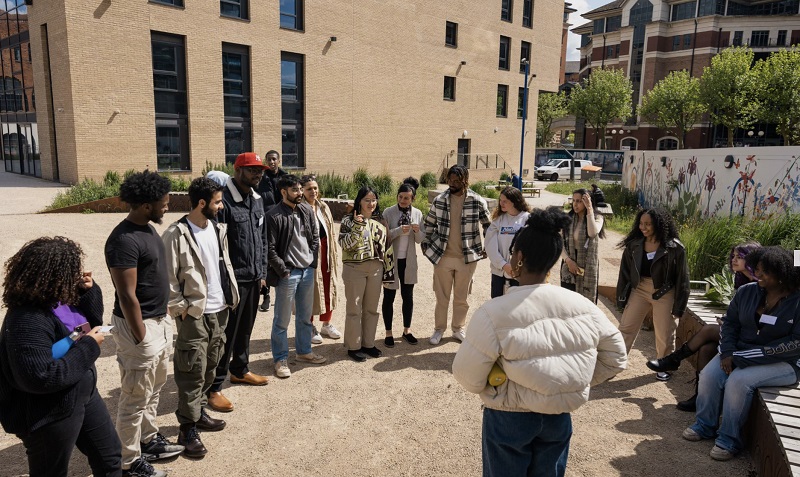
Clare Leczycki, Bristol Creative Industries Internship Programme manager, said:
“Our interns are two months into their first three month placement and we are delighted with the progress. Each of the supporting agencies are providing a 360 degree view of the different departments alongside bespoke support around the interns’ key areas of interest.
“I have the joy of spending Fridays with the cohort as part of the skills and training programme which is co-produced with the interns. Guest speakers come in to share knowledge and expertise on a range of topics. So far we have explored mental health and resilience tools and strategies, neurodiversity and uncovering barriers to work, how to speak to your employers about your needs, the power of networking and navigating live project briefs.
“The group is also working on a live brief which allows them to come together with a focus on their area of expertise. They learn from one another whilst producing a tangible product that they will be able to showcase at the end of their internship.
“I am blown away at how well the group has bonded, how they show up each week with great energy, ideas and commitment. I appreciate the time I get to spend with them.
“The journey for the interns and the participating agencies is far from straightforward. For the agencies, creating learning opportunities and delivering training whilst running a business and being ready to make changes to welcome people from diverse backgrounds to their organisation is a lot to manage all at once.
“For the interns, being a new person in a company can already feel quite daunting. Not really seeing anyone else who looks like you can feel quite intimidating, especially when you are so early on in your career.
“My job is to ensure everyone is having a positive experience, so it’s lots of listening, encouraging open conversations, building trust and nurturing relationships. There are lots of different needs to attend to and success looks different for everyone so managing expectations is key in navigating this project.
“Our aim is to create a space that empowers everyone involved to be open and ready to learn, to be comfortable with vulnerability, to share challenges across the team, addressing issues when they come up and be ready to respond and make changes when needed.
“Some days we get things wrong but I trust we are all here for the same reasons; to make long-lasting change to the creative industries by providing opportunities to these incredibly talented young people who need a foot in the door and a warm welcome when they step inside.”
Kayjay McDonald-Ferguson, who is interning at saintnicks, is regularly sharing LinkedIn updates with brilliant behind the scenes insights from the programme. Here are some of his posts:
You are currently viewing a placeholder content from Default. To access the actual content, click the button below. Please note that doing so will share data with third-party providers.
You are currently viewing a placeholder content from Default. To access the actual content, click the button below. Please note that doing so will share data with third-party providers.
You are currently viewing a placeholder content from Default. To access the actual content, click the button below. Please note that doing so will share data with third-party providers.
You are currently viewing a placeholder content from Default. To access the actual content, click the button below. Please note that doing so will share data with third-party providers.
Three of the interns joined the Bristol Creative Industries board meeting to deliver a brilliant presentation:
You are currently viewing a placeholder content from Default. To access the actual content, click the button below. Please note that doing so will share data with third-party providers.
You are currently viewing a placeholder content from Default. To access the actual content, click the button below. Please note that doing so will share data with third-party providers.
You are currently viewing a placeholder content from Default. To access the actual content, click the button below. Please note that doing so will share data with third-party providers.
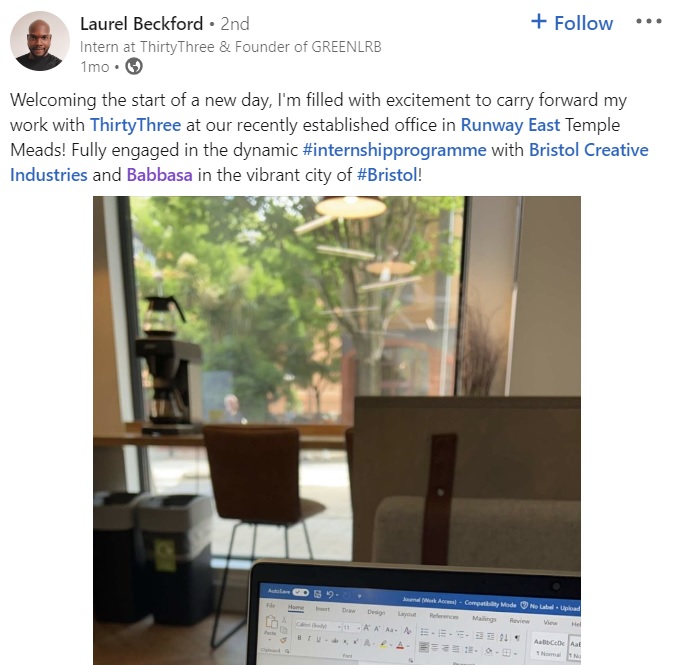
Laurel is an intern at ThirtyThree.
Amy is an intern at Halo.
See a video below or watch it on Instagram.
View this post on Instagram
Armadillo discusses being involved in the programme.
On the workshop during which the 14 interns were selected, Rob Pellow, executive technical director at Armadillo, said:
“Meeting the potential interns and working with them in the workshop was an unbelievably eye-opening experience. Nothing had prepared me for the level of passion, curiosity and dedication to finding work that energises them.”
Megan O’Keefe, senior account manager, added:
“I’m really looking forward to being part of this project. Having joined the workshop, it’s clear how engaged everyone was and how keen to learn. There were some great questions so I’m looking forward to having some fresh perspectives and input.”
He is an intern at Atomic Smash.
See the full post on Instagram.
View this post on Instagram
See the full post on Instagram.
View this post on Instagram
“We are thrilled to introduce Ahmed, the newest addition to the growing Newicon team. Ahmed has just stepped on board as our Software Development Intern, armed with an innovative mindset, enthusiasm, and a resolve to leave a lasting positive impact.”
“Last year, we shared our ‘Guide to a fair and inclusive workplace’, that hopes to address some of the hiring biases and challenges that are also preventing diverse talent from receiving and benefiting from opportunities. It considers where best to post job ads that will reach diverse audiences and how to write job ads without using gendered language. This tackles the practicalities of promoting the opportunities, but we were also looking for our opportunity to be able to provide an opportunity. Cue fanfare. This is when we heard about BCI’s new internship programme.
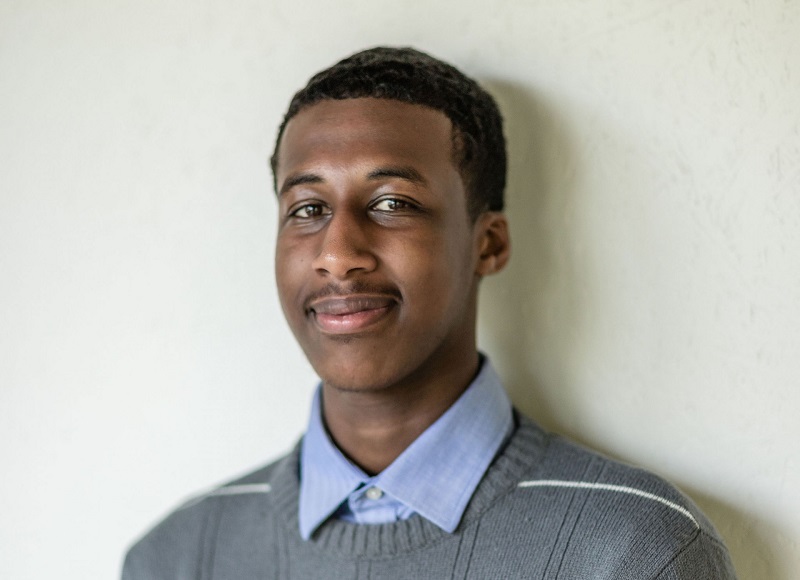
“We are thrilled to have welcomed our first intern, Sara Matloob, to the Mr B & Friends team. With a love of baking chocolate chip cookies, Jane Eyre and an interest in copywriting, idea generation and marketing we’re very excited to have her join the team.”
To stay updated on the Bristol Creative Industries Internship Programme, follow us on LinkedIn, Twitter and Instagram.
Main image credit: Alli Nicholas, Bristol Creative Industries membership manager
Second image credit: Eljay | www.instagram.com/Eljaybriss | www.eljaybriss.co.uk
The government’s long awaited creative industries sector vision has been launched with an aim to grow the creative industries by £50bn and support a million more jobs by 2030. Dan Martin looks at what it could for creative businesses, particularly those in the Bristol Creative Industries region.
Describing the sector as “a global British success story”, prime minister Rishi Sunak’s foreward to the full vision document says:
“As well as projecting our values on the world stage, the creative industries drive our economy at home. The contribution they make has often been underappreciated. These industries generate £108 billion a year. Employ over 2.3 million people in every corner of the country. And there is a real sense of energy in the sector, which has grown at more than 1.5 times the rate of the wider economy over the past decade.”
The vision promises to drive growth by “facilitating innovation and investment, alongside building a skilled workforce”. It includes £77m in new government funding.
Culture secretary Lucy Frazer said:
“The imagination and ingenuity of British designers, producers, content creators, writers and artists are spearheading growth right across our economy.
“The government is backing our creatives to maximise the potential of the creative industries. This sector vision is about driving innovation, attracting investment and building on the clusters of creativity across the country. And from first days at school to last days of work, we will nurture the skills needed to build a larger creative workforce to harness the talent needed for continued success.
“Working with the industry this vision is helping the UK creative sectors go from strength to strength – providing jobs and opportunities, creating world leading content and supporting economic growth across the country.”
The vision outlines the following funding announcements:
The government says it will invest at least £50m in the next wave of the Creative Industries Clusters programme. It will be used to identify and support at least six new clusters specialising in creative subsectors, helping entrepreneurs and businesses in these areas innovate with new technologies, secure investment, and access global markets.
Bristol and Bath is currently one of the clusters supported by the programme through Bristol & Bath Creative R&D.
Alongside the creative industries
sector vision, it was announced that 300 creative companies across the UK have received a share of £13m in government grants to help them innovate and reach their high growth potential.
The government will increase the budget of the Create Growth Programme by £10.9m, bringing it to a total of £28.4m until 2025. It says the increased funding will enable it to double the number of regions it covers to 12 and support 2,000 businesses to commercialise their ideas and access resources, knowledge and private investment to scale.
The West of England is one of the six regions currently part of the programme. The other regions are Greater Manchester, East Anglia, North East England, South East and East Midlands.
Alongside the creative industries sector vision, Innovate UK announced 108 creative industry businesses across the six current regions that get a share in the latest £3m of funding from the programme. It includes the following 13 companies from Bristol and the West of England:
The next round of funding (£4m across the six regions) launches in autumn 2023. Keep an eye on our funding guide for the latest information.
In the West of England there is also a support scheme as part of the Create Growth Programme run by Watershed and West of England Combined Authority. It includes training, workshops and a £2,500 grant to spend on mentoring, consultancy and coaching.
The second cohort for the support scheme launches in May 2024. Register your interest here.
Creative Catalyst is a £30m programme to help creative businesses commercialise their creative ideas.
Alongside the vision, Innovate UK announced a new partnership between the Creative Catalyst Programme and Creative UK. It will engage with key senior industry stakeholders and create exciting funding opportunities for small and micro businesses to address important industry challenges.
It also announced that the first Creative Catalyst sector-specific competition will focus on MusicTech. The £1m competition will launch later in the year.
Finally, Innovate UK announced over 200 creative companies across the UK that have received a share of £10m of innovation funding from the first round of Creative Catalyst. As part of the programme, the successful companies also will receive business growth support, join a peer network to encourage collaboration and have access to international missions to help expand their global ambitions.
The government said the majority of the funding has been provided to companies outside of the Greater South East including Bristol, Bath, Exeter and Cornwall.
Keep an eye on our funding guide for the latest information on the grants available through Creative Catalyst.
The UK Games Fund, run by UK Games Talent and Finance Community Interest Company, launched in 2015. It provides grants for prototype funding of up to £30,000 and supports graduate talent development.
The creative industries sector vision announces £5m in additional investment for the UK Games Fund which it says “will provide UK games studios with larger grants for content funding, supporting development of intellectual property that will allow companies to attract investment and reach their next stage of growth”.
The government will expand Arts Council England’s Supporting Grassroots Music Venues Fund by providing an additional £5m over two years to support around 400 grassroots music venues.
Funding for the Music Exports Growth Scheme, which provides grants to support touring and help emerging musicians break into new global markets, will be expanded to £3.2m over the next two years.
The most recent round of funding provided £500,000 to 28 UK artists including Bristol singer-songwriter Katy J Pearson.
The government referenced the announcement in the Spring Budget which reforms audio-visual reliefs into expenditure credits with a higher rate of relief than under the current system.
The vision added that the government is “considering the case for further targeted support for visual effects work, and will provide an update on this later in the year”.
On securing investment the vision says:
“While parts of the creative industries are attractive to investors, many entrepreneurs and creative businesses find it hard to access investment. The value of creative businesses commonly lies in their intangible IP, which can be hard to value, and project-based business models often create peaks and troughs of activity and revenue.
“Moreover, some products such as music or films can be ‘hits’-based, with unpredictable consumer demand. These factors, coupled with a lack of market intelligence and data, can make creative businesses appear a risky proposition to investors.
“These challenges are felt more keenly outside of London, with early stage equity finance and venture capital investors much less prevalent. The government and industry will work together to improve data on investment into the sector, to improve benchmarking against other sectors, and to better understand new and emerging business models and their finance needs.”
It said creative businesses can access the British Business Bank’s regional investment funds which offer loans from £25,000 to £2m and equity investment up to £5m.
The Bank’s £200m South West Investment Fund launched in July. Aimed at businesses in Bristol, Cornwall and the Isles of Scilly, Devon, Dorset, Gloucestershire, Somerset and Wiltshire, the fund provides:
Find full details in our funding guide for creative businesses.
The creative industries sector vision pledges “a creative careers promise” to “build a highly-skilled, productive and inclusive workforce for the future, supporting one million more jobs across the UK“.
The vision adds:
“Over the previous decade, the creative industries’ workforce grew at almost five times the rate of the rest of the economy, and it has the potential to continue growing rapidly. There are a huge range of roles in the creative industries and collectively they are the jobs of the future: more resistant to automation, highly-skilled and highly rewarding.
“The sector also has high levels of project-based working and reliance on freelancers, who make up over a quarter of the total creative industries workforce (about double the whole-economy average).
“A skilled, inclusive and productive workforce is vital to ensuring creative businesses can adapt to changes, compete commercially and identify new areas to innovate and grow.”
Skills and diversity is a major challenge for the creative industries. The BCI-commissoned A Creative Force to Be Reckoned With report found that increasing diversity and inclusion is a significant priority for six in 10 (59%) creative firms in Bristol, but almost half (48%) said they want help finding diverse talent from underrepresented groups.
The government says it will:
The vision highlighted Bristol Creative Industries member Boomsatsuma as a good example of creative skills training. It said:
“Boomsatsuma has identified opportunities to build on traditional models of education to better support creative employers. With a portfolio of 10 flexible further and higher education-level courses, Boomsatsuma aligns its offer with skills shortages faced by creative businesses across South West England, including rapidly growing Createch businesses in the region that are utilising digital and tech.
“Young people are nurtured through a system that guides them from school to college to a degree and into employment. It particularly suits young people from disadvantaged backgrounds who do not want to go down the conventional university route.”
Another example of giving young people the skills they need to access careers in the creative industries is the Bristol Creative Industries internship programme which supports 18-24-year-olds from underrepresented backgrounds.
As part of the programme in partnership with Babbasa, 14 creative companies from the BCI member community are providing full time paid placements to applicants in roles covering advertising, marketing, design, animation and digital.
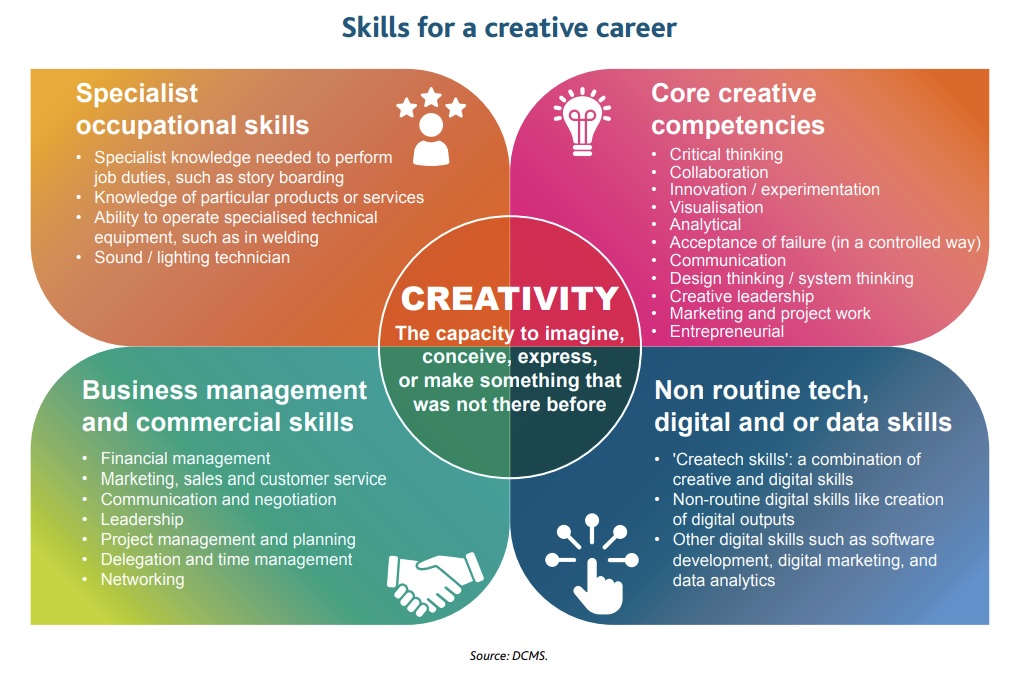
Graphic from the vision document:
Dr. Susan McMillan, an award-winning television producer and executive dean of Boomsatsuma, is a member of the Bristol Creative Industries board. She said:
“The Bristol Creative Industries board is looking forward to helping the city, its creative businesses and its education and training providers achieve the goals of the creative industries sector vision. The UK’s creative industries are so important to our future economy, generating £108bn a year, employing over 2.3 million people and growing at more than 1.5 times the rate of the wider economy.
In Bristol, creative industries employers make a unique contribution to the city’s identity and global reputation – think Aardman and the BBC Natural History Unit, as well as the multitude of creative companies producing everything from games to software.
“The report proposes that, as a sector, we can do more to unlock the growth potential and create opportunities for young people and the next generation of creative talent. Bristol Creative Industries is already doing that through our successful internship programme which is helping members access new and exciting creative talent. We plan to build on this success over the coming years.
“We are looking forward to working with our members on future initiatives to grow the sector, meet its skills needs for future talent and explore how the creative industries can contribute to addressing the big challenges of our day.”
The vision has the following goals for 2030. Click the links to go to the relevant sections.
Objectives are:
2030 innovation objective: increased public and private investment in creative industries’ innovation, contributing to the UK increasing its R&D expenditure to drive R&D-led innovation.
2030 investment objective: creative businesses reach their growth potential, powered by a step-change in regional investment.
2030 exports objective: creative businesses grow their exports and contribute to the UK reaching £1 trillion exports per year.
Objectives are:
2030 education objective: a foundation of education and opportunities to foster creative talent from a young age.
2030 skills objective: stronger skills and career pathways generate a workforce that meets the industry’s skills needs.
2030 job quality objective: all parts of the creative industries are recognised for offering high quality jobs, ensuring a resilient and productive workforce that reflects the whole of the UK.
Objectives are:
2030 wellbeing objective: creative activities contribute to improved wellbeing, help to strengthen local communities, and promote pride in place.
2030 environment objective: Creative industries play a growing role in tackling environmental challenges, helping the UK reach the targets set out in the Powering Up Britain plan.
2030 soft power objective: creative industries increase their reach to global audiences, strengthening the UK’s soft power and positive influence on the world.
If you’d like to share your thoughts on the creative industries sector vision, email Dan.
As we announced earlier this year, Bristol Creative Industries has teamed up with Bristol-based social enterprise Babbasa and 14 creative businesses to launch a city-wide internship programme.
The programme is aimed at Bristol-based young people aged 18-24 from an ethnic minority and/or from a low-income background who want to gain insight and experience in the creative industry.
The scheme sees many of the city’s most well-known creative companies offering six-month full time paid placements to applicants in roles covering advertising, marketing, design, animation and digital.
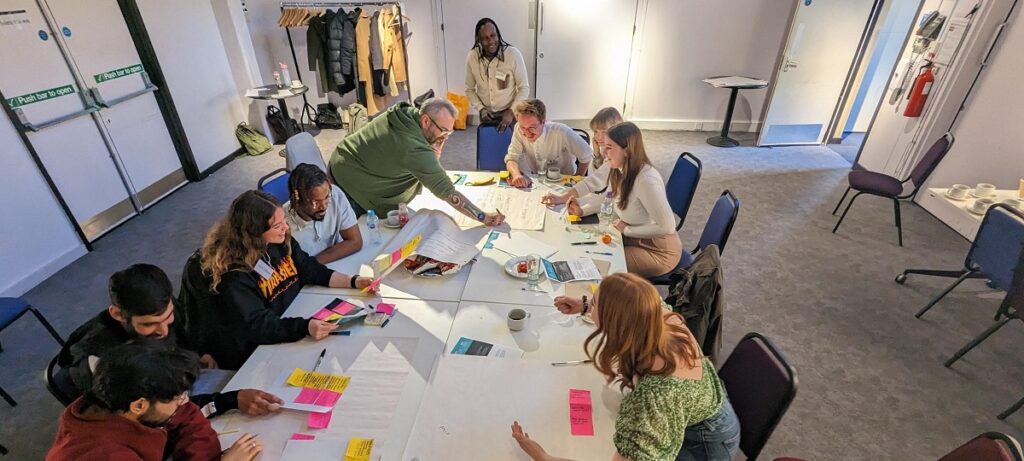
We held interviews last month (see image above) and we were so impressed by the talent and skills on display from the young people who applied. It was a very hard decision but we are delighted to announced the successful interns.
Watch the videos below for some insights from three of the agencies about why they are involved in the programme and the need to improve diversity in the creative industries.
You are currently viewing a placeholder content from YouTube. To access the actual content, click the button below. Please note that doing so will share data with third-party providers.
See Aardman Animations’ Bristol Creative Industries profile here.
You are currently viewing a placeholder content from YouTube. To access the actual content, click the button below. Please note that doing so will share data with third-party providers.
See Halo’s Bristol Creative Industries profile here.
You are currently viewing a placeholder content from YouTube. To access the actual content, click the button below. Please note that doing so will share data with third-party providers.
See Newicon’s Bristol Creative Industries profile here.
We are delighted to announce the 14 young people from across the city who have been selected as the initial cohort for the Bristol Creative Industries Internship Programme, in partnership with Babbasa and 14 creative businesses from the BCI membership community.
Launched earlier this year, the programme is aimed at young people aged 18-24 from underrepresented backgrounds wanting to gain more insight and real experience in the creative industries.
Two of the biggest challenges facing the sector are a long-term skills shortage and a lack of workforce diversity. This programme has been designed specifically to tackle those issues.
The BCI-commissoned A Creative Force to Be Reckoned With report found that increasing diversity and inclusion is a significant priority for six in 10 (59%) creative firms in Bristol, but almost half (48%) said they want help finding diverse talent from underrepresented groups.
As part of the Bristol Creative Industries Internship Programme, many of the city’s most well-known creative companies have offered six-month full time paid placements to applicants in roles covering advertising, marketing, design, animation and digital.
Sara Foley, senior designer at Mr B & Friends, commented on her agency’s reason for participating in the programme:
“At Mr B & Friends, we’re on our own journey for better representation and inclusivity within our agency and the industry as a whole. Our DE&I team (in its fifth year) understand that there are barriers to getting into the creative industry for those who are in underrepresented groups.
“Whether that be lack of education, lack of opportunities or lack of awareness that this is a career path for them, we were looking to be able to provide an opportunity for young people and this internship programme has helped give us that.”
Over the past few months, applicants met participating agencies for an informal interview and meet & greet session at The Watershed, where they had the chance to chat directly with the participating agencies to learn more about the businesses and remit of the available roles.
Rob Pellow, executive technical Director at Armadillo, commented on the recruitment process:
“Meeting the potential interns and working with them in the workshop was an unbelievably eye-opening experience. Nothing had prepared me for the level of passion, curiosity, and dedication to finding work that energises them.”
The successful applicants will now work for six months, during which time they will undergo two placements at two different agencies, both lasting three months each.
The programme will provide a mix of professional skills training, creative skills training, inspirational talks, networking events, mentoring and opportunities for future employment.
Zoe Lynes, head of services at Babbasa, said:
“This is an amazing opportunity we are creating for young people across Bristol and our collaboration on this scheme has been a real passion piece for all of us here at Babbasa.
“This project has allowed us to foster a strong collaborative relationship with Bristol Creative Industries, aligning our mutual goals of raising up those young people who have been disadvantaged, to work together to build opportunity, excitement, and progression for those young people who need it most in Bristol.”
Chris Thurling, chair of Bristol Creative Industries, commented:
“We are delighted to welcome our first cohort for the internship programme. Just the recruitment process itself has been incredibly rewarding for all involved and has only reinforced the reasons as to why we set up this initiative.
“We are incredibly excited to see the new recruits take the next step in their journey and kick off their roles with some of the very best creative businesses not just in the city of Bristol, but in the UK.”
The businesses and Bristol Creative Industries members participating in the programme are:
The full list of interns and the companies they are working their first placement at:
Read more information about the Bristol Creative Industries Internship Programme and full biographies for the interns here.
Top image credit: Eljay Briss [website] [Instagram]
Paul Bailey, brand strategy director, Halo:
“We are three days in to our internship and I’ve been amazed at the impact our intern has had. A super smart, super tuned-in, super vibrant personality, she has been a breath of fresh air to the agency. Her youthful energy and her lack of limits has inspired our agency already. Imagine what she will do in week two!”
Matt Woodman, UX/UI designer, Atomic Smash:
“Our first placement, Mohd, has been an absolute pleasure to work with. He’s keen, curious and engaged to a level that I could only have imagined. We can see exactly why he’s been matched with our agency and are excited for the coming weeks working together.”
Phill Lane, head of brand and insight, ThirtyThree:
“As an agency that works with employers on recruitment marketing, culture, and DE&I comms, it’s vital that we have an employee base ourselves that represents the whole of society, and benefits from the diversity of thought and experience that that brings.
“For us, the Bristol Creative Industries Internship Programme is a tool to help address the fact that there are underrepresented groups who don’t have access to, of understanding of, the creative industries – and that, without a dedicated programme of outreach, education and access to opportunity, we’ll never change that.”
Lucy Rees, people and culture manager, Newicon:
“The creative industry has needed a disruption for quite some time, this internship is just that, with diversity comes innovation and I cannot wait to see the impact the interns will have in all of our business over the coming months.”
Paula Newport, director of people and culture, Aardman Animations:
You are currently viewing a placeholder content from YouTube. To access the actual content, click the button below. Please note that doing so will share data with third-party providers.
You are currently viewing a placeholder content from YouTube. To access the actual content, click the button below. Please note that doing so will share data with third-party providers.
You are currently viewing a placeholder content from YouTube. To access the actual content, click the button below. Please note that doing so will share data with third-party providers.
Almost all UK agency owners worry about their business, with 14% feeling anxious every day.
That’s the finding of The Wow Company’s 2023 BenchPress reports, the largest survey of independent agency owners in the UK.
It found that 99% of all agency owners worry about their business, with 60% of those running agencies with £1m+ turnover and 70% under £1m feeling worried or anxious at least once a month. For both groups, 14% get anxious every day.
Agency owners shoulder a lot of responsibility & can sometimes feel anxious about their businesses. For all the highs, there are inevitably going to be some lows to navigate. Where do you sit among these figures taken from our new BenchPress report? More: https://t.co/qog2wRcsbi pic.twitter.com/306jMIrPWr
— The Wow Company (@thewowcompany) April 13, 2023
The top concerns that keep founders awake at night were team, new business and clients for £1m+ businesses and new business, cash flow and clients for firms turning over under £1m.
When it comes to work/life balance, 7% of owners of agencies under £1m and 5% of those £1m+ said they do not have one at all.
The report said you’re 50% less likely to worry about your business if you have a healthy work/life balance, so it urged founders to work on getting one.
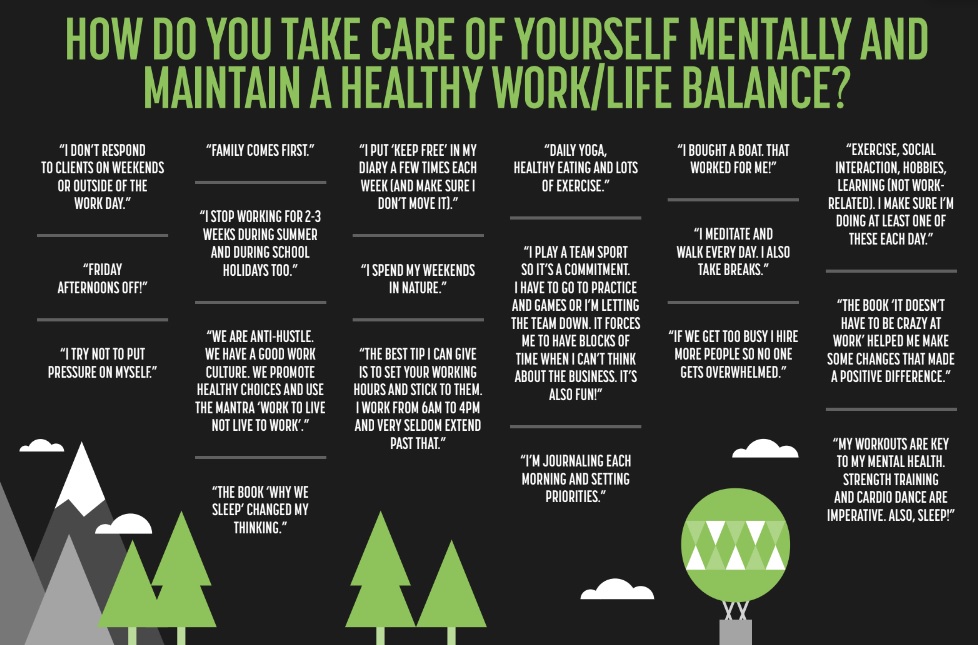
Read advice on mental health and wellbeing:
In another finding from the reports, confidence among UK agency owners at the start of this year dropped close to levels seen during the height of the COVID-19 restrictions.
Since 2012, the study has tracked how confident agency owners feel about the year ahead by giving a rating out of 100. Above 50, owners feel confident and below 50, they expect this year to be worse than last year.
The new report shows confidence in January 2023 was at 66, compared to 74 in 2022 which was the highest level since 2017.
In January 2021, during the COVID-19 pandemic, the score was 71 and in July 2020 it was 60.
As well as the issues around wellbeing described above, BenchPress said the fall in confidence is also driven by:
Growth: 71% of agencies under £1m and 79% of £1m+ grew in 2022, but growth wasn’t as strong as in previous years. Those that grew fee income by 26%+ dropped from 39% (under £1m) and 43% (£1m+) in 2021 to 26% (under £1m) and 27% (£1m+) in 2022.
Remuneration: Those earning over £50,000 per year dropped from 58% to 52%, while those earning more than £100,000 fell from 53% to 46%.
Profit: For agencies with under £1m turnover, average gross profit reduced to 36%, an 8% fall from the previous year. For agencies with £1m+ revenue, average gross profit has reduced to 40%, a 4% fall from 2021.
Despite the UK’s economic challenges, the report showed that having a purpose continues to be important for agencies.
It found that 24% of owners of agencies under £1m and 28% of £1m+ firms said building a business that has a positive impact on the world was their top priority.
[Online event for Bristol Creative Industries members on 19 May: Six steps to supercharge sustainability in your business]
[Read advice on business as a force for good and how to become a B Corp here]
The top ways agencies make a difference include:
The full BenchPress reports are jam-packed with lots more data plus advice on overcoming the key challenges and how to boost your agency. Download the reports here.
Catherine Frankpitt has a 20+ year career working in PR and communications. In 2020, she decided to launch her own business. Strike Communications works with organisations that are doing something positive in the world, such as delivering education, creating cultural opportunities and supporting disadvantaged communities.
Catherine launched her business just a few weeks before the start of the first coronavirus pandemic lockdown. A year into her entrepreneurial venture, she joined Bristol Creative Industries.
She tells Dan Martin about starting a business during the pandemic, how it has grown and the benefits of being part of the BCI community.
“I started out at the Mail on Sunday’s You Magazine as a 21-year-old. They had regular features called ‘My Last Good Read’ and ‘My Last Good Buy’. I phoned up celebrities to interview them. I spoke to Lloyd Grossman, Carol Smillie, Ulrika Jonnson and others
“I had a media degree and didn’t know exactly what I wanted to do although I knew it was on the editorial side of things. At the magazine most of the stories were coming from press releases and the copy was just rewritten. I decided that I wanted to go into PR because they were the ones actually having the fun writing the stories and coming up with the ideas.”
“While working at a big agency, the clients that I was really interested in were the likes of charities who had lean in house teams and were not able to maximise the opportunity to do bigger and better things, reach more people and get more funding etc because they hadn’t got the capacity and resources to do it. They need the support, but can’t afford the bigger agency fees.
“I’m motivated by working on communications that I think people need to know about. I work on a lot of causes, charities and culture where the comms plays more of a role than just selling. It’s not just a transactional thing. It’s reaching people that benefit from knowing about it.
“That’s why I decided to set up Strike Communications, to provide a full service agency offering but keep the costs leaner than a bigger agency.”
“I was director of communications at UWE. There are some brilliant people doing great things at the university, but while managing a big team, I missed being hands-on. I like to get stuck in and ask ‘what’s the problem?’, ‘what are the objectives?’, ‘let’s get creative’.
“I wanted to do my own thing so I went from running a department with 85 staff to running a business on my own during lockdown in my spare room!
“I’ve been a single parent with a single income for a while and I’ve always been careful with money. I took out a loan in advance of starting the business just in case something went wrong. That was the best decision I could have made. I very quickly needed it because I launched the business with two anchor clients but within a few weeks of lockdown, everybody went insular.
“It was scary to start with because I didn’t qualify for any of the support that the government introduced. All of my network was in Bristol and that’s where I had planned the work to come from but I had to rethink the plan and widen my reach.
“Eight weeks or so into the first lockdown people started realising that they needed to communicate more than ever. A previous boss once said to me that in a crisis, the first thing to go is the comms and marketing and the first thing to come back is the comms and marketing. She was absolutely right.
“Suddenly people were knocking on the door and saying they needed extra support. I worked with two London universities because their comms teams were so busy doing internal activities and keeping the students informed.
“My networks changed almost overnight and I teamed up with people in the same situation. My experience during lockdown shaped the business in a way that I didn’t expect. We were working with organisations in Devon, Basingstoke and London which we probably wouldn’t have done without the pandemic and everyone being online.”
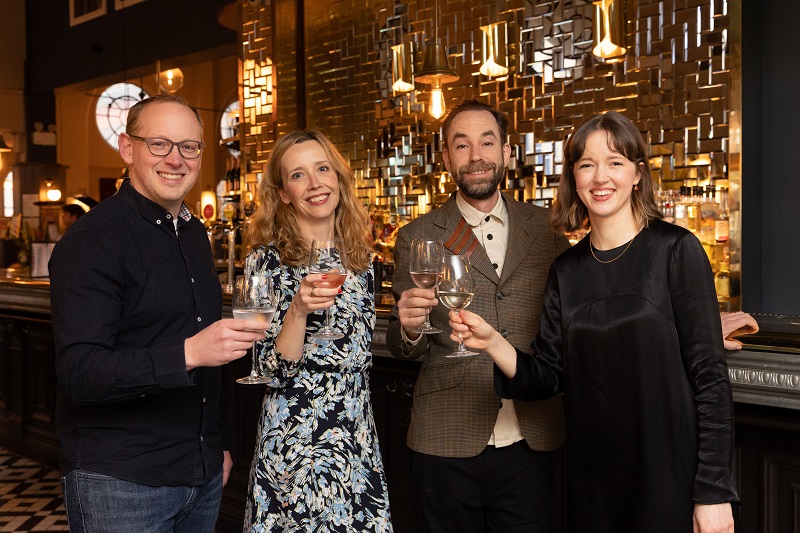
“There are now three of us full time and two associates who work with us regularly plus a few others we bring in as required.
“In March, we celebrated our third birthday and appointed Scott Fletcher as our new creative director.
“I got some advice from a business coach who said in year one, you do anything for anybody. Year two, you start working out the things that you don’t want to do. Year three, you work out who you are. That’s absolutely what I’ve found.
“In terms of reasons for success, I’ve got a really good network because I’ve worked with a lot of organisations and that has been really helpful.
“Also, I very much operate on gut instinct and my idea for the sorts of organisations that I wanted to work with that I thought needed the help at a certain price point has proven to be true. Whether it’s dealing with COVID-19 or the cost of living crisis, there is always a need for support at a certain level and a certain price. While there are plenty of creative people in Bristol we have created our own niche.
“I find it very hard to do anything other than be honest and transparent. I have strong values and the people that work with us, whether it’s staff or clients, buy into those values. People look at how we talk about ourselves and see that we’re authentic. There’s an appeal to that. There are certain organisations that we just wouldn’t work with because it wouldn’t be right for us. There are others that we really care about and want to help.”
“It’s important to be part of an organisation that is championing your sector, listening and supporting you. It’s also very useful for learning, networking and meeting people.
“I love the Friday morning Wake Up Call webinars with bite-sized advice. The members’ lunches have also been very helpful and I’ve made interesting connections. You can’t underestimate the importance of peer-to-peer support and solidarity, particularly for the founders of smaller businesses like mine. By talking to others, it makes it feel less overwhelming and less of a lonely place.
“The Bristol Creative Industries jobs board has been really useful when recruiting.”
Watching Wake Up Call webinars, attending free member lunches and unlimited job postings are some of the benefits of Bristol Creative Industries membership. Find out more.
“You need to know what it is that you’re trying to achieve, who it is that’s going to help you get there, what they are going to be interested in hearing to help you get there and where you will find them. Your comms should frame around that.
“People get really bogged down by saying things like ‘we need to be on TikTok’ and ‘we need to be on Twitter’ but they are being led by the activity. You should take a strategic approach and know what you are trying to achieve and how the comms can support you to get there. It’s about working out who your audiences, stakeholders or customers are and where they are, whether that’s online, the media they read or where you can physically find them.”
Fancy joining Catherine Frankpitt as a Bristol Creative Industries member? Benefit from industry expertise, training, leads, curated news, kudos and more. Sign up here.
Chancellor Jeremy Hunt delivered the government’s 2023 Budget on 15 March. Here’s a round-up of measures relevant to businesses in the creative industries.
If you’re a Bristol Creative Industries member and you’d like to share your view on Budget 2023, email Dan.
Describing his speech as a “Budget for growth,” Jeremy Hunt referenced the creative industries twice:
“Our film and TV industry has become Europe’s largest, with our creative industries growing at twice the rate of the economy.”
“I also want to make our taxes more competitive in our life science and creative industry sectors.”
In the full Budget document released after the speech, the government references the creative industries as being one of the five sectors it is focusing on for growth. The others are green industries, digital technologies, life sciences and advanced manufacturing.
The document says:
“The government will turn its vision for UK enterprise into a reality by supporting growth in the sectors of the future. There are opportunities to accelerate the progress of the technologies that will define this century by encouraging investment and smarter regulation.”
In terms of specific announcements for the creative sector, the Budget includes the following:
The government is reforming audio-visual tax reliefs into expenditure credits with a higher rate of relief than under the current system. This follows the government’s consultation last year.
The changes are as follows:
- 34% credit rate for film and high end TV and 39% for animation and children’s TV via the Audio-visual Expenditure Credit
- 34% credit rate for eligible video games projects via the Video Games Expenditure Credit
For the Audio-visual Expenditure Credit, the minimum slot length for high end TV will be reduced to 20 minutes, and applied on an episode-by-episode basis.
The government will put a definition of ‘documentary’ into legislation based on guidance by the British Film Institute (BFI):
“a factual or realistic programme based on real events, place or circumstances and intended to record or inform.”
The documentary definition will apply to the audio-visual expenditure credit and the current high end TV tax relief.
Final wording and exclusions to the definition will be published as part of draft legislation in Summer 2023 for comment.
The £1m per hour expenditure credit threshold for high end TV will remain unchanged.
Eligibility criteria for the Video Games Expenditure Credit will require a minimum of 10% of expenditure to be on goods or services used or consumed in the UK.
The new expenditure credits can be claimed from 1 January 2024, but there will be a transition period to allow companies to adjust:
- From 1 April 2025, claims for new productions and games must be made under the expenditure credits system.
- Film and TV productions that have begun but not concluded principal photography, and video games that have begun but not concluded development on 1 April 2025 may continue to claim relief under the current system until 31 March 2027.
- Any expenditure incurred from 1 April 2027 must be claimed under the expenditure credit regime.
Commenting on the change, Ben Roberts, CEO of the BFI, said:
“We welcome the chancellor’s news of the reformed expenditure credits across our screen industries, a testament to how crucial they are to the UK’s economy and growth. Combined with our extraordinary talent, infrastructure and technical and creative expertise, the screen sector tax reliefs – now remodelled as expenditure credits – have super charged our industry on an unprecedented scale.
“The news will ensure the UK remains a truly globally competitive production hub, giving us economic recovery and growth, creating thousands of jobs for people up and down the country and enabling creative talent and storytelling to thrive. It’s good news that the high end TV threshold has been preserved.
“I am particularly heartened to see a much needed boost for children’s television and animation as two areas of cultural and societal importance in which the UK excels creatively, but that still have significant growth potential.”
The temporary higher headline rates of relief for Theatre Tax Relief (TTR), Orchestra Tax Relief (OTR) and Museums and Galleries Exhibitions Tax Relief (MGETR) will be extended for two years from 1 April 2023
The headline rates of relief for the TTR and the MGETR will remain at 45% (for non-touring productions) and 50% (for touring
productions). OTR rates will remain at 50%.
From 1 April 2025, the rates will be 30% and 35%. On 1 April 2026 the rates of relief for TTR and MGETR will return to 20% and 25%. The headline rates of relief for OTR will return to 25%.
The government said its new chief scientific adviser, Professor Dame Angela McLean, will oversee a review into the creative industries.
In the November 2022 Autumn Statement the government said that from 1 April 2023 the SME research and development (R&D) tax relief scheme will decrease from 130% to 86%, while the SME credit rate will decrease from 14.5% to 10%.
This led to criticism from many organisations about the potentially negative impact on UK innovation. In response, the 2023 Budget includes the launch of a new SME R&D scheme from 1 April 2023 although it only benefits around 20,000 businesses. Loss-making companies that spend at least 40% on R&D will be able to claim £27 from HMRC for every £100 of R&D investment.
Among the businesses the government says will benefit are around 4,000 digital SMEs from the computer programming, consultancy, and related activities sector.
Speaking during the Budget, Hunt said:
“To strengthen our position in artificial intelligence (AI), in which the UK hosts one third of European companies, I’m accepting all nine of the digital technology recommendations made by Sir Patrick Vallance in the review I asked him to conduct in the Autumn Statement.
“I can report that we will launch an AI sandbox to help innovators get cutting edge products to market. We’ll work at pace with the Intellectual Property Office to provide clarity on IP rules so generative AI companies can access the material they need. And we’ll ask Sir Patrick’s successor Dame Angela McLean to report before the summer on options on growth duty for regulators.”
The government will also award a £1m prize every year for the next 10 years to researchers that drive progress in critical areas of AI. It will be known as the ‘Manchester Prize’, named after the world’s first stored programme computer which was built at the University of Manchester in 1948.
Creative businesses and individuals from the south west who take part in Edinburgh’s annual festivals may be interested in new government funding of up to £8.6m.
The Budget said the money “could help build a permanent headquarters for the Edinburgh Fringe Festival and create year-round opportunities for local artists and talent across Edinburgh festivals”.
Although none are in Bristol or the south west, there could be some benefits for local businesses with connections or offices in the regions chosen for the government’s new investment zones.
The zone will focus on the government’s “priority sectors”, which includes the creative industries. They will each receive £80m for tax reliefs, improving skills, providing specialist business support, improving the planning system, or boosting local infrastructure.
The English zones will be in:
The following are announcements not specific to the creative industries but are of interest to businesses in the sector.
The previously announced increase in corporation tax from 19% to 25% for businesses with profits over £250,000 will go ahead as planned from 1 April 2023.
Companies with profits of £50,000 or less will continue to pay corporation tax at 19%. Companies with profits between £50,000 and £250,000 will pay tax at the main rate reduced by a marginal relief providing a gradual increase in the effective corporation tax rate.
There is more advice on what the corporation tax changes mean for businesses in this post.
The £2,500 Energy Price Guarantee (EPG) for households in Great Britain has been increased for another three months from April to June.
No new energy support was announced for businesses. The Budget confirmed that the Energy Bills Discount Scheme will replace the Energy Bill Relief Scheme from 1 April. The new scheme, which runs until 31 March 2024, is significantly less generous.
Jeremy Hunt announced several measures aimed at helping the unemployed, parents and the over 50s to get jobs or increase the hours they work.
This includes extending free childcare to working parents of children from nine months old. The changes will be rolled out in stages:
For the over 50s, new ‘returnerships’ will bring together the government’s existing skills programmes. They will promote accelerated apprenticeships, Sector-Based Work Academy Programme placements and Skills Bootcamps to the over-50s.
All the labour market announcements in Budget 2023 are outlined here.
In a shift to focusing on local authorities having powers to deliver activity such as business support, the government said it intends, subject to consultation, to withdraw all remaining central support for Local Enterprise Partnerships from April 2024.
The Budget said: “The government is committed to empowering democratically elected local leaders at every opportunity.”
The new full expensing 100% first year allowance will be introduced from 1 April 2023 until 31 March 2026. This means that companies across the UK will be able to write off the full cost of qualifying main rate plant and machinery investment in the year of investment.
The annual tax-free allowance for pensions will increase from £40,000 to £60,000.
The £1.07m lifetime allowance will be scrapped completely. This is the maximum amount of tax relievable pension savings an individual can benefit from over the course of their lifetime.
If you’re a Bristol Creative Industries member and you’d like to share your view on Budget 2023, email Dan.
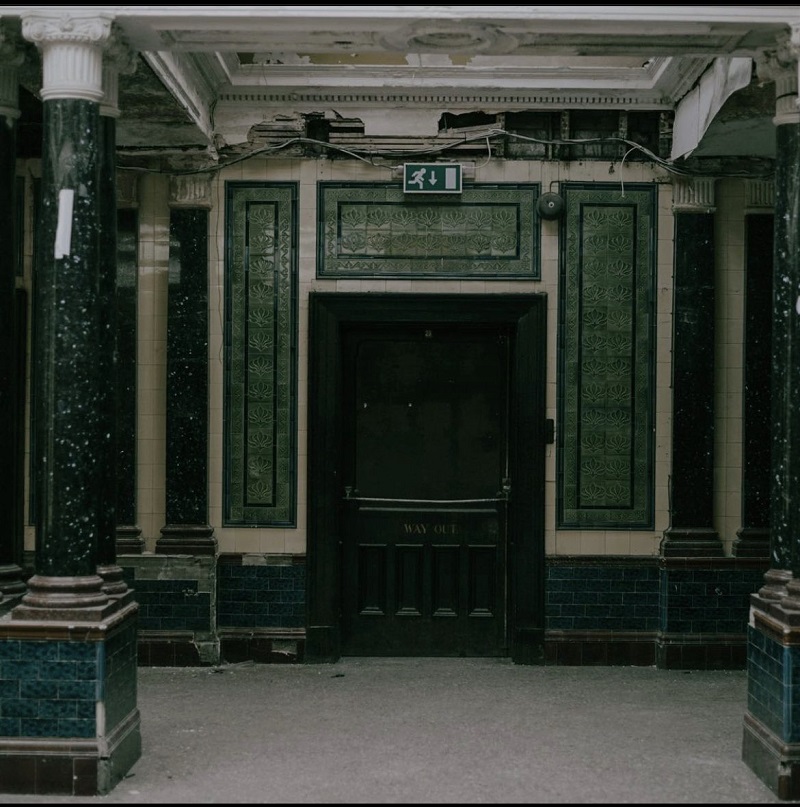
Creative Youth Network is redeveloping the old magistrates courts on Bridewell street in Bristol into a creative enterprise hub for creative organisations, individuals and diverse young talent.
With a range of office, meeting, incubator and co-working spaces available, interested parties are invited to show an interest in becoming tenants in this innovative, heritage space.
The Courts is set to open in late 2023/early 2024. It will be an enterprise hub, offering creative industries space and opportunity for development, networking and collaboration as well as professional office space.
There are a variety of offices available from as little as £26 per sq ft. Tenants also benefit from reception support, on-site catering and good quality spaces for hire.
Register your interest and outline your requirements using the form here.
Courtroom 2 on the ground floor of The Courts will be offered as co-working space for creative SMEs, individuals and freelancers who don’t require an office.
Desks will be £150 per month plus VAT** with an initial minimum contract of three months preferred.
Creative Youth Network would love to hear more about how this co-working space will be of benefit to you and what you might need. Register your interest using the form here.
** The rental charge has been set to ensure the space is affordable, but Creative Youth Network recognises that this may still be a barrier for some. Please get in touch if you’d like to talk about support. Email [email protected]
Bristol Creative Industries has teamed up with Bristol-based social enterprise Babbasa and 15 creative businesses to launch a city-wide internship programme.
The programme is aimed at Bristol-based young people aged 18-24 from an ethnic minority and/or from a low-income background who want to gain insight and experience in the creative industry.
The scheme will see many of the city’s most well-known creative companies offering six-month full time paid placements to applicants in roles covering advertising, marketing, design, animation and digital.
Two of the biggest challenges currently facing the creative industries are a long-term skills shortage and a lack of diversity in the sector.
A Creative Force to Be Reckoned With, our report released in September 2022, found that although increasing diversity and inclusion was a significant priority for six in 10 creative firms, almost half said they want more help with finding diverse talent from underrepresented groups.
We’ve been working hard to create a solution and are delighted to launch the Bristol Creative Industries Internship Programme.
Babbasa, which supports diverse young people to achieve their aspirations, is leading the recruitment process. We are working closely with them and the brilliant participating creative businesses to match applicants to one of the available roles.
Chris Thurling, chair of Bristol Creative Industries, said:
“We all want to make our industry more diverse and inclusive, but when you run a small business it’s not always easy to know how to make a practical difference. By coming together as the Bristol Creative Industries community to support the internship programme, members can do their bit to help young people get that all important foot in the door.
“We are delighted to formally announce this internship programme in partnership with Babbasa. The creative industry in Bristol is one of the best in the country, and we want to help open this up to as many young people in the city as we can.
“Our aim with this programme is to work closely with the fantastic team at Babbasa to connect bright young talent with some of the city’s best and well-established businesses.”
Starting on 15th May 2023, each successful applicant will work for six months. During that time participants will undergo two placements for two different agencies, both lasting three months each.
The programme provides a mix of professional skills training, creative skills training, inspirational talks, networking events, mentoring and opportunities for future employment.
The deadline for applications is 28th March 2023, with interviews taking place on 4th and 5th April at Watershed in Bristol. There will be an informal group workshop which will give applicants a chance to come and hear a bit more about the participating businesses, their internship offers and meet some of the team.
Applicants will then be given a 30-minute slot to chat to the interview panel to give us a chance to explore applications in a bit more detail. Bristol Creative Industries will cover costs for travel to the interview for every candidate.
The businesses and Bristol Creative Industries members participating in the programme are:
Big thanks to them all!
Poku Pipim Osei, CEO and founder of Babbasa, said:
“Last year, we consulted with a range of city partners and underrepresented communities to better understand how Bristol can close the inequality gap for the next generation, in a report called the OurCity20230: Socioeconomic Analysis Report.
“What was striking is that over 38% of the young people surveyed had aspirations to pursue a career in the creative industries. This is why we are excited to be part of this partnership, as a demonstration of our commitment to work collaboratively and unlock doors for those who would not have otherwise had the chance.”
To apply, applicants already registered with Babbasa can send a video/audio recording that’s around one minute long, or a written piece to recruitment lead Mikhaila at [email protected] explaining why they want to be part of the programme.
Those who aren’t yet registered with Babbasa can sign up here and the organisation will be in touch to help progress the application.
For more information on the programme, visit the Babbasa website and for more details on the businesses participating in the scheme, go here.
You need to load content from reCAPTCHA to submit the form. Please note that doing so will share data with third-party providers.
More Information