One of the big benefits of Bristol Creative Industries membership is the ability to self-publish content on our website. We’ve seen lots of great content published in 2023 including some brilliant business advice.
Here are the 20 most popular advice posts of the year. The list includes some posts from 2022 that have continued to attract views thanks to their great tips.
Want to publish business advice on our website and make it into the top 20 in 2024? Become a member of Bristol Creative Industries.
____
Written by Varn
Click below or read the article here.
Written by Janusz Stabik – Digital Agency Mentor
Click below or read the article here.
Written by Gravitywell
Click below or read the article here.
Startup funding: What is the difference between pre-seed and seed investment?
Written by JX Branding / Joanna Xenofontos
Click below or read the article here.
The role of brand architecture in Facebook’s rebrand to Meta
Written by saintnicks
Click below or read the article here.
Written by Adapt
Click below or read the article here.
Written by Fanatic
Click below or read the article here.
Written by Carnsight Communications
Click below or read the article here.
Written by Varn
Click below or read the article here.
Written by studio floc
Click below or read the article here.
Written by Carnsight Communications
Click below or read the article here.
Written by Halo
Click below or read the article here.
Written by Trusty Social
Click below or read the article here.
Written by AMBITIOUS PR
Click below or read the article here.
Written by Blog Write Ltd
Click below or read the article here.
Written by Varn
Click below or read the article here.
Written by Proctor + Stevenson
Click below or read the article here.
“Millennials don’t like being told what to do” – Time to rethink your strategy?
Written by saintnicks
Click below or read the article here.
Written by Carnsight Communications
Click below or read the article here.
Written by Flourish
Click below or read the article here.
One size doesn’t fit all – usable HTML across different email clients
Want to publish business advice on our website and make it into the top 20 in 2024? Become a member of Bristol Creative Industries.
On 24 November, we celebrated the first group of interns who took part in the Bristol Creative Industries Internship Programme with Babbasa as part of the OurCity2030 Pathway into Creative & Tech.
We had a wonderful night celebrating everyone’s achievements over the past six months. The graduation event, at the Gather Round co-working space in Bristol, brought together the brilliant interns plus many of the programme contributors, friends and family to reflect on the successes and learnings from the scheme.
We launched the programme earlier this year. It is aimed at young people aged 18-24 from diverse backgrounds wanting to gain more insight and real experience in the creative industries.
Two of the biggest challenges facing the sector are a long-term skills shortage and a lack of workforce diversity. This was highlighted by Bristol Creative Industries’ A Creative Force to Be Reckoned With report which found that increasing diversity and inclusion is a significant priority for six in 10 creative firms in Bristol, but almost half said they want help finding diverse talent from underrepresented groups.
The internship programme was designed specifically to tackle those issues and create more inclusive workplaces. We were delighted that brilliant agencies from the BCI member community stepped up to provide three month placements to the 14 interns:
At the end of the first placement, three of the interns used the experience to explore other projects, while 11 stayed to undertake a second placement.
As the pilot programme comes to an end, here’s an update on how taking part in the initiative impacted on the interns and what they plan to do next:
Abdifatah Kheyre is going travelling for a while but has some exciting plans to launch a new project with a friend.
Abdur-Rahman Shafi has been offered a continuation at his first placement at Noble where he will be doing an internship extension, with the view for being promotion to digital marketing executive after six months.
Ahmed Ismail is considering his options in design and software development.
Amy Smith has been offered a role as production runner at Aardman on an upcoming project.
Kayjay McDonald-Ferguson is looking to continue with his freelancing projects in design and strategy and is set to start a bootcamp coding course.
Laurel Beckford has been working with Babbasa on the organisation’s social media campaigns and is looking for further work in film production and social media.
Mohd Wani has gone on to study an MA in information experience design at The Royal College of Art.
Omar Ibrahim has started a front-end web development bootcamp and will continue to study whilst trying to get more work experience. He is looking for a junior level role in front-end web development.
Priscilla Kodjo is staying on at her placement at Time Machine Designs as a freelance concept artist.
Sara Matloob has applied to study with the Chartered Institute of Marketing and hopes to build a career focused on public relations and the experiential sector.
Sophie Kirk is continuing to pursue her career in film and television art departments, with her improved graphic design skills opening up more opportunities for freelance work.
Seren Spooner was offered a job as a junior designer at Armadillo, her first placement.
Touka Mostafa led an EDI audit at one of her placements and delivered her findings to the board. She has recently accepted an account executive role at Armadillo, one of the participating agencies.
Yasmina El Khatib hopes to continue her education and study a modelmaking course with a focus on fabrication. For now, she is looking for a design and creative role to allow her to save for her masters.
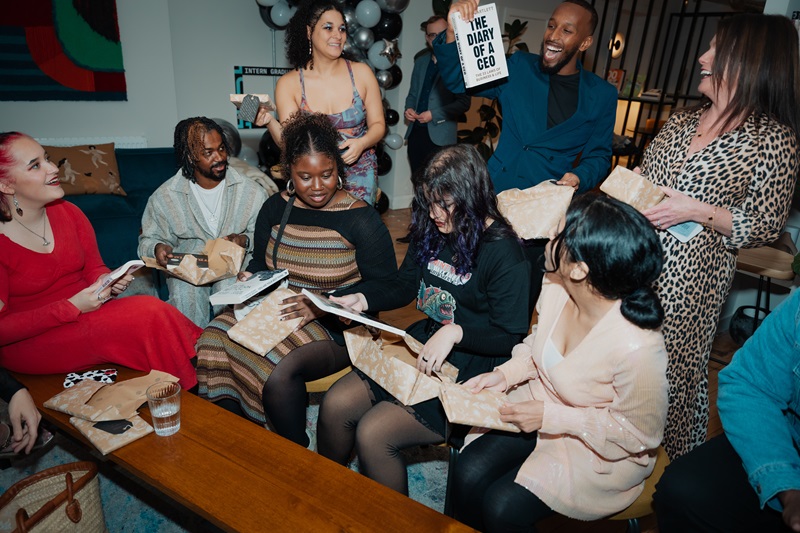
We asked some of the interns to reflect on taking part in the programme.
”The programme helped me find myself, be a better human and chase my dreams.”
Abdifatah Kheyre“This internship really has made my dream career happen. The continued support throughout has been great. I have also made some friends that I will have for life.”
Amy Smith”I took many learnings from the experience, but above all I learnt the importance of being an active learner. In a work setting it is important that you can communicate with the different departments and not be afraid to ask for what you want. In both agencies I felt comfortable to be myself and felt listened to. I like that the internship was tailored to what I needed.”
Kayjay McDonald-Ferguson”Don’t get me wrong, it wasn’t always a straight path, and I was never comfortable to put my hand up and say I want to learn more. But I have to say, I’m so glad I sat in the uncomfortable space for a little bit because I pushed past that point, I managed to develop and grow in so many different ways. ”
Touka Mostafa”I loved seeing how many agencies were interested in diversity and inclusion and I really enjoyed the networking opportunities that came with the internship programme. I also enjoyed learning new skills during our Friday sessions and watching all of the interns develop new skills that they’re proud of.”
Sara Matloob
For more from the interns, participating agencies and other who took part in the programme, watch this brilliant short film:
You are currently viewing a placeholder content from YouTube. To access the actual content, click the button below. Please note that doing so will share data with third-party providers.
The Bristol Creative Industries Internship Programme is not possible without the fantastic agencies who take part and provide placements for the young people to gain valuable experience.
Here, some of the agencies reflect on their experiences:
“The best businesses need the best talent. The best talent is diverse. This programme has helped us collectively engage that talent.”
Nina Edmunds, Halo“We’ve always aspired to have an internship programme that promotes diversity and inclusion and encourages the community to open more doors, yet time and resources have been a barrier to achieving this. By joining forces with Bristol Creative Industries, Babbasa and other member agencies, we were able to make it happen.”
Lucy Rees, Newicon“Collaborating with peers from other participating creative agencies has been a great experience. It has allowed us to actively contribute to shaping the program while exchanging ideas and learning from one another, particularly in areas around HR, people & culture, and innovative working practices.”
Anthony Butterfield, Aer Studios“We wanted to be challenged in our DE&I efforts. We hoped this scheme would help us push forward on our learning and DE&I journey and it has done exactly that.”
Abigail Croft, Diva“Our intern was really keen to learn all the different roles within the agency and really engaged in everything she was doing. Seeing her confidence grow each week, so she was asking the right questions to allow her to execute the task in front of her was a real highlight. The fact we could see the talent was there enough to offer her a job shows what an impact she made, and that is the true highlight.”
Jeremy Bourton, Armadillo“This amazing opportunity provides a springboard for young people with a paid placement that can really make a difference to their professional development. On the other side of the coin, it’s made me a more rounded professional and helped me to evolve.”
Matt Woodman, Atomic Smash“The BCI Internship Programme is a golden opportunity to partner with community-facing organisations. It is a real opportunity to learn as well as teach, whilst being supporting by BCI who follow the interns through the whole process.”
Ceilia Hunt, Aardman Animations
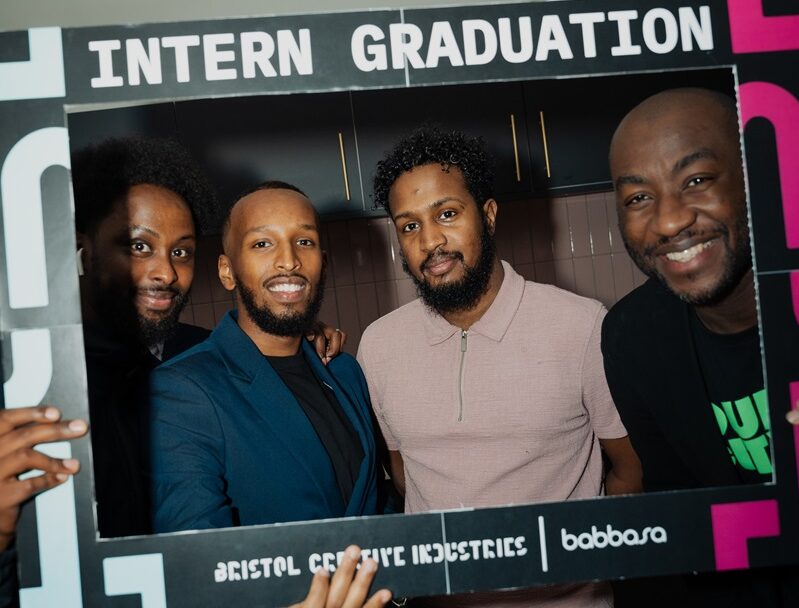
All of the interns are now Bristol Creative Industries members. Please do reach out to them if you are looking for collaborations or for young people to fill junior roles. We will also be welcoming them to Bristol Creative Industries events in 2024, so you will get a chance to meet them.
We look forward to welcoming back the cohort as ambassadors for the programme in 2024 and to help inspire the next group of interns.
Conversations for the 2024 Bristol Creative Industries Internship Programme have begun with Babbasa as part of the next OurCity2030 Pathway into Creative & Tech.
If you run a creative business in Bristol and are interested in hearing more about how to get involved, contact Bristol Creative Industries membership manager Alli Nicholas on [email protected]
Big thanks to @eljaybriss for the images.
It has been a big year for artificial intelligence; so much so that Collins Dictionary made AI the most notable word of 2023.
AI has actually been around for several decades, but since ChatGPT burst on the scene in November 2022 it has been a huge global topic of conversation.
Developments in the technology are moving fast and businesses around the world are using AI tools for various tasks. But there are also ethical concerns around bias, privacy, plagiarism and accuracy. And what does it mean for sectors like ours which has a big focus on human creativity?
Dan Martin asked members of Bristol Creative Industries to tell us how they are using AI, the tools that are most useful, any concerns they have about the technology and what impact they think it will have on the creative industries.
“In the field of design, AI has emerged not as a threat but as a formidable ally. It serves as a creative collaborator, an ever-available helping hand that can assist designers in unleashing their true potential and the potential of their ideas.
“AI algorithms can analyse vast datasets, identify trends, and provide inspiration that might have eluded humans. It extends the possibilities of what we can create, helping us push the boundaries of design. However, it’s crucial to recognise that AI doesn’t replace creativity – it’s an enhancer – part of a unique and collaborative team that will do great things together.
“As we embrace AI in design, we must tread carefully regarding ethics. AI’s capacity to mimic styles, artists, and writers raises important questions about originality, plagiarism, and intellectual property.
“We must recognise the ethical implications of using AI and we should establish guidelines and standards to ensure AI is directed fairly and honestly to constantly check ourselves and each other, always questioning the work we produce. Integrating AI into agencies is inevitable and holds tremendous promise. When used with integrity, it is a transformative force that can elevate our creativity, efficiency, and impact.
AI tools we use regularly include Chat GPT, Midjourney, Dalle and Vizcom. We are currently looking for the best opportunities to use Loops and Boords.
“There is one tool that is showing promise and potential; Claude. We’re finding it more of a helpful tool than say ChatGPT because it allows you to attach files. It’s also good for breaking up documents and summarising. It’s in beta, so it’s pretty rough and ready, but we’ve done things like ask it to create shot lists from video storyboards and it does a fairly good first job.
“Dalle3 has been put into Bing, and that’s a fun tool. It can create nice pictures in just one prompt. It’s been handy for stock image creation, but it’s limited. For example, it can’t create anything beyond a 1×1 ratio.
“Whereas Midjourney is a much more powerful image generator, but you’ve got to put a lot more into the prompts and variance tweaking. They are interesting, but I don’t see them replacing a creative function. You still need the creative vision to make them work.
“As an agency, we’re carefully exploring the risks and ethics of such tools in our sector. The Daily Telegraph and The Guardian are two examples where a cautious approach to AI is being taken and we anticipate that other publishers will follow suit. The Daily Telegraph has recently issued guidelines to staff prohibiting publishing AI-generated text except in limited cases with legal approval and The Guardian is vying to maintain transparency around human-produced journalism.
“We’re mindful that we’re still in the infancy of AI and advancement is bubbling away. As they stand, they’re not replacing anything or anyone, more that they are a string to the bow. It still feels like there’s a long way to go with AI tools but we’re excited to see what’s to come.”
“As a video production team, we’re really receptive to AI based tools that improve our editing workflow. We were early adopters of the beta version of Adobe Premiere Pro‘s text based editing tools, which really speeds up sync selection when dealing with multiple talking heads. We also use the enhance speech function to improve audio quality when location recording sound is compromised; this has varying degrees of success, but it’s good to see the capability evolving.
“An enthusiasm for exploring AI was an important factor in hiring our two newest members of staff and we try to make time for them to try out new applications.
“So far AI has been a positive experience for us, especially where it speeds up mundane tasks. We welcome it as a tool to further human creativity rather than undermine it. However we do appreciate this may be influenced by our team members requiring multiple skills rather than focusing on a specialised area of post-production.”
“We want to position AI as a complementary tool, rather than a replacement for strategic communications and copywriting. We are using specialist applications like Jasper and ChatGPT to add speed and scale to parts of the content creation process. We’ve focused this year on building our own internal experience and knowledge but there have already been a few projects where we have been able to show our expertise.
“Generative AI is like having a really inexperienced intern. It needs to be provided with the right information, instructions and tasks to get the best results. And because its responses are based on already existing content, the answers AI provides are always generic. While it might give us a starting point to add our own creative and strategic thinking to – it is nowhere near being able to create something we’d be happy to send to clients.
“As an agency and an industry, we must make sure this technology doesn’t replace actual human interns. That’s why we are continuing to take on interns from local universities next year. We want to help people gain the experience they need to build rewarding careers in the creative industries.
“Generative AI has felt a bit like discovering the internet for the first time; it truly is magic. When it comes to the practical business benefits, it has started to automate some simple tasks. We can edit podcast episodes and the accompanying social clips easily on Riverside.fm, do some image manipulation and we’ve started to experiment with its ability to write social media posts.
“There’s likely to be a big opportunity for creative businesses, if you embrace what’s possible and think about how it’s going to impact the way you work. We just need to be careful that we’re still supporting the development of people joining the industry — it’s the tasks they do that are being taken over — and that marketing focuses on quality and community. There’s going to be a lot more content created, so you’ll need to work harder to stand out!”
We recognise that the pace of change of technology is accelerating exponentially. By becoming comfortable with that and working within guardrails that support this change, we can identify and take advantage of areas of opportunity for our clients as well as for our own business.
With a focus on human centricity, our strategy is broken down into a couple of key areas. It all starts with open dialogue and conversation, from board level and across the organisation. We have AI champions from each part of our business, who are busy identifying the key challenges and opportunities within their own specialisms, from motion to finance. This allows the prioritisation for areas of focus, so that new tools that may not be in use already can be tested.
“We’re also putting in place a clear vision statement that aims to set boundaries within which innovation can flourish. For any concerns that may arise when using a tool, we’re setting up a bias council, so that these can be raised and explored to avoid the discrimination.”
“I think it would be foolish for us to deny the potential held by artificial intelligence. When it comes to research, data collection, analysis and reporting etc, AI tools are brimming with potential. They’ve certainly helped us streamline processes and massively improve overall efficiency.
“However, there are certain processes that simply cannot (at the moment), and should not, be replicated by computers.
“Be it copywriting, content creation, web design or strategy, we strongly believe in the value of creative human input across all our work. AI is unable to capture the essence of brands, clients and individuals, no matter how hard it tries.
“Yes, these tools will continue to evolve and improve, but our focus will remain on the knowledge and experience of people, not machines. They’ll help our people be more productive and reduce time spent on monotonous tasks but they lack that spontaneous and creative flare.
In terms of tools we use, it’s all ChatGPT at the moment. The plan is to create unique GPT models catered to all of our clients and work types. This will allow us to train models based on client-specific documentation like style guides, landing pages and SEO best-practice docs.
“We have previously been combining third-party plugins, such as Browser OP and Webpilot, with specifically engineered prompts. As GPT is improving at a rapid pace though, third party browser plug-ins are becoming less important and these features are becoming native within GPT.”
“AI cannot innovate, only replicate – at least in its current form. AI tools like the infamous ChatGPT are able to create things based on existing data that they have been shown. This inability to produce something from nothing, or to create an entirely new direction for a web service like development or design, means it is unlikely to serve a threat to the industry.
“That doesn’t mean we shouldn’t use it, however. AI is an incredibly useful tool in oiling up the creative process, making certain aspects like research and insights go much faster. However, it probably won’t replace traditional creative practices for companies that want something bespoke.
“For web design, and websites in general, most organisations want to speak to humans. That’s because they’re led by humans, and the services they offer are invariably for humans. This common factor means that human-led design is the most logical thing to do, both now and in the future.
“There will be organisations that embrace AI to the extremes, even creating full AI websites. The impact of this is most likely to be seen in entry level projects for people that want a site quickly such start-ups.
“There are indications that Google penalises websites that utilise full AI content. Furthermore, as AI is in its infancy, we’ve yet to see how it will evolve both legally and functionally – restrictions on things like use of content and copyright laws could come into play down the line.
“For now, it’s best to think about the good that comes from AI – the speedy research, the ideas generation, and the surface-level insight into a topic – rather than assume it’ll replace jobs or the creative industry as a whole.”
“We have integrated many video production based workflow enhancements using various AI tools, and have regular meetings to discuss its wider impact. Many conversations conclude with, “It’s good, but not great, and not yet ready” or “It feels like AI” etc, but the fact is that with AI’s exponential growth curve, it will be ready and soon!
“The level of disruption AI poses to business is both exhilarating and overwhelming, and we’re hoping that the benefits will balance the effort, money and time it takes to stay up to date with fast paced change, to test what’s right for each business and to integrate it successfully into better workflows.”
“AI in one form or another is used pretty frequently to support our team. I use the word ‘support’ intentionally.
“ChatGPT came with a lot of hype, but after the initial novelty wore off, we found that the majority of use-cases are typically rephrasing meeting notes or making email notes more concise – though creating approaches and frameworks for ideas has been more valuable.
“Voice AI is looking promising as a low-cost solution for social media assets, though it certainly doesn’t replace a voice over artist (yet). Again something we are experimenting with and will likely make more use of in the near future.
“Text-to-image tools are interesting. Photoshop has some half-decent inbuilt generative tools now, but in more powerful scenarios we’ve been able to build environments using MidJourney to support our creative. Notice the use of ‘support’ again? It’s not perfect, but it does help rule out what’s not working.
“Finally, and perhaps the most unusual use for us so far, was collaboratively working to set up an online chat-game for Conan the Barbarian. We worked in partnership with a text prompt engineer to craft a framework for a text based adventure game called ‘Tavern of Treachery’. Reviewed by PC Gamer, the campaign ran for the first two weeks of launch and generated over 3,000 unique AI encounters with Conan.”
“Like many teams, we used AI before ChatGPT burst onto the scene. Spending time on it has helped us find ways to bolster our work. Some of these findings will be shared in the chapter of a book called #PRStack, which is due out later this month.
“In our team meetings, AI chatbots record discussions and outline actions. A close friend’s creation, parker.ai, promises to enhance this.
“We’re also looking at how AI can manage tasks like analysing engagement feedback efficiently, allowing us to dedicate more time to strategic, high-value work.
“There’s no doubt it’s a game-changer, but I’m apprehensive about two things and irritated by a third.
“Firstly, like with social media, I worry that optimism bias will stop us from collectively recognising the potential for bad actors to wreak terrible harm. There is an important role for regulators here to ensure the right controls are in place.
“My second fear is that we fail to grasp the opportunities AI presents.
“My third concern comes from a long-standing bugbear: that the landscape between organisations and the public becomes even more littered with bad tech ‘solutions’ (chatbots and ‘convenience’ parking, I’m looking at you).
“That’s why I’m convinced that the AI success stories will be the ones who integrate it into their work while keeping people at the heart of what they do.”
“Performing initial discovery can be a time-consuming process, and even briefing it to someone else can seem like a chore. While it still requires a knowledgeable eye to read and verify responses, ChatGPT 3.5 has been a good tool for researching business sectors, personas, and helping to draft workflows. This has helped to cut down time on the tedious tasks in order to be able to focus on the fun ones.
“But AI isn’t a magic bullet (not yet, at least) as the results you get from these tools are only as good as the prompts you give them, much like the benefit of writing a good brief.
“Within early stage concepting especially AI assisted workflows are all about maximising your time and output. It goes without saying Photoshop’s Generative Fill has been a gamechanger – beyond that we are also using generative AI models like Stable Diffusion to help bring our ideas to life.
“The benefit of AI for people within the creative industries feels vast. For any concerns about its negative impacts, we can only look to other historical comparisons. Maybe the impact of the letterpress on calligraphy in the mid-15th century? Or the democratisation of the personal computer and home printer through the late-20th century? For now, these are all just tools and as long as we take care to use them appropriately, we can keep our excitement to use them!”
“Our first exploration of AI began with using early deepfake technology to recreate a young Ian Wright, for an Adidas 90s apparel re-launch project. AI has since become a key part of our workflow, e.g. in upscaling renders and adding in-between frames. This was essential for a 10 minute projection mapping project requiring 8K renders at 50fps, an impossible task without the AI tool Topaz Labs Video AI.
“We utilise the evolving AI features in tools such as DaVinci Resolve for tasks such as object removal, rotoscoping and denoising. We’ve enhanced efficiency and precision, making processes quicker and more streamlined.
LLMs like Bard and Chat GTP provide workflow advice on complex VFX challenges in software like Houdini, accelerating R&D and discovering more effective solutions.
“We’re also exploring AI for early-stage ideation and generating visual elements, a shift from traditional reliance on stock imagery.
“From our experience, there is no doubt AI will play a significant role in VFX and asset development. Although AI hasn’t yet perfected executing vision, its contribution to creativity and ideation is undeniable.
“Nuance, especially when iterating with clients and artists, means a production process where people have ultimate control is still essential.”
“We predict that AI will be disruptive but not fatal. We have been integrating AI into our work flows in a way which benefits our clients and as our business is all about SEO, is in line with Google’s guidelines. We believe, and the results from our clients show, that the core principles of good SEO will remain the same, even if the tools we use to deliver those results will evolve.
“It’s about strategy, and how to use it. A bit like when steam engines were invented, and everyone panicked about their impact. The ones that succeeded were the ones that learnt how to use the steam engine to their benefit rather than ignore it or try and stop them. Therefore, it will not change the core pillars of SEO, but it’s a tool that can be used to assist us in helping to make our clients visible online.
“One area to keep an eye on in search marketing, is that we are noting some of the biggest visual updates to Google SERPs that we’ve seen in some time – with Google’s Generative AI-powered Search Experience (SGE). Context will be carried over from question to question, to help you more naturally continue your exploration and these AI generated search results are very different from what we’re used to seeing. We expect more growth and development within SGE, over the coming months.”
“We’re getting great results when it comes to brand messaging. Copywriting at the branding stage can be like picking apart a plate of tangled thoughts, ideas and content, and then putting them into a coherent order.
“AI offers us strands to pull at sooner, giving us developed phrases that we can adapt and shape and link to. Yes, most of the output is cliché or inappropriate or wildly off-tone, but it’s a much better starting point than a blank page, a blinking cursor and a looming deadline.”
“We’ve been working on AI related-projects for our clients since 2019. We view AI integration as largely beneficial; embedding AI and machine learning in products and workflows offers advantages such as enhanced efficiency, superior decision-making, and enriched customer journeys.
“Understandably, skilled individuals across the creative industries may have concerns. Yet in my 20+ years in digital media, I’ve found new technology always requires time to find its place. I consider it a new toolkit that should ultimately liberate us to focus on the really smart stuff that relies on human creativity, curiosity, heart, soul and intuition.”
Chancellor Jeremy Hunt delivered the government’s 2023 Autumn Statement on 22 November. Here’s a round-up of measures and announcements relevant to businesses in the creative industries.
If you’re a Bristol Creative Industries member and you’d like to share your view on Autumn Statement 2023, email Dan.
In the full Autumn Statement document released after the speech, the government says:
“The UK has world-leading creative industries at the heart of an increasingly digital world. The sector grew at over one and a half times the rate of the wider economy between 2010 and 2019,73 contributing £126 billion in GVA in 2022.
“In June 2023, the government published its sector vision which set ambitions to grow the creative industries by £50 billion and deliver a creative careers promise to support a million more jobs by 2030. This included £77 million in new government spending, bringing the total announced since the 2021 Spending Review to £310 million. The sector also continues to be supported by significant tax reliefs, which were worth £1.66 billion in the year ending 2022.”
In terms of specific announcements for the creative sector, the Autumn Statement included the following:
In his speech, Jeremy Hunt said:
“Our creative industries already support Europe’s largest film and TV sector. This year’s all-Californian blockbuster Barbie was filmed in the constituency of the Hon Member for Watford, where the sun always shines.
“I know that even more could be invested in visual effects if we increased the generosity of the film and high-end TV tax credits, so I will today launch a call for evidence on how to make that happen.”
In the consultation document published after the speech, the chancellor says:
“I can confirm that we will provide more additional tax relief for expenditure on visual effects, to boost the international competitiveness of the UK’s offer. This call for evidence takes the first, crucial step towards this, as it will provide the government with the depth of understanding it needs to develop targeted proposals that best serve the needs of the visual effects industry.”
The call for evidence follows the announcement in the government’s March Budget that audio-visual tax reliefs are being reformed into expenditure credits with a higher rate of relief than under the current system. The new expenditure credits can be claimed from 1 January 2024.
The government is looking for comments on how the new Audio-Visual Expenditure Credit can provide more generous tax relief for visual effects by 3 January 2024.
Neil Hatton, CEO of UK Screen Alliance, said:
“Very often clients will say, ‘We love your creativity, your innovation and reliability to deliver. We love your people and we love working in the UK, but your VFX incentive doesn’t meet what is available elsewhere in the world’. Either that or, ‘We are capped out’.
“This consultation and the promise of a more competitive incentive should aim to position the UK as the first choice destination for VFX production for international film and TV. We are focused on capturing a larger market share as global demand for VFX recovers, following the US actors’ strike, and we aim to play a full part in growing the UK’s creative industries towards the government’s 2030 targets.”
The government said it will provide £2.1 million of new funding next year for the British Film Commission and the British Film Institute Certification Unit “to support the production of film and high-end TV across the UK”.
The unit certifies films, animation, television programmes and video games as British or as an official co-production in order to be eligible for the UK’s creative sector tax reliefs. The BFI has previously said that it lacks funding to adequately adminster the certification.
The government said it will review public investment in R&D spending for the creative industries “to a Spending Review timeframe”.
The 75% business rates relief for hospitality, retail and leisure businesses up to a rateable value of £110,000 has been extended until 2024-25, and the small business rates multiplier has been frozen at 49.9p.
The standard multiplier (paid by properties with a rateable value of £51,000 or more) will be uprated by September’s CPI next April (6.7%). This will mean an increase from 51.2p to 54.6p.
At the Spring Budget, the government extended the temporary higher rates of relief of three corporation tax reliefs that are collectively known as the ‘cultural reliefs’:
In a policy paper published alongside the Autumn Statement, HM Revenue & Customs said “the government is taking the opportunity to clarify some of the relief rules, including what is eligible for relief” in order to “provide clarity to the industry and ensure the fairness and success of the cultural reliefs”.
In a policy paper published alongside the Autumn Statement, the government said companies claiming tax relief for films, high-end TV, animated TV, children’s TV, video games, theatrical productions, orchestral concerts and museum and gallery exhibitions will be required to complete and submit an online information form.
This include claims made for the new expenditure credits: the Audio-Visual Expenditure Credit (AVEC) and the Video Games Expenditure Credit (VGEC). It also includes the cultural tax reliefs: Theatre Tax Relief (TTR), Orchestra Tax Relief (OTR) and Museums and Galleries Exhibition Tax Relief (MGETR).
The reason given is as follows:
“It is expected that these changes will streamline the process of making a claim and assist companies in transitioning to the new regimes. The completion and submission of the online information form will make it easier to tackle abuse and will reduce the administrative burden on HMRC, allowing claims to be processed faster.”
For AVEC and VGEC, the measure will take effect from 1 January 2024. For the cultural reliefs, it be introduced from 1 April 2024.
Freelancers make up a third of the creative industries so these measures are very relevant to the sector.
From 6 April 2024, self-employed people with profits above £12,570 will no longer be required to pay Class 2 National Insurance Contributions, while the main rate of Class 4 self-employed NICs will be cut from 9% to 8%.
The government said the changes will benefit around two million self-employed people with the average person earning £28,200 seeing a saving of £350 in 2024-25.
Compute powers the development of AI models.
The goverment will invest £500 million in further UK based compute over the next two financial years “so that universities, scientists and start-ups have access to the compute power they need to help make the UK an AI powerhouse”. This brings the total planned investment in compute to more than £1.5 billion.
The following are announcements not specific to the creative industries but are of interest to businesses in the sector.
Full expensing allows companies to claim 100% capital allowances on qualifying plant and machinery investments and write off the cost of investment in one go. For every pound a company invests, their taxes are cut by up to 25p.
The measure was due to end in March 2026 but the Autumn Statement announces that it has been made permanent.
The government said it worth over £10 billion a year and “the biggest business tax cut in modern British history”.
Alongside the Autumn Statement, the government published the report from its Prompt Payment and Cash Flow Review.
Measures aimed at tackling the impact of late payment on small businesses include:
The government will establish a Growth Fund within the British Business Bank to provide a permanent capital base of over £7 billion “to give pension funds access to investment opportunities in the UK’ s most promising businesses”.
Exentions of the British Business Bank’s Future Fund: Breakthrough programme with at least £50 million additional investment in “the UK’s most promising R&D intensive companies”.
A new Venture Capital Fellowship will be set up with the aim of “producing the next generation of world-leading investors in the UK’s renowned venture capital funds to support investment into the UK’s most innovative high-growth companies”.
A new £20 million cross-disciplinary proof-of-concept research fund to boost spin-out businesses in universities.
The existing Research and Development Expenditure (RDEC) and SME schemes will be merged for expenditure incurred in accounting periods beginning on or after 1 April 2024. The notional tax rate applied to loss-makers in the merged scheme will be lowered from 25%
as per the current RDEC scheme, to 19%.
The intensity threshold in the additional support for R&D intensive loss-making SMEs will be reduced from 40% to 30%, which the government says brings around 5,000 more R&D intensive SMEs into scope of the relief.
A one year grace period will be introduced so that companies that dip under the 30% qualifying R&D expenditure threshold will continue to receive relief for one year.
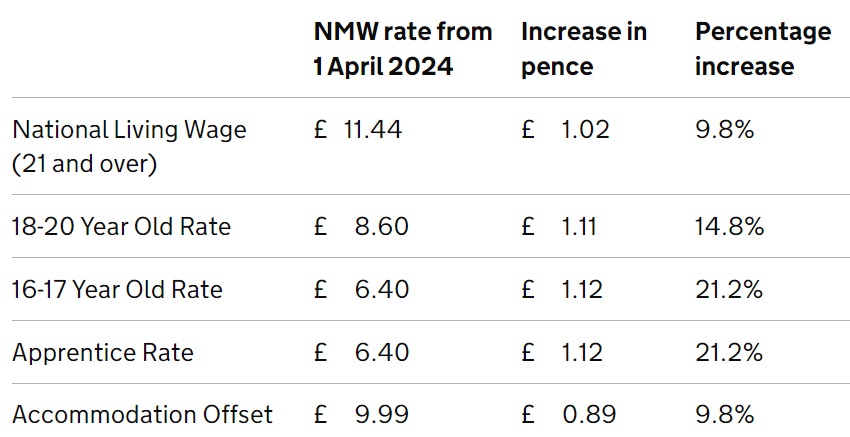
From April 2024, the National Living Wage (NLW) will increase by 9.8% to £11.44 with the age threshold lowered from 23 to 21 years old. The government said it represents a rise of over £1,800 to the annual earnings of a full-time worker on the NLW.
There are also changes in the National Minimum Wage:
Bristol Creative Industries is supporting jfdi with the 7th annual jfdi/Opinium New Business Barometer. This report is an absolute necessity for anyone who has a focus on building their agency’s new business as it will arm you with valuable insights and industry-wide stats to benchmark your performance.
If you’re an agency owner, managing director or part of your agency’s senior management team, please take a few minutes to complete the survey and you’ll receive a copy of the unique report as soon as it’s available in the new year.
In return, as well as the free report, you’ll:
jfdi will run a dedicated online roundtable for the BCI community if we get 30 responses from the region, so we encourage you to complete the survey and help make this happen.
jfdi help agencies grow by winning new business. The team are privileged to have worked with over 1000 agencies – both large and small and across marketing disciplines. The one thing they all have in common is their ambition to grow. For these bold and ambitious agencies, jfdi offer a mix of strategy, creativity and action that works in the real world not just in workshops and away-days.
Bristol West MP and shadow culture secretary Thangam Debbonaire has unveiled how a future Labour government would support the creative industries.
“Culture should be for everyone, no matter who you are or where you live”, Debbonaire said during a speech at the Labour Party Conference in Liverpool.
The former professional cellist, who was appointed as Keir Starmer’s shadow culture, media and sport secretary in his Shadow Cabinet reshuffle in September, added:
“Creative businesses can revitalise our communities and our high streets. They boost brand Britain, selling our talent and originality around the world.”
To support the sector and “fire up the engines of the creative economy”, Debbonaire, who has been MP for Bristol West since 2015, announced that if it wins power in the next election, Labour would introduce ‘Spaces to Create’, “the first national cultural infrastructure plan”, to boost creative spaces across the UK.
It will include a map that can be used by local leaders, businesses and philanthropists to “spot cultural spaces at risks and opportunities for investment and development”, while Spaces to Create teams will provide “guidance, training, learning and networking to get creative businesses on a strong footing”.
Debbonaire also discussed skills in the creative industries. She said:
“Successful creative industries are crucial to growing our economy. They will provide the great jobs of the future. But to do them, our children will need the necessary skills.
“So I’m working with [shadow education secretary] Bridget Phillipson on Labour’s creative curriculum to bring the best music, art, sport and drama to every child because every child’s talent matters.”
On diversity, the Bristol politician said “we’re all better off when we draw on everyone’s talents”, so champions of the creative industries need to tackle “tough questions” such as:
“How do we all share in the joy and the jobs? Where are the women? Where are the people of colour? Where are the people from working-class communities?”
An example of an initiative tackling skills and diversity in the creative sector is the Bristol Creative Industries Internship Programme which is providing paid placements at creative businesses for young people from under-represented groups.
Labour’s announcement follows the publication earlier this year of the government’s creative sector vision with plans to add £50bn and one million more jobs by 2030.
What do you think about Labour’s ideas? What are your views on the current government’s support for the creative industries? What do you think the next government, whatever party is in power, should do to support creative businesses?
Email Dan Martin with your opinions, ideas and suggestions.
The 60th anniversary specials of Doctor Who, Jayde Adam’s Ruby Speaking and Daisy May Cooper’s Rain Dogs are among the shows filmed in Bristol that contributed to TV and film production’s £20.1m boost to the local economy in 2022/23.
We’d love to know your favourite Bristol filmed movie or TV show. Send us a post on X at @Bristol_CI.
The new figures from Bristol Film Office show that £20,134,750 inward investment was generated in 2022-23 by 220 recorded productions.
The office assisted 838 filming days on location in the city and at The Bottle Yard Studios, the largest film and TV studio in the West of England.
A total of 502 licenses were issued which allow filming to take place on Council-owned streets, properties and green spaces.
The report said production levels have held strong in the city since 2021-22 when the economic impact of the sector was valued at £20.8m, the highest figure in a decade.
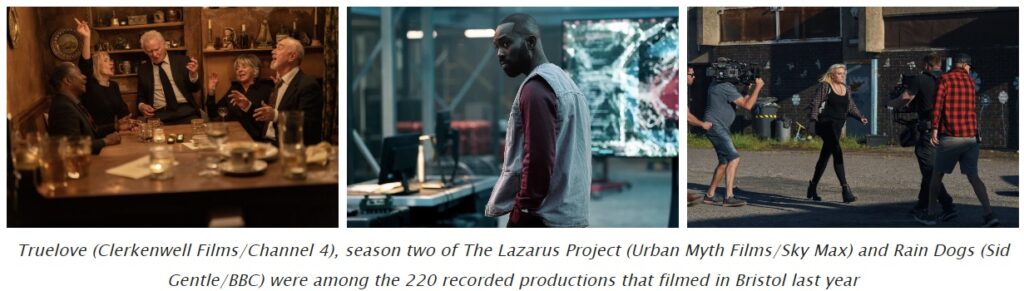
Among the productions filmed on location in Bristol in 2022/23 were:
Titles filmed at The Bottle Yard included:
Spot the Bristol scenes in the new #DoctorWho trailer! #Bristol #FilmedInBristol pic.twitter.com/yCrJJC3gU9
— Bristol Creative Industries (@Bristol_CI) December 26, 2022
Bristol Film Office celebrates its 20th anniversary this year. It was founded in 2003 by Bristol City Council to “attract, assist and provide business development opportunities for the moving image industry for the benefit of the city’s economy”.
In total, Bristol Film Office and The Bottle Yard Studios have assisted TV and film production worth an estimated £322m to Bristol’s economy. Its operations have generated more than £2.1m income for Bristol City Council through filming permits and charges.
Laura Aviles, senior film manager at Bristol City Council, said:
“It’s fantastic that inward investment generated by film and TV production held strong in Bristolat over £20m last year, a similar value to 2021-22 which included the post-pandemic surge in filming.
“This is proof that Bristol is maintaining its competitive edge as a leading UK filming city, thanks to services provided by Bristol Film Office, expanded facilities at The Bottle Yard and our skilled local crew.
“As we mark 20 years of Bristol Film Office, it’s clear that the impact this service has had over two decades is incredibly far reaching for such a small team. From its early days assisting shows like Teachers and Skins, it has provided a bespoke service to productions that has been reliable and consistent whilst the city’s filming infrastructure has grown, through the creation of The Bottle Yard Studios to its expansion last year.
“Not only has Bristol Film Office facilitated filming worth more than £320m to Bristol over two decades, it also played a central role to Bristol gaining UNESCO City of Film status in 2017.
“It rose to the challenge of supporting safe filming on the streets during the pandemic and has worked over and above to accommodate the higher numbers of crews we’ve welcomed into the city ever since. Its work is vital in attracting productions to Bristol, to spend money in our economy and create work for local crew, companies and facilities.
“I’m hugely proud of all that Bristol Film Office has achieved so far, and the team’s ongoing drive to grow Bristol’s profile even further, as the best UK filming city outside London.”
The second Bristol & Bath Screen Summit takes place in Bristol on 8 November.
We’d love to know your favourite Bristol filmed movie or TV show. Send us a post on X at @Bristol_CI or comment on this post on LinkedIn.
Find brilliant Bristol-based production companies in the Bristol Creative Industries member directory.
Top image credit: BBC/Sid Gentle Films/HBO/James Pardon
Leading filmmakers, producers and writers will join production companies, commissioners, and politicians will gather at the second Bristol and Bath Screen Summit on Wednesday 8 November. The UWE Bristol event at Arnolfini will celebrate the rise of the regional voice but will also explore what is required over the next five years to drive growth and to continue to develop talent in the city region.
Hosted by TV presenter and writer Sarah Beeny, the Bristol and Bath Screen Summit will build on last year’s inaugural event, with updates on the work towards a Regional Production Fund and the first regional new writers’ programme led by Channel 4.
Actor and BBC Radio Bristol’s new breakfast show presenter ‘Mr Bristol’ Joe Sims and ITV West Country’s Seb Choudhury will lead a series of expert panels as they unpick the building blocks for talent development, including what makes a hit returning series and what everyone needs to know about embracing creative technologies – from deepfake to artificial intelligence: the pleasure and the pain.
Award-winning producers and directors from the region’s production community, including Five Mile Films, BBC Studios Factual Entertainment Productions, Strong Film and TV, Twenty Twenty Television, Sid Wild and Bristol AF, will be among the panellists.
The afternoon’s final session will bring Nancy Medina (Bristol Old Vic’s artistic director and joint CEO) together with Sir Peter Bazalgette (co-chair of the Creative Industries Council, chair of the Royal College of Art’s Council, and former chair of ITV plc) to discuss the UK Creative Sector Vision.
The creation of the Screen Summit is a key recommendation from research by academics at UWE Bristol’s Digital Cultures Research Centre (DCRC).
Figures released by the Bristol Film Office show that film and TV production was worth an estimated £20.1m to Bristol’s economy in the 2022-23 financial year. This demonstrates that production levels have been maintained over the last 12 months. However, there continue to be opportunities to enhance the strength and visibility of the area as a regional screen powerhouse.
Lynn Barlow, UWE Bristol’s assistant vice-chancellor creative and cultural undustries engagement, said:
“With shows such as ITV’s Ruby Speaking and BBC 1’s Rain Dogs shining the light on Bristol, plus a highly anticipated third series of the Outlaws in the cutting room – no doubt bringing more BAFTAs, Emmy nominations and RTS awards to the region – it’s not surprising that UNESCO is using Bristol City of Film as a case study of a thriving, creative, and innovative city.
“But in the year since the last Summit our freelance community has seen work dry up with productions postponed or cancelled and, although there are positive signs for an upturn in business, it will be a while before it is buoyant again.
“The Screen Summit will bring together key players in the industry to continue the discussion on how to boost the region as a sustainable production location, build on its strengths and overcome the challenges in its way.”
The Bristol and Bath Screen Summit takes place on 8 November at Arnolfini, Bristol, from 14:00. Networking and refreshments will follow.
Tickets cost £25 for an individual and £35 for a company and are available online.
40 free tickets for freelancers, with at least one year’s industry experience, are available on a first come first served basis. To qualify, freelancers are asked to include a link to a professional profile on Talent Manager or LinkedIn when booking a ticket. This offer is open until 18:00 on Sunday 22 October.
We are today announcing that after 13 years at Bristol Creative Industries, Chris Thurling is handing over the reins as chair.
Since joining the organisation in 2010, when we were called Bristol Media, Chris has been hugely instrumental in our growth and success. That includes our rebrand, building the membership, growing our visibility and launching the groundbreaking Bristol Creative Industries Internships Programme.
Taking over from Chris as co-chairs are AMBITIOUS co-founder Lis Anderson and former Aardman executive producer Heather Wright.
As Chris hands over the role, he speaks to Dan Martin about his time at the organisation, its greatest successes and the future of the creative industries in Bristol and beyond.
“In 2010 I was the founder and managing director of a digital web design agency called 3Sixty. I was approached by Paul Appleby who was running Bristol Media with Mike Bennett. Mike was stepping down to do other things and they were looking for someone to join the board who could represent the growing digital sector in Bristol. I thought it was interesting and I signed up.”
“Bristol Media was still new when I joined. It got going with some public funding, but that stopped in 2009 and the organisation moved to a membership model to fund it.
“One of the main things I’ve seen during my time is the membership model embedding itself and the organisation becoming fully self funded and not reliant on any public money or major sponsorship.
“It has survived through the membership fees which is a pretty good achievement for an organisation like BCI. That has given it credibility and autonomy. BCI exists because of its members and the only agenda is the members who support it, and not that of another organisation that is funding it.
“It has matured as an organisation to figure out what it does and what it doesn’t do. Back in the day it was pulled in lots of different directions. There were lots of people wanting Bristol Media to fit their agenda, but over time it has grown in confidence to focus on the things that it does well, not be unrealistic about what it can achieve and not be too thinly spread.”
“We had feedback that the term ‘media’ wasn’t really the collective noun that properly described the sector that we represent. Back in the early noughties, ‘media’ might have been the right word, but over time the term ‘creative industries’ gained traction and became the common parlance.
“It seemed sensible to align ourselves with the terminology that everyone was using, so it’s clear who we are and what we represent. That was one of the first things I decided we needed to do when I took over as chair. Looking back, it has been successful.”
“It is an achievement that the organisation has been financially stable and self-sustaining, even during the pandemic. That has enabled us to continue to serve members and grow the BCI team.
“Another big achievement is the new BCI board, which we appointed following the rebrand in 2021. Our focus was to have a new team of directors to help us Bristol’s creative industry in nurturing and attracting talent, connecting and growing their businesses.
“We recognised the need for our board to better reflect the diversity of talent in the city. We need individuals who can bring different perspectives and experiences and help us widen our reach across the region. An example of that is Bristol designer Marissa Lewis-Peart who we appointed to the board. In 2019, Marissa won the Ben Martin Apprentice Award in collaboration with Bristol Creative Industries.
“We introduced a new always on event schedule led by Sian Pitman, the new full time events manager we employed last year. Rather than the main focus being on the two day Vision conference that we used to run, the events are now spread out across every month in the year. This means there is something for everyone in terms of topics and price range, with some free options for people to access, particularly if they’re members.
“That has been a big success and it has made BCI a lot more visible, because there’s always something happening.
“We also introduced new formats which are tied into our mission of connecting people. These include the member lunches and Walk and Talk events. They are good ways for members to connect with each other, easy to access and something no-one else is really doing for our community.
“The social media activity, newsletter and content has been transformed in the last few years. We produce a lot of really helpful and useful content for our members.
“Finally, the Bristol Creative Industries Internship Programme is the activity I’m most proud of.
“It started with the SXSW Apprentice and Ben Martin Apprentice Award, before evolving into the scheme that is running today.
“It will continue to grow and if BCI has been in any way instrumental in transforming the lives of young people who wouldn’t have had the opportunity without us, then that has got to be the biggest success.
“On diversity, so many organisations talk a good game, send all the right tweets and have all the right badges on their website, but to actually shift the dial, you need to invest proper resources and get expertise behind it.
“We’ve had rhetorical commitment for years, but BCI is now putting its money where its mouth by setting up the programme led by the full-time programme manager, Clare Leczycki.
“BCI is showing leadership in the community, which only an organisation like BCI can do because we are not commercial or competing with anyone else. We’re there to serve the interests of the membership.”
“Lis and Heather’s new roles as co-chairs marks an exciting new chapter for BCI. Having both served on the board and run successful creative businesses, they are experienced hands and well equipped to build on the successes that BCI has achieved to date. They have been key to the internships programme, getting insights on members’ key challenges and connecting them to available funding.
“BCI can continue to take a leadership role in the development and attracting of young talent into the industry in the longer term, making sure there’s a pipeline of fantastic people wanting to come into the industry in Bristol and opening it up to people from all backgrounds and the places that historically haven’t had a look in.
“BCI can also help our industry build firmer commercial organisations. A lot of creative companies are quite hand to mouth and not necessarily great at realising the value of the amazing work that they do because often they are businesses set up by creative rather than commercial people. As times get tougher, creative businesses need more sustainable business models, and not just charging by the hour but finding a way to charge more by the value that they deliver.
“Connected to that is access to finance and financial advice which small businesses often don’t have internally. A collective organisation like BCI can pool organisations together to help.
“The UK does still have a reputation internationally for the creative industries, and as the UK market gets more challenging and competitive, our industry needs to look beyond these shores for opportunities for growth.
“Finally, we need to guard against complacency and any inertia that we have in thinking that Bristol’s an incredibly successful city and we can roll along and it’s all going to take care of itself.
“We need to understand that there are a lot of other cities hungry to eat your lunch. We’re in a good place, but we can’t assume we will be in 20 or 30 years time. We need to make sure that what happened to the first generation of industries in the UK doesn’t happen to the current generation through complacency and taking things for granted. That’s where an organisation like BCI can take a leadership role in pushing innovation.”
“Consistency of messages is important. The government blows hot and cold on the creative industries. Sometimes they get mixed up in the ‘culture wars’ and think that’s it not a real and important sector.
“In schools, it’s all about science, technology, education, engineering and maths, but the arts subjects are struggling and not getting the support that they need both financially and rhetorically from the government. There’s a sense that they’re not seen as real and proper subjects.
“The government needs to buy into the fact that the creative industries is one of the UK’s strongest advantages in the world and we need to be championing and banging the drum from the top down.
“I think that the government needs to find a way to undo the damaging effects of Brexit on our sector. It has had a huge supply of talent cut off by the ending of freedom of movement, which many BCI members used to find incredibly valuable.
“Schools need to be better connected with the creative industries and it needs to happen at an earlier stage with younger children. As a school governor myself, I think that the employability side of schools is still out of date. The kind of jobs that they know about and the kind of connections that schools have with industry is pretty old fashioned. There’s an ignorance of the myriad of jobs in the creative industries that people can do.”
“If you’re a supporter of the Bristol region and the creative ecosystem, joining Bristol Creative Industries is doing your bit.
“Check out what is available from BCI. The membership offers huge value for money. There’s lots you can get out of it including jobs advertising, coming to events, publishing your content on the website, and participating in the social media activity and using it to raise your profile.
“You will definitely meet great people. There are lots of fantastic people who are part of the network. You never know how they might be able to help you and your business.
“If people stop supporting BCI, it will go. If it didn’t exist, people would want to invent it. It’s a valuable thing that has taken the best part of two decades to build. It’s a fantastic asset for the city and the region. BCI is part of the jigsaw puzzle that makes up what’s good about the region.
“Alli Nicholas, who has been at BCI for 10 years, is the go-to person for all things membership so do speak to her if you have any questions.”
Clare Leczycki shares an update on the Bristol Creative Industries Internship Programme.
We are just over halfway through the pilot year of the Bristol Create Industries Internship Programme, a scheme set up and funded by Bristol Creative Industries and and a group of members. It gives young people from under-represented backgrounds a chance to explore the different roles in the creative industries.
The programme, delivered in partnership with Babbasa as part of the #OurCity2030 initiative, provides interns with placements at two different agencies over a six-month period.
It aims to:
Our interns switched placements this month and are now working in their second agency.
During this process, several opportunities came up and we off-boarded three of the interns early.
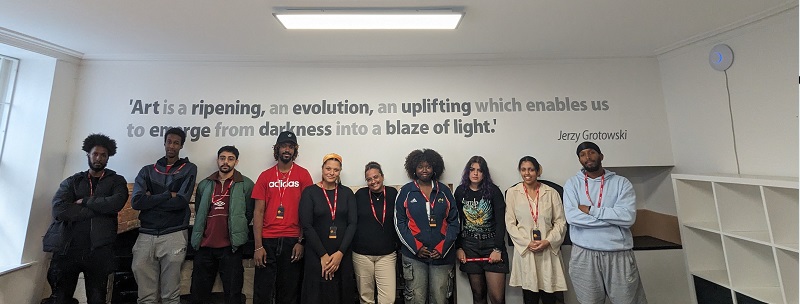
Seren Spooner was offered a job at Armadillo as a junior designer and decided to take the opportunity to move into full- time work.
“As a graphic designer, I was initially unsure about going into client service, but quickly found that I really enjoyed it. Agency structure has been a highlight for me and being openminded about all the different roles and opportunities available within an agency has been really interesting. It has allowed me to see where my experience and skills can fit with an organisation like Armadillo.
“I really wouldn’t be anywhere without this programme; it has made the transition out of university so incredibly easy. To have a variety of roles put in front of you is amazing, and even though I won’t be changing my agency and role in the second part of the programme, as I was offered a full-time position, to have the opportunity to switch and learn new skills at a new company makes such an impact.
“The support that you get from your peers throughout the programme is also so impactful, we have all been there for each other throughout this process which has been amazing.”
Mohd Wani decided to go back into education to do a masters in UX at one of the most prestigious universities in the UK:
“This programme has given me a new career path in an industry I never thought would be for me. By moving into UX design from graphic design, I can now see myself excelling more in this role than I ever could’ve imagined in graphic design.
“In four months on this programme working in UX, I can see more improvement in myself than in three years of training in graphic design.
“The work I have completed at Atomic Smash has helped me to secure a place at the Royal College of Art, which I will be starting later this year. But I have also been offered a full time by Atomic Smash when I finish my course, so I know my future is secure.
“The programme has taught me great networking skills, and different ways of talking to people. The skills sessions we do each week has also given me so many additional skills outside of my day-to-day job which are so valuable, and that is all thanks to this programme.
“The work I have done because of the programme and the skills that I now have, has helped me get rid of my past feelings of ‘I don’t belong here’, and now I know that I do.
“I would tell anyone thinking of joining the programme to just do it. It will give you so many different opportunities to find out what you are good at, what you are in to, and what your career path can be.”
Laurel Beckford is now working with Babbasa’s communications team:
”The BCI internship programme is one of the best out there for any individual looking to get their foot into the creative sector. The amount of support I have received is incredible and gives you so many opportunities to build up your skills.
“I was made aware of the programme through Babbasa and worked with them to help me with the process of getting in touch with BCI.
“Before I came on this programme, I didn’t know one thing about building a website, and now I can and have learnt so many skills.
“I have travelled to London with my agency, met clients face to face, and been involved in a photoshoot, which has been a real highlight.
“The BCI Internship programme can help anyone make their way into the creative sector and will give you the chance to do that.”
Whilst we are sad to be saying goodbye to some of the interns, we are incredibly excited to see opportunities created by the network and it’s brilliant to see the young people thrive and move onto the next stage of their career. We look forward to hearing more about how they are getting on in the coming months.
Other interns have also been offered jobs but have chosen to complete the internship programme, while some are exploring further training to hone their skills.
You can see the agencies currently involved in the progamme here.
The pilot programme will finish at the end of November. We will then review and reflect on the learnings from the interns and participating agencies to see how the scheme can be further developed and expanded. We are particularly excited to be working more closely with the team at Babbasa to develop our onboarding and training processes for the next round.
Conversations for the 2024 Bristol Creative Industries Internship Programme has begun. If you run a creative business in Bristol and are interested in hearing more about how to get involved, contact BCI membership manager Alli Nicholas on [email protected]
You need to load content from reCAPTCHA to submit the form. Please note that doing so will share data with third-party providers.
More Information