Delivering a project on time can be a rewarding experience but often than not, it can be very stressful if deadlines are missed or delays occur. Fortunately, with the right project planning and management tools available, you can get your projects over the line without the late nights and last-minute panics.
Here are five easy ways to help ensure clarity, structure and support to your projects:
Before you start your project, define exactly the ins (and outs) of your project scope, including any deliverables that need to be included and a timeline indicating when each deliverable or phase will be completed. This helps to ensure and avoid any “additional requests” that could eat into your delivery time.
A clear project scope provides clear focus which leads to on-time project completion.
A larger-scoped project lasting 10-12 weeks for example can feel overwhelming if you only see the finish line. Break down your project plan into smaller milestones and deadlines so your team is aware and knows what’s coming next and that progress throughout the project cycle feels tangible.
Whether it’s an in-person catch-up at the start or end of the week, a shared project tracker, or a quick Teams call; consistent updates throughout your project, especially with multiple stakeholders involved will keep everyone aligned and prevent last-minute surprises. No news is not good news in project management!
There are multiple project management tools that are easily accessible at little to no cost. The likes of Trello, Jira, and Notion are great for tracking your progress with very simple features to keep your tasks, files, timelines and feedback all in one place. A clear view of what’s completed, what’s outstanding and identifying blockers means you can act before things slip behind or delay your project’s delivery time.
Things will change during the project cycle, that is inevitable. Whether that’s receiving feedback later than planned, various teams being away on annual leave or sudden shifts in resource planning. That’s why it’s important to plan ahead and factor in extra buffer time during key stages of your project to allow for such circumstances when they occur.
By doing this, even with the hiccups, your project will cross the finish line on-time and within schedule.Delivering a project on time is more than just ticking boxes, it’s about building trust, providing direction and letting your best work shine.
Need help getting your projects over the line? Let’s have a chat and we can talk through what you need and how we can support you.
We also have Tell ‘em Fridays, our free 30-min project check-ins every Friday to help identify any blockers, prioritise next steps or just get a fresh pair of eyes on any projects you may be working on at the moment. Limited to just four slots so secure your spot.
Introducing Eden Sinclair, UX Designer & Research Lead at the RSPCA! Eden ensures intuitive digital experiences for animal lovers, crafting impactful solutions that inspire action and promote animal welfare. Eden’s dedication shines through, leveraging the support of over 200 volunteers to conduct user research. ‘Designing for good’ has exposed Eden to the immense passion and drive in the charity sector, enriching design with inclusivity for all users.
The purpose of our ‘Design For Good’ content series is to shine a light on how creative innovation can be a driver for positive change. We feature those that are making it happen, those with grand potential. Businesses and individuals that are shaking up their sector and finding ways to do things better, for social or environmental good.
Can you please introduce yourself and tell us what your role is at your organisation?
My name is Eden, and I’m a UX Designer and UX Research Lead at the RSPCA. In my work life, I’m responsible for ensuring that all of our digital platforms, including websites and mobile applications, are intuitive, user-friendly, and meet all of the needs of our very diverse audience base! I work hard to create digital experiences that inspire action and promote animal welfare.
My work involves understanding user behaviours and needs through research and analysis, using wireframing and prototyping to create impactful solutions that encourage really meaningful and lasting engagement with our charity. I also spend a lot of time collaborating with teams across the RSPCA as a whole to ensure our digital platforms are not only user-friendly but also promote empathy, education, and action for creating a better world for animals.
Can you tell us a bit more about the work your organisation does, and how the UX teams support this?
The RSPCA is the world’s oldest and largest animal welfare charity, and we focus on rescuing, rehabilitating, and rehoming or releasing animals across England and Wales. We’re also campaigning around animal welfare laws, effecting change for animals in laboratories, improving farm animal welfare, educating young people and adults, and providing scientifically backed advice and information to support this.
The UX team, comprising three designers (including myself) and a UX manager, focuses on improving our digital offerings: the main RSPCA website, the RSPCA Education site, the politics site, and new and exciting projects. As a unit, we work closely with the public to ensure that our designs are user-centric and that our UX is tailored to not only encourage people to donate to support us, but also improve animal welfare themselves.
Can you share some challenges or barriers you had to overcome whilst working in a charity and ‘designing for good’?
I’d say that resource is the biggest challenge that I’ve faced. My last company was in the Technology sector, and so resource was never an issue due to very large budgets. However, working at the RSPCA, it’s imperative that we keep costs as low as possible to maximise the number of animals we can help. This is especially evident when attempting to complete user research, as usually a company would pay for research participants, but we have to rely on the generosity of the public.
Thankfully, the public are incredibly generous, and we have over 200 wonderful volunteers who help us test our designs every week. We couldn’t do it without them, and it’s heartwarming to see the commitment to animal welfare.
What has been the key thing you’ve learned about ‘designing for good’ and your target audience specifically?
I think the key thing that I’ve taken away from designing for good has been the incredible passion and drive in the charity sector, not only from the target audience, but also my colleagues at the RSPCA. It’s a fantastic and rewarding place to work.
My target audience is incredibly diverse, but they all share a common love and concern for animals. Whether they are long-time supporters of the RSPCA, or children being introduced to animal welfare for the first time, the passion for animals and kindness is clear.
One of the most rewarding things about working in the charity sector is getting to experience this first-hand. I get to work rather closely with our audience, through research, testing and interviews, and it is incredible to see how deeply people care, and how our supporters are making such a positive impact.
What’s more, the diversity in our target audience really enriches the work that we do for the RSPCA and challenges us to make our designs accessible and inclusive for all. Irrespective of physical or cognitive abilities, embracing the diverse nature of our users allows us to create a more meaningful experience for everyone.
I think the passion and commitment of our audience really drives us to continuously innovate, iterate and improve our designs. It’s amazing to work alongside and for people that are making such a tangible difference to the lives of animals.
This article originally appeared on the ADLIB Blog.
AI and copyright of content is a controversial issue in the creative industries, with the government receiving 11,500 responses to its consultation on the UK’s legal framework for copyright. Ministers say they are reviewing all the responses and technology secretary Peter Kyle said:
“I am determined to harness expert insights from across the debate as we work together to deliver a solution that brings the legal clarity our creative industries and AI sector badly need in the digital age.”
We asked some Bristol Creative Industries members what they think the government should do. See below for their responses.
Russell Jones, JonesMillbank (see JonesMillbank’s BCI profile here):
“Jean-Luc Godard (1930-2022), a pioneer in filmmaking, said “It’s not where you take things from – it’s where you take them to”. Had he lived three more years, would he be saying the same thing about the generative imagery we’re seeing today?
“When nothing is original, and humans have copied and been inspired by others since the dawn of time, where do we draw the line between human inspiration and en-mass machine learning?
“Nobody has the answer yet, but any regulation must be worldwide – human-wide – to avoid creating an AI-divide.”
Phil Robinson, Proctor + Stevenson (see Proctor + Stevenson’s BCI profile here):
“I believe clarity and fairness are the two critical factors here. AI offers exciting creative opportunities, but we need a legal framework that respects the rights of artists while helping us explore new tools. Creators should know if their work is used to train AI, and there must be proper consent and fair compensation.
“I’d like to see rules that protect originality but also empower creatives to be ambitious and produce incredible work. If the government gets that balance right, AI could become a genuine asset to the creative industries, not a threat to them.”
Catherine Frankpitt, Strike Communications (see Strike Communications’ BCI profile here):
“Creative professionals are natural early adopters, so we must balance protecting our intellectual property with harnessing AI’s potential through proper legal safeguards.
“The government must work urgently with creative and tech sectors to establish a legally enforceable framework requiring clear disclosure of AI training data sources and mandatory opt-in licensing. We need a distinction between AI as a creative tool versus unauthorised training on copyrighted works. Creators must retain ownership and receive fair compensation for any AI usage of their work. Given AI’s global reach, this framework needs both robust UK legislation and international coordination.
“Finally, we must move at pace with regular legal reviews to ensure our protections evolve alongside the technology, preventing creators from being left behind.”
Mark Shand, UWE Bristol (see UWE Bristol’s BCI profile here):
“The proposals in the government consultation reflect an inconsistent approach to intellectual property, favouring undisclosed AI companies (other industries compensate creators), while disadvantaging university copyright holders across culture, research, education, business, science, and health. It places an unfair burden on creators, remains vague, appears technically unfeasible, and perpetuates business practices that undermine creators’ control and compensation.
“We are also concerned by the accompanying narrative, which frames creators as being at odds with ‘innovators’. In reality, our students and staff are innovators – they are also current and future income generators, market disruptors, and employers.”
Tim Shapcott, Tiki Media (see Tim Shapcott’s BCI profile here):
“Painful as it is to consider, it may be unrealistic to hold AI companies accountable for what’s already been done. Rather than close our borders to the world as other countries take advantage of the up-side, a more pragmatic path may be to focus on future solutions.
“Applying pressure to the AI industry to establish clear checks and balances could ensure that original creators receive fair recognition and compensation as AI evolves. This balanced approach may allow us to embrace the benefits of AI while still supporting our creative talent. If ‘back pay’ is possible as a part of that, then awesome!”
Claire Snook, AMBITIOUS (see AMBITIOUS’ BCI profile here):
“For the last 20 years, AI has helped our work and operations through programmatic ads, content development, chatbots, virtual assistants and more.
“But it’s undermining our creativity. Copyright is essential to protect our work. Our government has a responsibility to provide clarity for how AI is used in conjunction with creative work; we need clear and defined safeguards for creators. This should have been in the works decades ago.
“Companies are taking measures to protect our content. Cloudflare, one of the biggest architect providers, now prevents AI crawlers from scraping content without the creators’ permission meaning websites will be able to charge AI companies for accessing their content.
“We need a practical approach that protects and ensures our creative labour isn’t stolen, while making sure people can responsibly use AI for their needs and wants.”
Susan Pearson, Wordways (see Susan Pearson’s BCI profile here):
“The copyright for anything I write is 100% mine or my client’s. No-one or no ‘thing’ should ever have the right to reproduce the words of writers exactly unless these words are expressed within quote marks with the source of the quote acknowledged – unless they have specific permission. Anything else would be creative theft.
“Weakening of copyright law in any way will have a profound effect on the livelihood of writers and others in the creative industries. Even the suggestion that AI software can re-hash original material from creatives is a suggestion that theft should be legalised!”
Jessica Morgan, Carnsight Communications (see Carnsight Communications’ BCI profile here):
“AI is rarely out of the spotlight – particularly in the creative industries. It’s also a growth opportunity identified by the government, so it’s likely to remain there. This feels like a pivotal moment. Will we be left behind if we don’t evolve our regulations, or do we risk completely exploiting creativity if we do?
“Holding the consultation is a good first step, and those thousands of views given will have to be considered and taken into account (AI may prove useful here!) The key thing is, creative work is important and should be valued. Copyright exists for a reason and we’ve been abiding by it for decades. Any path forward needs to acknowledge that.”
Sandra Mouton, French translator (see Sandra Mouton’s BCI profile here):
“Copyrighted works available for reading online are routinely used to train the LLMs AI runs on. In my field of translation, that’s translated books, but also magazine articles, white papers from businesses or NGOs, video game content, etc. All this IP was created within the framework of copyright law and the protection it’s meant to provide for authors’ and copyright-holders’ rights.
“The government needs to ensure that protection is real and that the work of creatives like translators cannot be exploited for money without our express consent (with a default opt-in rather than opt-out system) and adequate compensation through royalties.”
Alex Murrell, Epoch (see Epoch’s BCI profile here):
“Human creativity thrives on curious minds and their insatiable appetite for inspiration. Film, fashion, art and architecture; it all gets devoured, connected and remixed into new and novel ideas. Copyright laws protect this process: copy too closely, and you risk infringement.
“But now, generative AI is rewriting the rules. If a machine uses your work to train a model, is that theft or fair use? Is it ethically different from a human remixing their inspiration? Should copyright continue to cover one’s output, or should it cover the input as well? That’s the question governments must answer—and fast.”
Emma Barraclough, Epoch
“AI is reshaping the creative landscape; enabling highly personalised, efficient design at scale. And as it becomes mainstream, using it has become essential to staying competitive in a fast-moving industry. But there are concerns we can’t ignore. Ambiguity around the ownership of AI-generated content presents legal challenges.
“For brand assets to be valuable, they must be protectable. And yet without clear rules AI generated assets are at risk of being copied and compromised by others. For AI to become a truly powerful tool for creatives, we need laws that make its output safe, ownable, and enforceable.”
Penny Beeston, Beeston Media (see Beeston Media’s BCI profile here):
“As an SME in the creative sector we embrace AI where it improves the efficiency of our craft. The red flags are where AI stifles or steals creative human endeavour. The horse may well have bolted in terms of past copyright theft, but the government has an important role to play in regulation going forward.
“Original assets used in generative AI should be traceable, accredited or paid for by third parties. The government’s commitment to investing in AI research and innovation with projects such as the Isambard-AI supercomputer is impressive. Let’s use that sovereign capacity for good by creating AI tools to shift the balance of power from poachers to gamekeepers.”
Chas Rowe, voiceover artist (see Chas Rowe’s BCI profile here):
“First, AI steals from creators. Then, AI steals from creators. Two wrongs don’t make a right. The government should stop providing shovels for the gravediggers of the creative industries.”
The creative industries are a vital component of the local economy and here at Bristol Creative Industries, we encourage young people to look to the sector for a rewarding and inspiring career. As modern technologies like gaming, VR and AI continue to develop, we need a new generation to take on the jobs of the future that the local economy needs if it is to thrive.
See below for our updated guide to creative industries-related further and higher education in Bristol, Bath, Weston-super-mare and beyond.
A selection of the creative post-16 courses offered by sixth form departments at Bristol schools and academies:
Among the A-levels at Bath Academy are art and media studies.
A-levels on offer at this Bath sixth form for boys include creative design and music.
Bristol Cathedral Choir School
Founded in 1140 as part of what was then Bristol Abbey, Bristol Cathedral Choir School is one of the city’s most popular sixth forms. Among the A-levels offered by the school are art, drama and music.
The sixth form at Bristol Creative Industries member Bristol Grammar School offers creative IB Diploma and A-level courses including art, dance, drama and theatre studies, design technology, music and music technology.
The IB Diploma is an alternative to A-levels which the school describes as “offering breadth of learning as well as academic rigour”.
Opened in 2016, Bristol Free School offers A-levels alongside selected BTEC Level 3 courses. Creative courses include art, drama and theatre, music and music technology and photography.
Cabot Learning Federation Post 16
The Cabot Learning Federation Post 16 is an independent provision located in two of CLF’s 20 secondary academies; Bristol Brunel and John Cabot. Among the A-levels on offer are art and design, dance, music and photography.
The sixth form at this school offers A-levels in subjects including art and photography, drama and theatre studies and music.
The sixth form at this school offers A-levels including art, design and technology and drama and theatre.
The North Bristol Post 16 Centre is a collaboration between Cotham and Redland Green Schools. Creative A-levels include art, photography, film studies, and media studies.
St Mary Redcliffe and Temple School
Located near Bristol Temple Meads, creative A-levels offered by this school are art, film studies, media studies, music, music technology and theatre studies.
Providing education to 10,000 learners across two campuses, Bath College offers a wide range of courses including post-16, apprenticeships, part-time courses, traineeships and degree-level education.
Subjects include art and design, fashion and textiles, fashion business and retail, photography, graphic design, digital production, and performing arts.
As one of the South West’s largest further and higher education colleges, Bristol Creative Industries member City of Bristol College operates from seven centres across the city. It offers a range of post-16 qualifications including A-levels, Level 2 Diplomas and BTEC Nationals.
For school leavers, several courses relevant to the creative industries are on offer. They include specialist subjects include visual arts and design, photography, fashion, performing arts and creative digital technologies (film and TV production, games design, computer graphics and animation).
The college also offers university-level creative arts and media courses in subjects including games design, animation and VFX, graphic design and photographic practices.
Abbeywood Community Schools is part of Olympus Post 16 with Bradley Stoke Community School and Winterbourne Academy.
Courses include art, design and technology, digital media, drama and theatre studies, film studies, music performance, music technology, photography and textile design.
Digitech delivers a specialised curriculum for progression into the creative digital and high tech sectors. Studio schools are small by design and only take 90 students into each year group. The school opened in 2015 and moved into a new purpose-built building in Warmley in November 2016.
For years 12 and 13, Digitech offers courses in partnership with boomsatsuma (see below), Bristol School of Acting and Robins Foundation. They include digital media, e-sports, film and television, music, and photography.
South Gloucestershire and Stroud College
This college has six campuses.
The college has a very extensive programme of Level 2 and 3 courses including computer games design, film and TV production, music production and musical and technical theatre.
At university level, the college offers a range of courses at foundation degrees, many of which also offer the opportunity to top up to a full Bachelor’s degree by adding a year. Subjects include fine art, game art, media production and computer games design and production.
Since September 2022, the college has offered the new vocational skills focused T-levels. The two-year technical courses are equivalent to three A-Levels and include a 45-day work placement. Courses include digital production, design and development.
St Brendan’s Sixth Form College
This college provides a diverse range of over 60 different A-level and Level 3 Applied General courses to 16 – 18 year olds. Courses include media studies, music, music performance, music technology, textile design and graphic communication.
Bristol Creative Industries member Weston College has several creative industries-related diploma and extended diploma courses for 16-19 year-olds as part of Creative Arts Weston.
The departments are art, design, graphics and fashion; film and tv, media production, photography, game and animation; performing and production arts, and music.
Creative courses at Cirencester College include craft and design (T-level), 3D design (A-level), digital foundation, digital media certificate, graphic communication (A-level), and photogrraphy (A-level).
Boasting ex-students including Ed Sheeran, Jess Glynne, Rita Ora and JP Cooper, Bristol Creative Industries member Access Creative College is a national college for young people looking for a career in the creative industries. It offers courses at various levels in subjects including games, animation and video effects, graphic and digital design, film, software development, video and photography and music technology.
In summer 2021, Access Creative College opened a new £5m games and media campus in Bristol city centre. It’s on the site of the former Bristol Bierkeller, host to Nirvana’s first ever UK gig, Slipknot, The Stone Roses and Arctic Monkeys. Facilities include a games lab, green screen studio, music tech suites, digital recording studio and band rehearsal studio.
Access runs degree courses in Bristol covering audio and music technology and music performance at dBS Institute, which it acquired in 2021.
Bristol Creative Industries member boomsatsuma is a specialist creative industries training provider. Courses take place in relevant professional environments in the city such as Leadworks, Ashton Gate Stadium, Bottle Yard Studios and Tobacco Factory.
boomsatsuma provides Level 3 Extended Diplomas, that are equivalent to 3 A-levels, as well as BA (Hons) and BSC (Hons) degrees. Courses include creative and digital media, film and television, games, VR and VFX and photography.
As a registered charity, Creative Youth Network supports young people to reach their potential and enjoy fulfilling lives. It offers free courses in youth clubs and other venues in Bristol. Subjects include music, photography and song writing.
Creative Youth Network has opened The Courts in central Bristol. It is an enterprise hub, located in Bristol’s Old Magistrates’ Courts, where young people can explore their creative potential, receive support, access mentoring, and find meaningful work.
dBs Institute of Sound & Digital Technologies
Based in the centre of Bristol, dBs is a specialist educational institute that offers undergraduate and postgraduate courses in music production, sound engineering, live sound, and game development.
It is a registered Avid Learning Partner (ALP) and Ableton Certified Training Centre that works with a wide range of creative industry organisations.
Students at dBs Institute can gain real-world experience alongside their studies thanks to dBs Pro, an in-house creative audio company. Students provide sound and music for film, television, video games, art installations and more.
University of the West of England (UWE Bristol)
The School of Arts at Bristol Creative Industries member UWE Bristol offers courses in subjects including drama, filmmaking, animation, photography, media production, journalism, creative and professional writing, film studies and media communications. There are also several fashion and design courses.
Facilities include film, photography and animation studios as well as drama, acting and music facilities.
Many graduates also enter the creatives industries after studying marketing courses at the UWE Business School. It includes the MSc in digital marketing, and MSc/postgraduate diploma/postgraduate certificate in marketing communications.
UoB offers undergraduate degrees in film and television, music and theatre. Facilities include Wickham Theatre, a 24-hour rehearsal space, sound and design studios, carpentry and costume workshops, 214-seat cinema, 39-seat screening room, digital filmmaking equipment, production studios, animation and edit suites and sound rooms.
The University of Bath does not have specific creative industries courses as it focuses on engineering, humanities, management, science, and social science. However, its degree courses include management with marketing featuring a work placement.
Bath Spa offers courses in subjects including film, design, media communications, art and drama. Facilities include a theatre and TV studios.
The university also has the Centre for Cultural and Creative Industries (CCCI) which “aims to magnify research, engagement and discourse surrounding the theoretical, practical and commercial frameworks that embody the arts, media, or creative industries”.
UCW offers higher apprenticeships, full-time degrees and higher technical qualifications (HTQs) in partnership with UWE Bristol and Bath Spa University.
Courses cover subjects including art, film, game, graphic design, digital technologies, performance, production arts and music.
Bristol Creative Industries jobs board
Members of Bristol Creative Industries sometimes post apprenticeship opportunities on the BCI jobs board. See the latest vacancies here.
National College Creative Industries
The National College Creative Industries (NCCI) offers specialist technical production and business support apprenticeships via Access Creative College. You can find the latest details on the NCCI website.
Channel 4, which has a Bristol office, offers apprenticeships. Find out more.
The BBC offers various TV production apprenticeship schemes, some of which are based in Bristol. See the latest opportunities here.
ITV Academy provides traineeships and entry-level pathways into one of the world’s largest commercial production companies. See the latest opportunities here.
Babbasa offers many training and employment opportunities for young people. See the latest opportunities here.
Government apprenticeships website
Creative and design and digital apprenticeships are regularly listed on the government’s apprenticeships website. Search here.
Circencester College offers apprenticeships in creative areas covering digital and IT, media broadcast and production, sales and marketing, and creative and digital.
The college provides intermediate, advanced, higher and degree apprenticeships.
Bristol Creative Industries member Professional Apprenticeships is a government-funded apprenticeship training provider specialising in marketing, IT, business and management. The latest apprenticeships are here.
UCAS has a guide to creative and design apprenticeships here including a directory of relevant employers.
Discover Creative Careers has a guide to apprenticeship routes into the creative industries here.
This list is not exhaustive. Email Dan with suggestions of other educational institutions and companies we can add.
A key focus at Bristol Creative Industries is boosting workforce diversity in creative businesses and helping to grow the talent pipeline for our members. Find out more about our intiatives here.
On a Wednesday evening in June – we hosted our first ‘Gather Round Presents’ event at the Trinity Church Gather Round. It was one for the books…
Whether it was the promise of an honest, open conversation about the challenges of working in the creative industries, or a need for the answer to the mutually felt question “Am I the only one feeling the pressure?” – tickets flew out in record time.
At 6.30pm we opened the doors to The Vestry and a new community of creatives flooded in, the vibe was electric. Backlit by a perfect summer’s evening and armed with their own stories to share, we saw people making instant connections, sharing contact details and engaging in deep conversations before we’d even sat down. This is something we all needed to talk about.
After a glass of free prosecco and some delicious free pizza from our partners Bosco, we moved through to The Great Hall bringing an air of focus with us, as our all-Gather Round-member panel took their seats to share their wisdom.

Bend, stretch, but don’t fold… become elastic. Your business depends on it.
A recurring theme from each of our speakers and touched upon in more depth by Jamie Ellul of Supple Studio, was Covid, a trying time to say the least. Jamie discussed how those turbulent years almost sent Supple down – something that, back then, was easy to take personally. This feeling was only made slightly more manageable due to the fact that his friends, colleagues & clients were all feeling it too. Jamie openly discussed how this felt like a great exercise in cutting the umbilical cord, once he realised how much of his self worth was wrapped up in the business. Something that he has since tackled through therapy and looking inward. This raw honesty was something that fuelled the rest of the evening, with equally inspirational testimony from the rest of our panel.
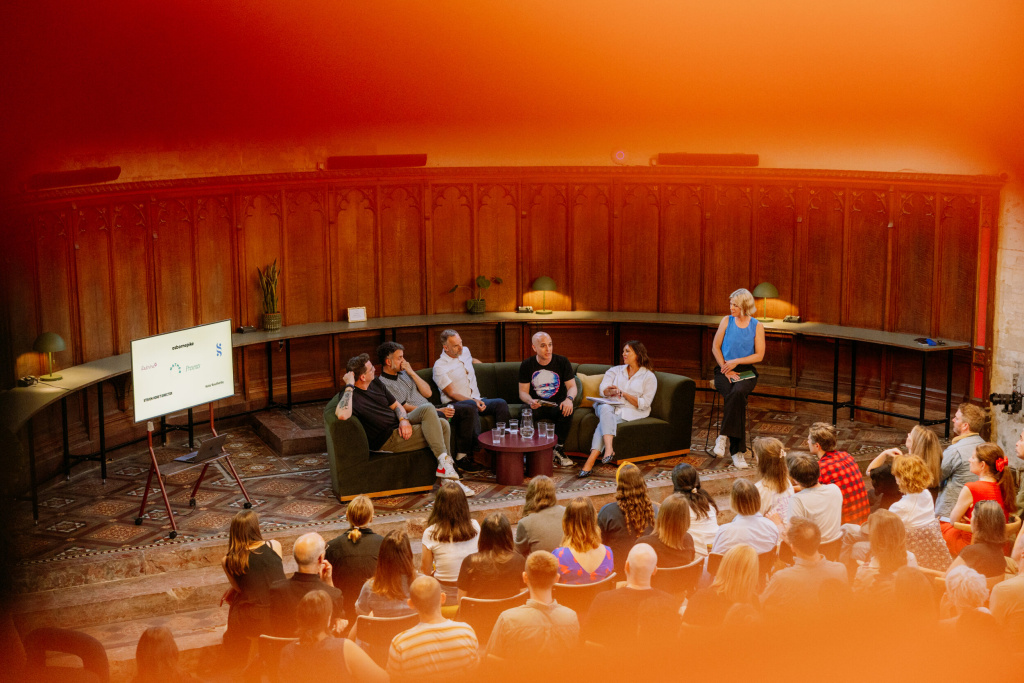
Tim Miness, Creative Director of Osborne Pike, shared a few mantras with the audience that have helped him stay flexible, creative and resilient. A statement that resonated was not being afraid to admit when something isn’t working. Bend the rules. What decision do I need to make in order to change my situation? How can I tap into that magic creativity and find the answer to this problem? Not only that, but how can I ask the right questions? Tim’s advice – hire people that are better than you. Expand that collective creativity, and together, you’ll find the right question.
Honesty is the best policy, and we definitely heard that from our panel. There were murmurs from the audience mentioning how refreshing it is to hear people being open about their downfalls, where they could improve and how they got through hard times. A refreshing perspective on managing a business, compared to older, more traditional ways of thinking.
Tim shared his dislike for the phrase “Fake it til you make it”. Something we’ve all encountered and tried to embody in some way, as we try to make sense of our place in the world. Sharing his love for the sentiment of trying new things, but ultimately landing on, why do we feel like we have to pretend to know what we’re doing? Perhaps one of his mantra’s “Learn it til you earn it” feels like a more sensitive way to approach things, although (in his own words) “…it doesn’t quite have the same punch.”
We heard Robin Worrall, Creative Director of Rednine open up about his heart-first approach to his work. Something he’s cultivated after pulling his business apart and asking the question, what am I really trying to achieve here? After getting the nudge he needed from a post he saw on LinkedIn, with the sticky phrase “old keys don’t open new doors”, he knew he needed to reposition and rebuild his entire creative offer. Looking at what he needed to keep, what he was prepared to lose and what would be great to add. Robin compounded this with the sentiment that being creative is emotional, and that’s something he pushes through his work, to find the heart of brands and tell their story with authenticity. It’s safe to say, a few tears were shed.
Ask for help, reach out, learn from others, share failures and compare challenges. It all starts with… “Can I chat to you about something?”.
Robin left us with a perfect segue into Kate Southerby’s interactive section of the evening. Coaching with the brain in mind, Kate is a facilitator of insights. She guided the audience through her 7 step plan, asking everyone to score themselves out of 10 for each section: Sleep, Movement, Focus, Introspection, Daydreaming, Play, Connection. There was an overwhelming consensus that we aren’t looking after our brains as well as we could be, so this was a welcome exercise that left the audience with plenty of food for thought.
The importance of nourishing your mental and physical health was a thread followed by all of our panellists, as each person has faced certain difficulties of their own. As Steven Hore discussed, managing stress has elevated how he works. He and his family made the decision to leave London after more than 20 years in the city. Initially causing more stress than intended due to commutes, but, after Covid eliminated presenteeism, time usually reserved for long car or train journeys was swapped out for more time in nature, exercising and moving through beautiful spaces that nourish his soul.
Something more attainable than moving city that he shared with the audience though, and perhaps the most simple and obvious tip: get a good night’s sleep! Steven shared how implementing this one action has transformed his ability to handle combined stressors such as job insecurity, shifting budgets and demands of 16+ hour shoot days with ease.
It’s not all about work though, as we revisit a comment from Jamie Ellul on not letting your self-worth get too wrapped up in your business, the panel delved into the importance of finding things outside of work to nourish your creative side. Find a hobby you love and indulge in it as much as you can. Hustle culture is dying, now is the time for slow, intentional living.
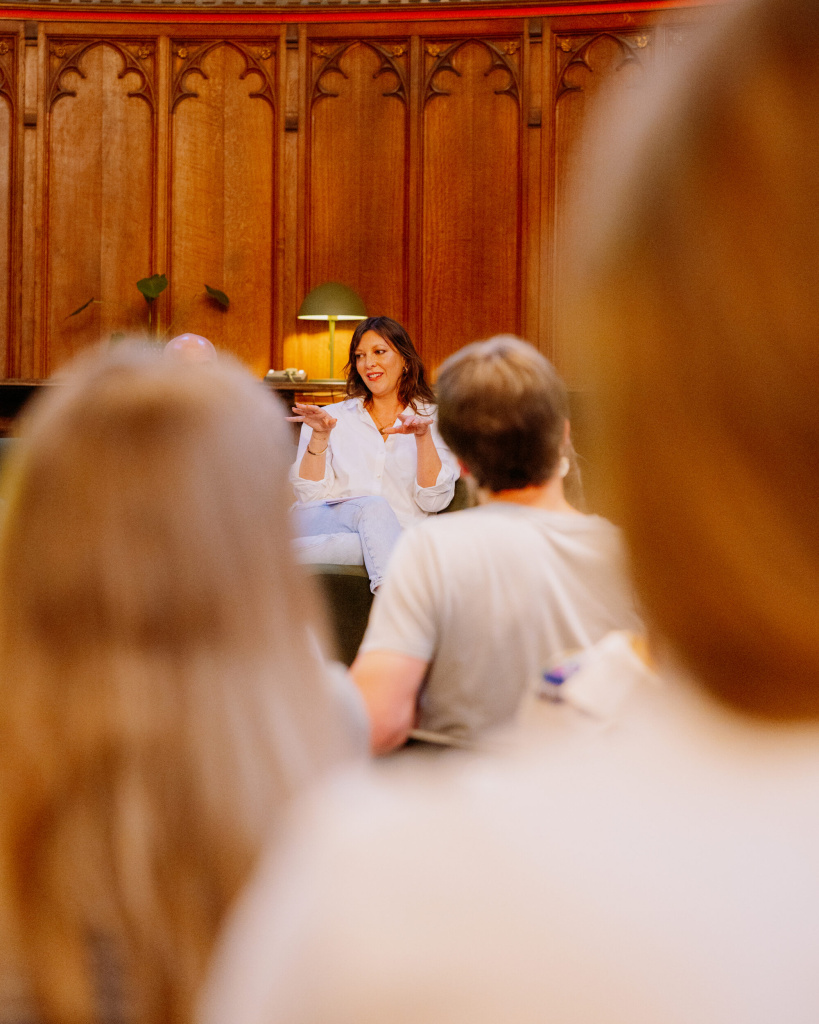
Of course – it wouldn’t be a conversation about the state of the world right now without touching on artificial intelligence. A topic that roused the crowd, unsure on how to feel about this powerful new tool we’ve all been given. But the biggest question on everyone’s lips… What does this mean for creative jobs? Tim, Kate, Steven, Robin and Jamie all steadfast in their belief that creative jobs aren’t going anywhere. A sigh of relief. Steven shared some positive thoughts on how AI is a great democratiser. The barriers to entry now are lower than before, meaning more eyes, more screens and work happening in more places than ever before.
This being said, clients will always want emotional, relatable, human stories. From Jamie’s perspective, AI can only produce more of the same and will never be a match for the way humans think and create. We left that topic firmly closed with his mic drop moment – “AI won’t give you a drumming gorilla for a Cadbury ad”.
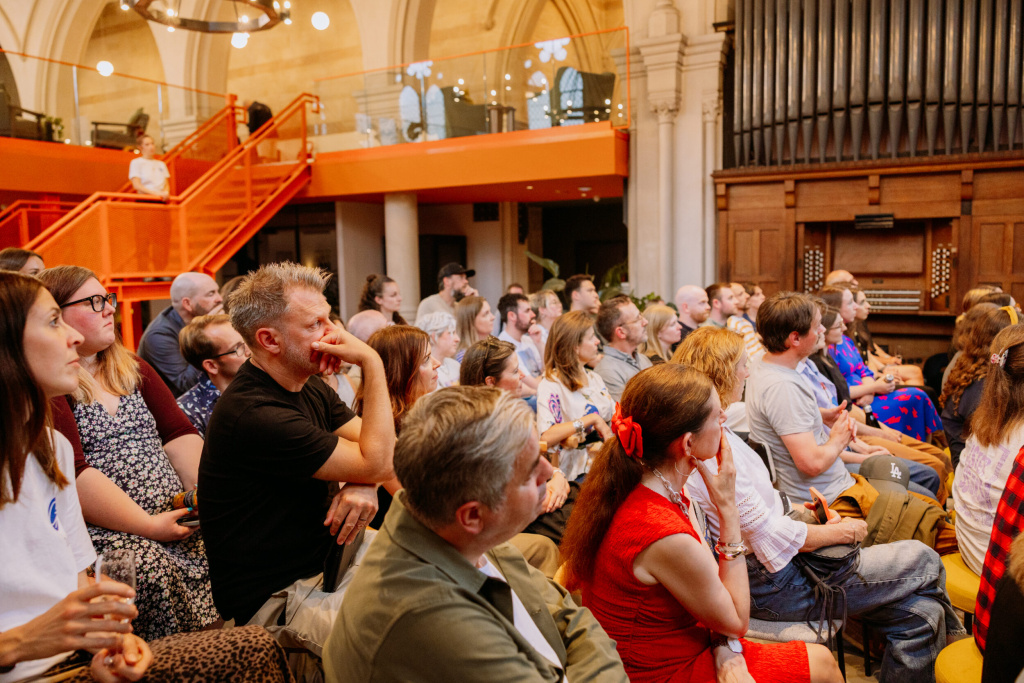
After a short break, we resumed the discourse in the form of an intimate Q&A. With questions from a concerned audience, on how positive the panel feel about the creative industries going forward – will we see an upturn? Leaving us with some final gems of knowledge, the panel discussed how being brave will ultimately lead to success. However you view success though, is up to you. Times have been difficult, really difficult, but they ARE changing. There are spaces, like Gather Round, where community is flourishing and people are coming together with ideas and strength beyond what they thought they were capable of, just a few years ago.
In the words of Anthony Burrill, “Work hard and be nice to people” – but most importantly, be brave, nourish your network, ask questions, take care of yourself and the rest will follow. Stay resilient out there!
If you want to get involved in our next event – make sure you’re signed up to our newsletter so you don’t miss out on tickets. They don’t hang around for long.
saintnicks has been shortlisted for four awards at the UK Social Media Awards 2025, recognising the agency’s standout work in user-generated content, integrated campaigns, long-term strategy and team excellence.
Best Use of UGC – POSCA
Best Integrated Social Campaign – Ascot Racecourse
Best Long-Term Strategic Use of Social Media – Ascot Racecourse
Best In-Agency Team – saintnicks
The UK Social Media Awards celebrate the very best in creativity, innovation and impact across social platforms. From the vibrant, creator-fuelled world of POSCA to diversification of Royal Ascot’s audience and fan engagement, saintnicks’ work continues to blend bold thinking with measurable success.
Callum Joynes, Head of Content at saintnicks, said:
“Social media is one of the most powerful ways to build meaningful brand experiences, and these nominations are a fantastic recognition of the agency’s creativity, commitment, and real-world strategic capability. We’re incredibly proud to be shortlisted across such a broad mix of categories.”
_____
saintnicks is a leading independent brand agency. We partner with ambitious brands to drive commercial growth, through standout strategy, campaigns, digital experiences, and social media. An agile, highly experienced team of specialists, combining top-tier strategic and creative talent from global agencies and client-side brands. We take brands further.
Earlier this year, Bristol Surf Cinema launched its very first event – a night dedicated to celebrating surf storytelling on the big screen. What started as a small, DIY project to bring people together around meaningful surf films quickly grew into something bigger, with almost 250 people buying for the inaugural screening in April.
The idea was simple: create a space to showcase surf films that go beyond the highlight reels, beyond the big brand edits – stories that dig into the social, political, and environmental threads woven through surf culture.
As a camera assistant working in film and TV and a lifelong surfer, I (Theo) set out to build something that connected those two worlds. In a time when the industry was unusually quiet, Bristol Surf Cinema gave me a creative project to get stuck into and a chance to pour energy into something that mattered. It was also a way to genuinely support filmmakers, every film we screen is fully licensed and paid for, and £1 from every ticket is donated to The Wave Project to help fund surf therapy for young people in the UK.
But perhaps what stood out most from the first event was how the Bristol surf community (and the wider ocean-loving crowd) showed up. Feedback from the night wasn’t just about the films, it was about the feeling in the room. People supported the event and made it clear they would like to see more. They wanted a space where all surf stories could be told, with better representation, better balance, and an even stronger connection to the community.
That’s where our second event comes in. On Saturday 12th July at Watershed Bristol, Bristol Surf Cinema returns with a matinee screening of Point of Change, a powerful documentary by acclaimed director Rebecca Coley. The film tells the story of Nias, Indonesia – a surf paradise that was ‘discovered’ in the 1970s and the environmental and cultural impact that unfolded for the local community as surf tourism in that area grew.
It’s a film that makes you think about the consequences of surf tourism — and we’re lucky to have Rebecca joining us on the day for a Q&A to explore those themes in more depth. Rebecca will be answering questions on her filmmaking process, handling delicate themes within documentary and the impact of tourism on the earth and native communities.
Alongside the feature, we’ll also be screening two UK-made short films:
Surfaced by Paul Stevenson, telling the story of Nick Corkill’s journey through addiction and mental health, and the grounding role that surfing and photography play in that journey.
Seb: A Surf Therapy Journey by Matilda Thompson, a beautifully observed short following a young surfer with ADHD and autism as he experiences surf therapy with The Wave Project Bristol.
For those who can’t make the main event, we’ll also be running a catch-up screening on Wednesday 16th July — same films, just without the Q&A.
Both events will offer the opportunity for networking and drinks at the Watershed bar after the event so you can minglew with like-minded film or ocean enthusiasts.
Bristol Surf Cinema was never meant to be a one-off. The ambition is to keep this platform going – to continue curating thoughtful, story-first surf films and to keep building a space where filmmakers feel supported and audiences feel connected.
Looking ahead, there are exciting plans for a national tour to bring these kinds of surf screenings to other UK cities and coastal towns. The vision is to grow Bristol Surf Cinema into a national platform, while always staying true to the ethos: supporting independent surf filmmaking, elevating underrepresented voices, and creating community-led spaces where ocean & surf centred stories, of all kinds, can be seen, heard, and shared.
Want to come along?
Tickets for the July screenings are available now via the Watershed website: https://www.watershed.co.uk/whatson/13320/bristol-surf-cinema-point-of-change
To stay up to date with future screenings or to get involved, follow @bristolsurfcinema on Instagram.
Bristol-made podcast, High Notes, returns on Monday 30th June, as it continues conversations around the art and business of voice, featuring the voice actors, directors and creatives who make it all happen.
Host Melissa Thom brings insightful conversations, illuminating perspectives and plenty of behind the scenes moments from the worlds of gaming and animation.
With six new episodes dropping every week, each lasting around thirty minutes, the podcast shines a light on the world of voice acting, for anyone who is already working in, hoping to break into, or simply fascinated by the business. The new series features professionals working in high level casting, voice acting and directing across AAA games.
Melissa Thom is an acclaimed voice actor with decades of experience voicing projects including Grand Theft Auto V for Rockstar Games, Elder Scrolls for Zenimax, LL COOL J, Google, Amazon, Nike and many more.
Melissa is also the Founder and CEO of BRAVA, and has trained thousands of people in voice from the UK and beyond – from rappers and reverends to ad creatives and countesses.
The first episode of the new season kicks off with a conversation with Kate Hansen-Birnbaum, Casting Director at Pixar, whose credits include animated films including Inside Out 2, Soul, Elemental and Luca.
Kate shares her unconventional path into casting, which began at a San Francisco talent agency under the mentorship of seasoned actors. She offers a rare look inside Pixar’s intricate casting process, highlighting the value placed on authenticity, natural vocal tone and the ability to truly inspire the animation team. The conversation touches on Pixar’s commitment to diverse and inclusive casting, including their practice of anonymised auditions to help reduce unconscious bias.
The full line up of episodes and release dates are as follows:
30/06/2025 – The Magic of Pixar: Voice Casting with Kate Hansen-Birnbaum
Kate brings memorable stories from her career – particularly the joy of working on Elemental – and shares thoughtful advice for aspiring voice actors.
07/07/2025 – Vocal Shapeshifting: Acting for Video Games with Andrew Whieldon Dennis
Andrew reflects on his expansive career as a voice actor in the videogame industry, from indie projects to AAA blockbusters.
14/07/2025 – Inside Aardman: Bringing Clay to Life – Characters, Voice & Performance with Merlin Crossingham, Creative Director for Wallace and Gromit at Aardman Animations
Merlin shares some surprising stories from his childhood that led him onto a very specific career path in animation, as well as thoughts on the timeless appeal of Wallace and Gromit.
21/07/2025 – Casting for Mocap, Games & Animation with Jessica Jefferies
Melissa sits down with Jessica Jefferies, a casting director who specialises in motion and performance capture for video games.
28/07/2025 – Directing Performance for Epic Games with Tom Keegan
Melissa talks to Tom Keegan, an acclaimed performance director behind major AAA titles such as Jedi: Fallen Order, Wolfenstein, Call of Duty, World of Warcraft and more.
04/08/2025 – Bob Bergen: The voice behind Star Wars, Spirited Away and Looney Tunes
Melissa is joined by five-time Emmy-nominated voice actor Bob Bergen, best known as the voice of Porky Pig – a role he’s brought to life for over 30 years.
Melissa Thom, High Notes’ host, said: “This season we’ll be lifting the curtain to reveal the reality of working within gaming and animation. Some key players in the business have shared their perspectives and experience to help the next generation of voice acting talent to break through. The voice acting world can seem like a mysterious closed shop, but the aim of High Notes is to demystify and remove barriers for those who would love to know more about this fascinating business.”
High Notes can be found at www.brava.uk.com/podcast and on all major podcast platforms.
Season 3 will be released later in 2025 and will focus on BRAVA Business and its corporate offering – how professionals can use their voice for impactful communication in the workplace and beyond.
The much anticipated creative industries sector plan has been published by the government.
With the creative industries one of the key sectors of focus in the government’s industrial strategy and the West of England one of the government’s priority areas for the creative industries, there is much of interest in the plan to creative businesses in our region.
Here’s a round-up of what’s in the creative industries sector plan:
Bristol and the wider region is mentioned several times in the plan. That includes a reference to Bristol as a “strong regional creative hub” and home to “cutting-edge createch“. It also references the BBC Studio’s Natural History Unit in Bristol which it says “has led to the region being known as ‘Green Hollywood'” which “not only boosts the region’s economy but also adds vital social value”.
A map of the creative industries in different regions has this for the West of England, with references to Bristol Creative Industries members Channel 4, The Bottle Yard Studios, and Aardman Animations.

The West of England is one of six areas getting a share of £150m to “design interventions that work for the creative businesses and freelancers in their region” as part of the new Creative Places Growth Fund. The government said this could include providing access to mentors, expert guidance, and connections to suitable investors.
The other areas are Greater Manchester, Liverpool City Region, North East, West Midlands, and West Yorkshire.
The fund will also support the development of a West of England-South Wales Creative Corridor.
Highlighting the West of England, the plan said the region is the UK’s third-largest production hub, a global centre for natural history filmmaking, and film tourism. It also referenced the region as being home to the the BBC as well as Bristol Creative Industries members Channel 4, The Bottle Yard Studios, and Oscar-winning Aardman Animations.
Helen Godwin, mayor of the West of England, said:
“I promised to work with the government and invest in the West. To have our creative industries recognised with this funding is a real vote of confidence in our region. People are drawn here from all over the world, whether it’s for our balloons and street art or the city so historic that UNESCO listed it twice. Creativity in the West knows few limits – or equals.
“Culture is part of who we are, whether it’s Oscar-collecting Aardman Animations or treble-winning Bath Rugby. It’s also a big part of the West of England’s economy, and it’s growing. Now we can invest in the future through the Industrial Strategy: helping businesses to grow, bringing through the next generation of creatives, and driving economic growth.”
The British Business Bank (BBB) will “significantly increase” support for UK creative businesses with debt and equity finance. It will be provided with £4 billion of Industrial Strategy Growth Capital to support investment and growth in the Industrial Strategy eight key sectors which includes the creative industries.
The British Business Bank will also launch a ‘Cluster Champion’ programme, with ‘Champions’ with deep expertise and local knowledge to support investment in 10 city regions, including the West of England.
UK Research and Innovation (UKRI) will “significantly increase” public funding for the creative industries, including support for commercialisation and technology adoption.
A £100m UKRI investment will “support the ambitious next wove of R&D creative clusters in new sub-sectors and locations throughout the UK”.
UKRI will publish a new creative industries R&D strategy later in 2025, enhance and streamline the funding support journey through Innovate UK, and support access to Horizon Europe funding.
The government wil investigate specific measuresto tackle barriers to lending to IP-rich SMEs in the creative industries.
Department for Culture, Media and Sport (DCMS) will fund the £25m Creative Futures programme to add five new CoSTAR R&D labs and two showcase spaces across the UK.
HM Revenue & Customs will publish revised guidance for the R&D tax reliefs. It will clarify that “where a project in the creative sector seeks an advance in science or technology, arts activities that directly contribute to the advance by resolving scientific or technological uncertainties are within the definition of R&D for the reliefs, and their qualifying costs, such as salaries, can qualify for relief”.
The guidance will be published in 2025 and will clarify that eligible interdisciplinary innovation can be supported by R&D tax relief.
Protection of copyright in the AI age has been a conversial issue in the creative industries. The government said it “will ensure a copyright regime that values and protects human creativity, can be trusted, and unlocks new opportunities for innovation across the creative sector and wider economy. It said is analysing responses to the consultation on delivering a copyright and Al framework and “recognises the need for this to be done properly and carefully in a considered, measured and reasoned way, to develop any future proposals”.
The government will establish a Creative Content Exchange (CCE) to be “a trusted marketplace for selling, buying, licensing, and enabling permitted access to digitised cultural and creative assets”.
An independent review will be published in the autumn which “seeks to deliver a curriculum that readies young people for life and work, Including in creative subjects and skills”.
The government will launch a new National Centre for Arts and Music Education in England in September 2026.
A new UK-wide £9m creative careers service will be launched “to equip the next generation of young people withthe ambition and knowledge to work in the creative industries”.
The government will launch a new DCMS and Skills England led Creative Sector Skills Forum and the Digital Skills Council, an industry-led advisory body.
DCMS, Department for Education and Skills England will work with industry to support increased access to quality specialist creative education provision acrossEngland to strengthen the supply of highly trained creative students.
The government will refine and develop the growth and skills offer to deliver apprenticeships and skills training that recognises the particular needs of the creative industries.
The government will allocate £132.5 million to increase disadvantaged young people’s access to enrichment opportunities, including in arts and culture, aimed at improving wellbeing and employability.
UKRI will provide resources and support for technology adoption, as well as an online directory of facilities across the UK where creative businesses can access cutting-edge technology.
Creative UK will work with chief technology officers from the sector and other technology leaders to identify next steps to accelerate the adoption of responsible AI.
The government will upskill creative businesses on security through guidance from the National Protective Security Authority and National Cyber Security Centre .
The government will appoint a creative freelance champion, to advocate for the sector’s creative freelancers within government and be a member of the Creative Industries Council.
The Department for Business and Trade will increase funding to facilitate meetings and showcasing at major creative trade shows and events, including South by Southwest, Cannes Lions, Game Developers Conference and International Association of Amusement Parks and Attractions Expo.
DCMS will invest in the British Fashion Council’s NEWGEN programme for emerging UK designers with funding for London Fashion Week showcases and business mentoring.
The government said createch will be a central part of UKRl’s new strategy for the creative industries launching later this year. UKRI will bring together stakeholders to tackle barriers and accelerate createch growth, reporting to DCMS and Department for Science, Innovation and Technology (DSIT) ministers with recommendations by the end of 2025.
Describing createch, the plan says:
“Createch combines creative innovation and cutting-edge technology to generate novel products, services and experiences. Createch businesses have the same growth potential as other technology firms and are expected to generate £18 billion in gross value added (GVA) and 160,000 jobs over the next decade.
“They are found in every creative sub-sector, with an estimated 13,800 creative businesses leveraging technologies including robotics, engineering biology, and XR. 3D printing has revolutionised sustainable fashion, AI is reshaping video games and performing arts, and gaming technologies are used in mental health therapeutics, aeronautics and engineering.”
A new £75m Screen Growth package over three years to develop independent UK screen content, support inward investment, and showcase the UK and International film. It includes a scaled-up £18m per year UK Global Screen Fund from 2026-2029 to develop international business capabilities, enable co-productions and distribute independent UK screen content.
The government will provide £10m to expand the National Film and Television School. It said the investment will unlock £11m of private investment, including from the Walt Disney Company, the Dana and Albert R. Broccoli Foundation, and Sky.
The government will scale up the BFI Film Academy to support 16-25 year olds from underrepresented backgrounds to enter the film industry.
New funding of £30m will be launched to suport start-up games studios and talent.
The UK Games Fund (UKGF) will be enhanced by providing support for new UK titles and skills over 2026-29 attracting match-funding for every supported project.
A new UK Video Games Council of industry representatives will work with the government and the Creative Industries Council to support growth of the video games sector.
Up to £30m in funding over the next three years will be launched with the aim of helping more UK emerging artists break through on a domestic and international stage.
A new ticket levy on arena and stadium gigs will deliver up to £20m annually through the LIVE Trust, with the aim of bolstering the UK’s grassroots music sector, supporting artists, venues, festivals and promoters.
The goverment said it is “working towards an industry-led agreement on music streaming, which will boost earnings for creators.
Ad tech businesses will be supported with accelerator programmes, to upskill founders towards International expansion and connect them with key investors.
The government will launch the BBC Charter to “ensure the BBC is empowered to continue to deliver a vital public service funded in a sustainable way, delivering a BBC that can maintain the trust and support of the public in difficult times, support the wider ecosystem, and that isset up to drive growth in every part of the United Kingdom”.
The government will ask the CMA and Ofcom to set out how changes in the sector – such as the convergence of broadcast, on-demand and video sharing – could be taken into account as part of any future assessment of television and advertising markets. This would include when considering any potential closer, strategic partnerships or possible consolidation between broadcasters which may benefit their financial sustainability and audiences.
On 6th June, our Performing Arts students came together to perform Echoes of the Stage at The Playhouse Theatre, an original production that incorporated a range of legendary musicals theatre numbers from existing Broadway and West End shows across different eras.
In this production, time had been shattered in a forgotten theatre and, in order to restore time and revive the theatre, six dreamers were summoned by the Clockmaker to journey through legendary musicals such as The Great Gatsby, Anything Goes, Mary Poppins, Cabaret, Les Misérables, and many more to piece time back together.
The students from Level 2 and 3 Performing Arts worked together throughout the 12 weeks of rehearsals to create this incredible show! They worked extremely hard on learning the choreography, songs and scenes, as well as developing new roles, characters and embracing this new and exciting original production.
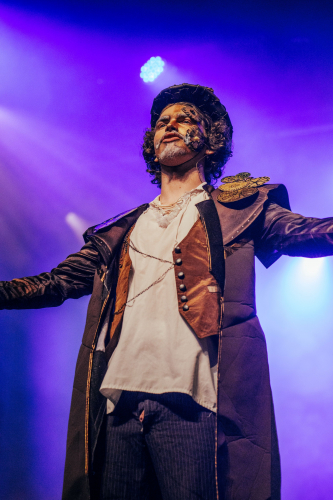
Throughout this production, students stepped out of their comfort zones and became more adaptable in a range of roles, characters and responsibilities. They developed their confidence on stage and perfected their techniques in a professional, real-life theatre environment which was excellent practice for future industry experience.
The production celebrated a range of musicals throughout history, seeing the development of different songs and dances over time. This was a great way for the students to experience the progression of Musical Theatre and the impact these popular productions have had on today’s industry.
The students took on a range of production roles to give them the opportunity to develop their skills, increase their employability, and provide them with a more holistic understanding of the theatre industry and its current requirements. This provides them with a variety of transferrable skills to give them a broader knowledge base, from helping with lights and sound, to assisting with the Marketing of the production.
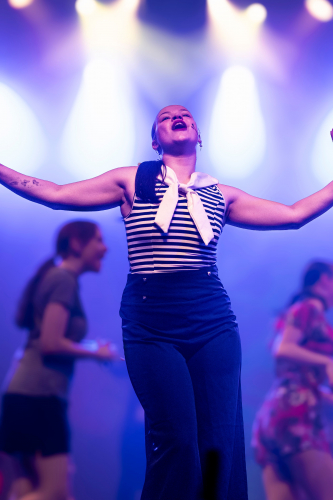
Not only this, Echoes of the Stage was also a celebration of inclusion and support, with all students getting the chance to sing, dance and act in the role that they desired. It was a fantastic way for everyone to flex their creativity and, due to the variety of musicals included, get the chance to be front and centre. They got to experience multiple quick changes and practice a range of different dances from across the decades.
Witnessing the teamwork, collaboration and professionalism from all the students was fantastic. They successfully learnt and executed this production in a short amount of time and seamlessly adapted to the new approach of this musical. It was very different from anything Weston College Performing Arts had done before as it was an original concept and script written by the team.
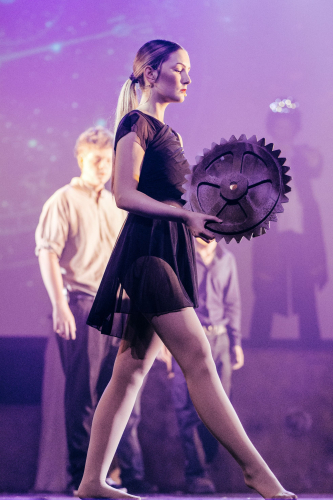
Joe Miller, one of our Performing Arts lecturers at Weston College, expressed how proud he was of the learners, saying, “The learners were stretched and challenged throughout the 12-week process, developing their skills in dance, acting, singing, planning, problem solving and performance, to name but a few!”
“The final show in The Playhouse was a huge success and we are incredibly proud of the work our learners have achieved. The feedback and reviews about the production were amazing, saying how inclusive our show was, how professional it was and, above all, how incredibly entertaining they found it! Here’s to next year’s show!”
This original production was created by the Performing Arts lecturers, Joe Miller, Lisa Frost, and Fiona Philp, who worked hard to choreograph and direct this unique and uplifting musical. It wouldn’t have been possible without their hard work and dedication, and with the collaboration of the students, this production was a celebration of all things Musical Theatre.
Well done to all the students who performed and helped, your efforts didn’t go unnoticed!
If you are interested in applying to one of our Performance and Production courses, click here.
This performance forms part of the Performing Arts and Production Careers Excellence Hub. Weston College’s Career Excellence Hubs are designed to be the launching pad for our learners’ careers. In a world where connections and relevant skills matter more than ever, these hubs offer a holistic approach that prepares learners to thrive in their chosen industries. With the support of these hubs, our learners are well-equipped to make a significant impact in their professional journeys.
You need to load content from reCAPTCHA to submit the form. Please note that doing so will share data with third-party providers.
More Information