In our previous blog, we explored a joint report from LinkedIn and the B2B Institute, ‘5 principles of Growth in B2B Marketing’ to find out how businesses make their purchasing decisions.
In the second part of this series, we’re exploring the case for brand memorability – or mental availability – and why you should consider a route to B2B fame.
Expanding your customer base
Acquiring new customers is expensive.
Many B2B companies believe increasing loyalty is the most profitable way to grow their businesses. Others focus on acquisition strategies, targeting new key accounts they want to penetrate.
The jointly commissioned report ‘5 Principles of Growth in B2B Marketing’ by LinkedIn and the B2B Institute shows that campaigns which talk to both new and existing customers – also known as reach strategies – are the most effective.
In fact, the report’s data reveals that those relying on a loyalty strategy alone showed a zero-success rate. Loyalty tends to be a side-effect of market share, and brands with a high penetration tend to have better loyalty rates.
Please see original article for picture: https://www.proctors.co.uk/knowledge-hub/b2b-marketing-masterclass-part-2
So that’s the science behind B2B decision making. But is it rational or emotional? The answer, according to psychologists, is that we’re all human. and our thought processes follow the same basic patterns.
One of these is our tendency to use mental shortcuts to reach a decision. NobelPrize winner, Daniel Kahneman, famously put it this way:
“Human beings are to independent thinking as cats are to swimming. They can do it, but they prefer not to. The brain is largely a machine for jumping to conclusions.”
Essentially, when presented with choices, or asked a question, we usually prefer to select the answer which comes to mind easiest. You may have experienced this yourself when put on the spot. Psychologists call this ‘mental availability’.
For brands, ‘mental availability’ has two levels.
The first level is awareness.
Your brand will have lodged in your customers’ memories, and they’ll recognise your name.
However, awareness will only get you so far, and the most you can expect is to be shortlisted from the long list of potential choices. To reach the top of your customer’s mental availability, your brand will need to level up.
The second level is fame.
Take IBM, for example.
Everyone knows their name, and I probably don’t need to remind you of their famous line: Nobody got fired for hiring IBM. This single creative line was repeated over and over again, forming an emotional connection that made it easy to make the choice. Long after they campaigned it, we still remember it, talk about it, share it.
And here’s the data which proves the point.
Please see original article for picture: https://www.proctors.co.uk/knowledge-hub/b2b-marketing-masterclass-part-2
Success isn’t a contest between lead generation and brand in B2B marketing. We can see that winning B2B companies apply both in their marketing mix. But if your Sales Director still isn’t convinced by the data, perhaps this story will help.
You’ve successfully launched your lead generation campaign. In fact, it’s been so successful that your sales team have followed up with an excellent meeting with Key Prospect Biz. Your salespeople do a great job of pitching the benefits of what you offer, and your brand makes it to the Key Prospect Biz’s shortlisting stage.
But now, your salespeople have left, and things go quiet. Key Prospect Biz’s decision goes to committee, and you’re not in the room to influence the conversation.
It’s been a while since your guys’ presentation, and human memory is short. This isn’t the final stage, but you know it’s more than likely they’ll use the easiest route to jump to their conclusions. This is where brand awareness will likely drive their mental availability and get you on the shortlist. Great news!
Now it’s a three-horse race. You’re each invited to pitch to a panel of C-suite decision-makers and the influencers who got you this far.
There may be an upstart challenger brand in the running for comparison, but the other two will be recognised brand names.
Now no-one doubts your abilities to work the room as a great salesperson. But it’s a fair bet that the famous brand amongst the pack will already have had an impact on the C-suite. In fact, they’ve probably already jumped to a conclusion before you enter the room.
So, which of the three would you rather be?
Ah yes, your Sales Director says, but our ABM campaigns have made sure that everyone in the room knows who we are and what we stand for.
True. ABM is by far the most effective B2B sales activation tool in your armoury, and a good campaign will have got you this far. But it won’t have made you famous.
Fame takes time to grow. The famous brand will have been imprinted in the minds of those executives consistently over and over again. Talked about with colleagues. Acknowledged as leaders in their sector. Collectively famous for what makes them great.
It will have made them the first name that springs to mind.
Your sales director still doesn’t buy it? OK, here’s a final question for them. Why is it that when successful salespeople move jobs, they’re usually tempted to work for bigger brands to advance their career?
If you’re still not getting anywhere, maybe it’s time you thought about moving jobs to a bigger brand yourself! (Only kidding.)
If you’d like to talk about supercharging your brand strategy with the latest industry data, or to discuss your creative marketing requirements, get in touch with us today at [email protected].
Although almost a third of the creative industries workforce is self-employed, the role and contribution of creative freelancers in the economy is poorly understood by policymakers and they should be better supported.
That’s the claim of a new report by support organisation Creative United which said that the lack of knowledge around creative freelancers “has been laid bare by the devastating impacts of COVID-19 on creative employment and freelancing, and the patchy support that freelancers have been able to access in response”.
Although government schemes have provided funding for millions of people during the pandemic, ministers were criticised for excluded a large section of self-employed people.
Creative freelancers contribute economic, cultural and social value, the study concluded, and much more needs to be done to support them in a way that better reflects their contribution to the UK economy and society.
The research, commissioned by Nesta’s Creative Industries Policy and Evidence Centre (PEC), makes 10 recommendations including:
Eliza Easton, head of policy at the PEC, said:
“This report is important for our understanding of freelancers in the creative industries, who, along with the self-employed, make up 32% of the sector, a much higher proportion compared to other areas of the economy. Before the pandemic, the creative industries were one the fastest growing parts of the economy, contributing over £100bn a year to the country and employing over 2 million people. However, the COVID-19 crisis has exposed the inadequacy of support for freelancers and self-employed workers. If we want a post-pandemic recovery that benefits everyone in the economy, we need to ensure that policies for freelancers are designed using evidence and research, rather than trying to apply a ‘one size fits all’ approach.”
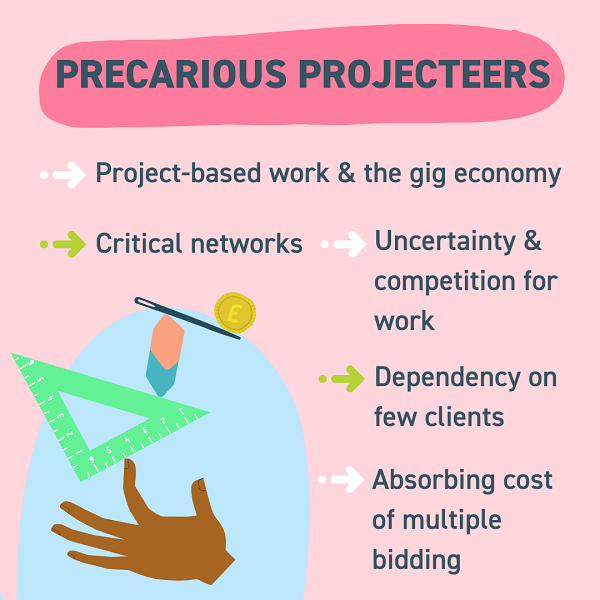
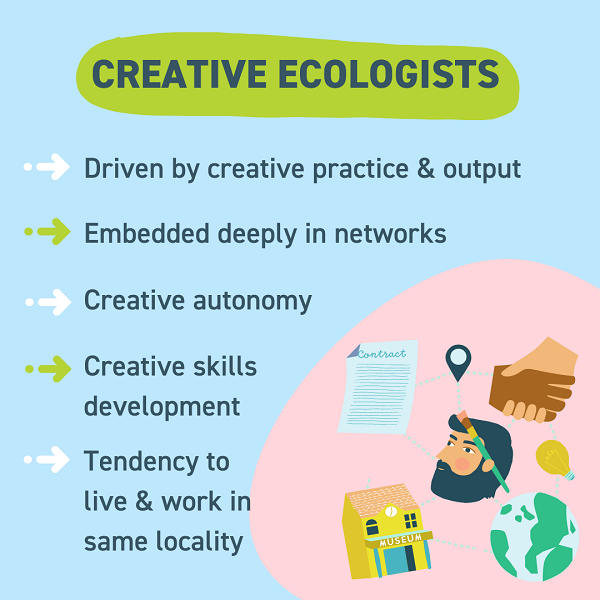
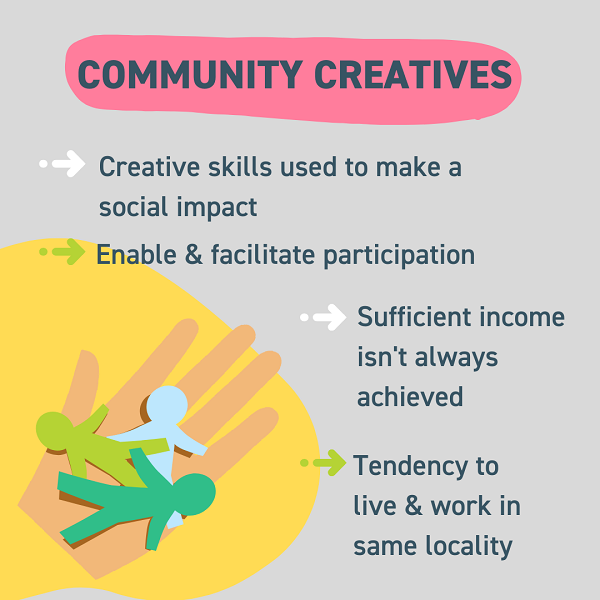
Researchers also interviewed 87 creative freelancers based in the Coventry City Region, London Borough of Waltham Forest and the County of Northumberland and compiled six groups to illustrate the range of creative freelancers, the characteristics that define their business motivations, and their modes of working.
A summary is below with full definitions in the report.
“I’d like to be expanding… I suppose I’d like to be ‘small to medium’ one day. I’m not sure I ever wanna be a ‘large’ business, you know, I think that probably takes a lot of the fun out of it.”
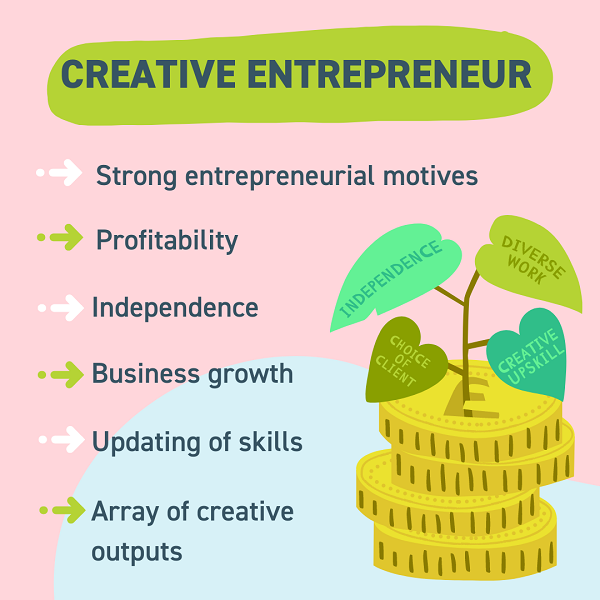
“I wasn’t interested in running a business, I just wanted to be an illustrator! I was quite happy having somebody pay me to be an illustrator.”
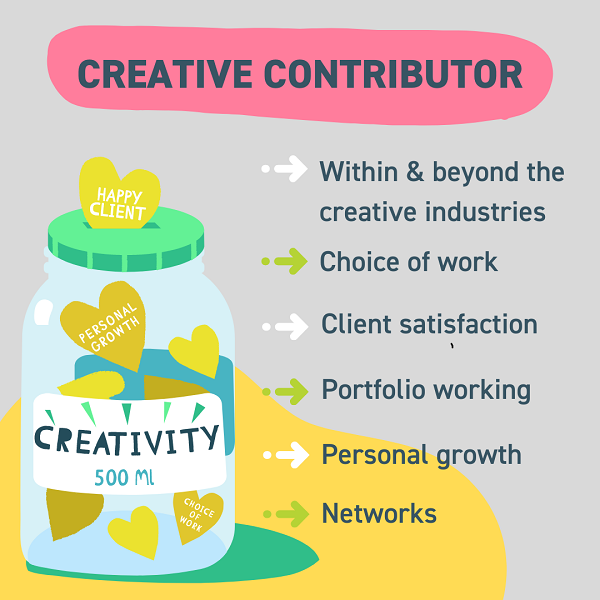
“I can be here when kids come back from school and can arrange meetings around that. I’m in charge of my own time, I don’t need anybody’s permission to do the things I want to do. It’s great.”
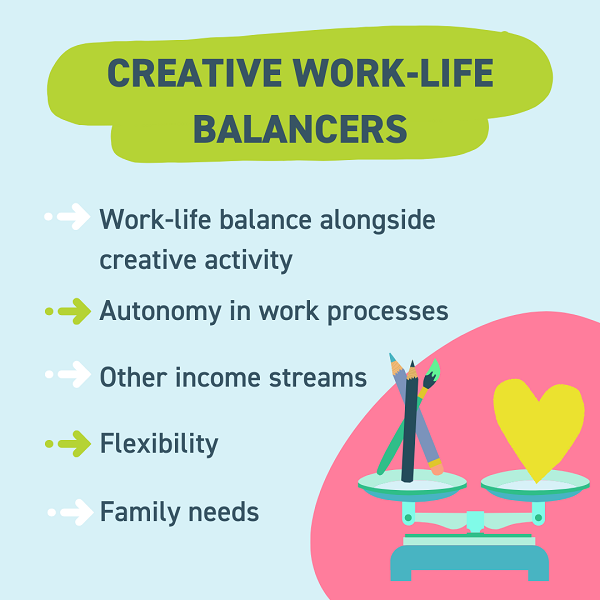
“This is the only way I can do the job I want to do, there is no alternative.”
“I would find it very hard to get out of bed to do something I didn’t care about. I’ve been obsessed with the arts and cultural industries all my life. I believe this makes a proper contribution to the community, to the world.”
“I work with a group of stroke survivors and to be able to see them return every week and to enjoy what they do and to really feel part of that group… Letting groups have their own identity – I never call myself a teacher, I am part of the mix. Learning from each other. Not about earning – the earning bit is not realistic in the arts world.”
Bristol Creative Industries has a membership level to support creative freelancers. Read what some of our members have to say about the many benefits of freelance membership.
In the first blog of this two-part series, we break down the findings of LinkedIn and the B2B Institute’s joint report, ‘5 principles of Growth in B2B Marketing’, and explore why it takes a balance of brand building and sales activation marketing to effectively grow their businesses.
People are emotional creatures. That’s why brand building works so well on consumers. People become invested in – and attached to – their favourite brands, from cereal, to phone networks, to operating systems.
But business buyers are rational. Right?
Wrong.
OK – maybe not completely wrong. Purchasing decisions are made rationally in any successful business. But you’re missing a trick if you think building a B2B brand doesn’t matter.
But sales activation or performance marketing is the most effective way to measurably grow a B2B business. Right?
Wrong again.
In fact, a jointly commissioned report by LinkedIn and the B2B Institute – ‘5 Principles of Growth in B2B Marketing’ – has the data to prove it. (And, by the way, so does our client’s data.)
So where do these entrenched views come from?
B2B companies tend to be driven by either product leaders, service leaders or sales leaders.
Product/service-led companies tend to view marketing as ‘the price you pay for an inferior product or service’. Sales-led companies are driven by short-term sales targets, and they want leads. Now.
So, whilst many B2B marketers recognise the commercial potential of longer-term brand building, they face an uphill internal struggle to make their case.
But the ‘5 Principles of Growth in B2B Marketing’ report empirically proves the business case for longer-term B2B brand building and its impact on growth, by demonstrating:
· B2B brand building increases ‘mental availability’ and ensures your brand is easily remembered in a buying situation
· Effective brand campaigns reach every buyer in your category
· Creative brand campaigns that capture attention at an emotional level are delivered consistently over time, growing significant sales in the future, not just in the short-term
· Increasing loyalty does not significantly add to growth, but customer acquisition does
B2B brands follow the same ‘share of voice’ rule as their B2C cousins. The report defines the rule as follows:
“There is a well-known relationship between a brand’s “share of voice” (typically defined as its share of all category advertising expenditure) and its rate of growth.
Brands that set their share of voice (SOV) above their share of market (SOM) tend to grow (all other factors being equal), and those that set SOV below SOM tend to shrink. The rate at which a brand grows or shrinks tends to be proportional to its “extra” share of voice (ESOV), defined as the difference between SOV and SOM.”

The research data shows a significant correlation between market share growth and ESOV for B2B brands, specifically, demonstrating that in B2B, 10% extra advertising share of voice causes 0.7% market share growth per annum.
The report shows that the best performing B2B brands have an optimal balance between long-term brand building and short-term sales activation/performance marketing.
In B2B, the optimal budget allocation is 46% for brand and 54% for sales activation.
Sales activation focuses on an immediate response, and is generally a rational sell, featuring a piece of informational content, an offeror a product/service feature capable of generating a cost-efficient response.
It’s tightly targeted at hot prospects who are in-market with an intent to purchase, and designed for simple, quick response. Sales activation is great for short-term lead generation and delivering directly measurable ROI, but, it’s unlikely to be memorable, so the effects are short-term and won’t contribute to long-term growth.
In contrast, brand building drives long-term growth, with its effects lasting longer and accumulating over time.
It uses creative impact at an emotional level to create a lasting memory that influences buying decisions long after the adverts run, with a reach that’s much broader than sales activation campaigns, targeting the whole of market, and its effectiveness relying on repeated exposure.

The time frame for any brand building to take significant effect and pass the sales activation peaks shown in this graph is typically 5-6 months.
Not convinced? We recently we decided to test this theory out for ourselves, using the website data of one of our clients. And the results were pretty impressive.
Not only did we find that brand traffic – both direct and brand search – built consistently over time in line with their brand building activity, but we also found that the conversion rates from website visit to meeting requests and paying clients was 50% higher than any other traffic source.
If that wasn’t enough, we also discovered that in territories where there is low brand awareness the conversion rates from lead generation campaigns increased over time as the effects of our brand building efforts kicked in.
Stay tuned for part two, where we’ll explore the case for making your brand famous.
In the meantime, if you’d like to discuss your brand strategy armed with the latest industry data, or to discuss your creative marketing requirements, get in touch with us today at [email protected].
Cookie acceptance pop ups might be driving us around the bend, but since the requirement to ask permission was introduced a couple of years ago, businesses and marketers have built their marketing strategies and systems around them.
Now things are all about to change again. It might have been predictable, but with Google telling us that 48% of consumers actually stop a purchase if they don’t trust the company to collect and manage data on them, it’s no surprise that Google are following the likes of Apple and Mozilla, and have announced that they were stopping third-party tracking in 2023.
This leaves businesses having to reset their marketing strategies, relying solely on any first-party data they hold, with many businesses, particularly in e-commerce, having to go back to more traditional marketing and brand building, but in a more digital world than before.
Any that fail to do so will find themselves simply giving their marketing keys to the tech providers with no real insight on their client base.
The option of doing nothing is a dangerous one, yet whilst Pimento research tells us that most marketing professionals intend to ‘do something about it’, 19 out of 20 acknowledge that they won’t be prepared for the great switch off.
Marketing will no longer be about stalking people across the web. We now have the opportunity where digital marketing can mature to become a real weapon to help brand building in a more meaningful way.
So, what’s the action plan? And what should all businesses, large or small, be lining up to do right now?
Action 1.
Do the gap analysis now. Work out what you currently use and need to achieve marketing penetration, and what will you have post the demise of third-party cookies. That’s the gap that needs filling.
Action 2.
Focus on the business infrastructure and get back to basics.
If you need support in doing the analysis, and in building the strategy going forward, make the move now to find it. Closer to the time, resources will be limited and remedial time scales will be longer.
Action 3.
Cement the data you have and get your consent strategy robust for the future, building the new approach around it. Undertake a cookie audit now.
Action 4.
Take a relook at customer experience and contextual for scale, so that you stay completely in touch with your customers’ buying triggers in the post cookie era.
This isn’t just a marketing challenge. It impacts the whole business spectrum, from SMEs to multinational corporates. Mid and large corporates will use their in-house resources to reposition, but small businesses will struggle in the absence of teams they can fall back on, and budget.
Pimento is well placed to be the surrogate team to look to though. With over 200 independent marketing agencies, covering most marketing disciplines, bespoke solutions are close at hand irrespective of size and sector.
This is not an issue for selective blindness. Businesses who fail to act will see their markets slowly dwindle away.
Press releases are an essential part of any digital marketing campaign, whether you’re making a general business announcement about a new product, service or crisis communication management, you need to think about why this news really matters and quickly demonstrate that you have a NEWS story. This is at the heart of all digital PR campaigns.
In light of recent discussions disputing the relevance of press releases, our stance at OggaDoon, Bristol, remains the same. The hunger for compelling stories, from publications, journalists and our industries as a whole, is stronger than ever. This has created a relationship, an essential yet, albeit, conditional one between journalists and PR – they need our help to deliver the stories their publications need and our industries want to hear about. For this reason, the competition among communicators is fierce and in turn, they have a wealth of different approaches on how to write the perfect press release – one they think will satisfy the needs of the journalist and secure them that vital collaboration. Here at OggaDoon PR, digital marketing and social media agency Bristol, we would like to share our formula gathering the key newsworthy facts to craft your perfect release. Here’s introducing the 5Ws, the 3Ps and the vital 1C. Intrigued, then please read on!
One common mistake is trying to write like a journalist – when what you should be trying to do is think like a journalist. Imagine you are on the receiving end; you have tens, perhaps hundreds of press releases along with other emails sent to you every day. What are you going to want to read and what is going to make your eyes roll? It’s fair to say that you’d click on the headlines that you are drawn to because they stick out, perhaps because they’re funny, perhaps because they’re succinct, maybe because it was unexpected. It’s also fair to say that you would be put off by big chunks of writing, you’ve got 101 things to do and think about and only 1% of that energy is reserved for reading emails. You would want to recognise newsworthy value, the angle and outcome within the first few lines, otherwise, the tidiness of your inbox would quickly supersede in value and just like that, the email that you spent an hour fashioning now resides in the trash.
If you want to make your press release stand out in a crammed inbox you must find a healthy balance between being original and trying too hard. The best way to do this is to think outside the box with your subject line and title, this is the only place you are granted to be creative and witty – the actual bulk of the release is purely pragmatic. Keep it to the point and make sure you hit the ‘Five Ws’. Don’t try and zhuzh it up with unnecessary jargon and clichés – journalists already know the jargon, they won’t be impressed that you do too. Lastly, don’t say your story is newsworthy, show that it is – if a press release looks like an advertisement, it will be ignored.
One way you can do this is by maintaining a sense of objectivity but also having an overarching sentiment throughout. This could be a sentiment of excitement, regarding a new launch or change in the marketplace, or it could have a theme, like nationalism or nostalgia. Part of identifying these themes is refining your angle and identifying the societal implications of your story.
Whilst people often stress the 5Ws when it comes to writing the perfect press release, the angle that you need to convey from these is often lost – so really, there should be three Ps, a C and an I threw in: alternative perspective, progress, public eye, conflict, and local impact. The angle of your story answers the questions journalists really want to know; Have you got another side to the status quo? What solution is it to what problem? What will the public response be? Who and what does it challenge? What impact does this have on the community? Remember that you have good reason to be invested in your story, but you need to look for the bigger, engaging storyline to give everyone else a reason to be.
Once you have got all these juicy bits in, it is time to offer a bit of context. Your second paragraph should contain an impactful quote from one or two persons that have authority in the industry. Here it is easy to fall into the trap so many are partial to – the temptation of adding fluff. Every sentence in a press release needs to have value, if you are adding one for the sake of it, maybe to balance out the sizing of your paragraphs, you have fallen headfirst into the trap. The key objective should be to select a quote that brings the story to life and helps paint a picture of how influential the announcement is. Quotes are not for information, but for insight – so make sure to use a quote that reflects a unique perspective on the subject.
The further you get down a press release, the less vital the information. Thus, there should definitely be nothing crucial to the story in the last paragraph. This section serves to strengthen and round off your narrative – this could mean offering background into ways the company developed the project or insights into future implications of the news (if this is a core theme of the release, then it belongs in the first paragraph, but if there are other stronger angles, it may be more appropriate at the bottom as additional content).
Empathy may not be the first emotion you would associate with journalists yet employing it will make not only make writing the perfect press release a far more streamline process but also far more successful in terms of responses. We can all think of ways to make our own jobs easier, so try and think of how you can make theirs so, and in the time you save doing so, invest more energy on constructing an irresistible title that will surely make them look twice.
Did you know 85% of people research the products they want to buy online before they make their decision?
When prospects land on a website of interest, yes they want information about the product on offer, but they are actually looking for a lot more than that at this early stage of the buying journey. They want to know what options are available, the price differentiation of those options, what the pros and cons of different products are, whether there are any related sustainability concerns and the general ethos of suppliers. In short, they want as much information as possible, so they feel well informed before they make their decision.
This is step one in the customer journey and yet it often gets overlooked.
Increase your influence
The most basic customer journey is the customer experience from finding out about a product, through to placing an order. Companies that pay this process the attention it deserves will create a Customer Journey Map to visually represent the journey their prospects take before they become customers, while they are customers, and possibly include after-sales service too. Breaking the process down in this way helps businesses to better understand each milestone in the journey and what impact they have on influencing the outcome at each stage. The more influence you can have during the research stages, the more likely prospects are to come back to you when they’re ready to buy.
Blog to build trust
A business blog is useful throughout the whole customer journey but really comes into its own in the early stages. The rest of a website will be front and centre for the second step in the process, when prospects have narrowed down their options and want to see what different competitors have to offer, but during this first step, more generic authoritative market information is a must have.
For example, if a homeowner is looking to buy a new conservatory, they will want to know about the pros and cons of conservatories vs extensions. They will want to know about the different styles of conservatory available, different types of materials used to manufacture conservatories and the pros and cons of glass vs solid conservatory roofing options. Someone looking to sign up to a new fitness regime on the other hand might first want to know about the latest popular trends in diet and exercise and which exercises are better for strength, flexibility or cardio.
It doesn’t matter if you don’t offer all of these products or services, by talking knowledgably about them you position yourself as an expert in the entire field. It is this expertise that warms a prospect to you and builds trust before they have even had any direct contact with you.
Make it easy
If you can make it easy for prospects to find the general market or product information they need, you will build trust and loyalty in your brand and visitors are more likely to return. Consistent business blogs are a great way of helping prospects find you in the first place because fresh content boosts search engine optimisation. You can read more about this here (https://blogwrite.co.uk/why-consistent-blogs-are-better/). Then, if your blog is full of helpful information, prospects can browse through it in their own time and gather everything they need to make an informed choice.
When you think about the customer journey in this way, who are they more likely to opt for? The company with the excellent informative blog that popped up at the top of their search and gave them all the information they need? Or the company that was hard to find in the first place and then only gave details of their own products with no additional market or product information? I know which one I’d choose!
So, when mapping out your online presence, don’t forget step one in your customer’s journey. Be helpful in the early stages and the trust and goodwill you build in the beginning, will come to fruition later, when they are ready to buy.
Is your digital marketing agency profitable on purpose, or by accident? At Digital Agency Coach we’ve worked with hundreds of agency owners over the years, some of whom were unaware of their profitability stats.
Many agencies end up being profitable by accident, as a positive consequence of the year’s work. In this article, we share our insights on turning an intentional and deliberate profit.
As a busy agency owner, it can be easy to prioritise managing the day-to-day operations and allowing your profitability to become an afterthought. With this mindset, it’s difficult for you as an owner, to have that profit-oriented, strategic mindset that is key to growing your agency.
At Digital Agency Coach, we always recommend approaching profitability with intention and purpose. This approach can feel foreign and a little acquisitive at first, but it’s important to remind yourself that it’s completely genuine and moral to design your business in such a way that it earns you money.
Having a profit-driven mindset enables you to reinvest into your business, enhance the quality of your service and grow your agency.
When it comes to an agency’s profitability, there are typically three different degrees of intent and three defined profit groups as an outcome.
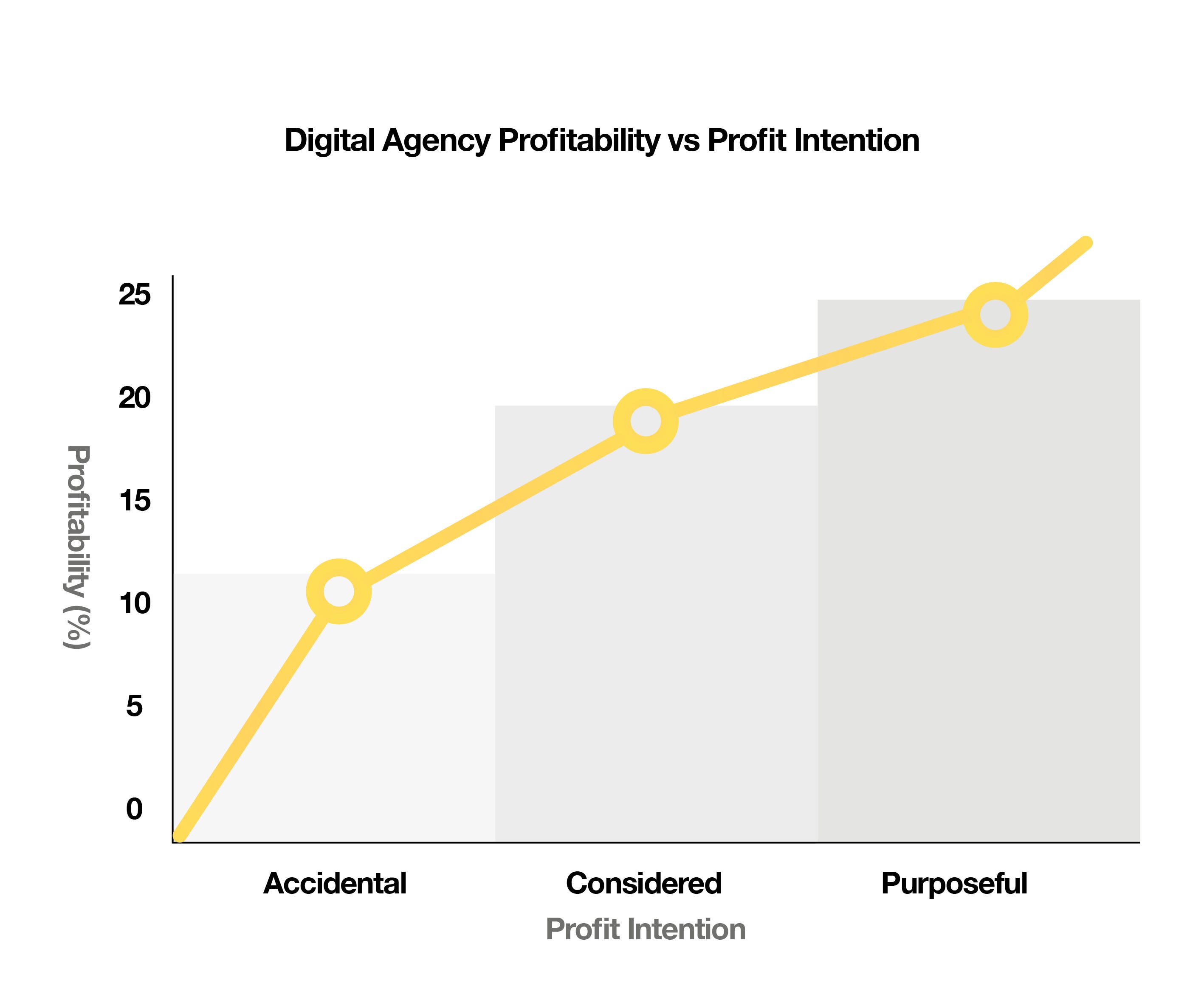
Agencies who generate anywhere from 0–12%* profit are generally doing so by accident. These agencies usually no profit strategy in place and the year-end results are unpredictable and often speak for themselves.
Those digital agencies turning anywhere between 13–22%* profit, are almost always doing it on purpose. The closer the number lies to 22%, the more deliberate and considered the profit is. The lower the number, the less intentional their outcomes have been.
And as for those generating a profit percentage anywhere north of 22%*, we classify those guys as purposeful, profit machines. These digital agencies know their services, their clients, their team, and their business like the back of their hand. Their sales pipeline and financial systems are geared toward driving high volume, quality leads which convert.
*These figures are general only, actual profit margins will depend on the agency size. Large organisations with substantial overheads typically will have tighter margins.
Address these six top-line areas and improve your agency’s profitability today.
Take a close look at your gross margins. If they’re outside the range of 50–60%, unfortunately, you’re not profitable enough. Your gross margins are calculated by taking the overall revenue of your agency, less the sum of those direct salaries and/or contractor and freelance fees required to deliver your particular service.
As a service-based business, your agency sells time — utilisation looks at how many billable hours you have available to your clients. If you are operating at less than 72% capacity, there is scope to improve your profitability by maximising your utilisation.
These can be either your employees or clients. If you attract and retain poor performers, this will lead to inefficiency and low profits within your agency. It might be that you need to address some of those long-standing, legacy clients from your start-up days, or certain team members who are less efficient than others. The solution? Try raising your fees or developing the skills and/or expertise of your employees.
Usually, those agencies who fall into the 0–12% profitability category, have no insight or oversight on their financial or sales reports and forecasts. Having a robust sales pipeline and reporting structure in place will allow you to understand when, where and how you can maximise your revenue and minimise your expenses — which we know will lead to a direct increase in your profitability.
For digital marketing agencies within the UK, it’s recommended you charge £90 per hour as an absolute minimum for your services. At Digital Agency Coach, we advocate charging anywhere between £100 — £150 an hour and ensuring you bill all for those all hours at your full rate in order to maximise your profitability.
Is the service you provide right for the current market? This is a big question for web design agencies who are competing against the likes of Wix and Squarespace. These ‘done-for-you’ website builders have significantly devalued the product to where it’s now within the reach of many small businesses and small budgets. As a specialist agency with a highly skilled team, you need to be bold and honest with yourself and ask if there is a future within your market. If the answer is no —you have to innovate and change with the times.
Remember, it’s perfectly moral and genuine to gear your agency to become a profitable, money-making business. As a business owner, you are doing your customers, employees, and your market a disservice if you are unable to reinvest your profits back into your industry.
Ready to begin? Start by asking determining which of the three levels of profit and intention describes your agency. If you’re turning a profit anywhere south of 20%, it’s time to change your mindset and address these six ways to increase your profitability.
Watch Our Free Video Class: Profit On Purpose (7min) & kickstart your journey toward profitability
Of course, if you have any questions or would like to chat with one of our Digital Agency Coach Consultants, please Get In Touch — they’d love to help.
The rebrand that sees the agency, originally founded in 2014, become The Co-Foundry, reflects its mission to work collaboratively with founders, bringing in specialist co-creators such as designers, photographers, animators and copywriters, according to specific project needs.
Owner, Sue Bush has developed a process that empowers client teams to be part of the strategic discovery phase, as well as the creative process. She is a firm believer in co-creation, “Ideas can come from anyone, and are not just the preserve of the design team. Brand identity design can, to a large degree, be democratic – not ‘design by committee’ but more, ‘winning ideas by group spark’.”
Having been at the helm of two agencies, Sue feels well placed to help solve the brand challenges tech and creative firms face. She co-owned a Shoreditch design agency when the internet was still in its infancy and then went on to establish her own brand design agency, Touchpoint Design, which harnessed design to the opportunities afforded by tech, “The challenge for tech and creative founders is the same, you strive to make a positive impact but are often too close to your business with too few hours in the day to find the best and most appropriate direction for your branding.”
“I set up The Co-Foundry because I believe there’s a better, more personal and inclusive way to approach branding. We work together with creative and tech founders and their teams to forge unique, purposeful brands, using co-creation and interactive discovery sessions to bring everyone in on the journey.”
The Co-Foundry sees Sue acting as an independent consultant with a team of specialists supporting her. When client needs dictate, she builds out and brings in this bigger team of co-creators to support her, creating a lean, agile and expert offer that’s especially designed to serve the creative and tech sectors.
To launch the new brand, The Co-Foundry has put together a series of short practical guides on how to start building a compelling brand, especially designed for small teams. Download the first instalment here.
Since my earliest years, I’ve been a fan of athletics. Long-distance running in particular. I’ve watched it on TV. Chatted about it with friends. Followed its greatest exponents with fascination and even become something of an (armchair) expert on the subject.
But until a year or two ago, I’d never taken the plunge and given it a go myself. It felt like something reserved for others. Something that you needed to prepare for meticulously, before ever getting out there and hitting the pavements for yourself. It just seemed altogether too difficult to try.
Then something changed. I was persuaded by a friend to join them on the journey from ‘couch to 5K’. And, at the risk of being that annoying running evangelist, I’ve never looked back.
For many in the marketing world, account-based marketing holds the same appeal – and presents equally erroneous perceived obstacles. It looks great. It seems to work brilliantly for others. But it can also appear prohibitively complicated and quite possibly hideously expensive.
Happily, if you get account-based marketing right, those negative perceptions are some way wide of the mark. And in this article, I’ll explain why it’s an approach you can’t afford to ignore.
There are websites, books, research papers, even degree courses devoted to an explanation of account-based marketing. But for our purposes today, I’m going to keep things straightforward. At Proctor + Stevenson, we view ABM as marketing that identifies high-value companies within defined sectors, and focuses on generating quality sales leads through targeted strategy and pinpoint messaging.
It’s an approach we’ve employed to great effect over the past few years, helping clients including Panasonic outperform campaign goals by as much as 100%. And we’re not alone: Forrester research reports that 62% of marketers have reported a positive impact on their marketing performance since adopting ABM.
It comes with strong credentials then. But if that isn’t enough to help you persuade your colleagues that account-based marketing is the way forward, here are those five key reasons that should really turn the argument in your favour…
The pandemic has taught us that certain sales and marketing approaches are affected by external conditions and factors beyond our control. Exhibitions and events being an obvious one. Account-based marketing remains impervious to those irresistible forces, replacing sales meetings and product demonstrations with digital outreach and online communication. It also has the flexibility to incorporate more ‘traditional’ tactics (personalised direct mail, for example) when the time and targeting is right, making it the marketing strategy for all seasons.
The beauty of ABM lies in its focus. Unlike other broad-brush strategies that make marketing a numbers game, account-based marketing is lean and keen, ensuring that your financial resources are allocated only where they’re going to have maximum, direct impact. Even in those longer B2B buying cycles, there’s no wastage. Communications and marketing collateral are sent to those prospects you’ve identified as interested, via the channels they use, carrying messages you know will resonate with them.
Most ABM strategies are built with digital communication at their core. So you can account for every penny or euro you spend, and attribute every click, reply, meeting booking, expression of interest or sales opportunity you elicit directly back to the activity you’ve instigated. And there’s little that will make your board-level colleagues happier than that.
Ah, the old sales vs marketing conundrum. Should be best of friends, very rarely are. In this respect, you can think of account-based marketing as the United Nations. Employed properly, an ABM strategy achieves that holy grail – a harmonious collaboration in which marketing and sales work in tandem, generating interest, qualifying leads and nurturing prospects until they’re ready to hit ‘buy’ (and beyond, if your ABM strategy is far-sighted enough).
As I mentioned a little earlier, our clients have enjoyed great success with account-based marketing over the past year or two. Working with them, we’ve doubled projected lead targets, improved ROI, achieved better conversion rates, even generated six-figure sales pipeline. And all within the parameters of tight marketing budgets.
The final advantage of ABM that I’ll mention here is that it isn’t an all-or-nothing strategy. It looks different for every business. And we can help you take those first steps towards making it work for yours. So if you’d like to know more, don’t sit on the side lines any longer. Lace up your shoes, get in touch and let’s see where account-based marketing can take you.
“We should definitely launch a podcast, more people than ever before are listening, and we’ve got budget to spend as we’re no longer running that big outdoor campaign”
This is the sort of conversation going on within brands and agencies in 2020 (well, at least we hope it is). It is a really exciting time to be launching a podcast, and so it’s really easy to go all in on imagining what podcast might sound like, who’s going to present it or how you’re going to get it produced. But before you’ve allocated your entire budget before you’ve even started, to get an idea of the costs it’s worth take a little step back and looking at the bigger picture.
We chat to a lot of brands about podcasts and hear some amazing ideas, but there’s a few vital podcast costs to consider that it’s easy for brands to overlook when you’re planning to nudge Joe Rogan down the charts. So, we thought we’d share them with you:
Hands up who has ever (literally) judged a book by it’s cover? 🙋 Or, bought a bottle of red saying ‘i love that grape variety’, when really it was the colourful art or on-trend font that really swung it? 🙋 Then we can all appreciate the value of having podcast artwork that pops. With a patchwork of podcasts in any given podcast app, it’s worth ensuring that your artwork isn’t an afterthought or ends up being your company logo hastily pasted onto a background in Photoshop.
Hosting is the means of getting your podcast out there to the world and the best and easiest way of doing this is with a good hosting provider. At its most basic you should expect your podcast to be distributed to every listening platform (the big three of course being Apple Podcasts, Spotify and Google Podcasts). But, for brands especially, getting insight into who is listening and how they’re listening via a great set of analytics, is the added value that your podcast needs.
We know that most people listen to podcasts via a podcast app on their smartphones (around 65% according to Edison Research), but that doesn’t mean it’s not important to have somewhere online for people to listen. Having a dedicated podcast page on your existing site, or it it’s more relevant, a standalone site is important for a few reasons:
At its most basic, the site can be a list of all your episodes with an embedded audio player, which all the top hosting platforms provide for you. The more added content you can then add, the better.
The hard work doesn’t end when you hit publish and put your podcast out there to the world, in a way it’s only just beginning. There are a lot of podcasts out there for listeners to choose from (we’ll be reaching one million active podcasts at some point soon), so they’re going to need a helping hand finding yours, no matter how great it is. We like to talk about how brands are going to promote their podcast and how it fits into a wider strategy right from the start, it’ll have an impact on your production and release schedule and maybe even the content too. There’s lots of things you can that don’t cost (apart from time), earned media such as creating engaging assets to share on social media and good old fashioned plugging on other podcasts, blogs or media. But increasingly important is assigning some budget to run podcast ads on other podcasts, a great way of attracting listeners who are already into the same podcasts as yours.
when we’re working with brands, we’re having these conversations from day one
A well known host or having notable guests on your podcast can be a great draw for listeners, giving you a boost to your promotional efforts. Someone with presenting skill or experience sets a high bar in terms of professional quality as well as making for better script delivery and guest interviews. Ultimately however the decision, like many you’ll make, should be based on your audience, the sweet spot is finding someone who your listener will connect with and who has a natural curiosity and interest in the subject matter, even if they’re from a different walk of life (and often they’re the best ones). However, people don’t expect to work for free, so have a think about who might be a good fit, it goes without saying that the more well known they are, the higher the fee, but there’s no harm in aiming high!
There’s a lot to think about when creating a podcast from scratch that not only stands out from others but fits seamlessly into your wider content strategy. That’s why when we’re working with brands we’ll make sure that we’re having conversations about all of the points in this post from day one. Nothing should be an afterthought, and finding the right approach all depends on the objectives, the audience and the budget available, but knowing what’s required from the outset means that budget is spent in the most effective ways.
You need to load content from reCAPTCHA to submit the form. Please note that doing so will share data with third-party providers.
More Information