Reading Room is proud to announce that it has been granted a Royal Warrant by His Majesty The King as Suppliers of Website Development and Management Services. This is a mark of recognition for the services we provide to the Royal Household reflecting our long-standing relationship which is still ongoing today.
The granting of a Royal Warrant reflects Reading Room’s commitment to maintaining digital services with the highest standards of quality, security, service, and reliability. The Royal Warrant is a prestigious acknowledgment, awarded to companies and individuals who have regularly supplied goods or services to the Royal Household for at least five years.
Speaking about the recognition, Polly Lygoe, Managing Director of Reading Room, said:
“We are honoured to receive this Royal Warrant for our digital and website services. It represents a testament to the skill, dedication, and professionalism of our team. We are proud to continue supporting our clients with the same high standards that have earned us this recognition.”
Reading Room joins a select group of businesses that meet the high standards required by the Royal Household. The Royal Warrant is a well-respected mark of recognition and is held in high esteem both in the United Kingdom and internationally.
Reading Room remains committed to upholding the traditions of excellence and discretion that are associated with a Royal Warrant.
For further information about Reading Room’s digital services, please visit www.readingroom.com.
Standard benefits packages won’t cut it for Gen Z. Here’s how they’re raising the bar and what you can do to meet it in 3 easy ways.
The generation that won’t settle for more of the same. Gen Z is here and they’re changing the game.
Born between 1997 and 2012, they’ve grown up digital, purpose-driven, and ready to challenge how work works. By the end of 2025, they’ll make up a quarter of the global workforce
And here’s the thing: standard benefits packages aren’t cutting it anymore.
If you want to attract, engage, and retain Gen Z talent, you’ll need a benefits experience that feels as personal, digital, and values led as they are. So being part of the Bristol Creative’s network let’s explore how this generation is raising the bar for benefits and what you can do to meet it.
Firstly, digital Natives Expect Digital-First Benefits! Gen Z grew up with smartphones, social feeds, and instant everything. So, when they join your workforce, they expect the same seamless experience from your benefits. A company’s tech influences whether they want to work there. They expect business tools to be as intuitive as TikTok and as mobile-friendly as their banking apps. If your benefits platform feels clunky or old-school? You’ll lose them before they’ve even logged in.
Secondly, they care deeply about purpose. For Gen Z, work isn’t just a job. It’s a platform for impact. Often, purpose at work matters more than a pay cheque. If your benefits don’t reflect your social and environmental commitments, you’re missing a massive engagement driver.
Then there’s the whole avenue called “flexibility”. Gen Z doesn’t measure success by hours logged. They care about outcomes and flexibility of schedules. In addition, there’s flexibility with regards to personalised benefits which I have mentioned numerous times. Forget biscuit-cutter packages. Gen Z expects choice: mental health support (which is non-negotiable being essential not optional), help their sustainability goals/carbon footprint, help with student loan repayments, help with community impact…all good examples.
Why? Well, it’s not rocket science – lower turnover, higher engagement and it makes you stand out in the crowd as an employer.
Gen Z is raising the bar for what great benefits look like. If you’re still offering one-size-fits-all packages, you’re missing a huge opportunity to engage the workforce of tomorrow.
If nothing else just look at
Because if your benefits aren’t easy to access, easy to understand, and easy to love, they aren’t working hard enough.
A couple of weeks back was Earth Day, and the 2025 theme is Our Power, Our Planet. This year, the Earth Day movement is uniting the globe around renewable energy to help us achieve ‘triple clean energy’ by 2030. Sustainability is at the heart of Bristol Creatives and as a community we should constantly strive to innovate and provide eco-friendly employee benefits.
But where do you start? Well, here’s a few pointers to embed sustainable and eco-friendly employee benefits into your business.
With CSR strategies becoming a must-have, companies are coming forward en masse to share their green credentials, giving birth to the term “Greenwashing”, where organisations talk the talk but don’t walk the walk when it comes to employee wellbeing practices. The same is true with greenwashing, but the scrutiny is even higher. If you make a claim about your environmental commitments, you must have the data to back it up. Without the data, it’s simply talk, and you’re at risk of being seen by your clients, consumers, and partners as greenwashing.
Clients and employees increasingly seek businesses that do good environmentally and socially, but they will also want to see the proof. Being branded a greenwasher will harm your reputation among employees, clients and partners, and you could find yourself in court.
So, how do you get CSR right? What are eco-friendly business practices?
There’s a long list of ways you can embed sustainability into your business through eco-friendly benefits and ways of working. Employees want to work for a business that authentically demonstrates ethical behaviours, and they’re scrutinising your corporate social responsibility policy alongside your Employee Value Proposition (EVP). Conscious quitting is a growing trend among socially conscious employees seeking equally socially conscious employers who contribute to the communities and environment in which they exist. By 2025, Millennials will make up nearly three quarters of the global workforce, and they’re looking for socially responsible employers.
Climate anxiety is real, especially among the younger generations, and these are the people who will make up the future workforce. Research tells us that young people don’t think the government is doing enough to avoid a climate crisis and expect their employers to act responsibly.
How can business’s embrace sustainable business practices through eco-friendly employee benefits. How about helping employee’s retro fit their homes…double bonus of improved financial wellbeing with energy bill savings and improvements in sustainability?
You can’t discuss eco-friendly employee benefits without stepping into the world of green car and cycle to work schemes. Both encourage greener ways of commuting to work, whether by an electric vehicle or bike and bring tax and NIC savings to employers and employees. Greener commuting and money back in your pocket! The more employees who take up a salary sacrifice scheme within your business, the more you’ll save on National Insurance Contributions. Cycling promotes physical wellbeing, and healthy people have less sickness absence = another saving to your outgoings. Your employees’ finances also benefit from a reduction in the taxable element of their payslips.
Cycling may not be feasible for those travelling long distances, but with your support, they can still make their commute greener. Offer your employees a salary sacrifice car scheme to create tax savings and make low-emission travel more affordable.
How about considering CSR Partnerships? Embedding paid volunteering opportunities into your strategy boosts morale, social value, and engagement. There are clear benefits to the business, such as being more attractive to potential partners and customers, but it isn’t without cost. Whenever you pay for a person to be out of the business, you’re funding time that’s essentially non-productive from a business output perspective.
Still, most employees think their employers should incorporate paid volunteering days as an employee benefit, claiming it allows them to learn new skills they can bring back to the business. There are employee benefit providers that allow employee to access even more volunteering opportunities within their local communities and is proving incredibly popular – a definite morale booster!
Post COVID flexibility in contracts is becoming the norm, which is excellent because they’re in demand. There are also measurable business benefits, such as a high increase in productivity. Offering flexible, hybrid, and remote contracts helps talent acquisition and retention, with two thirds of job seekers claiming they’d reject a role that didn’t offer flexibility. The more flexible you are as an employer, the more you support your employees in finding a healthy work-life balance, which will increase employee engagement levels.
From a sustainable business practices perspective, there are additional benefits to having a hybrid workforce including lower fuel and energy usage within the office and fewer employees driving to the office means lower emissions that you can chart against your climate or social value pledge.
In a time where hybrid or fully remote working is becoming increasingly more common, it is really important to be able to make the most of your work environment. Sitting at your desk all day may seem like the best way to complete all of your tasks for the day, but there is only so long a human can focus before productivity begins to take a nose-dive. There are lots of small, easy changes you can make to your working day in order to ensure you are as motivated and productive as you can be, whilst still looking after your wellbeing. Here are our 5 favourite tips for increasing productivity at your desk!
Sounds counter-intuitive doesn’t it? Well, plenty of studies have shown that taking regular breaks away from your desk increase your productivity when you are back at your desk. Give your mind a break from your workload by taking a walk, grabbing a coffee or just getting some fresh air, which is proven to massively increase focus.
It is really important to stay hydrated, both in and out of the office. Increased water consumption improves energy levels and the quality of your sleep, both of which will have an impact on the quality and speed at which you complete your work. Whilst a cup of tea or coffee will aid rehydration, it is a good idea to keep a bottle of water at your desk so that you can drink throughout the day.
Think about what motivates or inspires you, without distracting you. Studies have shown that having pictures of loved ones, plants or other small personal belongings provide a quick mood boost and can increase focus. Ensuring your desk space is personalised to you but not cluttered is a good way to make the workday run a little smoother. Staying on top of organisation and storage also reduces the time you’ll spend hunting for that file or favourite pen, which can lead to further distractions!
If your to-do list is seemingly never-ending, it’s easy to feel demotivated and like you aren’t actually achieving anything. Breaking down big jobs in to smaller, more manageable tasks creates an easy plan to follow, as well as a huge feeling of accomplishment when you complete everything on your list for that day. Setting yourself smaller goals for the day mean you don’t feel overwhelmed, and you might find yourself surpassing your targets, which will further add to your sense of achievement.
So you’ve tried everything, been for a walk, had some water, looked at your office plants, but your workload still seems to be increasing and you can’t seem to get going? Talk to your co-workers, or the other people in your office, whether it’s on zoom, email, or face to face, the chances are that if you are experiencing a dip in productivity, they may be able to help. Either by reminding you of what the end goal is for your task or project, or by helping you manage some of your workload, the people around you are all part of your support network, and being able to engage with and offer assistance to your colleagues can have a feel-good effect on you as well.
For more great tips or resources that help increase productivity in the workplace, we like SnackNation’s blog: 34 Ways To Be More Productive At Work
Wellbeing matters and is THE core key feature within any employee benefits package.
Wellbeing (noun) Definition: A good or satisfactory condition of existence; a state characterised by health, happiness, and prosperity.
We know that employee happiness and wellbeing are directly linked to the benefits they receive. Employees who feel valued and happy at work are more productive and effective in their roles. Additionally, organisations that provide appropriate benefits to support employee wellbeing are more likely to foster engaged and high-performing teams.
In today’s fast-paced, competitive corporate world, prioritising employee wellbeing is no longer a perk, but a necessity.
But why does employee wellbeing matter?
Employee wellbeing goes beyond physical health, it also includes mental, emotional, and financial wellness. Employers who invest in the wellbeing of their workforce not only meet their Duty of Care obligations but also create a positive workplace culture. This results in higher retention levels and enhanced productivity.
According to latest research, 82% businesses have seen their employees demanding more wellbeing benefits, with 56% of employees saying that they would leave their job if another company offered them a better benefits package. In addition, it’s widely recognised the need for benefits packages to address unprecedented employee stress levels causing burnout, decreased engagement, and higher absenteeism, highlighting how great wellbeing and benefits are not just good for employees; they are good for business.
Tangible benefits, especially those with high (perceived) value, can significantly boost employee morale and fulfilment. There is a lot of noise now for electric vehicles supplied as an employee benefit. A brand-new car, for example, is more than just a mode of transport, it’s a symbol of appreciation, recognition and support from an employer. Car benefit schemes not only signify support and recognition to employees, elevating job satisfaction and motivation but they also host several other perks that boost workplace wellbeing and engagement levels. One benefit of the scheme to employee wellbeing is financial peace of mind. Employees don’t need to worry about car loans, credit checks or deposits. A fixed monthly reduction from their salary covers it all- insurance, tyres, VED, servicing, and even breakdown cover.
Sustainable benefits have become vital to the wellbeing of a large proportion of employees in recent years, particularly Gen Z and Millennials. Offering environmentally conscious benefits, like EV schemes, helps promote a sustainable culture that aligns with employee’s values. As an added benefit, it also supports corporate social responsibility (CSR) goals.
As we settle into 2025, the ongoing cost of living crisis and economic volatility continue to strain both employees and employers, with many employees facing heightened financial insecurity.
So how can you optimise your benefits budget without cutting value? The first step is to discover how to reallocate wasted spend, secure better pricing, and leverage tax-efficient benefits to maximise impact.
Managing employee benefits, cost control is always on the agenda. But savings don’t have to come at the expense of employee experience. With a smart approach to benefits design, companies can reallocate wasted spend to more impactful benefits – or a better benefits platform to help you manage it all. This makes the most of your existing budget while boosting value for employees.
This practice is sometimes referred to as “cost-neutral benefits,” but the reality is more nuanced. While some companies can identify and redistribute significant savings, others may already be optimising their spend. Either way, a strategic review of benefits is always worth the effort.
Here are three key ways employers can find opportunities to optimise their benefits budget:
A common mistake? Investing in benefits that employees don’t value. Recent key research tells us that there is low appreciation levels from employees for their benefits.
The cause is likely to be benefits that don’t align with employee needs.
For example, a Bristol Creatives startup made up of mostly employees in their twenties might be overfunding its life insurance policy, as employees in this age group are less likely to engage with life insurance. By scaling back the coverage from 10x to 2x cover, they could free up a big chunk of their spend—money that could be reinvested in wider range of more relevant benefits, or a platform that helps manage the administrative burden of benefits.
So how can Business Leaders identify these opportunities?
But before you go cutting less utilised benefits, remember: there are some benefits that few employees might use, but that are highly valuable and even life changing to them when they do, such as reproductive assistance or critical illness cover. It’s important to balance these factors when assessing your benefits. Speaking to a benefits design expert will be your best bet to strike that balance.
Cost savings aren’t just about what you offer, but also how you fund it. Many companies lose money by not negotiating the best rates with insurers or missing out on more efficient financial structures.Here are some key ways to make the most of funding:
By optimising financial structures, companies can often unlock significant savings without compromising on benefits quality.
3. Leverage tax-efficient benefits
Another overlooked opportunity is tax-efficient benefits, particularly salary sacrifice schemes. These allow employees to exchange part of their salary for benefits, reducing both employer and employee tax contributions.For employers, this means that you’re able to offer amazing benefits like electric vehicle leasing schemes and even grocery schemes…at no cost to you!
In the UK, salary sacrifice arrangements can create savings on:
For employers not already leveraging these benefits, the savings can be substantial, especially on National Insurance contributions. Yet many organisations fail to fully utilise these tax advantages, leaving money on the table.
Maximise your benefits budget with expert support
Not every company will uncover huge savings—but almost all can optimise their approach. By identifying low-value spend, negotiating better financial models, and leveraging tax-efficient benefits, Business leaders and HR provide a significantly improved offering without increasing their spend.
Want to find out where your organisation can unlock savings? Book a free benefits audit consultation with me –same budget, bigger results.
Bristol-based design studio Rhombus has officially achieved B Corp certification, joining a global community of businesses committed to balancing profit with purpose.
Rhombus has prioritised more than design, working with organisations that share its values of sustainability, ethical business practices and social responsibility. B Corp provides a recognised framework to continue improving, ensuring accountability, and reinforcing the company’s dedication to purpose-driven partnerships.
Attaining B Corp status required a deep reflection on business values, operational impact, and areas for improvement. The rigorous certification, overseen by the nonprofit B Lab, evaluated Rhombus on its social and environmental performance, transparency, and accountability. While the certification is a proud achievement, the studio views it as the beginning of a longer journey toward continuous progress.
By joining the B Corp movement, Rhombus strengthens its pledge to foster sustainable and ethical design solutions. Moving forward, the company will focus on key areas including:
The certification is a testament to the dedication of the Rhombus team, whose commitment to using design as a force for good has been instrumental in this success. From rethinking internal processes to championing sustainability in every project, their efforts have been central to the studio’s evolution.
A special acknowledgment goes to Future Shift, a consultancy that played a vital role in guiding Rhombus through the B Corp certification process. Their expertise was invaluable in navigating the requirements and securing this important recognition.
With B Corp certification in place, Rhombus remains committed to driving positive change within the creative industry. This milestone represents not just an achievement but an ongoing responsibility to push the boundaries of ethical and sustainable design.
“B Corp certification is about contributing to a wider movement of businesses committed to using business as a force for good,” says Co-founder James Ratcliffe. “We’re excited to keep pushing boundaries, collaborating with like-minded organisations and progressive founders to solve the problems of tomorrow.”
Rhombus is a Bristol-based branding agency and now a B Corp UK Certified business. We partner with progressive people and organisations to build brands that move the world forward.
B Corps meet the highest standards of verified social and environmental performance, transparency, and accountability, proving that business can be a force for good.
Future Shift is a sustainability consultancy helping businesses navigate B Corp and Net Zero certification. Their guidance was instrumental in our certification journey.
Nine Tree Studios, Bristol’s biggest independent studio, has launched a WhatsApp Community to give back to local filmmakers, photographers, creatives, and production companies.
Primarily it’s a free loyalty programme offering studio discounts and freebies, including:
There’s also groups for advice and jobs, and private channels for production companies and studios to collaborate and share advice.
“We’ve always wanted our space to be able to support Bristol’s creative community” said Russell Jones, Co-Founder of Nine Tree Studios.
“Nowadays email newsletters feel old and clunky and aren’t really suited to what we wanted, like offering free studio hire to those who need it, and promoting and discussing events.”
“By virtue of having members we also hope it’ll be a space for freelancers, screen professionals, studios and production companies to share advice, post jobs, collaborate, and generally chit-chat.”
You can join the community at https://chat.whatsapp.com/D64qZ5CmnxCASYEevxDFEV and visit https://www.ninetreestudios.co.uk/community for more information and terms.
***
Nine Tree Studios is Bristol’s largest independent studio.
Suitable for set builds, commercial productions, photography and HETV, the space features two main studios – a 4,640sq ft soundstage and a 567sq ft infinity cove – plus a podcast suite, green rooms, production offices and a 9,000sq ft backlot.
For more information visit www.ninetreestudios.co.uk or email [email protected].
We were delighted to take part in this year’s Discover! Creative Careers Week, an industry-led initiative designed to provide young people aged 11-18, from England, with encounters and experiences of the creative industries through in-school, workplace and online opportunities.
In partnership with Speakers for Schools, these brilliant Bristol Creative Industries members provided virtual work experience sessions covering PR, marketing, advertising, film, TV and more:
Stuff Advertising | Modular Digital | Carnsight Communications | Fable & Verse | McCann | AMBITIOUS | Team Eleven | Hybrid | Sunhouse Creative | Taxi Studio | Stratton Craig | Shaped By | Enviral | Conscious Solutions | Fiasco Design | The Bottle Yard Studios | Beeston Media | JonesMillbank | Studio Giggle | Distortion Studios
The sessions, managed by Bristol Creative Industries membership and operations manager Alli Nicholas and internship programme manager Clare Leczycki, featured talks about life in the creative sector, myth busting, the huge variety of different roles, and career pathways.
In between the talks, the young people were split into groups to research roles in the industry and consider their own values. They also worked on an example marketing campaign, including the problem they were they trying to solve and the marketing strategy. At the end of the final day, they presented their ideas.
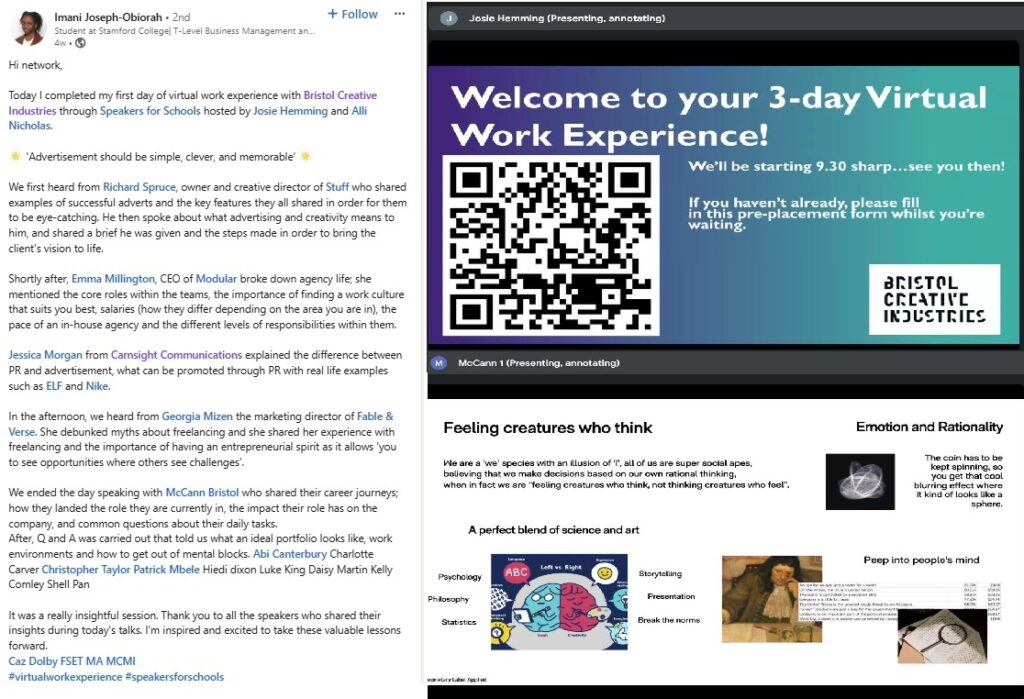
We were really impressed by the young people who took part. Big thanks to attendee Imani Joseph-Obiorah for sharing this great post about the first day. Click on the image to read a larger version on LinkedIn.
Here are great posts from some of the agencies about why they took part and their experiences during the events:
Nina Whittaker, Stratton Craig:
“Having discovered copywriting through a careers event myself, I know that events like Discover Creative Careers Week can genuinely change lives.
“A platform like this helps demystify the often lesser-known world of creative careers, opening minds to possibility and hopefully inspiring a new generation of talent. The whole process was imaginative, incredibly well-organised, and a privilege to be a part of. And it was easy to see that the students found it beneficial – they were engaged, curious and enthusiastic, and I was really impressed by their insightful questions, comments and feedback.”
Sally Knapton, Sunhouse Creative:
“It’s never felt more important to be supporting the creative industry and inspiring future talent is absolutely key to this. It was impressive to hear the students’ pitches off the back of three days of agency interactions – encouraging for the future of the creative industries!
“On a personal note, it took me a fair amount of trial and error to discover the brand design side of the industry even existed! So making ourselves visible and talking more about our part of the industry is something I feel really passionately about.”
Katharine Eriksson, McCann:
“McCann Bristol’s involvement with DCCW gave me the opportunity to show and say what I’d love to say to my younger schoolgirl self.
“I truly hope we managed to make an impact on the young people, show them their voices absolutely matter, and that they are welcome with open arms to the advertising industry and McCann!”
Daisy Martin, McCann:
“It was a great opportunity to bring attention to the variety of roles we have here at McCann. Hopefully, we were able to provide some insights on how advertising agency’s work and what we all get up to in our day-to-day.
“The questions at the end were really well thought out and insightful and makes me think many of the listeners would thrive in the advertising industry.”
Patrick Mbele, McCann:
“Speaking was an incredibly enjoyable experience. It was refreshing to see their genuine curiosity and enthusiasm as we talked about my role and the path I took to get here.
“Their questions were thoughtful and engaging, making the conversation lively and meaningful. I hope the session sparked some ideas and confidence in them to explore their own unique paths.”
Nick Farrar, Shaped By:
“We have a number of work experience students here each year and we’re always really enthused at how genuine and enthusiastic young people are about what our sector can offer.
“Inviting people into your studio is always good fun, it’s an investment of time that we never regret, but it was great to have a chance to reach a much wider audience for a short amount of time. Giving them access to a wide range of agencies over a two-day period is a top opportunity.”
Richard Spruce, Stuff Advertising:
“It was great to be involved in DCCW and I was really impressed with the students.
“To see how far they had come in a matter of days was quite incredible and speaks volumes to their attitude and all of the great help and advice Bristol Creative Industries had been able to offer them.”
A key focus at Bristol Creative Industries is boosting workforce diversity in creative businesses and helping to grow the talent pipeline for our members.
Find out more about our intiatives here.
Is there a creative resurgence in the low carbon, green sector in Bristol and Bath? Or has it been ticking away, quietly waiting, during recent years?
Bristol and Bath have always been key cities in driving forward the UK’s green and sustainability sectors – it’s part of the region’s DNA. Yet other UK hotspots seem to have taken more of a lead in developing this most vital of economic industries. Delightfully, we have recently seen multiple announcements about Bristol and Bath businesses with insightful, clever green products and inventions. Hopefully they will go beyond Bristol PR coverage and Bristol marketing to gain awareness across the UK, and potentially further.
For OggaDoon, highlighting innovative companies like the ones mentioned here is more than just showcasing future success stories; it’s about championing the bold ideas shaping a more sustainable future. Sharing their progress and getting excited about their work can be a way to inspire others to think creatively about solutions to common issues and encourage broader support for green advancements that extend beyond Bristol and Bath.
So what has caught our eyes in the low carbon market place?
We know that sustainable businesses can come from any sector, as long as they care about helping the environment and saving our planet through innovative products and services that change the way society behaves. At OggaDoon, we’re committed to amplifying voices like these and driving awareness of sustainable innovation. You can learn more about our experience in green PR and low carbon marketing on our website – or head over to our blog to read more of our takes on what’s important in the PR and marketing landscape right now.
You need to load content from reCAPTCHA to submit the form. Please note that doing so will share data with third-party providers.
More Information