UWE Bristol and Bristol Creative Industries (BCI) have formed a new partnership to support Bristol’s thriving creative businesses and provide enhanced careers opportunities to students entering the industry.
Bristol Creative Industries is one of the UK’s leading membership bodies for businesses and freelancers working in the creative sector. The not-for-profit organisation provides training and skills development, facilitates networking and business connections and supports sector growth, and currently has a membership of over 1,100. UWE Bristol will play a leading role in developing BCI’s student engagement and growing student membership.
With a rich creative and cultural sector in Bristol and the wider region, the partnership has been designed to offer insight and career opportunities to thousands studying courses rooted in the creative industries, including marketing, events, filmmaking, photography, media and communications.
Current and recent students can join BCI for free. Student members will have access to speaker events, placement and employment opportunities, and career advice from BCI members, which currently include Aardman, the Watershed and Bottle Yard Studios, giving students real-world experience and insight into working in the industry.
The partnership also aims to benefit BCI members, by developing a network of trained students who will make up the future workforce within the region and are ready to enter the industry.
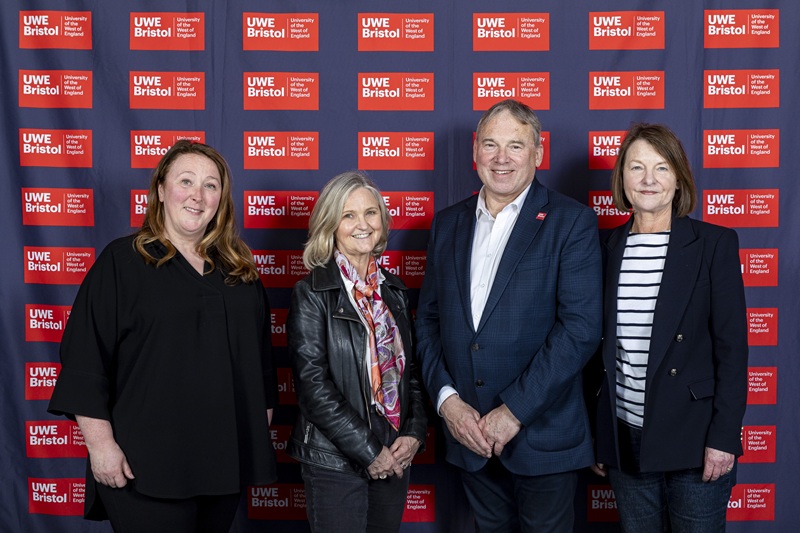
Lynn Barlow, UWE Bristol’s Assistant Vice-Chancellor for Creative and Cultural Industries Engagement, said:
“This is a really exciting opportunity for students and for Bristol’s creative industries more widely, as we support Bristol Creative Industries’ strong network of businesses and freelancers with fresh student talent. We’re really proud to be playing a leading role in such an important organisation.
“At UWE Bristol, our programmes are designed with industry to ensure our students are meeting the needs of their future employers and are work-ready. Our partnership with BCI bolsters this further, by offering students greater access to creative businesses of all sizes for invaluable industry insight and career opportunities.”
UWE Bristol and BCI officially signed a Memorandum of Understanding (MoU) at the University’s Bower Ashton campus, which will commit both organisations to developing and supporting BCI’s student membership offering.
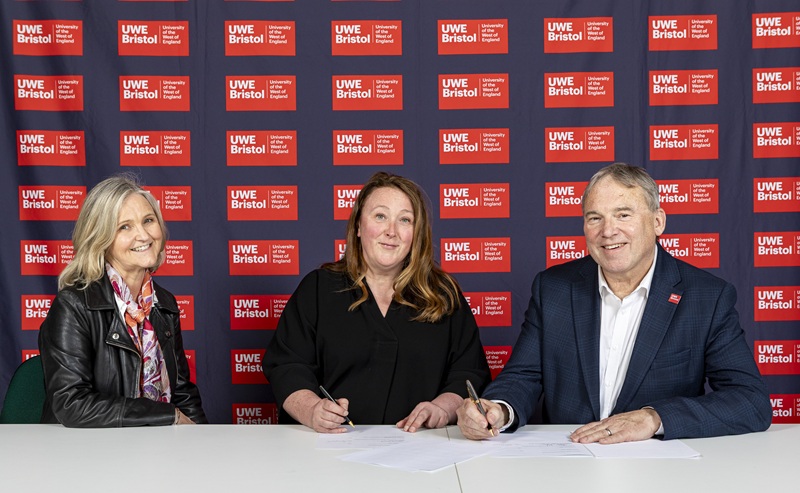
Lis Anderson, Bristol Creative Industries co-chair, said:
“Talent and skills development is a top priority for our members and this partnership will facilitate early access to emerging talent for our members, at scale.
“Building upon strong connections with education providers in the region, UWE Bristol’s breadth of programmes and BCI’s membership base of employers will work to bridge the gap between education and industry, enabling many students from a wide variety of backgrounds to unlock new opportunities and career pathways right here from the creative hub that is Bristol.”
As part of its commitment to connecting the next generation of innovators and creatives, SXSW London, the premier event for the convergence of tech, music, film & TV, arts, and innovation is launching a Roadshow in partnership with BIMM University and Digital Catapult. Free events will celebrate local innovation and creativity in Bristol, Birmingham, Manchester, Gateshead and Belfast, in the lead up to the inaugural European edition of SXSW London in June 2-7, 2025.
The first of these events will take place at BIMM Bristol on Friday 21st March and will feature thought-provoking discussions, interactive networking sessions and live performances led by local creatives and business leaders. Confirmed guest speakers for the day include Aardman’s commercial director Emma Hardie, Bristol Beacon CEO Simon Wales, Crack magazine founder Tom Frost, Visit West’s managing director Kathryn Davis, BBC Introducing’s James Threlfall, Redlight Management’s Leon Alexander and Mothers In Music founder Alice Ballantine Dykes to name a few. The day will be hosted by BBC Radio 1’s Alyx Holcombe
Participants will be able to:
This series of events will showcase Britain’s remarkable creativity, cultural diversity and cutting-edge tech industry, providing a platform for each city to celebrate the convergence of tech and creative voices, showcasing ‘beautiful collisions’ across sectors and disciplines and facilitating industry connections, career insights and visionary inspiration. It is designed to provide local communities the opportunity to give emerging creatives and innovators the tools, knowledge and new connections needed to turn ideas into reality – while tapping into the heart of local creative and tech scenes. Each event will inspire emerging talent to explore career opportunities, hone their skills and build professional networks.
SXSW London Managing Director Randel Bryan said: “SXSW London will provide a vibrant platform to showcase dynamic global voices and industry-leading ideas. We also aim to recognise the exceptional innovations emerging in the UK through this roadshow, which will celebrate the diversity within Britain’s technology and creative sectors, while spotlighting the British creativity, talent and ideas poised to drive positive impact on both a local and global stage.”
David Rowe, Pro Vice-Chancellor for Music, at BIMM University said “BIMM University is proud to be hosting SXSW London Roadshows at our vibrant campuses in Bristol, Birmingham and Manchester. We cannot wait to showcase an array of emerging talent from our creative communities and to welcome leaders from business and culture.”
Jessica Rushworth, Chief Partnerships Officer, at Digital Catapult said: “Building on Digital Catapult’s expertise in tapping into talent across the country, convening capabilities, and fostering connections with industry, SXSW London Roadshow will bridge the gap between emerging talent and real-world opportunities, fuelling deep tech innovation. Through our close collaboration with academic and industry-leading partners across the UK, we have collectively driven over £40million of investment into Createch SMEs over the last decade, reinforcing our shared commitment to providing the UK-wide expertise, facilities, mentorship, and opportunities needed to cultivate talent in the Createch space. That’s why we’re delighted to join forces with SXSW London and other partners on this inspiring initiative.”
Dates for the roadshow are as follows:
For more information please visit: https://www.sxswlondon.com
Chemistry, trust and authenticity are key ingredients in agencies winning new clients.
That’s the finding of jfdi and Opinium‘s annual New Business Barometer, a comprehensive survey of agency business development professionals, across disciplines including creative, digital, experiential, content and social.
The report, of which Bristol Creative Industries is a partner, found that generating strong chemistry with the client is the most important factor in converting prospects. It was cited by 74% of respondents, up 5% on last year’s report.
The study said:
“Chasing an increased number of opportunities coupled with hybrid working practice and pitch team stretch is making agency chemistry harder to sustain.”
Trust also plays a key role with connections and referrals the most popular prospecting strategies, highlighted by 86% and 74% of respondents.
jfdi said:
“Trust and authenticity has become a superpower in an anxious world fuelled by misinformation and uncertainty.”
When asked about the key internal challenges, time was the most popular highlighted factor, The report said time saving AI tools are one solution, with “speed of adoption over the next 12 months” potentially leading to “a significant competitive advantage for your agency”.
Five and a half months is the average lifecycle of a new business project from initial contact from pitch to client billing, the study said, and the “ghost pitch” continues to rise with 45% stating budget withdrawal as the reason for pitch loss, a 2% increase on last year.
“Agencies can safeguard their interests by activating tighter qualification of budget ‘status’ within client organisations: is it real, speculative or ‘tbc’?,” the report advised.
Additional findings from the report:
Jon Goulding, CEO at Atomic, said:
“The industry has never been more dynamic than it is today. With so many brands reviewing agency relationships and looking for such a diverse mix of specialisms, your new business strategy and approach is arguably the most important ingredient for modern agency success.
“Over nearly eight years, the New Business Barometer has become the go-to insight resource for the new business community. It always offers a fascinating snapshot into the new business community and this year is no different. While automation and AI may be improving the efficiency of new business processes, the continued importance of trust, personal connections, and chemistry really stands out.”
For a full summary of the report, email [email protected]
Event in Bristol on 13 March: How to retain your clients
Don’t lose sight of your new business pipeline
10 top tips for getting the pitch over the line
How Bristol Creative Industries members are using AI
What we’ve learned about AI in agencies: Insights from 30 creative leaders
How to prospect for new business without losing your soul
How creative businesses can write the perfect positioning statement
The West of England is one of the government’s 11 priority areas for the creative industries, culture secretary Lisa Nandy announced today.
The other areas, unveiled during an economic growth summit in Gateshead, are the North East, Greater Manchester, Liverpool City Region, West Yorkshire, West Midlands, Greater London, South Wales, Glasgow, Edinburgh-Dundee corridor, and Belfast.
The West of England is also one of six mayoral combined authorities that will receive additional funding, to be agreed as part of the government’s spending review. The others are the North East, Greater Manchester, Liverpool City Region, West Yorkshire, and West Midlands.
The government also announced £40m in funding over the next financial year for the following creative industries funding schemes:
Another announcement is that four cultural projects, including one in the West of England, have received £16.2m from the Cultural Development Fund.
The Tropicana in Weston-super-Mare, North Somerset has been awarded £2.7m to complete the final development phase of the Grade II listed seafront complex into a flagship cultural centre.
Councillor Mike Solomon, North Somerset Council’s executive member for culture and leisure, said:
“The much-loved Tropicana is a key destination at the heart of Weston-super-Mare’s seafront. I’m delighted that our bid for £2.7m from Arts Council England’s Cultural Development Fund has been approved by the UK government.
“This now enables us to carry out additional work to the building including finishing, fit out and providing increased accessibility so that more people can enjoy cultural activities and entertainment there. Reinventing this iconic landmark building will create new jobs, support local businesses, and deliver a year-round experience-led economy for the future.”
The other priojects that have received funding are:
A total of £3.6m in grants from the Creative Growth Programme has been provided to 127 creative businesses in 12 regions across England.
Recipients include these local businesses:
As announced in the industrial strategy green paper, the government is working on a full plan for the creative industries which will be published later this year. It will cover areas including funding and skills.
Feeding into the sector plan is the recently announced Creative Industries Taskforce, led by Baroness Shriti Vadera and Sir Peter Bazalgette. Sir Peter, the former chairman of Endemol UK and creative director of Endemol Group Worldwide, was last year appointed as chancellor of UWE Bristol. Read our interview with him here. In that interview, he said:
“Private investment is currently not good enough. The British Business Bank, which encourages investment in small and medium sized enterprises, is not really attuned to the way the creative industries run, the way small creative businesses work, and the criteria by which they have to be judged and invested in. We need to make progress on public and private investment.
“We also need to make progress on research and development tax credit definitions. The UK has a narrow definition of R&D, which is different to the one in other countries in Europe which includes the creative industries so creative businesses can claim tax credits for the innovation that they carry out.
“We need a more flexible apprenticeship scheme because small companies find it difficult to use the apprenticeship levy.”
Another member of the taskforce is Lynn Barlow, UWE Bristol’s assistant vice-chancellor for creative and cultural industries engagement.
In announcements ahead of the sector plan, the government says the British Business Bank, which supports £17.4bn of finance to smaller businesses, will increase its support for creative companies, and UK Research and Innovation (UKRI), which has an annual budget of £9bn, will strengthen its support for the creative industries.
The culture secretary will also announce that shorter apprenticeships will be be available from August 2025, which the government says “recognises the particular needs of the creative industries, as one of our first steps towards a more flexible growth and skills levy”.
Culture secretary Lisa Nandy said:
“From film and fashion to music and advertising, our creative industries are truly world-class and play a critical role in helping us deliver on this government’s mission to drive economic growth in all parts of the UK.
“Our £60m funding boost will support creative and cultural organisations across the UK to turbocharge growth by transforming local venues, creating jobs, supporting businesses and spreading opportunity across the country.
“But this is by no means the limit of our ambitions, which is why the creative industries are at the heart of the forthcoming industrial strategy and will continue to play a key part in this government’s plan for change.”
One of the big benefits of Bristol Creative Industries membership is the ability to self-publish content on our website. We’ve seen lots of great content published in 2024 including some brilliant business advice.
Here are the 30 most popular advice posts of the year. The list includes some posts from 2022 and 2023 that have continued to attract views thanks to their great tips.
Want to publish business advice on our website and make it into the top 30 most popular content in 2025? Become a member of Bristol Creative Industries.
Written by Moxie and Mettle
Click below or read the article here.
Written by Imagineerium
Click below or read the article here.
Mastering the Art of Pop-Up Experiences: A Guide for Experiential Designers
Written by Halo
Click below or read the article here.
Written by Varn
Click below or read the article here.
Written by Varn
Click below or read the article here.
Written by Moxie and Mettle
Click below or read the article here.
Posted by Carnsight Communications
Click below or read the article here.
Written by Carnsight Communications
Click below or read the article here.
Written by David Sheppard
Click below or read the article here.
Written by Carnsight Communications
Click below or read the article here.
Written by Imagineerium
Click below or read the article here.
Written by Varn
Click below or read the article here.
Written by OggaDoon
Click below or read the article here.
Written by Bopgun
Click below or read the article here.
The challenges of crafting a brand story & how to overcome them
Written by Superb Digital
Click below or read the article here.
Leveraging Machine Learning Algorithms in a Cookieless Future
Written by Rich Roberts
Click below or read the article here.
Written by Vid Communications
Click below or read the article here.
Written by Imagineerium
Click below or read the article here.
5 Ways AI can enhance creativity and engagement in experiential design
Written by Vid Communications
Click below or read the article here.
Written by Gather Round
Click below or read the article here.
Written by Ambitious
Click below or read the article here.
Written by OggaDoon
Click below or read the article here.
Greenwashing – Walking the Line Between Authenticity and Deception
Written by BrisTechTonic
Click below or read the article here.
SEO for Beginners: Unravelling the Mysteries of SEO+ for Up-and-Coming Businesses
Written by BrisTechTonic
Click below or read the article here.
Written by Blog Write
Click below or read the article here.
Written by SIM7
Click below or read the article here.
Written by Carnsight Communications
Click below or read the article here.
Written by Blog Write
Click below or read the article here.
Written by The Discourse
Click below or read the article here.
Written by South West Film
Click below or read the article here.
Want to publish business advice on our website and make it into the top 30 in 2025? Become a member of Bristol Creative Industries.
We were delighted to take part in this year’s Discover! Creative Careers Week, an industry-led initiative designed to provide young people aged 11-18, from England, with encounters and experiences of the creative industries through in-school, workplace and online opportunities.
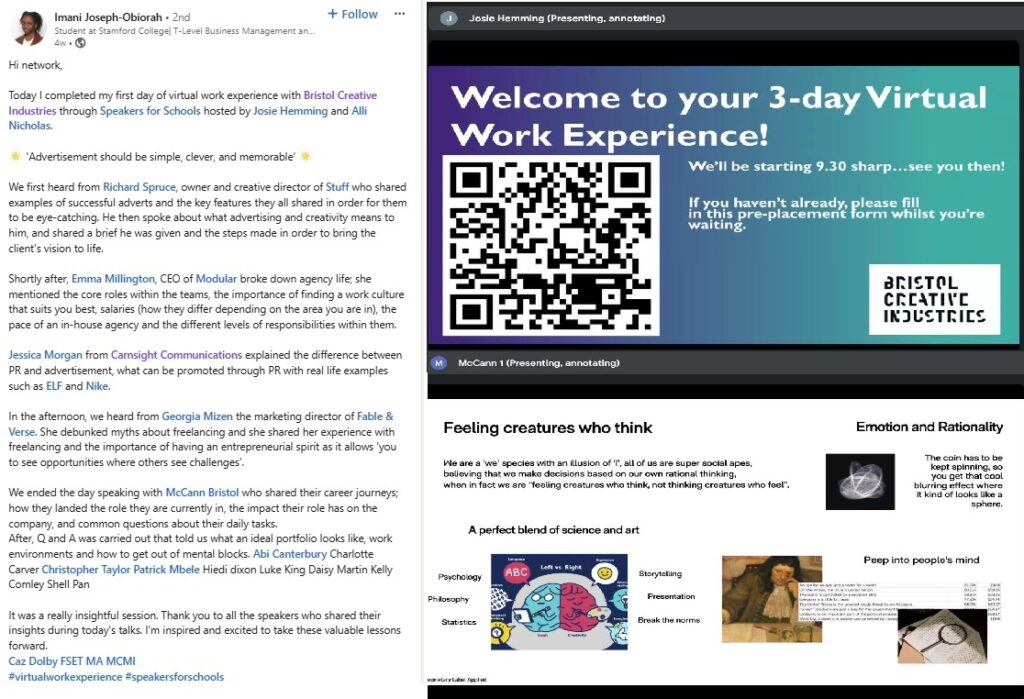
In partnership with Speakers for Schools, these brilliant Bristol Creative Industries members provided virtual work experience sessions covering PR, marketing, advertising, film, TV and more:
Stuff Advertising | Modular Digital | Carnsight Communications | Fable & Verse | McCann | AMBITIOUS | Team Eleven | Hybrid | Sunhouse Creative | Taxi Studio | Stratton Craig | Shaped By | Enviral | Conscious Solutions | Fiasco Design | The Bottle Yard Studios | Beeston Media | JonesMillbank | Studio Giggle | Distortion Studios
The sessions, managed by Bristol Creative Industries membership and operations manager Alli Nicholas and internship programme manager Clare Leczycki, featured talks about life in the creative sector, myth busting, the huge variety of different roles, and career pathways.
In between the talks, the young people were split into groups to research roles in the industry and consider their own values. They also worked on an example marketing campaign, including the problem they were they trying to solve and the marketing strategy. At the end of the final day, they presented their ideas.
We were really impressed by the young people who took part. Big thanks to attendee Imani Joseph-Obiorah for sharing this great post about the first day. Click on the image to read a larger version on LinkedIn.
Here are great posts from some of the agencies about why they took part and their experiences during the events:
Nina Whittaker, Stratton Craig:
“Having discovered copywriting through a careers event myself, I know that events like Discover Creative Careers Week can genuinely change lives.
“A platform like this helps demystify the often lesser-known world of creative careers, opening minds to possibility and hopefully inspiring a new generation of talent. The whole process was imaginative, incredibly well-organised, and a privilege to be a part of. And it was easy to see that the students found it beneficial – they were engaged, curious and enthusiastic, and I was really impressed by their insightful questions, comments and feedback.”
Sally Knapton, Sunhouse Creative:
“It’s never felt more important to be supporting the creative industry and inspiring future talent is absolutely key to this. It was impressive to hear the students’ pitches off the back of three days of agency interactions – encouraging for the future of the creative industries!
“On a personal note, it took me a fair amount of trial and error to discover the brand design side of the industry even existed! So making ourselves visible and talking more about our part of the industry is something I feel really passionately about.”
Katharine Eriksson, McCann:
“McCann Bristol’s involvement with DCCW gave me the opportunity to show and say what I’d love to say to my younger schoolgirl self.
“I truly hope we managed to make an impact on the young people, show them their voices absolutely matter, and that they are welcome with open arms to the advertising industry and McCann!”
Daisy Martin, McCann:
“It was a great opportunity to bring attention to the variety of roles we have here at McCann. Hopefully, we were able to provide some insights on how advertising agency’s work and what we all get up to in our day-to-day.
“The questions at the end were really well thought out and insightful and makes me think many of the listeners would thrive in the advertising industry.”
Patrick Mbele, McCann:
“Speaking was an incredibly enjoyable experience. It was refreshing to see their genuine curiosity and enthusiasm as we talked about my role and the path I took to get here.
“Their questions were thoughtful and engaging, making the conversation lively and meaningful. I hope the session sparked some ideas and confidence in them to explore their own unique paths.”
Nick Farrar, Shaped By:
“We have a number of work experience students here each year and we’re always really enthused at how genuine and enthusiastic young people are about what our sector can offer.
“Inviting people into your studio is always good fun, it’s an investment of time that we never regret, but it was great to have a chance to reach a much wider audience for a short amount of time. Giving them access to a wide range of agencies over a two-day period is a top opportunity.”
Richard Spruce, Stuff Advertising:
“It was great to be involved in DCCW and I was really impressed with the students.
“To see how far they had come in a matter of days was quite incredible and speaks volumes to their attitude and all of the great help and advice Bristol Creative Industries had been able to offer them.”
A key focus at Bristol Creative Industries is boosting workforce diversity in creative businesses and helping to grow the talent pipeline for our members.
Find out more about our intiatives here.
Bristol’s globally respected Encounters film festival will make a comeback in September next year following a change of management which sees Dave Taylor-Matthews take over as Executive Director.
The festival – widely praised for its knack of discovering new talent – cancelled its 2024 edition and cast doubts about the future after it was hit by a series of challenges triggered by Brexit’s impact on access to European funding and the pandemic.
But now Dave Taylor-Matthews, a veteran producer of festivals and live cinema events in the UK and beyond, is working on a re-launch – fixing 24 to 28 September 2025 as the dates of the landmark 30th Encounters and opening the call for entries.
He says:
“There is no way that Bristol, a UNESCO City of Film, nor the sector was prepared to let go of a festival which has a 30 year track record of showcasing brilliant short film, nurturing emerging film-makers and identifying talent and whose alumni include such stand-out figures as Andrea Arnold, Rungano Nyoni, Ruben Östlund, Martin McDonagh, Lynne Ramsay, and Denis Villeneuve.
“We are determined to lead the fight against ‘enshittification’ and are powering ahead with a 2025 programme which will screen bold and inventive new works, feature headline events of wide appeal, provide a space where new creative projects and partnerships are born and where all film fans feel welcome. 30 years of Encounters deserves an epic celebration!”
Entries are being invited now via www.filmfreeway.com/encountersfilmfestival for live action, animated, documentary or experimental films of under 40 mins in length and (to make up for the 2024 festival’s cancellation), completed on or after 1 January 2023.
There will be cash prizes for the top performing films in competition for the international and national grand prix plus the chance to qualify for entry to the British Independent Film Awards or BAFTAs &/or get nominated for a European Film Award.
Among those welcoming the return of Encounters to Bristol’s events calendar are Aardman co-founder David Sproxton; Mark Cosgrove, Cinema Curator at Watershed, and Natalie Moore, manager of Bristol Film Office and of the Bristol UNESCO City of Film programme.
Natalie Moore says:
“For thirty years, Encounters has played a pivotal role for Bristol; nurturing and springboarding film talent, leading industry conversations, and elevating our international profile. The festival’s return in 2025 is fantastic news for both filmmakers and audiences, and the 30th edition promises to be a celebration of everything Encounters does best – gathering film lovers, filmmakers and industry figureheads to enjoy the best shorts around and create film experiences to remember.”
To stay up to date with Encounters’ news, sign-up for the free e-bulletin via the festival’s website at www.encounters.film or find/follow the festival’s accounts on Bluesky, Facebook, Instagram, Vimeo or YouTube.
Launched with a successful pilot in 2023, the Bristol Creative Industries programme, in partnership with Babbasa, is aimed at young people aged 18-30 from under-represented backgrounds who want to gain more insight and real experience in the creative industries.
Brilliant agencies from the Bristol Creative Industries member community provide paid placements for the interns over six months.
The structure of the internship programme means that our interns spend Monday to Thursday working within the agencies and come together as a cohort on a Friday for a skills and training day.
The Friday sessions allow them to reflect on their internship experiences and pick up a range of other skills such as CV writing, building brilliant LinkedIn profiles, networking, how to navigate the workplace, and developing healthy work habits.
Other sessions were focused on technical skills and included managing a creative brief, digital accessibility, data analytics and SEO. As part of the programme, the group also attended the Building Brands Conference and worked on social media for Bristol International Balloon Fiesta.
Alongside the practical skills sessions, this year’s cohort was tasked with working on a live brief to develop a suite of material that could be used to educate, inform and inspire other young people considering a career in the creative industries.
Often, opportunities in the creative sector pass young people by, simply because they don’t know enough about the sector and the wealth of opportunities available. Across the region, we know that BCI members are worried about the potential long term skills shortages and a lack of diversity within the sector. To address this we need to get the creative industries in the minds of young people much earlier so that they view the creative industries as a viable and fulfilling career choice.
The live brief allowed the interns to work as a team, showcase and develop their skills and specialisms, and produce work they could include in their portfolios going forward. It’s also a lasting legacy that we can build on to support our outreach activities with local schools, colleges and universities.
“Create engaging and informative promotional materials aimed at young people interested in entering the creative industries (specifically creative agencies). These materials should explore and explain various job roles and required skill sets within the industry.”
The group began by discussing the brief and fleshing out the nuances and areas they wanted to focus on. Getting into the creative industry for a young person, particularly from an under-represented group, can be challenging, so we were keen to use this opportunity to create some assets and resources that would help young people better understand the different roles and departments with a creative agency.
The group split into groups (based on their individual strengths) to develop the strategy and research, production elements (filming and interviews), and design the digital assets.
As part of the initial research, the strategy team looked at the importance of diversity in the creative industries. Based on their own experiences and some further research, they explored some of the reasons why young people can find it hard to get into the industry.
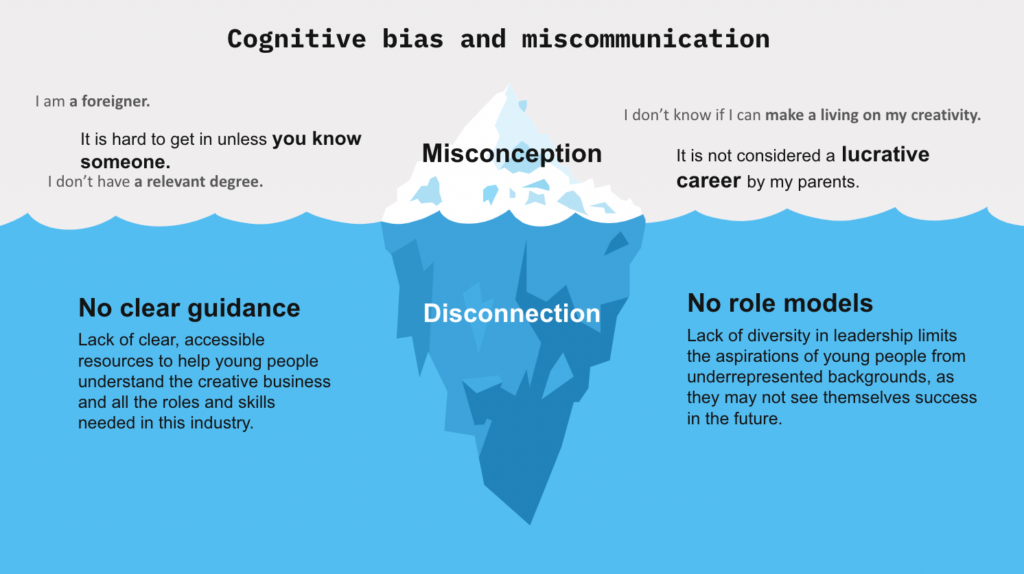
They also undertook some research into some of the potential barriers to entry for young people whilst also exploring why diversity is so important in creative teams.
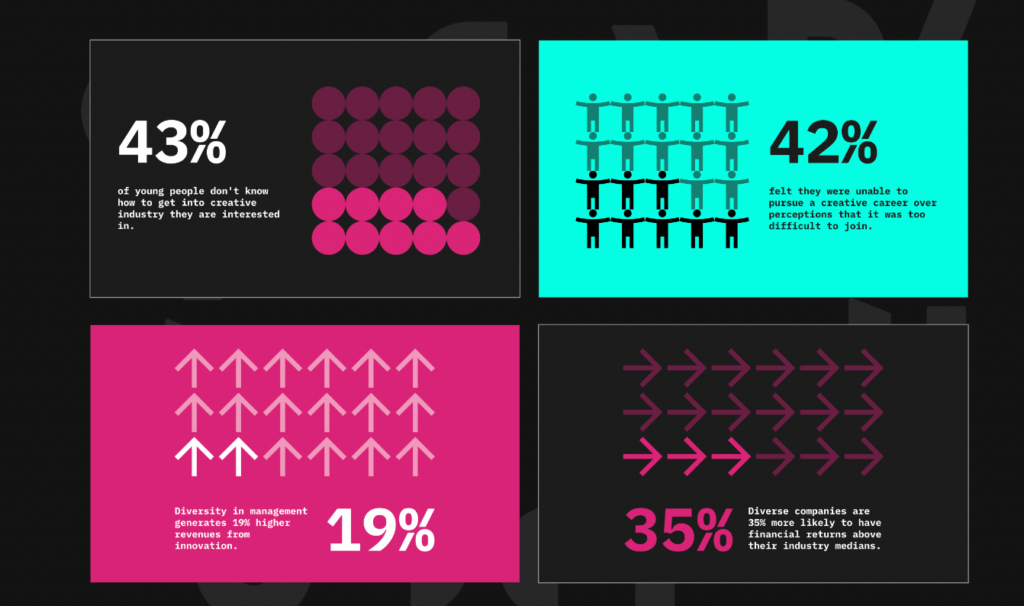
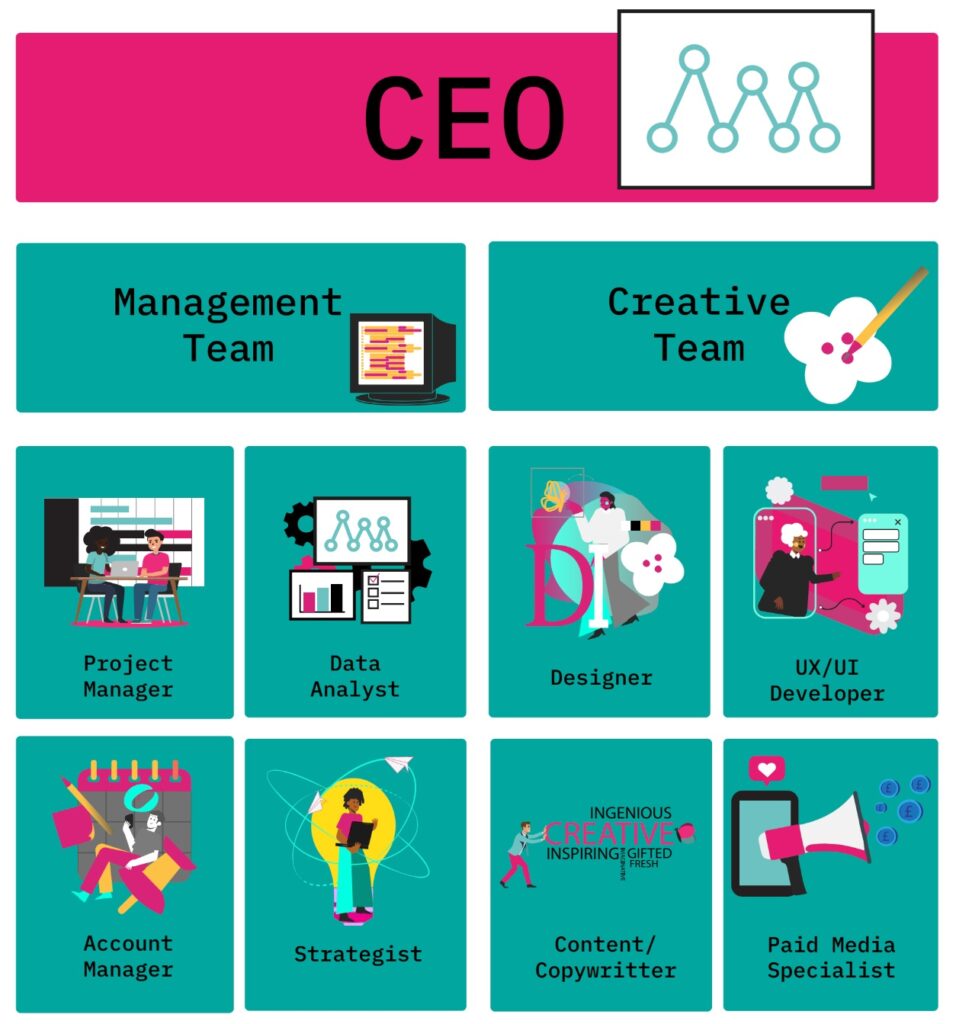
In order to address some of these issues to demystify what it means to work in a creative agency, the interns looked at the different team structures, job roles and types of projects, campaigns and products that are produced.
From their own experiences and their research, the team felt representation was key in promoting these job roles to the next generation of talent. They selected six people from the BCI membership, all from diverse backgrounds, to share their insights, pathways, and top tips for working in a digital agency.
As part of their campaign, the team were keen to create an impact to:
They decided to create three different assets:
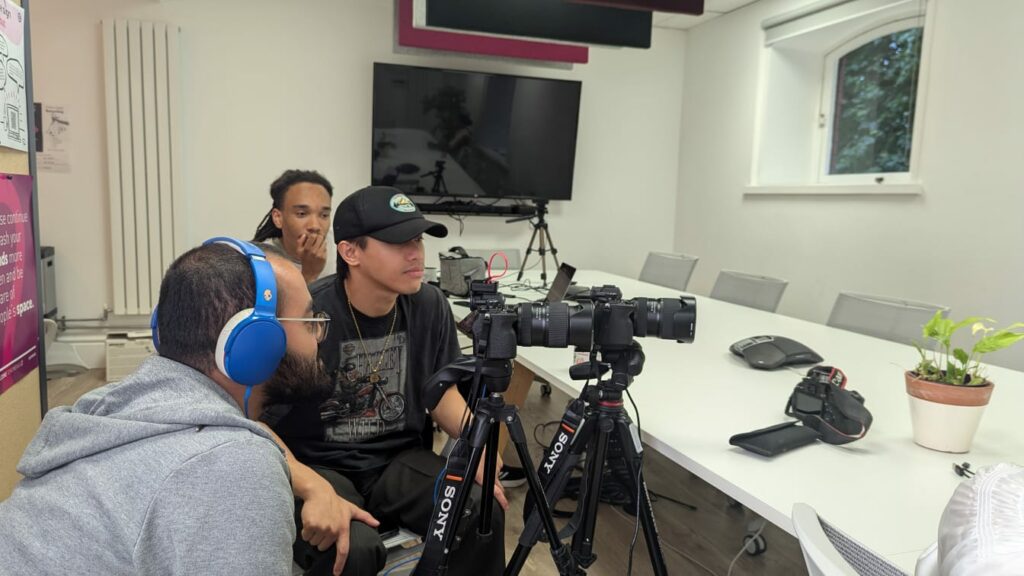
The film crew sourced equipment, put together a production schedule and interview questions, and spent two days visiting our guest interviewees in their place of work gathering content. It was an intense shoot but everyone worked as a team and played to their strengths. They captured six interviews which then needed to be edited and shaped into bitesize content.
The interviewees were:
Meanwhile, the design team made the digital assets that the content would feed into, creating infographics, and social media post templates. They used the BCI branding as a guide but wanted to bring in elements to make sure the designs appealed to a young audience and were both inclusive and representative.
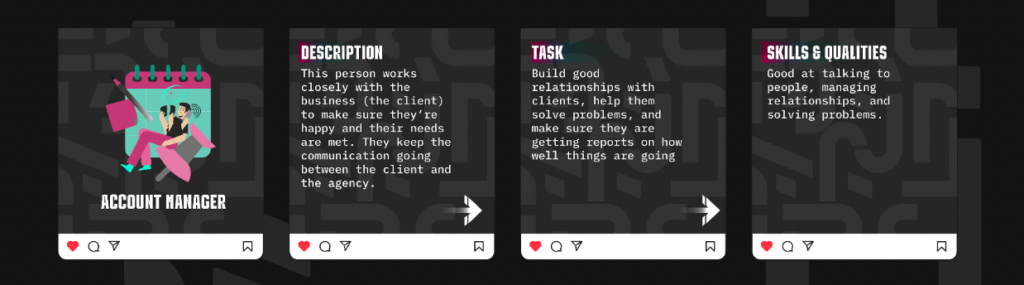
Job roles within a creative agency:
Instagram carousel:
Social media posts:
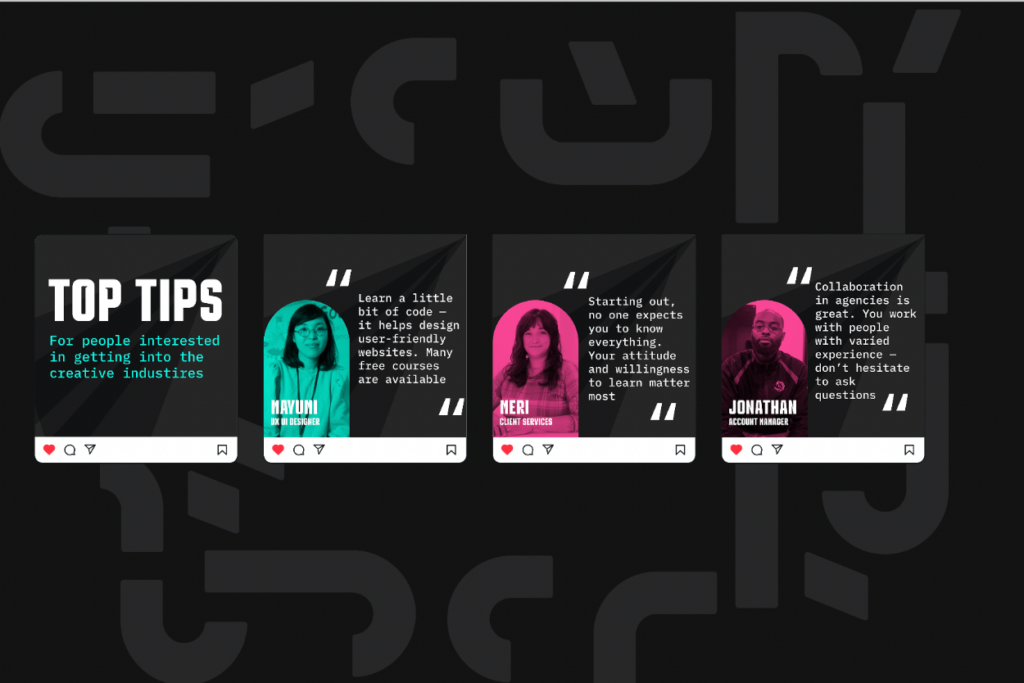
Once the interviews were complete, the team spent time pulling out the key quotes and messaging that could then be used for some social media posts which included top tips for working in the industry, pathways to creative careers, potential barriers to work, and the importance of diversity in the sector.
Webpage wireframe examples:
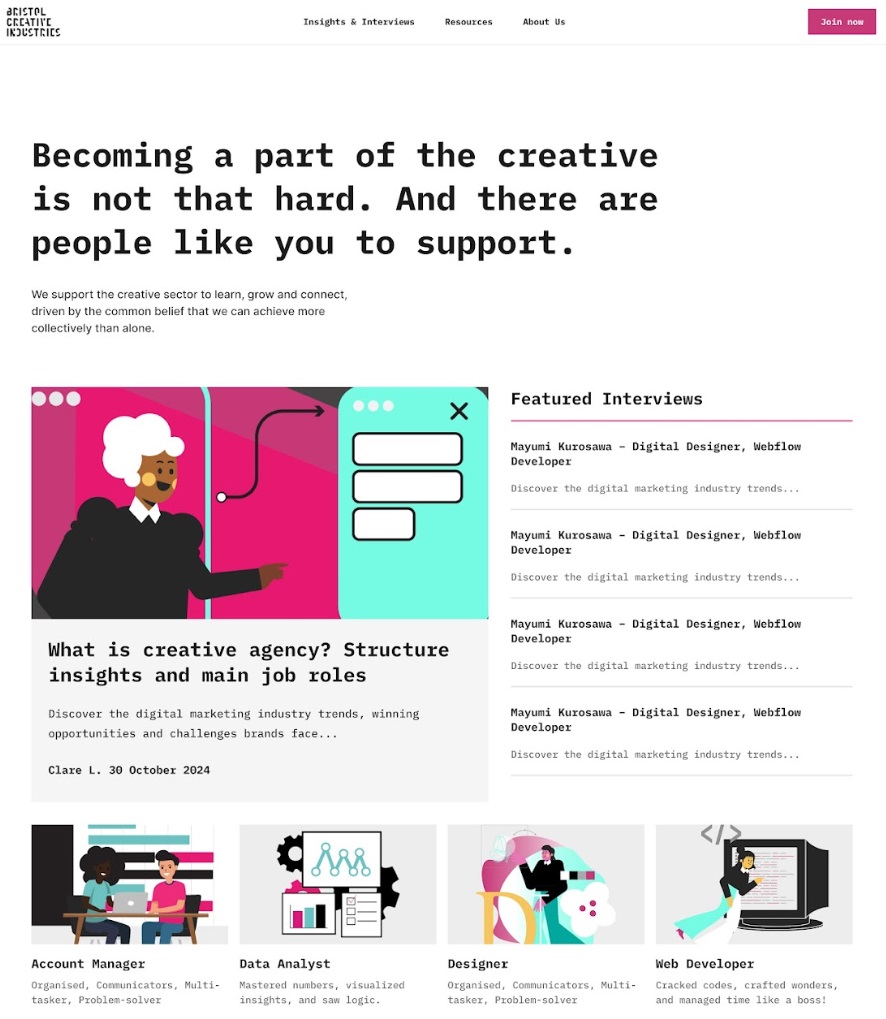
As part of their workflow, the group presented their research and designs back to the BCI team for feedback and suggestions. We are so impressed with their work and are keen to use it to create a resource pack we can send out to education providers and youth groups to help spread the word about creative jobs.
Watch the final film here:
You are currently viewing a placeholder content from YouTube. To access the actual content, click the button below. Please note that doing so will share data with third-party providers.
The interns will soon complete their Bristol Creative Industries internship placements and are looking for their next opportunity. If you have a role that you think may be suitable for one of this year’s interns, please get in touch with [email protected] asap before they get snapped up!
Here are some useful resources to help young people find opportunities in the creative industries, including internships and junior level roles:
Happy Global Entrepreneurship Week!
The UK’s creative industries are jam-packed with small businesses and self-employed individuals.
Government data shows 95% of the sector’s companies are micro-businesses, while self-employment accounts for 32% of employment, compared to 16% for the economy more broadly.
With that in mind, Dan Martin asked individual and startup members of Bristol Creative Industries to share their tips for running a successful freelance or small business. We received some brilliant responses which we’ve highlighted below.
Become an individual and startup member of Bristol Creative Industries for only £4.95 a month or £49+VAT a year and enjoy many business-boosting benefits. Sign up here.
Bristol Creative Industries members share their tips below. Click their BCI profile links to find out more about them and to see if there are opportunities for collaboration. We love to see members working together!
Build a network
Working for yourself can be a solitary pursuit and the idea of networking can be intimidating. But it starts with making friendly connections. That can create the basis for future partnerships, referrals and support.
We’re lucky to be spoilt for choice with a wonderful community in Bristol and the South West and Bristol Creative Industries is at the heart of that. I’ve enjoyed every minute of making like-minded connections and friends in the process.
Sell yourself with confidence
Don’t be shy. Remind people of your experience and expertise – don’t assume they know that already. Make it an easy choice for them to buy your services. If you keep it authentic and make a personal connection, selling doesn’t have to feel awkward.
Take time to contract with a clear brief
Over the years I have been eager to make it as easy as possible to get started on a scope of work by writing a proposal from a loose verbal brief. That means doing a lot of the scoping myself which, as well as a lot of time and effort unpicking the client’s needs, can leave room for (mis)interpretation. I find the most successful partnerships involve the client putting an equal amount of work in up front to shape a really clear brief.
Having a good support network is key. In my experience, this goes beyond family and friends. Of course, you need people around who love you unconditionally. You also need those people who, being self-employed, just get it. People who understand the ups, as well as the downs, and who can give you a boost with some sage words of advice. You never know when you might need to call on those freelance friends – whether it’s celebrating a big win or simply asking, ‘How do I do that thing on Mailchimp, again?!’ Don’t go it alone, you’ll travel farther with trusted, supportive people at your side.
—
The freelance life is full of many highs and lows, and it can be easy to focus on the negative, worries and stresses. When things have felt stressful or a bit bleak, which I know it has done for the freelance community over the last 6 months or so (everyone is feeling it, it’s not just you!), then put the work in, get your head down, send out the emails, chase the leads, get back in touch with previous clients and trust the process. It works. Work comes in, clients get back in touch, and those invoices (finally!) come through.
Being part of a community of likeminded freelancers and solo workers really helps. I created a Slack community for freelance and solo workers in the South West, which has been a great place for us to share briefs, get advice. We also share the wins. It feels great to celebrate your milestones with others as they know the importance of them too!
—
Work out who you are before you offer services
The creative industry is becoming more and more specialised, so we (as companies or individuals) need to move with that trend ourselves. It’s good to have multiple offerings and skills but you open yourself up to more competition. So when it comes to marketing yourself, it’s better to be amazing at a couple of things than being ‘just good’ at too many things. Maybe you focus on editorial design or you might be an illustrator in the sports sector. This doesn’t mean turning away work that doesn’t suit your marketing; it’s just simply good to have a focus. This makes branding your company far less complicated and helps with consistency.
Create a content strategy
It’s important to show up to work. If you don’t, you get fired. The same thing happens if you’re freelance or a small business but instead, the clients forget about you. Building a consistent content strategy keeps you at the forefront of your audiences’ minds. Write short blogs about your sector, interact with your audience by having competitions or you could even do peer shout-outs. Just make it relevant and consistent.
—
Invest in your own brand
There are so many businesses out there doing the same or similar to you, so make sure you are really clear about who you are. Not just your services, but really what makes you tick, what makes your business individual and why clients should come to you. Look at what you are incredibly skilled at, knowledgeable about, understand and enjoy. Then build on it.
Keep moving forward
Stay relevant, understand the market, keep talking to people to learn more. Just don’t get caught up in the jargon and hype. Your customers and clients won’t understand it, or care.
Be inspired by your own creativity
It’s your business so you should be excited by it. If you’re not then you’re probably on the wrong path. Look for the type of work you want to do and reflect it in your work. Talk to businesses that hold similar values. Follow people, brands and businesses on social media that give you fire in your belly.
Care about what you do
Actually give a damn. Care if you get back to someone, care if it is right, care if you think it could be better. Care about what you do and others will too.
Face reality
Running your own show isn’t easy. Always be ready to change the plan, surround yourself with people that are genuinely on your side and want you to succeed. Above all, have the right mindset, stay positive and believe in your own ability. Then just when you’re about to give up, that’s when you need to push even harder.
Give back
It may be a portfolio review, your time, your advice, your energy, but give back when you can and do it genuinely and generously.
—
Find yourself an accountability partner. When you’re running your own small business it’s important to have someone to talk to. When you don’t have a team of your own, find someone that understand’s the highs and lows of running a similar business. I have a weekly Friday afternoon Zoom call with another marketing consultant and we use it to share what we’ve been working on, what we’ve seen on social media and what we’re planning to work on next. Setting this up during Covid lockdowns, and continuing it since, has been one of the most valuable things I’ve ever done for my business and me personally.
—
Actively and regularly seek out your ideal clients
Sometimes money can overrule your decisions, whether on a practical basis of needing more of it, a big project that sounds too good to be true or it doesn’t quite feel like the right fit with your values and expertise. Working when you feel any kind of conflict (internally) can be really hard work for all involved. Don’t underestimate the strength of a long-term client that you align with and have trust and respect on both sides. Working with the career mentoring charity Ablaze for five years has been my biggest reward in terms of the value of the work they do and I support them with, and in being so consistent long-term.
Be alive to all opportunities
You never know what opportunities are behind someone’s ask for help on social media such as LinkedIn. I stepped in to some really interesting research work with Projects by IF through answering a last minute call for help when a team member got Covid. Plus chatting to a client via an introduction (thanks Constance Fleuriot!) at the Data Science Conference last year turned out they wanted help with a project researching the mental health ecosystem for their mental health app. Keep exploring and don’t miss opportunities on your own doorstep.
—
Climate/environment: Often an overlooked part of the business, it is important for you and your team to know where you stand. We are not talking about addressing global climate change, but rather what approach your business takes. Using something like the UN Global Sustainable Goals (SDGs) can be a useful tool to measure and monitor on-going improvement. Delegate this to one of your team who is passionate about climate and the environment.
Finance: Keep a close eye on financial health. Are you equipmed to do this yourself or should you delegate this and get someone to oversee this for you? Regularly analyse cash flow, manage expenses, and invest wisely to maintain stability and fuel growth.
IT/tech/web: Embrace technology to improve productivity and customer experience. An effective online presence and streamlined IT systems can enhance efficiency. Again, this can often be delegated to specialist that will advise, set up and keep your system safe. Don’t wait for the headache, scam, fraud, breach to hit you – anticipate and get an expert in to set you up.
Marketing: Develop a targeted marketing strategy to reach your ideal customers. Will you do this? Will one of your team? You know your business best, but are you best equipped to deliver this? Focus on cost-effective digital marketing channels that yield a high return on investment and consider whether you should do this internally or delegate it.
Mindset/culture/vision: This is so important and your team (and partners/freelancers) should be fully briefed on this. Keep an eye on it and cultivate a growth mindset and a clear vision for the business to share across your business, peers and clients.
Sales: Nurture a strong sales team and develop effective sales strategies. Consistent revenue generation is vital for business sustainability and expansion, and, a with ops and delivery, this is key to business growth. But should you be doing sales, or one of your team or outsource this? Only you can decide.
—
Be true to yourself, and be authentic. Take small steps if needed, celebrate all your successes, and try not to compare yourself to others. Set realistic goals, build a support network, and consider finding an accountability partner – someone who will listen impartially, remind you of your goals, and help you stay on track.
—
The key to doing what I love and building great creative relationships is forging a true connection at a personal level – getting as close as possible is where I do my best work because then I’m fully invested in both head and heart.
Time and time again it’s over a coffee or a wine that the no holds barred honesty chats happen and reveal the truth of what is on the table and why you are the best person to help bring it to life. People love to talk so offering them the opportunity to be heard is where the magic happens. I’ve often thought I should list in my proposals: two, three, four hour coffee chats as a key stage in the creative process.
As human beings we love to find connections and then tell a story about how that relates to us – and as designers that’s how we create beautiful solutions by listening, understanding and simplifying the story to make it easier to understand.
—
Always deliver on time or slightly early.
Be clear and proactive with the client, especially about what they said they would do/by when. If their lateness impacts you, say so right away – in writing.
Always assume there will be some fallow months. Take out money that you need not what you want!
Build a nest egg – the bigger the better.
If buying in services, such as print, get payment from the client upfront. Always mark up such services.
Keep personal drawings and money separate from business revenue – they are not the same.
Always keep money in the business account for a rainy day – cash flow is king/queen and the tax authorities will need paying!
Consider a limited company but understand the differences versus self employed.
—-
If you come up with a great name for your creative business, you must do due diligence to make sure it’s available. Check on Google, check domain names, check Companies House and, most importantly, check at the Intellectual Property Office as a trademarked name trumps a limited company name. If it is available, trademark it.
—-
Become an individual and startup member of Bristol Creative Industries from only £4.95 a month and enjoy many business-boosting benefits. Sign up here.
Chancellor Rachel Reeves delivered the 2024 Autumn Budget 30 October, the first from the UK’s new Labour government. Here’s a round-up of measures and announcements relevant to businesses in the creative industries.
Describing it as a Budget “to fix the foundations”, the Treasury said “difficult decisions” had to be made “on tax, spending and welfare to restore economic and fiscal stability” to deal with a “£22bn black hole” in the public finances left by the previous government.
The announcements included £40bn in tax rises, with the big headline the increase in employer National Insurance which will add significant costs to many businesses.
We’ve listed the measures relevant to most businesses at the end of this article. Firstly, here are the announcements specific to the creative industries in the West of England region.
The Budget confirmed that the government will continue to fund the following creative industries programme:
The government said it will provide £3m in funding to expand the Creative Careers Programme, which raises awareness of career routes and tackles skills gaps in the key sector.
The Creative Industries Clusters programme, which has supported creative businesses in nine regional hubs, will continue to provide support over the next six years, with more clusters to be announced. Bristol and Bath was one of the regions supported between 2018 and 2024 through Bristol and Bath Creative R+D.
The Autumn Budget confirmed that the creatives industries is one of eight sectors of focus in the government’s vision for its new industrial strategy.
It has published a green paper and launched a public consultation. Read more details here.
The government said it is providing tax reliefs for the creative sector worth £15 billion over the next five years, and confirmed announcements from the previous government’s Spring 2024 Budget:
From 1 April 2025, film and high-end TV productions will be able to claim an enhanced 39% rate on their UK visual effects costs. UK visual effects costs will be exempt from the credit’s 80% cap on qualifying expenditure, with costs incurred from 1 January 2025 eligible.
The previous government proposed that generative AI would not qualify for the additional tax relief for visual effects, but the new government has dropped that measure.
UK Screen Alliance said the move means that the UK is now set to attract an additional £175m per year of spending on VFX for film and TV, an increase of over 45%, and to create 2,800 new jobs.
Adrian Wootton OBE, chief executive of the British Film Commission, said:
“UK film and TV is globally admired, and a key sector driving economic growth. Our VFX sector is one of the jewels in the UK industry’s crown, with a depth of creative and technical expertise. But these are competitive times. Productions are looking globally for the best talent and incentives to guide their investment decisions.
“Any new measures must address intensifying global competition and help us put our best foot forward. Confirmation of the VFX tax credit increase doubles down on UK strengths and will drive up investment. It is not only welcome, but essential to support our sector and wider UK growth.
“We’re delighted that HM Treasury has listened to industry feedback on generative AI, and included these costs in the overall VFX tax credit enhancement. The BFC pressed for this in our consultation response and we believe this will play an important part in keeping our VFX sector future-proofed and globally competitive.”
From 1 April 2025, UK films with budgets under £15m and a UK lead writer or director will be able to claim an enhanced 53% rate of audio-visual expenditure credit. Expenditure incurred from after 1 April 2024 on films that began principal photography on or after 1 April 2024 is eligible.
From 1 April 2025, the rates will be set at 40% for non-touring productions and 45% for touring productions and all orchestra productions.
Culture Secretary Lisa Nandy said:
“The creative industries will play a critical role in helping us turn the corner and deliver on the national missions of this government – driving economic growth into our towns and cities; drawing on the wealth of talent that exists everywhere; and flying the flag for British culture and values on the world stage.
“The chancellor’s Budget underscored just how important these sectors are going to be with funding extended for vital programmes and tax reliefs, an expansion of the Creative Careers Programme and a £25m investment in the CrownWorks Studio in Sunderland that will make the city one of the centres of our TV and film industry for years to come.
“This government recognises that for millions of people, geography has become destiny. That while talent is everywhere, opportunity is not. This Budget has put the creative industries front and centre of how we write those people back into our national story and drive opportunity, jobs and prosperity into every community, in every region.”
The following are announcements not specific to the creative industries but are of interest to businesses in the sector.
To fund public services, including the NHS and education, the government will increase employer National Insurance.
The rate will increase by 1.2 percentage points to 15% from 6 April 2025. The secondary threshold, the level at which employers become liable to pay National Insurance on each employee’s salary, will reduce from £9,100 per year to £5,000 per year.
To protest the smallest businesses from the National Insurance rise, the employment allowance will increase to £10,500 from £5,000 and be extended to all eligible employers by removing the £100,000 cap.
The government said this will allow firms to employ up to four National Living Wage workers full time without paying employer National Insurance.
The government will increase the lower and higher main rates of Capital Gains Tax (CGT) to 18% and 24% respectively for disposals made on or after 30 October 2024.
Business Asset Disposal Relief, which entrepreneurs pay when they sell all or part of their business, and Investors’ Relief, which reduces CGT on a disposal of shares in a trading company that is not listed on a stock exchange, will increase to 14% from 6 April 2025, and to 18% from 6 April 2026.
The National Living Wage for employees over 21 will increase by 6.7% to £12.21 an hour from April 2025. The government said this represents an increase of £1,400 in the annual earnings of a full-time worker
The National Minimum Wage for 18-20 year olds will rise by 16.3% to £10 an hour, the largest ever increase in both cash and percentage terms.
The government said that intends to create a single adult wage rate over time.
The cap on bus fares in England, due to end on 31 December 2024, will be retained until 31 December 2025, but with a 50% increase from £2 to £3.
From 2026-27, “permanently lower” business rates rates for retail, hospitality and leisure properties in England will be introduced. The government said “this will be funded sustainably by introducing a higher multiplier for the most valuable properties, including distribution warehouses used by online giants”.
Business rates relief for retail, hospitality and leisure businesses in England, up to a cap of £110,000 per business, due to end in April 2025, will be retained for 2025-26. However, it will be cut from 75% to 40%.
The small business multiplier will be frozen in 2025-26.
The government confirmed continued funding for small business finance schemes provided by the British Business Bank including £250m in 2024-25 and 2025-26 for Start Up Loans and the Growth Guarantee Scheme. To boost access to finance for women entrepreneurs, the bank will also invest £50m into female-led funds.
The Budget confirmed that the UK Shared Prosperity Fund, the government’s replacement for EU funding which was due to end in April 2025, will be extended for another year but with reduced funding of £900m.
The government will also continue to fund the Help to Grow: Management course and Growth Hubs in England in 2025-26.
A “Small Business Strategy Command Paper” will be published in 2025 that will “set out the government’s vision for supporting small businesses, from boosting scale-ups to growing the cooperative economy, across key policy areas such as creating thriving high streets, making it easier to access finance, opening up overseas and domestic markets, building business capabilities, and providing a strong business environment”.
You need to load content from reCAPTCHA to submit the form. Please note that doing so will share data with third-party providers.
More Information