Neil Berry – Head of Development at Proctor + Stevenson
What does a back-end developer do?
The core of my work as a Back-End Developer, is of course writing code using the framework or language for the task or project. But there’s more to it than that.
On any given day, I might be building out a feature to an established application or altering how something works to provide better value to our clients. I may be investigating a scenario that is leading to undesired outcomes on the application and then proposing a solution to the team or client.
Or sometimes I’m tasked with thinking about how best to address a business need with an established system – either using a solution Proctors has previously created in a new context or using something entirely new.
Solutions we work with at Proctors are based on Drupal, Symfony or AWS and across the lifecycle of a project, a back-end developer will work closely with all parts of Proctors Technology.
There are also times when we’ll work directly with our clients to understand their needs or demo how progress is going.
Watch video here.
What does a typical day look like at P+S?
A typical day is a good mix of collaboration and focus time. That can be in the office or remote, thanks to our hybrid flexible working policy.
Usually, we’ll have a brief check in with the project team we’re working with. Then there’s either a follow up with some team members to discuss a specific aspect of the work, or I’m head down working on a feature until lunch.
If I’m in the office, I’ll join everyone in the canteen – especially if it’s a pop-up lunch day or (even better) one of our monthly pre-paid lunches. If I’m at home, I may take a long lunch and go for a run or catch up with friends.
My afternoons vary depending on the day. Sometimes I dive back into working on a feature, or sometimes there’s an internal workshop or meeting with a client to talk through a piece of work.
It could also be that the day is set aside for planning and estimating forthcoming work, or training. This is in support of the training roadmaps that are set out based on the goals discussed with the leadership team.
Working with clients
We work with marketing departments across various industries. And while most have similar needs, they all face unique challenges. It’s up to the development team to craft bespoke solutions that work for them.
We have some complex systems that require varying skillsets and experience so working as a team and sharing knowledge can be crucial. In some cases, we find a solution we’ve used in one project that might lend itself well to another. This is why it’s important to build simplicity and flexibility into our solutions to help us manage time efficiently, rather than starting from zero each and every time.
Why Proctor + Stevenson?
Proctor + Stevenson is more than a company people work for; it has a real sense of community. There’s a strong support network so if you ever need to talk to someone, there will always be someone to listen. On top of that, P+S have some great initiatives. From our weekly Wednesday quiz nights to our Friday socials and even pop-up lunches, there’s always something fun going on to get involved with.
There are also plenty of charity fundraising events and other community projects we get involved with which is fantastic. And we host the annual South West Design and Digital Student Awards which is a great way for students to kickstart their career in the industry.
And it goes further than doing good for people, we also have a number of initiatives surrounding our sustainability, and we’re currently working towards our B-corp certification.
These are just a few of the ways Proctor + Stevenson works to be a positive environment for employees and clients alike. Everyone is incredibly friendly and always happy to help each other out, it’s genuinely a really welcoming community of people.
If you’re interested in working with us at Proctor + Stevenson, check out our careers page to see if any of our opportunities suit you.
Getting traction online can be tricky without the right approach, but with a bit of creative thinking, generating online awareness can be done for even the most seemingly ‘stuffy’ brands.
Digital PR is very important when it comes to SEO, links are crucial to the algorithm for Google, and other metrics like social mentions and branded mentions are great for building your brand online.
Digital PR and creative content outreach is one of the key pillars of Varn’s full service approach to SEO, and covers a wide range of tactics and strategies around research and competitor analysis, content creation, and digital PR/link building.
Here we take a closer look at digital PR and why it is crucial if you weren’t your business to succeed online and your website to rank well in search engines.
There are a few key differences between digital PR and traditional PR even though they are often two complimentary channels.
Digital PR is a term which typically applies to more online activities and covers but is not limited to the following:
Traditional PR can often work as a stand-alone push and in many instances targets traditional media like print and television advertisements and placements. The ways that you measure success are also more apparent than with traditional PR.
Whereas a television campaign or print media advert may have reached a certain target demographic, tracking the actual numbers of people that saw it can be difficult and tracking the revenue impact is often even more challenging.
Whilst the tracking and right KPIs need to be set up in advance, measuring success is often easier with digital PR.
Brand mentions social media interactions and link coverage are all easier to track and set key performance indicators against. Other follow-on metrics can also be used like ranking increases when looking at SEO and the potential increased revenue impact from these increases in SERP performance.
Once you have content to reach out with (be it survey data, products, commentary or infographics) it is time to put together the target publication list. We work with the client to understand their ideal placements and tie it in with data on sites that we know move the needle when it comes to SEO value.
Before we start with the outreach, we ensure we have a list of ideal target rankings that we want to improve. You need to drive the right keywords to the right pages, which is why developing a proper keyword map is crucial, this is typically done as part of the Technical SEO onboarding process in the form of an audit.
Once we have developed the list we work through it in our quality control process then start with the outreach. Leveraging a tool like Buzzstream is great as you can scale the outreach and gain better insights into how each campaign is performing.
After that comes the outreach, email scheduling software helps you greatly scale up the efforts, from that we can then get a more targeted plan together to get placements on sites depending on the individual publications content guidelines and tone of writing.
After the outreach, we report on the links attained and over time are able to measure the impact on rankings. If we are working on an ongoing campaign, then these reports are more regular and can help build up a better picture when it comes to the digital PR impact on SEO in terms of rankings.
The diagram below shows one of the key differences in the method of outreach for digital and traditional PR. Whereas with traditional PR you want to get the content in front of the right audience straight away, with digital PR you are just as concerned with getting coverage on high-authority websites and increasing your rankings within Google. This way you are able to interact with potential customers when they are browsing content, but more importantly when they are seeking out relevant services that you want to rank for.
When it comes to measuring success with digital PR, the following metrics are great to have within your reporting toolkit:
All of the above are great ways to measure the success of campaigns, of course the ultimate aim is to build revenue and grow the business in a profitable way, but with more top of the funnel activities like digital PR having the above metrics to benchmark against is a great way to show the value of campaigns to clients and senior management.
Digital PR is a great way to create noise in your industry whilst also benefiting your SEO, at Varn our approach to digital PR is as transparent as it is effective. We always report on campaigns, and some get amazing results, others a slightly more muted, but we are always up front with performance.
Some of our favourite case studies include the Thought Clothing Black Friday survey push and the Festival Bag from Paper Bag Co. These are examples of two great digital PR tactics:
The above tactics are great for getting a large hit of links from news relevant sites and also consistent links to support your SEO over the long run.
Digital PR is a growing industry and is a very important part of a strong ongoing SEO strategy. If you would like to learn more about digital PR and the benefits it could bring to your business then get in touch with a member of the Varn team.
We have put together campaigns in the past which have driven great results for clients both in terms of coverage and impact on SEO. Our campaigns are set up with performance in mind, which is why we are trusted to deliver on our promises.
Count is a collaborative data tool that aims to go beyond insights and bring data into decision-making.
Count’s previously simple SQL notebook had evolved into something unique. They approached Fiasco Design with the challenge to bring their brand in-line with their vision for an ambitious platform that could transform how product teams make data-driven decisions.
Too often data platforms are branded for a technically-minded (often male) audience. Count wanted to turn this on its head. The design challenge therefore was to help reposition the brand by creating a visual identity that would open up the complex world of data analysis.
Fiasco’s identity for Count draws on the ‘aha’ moment when data insight can totally change the perspective on a problem or solution. It’s the concept of seeing something familiar but in a completely new light.
Overlapping shapes emulate the process of bringing different data sets and perspectives together. Much like Count itself, it’s about bringing together information in a way that presents the whole picture and allows teams to make more empowered decisions.
The new identity needed to work seamlessly across marketing communications, as well as the platform itself. Online, a set of styles and elements were developed to weave the brand into the product, creating a more seamless customer experience.
“The Fiasco team were fantastic to work with. We gave them a tough brief and we couldn’t be happier with how it turned out. They worked with us side-by-side through the brand process and then helped us deliver vision in digital form.” – Ollie Hughes, CEO, Count.
You can view the full case study here.
Working with Ben The Illustrator, Fiasco created an interactive glossary of terms to make the world of theatre more accessible to people from different backgrounds.
Developed as part of The Hub, The Old Vic Theatre offers free digital learning resources designed to welcome anyone of any age, experience or ability, into the world of theatre. Playing a key role is an “interactive glossary” of theatre-related terms, created by Fiasco Design.
The educational microsite aims to debunk the jargon often associated with theatre. Setting the experience on a stage, visitors are guided through an animated performance that explores the different roles, responsibilities and inner-workings of the theatre. Exploring the site, visitors learn about the many different people who help to run the theatre on a day-to-day basis. Visitors can watch and explore at their own pace, scrubbing back and forth to discover, revisit and learn.
“We want viewers to feel like they’ve stepped into our world and discovered something new and unexpected on their own terms.” Magid Elbushra, Digital Content Producer, The Old Vic Theatre.
“It was a pleasure to collaborate with Ben The Illustrator and The Old Vic on this microsite. Right from the start we were aligned on a more experiential approach, turning the passive action of watching into something active, engaging and fun.” Mike Frost, Digital Lead, Fiasco Design.
The colours are inspired by The Old Vic’s interior: opulent shades of reds and gold contrast a suite of deep and electric blues. The aim was to capture the atmospheric qualities of stage lighting by splitting the colour into ‘light’ and ‘dark’ themes, which mimic theatrical lighting effects.
“I’m very proud of what we collaborated on, it was a pleasure to work with the Fiasco team and will always state that setting the whole experience on-stage with the lit/unlit approach was a stroke of Fiasco genius!” Ben O’Brien – Ben the Illustrator.
You can view the project case study on Fiasco’s site here.
We are delighted to have won the Best Use of Search B2B and Most Innovative PPC Campaign at the UK Search Awards 2022 UK.
The UK Search Awards took place at the Bloomsbury Big Top in London this month, November 30. The evening is the premiere annual event for the digital industry in the UK, celebrating the best of SEO, PPC and content marketing across the country.
The two awards were in recognition of our work driving global revenue for an ISO consultancy firm based in the UK. It follows hot on the heels of Launch winning PPC Campaign of the Year for the same client at the UK Agency Awards in October.
The judges said: “The Launch campaign had a great innovative approach with value-based bidding. They had clear, ambitious targets which were all achieved. Overall, an impressive and successful campaign.”
Jaye Cowle, Founder and Managing Director of Launch, was delighted with the award: “Our mission is to be the happiest performance agency. I believe that happy people do great work, and by empowering our team to do their best, we continue to get impressive results for our clients.”
See the full list of winners on the UK Search Awards 2022 website here.
Writing for marketing purposes is a little different from other types of writing. You can forget some of the rules you were taught at school, but that’s not to say grammar and fact-checking should go out the window. Longer pieces such as feature articles and business blogs might be a bit daunting for those new to marketing, or even those who are suffering from creative block, so here are a few top tips that might not only help get you started, but also keep the words flowing.
Have a plan – For longer pieces it’s helpful to start with bullet points. Map out what you want to say to make sure there’s a sensible flow to the whole piece. You may be perfectly confident in everything you want to say but pouring out what’s in your head onto the page, without planning the structure first can be a costly mistake. Bullet points don’t need to be massively detailed, and don’t need to take hours of your time, but they might save you hours of editing, so they’re a worthwhile investment.
Just write – Once you have your broad structure, start writing. I have worked with many copywriters in the past and some feel the need to agonise over every sentence to make them word perfect as they write. But when you have finished the whole piece, sentences will get cut and you will find better ways to phrase the points you’ve made. So, the important thing is to make a start.
An empty page is so much more intimidating than a page full of copy. You can and indeed should always edit when you’ve finished anyway, to make sure the piece works as a whole and flows as you intended, so you don’t need to aim for perfection on your first draft. I’m not suggesting you produce substandard work, but if you spend an inordinate amount of time trying to perfect every sentence as you go, you will leave yourself no time for the all-important editing process. I have witnessed deadlines being missed before because a writer was so determined to achieve perfection, which obviously isn’t going to meet anyone’s objectives!
Get your facts straight – Whether you are writing a profile piece on your business, or a blog about an important issue in your industry, it’s often useful to include some facts and figures to provide context. To give you an example, when I write an article about blogging for business, I might start with a statistic about how many businesses blog. With some words wrapped around this figure, it shows readers why it’s important that they read on. Or why I am writing about that topic. It also demonstrates that you have done your research and what you say can be trusted, building authority for the brand you’re writing for.
Be useful – It can be tempting to make your copy all about you, but the most interesting copy offers thoughts, opinions, advice, or market information that are useful to your target audience. It’s sometimes helpful to think about one person – someone you would really like to work with – and write for them. What would they like to know? What would make their lives easier? Don’t take your experience for granted – other people want to know what you know. If you identify who you’re writing for at the beginning of the process and keep them in mind throughout, it will also help you ensure you stay on message for the entirety of the piece.
Edit. I read any piece of written work I create multiple times once I’ve finished it, making sure I have a break in between readings too. It is possible to stop seeing what’s right in front of you when you are constantly looking at the same piece of work.
Sometimes you get so caught up trying to get just the right phrase and then fall in love with the way you’ve said something that you lose sight of the fact it doesn’t fit in that spot or isn’t relevant to the overall argument of the piece at all. This is less likely to happen if you have written your bullet points up front, but we all veer off course sometimes.
Read your copy through on completion by all means – I always find reading it out loud helps identify any glaring errors – but then move onto something else, go for a walk, have your lunch, or ideally come back to it the next day. Take a break from the copy before completing your final one or two edits. The more changes you make, the more likely you are to need to take a break before reading it through again.
Writing longer copy can be a daunting task, especially if you have to do it consistently with regular marketing features or business blog posts. But if you take it one step at a time, plan it carefully, remember who you’re writing for and why you’re writing it, and edit it at the end, you will soon have the pages of copy you want.
UWE Bristol has unveiled its new immersive Sound Shower experience at Bristol’s Cribbs Causeway and Cabot Circus. Showing a mesmeric snapshot of campus life, the film was created by Skylark Media.
Filming took place at the university’s Frenchay campus and city with the support of student contributors. Multiple locations include the Atrium cafe, Centre for Sport, student union, library, as well as at the Arnolfini in the city centre.
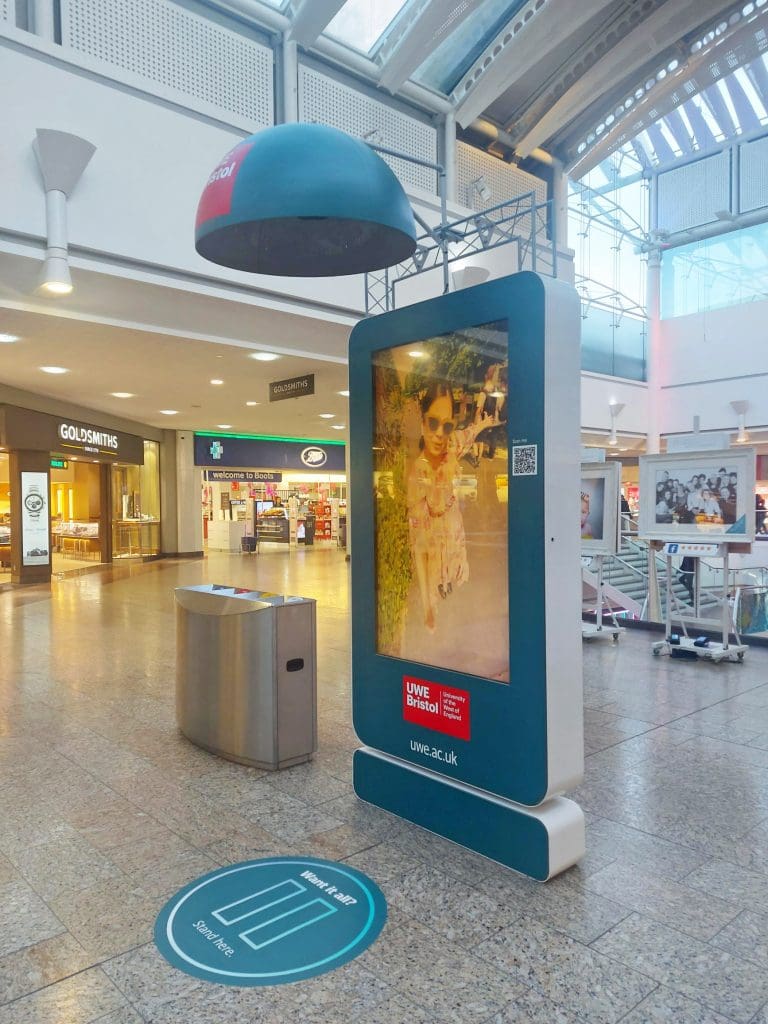
Stephanie Lee, Marketing Communications Manager at UWE Bristol says, ‘This is a really exciting film project with Skylark Media where we’re creating a film for a specific sound shower unit which will sit in Cabot Circus and Cribbs Causeway shopping centres to promote the university and bring campus life to the people of Bristol, so they can get a real immersive experience and sense of what it’s like to study here on our campuses.’
Skylark Media MD Jo Haywood adds, ‘For a unique out of home experience, we came up with a fully immersive concept using an Insta 360 camera on an extendable pole. It sits within the stitch line which then becomes invisible in post-production. The result is a fully immersive film that mimics a FPV drone – flying around from location to location or locking into subjects for detail. Diegetic sound is added in so that the viewer can eavesdrop into those private moments.’
You can experience UWE Bristol’s immersive Sound Shower at Cribbs Causeway or Cabot Circus this month.
Bopgun, a brand, strategy and digital agency, has been selected from a number of agencies to support Puzzler Media with the UX, design and development for a new lead generating B2B website.
Puzzler Media is the UK’s largest supplier of printed and digital puzzle-based content, backed up by end-to-end content management and support. With over 50 years’ experience, Puzzler Media is the go-to name in puzzles, working with business worldwide from national and regional newspapers to magazines, membership organisations and individual brands.
With only a consumer-facing website, Puzzler Media identified the need for a new B2B website to improve their online presence, increase brand awareness and ultimately generate leads. The website will showcase the huge range of puzzles on offer, alongside solutions to deliver content and client case studies that demonstrate their experience and capability – all delivered in a clean and user-friendly design.
“B2B is an exciting and growing part of our business. We help a multitude of clients in supplying print and digital puzzle content and tech solutions. We didn’t have a site that reflected the breadth of content and the quality of our client base. We chose Bopgun because, based on the good work we have seen them deliver for other clients, we believed they were the best agency to deliver our Puzzler Business Partnerships ‘shop-window’. We’re really excited to be partnering with them on this project.” Lynda Newland, Deputy MD, Puzzler Media.
Launched in 2008, Bopgun is a multi-disciplined creative agency with an unrivalled background across the publishing industry. With both the founders having worked in various roles at Future Publishing for over 14 years between them, Bopgun has grown into a substantial and distinguished company working with some of the world’s leading industry players including Elsevier, Story House Egmont, Anthem Media, Hachette Partworks and Kelsey Media to name a few.
From engaging websites for the likes of Marvel and Disney, to e-commerce subscription sites, promotional campaigns, animations and illustrations, Bopgun prides itself on delivering real value to the publishing industry.
“We were thrilled when we heard we’d won this project with such a prestigious brand as Puzzler, known by their existing clients as the UK’s largest puzzle supplier. Knowing how important it is for their business to convey their detailed and wide range of puzzles is the sort of challenge we love!” David Mathews, Managing Director at Bopgun.
Listening to podcasts is a great way to inspire and inform your creativity. We asked members of the Bristol Creative Industries LinkedIn group, which has over 7,400 members, to share their recommendations. Happy listening!
Created by the magazine dedicated to the creative industry, the Creative Boom Podcast features candid conversations with artists and designers about their creative journeys. Listen here.
Recommended by Ellen Carroll.
This is a podcast that “questions assumptions in the tech world and celebrates those working with technology in unconventional ways.” Listen here.
Recommended by Jessica Morgan (see Jessica’s BCI profile for Carnsight Communications here).
Hosted by Adam Tuckwell and Jon Wilcox, the PR Hub Podcast is a conversational PR and marcoms podcast with special guests discussing the world of communications. Listen here.
Recommended by Gina Jones.
This podcast includes interviews and discussions between Robert Craven and digital agency experts providing insights to help you grow your digital agency. Listen here.
Recommended by Robert Craven.
This podcast focuses on documentary film making and the people who do it. Listen here.
Recommended by Stuart Fox.
This podcast features marketers telling the stories behind the strategies that led to amazing work. Listen here.
Recommended by Kevin Mason (see Kevin’s BCI profile for Proctor + Stevenson here).
Hosted by Jon Evans, this podcast “uncovers the bulls**t and carefully managed PR messages to explore the good, the bad and quite frankly downright ugly truth about marketing”. Listen here.
Recommended by Matt Ramsay (see Matt’s BCI profile for Activation here).
This podcast features B2B marketers and creatives from the tech world discussing the role that creativity plays in helping them market their business. Listen here.
Recommended by Dave Corlett.
Hosted by entrepreneur and Dragons’ Den investor Steven Bartlett, this podcast is described as “an unfiltered journey into the remarkable stories of the people that have defined culture, achieved greatness and created stories worth studying”. Listen here.
Recommended by Alli Nicholas, membership manager at Bristol Creative Industries.
This podcast features conversations on the art of creative entrepreneurship. It is hosted by leading creative business experts David C. Baker and Blair Enns. Listen here.
Recommended by Alli Nicholas.
David C. Baker joined BCI for an event in February 2021 to share brilliant tips on how creative businesses can write the perfect positioning statement. Read a summary of his advice here.
“Aaron Dignan and Rodney Evans help teams all over the world discover a more adaptive and human way of working. Now it’s your turn. Each week, they’ll bring you a counterintuitive take on a common challenge at work—and you’ll hear from guests who have been there and found their way to something better.” Listen here.
Recommended by Kim Slater.
This podcast focuses on the smallest changes that can have the biggest impact. It shares simple evidence-backed tips to help you kick bad habits, get a raise, and grow a business. Listen here.
Recommended by Dr Thomas Bowden-Green.
“Organisational psychologist Adam Grant takes you inside some truly unusual places, where they’ve figured out how to make work not suck.” Listen here.
Recommended by Chris Thurling, chair of Bristol Creative Industries following a recommendation by Ann Hiatt.
This podcast from Creative Review looks at what is wrong with the creative industries and how to fix it. Listen here.
This podcast, from the community for creatives to make our industry a better place, interviews creatives, mental health experts and consultants to share advice, stories and conversations. Listen here.
JonesMillbank, Bristol-based video production company, worked with independent marketing communications agency Golley Slater to bring its campaign for Save a Life Cymru to fruition.
It comes as data reveals that every year in Wales more than 6,000 people will have a sudden cardiac arrest and around 80% of those will happen in the home. New data shows that almost one in four of us (24%) have witnessed someone collapse and possibly need bystander CPR and defibrillation intervention.
Yet, less than half of adults in Wales are confident in performing CPR: however, when people understand that on calling 999, the call taker will talk you through CPR and direct you to the nearest registered defibrillator, 73% of adults said that they would feel more confident to intervene.
Survival rates fall by 10% every minute without CPR or by using a defibrillator, can improve a person’s chance of survival.
Golley Slater developed the campaign strategy and creative for Save a Life Cymru – Help Is Closer Than You Think – which aims to show that if you see a cardiac arrest, there is more support around you than you might realise and commissioned JonesMillbank to produce and create content across the campaign, including bilingual TV commercials, radio commercials and social adverts.
Supporting studio photography was also captured to roll the campaign out across digital, print and OOH.
“Working on the production of such a holistic campaign, let alone one for a good cause, was a fantastic opportunity and allowed us to add a huge amount of value and experience” said Russell Jones, Co-Founder at JonesMillbank.
“We already work with NHS England and a number of individual Trusts and we understand the importance of that value alongside impactful messaging”.
Dave Warfield, Creative Copywriter at Golley Slater said “the team over at JonesMillbank built a fun, creative relationship with us from the off which made treatments of scripts and finding inventive solutions enjoyable and painless.”
Lewis Clements, Senior Art Director at Golley Slater added “being so well organised on shoot days and accommodating in post-production kept the atmosphere upbeat throughout the process and made all the difference in bringing our ideas to life, exactly as we imagined them. Real patience, craft and willingness from start to finish.”
Production was shot on-location in Wales at Little Man Coffee in Cardiff and Firebug Studios in Barry.
Save a Life Cymru is Wales’ national organisation which aims to improve cardiac arrest survival rates in Wales. The Welsh Government-funded organisation promotes CPR and defibrillation within communities and encourages everyone in Wales to learn or to top up their CPR skills.
Visit https://jonesmillbank.com/work/nhs/save-a-life-cymru to view the campaign and behind-the-scenes stills.
***
JonesMillbank are a passionate full-service video production company
They work in-house with a talented team of multi-disciplined creatives, all the while telling authentic stories long before it was cool for a range of clients such as University of Bristol, IDLES, NHS England, The Royal Mint and Battersea.
jonesmillbank.com
01173706372
[email protected]
You need to load content from reCAPTCHA to submit the form. Please note that doing so will share data with third-party providers.
More Information