Between 2026 and 2029, up to 12 challenge calls will be identified where innovative new thinking could catalyse a step change in the industry, while producing learning and insights that benefit the whole screen sector.
Abstract: This article examines Nandipha Mntambo’s pieces, ‘Umfanekiso wesibuko’ (Mirror image) and ‘Titfunti emkhatsini wetfu’ (The shadows between us) in particular, and her use of cowhide through Bhabha’s concept of Third Space Thinking. I also use Salomé’s understanding of femininity to form a deeper understanding of the female corporeal figures present in her work. Bhabha’s Third Space Thinking is a space where binaries dissolve and expand into new perceptions and draws parallels between Salomé’s description of the fluid, limitless and ineffable nature of femininity. I investigate societal beliefs surrounding female body hair through Kristeva’s understanding of abjection, being the discomfort that arises from the instability of the boundary between the internal and external. Mntambo’s work combines human/animal, masculine/feminine, self/other, and attraction/repulsion. and therefore, sits in ‘The beyond’ that Bhabha defines as the liminal space between binaries. The sculptures create a sensory and conceptual space that destabilises Western binary logic and creates a third space where the human, animal and feminine converge. This invites the viewer to engage in the transformative experience of third space thinking that could reshape how we perceive our surroundings and ourselves.
Nandipha Mntambo is a South African artist, born in Mbabane, Swaziland in 1982 (‘Nandipha Mntambo – Zeitz MOCAA’, 2017), who completed a Fine Art MA at the Michaelis School of Fine Art, University of Cape Town, in 2007 (‘NANDIPHA MNTAMBO | Biography | Everard Read London’, 7 November). Mntambo explores themes of the female body through sculpture, photography, mixed materials, and video. This essay will examine how Mntambo’s practice can be understood through Homi Bhabha’s concept of third space thinking (Kalua, 2009) and Salomé’s understanding of femininity. Within Third Space Thinking, Bhabha describes ‘the beyond’ as the liminal space where fixed binary oppositions dissolve, allowing new meanings to emerge through the interaction of conflicting elements. Mntambo allows the binaries of masculine/feminine, attraction/repulsion, life/death, and self/other to coexist and interact within
her work. This encourages the viewer to confront and contemplate the discomfort of merging these dualities.
While focusing on her pieces ‘Umfanekiso wesibuko’ (Mirror image) and ‘Titfunti emkhatsini wetfu’ (The shadows between us), I will discuss the female experience within the human, the animal and the feminine. The term ‘Human’ refers biologically to Homo sapiens and to the cultural position that conceptualises humans through exceptionalism, meaning they are separate and superior to all other entities on Earth (Holden and Fennell, 2017, pp. 19). Humans technically fall under the animal category, and so the inclusion of both terms in my title
highlights a culturally enforced separation that puts animals in the ‘other than human’ category, a distinction critiqued in philosophical discourse (Haraway, 2008). The ‘feminine’ refers to cultural and psychological associations historically attached to women. I examine these by looking at body hair and the taboo surrounding it. I will psychoanalyse the term using Lou Andreas-Salomé as my key point of reference, who suggests femininity enters the realm of creativity, embodiment and fluidity. By immersing ourselves in Mntambo’s sculptural forms and her words surrounding them, we engage with the collaboration of our perspectives and hers, thus, entering what Bhabha calls ‘the beyond’ (Simba and Davids, 2020). Her work becomes a visual manifestation of ‘the beyond’, a space of tension and transformation.
Mntambo has repeatedly expressed her dislike for being known solely as a South African artist. She points out that art made by people of colour is often assumed to be influenced by colonialism and politics (Ecclestone, 2012). This generalises people of colour’s individual experiences and groups them into a collective one. This stunts the viewer’s understanding of the artist’s work by limiting areas that the artist could be exploring. She says ‘My work was never meant to be a direct exploration of the African Female body. I just happen to be African and female and use my body in my art-making process’ (Mntambo, 2007). Therefore, while I acknowledge that her identity as an African female may be part of her work, I focus my analysis on visual cues and the conceptual framework to avoid reductionist interpretations. I also acknowledge that, as a white female, my perception of Mntambo’s work is shaped by my own positionality and cultural context. I hope that, considering Mntambo’s stance on how she wishes her work to be received, this will not limit my analysis, as I am looking beyond racial frameworks.
Figure 1.
https://dailyartfair.com/exhibition/1843/nandipha-mntambo-andrehn-schiptjenko
Mntambo, ‘Umfanekiso wesibuko’ – ‘Mirror image’ (2013)
Figure 2.
https://dailyartfair.com/exhibition/1843/nandipha-mntambo-andrehn-schiptjenko
Mntambo, ‘Titfunti emkhatsini wetfu’ – ‘The shadows between us’ (2013)
Figure 3.
https://dailyartfair.com/exhibition/1843/nandipha-mntambo-andrehn-schiptjenko
Mntambo, Titfunti emkhatsini wetfu – The shadows between us (2013)
To Navigate the concept of ‘the beyond’ and how it differs from typical Western thinking, we must first acknowledge how our thinking has been shaped. Throughout Western society, because of Aristotelian philosophy, our way of thinking is based on ‘the law of identity, which states that A is A, the law of contradiction (A is not non-A), and the law of the excluded middle (A cannot be A and non-A, neither A nor non-A)’ (Fromm, 1995). In other words, ‘it is impossible for the same thing at the same time to belong and not to belong to the same thing and in the same respect’. This has been engraved in Western thinking and has become an unconscious habit to assume that saying ‘X is A and not A’ is wrong.
Positive paradoxical thinking, prevalent in Taoism (or Daoism) and Bhabha’s ‘Third Space Thinking’, states that X can be A and Non-A at the same time. In Taoism, a Chinese philosophy and religion, the world is full of overlapping opposites. Taoism is a way believed to free ourselves from the limiting structures of our thinking patterns shaped by ‘the law of identity’ as the Western language blinds us from areas that sit in the between (or ‘the beyond’. “There is a limit to what language can do, and that limit of language is paradoxical”(Tanaka 2004, 191).
Bhabha’s ‘third space thinking’ reflects these beliefs and, in doing so, rejects compartmentalised or binary constructions of cultural views. This thinking becomes political, aiming to involve opposing beliefs and systems in open and productive dialogue.
Mntambo first started using cowhide during her fourth year at the Michaelis School of Fine Art at the University of Cape Town (Ecclestone, 2012). She initially intended to study forensic pathology, so she has an interest in the corporeal, DNA, hair, and bodily fluids. She is also intrigued by how movement is illustrated in classical sculptures made from such hard materials (Moret, 2013).
The spark of her attraction towards cowhide came from a dream involving cows.
She was then trained by a taxidermist who assisted her with formulating the chemicals needed to tan and harden the skin. Before the skin is hardened, Mntambo moulds it into her desired shape. She sources the cowhide ethically from abattoirs and tanneries where the animals are already being slaughtered for consumption (‘Nandipha Mntambo: Creating mirror images of the human body | Design Indaba, 2025). She takes what is left behind and gives it another life.
In Figure 1, Mntambo has sculpted cowhide into the shape of two women on all fours. Being physically below the audience’s eye line, the figures become a symbol of submission. It is also a position associated with the inferior, the dominated, and therefore, the female (Hooks, 2014). It can also have sexual connotations.
The discussion of female sexuality is based on a language of phallomorphism (Irigaray, 1985). The vagina is an object of absence, missing the penis, or a penis turned in on itself, and its only purpose is that of pleasuring a penis. The vagina becomes the embodiment of the male gaze – a void in which men can fill with projective fantasies (Salomé, 2002), Fantasies that are often unattainable and unrealistic. In this way, the female created in a man’s thoughts does not exist. The projections they force upon us are fragments of a false reality. ‘In his attempts to understand woman, man comes only upon his own fantasies’ (Mazin, 2025). We become a prop on the stage of a man’s imaginary play. This narrative has become subconscious for most, meaning that writers, including women, use language that further pushes it into reality. Because of this, women’s desire belongs to and relies on men. This is perfectly depicted in Mntambo’s sculptures. The absence of bodily substance inside the skin of the feminine figure, in this context, represents the lack of identity and focus on eternal appearances in the male gaze. It also illustrates how women often lose a sense of identity and individuality to conform to male desires (Hernando, 2017), as Mntambo removed the internal body from the skin, ripping it from
its mind. This is emphasised by the feminine sculpture being displayed in front of an audience, in a nude and vulnerable state, only existing to be looked at.
‘Not knowing what she wants, ready for anything, asking for more, so long as he will take her as his object when he seeks his own pleasure. Thus, she will not say what she herself wants: moreover, she does not know or no longer knows what she wants’ (Irigaray, 1985).
This quote describes the diminished sense of desire shaped by the expectation of women to be passive objects without pleasure or agency. The differentiation between enjoyment and validation is blurred. Our desire is defined and manipulated by our environment before we know what desire feels like (Lina, 2025). Endless conditioning steals the joy from a sacred act of pleasure, connection and creation. Sexuality can become a means of connection with their untamed, undomesticated selves and reclaim a sense of freedom as it is rooted in a biological force shared across animal life. The all-fours position, while having sexual connotations, can also refer to animals. ‘Sex is a subset of nature. Sex is the natural in man’ (Paglia, 1990). Yet women are shamed and scrutinised for expressing their sexuality, while men are praised for it (Farvid & Braun, 2006). Have too much sex and we are sluts, and have too little and we are frigid. Wear too few clothes and we are asking for it, but wear too many and we become invisible. Display just the right amount of subtle and restrained sexuality to get their attention, without appearing as though we want it. The key expectation is that women must want male attention. After all, their attention is essential to feeling whole, because without being seen through the male gaze, we don’t exist at all (Salomé, 2002).
The combination of the sexuality of these sculptures and the use of cowhide creates a tension between attraction and repulsion. The positions and visibility of the arched back, all fours position, and visible glutes, alluding to the figure being nude, would seem to appeal to the male gaze. However, the skin being covered in hair would do the opposite (Smelik, 2015).
‘What functions psychologically as the abject – as an ultimate object of disgust – figures socially as a taboo’ (Smelik, 2015).
The response of disgust to female body hair, a societal taboo, sits in the abject. The ‘abject’ is defined by Julia Kristeva as a feeling caused by an unstable boundary between the inside and outside of the body (1982). Body hair is a visible boundary between the internal and the external, as it is both inside the skin at the root and outside the skin. This means it also sits in ‘the beyond’ as it is positioned between boundaries between the internal/external,
human/animal and masculine/feminine. Therefore, our abjection towards body hair reflects our desire for a strict boundary between these binaries. I believe abjection is the manifestation of our psychological need to define and categorise all of existence. Our extreme rejection of natural bodily objects and fluids signifies humans’ fear of the undefined, and therefore of ‘the beyond’.
The female cowhide sculptures encapsulate all the causes of abjection to body hair. The bodily sculpture is shaped into a human form but made of non-human material. So, the visual cues suggest it is a human covered in hair. Body hair is often perceived as unclean due to its association with sweat and the pubic region (Smelik, 2015). Additionally, it blurs the boundary between men and women due to societal acceptance of men’s body hair and the male hormone naturally producing more of it. It also threatens our cultural separation from animals, especially the ones we developed from. These aspects are all exaggerated in Mntambo’s material choices. The abjection we experience towards the body is heightened because of this.
Mntambo’s tedious process of scraping the cowhide of fat, chemically preserving it and physically manipulating its shape into a desired form mirrors the manipulation of females and their bodies in today’s society (Gaard, 1993). The ‘hairless body’ has become the ideal beauty standard because it further separates men and women, human and animal, and represses the power of female sexuality (Smelik, 2015). Hairlessness in the pubic region has meant that the
visibility of the vagina and all its ‘complexity’ has risen. ‘The absence of hair thus reveals the vulva entirely, turning it into a simultaneously vulnerable and sexual site/sight.’ In Freud’s view,
the vagina is the absence of a penis, making it ‘the horror of nothing to see’ (Freud 1955 [1922]): 273). Contemporary male reactions to the body were assessed by Gaillard and Windish (2012), and they concluded that the hairy female body ‘both fascinates and terrifies, attracts and repulses’. So, her sculptures are the embodiment of the contradictions within societal beauty standards.
The bodies are doubled in both installations, making the concept of the self and the other prominent (Andréhn-Schiptjenko, 2025). These can be linked to her earlier work:
Figure 4.
Mntambo, ‘Narcisuss’ (2009)
Figure 4 is an interpretation of the ‘myth of Narcissus’, a story of a man who becomes infatuated with and dies beside his own reflection, thus having a flower named after him. It is a prominent and rich means of inspiration within Western literature and art.
Lou Andreas-Salomé is a psychoanalytic writer who explored areas of religion, philosophy and gender theory (‘Lou Andreas-Salomé: A Brief Biography, 2024). For Salomé, the environment in which Narcissus’ desire arose is significant. The cause of Narcissus seeing himself is water
reflecting an image back to him. Water, being an essential element that gives life to nature, becomes the vessel that connects him with nature. Salomé refers to this reflection as ‘the mirror of nature’ where he is seeing himself as within, and the same as, nature. He saw ‘himself as all’ (. Thus, to Salomé, narcissism was a ‘maniacal condition of love towards oneself and towards the surrounding world’ (‘The Femme Fatale – Lou Andreas-Salomé – European Journal of Psychoanalysis’, 2002).
The binaries of self and other are combined in the myth of Narcissus and, therefore, in Salomé’s view, within Mntambo’s painting and sculptures. The self and the other become merged as the other, in the mirror of nature, becomes the self. The confines of the selfhood inside the body are expanded and dissolved into its surroundings.
Figure 2 shows two figures that, given gender norms, can be assumed to be female because they appear to be wearing dresses. The cowhide is folded and pleated in a way that suggests the figures’ dresses are blowing in different directions, as if mirroring one another. They are suspended above the ground, making the viewer gaze upward. This gives the figures a physical position of authority and power. The side view (Figure 3) reveals that the front of the body is missing, as if being cut in half to reveal nothing inside. The title of the artwork, ‘The Shadows Between Us’, implies a relationship between the two sculptures, bringing attention to the space and emptiness separating them. The sculptures have been placed in front of a window, filling the hollow space with light and the front of the sculptures with darkness. The sculptures, therefore, appear to be shadows themselves. The sculptures are life-like, making them more human and intimate. Instinct, when looking at figures, is to allocate emotion and identity.
However, the head and hands not being present take away the individualisation of the figures. Your focus is directed towards the physicality of the bodily form and its tactile surface.
In Mntambo’s Narcissus piece, she sees her reflection in the water and, metaphorically, sees her inner psyche. Because of the natural environment in which she appears, you can infer that she is also connecting with and seeing herself within nature. She is sitting in ‘the beyond’, that is, the inescapable overlap of the human and non-human.
Salomé’s interpretation sees narcissism and creativity as one and the same. To be able to mirror and replicate one’s own being is an action that requires a knowing of oneself. She explains that this capability is limited to one’s gender. For a female, Salome believes, the
creative psyche has less desire to look externally for a muse and finds one internally. She has more access to her inner self for inspiration. She believes that this is caused by women’s connection to the maternal ground of being, it being less ruptured than men’s, as they have a uterus. ‘Ground of being’ refers to the original form of self and the core layer of experience that identity grows from. Salomé believes that women are better connected to this core because they are better connected to their origin – the mother (‘Jane Feldman: Lou Andreas-Salomé’, 2025). The mother creates. It makes sense, then, that women have a greater sense of inner creativity if we are biologically designed to create and have a stronger connection to the creator within ourselves.
‘Our deepest entry into ourselves, a thousandfold solitude. But it is as if this individuated solitude were surrounded by a thousand gleaming mirrors and thus appeared expanded, being vaulted into an all-embracing world.’ (‘Jane Feldman: Lou Andreas-Salomé’, 2025).
Within Salomé’s interpretations, women are without boundaries. Women, as we are without boundaries – limitless, we are fluid, ever-expanding entities. We are spacious, singing flesh, objectless and ineffable. The emptiness that sits within Mntambo’s paintings is symbolic of the infinite mirrors that exist within the woman’s universe.
As previously stated, the Western language is seen as limiting our capability to navigate the beyond that lies between the lines of words. Salomé suggests that women, because we are without boundaries, our language ‘does not contain, it carries; it does not hold back, it makes possible.’ It is ‘the language of a thousand tongues which knows neither enclosure nor death.’ We speak the language of ‘the beyond’.
Mntambo’s sculpture blurs the boundaries between self/other, internal/external, human/nature through the concepts of narcissism in her ‘Narcissus’ piece, which bleed into the pieces ‘Umfanekiso wesibuko’ (Mirror image) and ‘Titfunti emkhatsini wetfu’ (The shadows between us). It is emphasised in ‘Umfanekiso wesibuko’ (Mirror image) because, as its title states, the sculptures are mirroring one another and become each other’s reflections. She encapsulates Salomé’s beliefs involving femininity and its inherent connection with nature through female corporeality, its anima material. Mntambo is therefore exploring ecofeminist perspectives (Gaard, 1993). We are within Earth but simultaneously discontinuous with it (Bataille, 1987, pp. 1-9). Women and Mother Earth both go under exploitation and domination because of overlapping traits – like being maternal, unpredictable, wild, loud, fluctuating, creative – that are
seen to need controlling (Gaard, 1993, pp. 1–12). The space that sits ominously inside Mntambo’s corporeal sculptures symbolises women’s limitlessness and simultaneously represents the empty void that men see within women. Men project the ‘femme fatale’ into that empty void. The emptiness that is seen within the feminine causes women to be seen as non-existent without the male gaze imposed onto them.
Cowhide is an unusual and almost impossible material to use in sculpture. Being a temporary medium, it will eventually rot and disintegrate. Its ephemerality is exaggerated by the pungent smell of dead animals that fills the gallery space. ‘They don’t smell like leather, they smell like a cow’ (Du Preez, 2010). This smell reminds the audience of the reality of how these sculptures came to exist. Not only are they conceptual shells of a female body, but they are also what is left of an animal’s life. The sensuous experience forces the audience into a space haunted by the presence of animals and women, symbolically present but physically missing. Inside ‘the beyond’ of these sculptures, life and death are at play. The sensual experience is a reminder of the material’s temporality because of its aliveness. The position of all fours conforms with the male fantasy but distinctly opposes it through abjection caused by body hair. The smell signifies decomposition and life decaying, which juxtaposes the lifeless objectivity of the male gaze. The uncanny combination illustrates that the male gaze is solely a fantasy and can never materialise into reality.
Mntambo’s cowhide sculptures reveal how the human, the animal, and the feminine can no longer be sustained as separate or stable categories. Through Umfanekiso wesibuko and Titfunti emkhatsini wetfu, Mntambo creates a space of unsettling but necessary conversations between conflicting elements where the viewer can experience a form of third space thinking. The work demonstrates how femininity, humans and non-humans are interrelated by overlapping layers of cultural projection, abjection and desire, all rooted in a need for the human brain to categorise its senses and ultimately gain control by defining the undefinable.
Mntambo’s art is a place where the undefinable flourishes. The empty interiors and sensuous materials embody an alternate form of existence that resists confinement. Salomé’s understanding of femininity resists boundaries by describing it as boundless, expansive and connected with nature, which is illuminated by the hollow bodies in Mntambo’s work. Kristeva explains that the discomfort that emerges when the boundaries between human and animal are dissolved is abjection. By integrating binaries into a shared space, Mntambo’s practice challenges the Western insistence on fixed identity and categorisation. She challenges the
audience to resist this and embrace the ambiguity and mystery of ‘the beyond’ without defining it. Ultimately, her work opens up a liminal zone of new meaning and transformation created through converging the feminine, the human and the non-human, resulting in new ways of seeing and understanding the body.
At The Square Club, we’re more than just a members’ club – we’re a hub for Bristol’s creative community. In partnership with Bristol Creative Industries, we’re delighted to offer BCI members discounted membership at just £30 a month.
Members join a unique community of creative professionals, with The Square being a space for fresh ideas, discussion, and collaboration. Alongside a vibrant events programme and dining scene, it’s a dynamic environment for working, socialising, and networking.
Our spaces include a boutique lounge, the Square Kitchen restaurant, the Lower Deck Cocktail Bar, and a hidden city-centre terrace – perfect for focusing, hosting meetings, or catching up with fellow creatives.
You may already know us from BCI’s monthly Members Lunch or Freelancers Networking Evening, where Bristol’s creative community gathers to connect and collaborate.
But don’t just take our word for it. Here’s what BCI member, Mark Beavan of That Little Agency, had to say:
“I became a member of the Square Club as it offered an alternative working environment to home or the office. The warm, casual and welcoming environment is perfect to facilitate a number of different approaches to work – whether that is the need for focus, collaboration, or creative thinking. It is quickly becoming a meeting post for creative, media and agency professionals, with a weekly, monthly and annual calendar of interesting and engaging events aimed at this audience. The team are fantastic and always looking at ways to add more value to this community. In particular, Sophie plays a central role in fantastically managing this demanding group of professionals.”
Membership also includes reciprocal access to over forty clubs worldwide (including six in London), two complimentary hotel nights, access to over twenty events a month, and a network of like-minded creatives. Whether you need a space to focus, meet clients, or spark new ideas, The Square has you covered.
See it for yourself. Book a tour or apply for membership today by emailing [email protected], and discover why Bristol’s creatives are choosing The Square Club.
The government has back tracked on its plan to allow AI companies to train their models using copyrighted works unless the rights holder opts out following strong protests from several groups and individuals in the creative industries.
In a policy update, the Department for Science, Innovation and Technology (DSIT) said “a broad copyright exception with opt-out is no longer the government’s preferred way forward” after many people in the creative industries expressed concern that “a broad exception would allow generative AI to learn from their works, without compensation, and in direct competition to them”.
In a consultation, only 3% of the 11,500 respondents backed the government’s preferred option. High profile figures including Elton John also spoke out against the plans. He told the BBC it would be “committing theft, thievery on a high scale”.
When we asked Bristol Creative Industries members for their views on copyright and AI, several were against a broad copyright exempion too:
Catherine Frankpitt, Strike Communications:
“The government must work urgently with creative and tech sectors to establish a legally enforceable framework requiring clear disclosure of AI training data sources and mandatory opt-in licensing. We need a distinction between AI as a creative tool versus unauthorised training on copyrighted works. Creators must retain ownership and receive fair compensation for any AI usage of their work. Given AI’s global reach, this framework needs both robust UK legislation and international coordination.”
Susan Pearson, Wordways:
“The copyright for anything I write is 100% mine or my client’s. No-one or no ‘thing’ should ever have the right to reproduce the words of writers exactly unless these words are expressed within quote marks with the source of the quote acknowledged – unless they have specific permission. Anything else would be creative theft.”
Emma Barraclough, Epoch:
“For brand assets to be valuable, they must be protectable. And yet without clear rules AI generated assets are at risk of being copied and compromised by others. For AI to become a truly powerful tool for creatives, we need laws that make its output safe, ownable, and enforceable.”
In the policy update, the government said “we must take the time needed to get this right” and it will not introduce reforms to copyright law until we are confident that they will meet our objectives for the economy and UK citizens.
It added:
“This means protecting the UK’s position as a creative powerhouse, while unlocking the extraordinary potential of AI to grow the economy and improve lives. Any reform must ensure that right holders can be fairly rewarded for the economic value their work creates, and that they are protected against unlawful and unfair use of their work. It must also ensure that AI developers can access high quality content. It is clear through the consultation and our subsequent engagement that there is no consensus on how these objectives should be achieved.”
The government claimed there is “limited and uncertain evidence on the impact of copyright on the development and deployment of AI in the UK”, so the evidence base must continue to be built.
DSIT has also published a new economic impact assessment on copyright and AI which considers the available evidence.
The policy update said:
“We propose to address the gaps in evidence on copyright reform, consider alternative options and review our approach in light of wider market and international developments. Alongside this, we propose to take steps to help right holders control and license their work, including through encouraging greater transparency.
“We also propose to explore options for supporting human creativity and artistry. Across this, we will continue to seek input from voices across the economy, and engage with Parliament and technical experts to ensure any reform drives growth and supports adoption and diffusion of artificial intelligence.”
Other actions include:
Dan Conway, Publishers Association CEO, said:
“As the Publishers Association has long maintained, the UK’s gold-standard copyright regime is the foundation upon which growth and our world-leading creative and knowledge industries are built. Copyright is an enabler and a driver of UK competitive advantage, not an inhibitor, and the government should resoundingly dismiss any further tinkering with copyright as an alternative to the original exception. Alternative exception models – including those for science and research – must be taken off the table from this point. These exceptions have the potential to be even more damaging than the copyright exception initially proposed and are unjustifiable in the context of an established, growing AI licensing market.
“The significant positives in today’s announcement, in addition to the abandonment of the preferred exception, include the focus on transparency – on which we will continue to advocate strongly for legislative action – and on labelling to achieve clarity for readers in an increasingly polluted online retail space.
“The Publishers Association has advocated for the books and journals industry on AI and copyright for years and it’s gratifying to see progress being made on this generationally important issue. This is a step in the right direction, undoubtedly, but not all potentially damaging avenues have been closed down. We will continue to support the government with this work and we thank all of our members for helping us to campaign on this important issue on behalf of the sector we all care so much about.”
Paul W Fleming, Equity general secretary, said:
“The government has taken a welcome and marked change of approach, which has included engaging with Equity at the highest level in detail, and in advance of this announcement.
“The pause announced today is recognition that selling out the UK’s creative industries to benefit US tech companies would’ve been an act of national self-sabotage. The UK should be the best place on the planet to create, supporting the government’s growth agenda through a strong copyright regime and respect for creative workers.
“We welcome the government’s intention to introduce measures on digital replicas and we look forward to working with them to develop new protections against unauthorised and unpaid use of a performer’s voice and likeness, the bedrock of our members’ careers.
“What creators need after this pause is a firm commitment to copyright and neighbouring rights and support for collective licensing for AI uses, including via existing trade union collective bargaining mechanisms. We look forward to working with the Labour government on how best to secure these reasonable aspirations.”
Vision or mission statements often go unnoticed. But these statements are strategically and operationally critical.
But what are they, why are they important and why do you need mission and vision statements, if you aren’t a global brand?
In this article, we’ll dive into the importance of mission and vision statements. What they are, how to write them and most importantly, how the align with your communications strategy for maximum impact.
Vision statements and mission statements are clear and concise statements, designed to convey a company aims, values and direction. They may seem small and inconsequential, but they can have a huge impact on your culture, communications and operations.
Mission and vision statements are often seen as interchangeable. But they’re different and distinct.
A vision statement describes the ‘why,’ or the meaning behind a company’s actions. A mission statement describes exactly how the organisation hopes to achieve the vision and how it serves its goals.
Well-thought-out mission and vision statements can bring a lot of benefits.
They can help consumers and staff fully understand your brand, first and foremost.
But they can also help communicate your company values, outline company direction and values – which is a baseline for building customer loyalty.
Some of the largest brands in the world build their brand around mission and vision statements. But so do smaller businesses. You don’t have to be a giant to set yourself apart from the competition. So here are some of the advantages of strong vision and mission statements for your company:
Purpose, values and goals. These are the three main elements of your missions statement.
Within this short statement you must declare why your company exists and why you serve your customers. It serves to communicate the overarching direction and purpose to your employees, customers and other stakeholders.
Here are our top tips on writing a good mission statement for your business:
1. Keep it brief: a mission statement should be short enough to remember but meaningful enough to matter.
2. State what your company does: start with the essentials. For example, a car manufacturer might emphasise delivering safe, affordable vehicles.
3. Explain how you do it: boil your operations and approach down to a simple, honest description of how your organisation works.
4. Clarify why you do it: these are you values and your motivations for doing what you do. Not the commercial benefit.
5. Bring it all together: Avoid jargon, stay specific and ensure the statement genuinely reflects your business and your what, how and why.
A vision statement is a similarly.short, memorable summary of your organisation’s long‑term ambition. As well as your values it should set the direction of travel. It should also be inspirational, people need to believe in it to follow it.
So it’s best to keep it brief, clear and focus… and this is how:
1. Start with an outline: What do you aim to achieve, and why does it matter? Sketch out the future you want for your organisation and the people you serve.
2. Involve your team: a vision only works if people believe in it. Ask employees what motivates them and use their insight to shape a statement that unites and energises.
3. Keep it short: avoid jargon. Make it easy to recall and repeat.
4. Be bold: a powerful vision should excite people and align with your core values.
Your vision and mission statement defines why your company exists, as well as your hopes for the future. Here are some inspiring vision and mission statement examples from some of the world’s leading brands.
Mission: To create the most compelling car company of the 21st century by driving the world’s transition to electric vehicles.
Vision: To accelerate the world’s transition to sustainable energy
Mission: To entertain, inform and inspire people around the globe through the power of unparalleled storytelling.
Vision: To be one of the world’s leading producers and providers of entertainment and information.
Mission: to offer a wide range of well-designed, functional home furnishing products at prices so low that as many people as possible will be able to afford them.
Vision: To create a better everyday life for the many people impacted by our business.
These are just three examples from three giants of industry. But you don’t have to be a titanic brand to have a crystal clear vision and mission.
For all of these brands, and for every business that established this cultural and operational benchmark, the mission and vision statements act as a barometer and a baseline.
These statments keep you, your operations and your communications true to your underlying values. So whatever strategy or tactics come next, you have these statements as a tangible factor to keep you on track.
A strong marketing and PR strategy links mission and vision and places tactial and tangiable communications strategies in place to communicate these messages.
Everything you put out, whether that’s a press release, a social post or piece of video content should come back to these elements.
The mission gives you your starting point. The vision, your direction of travel.
Communications strategies can then overlay and intersect between these, ensuring that every piece of messaging, however big or small, is always shaped and informed by what you and how and why you do it.
For a start-up, Mission and vision statements also help define your brand identity. Help you to position yourself, competitively and strategically, in a crowded market.
They offer clarity, focus and a shared reference point for your team. Giving them something to believe in. For you customers they do exactly the same. They establish a set of shared goals and beliefs, a rallying point for your customers to hold onto.
Now a mission and vision statement won’t solve every challenge. But what they will do is give you the confidence you need to communicate something with clarity.
With this clarity and confidence, your communications becomes sharper. Your storytelling, more relevant and engaging… all of which contributes towards you and your business making a greater impact where it matters most.
Congratulations! You’ve produced a video you’re really happy with. Now all that’s left to do is upload it to your preferred streaming platform and forget about it, right? Well, not quite. Uploading it to one platform and moving on is a missed opportunity. A single video can generate weeks or even months of marketing content when used as part of a structured video marketing strategy.
There’s a much better way to maximise your investment, and it’s far less expensive than you might think…
As video becomes more and more important in buying decisions (don’t just take our word for it) making the most of your content has become essential. The aim is to maximise the number of opportunities to engage with your audience and that means translating your content into the most eye-catching formats and showcasing it on the most relevant platforms.
Ensuring the consistency of your brand’s look and feel across each touch point is also key to helping build trust and recognition. Plus, it means you can have content that can more easily be used at a later date.
This is where the strategy of producing one main film and cleverly repurposing it with mini edits comes into play. Where appropriate, you can also use it to create micro content (films or animations). Extracting key moments and insights from the hero video means marketers can tailor their content to suit different platforms and audience preferences.
So how is it done? There are 3 main ‘Ms’ to bear in mind.
(view image in the original article here)
The first M (Main) is pretty straight forward, so we won’t spend too much time here. Your Main is the complete film you’ve put all your effort and time into. A tight script, some fun effects and clever camera work and you’re good to go.
As a rule of thumb, you’ll want to put this on YouTube or your preferred streaming platform etc. YouTube is perhaps the best know and makes your videos very discoverable, but you might benefit from the additional insights a platform such as TwentyThree can provide. This allows you to continue refining how you position your content and helps you attract more views.
*Don’t forget that you might want to hype your main film using your shorter pieces of content first, so hang fire on posting it until you’ve released a few canny ‘teaser’ edits.
We’ve used an example from the TOUGHBOOK campaign we produced for technology pioneers, Panasonic, highlighting how we maximised the video assets – from the primary film to short clips and teaser content.
(view the video in the original article here)
The second M (Mini) is where you start to create shorter, more focused edits of your Main film. A Mini edit’s purpose can either be to build a queue of people ready to watch your main film OR highlight unique parts of your offering.
For example, your Main film may be about your complete suite of products or services, but your Mini edits might break it down into your specialism in individual sectors. Equally, you might have produced a tutorial on how to use your product and found that people are most often searching for (and watching) one particular step of the process. Creating a Mini edit focused on that one step, packed with quality SEO, can increase your discoverability to new prospects.
The key here is not to create lots of new content, you should be aiming to recycle, reuse and reformat as much as possible into new edits.
Here’s a quick shorthand for how you might define those different types of edit.
These give the audience a reason to watch your main video. What are you audience going to find out? Does it give a glimpse of a new product or service? Are you announcing a particular date or event? Perhaps your interview had a nugget of gold in, you can create a short edit that leads up to that point, encouraging viewers to watch your main film to find out more.
Think of this as a short snappy edit that sets everything else up. This will come out in advance of your main video, so the goal is to create a queue of people ready and waiting for when the main video launches.
Here’s a little teaser video from the Panasonic Toughbook campaign.
(view the video in the original article here)
These combine as many hooks as possible to pull people towards your main film OR provide another CTA i.e. to a landing page or sign-up form.
By condensing the most compelling moments and messages from the core video into shorter formats, marketers can deliver targeted edits that resonate with different segments of their audience.
Now’s the time to think social media: using LinkedIn, Instagram, Facebook, Twitter, TikTok etc. With these platforms, your audience often wants smaller bite-size content.
Whether it’s a brief teaser, a highlight reel, or a quick tutorial, each edit serves to capture attention and drive engagement, ultimately leading viewers back to the full video for a deeper dive into the content.
Check out this short snippet from the Toughbook campaign- a quick example of how a single core video can evolve into engaging mini content that grabs the attention of the viewer.
(view the video in the original article here)
This most often refers to content such as Gifs, presentations or web animations. Think of them as small single-issue messages, or very brief statements. Examples could be:
The key here is to keep it concise. If someone asked you to explain your micro edit, could you sum it up in one sentence? You’re giving potential customers clarity in seconds, and for the time-poor that’s a compelling reason to click.
The outputs for Micro tend to fall into gifs, MP4s, or Lotties and Rives, and the use cases are the broadest:
Here’s an example of how we make the most of one explainer video. This is our Atomic Design explainer video. We use the complete video to kick off pitches, giving the audience a quick overview of the methodology.
(view the videos in the original article here)
Video marketing remains a powerful tool for brands looking to engage audiences and drive meaningful interactions. By creating one full video and repurposing it into shorter edits, marketers can maximise the reach and impact of their content across various platforms –without drastically increasing the total cost.
A well thought out video marketing plan should guide your production of the video. It lets you know up-front exactly what the strategy is and the exact content you’ll need to produce. For example, when you animate that icon, is it also going to be needed for a Lottie? And, if so, what steps do you need to take to minimise additional work?
By combining compelling visuals with strategic messaging, and getting under the right noses, brands can create memorable experiences that resonate with their audience and drive tangible results.
If you’re wondering how to squeeze even more value out of your video content, or just want to talk through your ideas, get in touch at [email protected].
In-person meetings might be the gold standard when it comes to fostering familiarity with your clients, but self-shot videos of you and your company might just run them a close second. Why? Because it’s a medium that works really well at capturing who you are, giving people a little sneak peek behind the scenes, and fostering brand loyalty.
We do appreciate that introducing yourself to the world can be a slightly strange experience, we’ve been there! But there are a number of compelling reasons to consider going for it:
Viewers are now far more forgiving of self-shot content than they were even a few years ago, so don’t worry if your budget doesn’t stretch to perfectly lit, noise-treated studios. Authenticity is the keyword here: you’re the experts, you’re the people current or potential clients will be speaking to.
‘Before you start filming, it is absolutely essential to plan down to the finest of details, and then you get on set and rip it up on day one.’
Niko Pueringer – Corridor Digital
We’ve put together a step-by-step guide to getting the most out of the filming kit you probably already own, leaving you to concentrate on what it is you really want to say.
Phone cameras and webcams struggle to capture complex or small-print patterns. This results in a visual distortion (known as moiré) that makes it appear as if your clothing is jittering or jumping.
It can also soften the overall image thanks to the available bandwidth being taken up in attempting to capture the patterns. It’s safest to stick to plain colours. Sorry to those with a love of jazzy shirts!
Cameras can struggle to capture the full dynamic range (this is the difference between the brightest and darkest parts of an image that our eyes can see). Filming with a window behind you will create a very large bright object with a shady silhouette of you in the middle. Atmospheric but not very informative.
Cameras love light, the brighter and more evenly lit your shot, the better it will look. Aim to shoot with any windows behind the camera, this way you are nicely lit with the brightest light available to you.
Try to shoot during the day when there is plenty of natural light. Shooting at night using household lights will force the camera to ‘work harder’. In a similar way to what happens when you turn up the volume on a stereo, this will create more distortion in the image.
If in any doubt, record a little segment and watch it back. You may notice that lamp behind you is appearing much brighter than you were expecting. Not a problem, just move it out of shot while you’re filming.
Don’t be afraid of using your phone, if it was good enough for Danny Boyle then it’s ok with me. Yes, I love the footage from our professional-grade cameras, but sometimes the ability to whip a phone out and start filming in a matter of seconds, all to a good enough standard, is the best option.
Viewers may be relatively relaxed about the visual quality of a video, but they do expect good quality sound. Think about what time you’re going to shoot: if you know the 10:15 to Cardiff always passes your window promptly, why not push filming back to 10:30 onwards?
You can massively improve the quality of your video by buying a cheap lavalier (clip-on) mic. Something like a Rode Lavalier Go is cheap, sounds much better than the audio captured on a camera mic, and is really straightforward to use. Most phones will have a free audio notes app and these are also a great option as portable audio recorders.
Deciding what format your video will take is a great start; is it going to be an interview or open discussion for example? Writing a rough script in advance can help clarify your thoughts. Go through and highlight the key phrases that remind you what you want to say, then write down just the highlighted phrases and use this as a prompt.
Equally, you may feel more comfortable just discussing the subject on the spot, and this often leads to the best outcomes: not overthinking answers can result in more natural footage.
It may be helpful to ask someone to sit behind the camera and deliver your answers to them. For most people it feels more natural speaking to a person rather than a camera.
If you’re anything like me on camera, I tend to relax a bit after the first couple of minutes (apologies in advance for the pre-prepared bad jokes I have stashed to cover those first-minute nerves!).
The lesson? Record a couple of takes. Sure, 80% of them will be similar, but occasionally you’ll nail a particular section that bit better and FGTOLOCAO (Finally Get That Overly Long Overly Complicated Acronym Out).
Planning on editing a few people together? A mix of answers can prove invaluable. A longer speech is great for covering a topic in more detail. A short sound bite is great to quickly reaffirm another person’s view or offer the counter narrative.
Compared to how we write, we speak and act very differently. We have a habit of adding ‘ummms’ and ‘ahhs’ (it’s a natural way our body creates some breathing space to recall and form the next statement). You might also have noticed that people often blink after finishing a sentence, editors often describe this as the body’s way of editing the world around it and creating some order (we’re very much artists, not scientists).
Viewers tend to prefer a well thought out answer to a perfectly polished one. If you want to re-shoot then, by all means, feel free but don’t worry about perfection: sincerity is the key here.
Our Video Toolkits give you the tools to brand your videos consistently, but more importantly, they’re super easy to implement. We’ve talked about these before, but it’s well worth a look!
Most importantly, don’t forget you can do as many takes as you feel comfortable with. And you might just enjoy it!
If this has left you with burning questions about self-shooting, or any other video-related stuff, then please do feel free to get in touch at [email protected]
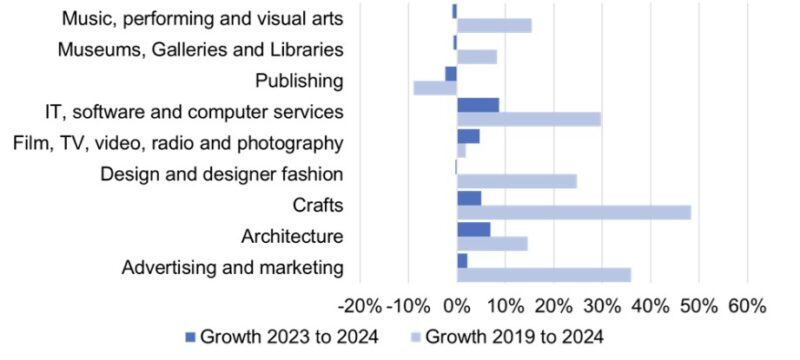
The creative industries contributed £145.8bn in gross value added (GVA) to the UK economy in 2024, new government figures have revealed.
Creative industries GVA rose by 4.6% between 2023 and 2024, compared to the UK economy as a whole which grew by 1.0%, the data from the Department for Culture, Media Sport (DCMS) shows.
The sector’s GVA was 19.7% higher than pre-pandemic (2019) and 60.3% higher than in 2010, in real terms.
The growth was driven by the ‘IT, software and computer services’ subsector which increased by an estimated 8.7%, followed by ‘film, TV, radio and photography’ and ‘advertising and marketing‘ which grew by 4.6% and 2.1% respectively.
‘IT, software and computer services’ is the largest subsector of the creative industries by GVA, contributing an estimated £62.4bn in 2024. ‘Advertising and marketing’ is the next largest with £24.3bn.
Growth in creative industries subsectors, in chained volume measures (CVM):
Other data released this month showed the creative industries account for almost a 10th of UK firms classified as having ‘high-growth potential’, and a lot of those businesses are in Bristol and the south west.
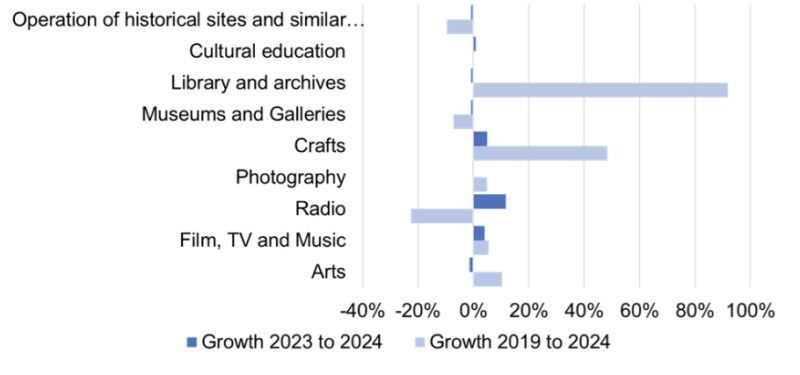
The DCMS report also included data for the cultural sector which contributed an estimated £40.3bn in 2024, accounting for 1.5% of UK GVA.
GVA grew by around 2.4% from 2023 to 2024, compared to the UK economy as a whole which grew by 1.0%. From 2010 to 2024, culture GVA grew slightly faster than the UK economy (25.4% vs 24.3%).
DCMS said the increase in cultural sector GVA was almost entirely due to a 4.1% increase in the ‘film, TV and music’ subsector.
The subsectors that saw the largest relative growth in cultural sector GVA were the ‘radio’ which increased by an estimated 11.8% and ‘crafts’ subsector which grew by an estimated 4.9%.
‘Film, TV and music’ is the largest cultural subsector in size economically, contributing an estimated £23.8bn to the UK economy in 2024. The second largest is ‘arts’ with £11.4bn.
Growth in cultural sector subsectors, in chained volume measures (CVM):
Alongside the data for the growth of the creative industries, the government has announced new funding and related support for creative businesses.
It follows the publication last year of the creative industries sector plan. In addition, the creative industries is one of the eight key sectors of focus in the government’s industrial strategy and the West of England is one of the government’s priority areas for the creative industries. As part of that, the £25m Creative Places Growth Fund will run for three years from April 2026.
The new funding and support announced this month is:
DCMS has also published new resources to help creative businesses access funding including a map of finance available to the sector, and case studies of successful creative scale-ups.
Bristol Creative Industries also a regularly updated guide to funding for creative industries businesses in the West of England here.
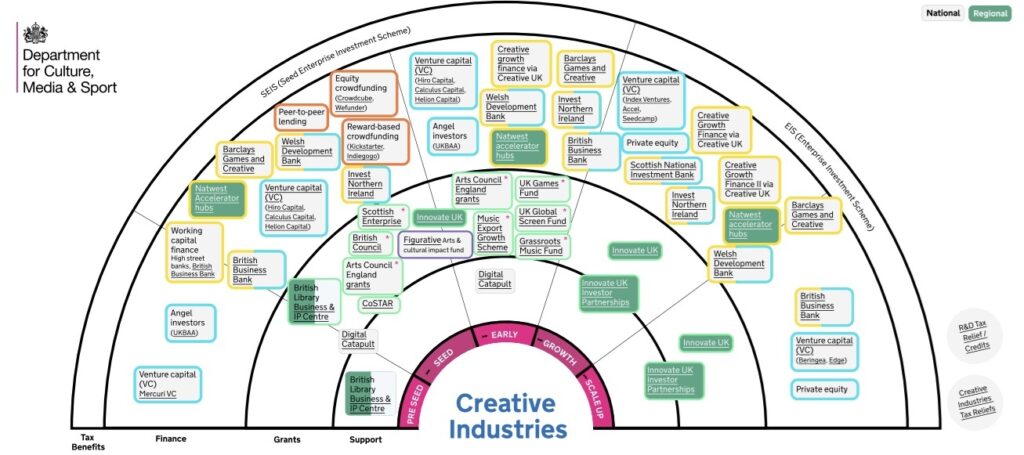
Click on the map for links to all the sources of creative industries funding
We’ve seen how branded content evolves from campaign support into institutional infrastructure. At a certain point, what’s needed isn’t more output – it’s an engine.
There comes a point in many complex organisations when branded content stops being a marketing activity and starts becoming an operational, commercial responsibility.
The shift is gradual. Calendars fill up and channels multiply. Thought leadership, product storytelling, web content and social activity begin competing for attention. Regional teams interpret messaging in subtly different ways. Leadership asks for clearer evidence of impact. And the system begins to strain.
We’ve encountered this pattern repeatedly in global institutions and growth-focused organisations: nothing appears broken, but momentum becomes harder to sustain.
At that moment, the problem is rarely creativity or ambition. More often, it’s architecture.
Branded content has become central to reputation, growth and authority, yet it’s often still managed as a series of disconnected outputs – campaign by campaign, post by post, asset by asset. What’s missing isn’t volume, but continuity: a defined, constant engine that turns strategy into sustained, measurable narrative in market.
When branded content reaches that level of importance, it requires more than coordination. It requires a deliberate operating model behind it: a branded content engine.
Limits of the traditional approach
Most organisations respond to rising branded content demand in practical ways. They expand internal teams, commission freelancers, or engage agencies to support campaigns. Each approach can work, particularly in the short term, but none fully resolves the underlying question of operational design.
Internal hires bring proximity and brand familiarity, yet rarely encompass the full spectrum of skills required for sustained branded content leadership – editorial strategy, tone governance, digital optimisation, performance reporting and cross-channel adaptation. Freelancers offer flexibility but depend heavily on internal direction and oversight, which can create bottlenecks. Agencies often excel at campaign bursts, but episodic engagement doesn’t necessarily create institutional continuity.
Over time, this can lead to fragmentation. Tone drifts subtly between markets. Institutional knowledge resides in individuals rather than systems. Reporting becomes retrospective rather than forward-looking. The branded content function grows in importance, yet remains structurally underdeveloped.
Many marketing leaders recognise this – even if they don’t initially describe it in these terms. The challenge isn’t volume. It’s structure.
When branded content becomes infrastructure
As organisations mature, branded content stops being simply supportive. It becomes infrastructural. At that point, the question shifts from “Who can produce this?” to “How is this function designed to operate over time?”
Treating branded content as infrastructure means building a system rather than assembling outputs. It involves defined workflows, clear roles and accountable leadership. It calls for integration between editorial thinking, design execution, digital performance and governance requirements. It also requires financial visibility, predictable delivery rhythms and continuous optimisation.
In our experience supporting large-scale branded content programmes – from multi-market institutions to global campaign partners – the difference is rarely the idea. It’s the engine behind it.
In this context, branded content is no longer an occasional marketing initiative; it’s an ongoing organisational capability. Thought leadership programmes, executive commentary, website ecosystems, social storytelling and campaign narratives need to align under a coherent operating model. Without that model, even the strongest strategy risks dilution through inconsistent execution.
We’re also seeing this shift in organisations moving from service-based models into self-serve or SaaS products. Launch strategy is only the beginning; sustained growth depends on a consistent branded content engine that educates, reassures and converts over time.
Importantly, this doesn’t mean adding layers of bureaucracy. A well-designed structure doesn’t slow creativity; it supports it. When briefing processes are clear, approval pathways are agreed, and optimisation and reporting are embedded into the workflow, teams can focus on insight and storytelling rather than navigating friction.
Recognising the structural signals
Not every organisation requires a fully embedded branded content division. However, there are clear signals that a more deliberate model may be needed.
This moment often arrives when content demand becomes continuous rather than cyclical; when multiple markets need alignment around a shared narrative; when leadership expects performance data alongside brand storytelling; when procurement and finance require greater transparency around investment; and when internal teams find themselves managing coordination more than strategy.
These signals point to a structural reality: branded content has grown in strategic importance, but the operating model behind it hasn’t always evolved at the same pace.
Once that gap becomes visible, the solution isn’t simply to produce more material. It’s to design the system that sustains it.
Building the operating model behind branded content
A structured branded content function integrates several disciplines within a unified framework. Editorial leadership ensures narrative coherence and tone consistency. Design and digital expertise translate ideas into engaging, multi-channel formats. Optimisation and analytics provide visibility over performance and audience behaviour. Governance processes align the function with procurement, compliance and reporting structures.
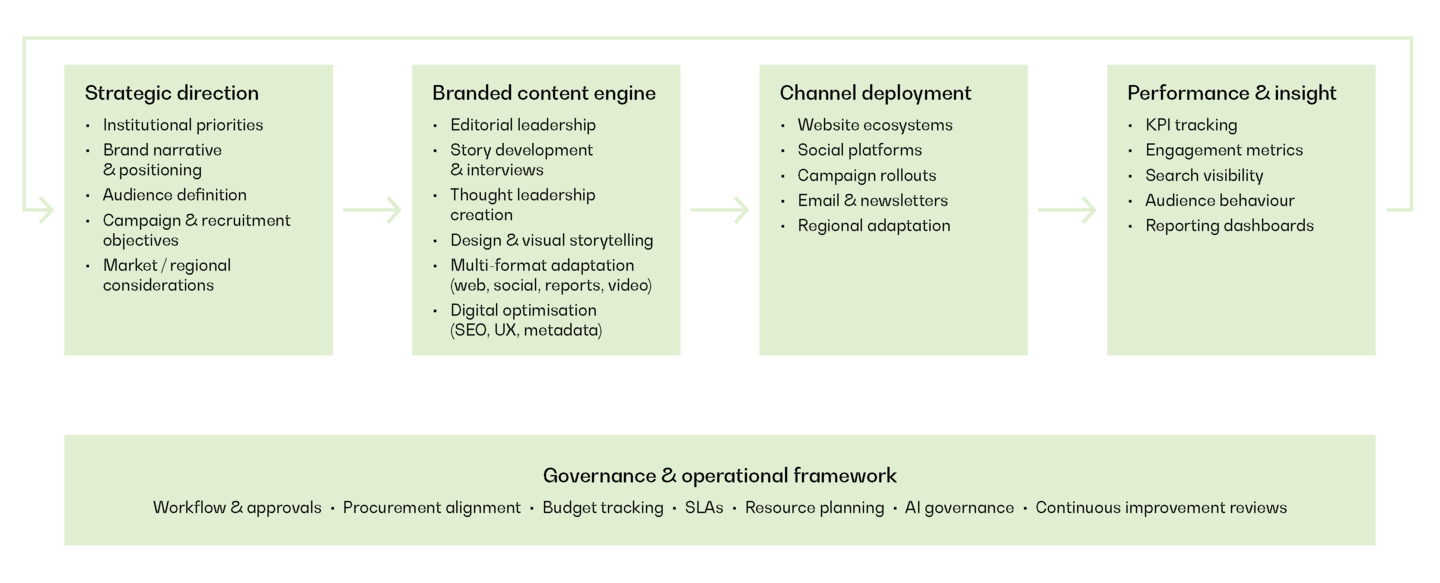
Rather than treating each campaign or article as a standalone project, this model establishes continuity. Planning becomes strategic rather than reactive. Reporting becomes a regular, forward-looking discipline rather than an afterthought. Institutional memory accumulates and strengthens the organisation’s voice over time.
For Marketing Directors and CMOs, the benefit lies in predictability and clarity. Branded content activity can align directly with organisational objectives, budget visibility improves, and cross-market consistency becomes achievable without heavy-handed control. Expertise scales without permanently expanding headcount, and the organisation retains the agility to respond to emerging opportunities.
This approach also provides a stable foundation for innovation. As technologies such as generative AI and advanced analytics become more prominent, a structured operating model ensures that new tools are integrated thoughtfully, with human editorial oversight safeguarding quality and credibility.
A more deliberate future
Over the past decade, many organisations have invested heavily in brand positioning and digital platforms. Increasingly, attention is turning to the systems that sustain those investments. Strategy defines direction and platforms extend reach, but operational design determines whether branded content can deliver sustained impact.
For organisations navigating complexity – multiple stakeholders, global audiences, formal governance and high editorial demand – the conversation is evolving. The issue is no longer whether branded content matters; its strategic value is widely understood. The more pressing question is whether the structure supporting it is robust enough to match its importance.
If branded content now shapes reputation, authority and growth, it deserves the same rigour applied to any other critical function.
Because in many organisations, the real challenge isn’t content at all.
It’s structure.
If your organisation is reaching the point where branded content needs more than coordination, we’d be pleased to continue the conversation. Explore more of our work, or contact us to discuss how we can help.
In summer 2021 we ran an event discussing funding for creative businesses with the south west team at Innovate UK EDGE and a group of Bristol Creative Industries members.
During the discussion, attendees said it would be useful if we could provide regular updates on the finance schemes that are available for creative companies in the south west and beyond. This guide is our response.
The guide is one of Bristol Creative Industries’ most popular ever blog posts. We keep it updated with the latest funding schemes for creative businesses so check it regularly. We also include the post in our monthy email newsletter, BCI Bulletin. To sign up, go here.
Funding news:
The West of England is one of the government’s priority areas for the creative industries and the West of England Combined Mayoral Authority will receive £25m of the funding to support the region’s creative industries through the Creative Places Growth Fund.
The funding will run for three years from April 2026. Read more details about the fund here.
The British Business Bank, the government-owned business development bank, has launched the £200m South West Investment Fund (SWIF) “to help address market failures by increasing the supply and diversity of early-stage finance for UK smaller businesses, providing funds to firms that might otherwise not receive investment”.
Aimed at businesses in Bristol, Cornwall and the Isles of Scilly, Devon, Dorset, Gloucestershire, Somerset and Wiltshire, the fund provides:
SWIF is managed by four fund managers:
The region is split as follows:
North of the region:
South of the region:
The funding is split as follows:
Businesses can apply for funding directly to the relevant fund managers here.
Grants of £2,500 to £10,000 are available to help small businesses, sole traders, charities, community interest companies (CICs), community organisations and creative and cultural groups open new premises.
The deadline for applications is 11.59pm on Monday 30 November 2026.. If all available funding is allocated before the deadline, the scheme may close early.
Successful applicants must start trading from the funded property by Friday 26 February 2027.
This £35m Creative UK and Triodos Bank investment fund provides loans of £100,000 to £1m.
Finance is directed to post-revenue creative businesses presenting promising growth potential and who:
PRS Foundation offers various grant funding schemes for music creators and organisations, including The Open Fund for Music Creators and The PPL Momentum Music Fund for artists/bands to break through to the next level of their careers.
The Black Artists Grant, offered by Creative Debuts, is £500 no-strings attached financial support to help Black artists.
The fund is an open access programme for arts, libraries and museums projects.
Funding of between £1,000 and £100,000 is available.
Loans of between £100,000 and £1.5m to UK charities and social enterprises based in England, Wales and Scotland.
Established games companies with a track record and a game development project at an early stage can apply for grants up to £100,000.
The deadline is 12pm on 5 May.
Grants of £100,000 – £250,000 for games companies with a commercial entertainment game prototype.
Funding of between £20,000 and £50,000 for social enterprises grow. Repayments are based on a percentage of revenue so if revenue falls, repayments reduce.
This fund from Arts Council England supports individual cultural and creative practitioners in England thinking of taking their practice to the next stage through things such as: research, time to create new work, travel, training, developing ideas, networking or mentoring.
Grants of between £2,000 and £12,000 are available.
The next round of funding will open to applications in June 2026.
The £5m Supporting Grassroots Music fund supports rehearsal and recording studios, promoters, festivals, and venues for live and electronic music performance.
Craft practitioners and organisations can apply for small grants to fund projects that support endangered crafts. The deadline is 5pm on 8 May.
Travelwest provides match-funded grants for initiatives that improve sustainable travel provision in a business.
The aim is to provide financial support and incentives to employers to enable them to encourage sustainable modes of commuting or in-work travel (including site visits and meetings) amongst their staff.
The grants can be used for the implementation of physical measures, promotional events or any other measure that will encourage mode change amongst staff.
Grants are currently availables for businesses in Bristol and North Somerset.
Innovate UK’s £100m BridgeAI programme aims “to help businesses in high growth potential sectors such as creative industries, agriculture, construction, and transport to harness the power of AI and unlock their full potential”.
The programme offers funding and support to help innovators assess and implement trusted AI solutions, connect with AI experts, and elevate their AI leadership skills.
This fund supports organisations who work at the intersection of art and social change. It offers grants between £90,000 and £300,000 over three years.
Applications are currently closed but details of the next round will be announced soon.
This new £23m social impact investment fund is for socially driven arts, culture and heritage organisations registered and operating in the UK. It offers loans between £150,000 and £1m repayable until May 2030.
The Elephant Trust says its mission is to “make it possible for artists and those presenting their work to undertake and complete projects when frustrated by lack of funds. It is committed to helping artists and art institutions/galleries that depart from the routine and signal new, distinct and imaginative sets of possibilities.”
Grants of up to £5,000 are available. The next round of funding is expected to open soon.
Grants of up to £100,000 are available for arts, libraries and museums projects.
The grants support a broad range of creative and cultural projects that benefit people living in England. Projects can range from directly creating and delivering creative and cultural activity to projects which have a longer term positive impact, such as organisational development, research and development, and sector support and development.
The UK Global Screen Fund (UKGSF) is designed to boost international development, production, distribution, and promotional opportunities for the UK’s independent screen sector. It has the following schemes:
This fund aims to grow exports and global demand for UK independent film by supporting the UK film industry to achieve measurable results which would not have been achievable without the support.
Applications close on at 11.59pm on 31 March 2028.
This scheme supports the festival launch of UK films in order to enhance their promotion, reach and value internationally.
Applications close on at 11.59pm on 31 March 2028.
Supports UK producers to work as partners on international co-productions and help create new global projects.
The next round of funding is due to open for applications in September 2026.
Awarding National Lottery funding to develop innovative new solutions which tackle the UK screen sector’s most critical challenges.
Between 2026 and 2029, up to 12 challenge calls will be identified where innovative new thinking could catalyse a step change in the industry, while producing learning and insights that benefit the whole screen sector.
Up to £150,000 is available for immersive works of fiction from experienced UK producers and creative leads with a track record in immersive or related screen-based practice.
The deadline is 12pm on 3 June 2026.
Funding for factual immersive screen projects.
Supports early career filmmakers with original and fictional shortform projects of up to 15 minutes in length in live action, animation and immersive/virtual reality.
Grants awards of between £5,000 and £25,000 are available. The next round of applications is scheduled for spring 2027.
Thsis scheme awards National Lottery funding to support the exhibition and distribution of nationally significant audience-facing independent film and immersive projects.
A Start Up Loan is a government-backed unsecured personal loan for individuals looking to start or grow a business in the UK. Successful applicants also receive 12 months of free mentoring and exclusive business offers.
All owners or partners in a business can individually apply for up to £25,000 each, with a maximum of £100,000 per business.
The loans have a fixed interest rate of 6% p.a. and a one to five year repayment term. Entrepreneurs starting a business or running one that has been trading for up to three years can apply. Businesses trading for between three and five years can apply for a second loan.
If you’re running a creative social enterprise you may be able to access funding from UnLtd.
Finance of up to £5,000 is available for starting a social enterprise and up to £15,000 for growing a social enterprise.
Successful applicants also get up to 12 tailored business support plus access to access to expert mentors and workshops.
Businesses can apply for up to £3,500 to cover the costs of installing gigabit broadband.
Check if the scheme is available in your area here.
Grants to provide support towards the costs of the purchase, installation and infrastructure of electric vehicle chargepoints at eligible places of work.
The scheme covers up to 75% of the total costs of the purchase and installation of EV chargepoints (including VAT), capped at a maximum of £350 per socket and 40 sockets across all sites per applicant.
The deadline for applications is 11.59pm on 31 March 2027.
This grant supports the uptake of electric vans and trucks. It currently offers discounts up to £2,500 for small vans, £5,000 for large vans, £16,000 for small trucks, and £25,000 for large trucks.
On 18 August 2025 the government announced the plug-in van and truck grant has been extended until 2027.
If you know of another scheme that we haven’t listed and you’d like to share it with other creative businesses, email Dan to let us know.
BRAVA, a leading provider of high-quality coaching in the art and business of voice, is proud to announce a new partnership with Films @ 59, Bristol’s premier film and television studio complex.
This collaboration will see Films @ 59 provide world-class studio facilities for BRAVA’s extensive programme of group voice acting workshops and masterclasses, further strengthening Bristol and the South West as a global hub for voice excellence.
BRAVA is renowned for bringing the very best voice coaches from around the globe to Bristol and the South West, offering elite-level training that spans performance, technique, and the commercial realities of the voice industry. Through this partnership, Films @ 59 now offers the ideal environment to combine dynamic workout sessions with professional studio recording, giving participants a seamless, industry-relevant training experience.
The partnership enables BRAVA to deliver its workshops and masterclasses in fully equipped, high-spec studio spaces, allowing artists to train, record, and refine their craft in facilities used by leading productions across film, television, and voice media.
Melissa Thom, CEO of BRAVA, said:
“This partnership with Films @ 59 is a hugely exciting step for BRAVA. Our mission has always been to provide world-class voice coaching and to make Bristol and the South West a destination for excellence in the industry. Having access to such outstanding studio facilities means our artists can train and record at the highest professional level, right here at home. Together, we’re not just serving our local community, we’re putting Bristol firmly on the global voice map.”
Films @ 59, widely recognised for its state-of-the-art studios and commitment to creative excellence, sees the partnership as a natural alignment of values and ambition.
George Panayiotou, Business Director at Films @ 59, commented:
“We’re delighted to welcome BRAVA to Films @ 59. Their reputation for attracting the highest quality coaches and nurturing exceptional voice talent perfectly complements our facilities and our commitment to supporting the creative industries in Bristol and the South West. By bringing training, workouts, and professional recording together under one roof, we’re helping to elevate the region’s profile and showcase it as a serious global player in the voice and screen industries.”
Together, BRAVA and Films @ 59 aim to create a best-in-class training environment that supports emerging and established voice artists alike, strengthens the regional creative economy, and positions Bristol and the South West as an international centre for voice talent, innovation, and opportunity.
BRAVA’s series of advanced masterclasses will take place throughout 2026.
-ends-
You need to load content from reCAPTCHA to submit the form. Please note that doing so will share data with third-party providers.
More Information