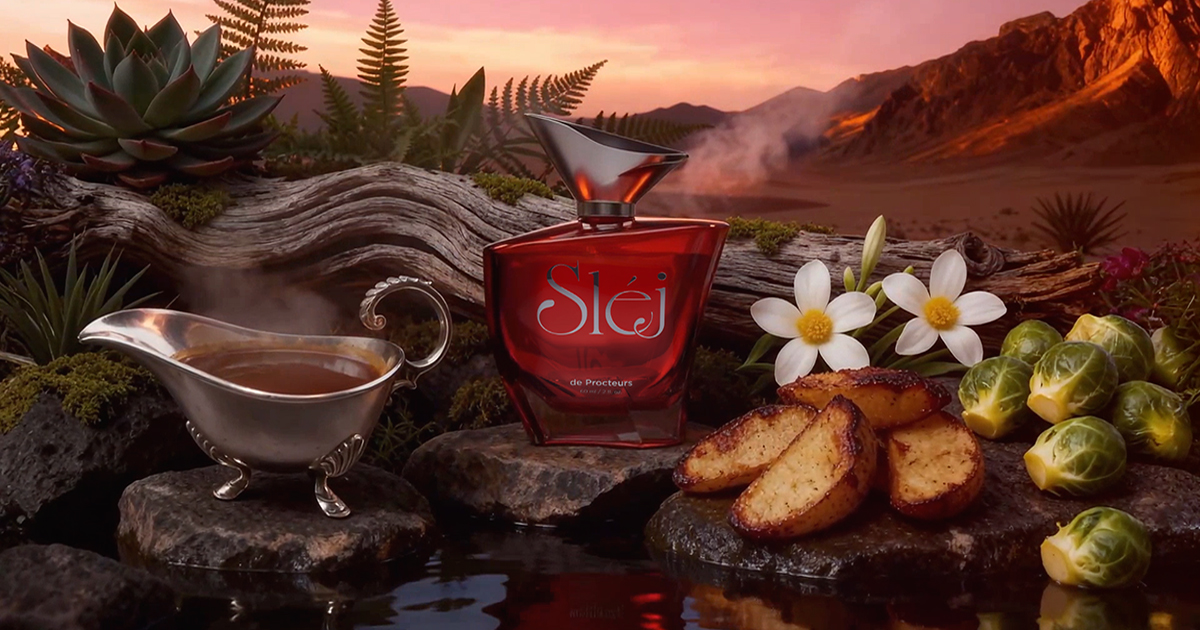
Sléj ride? – the making of our AI Christmas perfume ad

Advertising / Marketing
Agency
Digital
Marketing
Technology
TV / Film / Animation
GenAI video has been causing quite a stir recently: whether it’s backlash over the tide of AI slop, something being decried as an AI fake (whether it is or not), or an agentic AI business formula that’s made ‘millions’ overnight. Oh, and the ‘ultimate’ prompt-writing masterclass? You’ll have seen all the ads…
But look a bit harder and there’s some really interesting work out there:
One thing is undeniable: AI is going to affect digital industries – the debate around the extent and exact timeline gets far more complicated.
With all that in mind, we wanted to use our yearly Xmas video as a test bed of GenAI, to see what it could do and, importantly, what it couldn’t. And we thought we’d bring you along for the ride…
It all started in August (don’t judge). We had just ironed out our company-wide AI training roadmap and we were updating our AI usage policy. As a creative agency, it felt like we were taking real leaps forward. But it also gave our creative studio a lot to think about. We each mulled over our own questions around authenticity and the future of creative production (the part of our job many of us love most of all).
So we got our heads together and talked about how we should be doing things. What we arrived on was that creative thinking, sketching, scribbling, chatting, tinkering, and FUN should all be ring fenced and given the time they deserve. That’s why we decided to collaborate on a brief so ambitious and outlandish it simply had to work.
It should no longer come as a surprise that typing a basic prompt into AI engines only leads to AI slop.
So, before we even touched a computer, we came up with a basic concept – the ultimate tongue-in-cheek pastiche of Christmas perfume ads – and then had a mass brain-storming session where we asked the whole company for their craziest ideas. And boy did they deliver!
In a short space of time, we had suggestions ranging from a simple Xmas magic box to rivers of gravy, something about a unicorn that didn’t quite make the final edit, and the perfect name – ‘Sléj’ (pronounced as ‘slay’, obviously).
Our copywriters pulled the ideas together into a script, using a knowledge of Christmas-related puns that took a lifetime (or previous life editing rather niche magazines) to develop.
This isn’t the place to be overly reliant on AI. Allowing people free reign to throw stuff at the page works well. Importantly, don’t shut down ideas too early. The most unlikely suggestions can get workshopped into something surprising and brilliant.
This could turn into a whole blog by itself. More than any other, this stage will determine the look of your film so the more references you can include the better.
It’s crucial to find references that you have rights to both use and pass to a third party – in this case, an AI model.
For this reason, we used Generative AI to generate our reference images, feeding the output images back into the AI multiple times and asking for tweaks and refinements.
This produced a combination of a storyboard and multiple accompanying style frames (high-quality images that give a good overall feel for what the video will look like once animated).
You’re aiming to find references for each part of the shot you want to generate, for example the setting, tone, pose, character and composition etc. You want the AI to have as much information as possible and limit how much it figures out by itself.
We quickly learnt that there isn’t one AI model to rule them all, with different options performing better for different tasks. We’d highly recommend experimentation here to find which works best for your requirements.
Using detailed prompts and the bank of reference images we had gathered for each shot, we generated our footage. Prompts were written in a similar way to how we’d add
notes on a storyboard, i.e. ‘camera push in’, ‘talent to walk across frame left to right’, ‘high-key lighting’ etc but they also included additional things that wouldn’t usually be directable without heavy VFX work, i.e. ‘swirling wind kicks up dust behind legs’.
The point here is to think like a filmmaker and art director, you need to be able to supply image references but, just as importantly, you need to be able to articulate what you want to see in the frame. Playing AI like a slot machine will lead to slop.
In the same way that you rarely edit footage together straight out of the camera, generative video will almost always benefit from some post work. Again, this is a place to add further human touches that a text box often doesn’t offer. This could be reframing, changing the colour, or in/out painting of items in the scene.
Editing and sound design is another area where, as far as we’re concerned, humans just can’t be beat (not yet). Editing – the process of deciding where to push and pull those beats and gaps – and sound design are very much a process of creating a feeling and mood.
As with traditional film making, have in mind what you want to see. Those hard-won post skills still have lots of value.
It would be remiss not to briefly discuss some of our thoughts behind the ethics of our experiment.
The ethics of AI are extremely complicated. As with most things, a simply binary choice may feel tempting, and at times compulsive, but this rarely does justice to the many nuances of a topic. There is so much for every individual and organisation to consider, and I’d argue the often-discussed environmental and job-replacement angles are just the beginning.
For further information I’d highly recommend:
For me, I think After Effect’s AI roto-brush sums up a lot of the debate:
https://www.youtube.com/watch?v=cXMTHe8z6Tw
So, how do I feel about the finished video? I think the team have done a great job of making a whimsical and audacious Xmas vid with just the right level of self-awareness. And with a level of production that, prior to GenAI, our budget simply wouldn’t have stretched to.
I also hope it’s as clear to you, as it is to me, that we couldn’t have come anywhere close to the result without the thought, skill, talent and humour that went into it from right across the agency.
And how do I feel about AI? It’s complicated…
From tackling your marketing painpoints to delivering global brand strategies, Proctor + Stevenson is the B2B marketing specialist that says YES to your commercial challenges.
You need to load content from reCAPTCHA to submit the form. Please note that doing so will share data with third-party providers.
More Information