A new podcast series, Nothing, Something Nothing, has launched from Nine Tree Studios, Bristol.
The series explores how people approach creativity, are inspired, and develop their creative practice.
It’s about the creative moments you didn’t know you missed. It’s about the space between ideas, and the highs and lows that shape creative work.
It’s sector-agnostic with some high-calibre guests from the worlds of music, food, art, business and design.
Season 1’s guests include Lee Kiernan (Guitarist, IDLES), Calum Franklin (Restaurateur, Harrods), and Alex Rodrigues (Producer/Director, Channel 4).
And – as a Bristol Creative Industries exclusive – the podcast will also be dropping an episode with Mike Bailey (Actor/Teacher), known for his role as Sid in Skins.
New episodes drop every Wednesday on your favourite platform; visit www.nsnpodcast.com to listen and subscribe on Spotify, Apple Podcasts, and YouTube, as well as on social.
The podcast has launched from production company JonesMillbank and Nine Tree Studios, with recording currently taking place in Bristol.
***
JonesMillbank are a full-service production company based at Nine Tree Studios, their 10,000sq ft film studio.
Producing branded content, TV ads and social content their clients include local, global and household brands such as Dyson, Freixenet, DHL, Oxfam, Pukka and Vax.
jonesmillbank.com
01173706372
[email protected]
Immersive Ideas Founder Sarah Morris explores how ‘immersive’ emerged as a practice and methodology, not just a passing trend, but a cultural shift shaped by decades of experimentation.
The word immersive is now everywhere in the live experience industry. It appears across theatre, exhibitions, themed entertainment, festivals, brand activations, and cultural events. Yet its widespread use often obscures the fact that immersive is not a new idea, nor a shallow one. It is a term with a long, contested, and deeply theatrical history, and much much more than just a buzz word.
Immersive did not begin as a marketing label. It emerged through artistic experimentation, theoretical debate, and a growing dissatisfaction with distance between audiences and performance. While many disciplines have contributed to immersive practice, it was actually theatre that crystallised immersive as a cultural movement, articulated its values, and pushed it into the mainstream consciousness.
This article traces the history of immersive practice across theatre and live experience, arguing that immersive is not defined by technology or format, but by a convergence of artistic integrity, world building, audience journey and agency, story, performance, and theatrical design.
Immersion existed long before immersive had a name.
Before immersive became a recognised practice, performance was already concerned with how audiences enter a world rather than simply observe it. Classical theatre traditions were built around proximity, ritual, and shared focus. Greek tragedy used architecture, chorus, rhythm, and repetition to draw audiences into a collective emotional state. Medieval mystery plays moved through streets and civic spaces, embedding story into daily life and collapsing the distance between performance and reality.
Theatre scholar Dr Emma Cole notes that immersion has “intrigued humanity since antiquity,” pointing to the long standing human fascination with belief, illusion, and participation.
The impulse behind immersive work, the desire to step inside a story, to feel present within it, predates any contemporary terminology.
What emerges here is immersive as a practice not a label, it relies on trust, belief, and the willingness of audiences to enter into a world together. These principles sit at the heart of even the most mainstream immersive work today.
Although immersive thinking exists across many disciplines, it was theatre that transformed immersion from a design technique into a cultural force.
Experimental practitioners rejected the safety of the proscenium and began designing worlds audiences had to enter physically and psychologically. Immersion in theatre was never about comfort. It was about proximity, vulnerability, and consequence.
This is why immersive theatre became a movement, rather than simply a style. It was accompanied by critical writing, artistic intent, and cultural debate. Theatre gave immersion its intellectual backbone.
Alongside theatrical experimentation, theme parks and attractions had been developing immersive environments for decades. Dark rides, walkthrough attractions, and themed lands relied on coherent world building, scenic design, sound, smell, pacing, and audience flow to sustain belief.
Attractions understood something fundamental early on. Immersion depends on consistency. Worlds must operate according to internal logic. Set building, sightlines, operational choreography, and performance all reinforce narrative integrity.
What distinguishes attractions is scale, repeatability, and operational discipline and in contrast what distinguishes theatre is intent, intimacy, and liveness.
The most powerful immersive experiences today draw from both traditions, blending theatrical meaning with the spatial intelligence of attractions design.
The term immersive theatre enters academic discourse in the early 2000s as scholars attempt to name practices that resisted existing categories such as site specific, promenade, or participatory theatre, and naturally around a decade later, marketing terminology.
Dr Gareth White defines immersion as a perceptual and psychological state shaped by spatial orientation and attention.
Dr Josephine Machon emphasises embodiment and audience journey.
Language evolves because practice evolves. Immersive is not a perfect word, but it is a useful one. It sets expectations. It signals intent. It allows different disciplines to speak to one another.
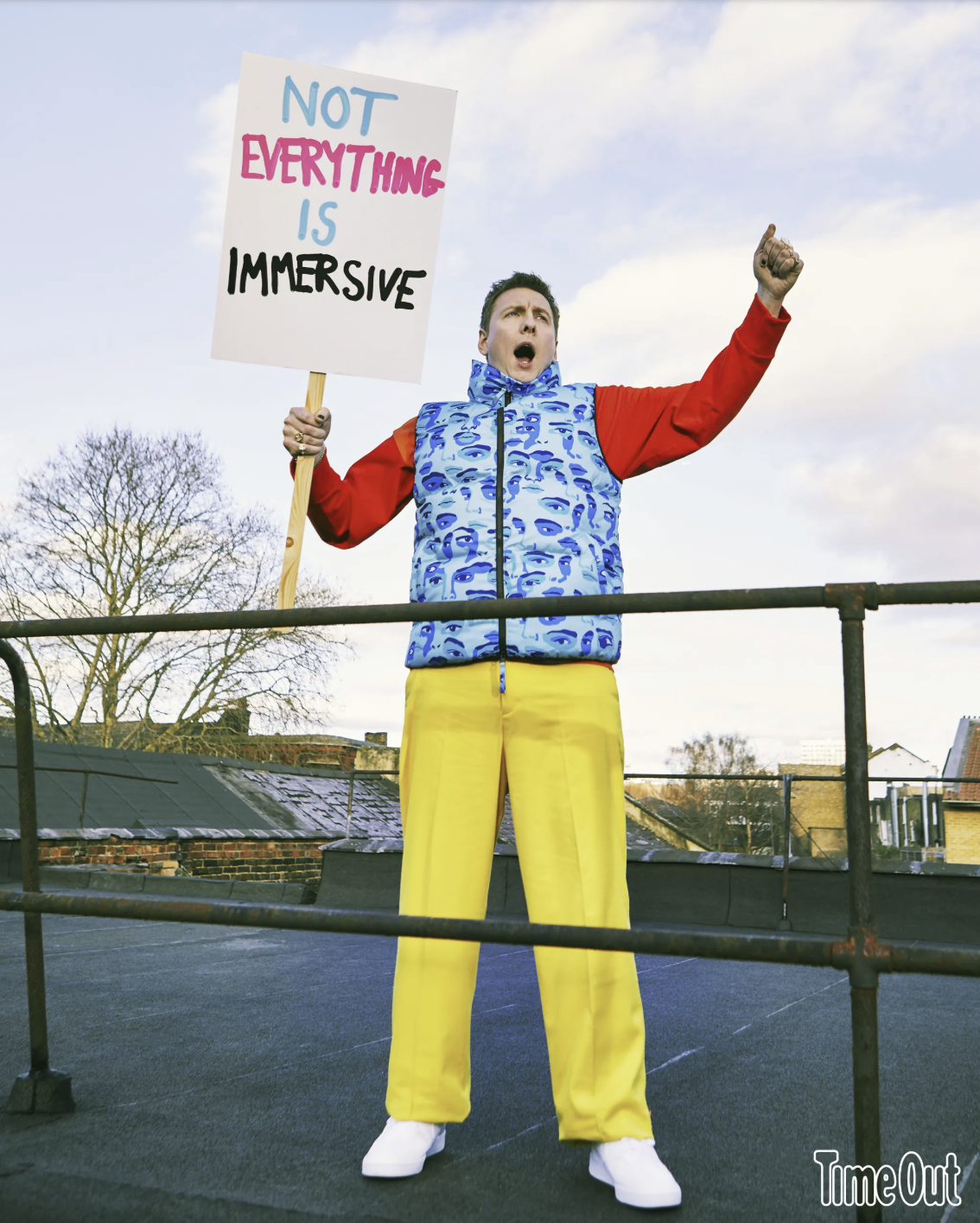
To quote Joe Lycett, “not everything is immersive” But that does not invalidate the term. Language evolves alongside practice. Immersion exists on a spectrum, the word will continue to stretch as the work itself stretches.
Anger at the word immersive often masks discomfort with its popularity. But popularity does not negate legitimacy. It confirms cultural relevance. Don’t call something immersive just to sell tickets, but don’t be trapped by terminology either.
As Cambridge Dictionary quotes “IMMERSIVE – seeming to surround the audience, player, etc. so that they feel completely involved in something”
Language in the arts shifts as practice shifts, and as work needs to be communicated, words spread when they are needed.
For many audiences, immersive theatre became culturally legible through the work of Punchdrunk. Their productions introduced large scale environments, fragmented narratives, and audiences who moved freely through performance worlds rather than sitting passively in front of them. Theatre became the vehicle that carried Immersive into the mainstream.
Punchdrunk did not invent immersive theatre. They would be the first to acknowledge that. In fact, they now more often describe their work as site-responsive rather than immersive. What they did do was translate experimental practice into a form that captured public imagination at scale.
Immersive became something audiences could recognise, seek out, and pay for. Theatre made immersive visible.
Alongside this sat a rich ecosystem of UK companies making immersive, interactive, and participatory work throughout the 2000s, long before immersive became a mainstream label. You Me Bum Bum Train, Shunt, Les Enfants Terribles, Secret Cinema, Coney, DifferenceEngine, CoLab Theatre, Apocalypse Events, dreamthinkspeak, Blast Theory, Uninvited Guests, Third Angel, Improbable, Rotozaza, Invisible Circus, Lab Collective, Dank Parish, and many others were already experimenting with audience agency, world building, participation, and non theatrical space, this is also where a lot of the current practitioner (including myself) who have gone on to make more commercial experiences cut their teeth.
This list is far from exhaustive. It exists as a reminder that immersive practice is not new. It is rooted in decades of experimentation, often happening in warehouses, abandoned buildings, churches, shops, offices, basements, and outdoor sites, almost never on a traditional stage. These pioneers laid the groundwork for everything that followed.
In contrast to those early days, immersive experiences now operates at scale. Ticketing platforms have reported sharp rises in demand, with Eventbrite recording an 83 percent increase in searches for immersive experiences year on year, and DesignMyNight reporting an 88 percent rise in interest. The global immersive entertainment market has been valued at £98 billion – The Independent, pointing to sustained public appetite rather than fleeting novelty.
With that growth comes friction. The word immersive is now used widely, sometimes loosely, and sometimes badly. Misuse can be damaging, not because the term itself lacks meaning, but because poor delivery erodes audience trust and undervalues the craft behind the work.
The much publicised failed Wonka experience is a useful example. It was marketed as immersive because that was the intention. Tickets sold for a reason. Audiences wanted to believe in the promise. The failure was not the ambition, nor the terminology, but the absence of expertise, structure, and understanding needed to deliver immersive in practice.
The risk to the industry is not that immersive is used too broadly. Projection mapped digital art in a gallery space has every right to call itself immersive. So do theatre, live events, attractions, and hybrid digital worlds. The real risk is the wrong people making the work without the skills, experience, or long term practice required to support it.
Immersive is not the problem. Inexpert delivery is, or the work being created without intent as a money grab, but this shouldn’t tarnish the industry or the word immersive.
And The Stage rightly observed that “the term immersive has been maligned and misinterpreted but it is still the word under which some of the most exciting theatre is being made.”
Immersive went mainstream because people wanted it. The responsibility now is to make it well.
Immersive is not a genre. It is a methodology.
At its core, immersive practice brings together artistic integrity, world building, audience journey, story, performance, theatrical design, and craft-led making. Sometimes this is supported by advanced technology, sometimes it is entirely analogue. When these elements align with intention, immersion is not applied, it emerges.
What has changed in recent years is scale, support, and reach. Immersive is no longer operating at the margins. It is now underpinned by formal funding streams and strategic investment, including national initiatives such as Immersive Arts UK, alongside long established public funders like Arts Council Engand. This has enabled artists and companies to develop original IP, experiment, tour, build sustainably, and take creative risks that would previously have been inaccessible.
At the same time, rapid advances in technology have expanded what immersive can be. Spatial audio, real time engines, mixed reality, projection mapping, responsive environments, and networked digital platforms have allowed immersive work to exist beyond physical sites, opening up digital and hybrid spaces that are participatory, persistent, and globally connected. Audiences can now step into worlds that live online, overlap with physical environments, or evolve over time, often at a fraction of the cost of traditional large scale builds.
Alongside funding and technology sits a growing professional ecosystem. Communities such as The Immersive Experience Network and World Experience Organisation have helped formalise knowledge sharing, advocacy, skills development, and international collaboration. This matters as it creates clearer career pathways, supports freelancers and small studios, and continues to generate new roles across design, production, performance, fabrication, engineering, and digital development.
The question is not whether a term is used imperfectly, but whether the work behind it is intentional, crafted, and coherent, when it does it remains a meaningful way to describe work rooted in world building, audience journey, and lived experience rather than novelty alone. We may never all agree on the terminology, but the trajectory is clear: immersive is a practice and what it describes is real, growing, and here to stay.
This is not a phase. It is a movement.
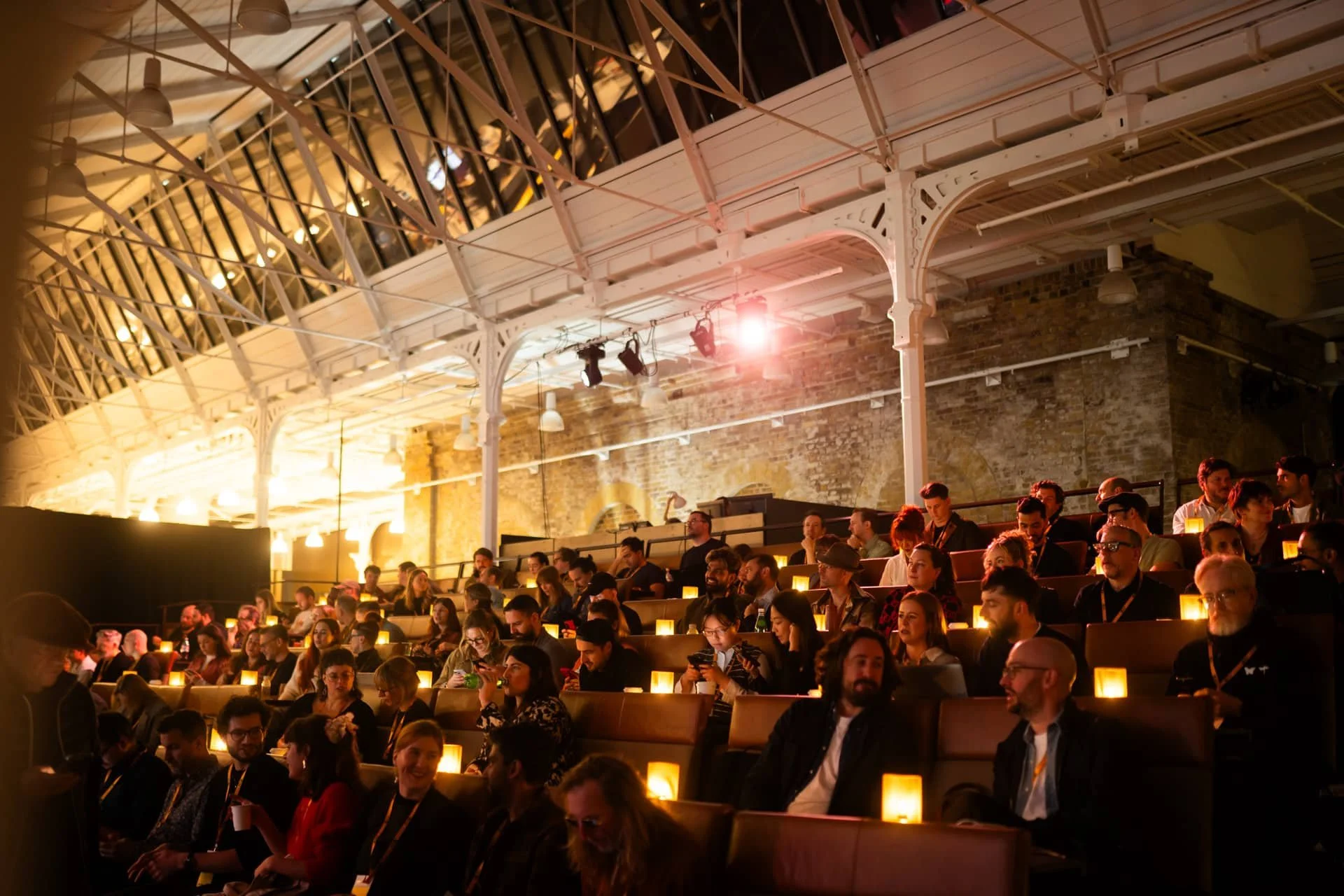
Immersive Experience Network: IEN Summit 2024
Immersive Ideas Ltd is not a name we arrived at casually. We own it because we have spent over a decade living and breathing the work that defines it, in it’s simplest form putting audiences inside experiences, not just in front of them.
Our practice has been built through making immersive work across theatre, live events, festivals, attractions, brands, and experiential environments, long before the term became widely used. Through this we have learned what immersive actually demands when real people are present, moving through space, making choices, trusting the world around them, and responding in real time.
Our skills come from doing the work. From testing audience behaviour, designing and building spaces that have to hold together under pressure, and making creative decisions that balance emotion, logistics, safety, scale, budget, and meaning.
We understand immersive because we have built it, broken it, refined it, and built it again, often in the strangest of spaces, often under tight constraints of budget, time, and circumstance.
Our past experience has given us a strong instinct for emotional logic, clear audience journey, and the subtle mechanics of trust. We know what audiences want, what clients and collaborators need, and how to design experiences that feel generous, coherent, and alive. This kind of thinking only comes from long term, hands on immersive practice.
We use the word immersive with care because it accurately describes the work we specialise in – If a project is not immersive in nature, in some form or another, it is probably not the right fit for us, and that clarity is deliberate and honest.
If you want to work with people who understand where immersive practice comes from and where it can go next, we would genuinely love to talk.
You can explore more writing on immersive practice, world building, and immersive experience design on our website, or get in touch to discuss a project, collaboration, or commission.
Immersive is not about pulling audiences in. It is about building worlds, spaces, attractions, and live experiences that earn belief, establish trust, and reward curiosity.
When we say at Immersive Ideas Ltd “we make reality sweat” we really do mean it!
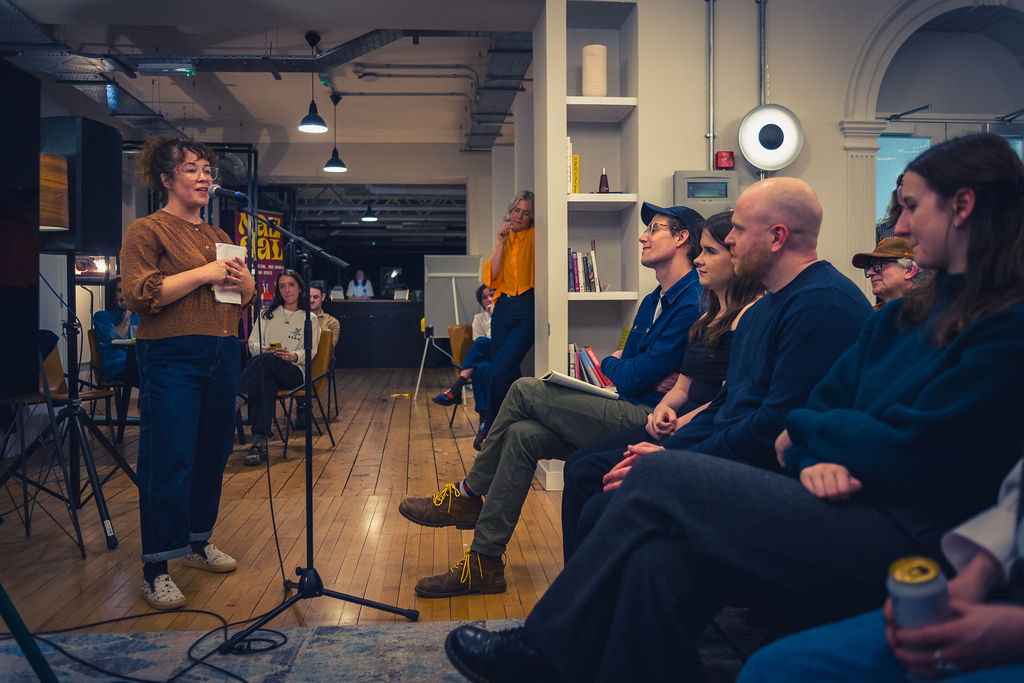
Last week, the Gather Round at Brunswick Square was buzzing. A packed room, a hum of anticipation, and a palpable sense that something meaningful was about to unfold as we kicked off the third year of our award-winning series, Gather Round Presents.
From the very first moment, the evening invited us into stories that stretched beyond words on a page. Our panellists didn’t just tell stories: they cracked them open. Stories of human understanding, our relationship with the world around us, and the narratives we carry about ourselves and others. Together, they explored how the past can be re-examined, reshaped, and used to imagine new futures and how powerful it feels when those stories land.
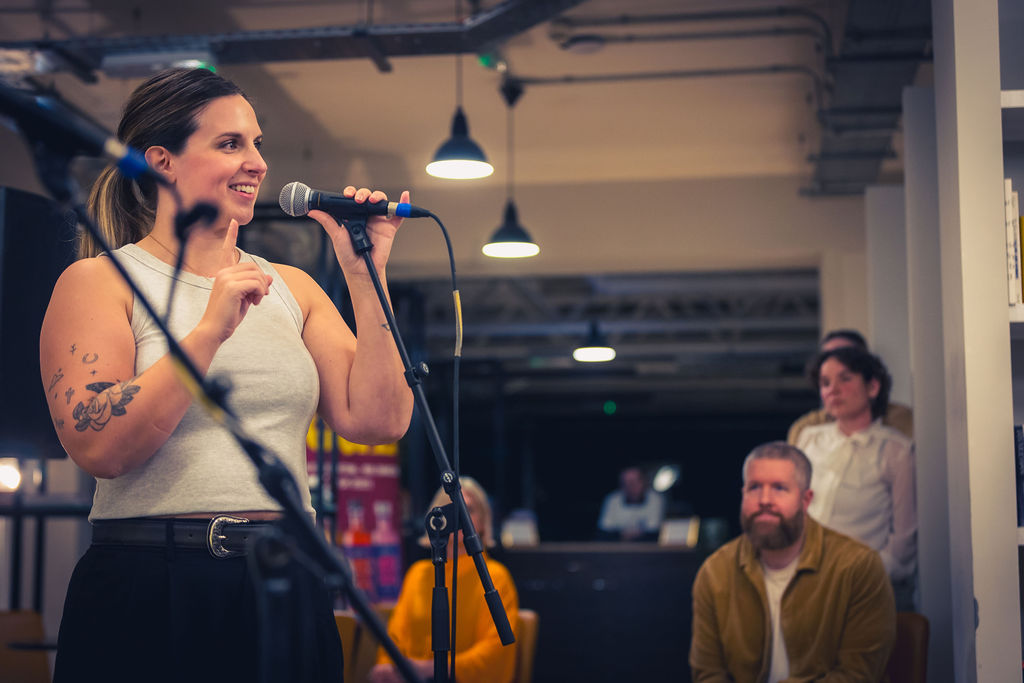
Sara Joyner, Senior Podcast Producer, opened the evening and wasted no time pulling us in. What began with a slightly shocking story instantly had the room leaning forward, unsure where it might lead. But that uncertainty quickly turned into delight as Sara revealed her craft with warmth, humour, and total ease.
With sticky notes representing three characters in an upcoming podcast, Sara physically rearranged the facts in front of us, showing, in real time, how a story can be subtly shaped. Laughter rippled through the audience as she explained, with playful honesty, how she “manipulates” the listener.
As the audience was invited to guess where the story was heading, there was a collective realisation: context is everything. By withholding or revealing certain details, a story and a person can be perceived in entirely different ways. Sara’s delivery was disarming and deeply engaging, leaving us entertained, slightly unsettled, and newly aware of how easily we’re led… often without noticing.
Connect with Sara on LinkedIn or check out her web page for more info on her work.
Dan Caulfield, Film Director and Storyteller at Enviral, followed and had us hooked within seconds. He began with what felt like a deeply emotional story: a grieving father, a lost child, and an epic journey born of love and loss. The room softened.
And then, laughter erupted.
The characters were revealed to be Marlin and Nemo. Pixar, of course. A collective groan, smile, and appreciation washed across the room.
He wasn’t done yet. The second story, a tender, hilarious retelling of a tale once told to him by his Irish grandad in a pub, had us in stitches. Dan described piecing together meaning from thick accents, facial expressions, and half-heard words, transporting us back to a time when storytelling was something you felt as much as heard.
Behind the humour was something deeper. Dan spoke passionately about the ancient tradition of oral storytelling and the responsibility of keeping it alive. Though he works in marketing, this wasn’t a sales pitch. It was human.
Stories, he reminded us, exist everywhere across cultures, languages, and generations. They shape who we believe we are. They can fuel fear… or they can bring us together. As the laughter settled, the room grew reflective. Dan invited us to consider the stories we tell ourselves about identity, worth, and belonging. Food for thought that lingered long after he left the stage.
Follow Dan on Instagram or connect with him on LinkedIn to see more of his work.
Ghostwriter and part-time stand-up comedian Nick Anderson Vines carried us into the first break and promptly had the room roaring. Sharp, self-aware, and genuinely funny, Nick brought a different energy while still keeping storytelling firmly at the centre.
He spoke about how he works LinkedIn with refreshing honesty, unpacking how to attract clients while still telling meaningful stories. When ChatGPT entered the scene in 2023, Nick admitted it shook the writing world fear, uncertainty, and the sense that everything might change overnight.
But then came the shift. Opportunity. A return to craft. Writing more. Writing better.
Nick’s passion was contagious. In a fast-moving digital landscape, he argued, stories are what stops the scroll. They’re what make us care. Using the pull of before and after, and reframing narratives with intention, Nick left us laughing — and quietly fired up to rethink how we tell stories online.
Connect with Nick on LinkedIn to hear more about his work.
Rosa ter Kuile, known as RTiiiKA, gently reset the room as the only visual artist on the panel. Her presence felt grounding, inviting us to slow down and see stories differently.
Rosa spoke about storytelling beyond words: through murals, characters, and playful alter egos. From the giant foyer mural at Bristol Beacon to the personas she created and played in videos to tell her story – ‘Grinder Guy’ and her ‘own agent’. She showed how storytelling can be both strategic and deeply personal and sometimes with a touch of humour. These characters, she explained, often became the most compelling part of her work — a way to narrate process, vulnerability, and creativity in real time.
As Rosa shared the recurring themes that shape her art: sexuality, falling in love, road signs, bikes (and more) the message became clear: stories exist everywhere. Some shout. Others whisper. It’s up to us to notice them.
Follow Rosa on Instagram to see more of her creations or connect with her on LinkedIn.
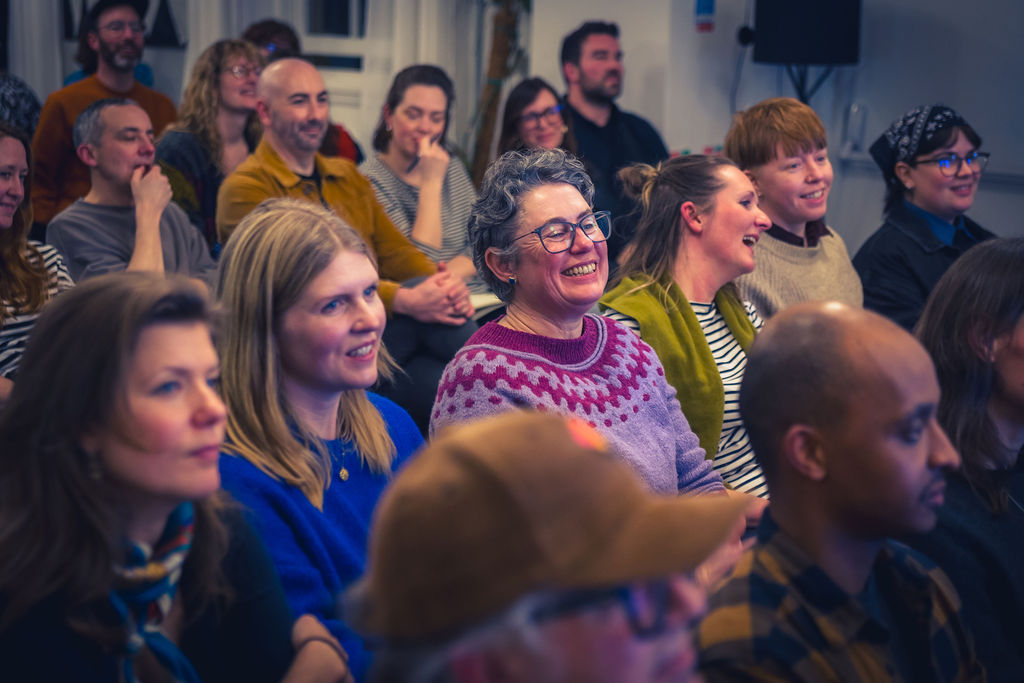
Mark DeLisser stepped onto the stage and immediately stilled the room opening with a poem from his new book, Ashes to the Breeze.
Mark spoke about his deep relationship with the natural world, and the idea that while he writes stories, often as poems, he is also being storied. By landscapes. By relationships. By life itself. There was a quiet reverence in his words as he described knowing he is part of something far bigger, a story that began before him and will continue long after.
He spoke of listening to the body while writing, noticing moments of tightening, softening, longing — and allowing those sensations to guide the words. Poetry, he said, comes from slowing down and noticing, not forcing meaning into existence.
Sharing two poems: Your Name and The Stories We Tell. Mark echoed something Dan had said earlier: the importance of telling stories about what we want to be true. Stories that interrupt the constant stream of horror and remind us of other ways of living. In that moment, it felt like the room was breathing together inspired, hopeful, and deeply moved.
You can buy Mark’s book Ashes to the breeze in Waterstones.
And follow him on Instagram to hear more of his beautiful words.
With just 24 hours’ notice, Kendra Futcher OG Cigar Factory member closed the evening, and what a closing it was. Ever-eloquent, deeply present, and emotionally generous, Kendra held the room with quiet power.
A self-described writer, thinker, and noticer, she spoke about paying attention to the smallest details: the inflection of a voice, a texture, a sound, the scrunch of a nose. This practice of noticing, she shared, became vital during Covid a way to stay alive to the world and to herself.
Kendra spoke about vulnerability as the beating heart of storytelling. Emotional honesty, she reminded us, is what truly connects people. Words can divide but they can also unite.
She spoke of her collection of photographs from protests placards filled with raw, urgent language that has so inspired her. She shared two poems with us – the first, Monobrow, about her daughter, silenced the room completely. It was her first time reading the poem aloud, and the moment felt sacred. You could feel the tears, the tenderness, the shared humanity.
For Kendra, truth is freedom. And that, she believes, is the essence of storytelling.
Follow Kendra on Instagram or connect with her on LinkedIn or have a look at her website to read more about her many skills.
Our beautiful event space at Brunswick Square is available for hire, email Hannah on [email protected] for more info and come and host your event at our place!
Follow us on Instagram for more stories from our creative community and if you want to come and join us, we’re currently offering 30% off for 3 x months if you join before 28th February 2026,more info on our offer page.
Bristol, UK – January 2026 — Ignition DG Ltd, the Bristol-based strategic events and exhibitions agency, as part of Istoria Group, today announces significant business growth. From expanded global reach to continued leadership, Ignition DG continues to generate impressive results in the sector.
Founded in 2007 with a mission to challenge traditional “build and burn” event practices, Ignition DG has grown into an award-winning creative agency known for blending strategic planning with world-class delivery.
Global Growth
Ignition DG designs and delivers hundreds of exhibitions and event programmes each year – serving clients across pharmaceutical, beauty, biotech, aerospace and technology sectors.
To support recent successes, Ignition DG ended 2025 with the opening of a new European office. With strategic hubs and warehouse facilities now established across the UK, EU and the US, Ignition’s global growth goes from strength to strength. Paired with trusted partners across Asia, the Middle East and South America, the business has consolidated its ability to support global programmes with local expertise.
Client Success
From complex exhibition portfolios and major congresses, Ignition’s work emphasises strategic intent, creative innovation, and seamless project management – underpinning sustained client retention and growth.
Alongside continued client success, Ignition has won awards for booth designs, creative event executions, and bespoke modular solutions that deliver high impact and cost efficiencies for global brands.
With recent client wins, Ignition has attracted new talent to the company, seeing a 19% increase in employees throughout 2025.
Innovation Through Change
In recent years, the company has responded to shifts in the events landscape by scaling its digital and hybrid capabilities. This adaptability has reinforced client partnerships, enabling Ignition DG to deliver hundreds of virtual events and hybrid programmes that seamlessly blend creativity with technology.
Innovation continues to be part of Ignition’s DNA. New strategic capabilities, such as building exhibition attractors in-house, are being launched, alongside medical content writing as a service.
Looking Ahead
“We’re proud of the sustained growth we’ve achieved while staying true to our founding values,” said Sam Rowe, CEO of Ignition DG. “Our team’s focus on creativity and strategic excellence has allowed us to support clients around the world with meaningful, measurable experiences.”
With continued investments in strategic solutions, talent and technology, Ignition DG is poised to grow further into 2026 and beyond. The company remains committed to helping clients across regulated industries to create impactful live experiences that drive business results without compromising environmental or ethical standards.
For media enquiries, please contact:
[email protected]
Bristol is preparing to take its first steps towards a potential bid to become the UK City of Culture in 2029, a title that celebrates creativity, community, and the power of culture totransform lives.
On Tuesday 20 January councillors agreed to submit an expression of interest to the Department for Culture, Media and Sport (DCMS). This marks the beginning of a journey that could see Bristol shortlisted for one of the country’s most prestigious culturalhonours.
The UK City of Culture programme shines a national spotlight on the cultural life of cities, bringing opportunities for residents and visitors to experience creativity in new and exciting ways.
Previous winners have seen lasting benefits: increased local pride, stronger community connections, and a boost to the local economy through tourism and investment.
For Bristol, the ambition is clear: to use culture as a force for inclusion and opportunity.
Philip Walker, head of culture at Bristol City Council, said:
“Our city is renowned for its creativity – from street art and music to festivals and independent venues. While we take pride in our city’s offer not everyone has equal access to cultural experiences. Barriers such as cost, location, and representation mean some communities feel disconnected from Bristol’s cultural offer.
“A bid for UK City of Culture would aim to change that. The UK City of Culture programme is about more than events and festivals – it’s about creating lasting change. For Bristol, this means cementing culture as a means to tackle inequality, strengthen communities, and inspire future generations.
“It means celebrating what makes the city special while opening doors for those who feel excluded. A Bristol approach is one that is rooted in its grassroots cultural scene – the community-led projects, local artists, and neighbourhood initiatives that give our city its distinctive character. By building from the ground up, our bid would seek to ensure that everyone, regardless of background or postcode, can experience and benefit from Bristol’s vibrant cultural life.
“We want to empower a whole city bid that captures the spirit of the sector and the communities of Bristol. Should the committee give us the go ahead to start the bidding process we want to build a bid on the power our cultural offer has to bring people together, foster understanding, and strengthen the voices of our communities.”
LaToyah McAllister-Jones, founding partner and lead facilitator at Citizens for Culture, said:
“After more than a decade working in Bristol’s cultural sector, I’ve seen first-hand the extraordinary breadth of creativity this city offers. As a founding partner of Citizens for Culture, Bristol is already shaping its cultural future with its citizens. This bid is about Bristol’s role in the wider West of England ecosystem and how UK City of Culture can deliver lasting regional benefit.”
Bristol now join other cities in the race to become UK City of Culture 2029. The process involves several stages, starting with the expression of interest and leading to a shortlist of cities invited to develop full bids.
We are proud to have several cultural businesses and organisations as Bristol Creative Industries members. They include:
Design West | RWA (Royal West of England Academy) | Watershed | Bristol Beacon | Curzon Cinema & Arts | St George’s Bristol | Bristol Cathedral | We The Curious | Tobacco Factory Theatres | Aardman Animations | Wake The Tiger
Jurassic Park is often cited for its technical innovation or iconic moments, but its real influence runs deeper. Long before immersive experiences became the buzz word we know today, the film demonstrated how to build a world audiences could fully step into, understand, and believe in. For creatives, designers, and producers, Jurassic Park functions as a near perfect case study in experience architecture.

One of the film’s greatest strengths is how clearly it establishes its internal logic. Before the dinosaurs appear, the audience is oriented.
We are shown how the park operates, how guests move through it, what is automated, what is controlled, and where the boundaries lie.
This mirrors best practice in immersive experiences. Audiences need orientation before participation. Clear rules do not limit immersion, they enable it. When people understand how a world works, they relax into it. When those rules later fail, the impact is emotional rather than confusing.
Jurassic Park earns its chaos because it first earns its structure.
The arrival sequence, the branding, the orientation film, the guided tour vehicles. This is onboarding in its purest form. The park reassures its guests that they are safe, looked after, and part of a carefully designed experience.
Experience design relies on the same mechanism. Audiences need to know what kind of experience they are entering, how they are expected to behave, and what level of risk or participation is involved. Without this, surprise becomes anxiety rather than engagement.
Jurassic Park understands that trust must be built before it can be broken.
A common misconception in immersive work is that closeness equals immersion. Jurassic Park proves the opposite. The audience is rarely placed in direct danger. Instead, tension is created through perspective. Watching from inside the car, behind glass, under the fence.
The film controls audience position with precision. This is exactly how immersive experiences maintain emotional intensity without overwhelming participants. Immersion is about relationship to events, not physical distance from them.
The science in Jurassic Park is famously flawed, yet the film remains emotionally convincing. That is because its characters behave like people and its consequences feel earned.
Immersive experiences do not need realism. They need emotional logic. Audiences will accept extraordinary premises if the world responds to them honestly and consistently.
At its heart, Jurassic Park is a cautionary tale about creation without accountability. The ability to build something spectacular does not absolve the creator of responsibility for its impact.
This is a vital lesson for immersive practitioners. Immersion amplifies emotion, vulnerability, and trust. With that comes a duty of care. Designing worlds is not just a creative act, it is an ethical one.
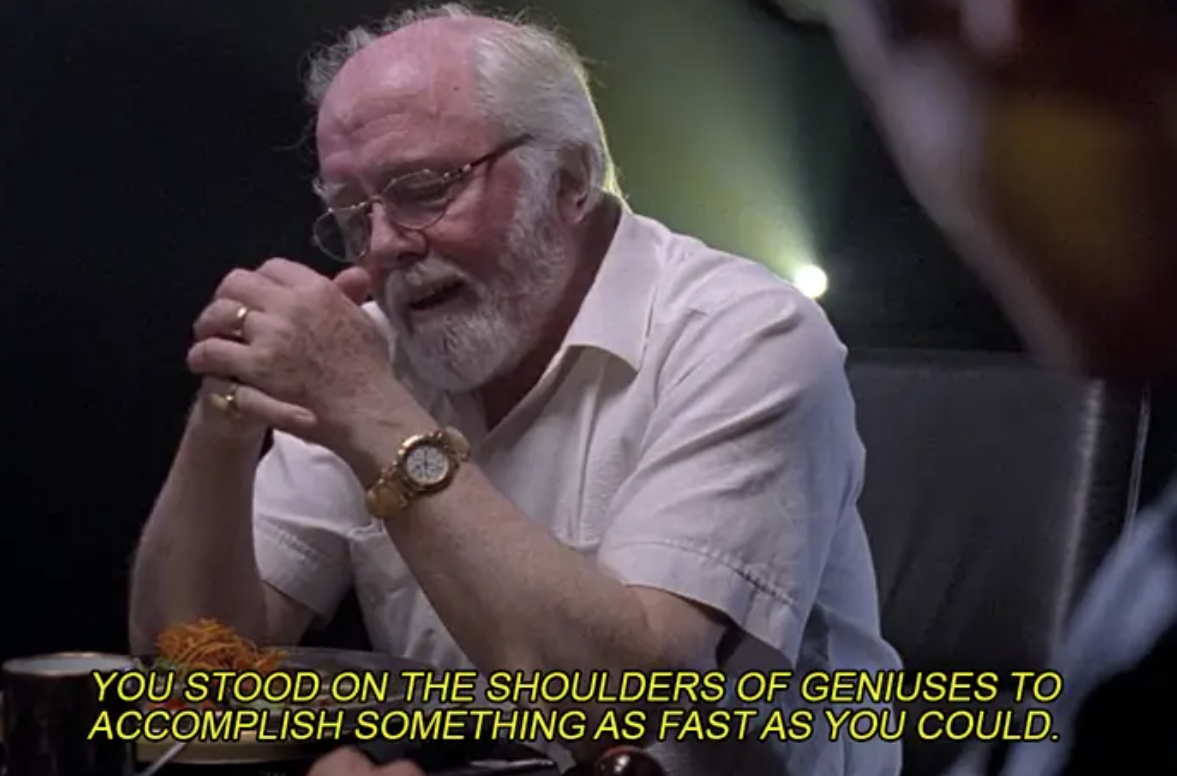
Universal
Jurassic Park matters because it is not just a blueprint for brilliant world building, it is also a quietly terrifying dystopia for the future of live experiences and attractions if we get complacent.
Strip away the dinosaurs and you are left with something uncomfortably familiar. A premium attraction driven by scale, automation, branding, efficiency, and spectacle. Guests are processed, reassured, and managed. Human complexity is treated as an inconvenience. Risk is assumed to be solvable by systems. Sound familiar? If not, spend five minutes in a badly designed immersive experience where no one quite knows what is allowed, where the exit is, or who is actually in charge.
Jurassic Park shows us what happens when experience design prioritises control over care, throughput over trust, and innovation over responsibility. It is the logical end point of the thinking that bigger, faster, smarter, more immersive is always better. The joke, of course, is that this is exactly how people get eaten by raptors.
For immersive creators, this is the real takeaway. World building is not neutral. Immersion magnifies everything, emotion, fear, delight, confusion, vulnerability. The more convincing the world, the greater the responsibility of the people who build it. Consent, clarity, pacing, agency, and safe failure are not nice extras. They are the difference between magic and meltdown.
This is where thoughtful immersive design matters. Not just how impressive something looks, but how it behaves under pressure. What happens when things go wrong. How audiences are supported, not managed. How trust is earned, not assumed.
At Bristol based Immersive Ideas Experience Agency, this is exactly where we focus our work. We design experiences that respect audiences, honour story, and understand the emotional mechanics of participation. We build worlds that feel alive because they are coherent, human, and accountable. Not theme parks with better tech, but experiences with purpose, care, and consequence baked in from the start.
Jurassic Park endures because it understood something the industry still occasionally forgets. Just because you can build it, does not mean you should build it that way.
And if the future of live experiences ever starts to feel a bit too much like a glossy orientation film promising everything is completely safe, while the fences quietly hum in the background, that is probably the moment to pause, step back, and rethink the design.
Aer Studios and Condense have collaborated with BBC Children in Need to bring Pudsey to life in a new interactive 3D experience for this year’s fundraising campaign.
Donors are invited to unlock a playful ‘paw-gmented reality’ moment, where a 3D-captured Pudsey appears in their real environment to deliver a personal thank you. Using only a mobile device, supporters can place Pudsey in their home, move around him, change his size, and enjoy a light-hearted, uplifting interaction created especially for the appeal.
Nick Fellingham, Founder of Condense says, “The BBC Children in Need Pudsey experience reflects the heart of what our technology makes possible. Fun, accessible and engaging moments that bring real 3D performances anywhere. We’re proud to support such a meaningful cause and to collaborate with brilliant creative partners on an experience that feels joyful for donors.”
Tom Harber, CEO at Aer Studios says, “Our mission as a company is to create positive impact through meaningful digital experiences, so when BBC R&D’s FWD team approached us we were really enthusiastic! We’re proud to have created a truly user-centred platform to delight people donating to such a worthwhile cause in a short amount of time.”
The experience has been brought to the fore by the partnership between MyWorld, the creative innovation institute, and the BBC. With an eye on the future application of technology into entertainment spaces, the BBC R&D team identified a potential use for BBC Children in Need following an interactive event during this years’ BTF+.
Claire Hoyle, CEO at BBC Children in Need said: “We partnered with R&D’s FWD team to deliver this as a nice experience for donors and to give them a little bit of extra Pudsey joy. With ‘paw-gmented’ reality you’re not only helping to support children and young people, but you get you a personal visit from the icon that is Pudsey, himself.”
The Pudsey ‘big thank you’ launched during the Children in Need 2025 Appeal and will remain available to experience for anyone making a donation through to the end of January. For a chance to participate visit https://donate.bbcchildreninneed.co.uk/.
You can find out more about the technology behind Pudsey’s Big Thank You on BBC R&D’s website.
Creative technology company, Aer Studios, has appointed Jay Robinson to lead its user centred design practice as the studio continues on its growth trajectory. Taking up the role of Creative Director, Jay rounds out the leadership team while bringing additional expertise to develop the company’s creative and design capabilities.
Jay is a senior creative leader with a track record of delivering complex, high-impact work across brand, digital and experience. He has led global teams, built design capability and delivered work that operates at both cultural and commercial scale. He has worked across leading agencies (such as Taxi and Epoch Design) and direct client engagements, partnering at board, client and team level to deliver for brands including Netflix, Microsoft, Samsung, Clarks and Cube Bikes.
Amongst Jay’s recent achievements, he led the end-to-end brand and digital design for the Royal Shakespeare Company’s Shakespeare Curriculum, a nationally scaled education platform reaching thousands of UK schools. He also headed digital delivery on a year-long engagement with Nestlé, overseeing a UX transformation across 70 international markets and lifting global performance rankings. Bringing a wealth of expertise in creative strategy and user-centred design to Aer Studios, Jay champions purpose-driven ideas, craft and clarity to create products and services that people love to use while delivering genuine business impacts.
Jay will join the senior leadership team alongside Head of Technology, James Hobbs, Head of Marketing, Sarah Dennis, Head of People, Culture and Operations, Emily Armstrong and Head of Finance, Kate Stubbings. The cohort will work closely with CEO Tom Harber, and Director, Geoff Wells.
Aer Studios continues to grow steadily year on year with a mission to create meaningful digital experiences that have a positive impact on people and planet. The last few years have seen the agency expanding their partnerships with key clients including the BBC and Dogs Trust as well as winning multiple clients both locally and globally, including CEPI, GAVI and Great Ormond Street Hospital Charity.
Speaking on joining the company, Jay says, “From my first conversations with the team at Aer, it was clear there was something already impressive to build on. The studio’s focus on thoughtful, user-centred work for clients doing positive things aligns closely with my own values. The depth of talent across both design and technology stood out, as did the ambition to bring those disciplines closer together.
I believe the best outcomes come when design and development shape ideas together, not in sequence. At Aer that mindset is already in place – and it’s something I’m excited to help build and evolve.”
CEO Tom Harber says, “Last year we set out our vision for the next five years, and Jay’s appointment is crucial to delivering on that. Having come highly recommended from across the ecosystem, Jay brings a brilliant blend of creative firepower and design thinking capabilities needed for this next phase of growth. This is a really exciting time for Aer Studios with a number of significant projects landing and with Jay’s leadership, we’re looking forward to being able to deliver even more impact for our clients and their audiences”
Improve your communication skills in the workplace and beyond. If you’re ready to take your first steps in developing your speaking and presentation skills, this is the perfect place to start.
COURSE DETAILS
A 3 hour, live course delivered over 3 consecutive evenings across one week, with BRAVA CEO, Melissa Thom. This course will help you understand the theory and lay down the fundamentals skills and practical techniques you need in order to communicate more effectively, with increased confidence.
COURSE OVERVIEW
WHO IS IT FOR?
This small group class is for anyone who’d like to learn practical tips to help unlock the power of their voice, successfully influence an audience and communicate with confidence.
WHY BRAVA?
At BRAVA, all of our training is live and tailored to you. There are no pre-recorded modules and we work with people of all ages and experience levels from 20 yrs+, from a wide range of backgrounds.
Many people are surprised by how much there is to learn and how much they can grow, even in just three sessions.
—
£180 (inc. VAT)
Dates: 2, 3 & 4 February (Mon, Tues, Weds) 2026
Time: 6pm – 7pm
Online via Zoom
To book, visit:
https://www.brava.uk.com/masterclasses/foundation-in-public-speaking
Weston College recently delivered a highly successful series of online apprenticeship preparation workshops in collaboration with Channel 4, delivered in partnership with their 4Skills team. These sessions were specifically designed to support learners in advance of the Channel 4 Apprenticeship Programme, which is due to launch in January 2026, and to demystify the application and recruitment process for a highly competitive creative employer.
The workshops were well attended, with over 120 learners taking part from a wide range of curriculum areas, including Media, Creative, A Levels, Digital, Business, The King’s Trust, and SEND pathways. This broad engagement highlights both the strong interest in creative industry opportunities and the accessibility of the sessions across diverse learner groups.
Throughout the workshops, learners gained valuable and practical insight into the Channel 4 recruitment journey. This included guidance on completing high-quality applications, preparing for interviews, and approaching project-based assessment tasks with confidence. Particular emphasis was placed on the importance of values, behaviours, and transferable skills, alongside the attributes Channel 4 seek in aspiring apprentices entering the creative industries.
A key highlight of the sessions was the opportunity for learners to hear directly from current Channel 4 apprentices. Their first-hand experiences provided an authentic and relatable perspective on routes into the organisation, offering honest insights into day-to-day working life, progression opportunities, and what differentiates successful applicants. This peer-to-peer element proved especially impactful in building learner confidence and aspiration.
The positive impact of the workshops has been immediate and tangible. A number of learners have already submitted apprenticeship applications following the sessions, demonstrating increased confidence, motivation, and readiness to progress to the next stage of their career journey.
Overall, this collaboration showcases the strength and effectiveness of our wider Career Excellence employer partnerships and reinforces the value of targeted, employer-led enrichment activity in supporting learner progression into high-profile apprenticeship opportunities. Further collaborative activity with Channel 4 is planned for 2026, ensuring continued engagement and sustained impact for future cohorts.
You need to load content from reCAPTCHA to submit the form. Please note that doing so will share data with third-party providers.
More Information