Workforces in the creative industries are at risk of becoming more unequal unless efforts are made to improve diversity and inclusion.
That’s the warning by the All-Party Parliamentary Group for Creative Diversity following an 18-month research project with King’s College London and the University of Edinburgh.
The resulting report, Creative Majority, publishes a framework of five guiding principles which it says will lead to immediate and long-lasting change. It also makes a series of recommendations to the government and businesses.
The UK’s creative industries remain unrepresentative of the population as a whole, the report says.
Straight, able-bodied, white men living in London are only 3.5% of the UK population, it highlights, but “this small minority still dominates the creative sector, and in particular occupy a vast number of the most senior creative roles”.
Chi Onwurah MP, co-chair of the APPG for Creative Diversity, said the coronavirus pandemic has deepened this issue with fewer creative organisations and job opportunities for diverse talent.
Disabled people, younger workers, those not engaged in higher education and mothers are among the employees hardest hit by the pandemic. Individuals from a minoritised racial group have also been hit hard. Employment in the arts and entertainment sectors for women in those groups has fallen by 44%, more than any other group in any industry.
“Without action, we risk exacerbating inequalities further in the creative industries and an entire generation of talent – the future of the sector – could be lost,” Onwurah warned.
As part of the research, roundtables were conducted to gather evidence about diversity and inclusion in the creative industries. Among those participating were Sam Friedman, associate professor of sociology at London School of Economics and commissioner at the Social Mobility Commission, who said:
“In most of these industries there’s a kind of historical legacy of who’s done this kind of work in the past and how they’ve been able to embed, even institutionalise, their own ways of being that still, in the present, are able to shape taken-for-granted ideas about who is appropriate to promote and progress, and that’s basically the legacy of white, privileged men in this country in almost every elite industry.
“What’s being valued is a misrecognition of merit that tilts in favour of behavioural codes and forms of self-presentation that dominant groups and yes, people from privileged backgrounds but also this is hugely racialised and gendered, around acceptable ways of being in the workplace.”
Robert Adediran, EDI consultant and former executive director at London Music Masters, said:
“There’s a strong sense that everyone who is at the top is there because they are the best people for the role and that’s very damaging because it prevents us from looking for talent elsewhere.
“In music, particularly classical, there’s a sense that the art form has reached a pinnacle, that it could not possibly get any better than it already is. Again, that is very dangerous because it robs one of the key drivers for diversity and inclusion, which is to make the art form better. There isn’t the drive to bring new people in to change things and to push a more creative output or a better creative output.”
Miranda Wayland, BBC head of creative diversity, said:
“We can’t really be effective until we tackle the question of what ‘good’ really looks like. I can sit here and come up with different metrics about how diversity of thought and diversity of inclusion in our recruitment practices are really at the heart of it, but if those people who are making decisions aren’t really thinking about what good looks like, no initiative, no scheme, no target that we’ve all been imbedded in supporting over the last 10, 15, 30 years, is going to make a difference.
“We need to break the illusion that ‘good’ only comes in a certain package, from a certain background, with a certain title and a certain destination.”
The report said the creative industries have many lessons to learn from how society has adapted to big changes in the way people work.
Working from home, collaborating remotely and new safety measures show that “change, on a massive scale, is possible in a short time frame”, the report said. “The same momentum now needs to be applied to equity, diversity and inclusion (EDI).”
The report publishes five principles as a framework for good and effective practice that it says should act as benchmarks for anyone wanting to see results in EDI.
The five principles are:
Read more detail about the framework in the full report.
The report also makes a series of recommendations to policymakers and creative organisations.
It says: “This report represents a challenge and represents a demand. It offers a chance for policymakers, along with organisations and businesses, to step up and to lead.
“We need bold and visionary leadership to support diversity in the creative economy. As our report shows, the challenges are great. Yet, bold and visionary leadership will reap the rewards of a diverse workforce and audience. It is a challenge to which we need policymakers to rise.”
The recommendations to government include:
The recommendations to creative industry businesses and organisations include:
This event is a practical series of five virtual sessions to set you on the right track with your diversity & inclusion (D&I) efforts. It will help you make sense of what D&I means for your business, why it matters, and how to turn the conversation into action. You’ll get insights, tools and techniques to help you overcome any fears and obstacles, before starting to develop a plan.
The first session has already taken place but book the remaining four sessions by 9.30am on 6 October and you’ll be sent a recording of the first session along with the presentation slides.
Sign up here. Bristol Creative Industries members get £75 off the ticket price.
ADLIB certified as a B Corp in September 2019. As we approach our 2nd anniversary, it has become abundantly clear that certifying is the start of the journey. A starting point from which to measure, guide and improve.
As a B Corp Ambassador, and the person that introduces B Corp to each of ADLIB’s new starters, I’m continually reminded of the complexity and breadth by which a business and its stakeholder group are measured. There isn’t a light switch you flick on and become a B Corp, it’s a living and breathing thing which fundamentally comes down to considering each and every stakeholder that comes into contact with your business and the planet we live on. If that care is authentic, the rest will fall into place through good practice, impact measurement and using business as a force for good.
We’re immensely proud of being one of the first recruitment businesses to achieve B Corp certification. From conversations with several CEOs / MDs of well-respected digital and technology recruitment firms over the past 12 months, we should be seeing more certifications imminently, a very positive move for the industry.
Becoming a B Corp has also positively progressed our client proposition, we’re fortunate to work with an ever-growing portfolio of purpose driven organisations, with which we share underlying beliefs in personal and life values. We’re also proud to have turned away clients from the defence and gambling sectors.
It’s our belief that B Corp should become a normal part of every company’s everyday business. We know that an inclusive workplace brings engagement, and creating an environment of involvement, respect, and collaboration ultimately drives more business value. This has proven itself beyond words for ADLIB as we stand here today readying for recertification in 2022.
This article was originally published on the ADLIB Blog.
Atomic Smash is pleased to announce the sponsorship of a desk space at Spike Island Workspace – the same co-working space where Piers Tincknell and David Darke, co-founders of Atomic Smash, first set up shop as WordPress and WooCommerce specialists over a decade ago.
Atomic Smash will cover the full desk space costs for 12 months so that the recipients can concentrate on developing their business, with the option – but no obligation – to continue as users in Spike Island Workspace after the sponsorship ends.
Spike Island Workspace is the perfect location for emerging or micro-businesses who are ready to develop and establish themselves further. Working from the space expands your connections and opportunities for growth, as you join a dynamic and diverse community of artists and creative businesses.
This sponsorship is aimed at:
The sponsorship is open to all creatives who would benefit from the opportunity and we welcome and encourage applications from people of all backgrounds.
Through your application, you will be able to tell us how this opportunity could make a significant difference to your future. Please also describe any access requirements you may have within your application.
Recently refurbished, Spike Island Workspace is located close to Bristol harbourside and in a busy building offering art exhibitions, artists’ studios, offices, production facilities and a café. Find out more about the space.
Monday 18th October 2021: Application closing date
Monday 25th and Tuesday 26th October 2021: Interview dates
Friday 29th October 2021: Spike Island Workspace visit
Monday 8th November 2021: Sponsorship start date
Friday 4th November 2022: Sponsorship end date
Would you benefit from this opportunity? Apply here!
What’s the one thing Siri, Alexa, Cortana, and Google Assistant have in common?
In short, they’re all female.
At first, this may seem a harmless coincidence, but if we scratch the surface, the domination of the female voice in AI is far more problematic than it may appear.
Today, almost 3 billion people are currently using voice automated software to assist with daily tasks such as setting alarms, checking the weather, or even texting a friend. And the number of people opting to use voice assistants is not expected to decrease.
Yes, we all know this form of AI is beneficial for our ever-evolving digital world, but are these voice assistants causing more harm than we realise?
A greater number of consumers are starting to question the gender bias in voice automation, as they are starting to understand that opting for a female voice can reaffirm the social ideals that women are obedient, should do as they’re told, and most importantly, are here to serve the needs of others.
And because of these observations, many AI creators are now facing criticism for opting for female voices.
With all this in mind, we were intrigued as to why so many companies opt for female voices. Throughout this article, we uncover why there is such a strong gender bias in AI and map out the key steps we can take toward changing this bias.
The lack of male data is the most common reason most programmers opt for female voice when creating voice automated AI, and this is a problem that has been building for some time.
To create voice automation, you need to have a rich set of voice recordings within your text-to-speech system, and most text-to-speech systems have been trained using female recordings. Therefore, it’s much easier and cheaper to create female voice assistants.
So, why do we have so many recordings of female voices available to use?
Up until 1878 telephone operators used to be a solely male-dominated workforce, but they were often heavily criticised for being rude, abrupt, and unhelpful. In response to this Alexander Graham Bell suggested hiring a woman to see if her voice was better received.
Emma Nutt made history and became the first woman to be a telephone operator. Customers responded so well to her voice that she sparked an industry-wide overhaul, and by the end of the 1880s telephone operators were exclusively female.
It’s because of this industry-changing decision we now have hundreds of years of tried-and-tested female audio recordings available to us to create new forms of voice automated AI.
And this leads us on nicely to our next point…
This is probably the most contentious reason why AI programmers opt for female voices – we prefer the sound of female voices.
Many studies have suggested that our preference for the female voice begins when we are in the womb, as these sounds would soothe us even as a fetus.
Another reason why some researchers argue this preference exists is that women tend to articulate vowel sounds more clearly, making female voices easier to hear and understand than male voices.
An example of this can be seen as far back as World War II. Female voice recordings were used in aeroplane cockpits as they were easier to hear over the male pilots.
Up until now, this idea that female voices offer more clarity than a male voices remained unchallenged. Today, many researchers heavily dispute this claim and have found that the many studies that claim female voices are easier to hear when using small speakers or over background noise are simply not true.
There’s even more evidence to show that many people criticise women for their vocal ticks. For example, if you type into Google search “women’s voices are” the top suggested search will finish this sentence with the word “annoying” …
Clearly, AI programmers currently face a difficult challenge when asked to create male voice automation, and Google is a prime example.
Google Assistant was first launched in 2016, and many people were wondering why this AI product was not assigned a gendered name. The reason behind this choice was because Google wanted to launch its new voice assistant with both a male and female voice.
Unfortunately, Google’s text-to-speech system is what ended Google’s desire to launch a virtual assistant with a male and female voice.
Google’s initial text-to-speech system worked by joining segments of audio together from recordings, by using a speech recognition algorithm. It would add markers in different places in sentences to teach the system where certain sounds would begin and end.
As the text-to-speech system was trained using female data, Google Assistant performed better with female voices.
The global engineering manager for text-to-speech at Google, Brant Ward, explained why it was so hard to create a male voice for Google Assistant.
He said that the markers used in their text-to-speech system were not placed accurately for male voice recordings, this meant that it was more challenging to create a male voice assistant of the same quality as the female counterpart.
As it would have taken over a year to create a male voice for Google Assistant, the team at Google decided to run its Google Assistant with only a female voice.
As you can now see, the gender bias in voice automation has become an unshakeable paradigm because of a lack of data and societal acceptance over the preference of the female voice.
When a whole industry is stuck in its ways, even the notion of creating male voice automation can feel like an uphill battle.
It’s time we changed our approach to male voice automation, and there are some simple things we can do as an industry to eliminate the gender bias in voice automation and throughout the AI industry.
1. Inclusivity Is Key
Perhaps it’s obvious to say, but this is an issue that needs to be highlighted. Full stop.
Currently, “women make up an estimated 26% of workers in data and AI roles globally, which drops to only 22% in the UK”. And this percentage drops even further when you look at the number of people in AI who are transgender or non-binary…
It’s disappointing stats like these that show we need to do much more to encourage people of all genders to pursue a career in AI. We want our AI development teams to be more diverse, and this won’t happen if we don’t act.
Once we have a more diverse workforce, we will be able to pinpoint and resolve complex gender issues before and during the production stages of new AI products. Now, in order to attract more diversity, we need to start looking at ways to encourage all genders to follow a career path in AI in higher education.
This can be easily achieved by creating a strong educational foundation, with multiple learning channels available to all students, no matter their gender orientation.
We also need to encourage people of all genders to take an active role in the development of AI course materials. When students see they are being represented in courses they are studying, they are more likely to continue in further education.
2. Develop New Machine Learning Technology
Machine learning technology has come on leaps and bounds in the past few years, and there are now new text-to-speech systems available that create naturalistic male and female voices for AI.
After Google struggled to create a male voice for its virtual assistant, the tech giant joined forces with AI specialists DeepMind to develop a more advanced text-to-speech algorithm that significantly reduced the volume of recordings needed to simulate human voices.
Now known as WaveNet, this algorithm allowed Google to create a more naturalistic voice for all genders, which were then added to Google Assistant in 2017.
Today, America’s version of Google Assistant comes programmed with 11 different voices, and new users are assigned one of two basic voices – one male and one female – at random.
3. Industry-Wide AI Standards Need to Be Made
The domination of AI is not expected to slow down any time soon. In fact, the global market value of AI is expected to reach $267 billion by 2027!
When you think about how AI is becoming an integral part of our society in one way or another, it is shocking to think that there are still no standards in place concerning the humanization of AI.
To this day, most tech companies develop virtual automated systems with a female voice, and this can still enforce the stereotype that women are “assistants”. In order to combat this, we need to have AI standards in place to ensure our products are far more inclusive.
To create these industry-wide standards we must include people of different genders, sexual orientations, races, and ethnicities in the decision-making stages.
With a more diverse group of individuals, we can work together to define what “female,” “male,” “gender-neutral” and “non-binary” human voices sound like and when it’s appropriate to use such voices.
These industry standards should also include a basic set of protocols. Companies would then need to adhere to these rules when creating text-to-speech algorithms to ensure AI products are unbiased and sensitive to potentially harmful gender stereotypes.
It looks like voice assistants will be a part of our lives for the foreseeable future, and because of this, we need to address the gender bias surrounding this type of AI technology now.
Just by opening a discussion about gender representation in voice automation, we can actively begin to create a future of AI that’s more inclusive for all.
We all know how important it is to encourage equality through our culture in the workplace. But it’s no secret that women are underrepresented in senior leadership positions.
It’s everyone’s shared responsibility to become not only advocates, but champions of women from diverse backgrounds within their organisations – and in their lives at large. And in the creative sector, if we want to truly do our part to help women stake their claim, it means businesses taking ownership of their own equality scores in a number of ways – not least, by appointing women to the senior leadership positions we need them to be in.
At Proctor + Stevenson, we’re one of the UK’s longest-established independent marketing agencies. Despite this, we’ve never been conformists, and we’re a good step ahead of your traditional London-based agency in more ways than one.
Our Founder and Chairman, Roger Proctor, has always been an outspoken industry figure. He’s championed diverse young creative talent from the South West of England and Wales – an often neglected region for the arts – throughout his career.
Back in 1979, he laid in our bold and independent foundations in Bristol. And the rest is history. We’ve been challenging inequities and hiring diverse talent ever since – such as through hosting the South West Design + Digital Student Awards (which saw a particularly high volume of entries from young female designers this year).
In short, the talent is there. So what changes are being made?
At the start of 2021, Roger and the senior team restructured Proctor + Stevenson by splitting the larger brand into three companies: P+S Creative, P+S Technology and P+S Strategy, all overseen by the P+S Group (you can read more about these changes here). And this change marked a new milestone for the P+S team.
Our restructuring was the perfect opportunity to progress our own equality targets across the team at Proctors. It was at this point in our journey that we ensured the P+S Group met a target of 50/50 male-to-female directorship.
So, without further ado, meet our board…
· Joy Locke is our Company Secretary. She applies her 20+ years’ experience with us to take lead of everything operations, finance, accounts, and administration. She ensures that we were keeping on track with budgets.
· Ailsa Billington is one of our Directors. She leads our client services operations and takes charge of directing major global campaigns for our multinational portfolio of clients. She directs over all teams in the P+S Group to make sure that we deliver the best campaigns to transform our clients’ businesses for the better.
· Nikki Hunt is our Financial Director. CIMA-qualified, Nikki brings a wealth of experience in management accountancy, HR, payroll, and health and safety to our business, keeping us running efficiently and safely.
· Roger Proctor is our Chairman. He founded P+S in 1979 and has continued to lead its transformation ever since. Under his leadership, the business has grown from 2 people to more than 70, plus a network of freelance talent, and has won a global portfolio of clients such as Panasonic, National Grid, Saudi Arabian Airlines, and much more. He is passionate about the power of creativity to make positive change and is also heavily involved in strengthening the links between the creative industries and education.
· Mark Jamieson is another of our Directors. He helped establish our presence in the Middle East and is an expert in developing, building, and maintaining positive client relationships in across all sectors.
· Steve King is the final member of our current team of Directors. He leads our large-scale digital projects on everything concept creation, development, and project delivery. He’s worked on many innovative and world-first technology projects.
At Proctors, we’ve always taken equality and diversity extremely seriously. Because when we celebrate and empower women in business, it benefits everyone.
We strive to nurture careers amongst our female talent, building them up into more senior roles within our business. And we want to continue to progress further. We’re currently building a broader, transparent picture of our teams, our diversity, and our biases to discover how we can do better.
There’s lots more to be done to help narrow the gap between women in leadership across the UK. It’s a fact that only 5.6% of women in the UK run their own business and women only account for 33.8% of positions as directors on business boards in the UK, with only 16% of creative directors reported to be female.
We’ve just launched the first instalment of our Women in Business interview series. In it, our own Marketing Manager, Becca Peppiatt, sits down with Peaches Golding OBE CsJT, Her Majesty’s Lord-Lieutenant of the County and City of Bristol. This interview, like the rest of the series, delivers insight into the female perspective of working in business, so aspiring young women can see themselves represented in leadership roles. Stay tuned for more instalments of the series, coming soon.
We can all do our part to progress the important conversations which need to be had about an industry that is in many ways stuck in the past, ignoring some of its blatant inconsistencies. There’s lots more to be done and we intend to continue to work hard to narrow some of the gaps that exist. We need to think intersectionally about how we hire, and how we can create healthy, fair environments for women to succeed in.
For more information about Proctor + Stevenson, or to discuss our services or teams in more detail, please email us.
More and more businesses are taking sustainability seriously.
The Purposeful Company recently announced that 14 of the UK’s top companies have pledged to put employees, communities, and broader society higher on their boardroom agenda.
In the UK, on average, one company per day is gaining B Corp certified status. Even the FT has recently said that “rewards await those who put sustainability ahead of short-term gains”.
There has also recently been a wave of books devoted to the concept of ‘conscious capitalism’, from John Elkington’s Green Swans to Mark Carney’s Value(s) via Bill Gates’s How to Avoid a Climate Disaster.
The consensus is that we still need to make significant changes to the way we make, sell and buy our stuff; but change is happening, and businesses are realising that sustainability and profitability are not contradictions (in fact, they are often catalysts).
What can we, as advertisers and marketers, do to help? Well, according to the World Federation of Advertisers, quite a lot…
They’ve recently launched ’Planet Pledge’ in an attempt to create a framework to galvanize our industry to make a difference.
We need to stop thinking of ourselves as merely ’consumer drivers’ and look at the bigger picture – and who else is better placed to help shape consumer behavior and preferences than marketing and advertising specialists?
As someone who works in conversion optimisation, I’ve been considering how to add this way of thinking to our armory. We’re used to considering various heuristic frameworks, cognitive biases and persuasive mechanisms when seeking to refine customer journeys; let’s overlay the importance of sustainability factors too.
In order to do this, I found an incredibly useful resource from the Sustainability Accounting Standards Board: their ’Materiality Map’. It’s a detailed summary of the sustainability issues most likely to affect the performance of companies in different markets and industries.
These issues can act as a proxy for consumer preference and help us move away from just thinking about ’sustainability’ as a whole, and dig deeper into what really matters.
From the SASB Materiality Map we can see that under the building products and furnishings section, one of the key factors is product design and lifecycle management. As they state themselves, this relates to the way a company manages the product lifecycle, including end-of-life.
Our conversion optimisation experience also tells us that consumers respond well to reciprocity (will feel a need to give back to others if they’ve gained themselves) and also commitment (when someone publicly commits to doing something that aligns with our values).
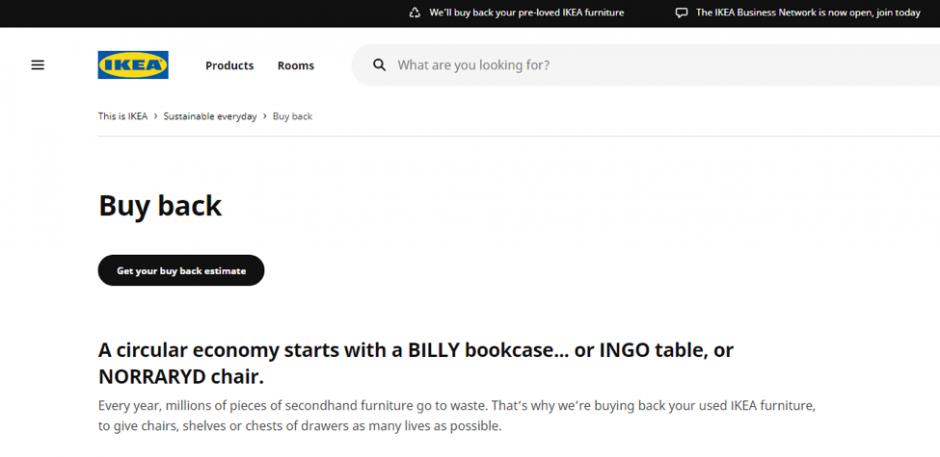
With this in mind, you can see why Ikea’s ‘buy-back’ service could be a great success for them… as well as generate some fantastic PR.
Nationwide has always created compelling messaging built on their heritage as a building society, hence their investment in community.
When it comes to typically persuasive messages that would align with this, we’d probably lead with social proof (evidence that other people have been here before) or liking (we like to buy from people and organizations that seem ‘similar’ to us).
But if we consider the sustainability factors, it reminds us that financial institutions are judged very closely on factors such as privacy and data security – remember, sustainability isn’t just about treating the environment well, it’s about treating people and society well too.
If you take a look at the Nationwide website, and many of their advertising campaigns, you can clearly see plenty of references to the crossover between data security, privacy and community. It’s not at all surprising why this is impactful.

Sustainability has always been a core part of the mission for Bamboo Clothing (you can read their story here), so messaging around sustainability obviously features significantly along the customer journey.
However (and I’m trying to be objective because they are a client of ours), they display these messages in some fantastic ways.
From a conversion optimisation perspective, the journey contains prominent, product-level, third-party reviews that provide reassurance.
The website has loads of great content around sustainability, which cements their value proposition as a leader in this area; plus, they do a great job of reducing anxiety by providing clear messages around their flexible delivery and returns policies.
But it’s one specific sustainability element that I want to highlight.
If we go back to the SASB Materiality Map, we can see that in the apparel, accessories and footwear sector, two of the key factors are supply chain management, and materials sourcing and efficiency; consumers want to know their product has been produced in a truly sustainable way.
What better way to do this than show the impact of every item’s production on the environment? Bamboo Clothing has worked with Green Story, a Canadian business specializing in supply chain evaluation in the fashion industry.
The objective credibility of this is great, but it’s the execution that’s brilliant. For each product, they then display the positive impact the consumer will have if they purchase this product from the supplier in question compared to a regular fashion retailer.
Sustainably-conscious customers can toggle between a view that shows the ‘equivalent’ impact (for example, water saved is shown in ‘days of drinking water’) or the ‘actual’ (water saved shown in liters)

Each of these businesses has taken an approach to sustainability that is more meaningful and widespread rather than using it simply as a tool to nudge someone along the customer journey; for an increasingly sustainability-conscious consumer, that authenticity is key.
However, it’s the way they are then leveraging that approach, inserting compelling signposts to improve their website performance, that is impressive.
I expect to see more and more of this over the coming year; as such, maybe those of us working in conversion optimisation just might be able to do our bit extra to help save the planet.
This month I’ve been stunned by two different films that come from popular mobile brands, Samsung & Orange.
Although the films are very different, they have some telling things in common. Neither of the films feature any product or service whatsoever, apart from the logo at the end. How refreshing…it’s as if the Covid crisis has forced many brands to have more of a conscience. Both these films support an idea that benefits humanity. Brands are beginning to realise that unless they put their money where their morals lie, unless they can actively demonstrate they are purpose-led, as well as creative in their communications, consumers will just switch off.
SAMSUNG’s film – ‘Inspired by a True Photo’ – is really inspired by an original photo, a simple sack of ‘Onions’, taken by a real person called Scott Anders. But we don’t see Scott take the photo, instead Director Sam Hibbard of Somesuch imagines a story behind the photo that sees a boy meet a girl for the first time – but full of comedy, pathos and using a surreal style. At its heart, the film is about connection – the hope & expectation of the boy’s journey.
Samsung have realised that it’s not the quality of camera that is important but the way people use images to communicate with each other. Samsung claim that when we take and share our images, they take on a life of their own. The shot becomes the conversation. The beauty of Sam’s film is that it avoids all the brand’s technology to tell a fun story using great characters, images & original music.
Connection & communication that is funny & uplifting in the time of Covid has never been more important.
The ORANGE film – ‘The Toy’ – takes a more direct approach to saving humanity by encouraging us to recycle our old phones. Millions of old phones are to be found hibernating in long-forgotten draws & these phones are wasting our planet’s precious resources.
The film is directed by Frédéric Planchon of Iconoclast, aimed at a European rather than UK market. It shows the relationship a little girl has with one of her first toys, the famous ‘Fisher-Price’ rolling phone. We see the girl become an adult & then rediscover her old toy in the attic with her own child. The recycling parable is clear.
Like the Samsung film, ‘The Toy’ uses great images & music to tell a life-affirming story with emotion.
This is a Bristol Media People Forum event, with our special guest speakers Dan Foster of Triodos Bank, Nick Davies of Neighbourly.com and Sue Turner of Quartet Community Foundation. This session is kindly sponsored and hosted by Bristol Sport Foundation.
It increasingly matters to employees that their organisation does something good and socially responsible for the community and in what they offer customers. What’s more, a sense of purpose and values fit is particularly important to the millennial workforce.
Corporate Social Responsibility (CSR) can therefore be a strong enabler of employee engagement. So what is it, and how do you get it right?
About the session:
Our three speakers come from organisations where giving something back is at the core of their principles. Doing the right thing also contributes strongly to their employer brand and engages talent within their businesses.
This session will cover what good CSR looks like and offer tips on how to make it successful in your organisation.
You’ll leave the session with:
This seminar will build on Bristol Giving Day on the 10th of October. One day in the year when local businesses celebrate and showcase their charitable and volunteering efforts. But, as we’ll show in our seminar – it’s good to do this for more than just one day a year.
There will be an opportunity to have a guided tour of the Stadium after this event on 29th November at 12pm (optional).
About the speakers:
Sue Turner is the CEO of Quartet Community Foundation – the organisation that inspires philanthropy across the West of England to give everyone here a fair chance of a good life. Quartet gives over £3 million a year to support local charitable causes and Sue and her team created and delivered Bristol Giving Day to stimulate businesses and their staff to give to small local causes rather than always choosing a large, brand name charity of the year.
Dan Foster is Talent Acquisition Manager at Triodos Bank. Well known for their ethical stance, Triodos Bank believe banking can be a powerful force for good by lending exclusively to organisations who put people and the planet before profits.
Nick Davies launched Neighbourly.com in July 2014 to help forward-thinking companies find the right balance between value for shareholders and value for society. Neighbourly companies can work together to help communities address local needs – and together become a powerful force for good in the world.
All proceeds from this event will be donated to the Bristol Sport Foundation.
For further information:
Please contact Richard Roberts at en:Rich HR
Phone: 07941 201916
Entry Cost: £11.37 (includes breakfast)
You need to load content from reCAPTCHA to submit the form. Please note that doing so will share data with third-party providers.
More Information