On a Wednesday evening in June – we hosted our first ‘Gather Round Presents’ event at the Trinity Church Gather Round. It was one for the books…
Whether it was the promise of an honest, open conversation about the challenges of working in the creative industries, or a need for the answer to the mutually felt question “Am I the only one feeling the pressure?” – tickets flew out in record time.
At 6.30pm we opened the doors to The Vestry and a new community of creatives flooded in, the vibe was electric. Backlit by a perfect summer’s evening and armed with their own stories to share, we saw people making instant connections, sharing contact details and engaging in deep conversations before we’d even sat down. This is something we all needed to talk about.
After a glass of free prosecco and some delicious free pizza from our partners Bosco, we moved through to The Great Hall bringing an air of focus with us, as our all-Gather Round-member panel took their seats to share their wisdom.

Bend, stretch, but don’t fold… become elastic. Your business depends on it.
A recurring theme from each of our speakers and touched upon in more depth by Jamie Ellul of Supple Studio, was Covid, a trying time to say the least. Jamie discussed how those turbulent years almost sent Supple down – something that, back then, was easy to take personally. This feeling was only made slightly more manageable due to the fact that his friends, colleagues & clients were all feeling it too. Jamie openly discussed how this felt like a great exercise in cutting the umbilical cord, once he realised how much of his self worth was wrapped up in the business. Something that he has since tackled through therapy and looking inward. This raw honesty was something that fuelled the rest of the evening, with equally inspirational testimony from the rest of our panel.
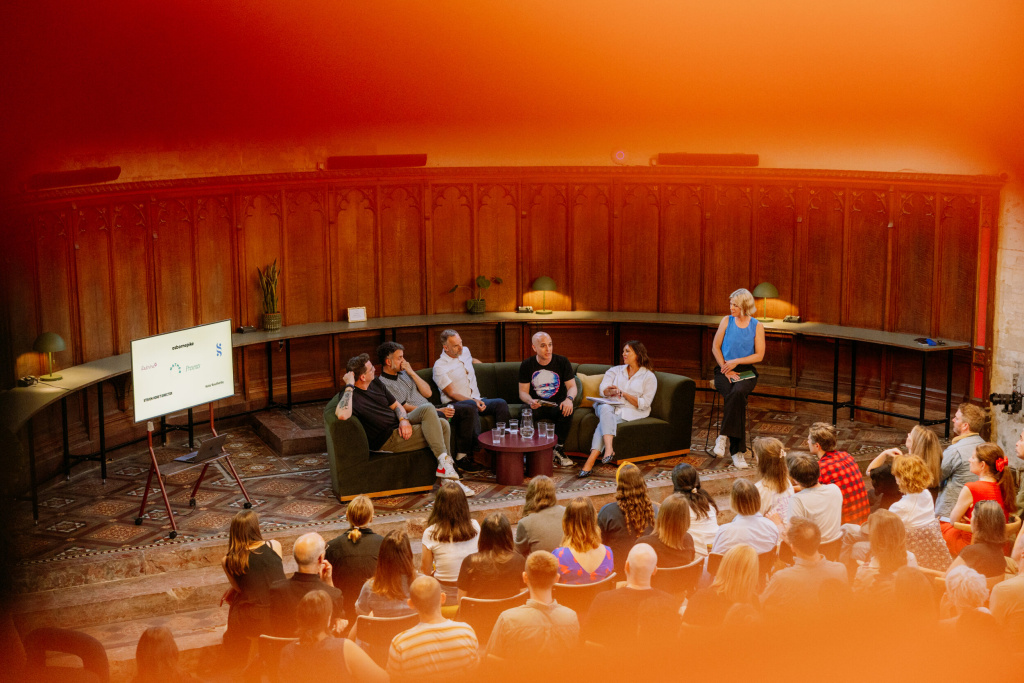
Tim Miness, Creative Director of Osborne Pike, shared a few mantras with the audience that have helped him stay flexible, creative and resilient. A statement that resonated was not being afraid to admit when something isn’t working. Bend the rules. What decision do I need to make in order to change my situation? How can I tap into that magic creativity and find the answer to this problem? Not only that, but how can I ask the right questions? Tim’s advice – hire people that are better than you. Expand that collective creativity, and together, you’ll find the right question.
Honesty is the best policy, and we definitely heard that from our panel. There were murmurs from the audience mentioning how refreshing it is to hear people being open about their downfalls, where they could improve and how they got through hard times. A refreshing perspective on managing a business, compared to older, more traditional ways of thinking.
Tim shared his dislike for the phrase “Fake it til you make it”. Something we’ve all encountered and tried to embody in some way, as we try to make sense of our place in the world. Sharing his love for the sentiment of trying new things, but ultimately landing on, why do we feel like we have to pretend to know what we’re doing? Perhaps one of his mantra’s “Learn it til you earn it” feels like a more sensitive way to approach things, although (in his own words) “…it doesn’t quite have the same punch.”
We heard Robin Worrall, Creative Director of Rednine open up about his heart-first approach to his work. Something he’s cultivated after pulling his business apart and asking the question, what am I really trying to achieve here? After getting the nudge he needed from a post he saw on LinkedIn, with the sticky phrase “old keys don’t open new doors”, he knew he needed to reposition and rebuild his entire creative offer. Looking at what he needed to keep, what he was prepared to lose and what would be great to add. Robin compounded this with the sentiment that being creative is emotional, and that’s something he pushes through his work, to find the heart of brands and tell their story with authenticity. It’s safe to say, a few tears were shed.
Ask for help, reach out, learn from others, share failures and compare challenges. It all starts with… “Can I chat to you about something?”.
Robin left us with a perfect segue into Kate Southerby’s interactive section of the evening. Coaching with the brain in mind, Kate is a facilitator of insights. She guided the audience through her 7 step plan, asking everyone to score themselves out of 10 for each section: Sleep, Movement, Focus, Introspection, Daydreaming, Play, Connection. There was an overwhelming consensus that we aren’t looking after our brains as well as we could be, so this was a welcome exercise that left the audience with plenty of food for thought.
The importance of nourishing your mental and physical health was a thread followed by all of our panellists, as each person has faced certain difficulties of their own. As Steven Hore discussed, managing stress has elevated how he works. He and his family made the decision to leave London after more than 20 years in the city. Initially causing more stress than intended due to commutes, but, after Covid eliminated presenteeism, time usually reserved for long car or train journeys was swapped out for more time in nature, exercising and moving through beautiful spaces that nourish his soul.
Something more attainable than moving city that he shared with the audience though, and perhaps the most simple and obvious tip: get a good night’s sleep! Steven shared how implementing this one action has transformed his ability to handle combined stressors such as job insecurity, shifting budgets and demands of 16+ hour shoot days with ease.
It’s not all about work though, as we revisit a comment from Jamie Ellul on not letting your self-worth get too wrapped up in your business, the panel delved into the importance of finding things outside of work to nourish your creative side. Find a hobby you love and indulge in it as much as you can. Hustle culture is dying, now is the time for slow, intentional living.

Of course – it wouldn’t be a conversation about the state of the world right now without touching on artificial intelligence. A topic that roused the crowd, unsure on how to feel about this powerful new tool we’ve all been given. But the biggest question on everyone’s lips… What does this mean for creative jobs? Tim, Kate, Steven, Robin and Jamie all steadfast in their belief that creative jobs aren’t going anywhere. A sigh of relief. Steven shared some positive thoughts on how AI is a great democratiser. The barriers to entry now are lower than before, meaning more eyes, more screens and work happening in more places than ever before.
This being said, clients will always want emotional, relatable, human stories. From Jamie’s perspective, AI can only produce more of the same and will never be a match for the way humans think and create. We left that topic firmly closed with his mic drop moment – “AI won’t give you a drumming gorilla for a Cadbury ad”.
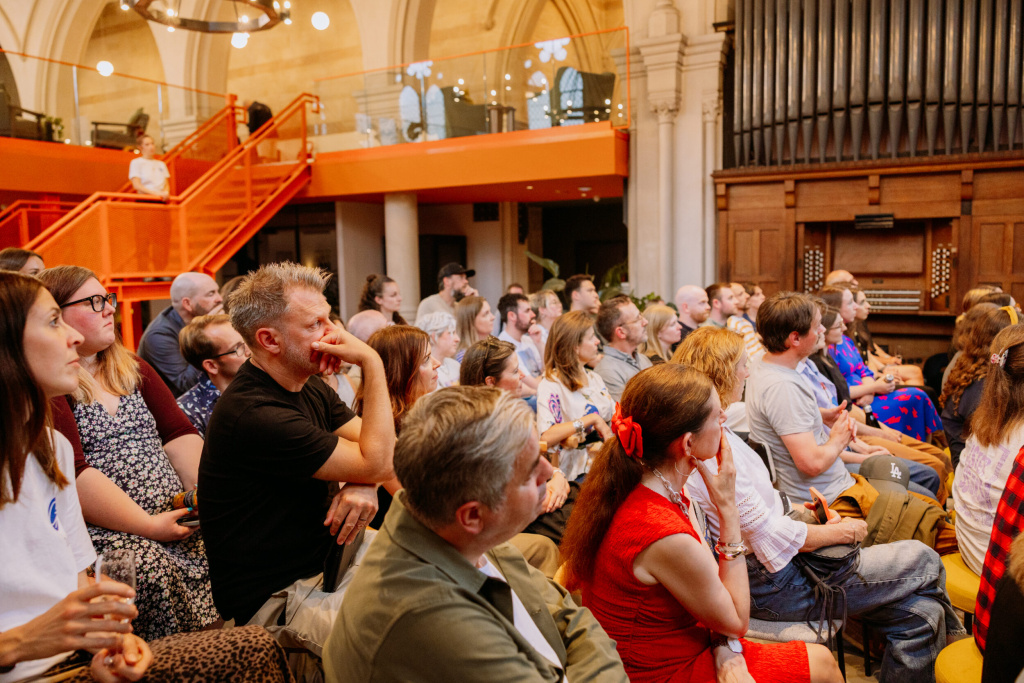
After a short break, we resumed the discourse in the form of an intimate Q&A. With questions from a concerned audience, on how positive the panel feel about the creative industries going forward – will we see an upturn? Leaving us with some final gems of knowledge, the panel discussed how being brave will ultimately lead to success. However you view success though, is up to you. Times have been difficult, really difficult, but they ARE changing. There are spaces, like Gather Round, where community is flourishing and people are coming together with ideas and strength beyond what they thought they were capable of, just a few years ago.
In the words of Anthony Burrill, “Work hard and be nice to people” – but most importantly, be brave, nourish your network, ask questions, take care of yourself and the rest will follow. Stay resilient out there!
If you want to get involved in our next event – make sure you’re signed up to our newsletter so you don’t miss out on tickets. They don’t hang around for long.
Earlier this year, Bristol Surf Cinema launched its very first event – a night dedicated to celebrating surf storytelling on the big screen. What started as a small, DIY project to bring people together around meaningful surf films quickly grew into something bigger, with almost 250 people buying for the inaugural screening in April.
The idea was simple: create a space to showcase surf films that go beyond the highlight reels, beyond the big brand edits – stories that dig into the social, political, and environmental threads woven through surf culture.
As a camera assistant working in film and TV and a lifelong surfer, I (Theo) set out to build something that connected those two worlds. In a time when the industry was unusually quiet, Bristol Surf Cinema gave me a creative project to get stuck into and a chance to pour energy into something that mattered. It was also a way to genuinely support filmmakers, every film we screen is fully licensed and paid for, and £1 from every ticket is donated to The Wave Project to help fund surf therapy for young people in the UK.
But perhaps what stood out most from the first event was how the Bristol surf community (and the wider ocean-loving crowd) showed up. Feedback from the night wasn’t just about the films, it was about the feeling in the room. People supported the event and made it clear they would like to see more. They wanted a space where all surf stories could be told, with better representation, better balance, and an even stronger connection to the community.
That’s where our second event comes in. On Saturday 12th July at Watershed Bristol, Bristol Surf Cinema returns with a matinee screening of Point of Change, a powerful documentary by acclaimed director Rebecca Coley. The film tells the story of Nias, Indonesia – a surf paradise that was ‘discovered’ in the 1970s and the environmental and cultural impact that unfolded for the local community as surf tourism in that area grew.
It’s a film that makes you think about the consequences of surf tourism — and we’re lucky to have Rebecca joining us on the day for a Q&A to explore those themes in more depth. Rebecca will be answering questions on her filmmaking process, handling delicate themes within documentary and the impact of tourism on the earth and native communities.
Alongside the feature, we’ll also be screening two UK-made short films:
Surfaced by Paul Stevenson, telling the story of Nick Corkill’s journey through addiction and mental health, and the grounding role that surfing and photography play in that journey.
Seb: A Surf Therapy Journey by Matilda Thompson, a beautifully observed short following a young surfer with ADHD and autism as he experiences surf therapy with The Wave Project Bristol.
For those who can’t make the main event, we’ll also be running a catch-up screening on Wednesday 16th July — same films, just without the Q&A.
Both events will offer the opportunity for networking and drinks at the Watershed bar after the event so you can minglew with like-minded film or ocean enthusiasts.
Bristol Surf Cinema was never meant to be a one-off. The ambition is to keep this platform going – to continue curating thoughtful, story-first surf films and to keep building a space where filmmakers feel supported and audiences feel connected.
Looking ahead, there are exciting plans for a national tour to bring these kinds of surf screenings to other UK cities and coastal towns. The vision is to grow Bristol Surf Cinema into a national platform, while always staying true to the ethos: supporting independent surf filmmaking, elevating underrepresented voices, and creating community-led spaces where ocean & surf centred stories, of all kinds, can be seen, heard, and shared.
Want to come along?
Tickets for the July screenings are available now via the Watershed website: https://www.watershed.co.uk/whatson/13320/bristol-surf-cinema-point-of-change
To stay up to date with future screenings or to get involved, follow @bristolsurfcinema on Instagram.
Creating an effective public relations (PR) budget is crucial for scaling businesses aiming to enhance their brand presence and credibility.
Thorough market research serves as a foundational element in developing effective PR campaigns and long-term success. But knowing where to start can be a challenge.
This guide outlines key considerations and strategies to help you allocate your comms resources effectively.
Allocating a specific percentage of your gross revenue to marketing and PR is a common approach.
The Chartered Institute of Marketing (CIM) recommends that companies spend between 5% to 10% of their gross revenue on marketing. But this is a ballpark figure.
The actual percentage you spend can and will vary on a lot of different factors. Are you B2B or B2C, what’s your sector? What’s the size of your business, and what are your business goals?
All of these things, and more, can have an impact on your marketing budgets. So it isn’t as simple a task as looking at the averages or the recommendations. It’s a decision that needs to be personalised to your wants, needs and goals.
To tailor your PR budget effectively, consider the following questions:
Target revenue for the next year: having a clear understanding of your financial goals helps set a proportional marketing budget.
Existing marketing budget: review current spending to identify areas for reallocation or enhancement.
ROI review: in line with reviewing existing or previous budgets, look at what’s working in your current plans, what isn’t and why.
Focus areas for the coming year: what do you want to achieve in the year to come? A strategic picture of these goals will help you implement tactics to achieve these goals.
Benchmarking against competitors: research industry standards to ensure your budget aligns with or surpasses your competition.
With clear objectives, targets and a strong understanding of what success looks like for you, it’s far easier to set a PR budget. Then you need to make a call on whether you can achieve this internally or if you need to bring in a third party.
Deciding between in-house and external PR resources depends on your company’s capabilities and objectives.
External PR agencies can offer specialised expertise and established media relationships, which can be priceless. The cost of bringing in an external agency can vary. Smaller UK agencies may charge between £1,500 – £5,000 per month, while larger firms’ retainers start from £5,000 per month.
Opting for an in-house solution may result in you maintaining more direct control. With an in-house PR, there is a complete, dedicated focus. But this comes with the challenges of hiring, retention, training, development and investment in standard tools, like media monitoring and journalist databases. These are tools which we, as an agency, invest in so you don’t have to.
Beyond in-house vs external, there are other industry-specific considerations that you need to factor in when allocating your budgets.
Marketing budget allocations can differ across industries. For example, consumer packaged goods companies in the UK allocate more than 20% of their budgets to marketing expenses, whereas the average budget in real estate is less than 10%
Understanding your industry’s standards can guide appropriate budget setting. Hubspot provides a helpful breakdown of sector budgets. But as an agency, as part of pre-briefing or the briefing process proper, we can give you our expertise and insights and help you put your spend in the most effective and appropriate places.
Then, you need to consider your relative size and scale.
It’s often said that scaling businesses need to dedicate more of their budgets to marketing than more established businesses. But this rationale does have its flaws.
Firstly, budgets are often referred to as a percentage of net revenue rather than a cash value. So, it can be easy to fall into the trap of thinking that a lower percentage means less investment. But that’s not the case; 20% of revenue for a start-up could be similar to 5% of an established business; it’s all relative.
Speaking of relativity.
There’s also the notion that just because you’ve reached a point of relative success, why would you slow down then? This is where having an agency partner can be very useful. Because we’ll have a certain degree of separation from your day-to-day, which often allows us to join dots and make connections which can be hard to see when you’re caught up in operations.
The reality of the situation is that if and when you reach a certain size or stature, there are going to be start-ups that are hungry and eager. They’re coming for your spot on the ladder.
Look at it this way: Microsoft still puts 10% of its $240 billion revenue into marketing.
How you divest and spread out your spending is, ultimately, down to your targets and goals.
But spending for spending’s sake should be discouraged.
Whether it’s paid campaigns through social media channels, content creation, SEO performance or media office fuelled by press releases. Whatever and wherever you’re spending, it needs to be driving value.
It’s important to recognise that value doesn’t always mean converted business leads. In the context of broader PR strategies, value has many meanings, from the quality of media coverage earned to engagement on your social media posts.
This is where it’s important to develop PR strategies with both breadth and depth. The array of expertise and specialisms within the AMBITIOUS team means we are especially well-placed to deliver this kind of approach.
Depending on your sector and relative size, as well as your goals, you’ll be implementing different tactics. So it’s difficult to say, in the space of a paragraph, how and where you should be spending without this wider context.
But broadly speaking, the following strategies can bolster your PR outreach.
Investing in PR is vital for building trust with your audience.
For this reason, setting a PR budget isn’t just about throwing money at different activities. It’s about making sound strategic investments in your brand’s future.
Your PR budget is more than just numbers on a spreadsheet, and spending for spending’s sake needs to be discouraged. Regardless of whether you’re a hungry start-up or an established business, your comms strategy needs to be as dynamic and purposeful as your business goals.
You can invest in all kinds of strategies and tactics. So much so that it can be dizzying. This is why having an expert in your corner helps, as they can help steer the overall direction of your PR outreach.
But whether you decide to build an in-house team or partner with an external agency, you need to achieve the same thing: create a communications approach that doesn’t just speak to your audience but genuinely connects with them.
Remember, investing in PR isn’t an expense; it’s your pathway to establishing credibility, supporting growth and securing long-term success and trust.
And trust is your most vital commodity.
We talk a lot about leadership pipelines, talent retention, and gender equity at work. But one of the biggest moments of risk in a woman’s career isn’t when she hits a glass ceiling. It’s when she goes on maternity leave.
Despite decades of progress, research shows that up to 74,000 women in the UK lose their jobs each year due to pregnancy or maternity-related discrimination¹. Nearly half of mothers report negative experiences at work related to pregnancy, maternity leave or returning—and 1 in 5 leave their jobs as a result². And for those who do return? Over 80% say it negatively impacts their confidence, mental health or both³.
These numbers tell a clear story: we are underestimating the scale and complexity of the transition to motherhood. And we are under-resourcing women through it.
That’s where maternity coaching steps in—and why it’s far more than a “nice to have.”
Maternity coaching provides structured, professional support before, during, and after parental leave. It holds space for the emotional, identity, and logistical challenges of becoming a parent while managing a career.
Common coaching themes include:
Planning for leave and managing handovers
Navigating identity shifts and loss of confidence
Returning to work and re-establishing role clarity
Rebalancing domestic responsibilities
Reconnecting with ambition and long-term goals
But coaching isn’t just about performance—it’s also about wellbeing. And that brings us to something that still isn’t talked about enough: maternal mental health.
In my article for Maternal Mental Health Week, I reflected on how easily new mums downplay how they’re feeling.
The six-week postnatal check isn’t enough. Many mothers never say out loud that they’re not okay. Postnatal depression, anxiety, rage, or the long tail of sleep deprivation can linger well beyond maternity leave—and often bubble up again during the return to work.
That’s the missing link: Maternal mental health doesn’t stop when maternity leave ends. For many women, returning to work—often exhausted and unsure of themselves—is just as vulnerable a period. And yet, the expectation to “bounce back” is enormous.
Coaching can’t replace clinical care, but it plays a vital complementary role. It provides space to process the emotional load, build confidence, and plan realistically. And for many, it’s the first time they’ve been asked: “How are you really doing?”
As someone with ADHD, I know how difficult it is to manage the chaos of early motherhood. Executive dysfunction, mental load, and disrupted routines can overwhelm even the most high-functioning professionals. When structure disappears, so can confidence.
For neurodivergent mothers, maternity coaching provides scaffolding. It helps build systems, protect energy, and move forward with clarity—even when everything feels uncertain.
In coaching sessions, I often ask: “What would be the impact of not preparing before maternity leave or return?”
The answers are sobering:
Loss of identity
Lack of confidence
Conflict at work or home
Anxiety over visibility and career progression
The silent question: “Can I still be the ambitious person I was now that I’m also a parent?”
The coaching process brings clarity, strategy, and self-compassion. It helps new parents stay anchored to what matters most, even when the external world is shifting.
If you’re serious about retention, inclusion, and wellbeing, start here. Maternity coaching isn’t a “perk.” It’s a strategic, inclusive intervention that helps people return to work stronger, not smaller.
Support doesn’t have to mean fixing every problem. Sometimes it just means saying, “We see you. And we’re with you.”
Here’s a prompt I often use with clients: “What do you want life to look like in five years and what needs to happen now to make that future possible?”
It’s easy to live in the short term when you’re exhausted. But your long-term goals, values and ambitions deserve space too.
Pause. Reflect. And know that support is out there, coaching included.
A final note: I’ve been using the brilliant maternity coaching framework developed by Frances Cushway, a comprehensive, compassionate and practical model that supports every stage of the transition to working parenthood. It’s been a powerful tool in my work, especially when combined with an ADHD lens.
If you’re curious about how this framework can support neurodivergent parents—or want to learn more about the pilot I’m currently running, you can find more details here.
Footnotes
Pregnant Then Screwed & HR Magazine (2024): 74,000 women lose their jobs due to pregnancy/maternity discrimination annually
EHRC and TUC Research: 1 in 5 women leave their job due to pregnancy and maternity discrimination
Working Families Annual Report (2023): 84% of women face challenges returning to work; 30% receive no employer support
We’ve all had it- that awful unexploded bomb of an email from a client sat in your inbox. So what do you do next? This article will walk you through my tried-and-tested process for handling a difficult communication, so you’ll be able to head into any negotiation feeling prepared.
It is so tempting, in those first moments, to fire back with a few home truths, or alternatively to loathe the idea of conflict so much that you grit your teeth and give in to their unreasonable demands. Instead of doing either of those things, remember this:
You only win if you get what you want.
A trite phrase, but memorable, which is why it’s important here- in these early moments, your body is physically reacting to a stressful situation, and you may not be at your calmest, most rational best. So having a ridiculous catchphrase to use as your compass is actually quite useful. Remember it and let it pull you back to your objective- achieving success in your negotiation.
The point is to focus on the OUTCOME. Negotiations are a multi-step process (even if they’re just a couple of emails) and from this moment, everything you say and do should be geared towards delivering the outcome that is best for you and your business. If you need to get something off your chest, scream in frustration, that’s fine- but do that separately, and out of your client’s hearing. For now, focus on identifying what outcome you’re after, and working through the steps necessary to achieve that.
Before sitting down to draft a response, it is essential to do some information-gathering and analysis. Here are the steps to walk through, in this order, to equip you with the information you need to decide on a strategy for your reply.
Do some digging and consider the following:
– If you have a contract, what do the terms say?
– Where do things stand in terms of finances/invoicing? How much money do they owe you?
– Where are you with deliverables- what has been done, what has been handed over, what is left to do? How does that line up with your contractual commitments?
– Are there wider relationship/ business issues to consider? Is this client particularly influential, or linked to other clients of yours?
– What is the potential impact, on you, of what they are asking of you?
The list above is just a suggestion, as every situation will need its own consideration, but broadly speaking you want to assess your EXPOSURE to this client, whether financial, reputational, legal etc, and other hand, any LEVERAGE you may have. Assets you’ve not yet handed over that they need, knowledge you hold that’s not easily replicable, etc.
The purpose of this is to look clearly at what the possible consequences could be of whichever path you choose. Your next steps are focused on minimising your exposure and putting any leverage you have to the best possible use.
– Work out your best-case scenario, and your absolute hard line
– Think about your time, any resources needed to do whatever they’re asking
– The impact on your mental health
– The opportunity cost of your time- what else could you be doing
– Intangible benefits you might want- credit/exposure/introductions/portfolio building, etc
This is not about what they’ve said, or asked for, but what they actually value. Use all the information you know about them and their circumstances to work out what is motivating them. What pressures are they facing, from their own clients/within their organisation? Consider the following:
– are they under time pressure
– what are their deliverables
– do they need to prove they’ve negotiated the price as low as it can go (i.e. is a request for a discount actually to enable them to demonstrate, either to themselves or their seniors, that they’ve got the best price)
– is there an ego element (hint: yes. Always.)
Using the information you’ve gathered above, and maintaining your laser-focus on your desired outcome, map out your response. The most important thing to consider here is:
“What action do you want them to take?”
And then make it EASY.
Want them to consider a couple of options and pick one? Set them out and sign off with “please reply and let me know if you’d prefer A or B”. Want them to pay an invoice before you continue your work? Attach it, or include a link to pay. Never want to hear from them again? Make sure you don’t ask them any questions, or leave any loose ends they’d need to follow up. If you are asking them for more information, be sure that you genuinely do want that information and are prepared to engage with whatever they send back. If the information won’t make you change your response, don’t ask for it.
Also remember: you don’t need to respond to every point they made in their email. Unless it needs to be addressed or dealt with, you can just leave it- and focus on the action you want them to take, to achieve the outcome you’re after.
Here are five key points to consider:
You may not feel like pandering to their ego, but a bit of tactical empathy is incredibly effective. Re-framing their concerns or acknowledging their point of view enables them to stop trying to get their point across and be more open to what you are saying. Even when you are delivering unmitigated bad news, a small demonstration of empathy can significantly soften the delivery. For example, “I have some news to share that may be tough to hear, but I wanted to get in touch as soon as I could to give you as much time as possible to digest the impact…”
Whatever your proposed next steps are, put your correspondent at the heart of them. What will they receive? How will they be impacted? For example, and building on the tactical empathy in the previous point, “I absolutely understand where you’re coming from on budget constraints, and being mindful of that, I am able to offer [add detail of what they will receive for that price].”
Don’t feel that you need to give a reason for your position- if you can frame a polite ‘no’, that’s great. But if you DO feel like giving an explanation, choose the single most unassailable reason, and stick with it. When you are in conflict with someone, the more reasons you give, the weaker your argument looks- you are only as strong as your weakest argument. You’ll also be giving them more ways to try and pick holes in what you’re saying.
Ignore what your English teacher told you about using the passive voice. Say “I’m afraid it’s not possible to…” instead of “I refuse to…”. It just softens things and also can make the decision making process seem more removed, and less able to be challenged.
People HATE an awkward silence. They will rush to fill it, often saying ill-advised things that cut across their previously carefully-delivered position. If you can, and if it’s appropriate, hold your nerve and don’t reply right away. This will firstly give you a chance to calm down and go through the preparation steps outlined above, but it will also show your counterparty that you are not replying in haste with a cobbled-together response. Rather, you are calm and collected, and confident in your reply. You may find that by waiting just 24 hours to reply to an incendiary email, the other party (who was expecting you to blow up and reply straight away) is unnerved enough to email again, undermining their previous position. Even if that doesn’t happen, a bit of waiting time can put them off their combative stride.
The only caveat to this is if something very urgent has happened, but you need a bit of time to work out what to do- in this case, a quick holding email, something like “just a note to let you know we have seen this and are working on it, I will come back to you shortly” will buy you some breathing space to consider before they start chasing you and causing you further stress.
After all this, I sincerely hope you’ve achieved your desired outcome, or gotten closer to it. Regardless of what’s happened, though, please remember that this kind of interaction takes a lot out of you, mentally and emotionally. You may be left feeling that your counterparty has not understood how bad their behaviour was, or you’ve had to empathise with someone who has treated you badly. Take time to process and reflect, and care for yourself afterwards.
And if you’ve found this helpful, or would like to chat about strategy, negotiation, or anything else, please do get in touch!
But this isn’t a cautionary tale about machines taking over. It’s about what happens when human expertise and intuition meet cutting-edge technology. It’s about unlocking new possibilities. It’s about creating deeper, more meaningful connections between brands and the people they exist for.
At Proctor + Stevenson, we believe great marketing has always been human at heart. Emotional. Empathetic. Powered by creativity, insight and experience. And with AI, we now have tools that can make those human qualities even more powerful – helping us understand audiences more deeply, respond more personally and connect more meaningfully, at scale.
We see AI not as a replacement, but as a willing partner. When used intelligently, it enables us to do what we do best – and hopefully better.
Audiences today expect relevance. They want to be seen, understood and spoken to like individuals. In B2B as much as B2C, they crave experiences that feel personal, rather than generic. But here’s the challenge: how do you do that at scale?
This is where AI really shines.
We’re using smart platforms and tools that help us go beyond broad segmentation to deliver hyper-personalised experiences in real time. Crucially, they give us more time to focus on what really matters: crafting the campaigns, content and experiences that make those connections memorable.
Here are just a few of the ways we’re exploring a combination of AI and imagination:
These tools don’t just streamline workflows: they unlock creative opportunities. They help brands be more responsive, more relevant and more remarkable.
AI doesn’t just help us understand what’s happened. It can also predict what’s coming next.
Thanks to predictive analytics, we can now anticipate the needs of your customers – sometimes before they even know them themselves. It means better lead prioritisation. Smarter targeting. And more timely, relevant campaigns that reach people when they’re most ready to act.
Here’s how we can do just that:
At Proctors, we’re constantly experimenting with these tools, combining them in ways that bring out the best in your brand and deliver real business impact.
Let’s be clear – AI is amazing. But it’s not the headline act. You are. Your brand. Your story. Your voice. AI is just here to help amplify it, to help you move faster, personalise more deeply and connect more powerfully.
When human insight meets machine intelligence, the results can be extraordinary.
More creativity, not less. More connection, not distance. More time to focus on the things machines can’t do – like telling compelling stories, understanding complex emotions and building lasting trust.
We’re not just using AI to save time. We’re using it to make space for better ideas.
If you’re curious about how AI can help your brand be more personal, more agile and more effective – without ever losing its human heart – we’d love to talk.
At Proctor + Stevenson, we believe the future of marketing is collaborative, creative and joyfully human. With the right tools, it’s a future we can build together.
The cost-of-living crisis in the UK is still hitting both businesses and their employees hard. As operational costs rise and consumers tighten their belts, businesses face the dual challenge of maintaining profitability while ensuring their staff are adequately compensated.
The key is to empower your employees. In the midst of the escalating cost-of-living crisis, new research reveals a stark reality: One example…87% of hospitality workers’ mental health is worsening because of financial concerns, exacerbating an already challenging situation. With wages stagnating and essential expenses on the rise, workers face mounting challenges, including housing and food insecurity, limiting their ability to save and thrive. According to recent studies, nearly 60% of workers struggle with financial stress, with over 40% citing it as a major concern affecting their overall wellbeing.
Amidst these challenges, one pioneering solution that has emerged is Earned Wage Access, which revolutionises the traditional pay cycle by providing instant access to earned wages, empowering employees to navigate their financial obligations with newfound flexibility and control.
By eliminating the need to wait for payday, new employee benefits providers enable workers to address immediate expenses without resorting to high-interest loans, thereby alleviating financial stress and promoting overall wellbeing.
Recent user surveys conducted by one industry provider underscore this impact, with 92% feeling more in control of their money thanks to Earned Wage Access and 88% being more likely to stay working at their current employer when this benefit is offered.
Another key solution is supporting workers with financial wellbeing benefits and education to reduce financial stress and help them better manage their finances.
These can take many forms such as personalised educational resources, financial coaching, money management tools, employee discounts, and flexible pay options, among other things.
PwC revealed that financially stressed employees are 5 times more likely to be distracted at work, highlighting the potential productivity gains for employers. By investing in these programs, hospitality companies can therefore enhance both employee wellbeing and operational resilience.
Another key focus are smart budgeting strategies which can significantly benefit companies during the cost-of-living crisis. By regularly monitoring expenses, implementing energy efficiency measures, optimising inventory management, adjusting staffing levels based on seasonal demand, and negotiating bulk purchasing agreements, companies can reduce operational costs and improve financial stability.
For employees, smart budgeting strategies are equally crucial. Creating a detailed monthly budget, setting aside an emergency fund, prioritising debt reduction, automating savings, and utilising employee discounts can help workers manage their finances more effectively. These practices reduce financial stress, increase disposable income, and provide a buffer against rising living costs, ultimately fostering a more engaged and productive workforce.
Where do you start? Well, you can talk to professionals such as myself who mitigate these employee risks…or if nothing else have a look at the Government website www.moneyhelper.org.uk where you can find simple and straightforward with tools to direct your employees.
Get your networking hat on in May, June and July! We have some brilliant networking opportunities over the next few months. They are free or discounted for Bristol Creative Industries members.
Our second screen industries meetup focuses on skills and opportunities for people in the industry, and the challenges for finding work or moving to different sectors.
The event is £5+VAT for BCI members, £8+VAT for non-members. Tickets include food and drinks. Register here.
BCI’s free members’ lunches are the perfect opportunity to catch up with fellow members and the BCI team which enjoying a delicious Mediterranean buffet lunch too.
Open to freelancers and those who engage with freelancers, join this event to widen networks, make new connections, discuss common problems, and discover potential opportunities for collaboration.
The event is free with a free drink for BCI members, or £5+VAT for non-members.
A great opportunity for members to make new connections whilst getting some much needed fresh air! This event is for BCI members only and costs £10+VAT.
Wellbeing matters and is THE core key feature within any employee benefits package.
Wellbeing (noun) Definition: A good or satisfactory condition of existence; a state characterised by health, happiness, and prosperity.
We know that employee happiness and wellbeing are directly linked to the benefits they receive. Employees who feel valued and happy at work are more productive and effective in their roles. Additionally, organisations that provide appropriate benefits to support employee wellbeing are more likely to foster engaged and high-performing teams.
In today’s fast-paced, competitive corporate world, prioritising employee wellbeing is no longer a perk, but a necessity.
But why does employee wellbeing matter?
Employee wellbeing goes beyond physical health, it also includes mental, emotional, and financial wellness. Employers who invest in the wellbeing of their workforce not only meet their Duty of Care obligations but also create a positive workplace culture. This results in higher retention levels and enhanced productivity.
According to latest research, 82% businesses have seen their employees demanding more wellbeing benefits, with 56% of employees saying that they would leave their job if another company offered them a better benefits package. In addition, it’s widely recognised the need for benefits packages to address unprecedented employee stress levels causing burnout, decreased engagement, and higher absenteeism, highlighting how great wellbeing and benefits are not just good for employees; they are good for business.
Tangible benefits, especially those with high (perceived) value, can significantly boost employee morale and fulfilment. There is a lot of noise now for electric vehicles supplied as an employee benefit. A brand-new car, for example, is more than just a mode of transport, it’s a symbol of appreciation, recognition and support from an employer. Car benefit schemes not only signify support and recognition to employees, elevating job satisfaction and motivation but they also host several other perks that boost workplace wellbeing and engagement levels. One benefit of the scheme to employee wellbeing is financial peace of mind. Employees don’t need to worry about car loans, credit checks or deposits. A fixed monthly reduction from their salary covers it all- insurance, tyres, VED, servicing, and even breakdown cover.
Sustainable benefits have become vital to the wellbeing of a large proportion of employees in recent years, particularly Gen Z and Millennials. Offering environmentally conscious benefits, like EV schemes, helps promote a sustainable culture that aligns with employee’s values. As an added benefit, it also supports corporate social responsibility (CSR) goals.
A new report by Creative UK has revealed the challenges faced by creative industry freelancers.
According to the study, almost two-thirds (64%) of respondents had experienced low or unfair pay in their careers, and “an overwhelming majority” said late payment of invoices had impacted their ability to meet everyday expenses such as rent and household bills.
In other findings, a fifth of freelancers said they had seen a decrease in demand for their services as a result of generative AI, and structural inequalities were highlighted too.
There was a recurring theme of “tokenism” reported by ethnic minority respondents to the survey who said their inclusion in projects felt performative rather than substantive, while the report highlighted barriers for disabled freelancers such as inaccessible application processes and limited workplace adjustments.
Caroline Norbury, chief executive of Creative UK, said:
“The Covid pandemic changed so much about all of our working lives, but this is especially true for freelancers. Many who work in this way have found opportunities to be more precarious than ever. We need to find ways to better support this vital part of the creative workforce, and to create new systems in a post-Covid world.
“This means adapting provision within both the public and private sector to ensure it is more fit for purpose, incentivising the creation of new products and services that support the freelance workforce, and in the process, unlocking the potential of an expert, committed, agile and flexible workforce. It’s vital that we get this right – for creatives, and for the wider economy.”
Among the recommendations in the report were:
Freelancers are the backbone of the creative industries, accounting for 30% of the sector’s workforce. It’s vital that they are supported.
In the Bristol Creative Industries membership community, we have several hundred freelancers and many business members who employ freelancers. See them in our member directory. If you’re not already a member, you can sign up here.
Collaboration, sharing of ideas and meeting freelancer-friendly employers is a key benefit of the network. We facilitate this at our freelancer networking drinks events at The Square Club in Bristol. They are free for BCI members including a free drink or £5+VAT for non-members.
The next event is on Tuesday 10 June at 5.30pm. Sign up here.
Other freelancer networking drinks events take place in 2025 on 9 September and 11 November.
You need to load content from reCAPTCHA to submit the form. Please note that doing so will share data with third-party providers.
More Information