Liana Dinghile, Partner at Tonic Creative Business Partners, discusses flexibility – is it a good or a bad thing for the future of work?
Most agencies are already embracing a more flexible approach to work and an overwhelming majority of employees would like to see this continue. But as so-called Freedom Day approaches and businesses get to grips with what the future might really look like, it’s worth considering where being less flexible can increase your chances of success.
Counter-intuitive maybe. But some things will need to be inflexible and non-negotiable for a more flexible future to succeed. Let’s explore.
The conundrum
On one hand, remote working has changed the game that needed changing. It’s levelled the playing field by creating access and inclusion for diverse talent and given people the opportunity to better balance their lives. Productivity has increased and priorities have been sharpened. But on the other hand, many argue that creativity, culture and learning have been compromised as a result. The double-edged sword now forcing a hybrid work revolution.
Every business is finding its way through this revolution. Some are leading with new ideas and bold policies they hope will work – from four-day weeks to mandated days and localised work hubs. Others are following and failing to master the transition – criticised for uninspiring or restrictive policies or not properly explaining or setting clear boundaries for people to get creative with.
In all cases, however you move forward, it mustn’t come at the expense of employee trust or compromise the strength of your culture. These two factors are still an agency’s best advantage when looking to win the big briefs and the battle for talent.
The non-negotiables
With boundaries, people are more likely to experiment and make good judgements. When supported, people are more likely to support others and act beyond their own interests. All basic principles, but never more fundamental and at the centre of a new cultural contract that’s separating the best from the average in business and society.
#1 A solid values system. Having a strong belief system at the heart of every action you take, evident in every leadership decision and willingly embraced by every member of your team. Non-negotiable.
#2 A minimum standard of work. Setting parameters for what great looks like for the work. Wherever and however work gets done, having a standard that is universally understood, championed and honoured. Non-negotiable.
#3 Empowered teams and managers. Setting clear objectives at a team and project level to set the boundaries for autonomous action in the interests of the clients they are closer to. Support leaders to manage the complexity and be the simplifiers and role models their teams need. Non-negotiable.
#4 A well-harnessed culture. Creating a culture of wellbeing and psychological safety for people to openly share their needs, concerns and successes as they find their way through a different time. Non-negotiable.
Structured flexibility
With the non-negotiables in place, you’ll have the confidence to find the flexibility level that’s right for you. Here’s three new ERA principles to help get the balance right:
Continue the EXPERIMENT
– Draw on learnings from the last 18 months of experimentation. Ruthlessly reappraise the core work of the agency and what it takes to do it really well. Where has remote working accelerated or challenged your capacity to deliver to this standard?
– It will take time to fine-tune and adapt a future work policy. So be upfront with your teams that this is an experiment and be clear about where you need their help to stress test.
– Whilst its unhelpful to follow blindly because ‘Apple or Twitter tried it’, there’s a lot of experience out there to learn from that may give the benchmarks you need to explain the benefits of your strategy.
Be RUTHLESSLY focused
– Seriously ask and challenge what an existing office or potential workspace is for. Architects are experimenting with different models from ‘plazas’ to ‘neighbourhoods’. Co-working spaces are seeing a revival and hotels are reinventing themselves as work hubs with benefits. Lots of possibilities, but what will your ‘workspace’ be for – learning, collaboration, contemplation? Be ruthless about whether it measures up.
– Genuinely ask your teams how ready and confident they are to change. Be clear about what their needs really are rather than be forced to change things to retain them later down the line. Create space for people to share concerns about work, welfare or location. What you learn will be the underlying data needed to design a truly equitable workplace culture.
ACT and ADAPT
– Create the blueprint for your fully remote or hybrid future and draw from your research to demonstrate how it’s designed to the specific dynamics and workflows of your agency and teams. Put into practice as an experiment and be upfront and clear on how, and how often, you’ll measure success.
– Be ‘all-in’ from the start. Draw on your belief system and rally everyone around the experiment. Recruit their support and feedback to know what’s working and will be right long term. And don’t forget to role-model the changes you want to see in your teams.
Winning agencies will attract and retain a diverse mix of talent based on the strength of culture and thoughtful design of their workplace strategy. They will exceed expectations for productivity and creativity by harnessing the strengths of their teams. And they’ll do so not because of where they come together but how they make it count. Here we see the rise of the interdependent agency – mastering the non-negotiable bonds in order to realise the true power of flexibility.
First appeared in Creative Brief BITE on 15 July 2021.
Despite billions in losses due to the coronavirus pandemic, the UK’s creative industries can lead the post-COVID recovery if the right investment is unlocked.
That’s the big headline in a major new study by the Creative Industries Federation and Creative England, which together comprise the non-profit Creative UK Group.
The organisations’ report, The UK Creative Industries: Unleashing the power and potential of creativity, found that the pandemic has hit our sector hard. Creative industries are estimated to have lost almost £12bn in GVA, with job losses predicted to reach over 110,000 by the end of the year.
Freelancers have suffered five times as much as those on payroll, with 95,000 freelancers losing jobs compared to 18,000 employees. Creative organisations reliant on footfall, such as museums and performing arts, has been the hardest hit sub-sector, whilst the creative industries in the North East and Wales are expected to be slowest to return to pre-pandemic levels.
But despite such a devastating impact, the impact could have been much worse. The report said UK, devolved and local government support, such as the £1.57 billion Culture Recovery Fund, have been “enormously instrumental” in preventing the 400,000 job losses that the Creative Industries Federation warned of in June 2020.
As Britain looks to recover from the pandemic, Creative UK Group said the creative industries need to be at the heart of the government’s plans.
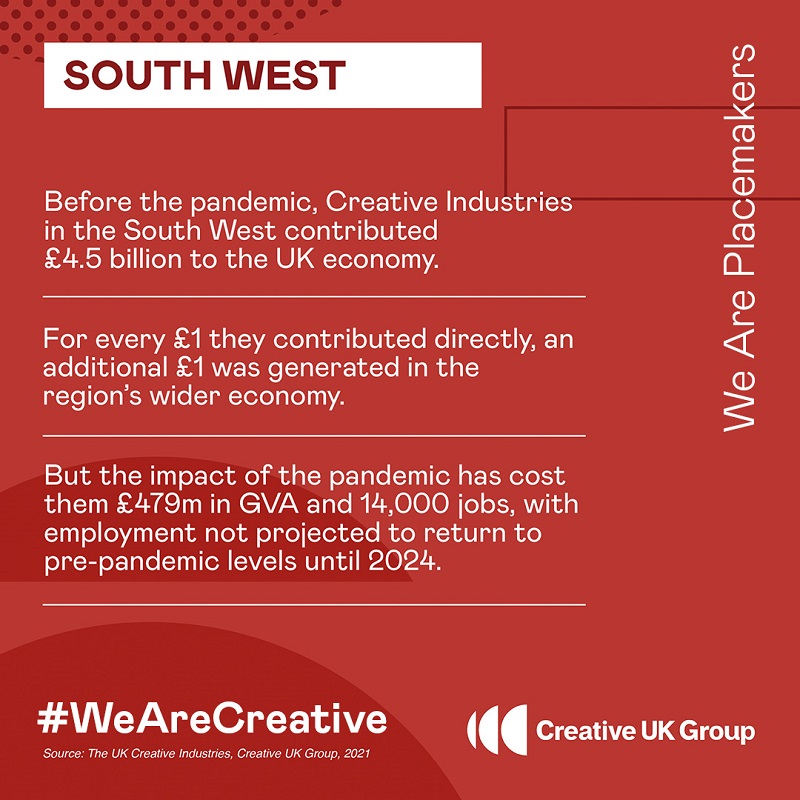
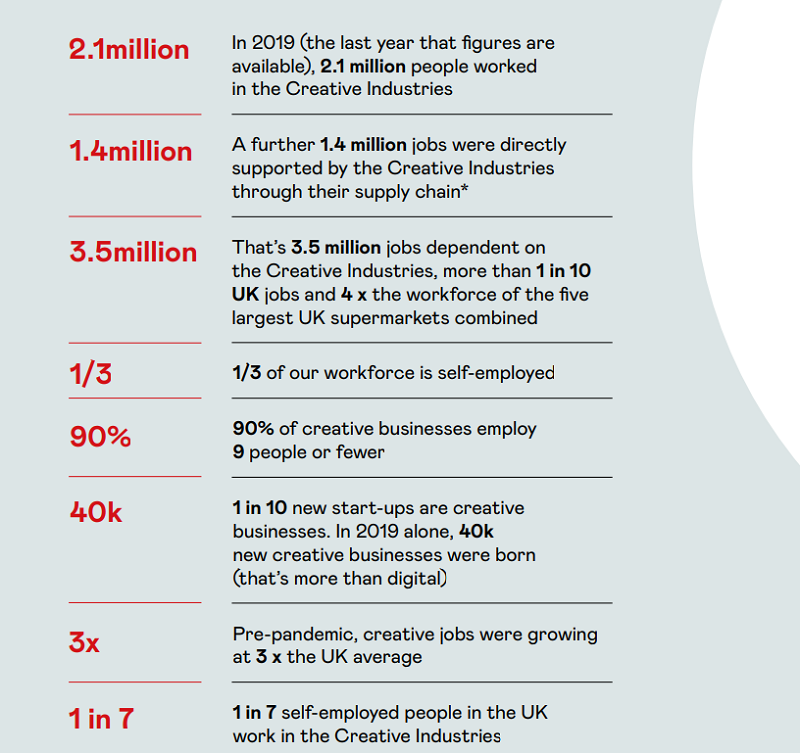
Included in the report is new data from Oxford Economics which showed that before the pandemic, the creative businesses directly supported more than one in 10 UK jobs. As well as the 2.1m pre-pandemic jobs in the sector itself, another 1.4m roles were directly supported through its supply chains.
Oxford Economics also estimates that for every £1 the creative industries before the COVID-19 outbreak, an extra 50p was generated in the wider economy via supplying businesses. That amounts to a combined economic contribution of £178bn.
The report said that with the right investment, the sector could recover faster than the UK economy as a whole, growing by over 26% by 2025 and contributing £132.1bn to the economy in GVA. That’s £28bn more than in 2020, and more than the financial services, insurance and pension industries combined.
By 2025 the Creative Industries could create 300,000 new jobs which is enough new roles to employ the working-age population of Hartlepool and Middlesbrough twice over.
Caroline Norbury MBE, CEO at Creative UK Group, said:
“The past decade has seen the creative industries achieve remarkable growth and success with the sector’s vast power to grow wealth and employment extending throughout local communities across the whole of the UK.
“With ambitious investment, the creative sector can rebuild faster than the UK economy and make a major contribution to the country’s post-pandemic recovery. We are money makers, job creators, innovators and problem solvers. We can reshape this country’s future for the better, but to realise our ambitions for tomorrow, we must invest in creativity today.
“We are not asking for handouts. We are asking for meaningful, targeted investment in creative ideas, creative industries and creative skills, that can unlock the incredible potential of the creative sector to kickstart our country’s recovery, and that will be repaid many times over.
“It is critical that we seize this opportunity to unlock the UK’s incredible creative potential, and avoid leaving key parts of our sector – and our country – behind.”
Tim Marlow OBE, chief executive and director at Design Museum, added:
“The creative industries have been hit incredibly hard by the pandemic. They are also central to our recovery. The creative industries – and design in particular – have the capacity to change behaviour, bring people together, empower communities and transform individual experience.
“The UK is world renowned for its creative industries, which in turn make it an attractive place to live, work and invest. Human creativity, unlike so many of our natural resources, is limitless – so it makes sense to invest in its potential to transform lives, level up and build sustainable and inspiring futures for many.”
The report contains several ideas for how the creative industries can be supported. They include:
The report outlines in statistics the make-up of the creative industries which show just how important it is.
Although the UK is world-renowned for big creative names such as Tate, Burberry and Working
Title Films, the creative sector is predominantly comprised of small businesses, micro-businesses and freelancers. As the report says: “Together we punch above our weight in terms of impact.”
There are thousands of examples of businesses pivoting and adapting to deal with the impact of the pandemic. We are delighted to see a Bristol initiative featured in the report:
“The immersive cinema group Compass Presents, whose planned productions were cancelled during the pandemic, brought the skills and knowledge they’d gained through immersive practice to disadvantaged communities in partnership with Knowle West Media Centre. Supported by BFI Film Hub, the organisation delivered 12 weeks of training in immersive screening to a group of young people in South Bristol, culminating in them organising their own immersive event for their local community.”
Ahead of the government’s Spending Review, Creative UK Group is calling on creative business owners and employees to highlight the importance of the sector to their MP.
To do that, it has launched the #WeAreCreative campaign.
You can download a draft email to send to your local MP and ask them to sign up to the pledge to support the creative industries.
You are also encouraged to shout about the sector on social media. We’d love to see Bristol Creative Industries members getting involved. Use the #WeAreCreative hashtag and tag us and your MP. We’re on Twitter, Instagram, Facebook and LinkedIn.
You can use the tools here to create your design. You are encouraged to start your post with ‘We Are…’ to “build a recognisable campaign that simply cannot be ignored”.
Agency culture is something that is typically easy to manage and foster within a small, start-up organisation. When your team is small, you’re able to communicate your values and ethos more easily and directly encourage your employees to embody the right behaviour for your agency.
This becomes more challenging as your agency grows and your teams grow and disperse between line managers and agency pods.
At Digital Agency Coach, we’ve helped over 200 growing digital agencies overcome their company culture nightmares — and in this article, we’re going to tell you exactly how we do it.
First thing’s first — it’s important to note that a good agency culture is not about ping-pong tables and fresh fruit deliveries. A good agency culture is about the values and behaviour of the individuals within your team.
How your team behaves and interacts with one another, is dictated by the overarching company culture — and as the agency leader, this has to start with you.
As the captain of the ship — the behaviour of your agency and your people begins with you. With this in mind, the first step to creating a great agency culture is to embody this within yourself first.
Once you become the agency culture example, demanding and expecting this from your team becomes much easier.
An agency’s behaviour is defined by its values. It doesn’t matter what those values are, as long as you and your team can honour them and they’re the right characteristics for your agency’s purpose.
Some agencies are driven by philanthropic, social or environmental values, while others are heavily sales-driven and are motivated by competition and commercial values. These are two very different examples of strong values, both of which are equally as valuable when it comes to creating the right culture for your agency.
To define your values, think about the overarching direction of your agency (as above) and consider what your ideal employee or manager looks like.
We advocate thinking about those standout individuals in your current team or people you have previously worked for or with, and pluck out the key attributes that made them great. Use these to build a base of 7–10 core values and let these dictate the behaviour and culture of your digital agency.
Poor-fitting employees will impact the productivity and morale of people around them. Addressing any ‘bad apples’ within your team is key to improving your agency’s culture.
At Digital Agency Coach, we advocate using a ‘Cultural-Fit First’ approach within your recruitment process. Prioritise the cultural fit and core-values screening early on in your recruitment process, and if a candidate doesn’t fit the bill, don’t continue with the hiring process.
Building the right team, with the right values, from the very beginning is the easiest way to foster a sustainable, scalable agency culture.
With that being said, it’s never too late to address the values and culture within your existing team.
One of the key Coaching & Mentoring exercises we work with agency owners on is analysing the culture and values within your current team. This exercise helps to Identify any ‘bad apples’ that could be impacting the morale, productivity and ultimately, the performance of your agency.
To do this, we use an Entrepreneur Operating System tool called The People Analyser.
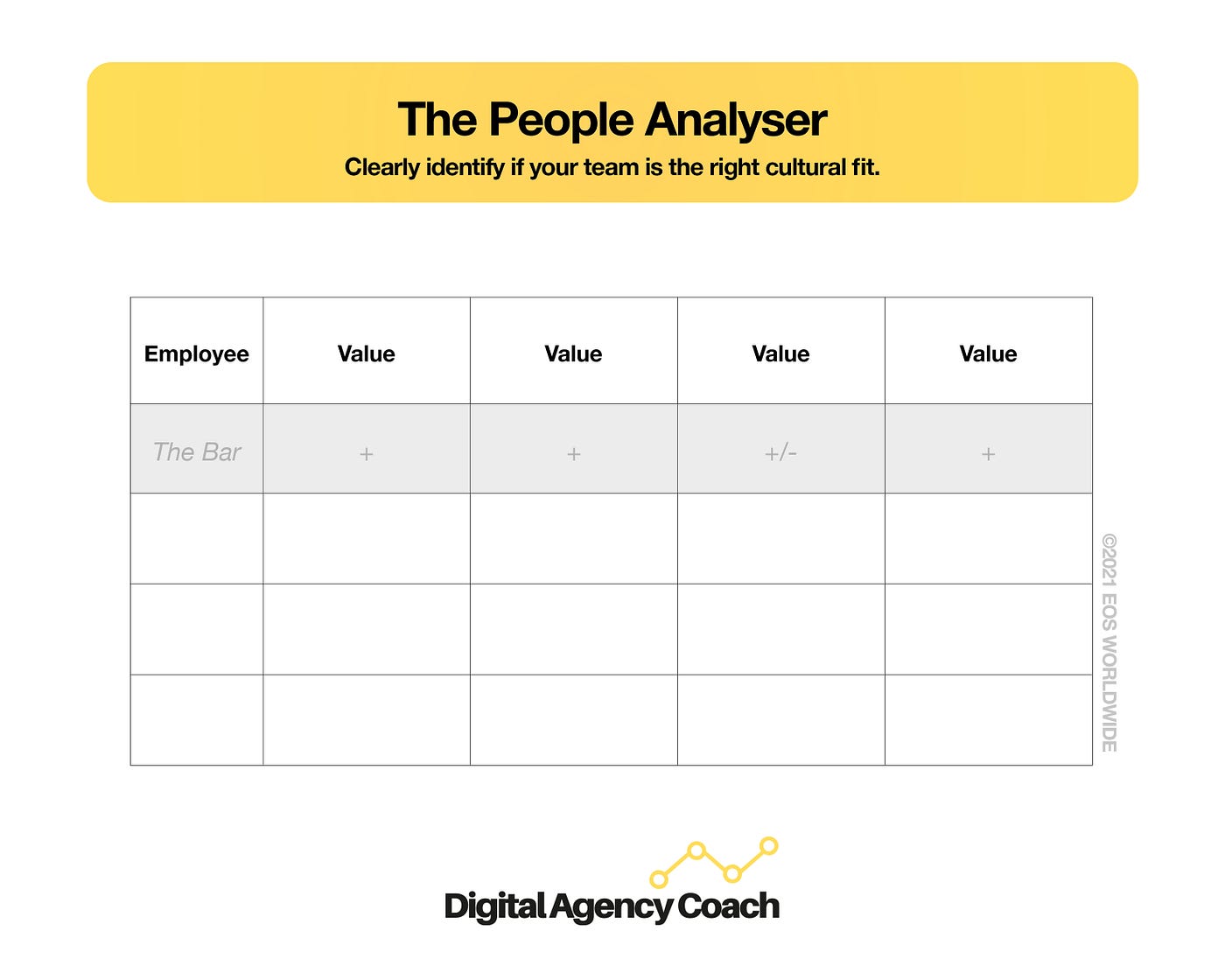
This is a simple template you can create yourself within a Google sheet or Excel workbook. Start by listing your 7–10 values along the top and a list of all your employees down the left-hand side. The trick is to make sure you set ‘The Bar’ as the minimum standard of what you require from an employee.
Once you have this set up, measure each individual against your values and determine whether this is something they Always, Sometimes or Never demonstrate. Once complete, you’ll have created a visual representation of employees who are a good cultural fit and those who aren’t.
Implementing these five steps will guarantee positive changes to your agency’s culture and ensure that you are able to scale your business and grow your team with the right people.
As always, if you have any questions about fostering a great agency culture or would like some help using The People Analyser tool, please Get In Touch with the team at Digital Agency Coach, we’d be more than happy to help.
Cookie acceptance pop ups might be driving us around the bend, but since the requirement to ask permission was introduced a couple of years ago, businesses and marketers have built their marketing strategies and systems around them.
Now things are all about to change again. It might have been predictable, but with Google telling us that 48% of consumers actually stop a purchase if they don’t trust the company to collect and manage data on them, it’s no surprise that Google are following the likes of Apple and Mozilla, and have announced that they were stopping third-party tracking in 2023.
This leaves businesses having to reset their marketing strategies, relying solely on any first-party data they hold, with many businesses, particularly in e-commerce, having to go back to more traditional marketing and brand building, but in a more digital world than before.
Any that fail to do so will find themselves simply giving their marketing keys to the tech providers with no real insight on their client base.
The option of doing nothing is a dangerous one, yet whilst Pimento research tells us that most marketing professionals intend to ‘do something about it’, 19 out of 20 acknowledge that they won’t be prepared for the great switch off.
Marketing will no longer be about stalking people across the web. We now have the opportunity where digital marketing can mature to become a real weapon to help brand building in a more meaningful way.
So, what’s the action plan? And what should all businesses, large or small, be lining up to do right now?
Action 1.
Do the gap analysis now. Work out what you currently use and need to achieve marketing penetration, and what will you have post the demise of third-party cookies. That’s the gap that needs filling.
Action 2.
Focus on the business infrastructure and get back to basics.
If you need support in doing the analysis, and in building the strategy going forward, make the move now to find it. Closer to the time, resources will be limited and remedial time scales will be longer.
Action 3.
Cement the data you have and get your consent strategy robust for the future, building the new approach around it. Undertake a cookie audit now.
Action 4.
Take a relook at customer experience and contextual for scale, so that you stay completely in touch with your customers’ buying triggers in the post cookie era.
This isn’t just a marketing challenge. It impacts the whole business spectrum, from SMEs to multinational corporates. Mid and large corporates will use their in-house resources to reposition, but small businesses will struggle in the absence of teams they can fall back on, and budget.
Pimento is well placed to be the surrogate team to look to though. With over 200 independent marketing agencies, covering most marketing disciplines, bespoke solutions are close at hand irrespective of size and sector.
This is not an issue for selective blindness. Businesses who fail to act will see their markets slowly dwindle away.
We all know how important it is to encourage equality through our culture in the workplace. But it’s no secret that women are underrepresented in senior leadership positions.
It’s everyone’s shared responsibility to become not only advocates, but champions of women from diverse backgrounds within their organisations – and in their lives at large. And in the creative sector, if we want to truly do our part to help women stake their claim, it means businesses taking ownership of their own equality scores in a number of ways – not least, by appointing women to the senior leadership positions we need them to be in.
At Proctor + Stevenson, we’re one of the UK’s longest-established independent marketing agencies. Despite this, we’ve never been conformists, and we’re a good step ahead of your traditional London-based agency in more ways than one.
Our Founder and Chairman, Roger Proctor, has always been an outspoken industry figure. He’s championed diverse young creative talent from the South West of England and Wales – an often neglected region for the arts – throughout his career.
Back in 1979, he laid in our bold and independent foundations in Bristol. And the rest is history. We’ve been challenging inequities and hiring diverse talent ever since – such as through hosting the South West Design + Digital Student Awards (which saw a particularly high volume of entries from young female designers this year).
In short, the talent is there. So what changes are being made?
At the start of 2021, Roger and the senior team restructured Proctor + Stevenson by splitting the larger brand into three companies: P+S Creative, P+S Technology and P+S Strategy, all overseen by the P+S Group (you can read more about these changes here). And this change marked a new milestone for the P+S team.
Our restructuring was the perfect opportunity to progress our own equality targets across the team at Proctors. It was at this point in our journey that we ensured the P+S Group met a target of 50/50 male-to-female directorship.
So, without further ado, meet our board…
· Joy Locke is our Company Secretary. She applies her 20+ years’ experience with us to take lead of everything operations, finance, accounts, and administration. She ensures that we were keeping on track with budgets.
· Ailsa Billington is one of our Directors. She leads our client services operations and takes charge of directing major global campaigns for our multinational portfolio of clients. She directs over all teams in the P+S Group to make sure that we deliver the best campaigns to transform our clients’ businesses for the better.
· Nikki Hunt is our Financial Director. CIMA-qualified, Nikki brings a wealth of experience in management accountancy, HR, payroll, and health and safety to our business, keeping us running efficiently and safely.
· Roger Proctor is our Chairman. He founded P+S in 1979 and has continued to lead its transformation ever since. Under his leadership, the business has grown from 2 people to more than 70, plus a network of freelance talent, and has won a global portfolio of clients such as Panasonic, National Grid, Saudi Arabian Airlines, and much more. He is passionate about the power of creativity to make positive change and is also heavily involved in strengthening the links between the creative industries and education.
· Mark Jamieson is another of our Directors. He helped establish our presence in the Middle East and is an expert in developing, building, and maintaining positive client relationships in across all sectors.
· Steve King is the final member of our current team of Directors. He leads our large-scale digital projects on everything concept creation, development, and project delivery. He’s worked on many innovative and world-first technology projects.
At Proctors, we’ve always taken equality and diversity extremely seriously. Because when we celebrate and empower women in business, it benefits everyone.
We strive to nurture careers amongst our female talent, building them up into more senior roles within our business. And we want to continue to progress further. We’re currently building a broader, transparent picture of our teams, our diversity, and our biases to discover how we can do better.
There’s lots more to be done to help narrow the gap between women in leadership across the UK. It’s a fact that only 5.6% of women in the UK run their own business and women only account for 33.8% of positions as directors on business boards in the UK, with only 16% of creative directors reported to be female.
We’ve just launched the first instalment of our Women in Business interview series. In it, our own Marketing Manager, Becca Peppiatt, sits down with Peaches Golding OBE CsJT, Her Majesty’s Lord-Lieutenant of the County and City of Bristol. This interview, like the rest of the series, delivers insight into the female perspective of working in business, so aspiring young women can see themselves represented in leadership roles. Stay tuned for more instalments of the series, coming soon.
We can all do our part to progress the important conversations which need to be had about an industry that is in many ways stuck in the past, ignoring some of its blatant inconsistencies. There’s lots more to be done and we intend to continue to work hard to narrow some of the gaps that exist. We need to think intersectionally about how we hire, and how we can create healthy, fair environments for women to succeed in.
For more information about Proctor + Stevenson, or to discuss our services or teams in more detail, please email us.
If you take a look around Digital Agency Coach’s website you’ll see the two core services we offer to digital agency owners: Mastermind Groups and Coaching & Mentoring Programs.
Digital Agency Coach’s bi-monthly Mastermind Groups provide a peer-to-peer learning and networking environment for agency owners and are a brilliant way to share ideas, learning and insights with other like-minded professionals. Watch our Mastermind Group Explainer Video (1min) for a detailed look at how this service benefits busy digital agency owners.
Our Coaching & Mentoring Program is by far our most comprehensive and rewarding service, where our agency owners benefit from extensive 1:1 consultancy and expertise guaranteed to scale and grow their digital marketing agencies.
In this article, we share how our Coaching & Mentoring Programs work and what you, as an agency owner, will experience both during and as a result of the program.
1:1 coaching provides a dedicated space to solve problems, gain accountability, design and execute business plans through external, expert advice. You’ll make decisions faster, build better teams, deliver higher quality work and your digital agency will grow, and you’ll enjoy the journey.
All Digital Agency Coach Mentee’s have the opportunity to become one of our successful agency owners who:
Grew Their Revenue & Profit
You’ll achieve significant growth in both your revenue and your profit within the first 12 months of working with us.
Won More Leads, Clients & Awards
You’ll develop the skills to convert more leads, grow your client base and win noteworthy, genuine industry awards as part of your recognition.
Bought, Merged Or Sold Businesses
Want to grow quickly through Mergers & Acquisitions? We’ll guide you through the processes and purpose behind these growth strategies so you can benefit from the results faster.
Gained Freedom And/Or Early Retirement
You’ll be able to spend less time in your business and start working on it. Our mentees now have more time and freedom to do the things they enjoy, and many have been able to reap the rewards of their lifetime’s work and step into retirement.
Participating in our Coaching & Mentoring program generally follows this engagement process:
Onboarding — This where the scope of work is agreed and all our reciprocal learning and understanding is carried out.
Building — Together, we put together a strategy and a plan based on our learnings from Step One
Execution — As the name suggests, Stage Three is where we execute the plan and start to grow your agency.
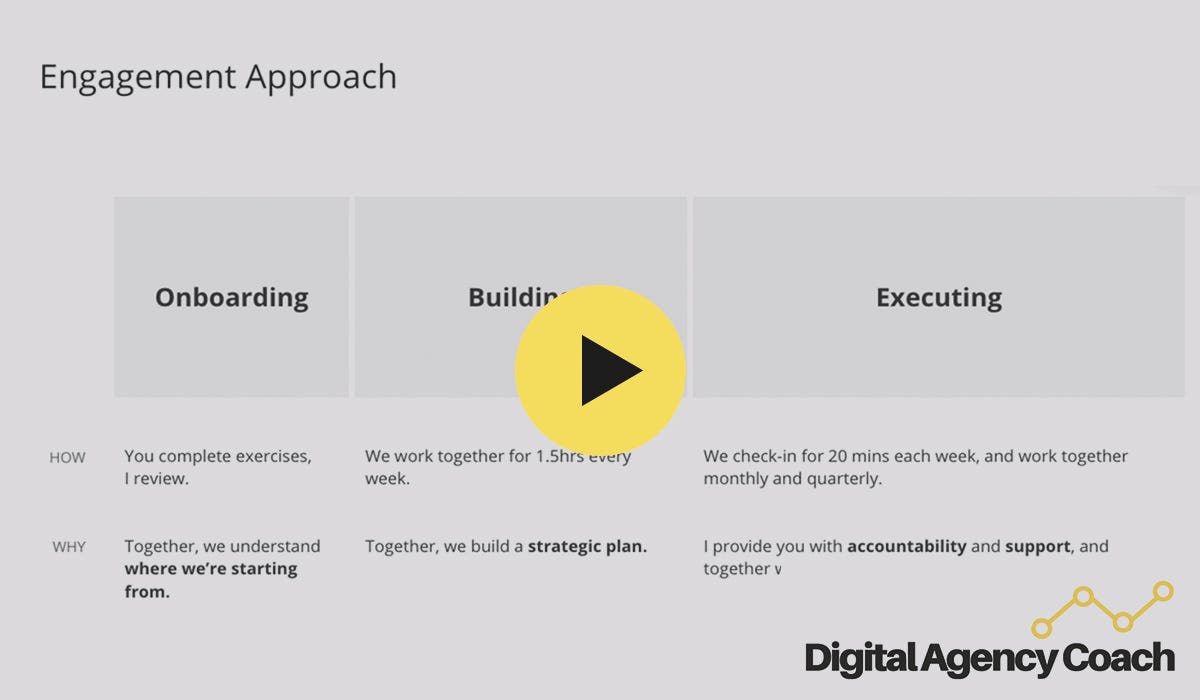
This is where we get to know each other. We’ll begin with a discovery session, where our consultant will ask you to share details and insights about your agency’s current status and any plans, aspirations and goals you have for the future.
This then is reviewed, packaged and shared with you. We’ll put together a presentation that summarises your goals, business position and the strengths, weaknesses and opportunities for your agency. We’ll also detail a top-level roadmap and a handful of quick wins for you to implement then and there which are guaranteed to have an immediate effect on your business from day one.
This onboarding phase usually takes about a month to complete and once we have this understanding we can put together a plan and roadmap for us to move forward with.
This is where we put together your growth strategy. We’ll use our Agency Accelerator Canvas to break down your business plan into achievable, bite-sized objectives, milestones and KPI’s for you and your team.
Our consultants will work with you to formulate a plan and share insight, context, benchmarks and tactics from our portfolio of the 250 digital agencies we’ve worked with. Creating these objectives and key results and writing your business strategy usually takes about 6–8 weeks to complete.
Stage three – execution, makes up around 75–85% of our program. This is where we put our planning into practice and start to make big, impactful changes to your agency’s operations.
You’ll chat with your consultant weekly for 10–15 minute accountability meetings to check in and make sure things are running smoothly. Between these sessions and our ongoing, ‘always-on’, ad-hoc support, you’ll execute the daily and weekly tasks in your business plan.
Every four weeks we’ll set aside a few hours to plan for the coming month and set the KPI’s to make sure the overarching plan is still in sight. Then each quarter, we’ll orchestrate a full review of the work completed and the work ahead and make any necessary changes to the master plan.
At Digital Agency Coach, we work deeply with a small roster of agencies at any one time as our Coaching & Mentoring Programs are long-term relationships that deliver long-term, long-lasting results. The average timeline for these programs is anywhere between 12 to 18 months, depending on your capacity.
Now that we’ve unpacked our Coaching & Mentoring Program and how our services can help you achieve stratospheric growth for your marketing agency — it’s time to ask yourself if this is the right fit for you and how you like to work.
If the answer is yes, please get in touch and Arrange A Free Consultation with one of our friendly consultants. We’ll be happy to answer any questions you might have and get you on the path to success.
When you’re trying to market yourself, it’s not enough just to have a clear avatar, a tagline or a good 60-second speech. Marketing yourself is much more than that, and focusing on a comprehensive marketing approach will help you get better and more sustainable results.
There are three areas that make your marketing work. And I want to share these with you in the form of a proven framework called BRAVE Marketing that has helped many self employed professionals get more confidence in themselves and their marketing approach in a very short time. The three areas are YOU, your CLIENTS and your MARKETING.
The first area is YOU. Marketing yourself and marketing an external product, in my opinion. are very different. When you’re selling your own time and expertise, it’s so important that you first master your own self awareness. Many people who talk to me about their challenges tell me that they actually know what marketing strategies to use. They have a clear avatar. They even have a nice slogan. But for some reason, they’re procrastinating or they live in self doubt. That’s a challenge when you’re working for yourself and by yourself. If you’re not mastering your internal belief system, if you don’t have a clear why and you’re not connected to your purpose, or if you’re not clear on your uniqueness and strengths, then all your marketing strategies and theories will not produce optimal results. So I love working with you on getting clear life goals behind your business goals (your reason for doing what you do), removing the limiting beliefs that block you and helping you build a unique business based on your strengths. When the internal stuff is sorted, you’ll start operating with more ease and flow and you’ll know what to do when your demons to pop up again.
The second area is to clearly identify your CLIENTS and build empathy towards them. People usually call this building your avatar. But I want to take this step a few inches deeper. First of all, how are you choosing your target market? Are you being too vague or wanting to serve everyone? And for some of you, you’re telling me that it’s difficult to segment them using a specific demographic. Well, sometimes it’s about segmenting them on their needs and problems. Whatever your challenge, it is very important to understand who you’re going to serve. And if you can serve more than one market, then the question is not “Who do you want to serve?” but “Who do you want to serve first?” Many times, it’s hard to come up with a sharp marketing campaign, if you’re trying to hit multiple audiences using multiple services all at once. Sometimes you’ve got to stop being opportunistic and start being strategic. Get clear on one group of people and market one service in one marketing campaign. When you’re getting good results, then you’re allowed to target another segment with another campaign. And after you’ve identified that ideal client, then empathise with them emotionally understand their needs and challenge. Layout their journey with you and the clear transformation they will get when they use your service. Remember, most of you are selling something intangible. So working on the customer process and transformation is key to developing a tiered product ladder that will help your audience understand what you sell and what you promise.
The third area is YOUR MARKETING. This area deals with helping you create an effective one-liner and marketing assets. I also work with you on designing an effective & comprehensive marketing plan. Here I want to highlight the importance of using your own style to market yourself. Many people use templated marketing strategies that are proven for others without getting really clear about their own personalities and marketing styles. When you are not comfortable executing your strategies, you will start to procrastinate or find excuses why it’s impossible. I find that in the beginning, you need to experience wins by doing the strategies that play on your strengths, feature you at your best, and give you fun and enjoyment. In my experience, the best marketing plan is the one you will execute! In my journey building a top-ranked firm marketing 6 coaches, I’ve learned that everyone’s got their own genius… everyone has their own style and their own appeal. Find yours and you’ll find more enjoyment in marketing yourself. Be authentic and the right kinds of leads will be attracted to you. Try to be someone else and you’ll end up frustrated and lost in self doubt.
These are the 3 areas that will make your marketing approach holistic and effective. If you focus on one without the other, you may feel confused why your hard work is not generating the results you want. Working on the YOU will help you increase your self mastery and be the type of person that will successfully represent your brand. Empathising with your CLIENT will help your core message be at the top of their hearts, not just their minds. And having a comprehensive MARKETING plan with the strategies that suit your style and your strengths will help you enjoy doing what you need to do to grow your business with consistency, confidence, and flow.
If you want a fresh perspective about your marketing approach, let’s have a talk. I’d love to connect with you. Email me at [email protected]
A lot of emphasis these days are being put on getting leads, but leads don’t generate revenue. Clients do! In this video, I go through the 3 reasons why clients may not decide to buy your services and what you can do to improve your sales conversion.
You’ve got the lead, they book a call, but what makes them say, “I’ll think about it” and never call again? Why do they prefer other service providers instead of you?
Let’s start off with confidence. How confident are you? I’ve been in sales since 1996 and I must tell you that confidence, not competence, is convincing. How confident are you in yourself? Are you discounting your abilities and unconsciously using negative self talk? How confident are you that you can help them? Are you confident in the value you can offer them?
If you want to improve your sales conversion, first work on your self confidence.
Confidence is affected by several things.
The next thing that affect sales conversion is your sales conversation. Are you acting like a human brochure or are you actually solving their needs?
We don’t all have lots of selling experience, but we’ve all had experience being sold. So think about what kind of sales conversations you enjoyed in the past; the ones where you felt comfortable, helped, and cared for. Think of that process you went through and how it made you feel confident to buy. What did the sales person do to you, with you, and for you? What kind of conversation did you have? Was it a one-way presentation about the products or was it a two-way conversation that used questions to discover your needs? Who was the sales person for you? Were they human brochures who just waffled about their features and benefits, or were they solution-providers who listened to you and suggested useful advice?
Now look at how you sell. No matter what you sell, there is a pattern in your selling conversations. How do you start? What do you spend the most time on? What is the ratio between talking and listening? What kinds of questions do you ask, or don’t ask? Here’s my favourite test for aspiring sales people: “Good sales people drink their coffee hot!” Let’s say you’re doing a zoom meeting with your prospect and you each prepare a cuppa for yourself before the call. Do you get to drink your coffee hot, or is it already cold by the time you drank it? If you get to drink it hot, well done! That means you’re discovering and listening to the prospects first before waffling away about what you can do for them. If you’re drinking it cold, well, you’ve been talking too much. And don’t be surprised if they reply with, “Uh-huh… ok… well, great. Let me think about that and I’ll let you know.” Your sales conversation should make the clients feel that you understand their needs. You have listened and your solutions are relevant. They should also feel that they co-created the solutions with you. People are less likely to say No to a solution, if they feel that they’ve co-created it.
And finally, the third thing that affects your sales conversion is follow up. It’s amazing to meet sales people who are so excited to have a sales meeting with you, but do not follow up afterwards. They make the proposal, send it off, and then expect the wheel to turn by itself. Or they end their proposal with, “Let me know if you have questions.” That’s a reactive attitude. End your proposals by making an appointment for another call to explain the details and to answer their questions. That’s another excuse to talk to them, and another chance to get a decision.
Marketing gets you leads, but leads don’t generate revenue! Clients do. So let’s focus now on your sales process, not just your marketing strategies. I hope this blog has helped and if you want to sharpen your sales process and need customised advice to do so, email me at [email protected]
Marketing yourself starts with mastering yourself. Many self employed professionals get stuck in self doubt and lack of clarity. In the end, this lack of self awareness keeps them from reaching their potential in their business. In this video, I will cover the 3 areas you need to master to strengthen your uniqueness and positioning. By focusing on these areas, you will increase the confidence you have in yourself and in your business. You will overcome your imposter syndrome, and have a clearer core message about who you are and what impact you make. You will attract the types of clients that appreciate your value, and as a result, you will have more fun growing your business. So let’s get started.
The first area to master is your outcome. What are you building and why is that important to you? Have you ever lost motivation to get things done? You know what to do, and even how to do it… but somehow, you just don’t have the drive? This is a great indication of not having a clear vision and purpose. Many people I speak to have a very cliche reason why they do what they do. “I want to be successful… I want to have more income… I want to help people.” Great, what does that look like? How clear is that vision? How much passion and emotion do you feel towards it? Why is all this important to you? If you’re struggling to find the answer, or if you don’t feel emotionally connected with your answer, then perhaps you need to work on mastering your outcome. This part is so important for at least 2 reasons. First of all, when times get tough, your connection to your WHY will keep you going. Without this, you will procrastinate and find many excuses to delay progress. Secondly, if you have a clear vision and purpose, it will be easier for people to know what you stand for. It will be easier for people to resonate with you. You will exert a type of energy that attracts the right clients to you. People are inspired by and drawn to people who are excited, passionate, and on a mission. Do you have that energy?
The second area to master is your belief system. What beliefs influence your feelings and actions? Your existing beliefs are usually shaped by past experiences, and they affect you subconsciously. Mastering your belief systems start by bringing them up to the conscious level. Whether or not they are empowering you, it’s important to be aware of what they are, where they might have come from, and whether or not they are useful to get you where you want to be. Beliefs are never good or bad; they’re just either useful or not useful. And if you’ve done the work of clarifying your outcome, you will have an easier time to select the useful ones that will get you there. The beliefs to master are usually those about yourself, your business, your likelihood for success, your clients, and how the world works. So basically, everything!
The third area involves finding your essence and your natural strengths. Comparing yourself to other people will just make you feel inadequate. Find your genius by understanding your WHY and your Ikigai. Finding your WHY will help you find your essence; this is what you stand for and how you’re designed to contribute. It’s a process that takes you back to realise how your past has shaped your purpose and passion. Your essence is not an aspiration or dream. It is who you already are. Your Ikigai helps you understand your reason for being. The crossover between what you love, who you love to serve, what they need & willing to pay for, and what you are good at will give you a very clear idea of your uniqueness and may even open up new opportunities that you have never thought of.
Behind every business is a human being, and most human beings actualise themselves through some sort of career or business. A business works when the human behind it is functioning well: body, mind and spirit. So it’s no surprise that an essential step to building a high-performing business is creating a high-performing human being; someone who understands what they want to achieve, and how to use their best self to achieve it.
So I invite you to start the process of enhancing your self mastery. Which of the three areas do you need to sharpen? Your outcome? Your belief systems? Your genius? Working on this during the last few months of year may help you create an amazing year ahead!
If you have any questions, email me at [email protected]
Is your digital marketing agency profitable on purpose, or by accident? At Digital Agency Coach we’ve worked with hundreds of agency owners over the years, some of whom were unaware of their profitability stats.
Many agencies end up being profitable by accident, as a positive consequence of the year’s work. In this article, we share our insights on turning an intentional and deliberate profit.
As a busy agency owner, it can be easy to prioritise managing the day-to-day operations and allowing your profitability to become an afterthought. With this mindset, it’s difficult for you as an owner, to have that profit-oriented, strategic mindset that is key to growing your agency.
At Digital Agency Coach, we always recommend approaching profitability with intention and purpose. This approach can feel foreign and a little acquisitive at first, but it’s important to remind yourself that it’s completely genuine and moral to design your business in such a way that it earns you money.
Having a profit-driven mindset enables you to reinvest into your business, enhance the quality of your service and grow your agency.
When it comes to an agency’s profitability, there are typically three different degrees of intent and three defined profit groups as an outcome.
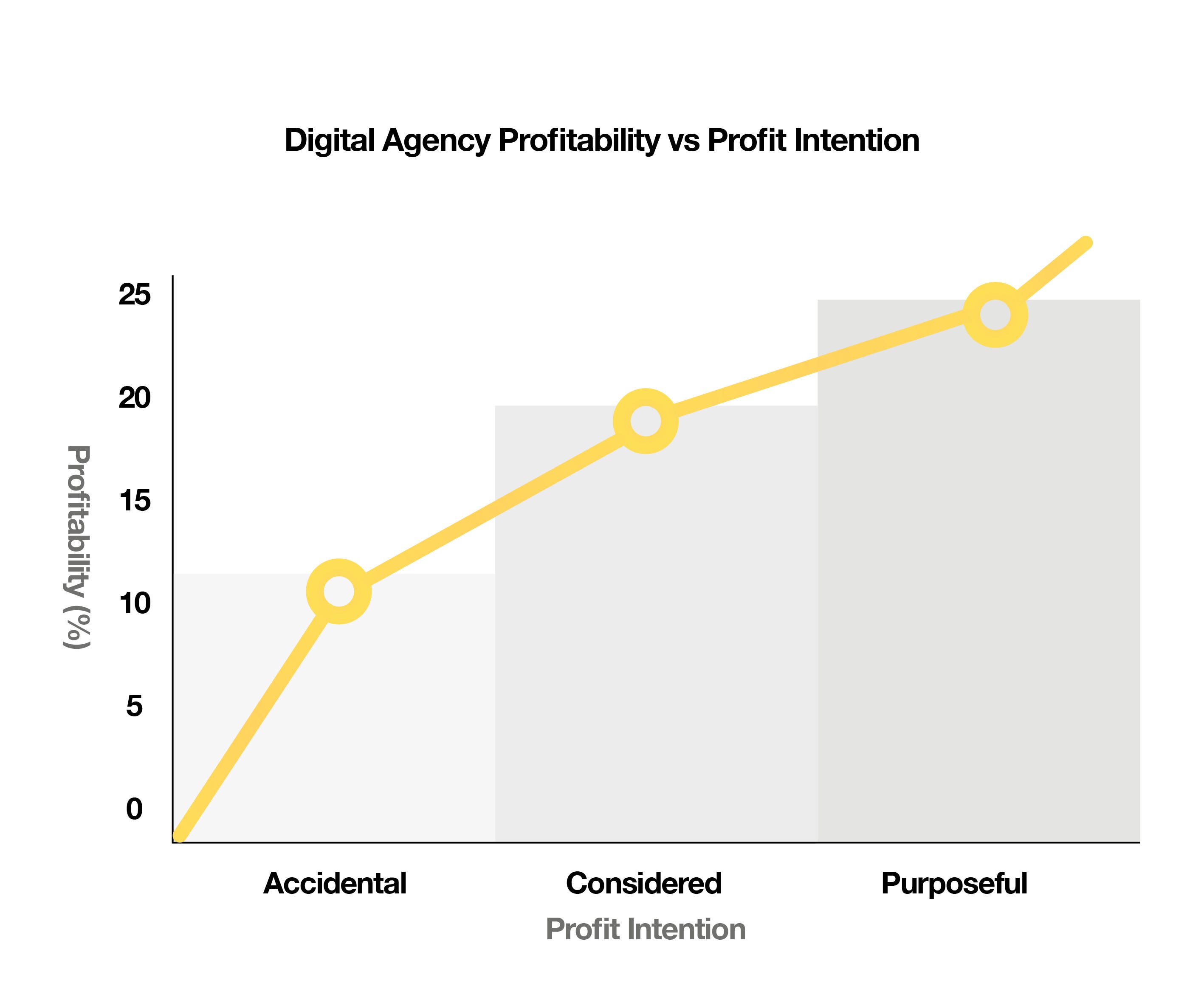
Agencies who generate anywhere from 0–12%* profit are generally doing so by accident. These agencies usually no profit strategy in place and the year-end results are unpredictable and often speak for themselves.
Those digital agencies turning anywhere between 13–22%* profit, are almost always doing it on purpose. The closer the number lies to 22%, the more deliberate and considered the profit is. The lower the number, the less intentional their outcomes have been.
And as for those generating a profit percentage anywhere north of 22%*, we classify those guys as purposeful, profit machines. These digital agencies know their services, their clients, their team, and their business like the back of their hand. Their sales pipeline and financial systems are geared toward driving high volume, quality leads which convert.
*These figures are general only, actual profit margins will depend on the agency size. Large organisations with substantial overheads typically will have tighter margins.
Address these six top-line areas and improve your agency’s profitability today.
Take a close look at your gross margins. If they’re outside the range of 50–60%, unfortunately, you’re not profitable enough. Your gross margins are calculated by taking the overall revenue of your agency, less the sum of those direct salaries and/or contractor and freelance fees required to deliver your particular service.
As a service-based business, your agency sells time — utilisation looks at how many billable hours you have available to your clients. If you are operating at less than 72% capacity, there is scope to improve your profitability by maximising your utilisation.
These can be either your employees or clients. If you attract and retain poor performers, this will lead to inefficiency and low profits within your agency. It might be that you need to address some of those long-standing, legacy clients from your start-up days, or certain team members who are less efficient than others. The solution? Try raising your fees or developing the skills and/or expertise of your employees.
Usually, those agencies who fall into the 0–12% profitability category, have no insight or oversight on their financial or sales reports and forecasts. Having a robust sales pipeline and reporting structure in place will allow you to understand when, where and how you can maximise your revenue and minimise your expenses — which we know will lead to a direct increase in your profitability.
For digital marketing agencies within the UK, it’s recommended you charge £90 per hour as an absolute minimum for your services. At Digital Agency Coach, we advocate charging anywhere between £100 — £150 an hour and ensuring you bill all for those all hours at your full rate in order to maximise your profitability.
Is the service you provide right for the current market? This is a big question for web design agencies who are competing against the likes of Wix and Squarespace. These ‘done-for-you’ website builders have significantly devalued the product to where it’s now within the reach of many small businesses and small budgets. As a specialist agency with a highly skilled team, you need to be bold and honest with yourself and ask if there is a future within your market. If the answer is no —you have to innovate and change with the times.
Remember, it’s perfectly moral and genuine to gear your agency to become a profitable, money-making business. As a business owner, you are doing your customers, employees, and your market a disservice if you are unable to reinvest your profits back into your industry.
Ready to begin? Start by asking determining which of the three levels of profit and intention describes your agency. If you’re turning a profit anywhere south of 20%, it’s time to change your mindset and address these six ways to increase your profitability.
Watch Our Free Video Class: Profit On Purpose (7min) & kickstart your journey toward profitability
Of course, if you have any questions or would like to chat with one of our Digital Agency Coach Consultants, please Get In Touch — they’d love to help.
You need to load content from reCAPTCHA to submit the form. Please note that doing so will share data with third-party providers.
More Information