Bristol based agency, Flourish Direct Marketing, have been recognised as the ‘Best Email Marketing Agency’ in the South West of England in the Acquisition International Research & Development Awards.
Acquisition International launched the Research & Development Awards to acknowledge the work that goes into an often-overlooked industry. Indeed, many of the extraordinary advancements the public sees are due to the incredible efforts of the teams that worked tirelessly to bring a vision to reality. Awards Coordinator Holly Blackwood commented on the eve of the announcement: “It has been an absolute pleasure to speak to you all and find out how you continue to innovate and create in your respective industries. I wish you a fantastic rest of the year ahead.”
Flourish was first established in 2004 and has since built a team of around 50 specialists to deliver innovative customer journeys to their wide range of business clients. The news of their industry recognition comes alongside their recent announcement about joining independent agency collective, Harbour, as the dedicated CRM agency.
Paul Hammersley, Managing Partner, Harbour, said: “The understanding and management of customer journeys and experience are key parts of today’s marketing plans, so it’s essential that we have this capability at the heart of our offering. Flourish are one of the best independent agencies in this space, with an impressive leadership team, a strong client base and an excellent skillset across strategy, creative and media, making them the ideal CRM partner for Harbour Collective.”
Ian Reeves, Managing Director, Flourish, added: “We’re genuinely delighted to have received recognition for our contributions to improving best practice in the email community. We aim to help improve and implement a universal approach to email marketing that will not only benefit our clients, but all user experiences too. A huge thanks goes to our team for all their hard work.”
By all regards, the businesses featured in the 2022 edition of the Research & Development Awards showcase the importance of innovation, creativity, and future-thinking to the greater business landscape.
Acquisition International prides itself on its awards and winners. The awards are given solely on merit and are awarded to commend those most deserving for their ingenuity and hard work. To learn more about our award winners and to gain insight into the working practices of the “best of the best”, please visit the Acquisition International website http://www.acquisition-international.com) where you can access the winners supplement.
About Flourish
Flourish is a specialist CRM Agency, focused on the development and delivery of data-driven and creative communications and content in the B2C, B2B, B2G and NFP sectors. Based in Bristol, UK, the business opened its doors in March 2004. Since then, Flourish has extended its footprint with teams in both London and Dubai to support regional economic growth and a Global client portfolio.
With a heritage in Direct Marketing, Flourish has sector-leading CRM expertise, focusing on driving action at every stage in the Customer Journey, whilst acknowledging individual customers’ needs and circumstances. Flourish has helped brands like Samsung, Twitch, Coca-Cola, Nissan and Crisis revolutionise their approach to customer communications and, in-turn, maximise lifetime value through a blend of data, technical and activation solutions across a range of audiences, channels and touchpoints.
If you’d like to discuss how Flourish could help your business maximise the value of your customer audience then reach out to Ian Reeves via email on [email protected]
About Harbour
Harbour is an independent brand communication consultancy that sits at the heart of a collective of specialist agencies. It was launched in 2017 by Paul Hammersley (Managing Partner) who was joined by Mick Mahoney (Creative Partner) and Kev Chesters (Strategy Partner) in 2019. Its unique structure and client offering are designed as a contemporary alternative to the large legacy agency groups. Clients include McCarthy Stone, Tilney Smith & Williamson, The Athletic, BT, Match.com, Fitbit and John Lewis.
Our latest survey has found that most people (68.2%) do not recognise a Google Ad in their search results. This means that almost a third of us DO recognise the Adverts in our search results and almost 80% of those people (78.6%) will then refuse to click on the Ads.
Over the past six years , Varn have conducted research every six months to measure the degree to which people can recognise the Adverts within the Google Search results.
We work with our clients to hypothesise and evaluate holistic click through rates with and without the presence of a paid ads in the SERPs. Where possible we review the revenue per click generated by each channel in the context of search competition to identify the best search strategy. We are often reviewing data about click through rates on Adverts vs Organic listings, and we have always wondered who actually recognises a Google Ad when they search and what do they do then?
We all know how important advertising revenue is to Google. In 2021, Google’s ad revenue reached a staggering $148.9 billion. Add in YouTube advertising revenue and Google Networks advertising revenue, we have a total of £208.7 billion. This amounts to 81% of Google’s total revenue so, perhaps unsurprisingly, advertising and paid search is vital to Google. But how much do people recognise it’s advertising they see when they do a Google search?
We have been curious about this for some time and for the last 6 years, every six months in the UK, we have conducted a survey online asking over 1000 people across all age groups:
“Do you know which links on the Google search results page are paid adverts?”
Our research has highlighted that the majority of searchers (68.2%) still do not realise it is an Advert that is appearing at the top of their Google search results.

This is good news for advertisers, as this large proportion of searchers won’t be put off by anti-advertising perceptions, before clicking on your website. However, it does pose the question that if 68.2% don’t realise they are looking at an Advert, then 31.8% do recognise they are seeing Adverts in their SERPs.
Well, based on our latest findings, 25% of people do recognise it’s an Ad. They will then refuse to click on it. Only 6.8% of the people that recognise a Google Advert will then actually go on to click.
This means that 78.6% of the people that recognise Google Adverts, refuse to click on them!
This implies there is a large chunk of your potential market deliberately choosing to ignore your advert. With an estimated 3.5 billion searches per day in the UK alone, based on our findings, 31.8% of those searches, (1.1 billion) will know that there are Ads in their search results. Of those 1.1 billion searches, almost 80% of those searchers could be actively choosing not to click on your Ad. This is a large amount of people searching and making a conscious choice to ignore your Advert, precisely because it is an Ad.
Given we know these searchers will knowingly refuse to even look at your paid Ad, this means your business will need to try and engage with these people with other ‘search’ tactics. You simply can’t just throw budget at a paid media strategy alone, instead organic search will have an important role to play and a combined or hybrid search marketing strategy is needed.
From Google’s perspective they state that:
“Google’s first responsibility is to provide Search users with the most relevant possible results. If businesses were able to pay for higher rankings in the search results, users wouldn’t be getting the information they’re looking for.”
We examined how Google have presented Adverts to the searcher over time. Interestingly, since 2013, Google has changed it’s adverts over time to be less obvious. In the graphic below you can see how Google search Ads have evolved. The format and styling change frequently and it could be suggested that the graphic signposting of Adverts has become much more subtle over time and more in line with a standard organic listing.

When we look at our Varn research over the last 6 years, the ability to recognise an Advert hasn’t changed a great deal, even though theoretically people are getting wiser to how search engines work. It has remained between about 57% and 65% since 2017 and you can see how this may be influenced by the design of the Google Ad labelling which has since transformed to look more like regular Google listings. This year we see that figure at 68.2%, at a time when the Ad design really is very similar to an organic search listing.
Can you spot the difference…?
It really is not surprising that the majority (68.2%) of people still don’t recognise Ads, as if you line up a paid Advert and an organic search result and see how they actually look to a searcher, you can see there is not much difference at all:
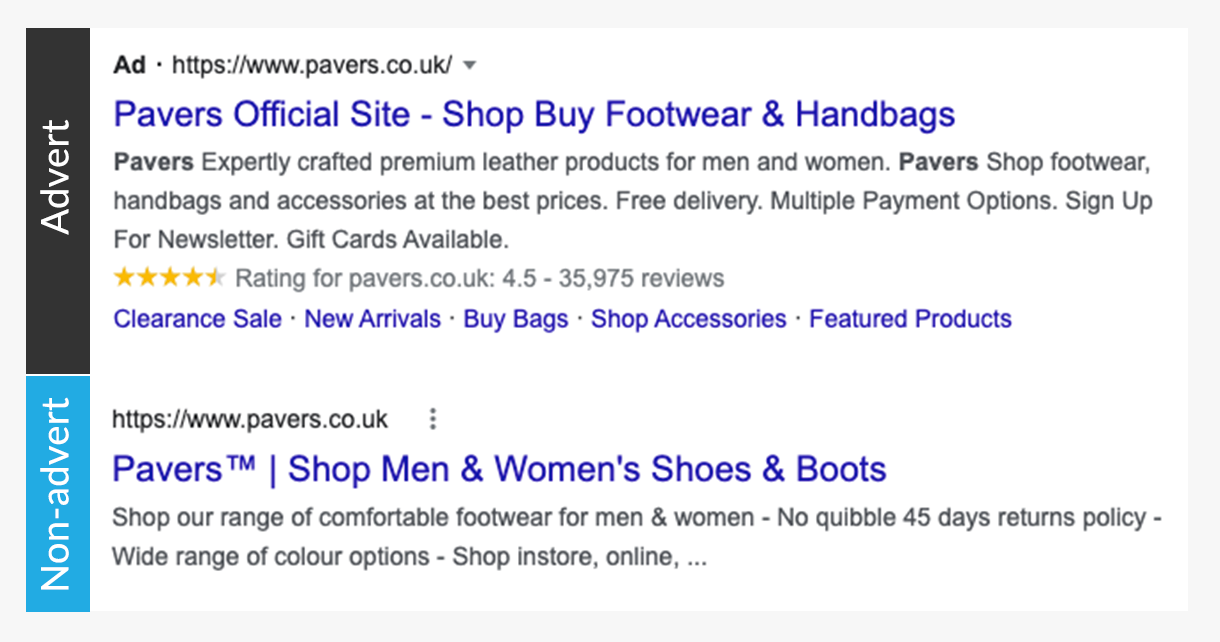
We have also seen that Ads can often take up most of the page of a search result. Combine this with the subtle design cues used to indicate the Advert status, you can see why people may not understand they are looking at just Ads rather than organic search results.
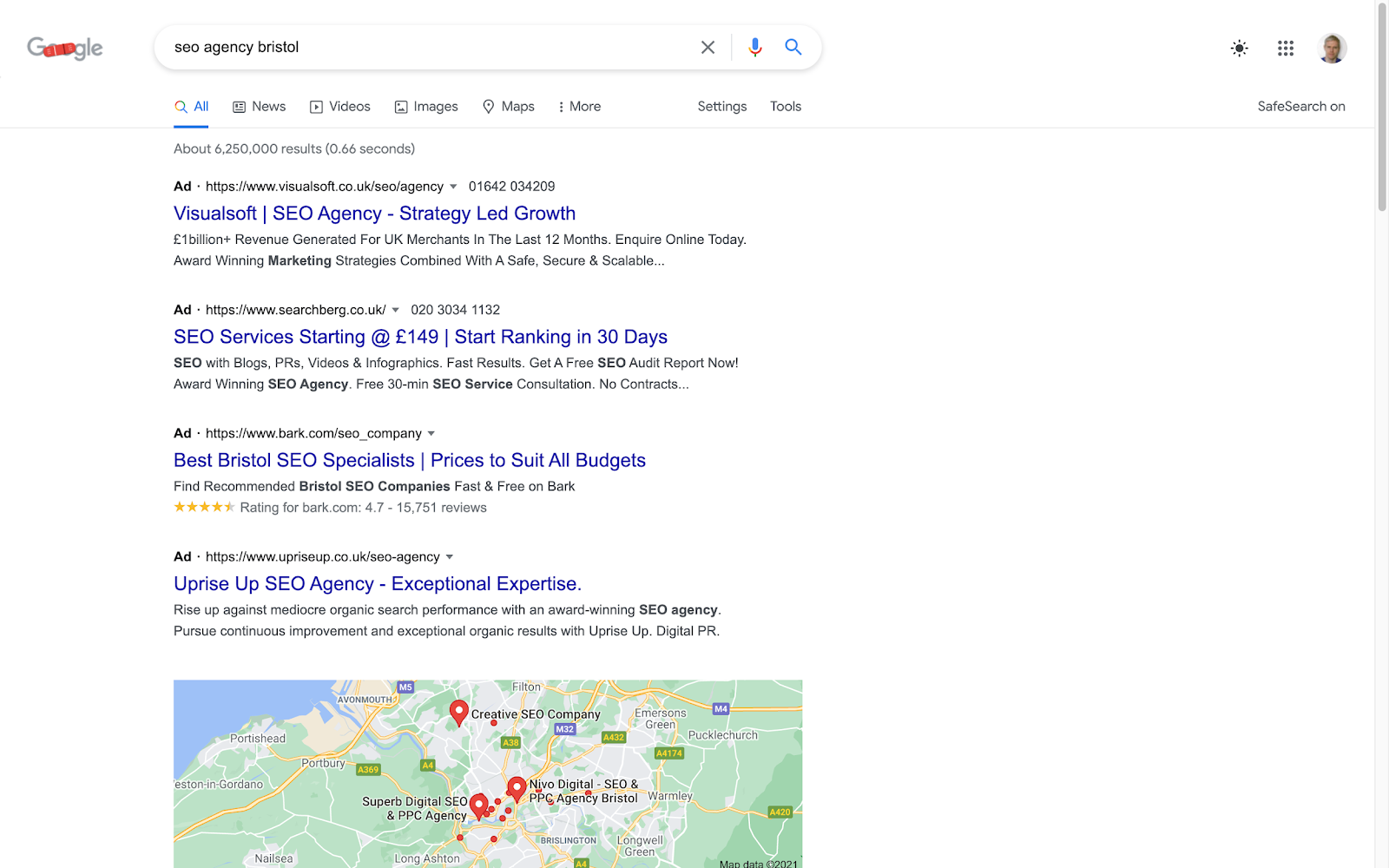
A good example is, if you search something close to our heart…. ‘SEO agency Bristol’. As you will see the paid Ads take up your whole screen when you initially search and you have to actively scroll down to get to the first organic search results. Given that 75% of people don’t scroll past page 1, those Adverts can really take up people’s attention and clicks.
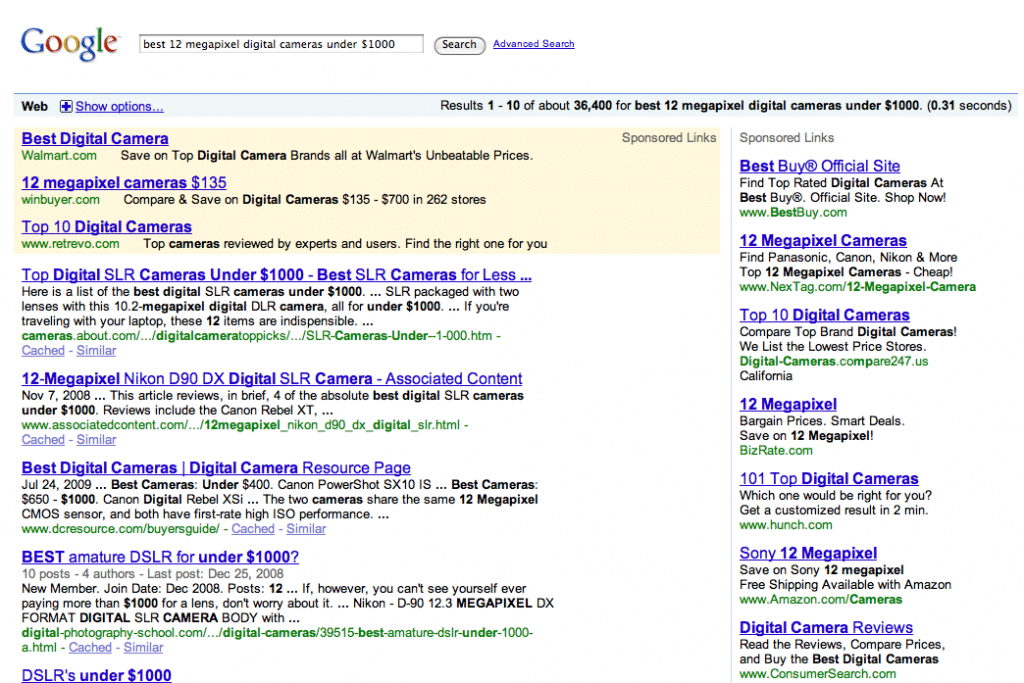
When we compare that back to 2009, these were the sorts of results you would see. It is really quite noticeable the the ‘Sponsored links’ are very clearly labelled.
In order to make sure your website is visible to the biggest search audience possible, it really is vital to make sure you have a search marketing strategy that embraces both SEO (organic search results) and PPC (paid search advertising).
We know from our ongoing research that the majority of the search market will not even recognise the Ad, and we can see from the examples of how Advert styling has evolved over time, why that has remained high. However, we know that we can’t ignore the large proportion of a target market who do know an Ad when they see one, especially as almost 80% of these searchers will then decide not to click. Therefore, it is critical to execute both SEO and PPC in the most optimal way possible, to ensure you are not missing out on potential clients.
Data suggests that approximately 53% of all website traffic comes from organic search and 27% from paid media,so it really is a sensible idea to not put all your eggs in one search basket. Neither organic nor paid search is inherently superior to each other and whilst paid ads do have a cost, you should be trying and testing both paid search and SEO, (with organic search optimisation, you’ll have to test for at least six months). By testing, reiterating and learning from both paid media and SEO, you can see what works for you and your business, short and long term, ensuring you capture all the possible clicks out there.
Given our latest research findings combined with the need to have a strategy that ensures you speak to the widest possible target search audience we have a clear recommendation. The best way to optimise reach and drive rankings and clicks, is to adopt both SEO and PPC strategies and tactics and to ensure you carefully plan and structure both for optimal results.
And Google seems to agree so we will leave the last word to them…
“Using SEO and Google Ads together may give you the best chance of bringing traffic to your site in the short term, and enhancing your business’s presence online for long-term success.”
Get in touch here to find out more about how to perfect your own hybrid model of optimised organic SEO combined with paid search media.
Flourish Lead Developer, Hussein Alhammad, is a founding member of the Email Markup Consortium (EMC). The EMC is a community-led group working to improve the user experience, accessibility, performance, consistency, and reliability of email markup. They have recently published an insightful report on the state of accessibility in HTML emails based on their analysis of over 35,000 emails.
More than 99% of the analysed emails had accessibility issues. This means most businesses are sending emails that are made difficult for a percentage of their audience to consume. Whether you are trying to increase conversion or simply communicate better with your customers, sending accessible HTML emails to your audience can make a huge difference.
Accessibility in email makes your products and services available to customers who are blind, colour blind, dyslexic or need to use assistive technologies or alternative input device – potentially a large proportion of your customer base.
Automated testing is immensely helpful, but more attention is required to truly produce accessible HTML emails. Accessibility work should be a core part of all stages – not only implemented during development, after everything has been decided already.
For example, design has a major impact on the accessibility of your email. Designers should consider colour choices and typography, as well as the dark mode friendly images.
There are also best practices to apply when writing copy for your emails, such as avoiding ‘click here’ calls to action, optimising SEO for email, and making the most of personalisation and creative subject lines.
Your unique audience could be more diverse than you think. Therefore, translation software can be considered an assistive technology. And when it comes to email, many email clients including Gmail and Outlook have a built-in translation feature. Ensuring any text that is critical to delivering your message is not embedded in an image is crucial here. Translation software is not going to translate embedded text for the user. You could make key information inaccessible by embedding it in an image.
Do you need help with improving your email accessibility, deliverability or generally your CRM practices when it comes to communicating with your audience? The Flourish team are here to help. Working alongside our in-house experts like Hussein, we can help you optimise, elevate and transform your use of email to deliver the best customer experience. Get in touch to discuss your challenges and to request a free email review.
Having a strong organisational structure in place is key to growing your digital agency.
Whether your agency is brand new or has 100 employees, the structure of the team is going to have a direct impact on your overall efficiency, culture, client satisfaction, and scalability. Without a considered organisational structure in place, many agencies suffer from poor communication and frustrated team members and clients.
So, what are your options when it comes to structuring or restructuring your agency? How do you know which structure is going to guarantee both employee and customer satisfaction and give you the permission to scale your marketing agency?
Get more brilliant advice from Janusz at the 12-month Mastermind group for agency leaders. Gain momentum, resolve and focus to achieve your goals, with the support, accountability and insight of GYDA experts and like-minded peers. Find out more.
1-Flat
A flat team structure is common in smaller agencies and start-ups. Flat structures have only a couple levels, if any at all, between management and employees. These organisations tend to require employees to ‘wear many hats’ and as such, often produce a lot of generalists but no specialists.
2-Functional
Then we have functional structures — in which teams are organised by services. For example, a digital agency with a functional structure could have a Social Team, an Email Team and a PPC Team, and so on.
A functional structure concentrates the expertise and knowledge within those services or groups. As such, this structure often falls down when the client requires more than one service from the agency, forcing disjointed communication between the executives in each team.
As the agency grows, communication and coordination between these teams is only more and more convoluted and scaling becomes very clunky and difficult.
3-Matrix
A matrix structure is similar to a functional one, with added levels of management and communication weaved into the mix, hence matrix.
This structure involves side-ways communication between team members, like account managers who coordinate other functions. Like the functional structure, the matrix is limited to a team of a certain size, as this web of communication is difficult to scale.
4-Holacracy
Holacracy organisational structure is where there are no clearly assigned roles. Employees are given the flexibility to take on any duty or role and move between teams freely. A holacracy can work well within some industries, but broadly speaking, this structure is a poor fit for all digital agencies as having expertise and specialism within your personnel is essential.
5-Pods
A pod organisational structure is where an agency arranges their teams by client type or sector, rather than the agency function or service.
This creates specialist teams, which function similarly to sports teams. For example, each ‘Pod’ would have a PPC expert, an SEO specialist, and a Social Media manager and this pod would service a particular category or type of clients, such as Automotive Clients or the Legal Sector.
Watch: A detailed look at Functional Structures Vs Pods (4min)
Utilisng a pod structure allows you to lean into your niche and achieve a deeper level of industry or sector specialism from each pod.
Pod structures also have no dependencies on other teams within the agency, thus there is no web of complex internal communication. This creates friction-free workflows within your teams and an enriched experience for your clients at the other end.
Finally, a pod structure creates accountability and responsibility among your team members. As employees are being regularly challenged by exciting projects within their specialism, they are likely to have increased job satisfaction levels.
At Digital Agency Coach, we advocate running weekly or bi-weekly workshops for all specialist executives, hosted by a technical lead. Keep the agency focused on strategy, process improvement and professional development and create a conversation the other experts from each pod.
Regularly hosting these casual, friendly and engaging workshops with employees of the same skill set promotes an easy and productive conversation with relevant learning and take-homes for each employee.
There’s no denying restructuring your digital agency can be a disruptive process in the early days and it probably won’t happen overnight. But once the hard groundwork is done, growing and scaling your agency can simply be a matter of copy and pasting a new pod.
This team structure eliminates the complex web of communication just as effectively as if you have a team of 30 or a team of 300 people.
If you are a full-service agency and your clients are purchasing multiple products or services from you, perhaps it’s time to reconsider your organisational structure.
Watch Our Quick Functional Structures vs Pods Explainer Video (4min)
If you feel you’d like any help or guidance with restructuring your agency, get in touch with Digital Agency Coach to arrange a consultation, we’d be delighted to help.
Get more brilliant advice from Janusz at the 12-month Mastermind group for agency leaders. Gain momentum, resolve and focus to achieve your goals, with the support, accountability and insight of GYDA experts and like-minded peers. Find out more.
The National Governance Association (NGA) has announced the appointment of Bristol based Mentor Digital as its digital agency partner for a series of upcoming high profile digital projects. Following a highly competitive and extensive procurement process, led by technical procurement experts Hart Square, Mentor Digital was chosen as the winning bidder to deliver a new website, CMS solution, and CRM integration for NGA. Alongside the UX and website build project, Mentor Digital has also been selected by NGA in a separate tender process to deliver a full rebrand of the organisation including a new logo, style guide, and branding guidelines document. These projects will help NGA to deliver their ambitious digital strategy and will develop a solid foundation both creatively and technically for NGA & Mentor Digital to build upon in partnership over the coming years.
The National Governance Association (NGA) is the membership organisation for governors, trustees and clerks of state schools in England. Mentor Digital will design and develop a new CMS and website to support NGA’s 75,000 members. The project will include brand new information architecture and website design, along with new UX and user journeys to provide an excellent experience for members as they are onboarded, renew their memberships, and take advantage of the many excellent services that NGA provides.
Mentor Digital’s MD Holland Risley said “We are absolutely delighted to have been chosen by NGA for this project. The whole team has been great to work with during the procurement process, and we are really excited to be adding such a prestigious membership organisation to our client portfolio!”
NGA provides members with CPD and training opportunities along with an extensive e-learning offering through their highly popular Learning Link subscriptions. During the tender process NGA was impressed by Mentor Digital’s award-winning e-learning work for the National Composite’s centre. Integrating e-learning platforms is a large and exciting part of this project, and Mentor Digital presented a strong ability to deliver solutions to NGA’s challenging requirements.
As with all major membership organisations NGA has a CRM (Customer Relationship Management) system that needs to be seamlessly integrated with the new website. Mentor Digital’s team is highly experienced at integrating 3rd party CRM systems with front end websites and have many high-profile case studies of doing very similar projects with major membership organisations, including Royal Town Planning Institute (RTPI), National Deaf Children’s Society (NDCS), Equity (the artists union), and Research in Practice.
To develop a website of this scale requires an in-depth process of stakeholder engagement, user research, design, and prototyping. Mentor Digital will lead an extensive series of discovery workshops with NGA and their members before producing fully mobile responsive prototypes as part of the project process to allow for the new website to be fully user tested using mobile devices and desktops. Mentor’s UX testing team carries out mobile device guerrilla testing with specialist cameras for mobile devices and desktop UX testing, with their eye tracking suite, to ensure that all interfaces and journeys are intuitive and clear when used by real world users.
The websites will be developed using the excellent open-source Umbraco CMS platform, which provides highly secure, enterprise level, content management experiences with no ongoing licenses. Mentor Digital is an Umbraco Gold Partner and has implemented Umbraco CMS for many NHS Trusts and CCGs along with a wide range of B2B and B2C clients.
If your organisation is looking for a digital agency to work on a new or existing project, please get in touch with Mentor Digital, they would love to hear about your plans and how they can help you achieve them. You can fill out a contact form here or drop them an email to [email protected].
To see more examples of the work Mentor Digital produces you can visit the ‘work’ area of their website here.
In this piece, we help you avoid common process pitfalls so you can become a lean, mean, agency machine. Because refining your agency’s processes will drive efficiency, build your agency’s value and boost profits, but having efficient processes isn’t enough, they need to be documented and followed religiously by all employees.
Project planning is everything, below we highlight two common reasons project planning fails:
You can’t produce an accurate figure on how long a project will take if you’re not clear on what you’re delivering. It’s crucial that you ask clients the right questions to deeply understand what’s being asked of you. Then this needs to be mutually agreed, documented, and signed off by client and agency stakeholders. Documenting this project sign-off process is crucial to significantly reduce the risk of scope creep.
There are several reasons this can happen, we wrote a whole piece about improving your agency’s estimating but the two most common reasons are:
Please note, the time it takes to deliver a project doesn’t change, according to how much you charge for it, delivery timescales are what they are! So you need a rock-solid process around how your agency produces estimates, and how you record it when you’ve deliberately reduced an estimate.
Above we discuss not understanding the scope of a project, but of course the scope can be understood but not clearly communicated.
Using your approved scope document as the basis for the brief to the teams delivering the work should reduce the risk of confusion, and again having this ‘scope to brief’ process documented will ensure it happens on every project.
Following this clear process will save you time as confusion over what needs to be delivered will inevitably mean more amends or repeating entire tasks.
Sometimes it’s not that you can’t see how many hours have been used vs budget, or when the project needs to be completed by. It’s simply that these metrics haven’t been set. This creates the prefect opportunity for timescales and budgets to run wild.
If you do all the above then you’re starting your projects on great footing but you’re not out the woods yet, the above doesn’t automatically mean that your project will be delivered on time and to budget. Now we will look at some common process shortcomings when it comes to project delivery.
You may feel that in your agency’s structure, it’s obvious who runs the projects. But roles change and people come and go so you can’t assume that this will always be clear to everyone. Plus, it might change project-to-project. On a larger project it may always be an Account Manager, but on a smaller project maybe the Project Manager can do it?
Someone needs to formally own the project, and they’re ultimately responsible for tracking progress against budget and timescales. Who this is and how they do this, should be formally agreed in a process. Are budgets to be checked every week, or when a monetary or delivery budget is met? Recording all this as part of a process means it’s more likely to get done.
You also need to consider how someone will get this information. You can’t relay on the data if everybody has a different process for working out these metrics. But if you’re using an agency management system to track this then you can be confident that your data is correct.
Sometimes when a project starts to run over, the person responsible for monitoring this simply sticks their head in the sand. This is dangerous because a project that may have run 5% over, could spiral into a 15% overrun. Your processes need to involve continual monitoring of work so no matter where the project is at, the progress is still monitored.
Documenting your processes and having an agency culture where they must be followed will help you sleep easy that everyone is doing the right thing. Far from being more red tape, these processes will ultimately save you time and ensure projects are delivered on-time and to budget.
You can learn more about how the right Agency management system can support your solid agency processes and help you on your journey to becoming a lean, mean, agency machine on the Synergist website.
Our creative and digital industries are facing a critical shortage of developer skills right now, particularly when it comes to Web3 developers, with Web3 developers only representing 1% of worldwide devs. Yet there’s so much potential for positive, disruptive change. Collectively we need to up-skill our teams to realise that huge potential.
But WTF is Web3 and why should we care?
Simpleweb is hosting a month-long virtual festival throughout October to help to demystify Web3 and see past the nonsense. The goal is to onboard the next generation of Web3 talent across the UK. Similar to a hackathon format, they’ll be helping agencies, developers and UX teams learn the fundamentals and begin their Web3 journey, using a range of Web3 tools and best choice blockchains.
Participants will learn about Web3 and its benefits to help build expertise and extend product & service offerings, and agencies can enter individuals or teams who will be able to work together and bring their collective knowledge back to share with others. They’ll also receive an NFT certificate of completion, as well as get the chance to win a number of prizes across different categories. It’s free to join, and could contribute to agencies’ CPD efforts as well as innovation endeavours.
Another opportunity for us to pull together to put Bristol on the map, supporting our creative and tech talent and building an even stronger community. Why wouldn’t you?
https://www.meetup.com/simpleweb/events/287735158/
– Flourish becomes Harbour Collective’s dedicated CRM specialist agency
– With a heritage in direct marketing, Flourish has helped brands like Samsung, Twitch, Coca-Cola and Nissan to revolutionise their approach to customer communications
LONDON, 5th September 2022 – Brand communication consultancy Harbour has today announced the addition of CRM agency Flourish to Harbour Collective, its collective of 12 specialist independent agencies and 500+ experts.
Flourish will now become the collective’s dedicated CRM specialist agency.
Headquartered in Bristol and with teams in London and Dubai, Flourish was founded in 2004. With a heritage in direct marketing, the CRM specialist agency has helped brands like Samsung, Twitch, Coca-Cola, Nissan and Crisis to revolutionise their approach to customer communications.
Harbour Collective’s group of independent agencies work together on multiple shared clients to combine skillsets across data and insight, media, content creation, engagement, experience, and delivery.
Ian Reeves, Managing Director, Flourish, said: “We’re genuinely delighted to join Harbour Collective as the group’s CRM specialist agency. Traditionally Flourish and our client partners have been brave and ambitious, and we believe joining Harbour Collective is a reflection of this. As part of a collective we can extend our offering of genuine sector expertise, stand apart from network and integrated agencies and open up a world of further complementary possibilities.
“Meeting with the Harbour team, it was immediately obvious that we speak the same language, prioritising the impactful and the pragmatic. We know our clients will instantly be able to benefit from being part of the wider group and we look forward to supporting existing Harbour Collective clients in enhancing their CRM strategies, capabilities and programmes.”
Paul Hammersley, Managing Partner, Harbour, added: “The understanding and management of customer journeys and experience are key parts of today’s marketing plans, so it’s essential that we have this capability at the heart of our offering. Flourish are one of the best independent agencies in this space, with an impressive leadership team, a strong client base and an excellent skillset across strategy, creative and media, making them the ideal CRM partner for Harbour Collective.”
About Harbour
Harbour is an independent brand communication consultancy that sits at the heart of a collective of specialist agencies. It was launched in 2017 by Paul Hammersley (Managing Partner) who was joined by Mick Mahoney (Creative Partner) and Kev Chesters (Strategy Partner) in 2019. Its unique structure and client offering are designed as a contemporary alternative to the large legacy agency groups. Clients include McCarthy Stone, Tilney Smith & Williamson, The Athletic, BT, Match.com, Fitbit and John Lewis.
https://harbour.london
About Flourish
Flourish is a specialist CRM Agency, focused on the development and delivery of data-driven and creative communications and content in the B2C, B2B, B2G and NFP sectors. Based in Bristol, UK, the business opened its doors in March 2004. Since then, Flourish has extended its footprint with teams in both London and Dubai to support regional economic growth and a Global client portfolio.
With a heritage in Direct Marketing, Flourish has sector-leading CRM expertise, focusing on driving action at every stage in the Customer Journey, whilst acknowledging individual customers’ needs and circumstances. Flourish has helped brands like Samsung, Twitch, Coca-Cola, Nissan and Crisis revolutionise their approach to customer communications and, in-turn, maximise lifetime value through a blend of data, technical and activation solutions across a range of audiences, channels and touchpoints.
If you’d like to discuss how Flourish could help your business maximise the value of your customer audience then reach out to Ian Reeves via email on [email protected]
How should an organisation launch a new or revamped brand? Brand launches should reflect the character and personality of the brand. They are often informed by the client and their desire and appetite for a more ritualised and expansive introduction. Two revamped brand identities we have been working on for several months will be launched in the next few weeks. Due to their shape and personal involved their launch will be subtly different. Both appropriate and both reflecting the type of organisation and personal involved.
A new brand identity is a huge opportunity to explain the new trajectory the organisation is heading, reinforce what is stands for, believes in and articulate what is important to it. Often the perception of focus for a brand launch is external. Just as important is is the internal brand launch. After all, these are the people who will represent and espouse and the brand. They are the ones who need to be totally clear what the brand stands for in order for them to live it well.
The external brand launch often will involve both digital and traditional media. If my involve PR consultants, media relations and sometimes sophisticated multimedia events coordination. Brand launch is a unique opportunity for organisations to manage their brand messaging in a controlled way before it begins swirling around in very wide circles.
In some cases clients are keen to have less razzamatazz– or soft launches – for a number or reasons. Budget is a big one. A full rebranding exercise can be expensive, not necessarily in brand consultants’ fees but in the cost of producing literature, signage, vehicle graphics, websites etc. – all in one hit. Regularly we have worked in a way that phases out the old system. . This is when existing stocks, containing the old identity are run down. New items with the new identity are created once the old ones have been used saving waste.This way a rebranding exercises can sometimes be achieved using existing budgets without the neccisity for a single one off investment.
If you would like to discuss how Ice House Design can help you with launching your brand please get in touch.
We’re pleased to officially welcome Joanna Penn, Managing Director, to the Armadillo board of directors. Our board is the backbone of our business, overseeing all strategic and operational decisions as well as ensuring the company meets its statutory obligations.
Joanna was promoted to Managing Director in 2022, to lead the day-to-day management of the agency, ensuring excellence as we grow and scale. She excels at nurturing a high-performing, motivated team, leading from the front in delivering the best work for all Armadillo clients. She continues to push the boundaries of CRM helping our clients use data to change behaviour to drive ROI for their iconic brands.
She joins James Ray, CEO, who spearheads the agency’s growth and development. With Joanna at the helm of operations, James focuses on strategies to continue Armadillo’s momentum. His expert knowledge and drive have been the force behind Armadillo’s evolution into one of the UK’s most successful independent CRM specialist. James is also City Head for Bristol, Cardiff and the South West for the Institute of Practitioners in Advertising (the IPA).
Chairman Chris Thurling and CFO Andy Brown complete our executive board. Andy and Chris have both recently been awarded Chartered Director status; with fewer than 2,000 Chartered Directors worldwide, the qualification demonstrates their commitment to investing in continual development, as well as the business’s dedication to corporate and social governance.
Chris Thurling is also Chair of Bristol Creative Industries and, having founded one of the UK’s first digital design agencies in 1995, has maintained a keen interest in the intersection between marketing and technology throughout his career bringing a unique perspective to the board.
Andy Brown equally offers an invaluable view due to his position as CFO not only at Armadillo but two other agencies, empowering him with significant experience as a finance Director in Marketing and Technology businesses.
We are very lucky to have Ann Hiatt as our Non Executive Director. Ann is former Executive Business Partner to Google CEO, Eric Schmidt and ex-EA to Amazon CEO, Jeff Bezos having worked in Silicon Valley for 17 years. She works alongside the board on strategy, growth and leadership development for maximum impact, and is particularly focused on finding the best ways to apply the lessons she’s learned about innovation and creativity to Armadillo.
As board members, the team is focussed on serving Armadillo, supporting sustainable, long-term growth. It aims to provide strong leadership, governance and strategy, and enhance Armadillo’s effectiveness.
With a team of over 70 people, Armadillo blends data, insight, and strategy with talent, personality, and craft to deliver unrivalled results for global brands, including McDonald’s, Disney and Carnival UK. Effective work is also award-winning work, and we were pleased to pick up five DMA Awards at the end of 2021, including a gold and two silvers.
You need to load content from reCAPTCHA to submit the form. Please note that doing so will share data with third-party providers.
More Information