A deep dive into the UK branding and marketing market from the perspective of independent agencies
(link to full article including interactive heatmap)
Clide Research | February 2026 | getclide.com
When an agency achieves the remarkable feat of 7-digit revenue, the owners (and their teams) are often not content with continuing as a lifestyle business and want to grow further into 8-digit.
A larger agency is not just about more revenue; domain authority does deliver premium pricing (30+%) and better profit margin (5+%).
This is rarely achievable by “doing more of the same”, especially in a market dominated by large global networks at the top. Most agencies try a lot of ideas, which brings the challenge — there are often more ideas than the resources available.
We studied the growth paths of hundreds of UK agencies to analyse what propelled them to 50-100+ people organically, not to offer a playbook, but to illuminate the proven paths and help agency owners anchor their thinking.
The analysis revealed intriguing patterns:
We identified 4 structural changes that independent agencies could seize next 1-3 years, driven by AI adoption and key regulatory changes.
The report concludes with a high-level framework for agency owners to identify the 2-3 strategic bets that best suit them, and how to narrow down to a winning bet.
Getting an agency to seven figures is genuinely hard. Most new agencies never manage it. You survived the project feast-and-famine of the early years, built a team you trust, developed a body of work you are proud of, and found enough clients who value what you do to sustain something real.
The success also means your team no longer just show up to do a job, they gather because of your vision, and what it could mean for their futures. The anticipation for further growth is strong.
You have no shortage of idea. That creative, entrepreneurial instinct is precisely what built the business. It generates hypotheses constantly: a new sector to target, a new service to offer, a new positioning to test, a new market to enter.
The problem is not the ideas. It is the fact that you cannot try everything.
When many ideas are pursued, experiments multiply. The team follows each new direction with diminishing energy. The founding partners become stretched across too many fronts.
This is a familiar pattern at the seven-figure level, and it is not a failure of ambition or effort. It is the natural consequence of a business growing beyond its original design.
Large company chief executives solve this differently. They also face resource constraints and uncertainty, and they invest efforts into identifying a small number of strategic bets that suit their organisations. It’s followed by clear evaluation and aggressive narrow down based on evidence. This approach feels like a luxury when you are building from zero. When you are running a team of twenty or thirty people, it starts to become a necessity.
That is what this article is designed to support. It does not offer simplistic playbooks. It offers a structured view of the UK market from the independent agency perspective, and draws from hundreds of case studies to illuminate the proven paths.
The goal is to help you build conviction from evidence — and then commit to it.
KEY INSIGHT The UK agency fee pool is £8-12bn, but is dominated by large global networks. However, enterprise buyers increasingly prefer best-of-breed capabilities, providing opportunity for well-positioned independents to capitalise.
The UK advertising and marketing market generated £42.6 billion in total spend in 2024, according to the AA/WARC Expenditure Report, and is expected to grow by c.10% per year.
But much of this number is not relevant for independent agencies.
75-80% of this is media spend: the cost of buying airtime, ad space and search/social placement. That money flows through agencies in many cases, but it does not represent fees earned for thinking, creating, or advising. The actual fee pool for branding and marketing services is estimated in the region of £8 to £12 billion.¹
Within this fee pool, the global networks like Omnicom/Interpublic, WPP, Publicis, Havas and Dentsu dominate, by holding the agent-of-record relationships with the largest spenders.
That said, independent agencies have consistently carved out a corner — the top 50 UK independent agencies generated £2.23 billion in the most recent survey year.³ Opportunities usually come from two sources.
Enterprise customers increasingly prefer best-of-breed capabilities on specific areas (e.g. product launches, customer communication, etc.). This opens a wide spectrum to attack for agencies with unique creative philosophy, deep audience understanding or channel expertise.
Most established independent agencies built their businesses in this space and there is a continuous supply of opportunities for up-and-coming agencies. To name a few recent examples:
In each case, the independent agencies provided specialist depth that the networks could not match on that specific brief.
Global networks don’t tend to pitch for customers with <£500k annual fees, constrained by the overhead costs in their business models. This floor is likely increasing due to persistent cost inflation.
This market is collectively large, but the challenge is finding consistent spend streams. The companies in this segment are typically smaller and do not spend consistently on brand strategy and creatives. However, some sectors do reliably spend on communication (e.g. financial services) and downstream marketing services (most B2C sectors).
KEY INSIGHT Financially, scaled agencies are not just bigger versions of smaller agencies. They earn more per person, hold structurally better margins, and have materially more options — including the choice of whether to remain independent.
The 2025 Moore Kingston Smith Annual Survey of UK Marketing Services Companies reveals a clear and consistent gap between group-owned agencies — those within network or PE structures — and independent agencies.
Fee income per head averaged £130,072 at group-owned agencies against £100,926 at independent agencies.³ That is a 29% premium in revenue productivity. At the size where this gap opens up, it is not a marginal difference — it is the difference between a business that generates surplus capital and one that does not.
The margin picture tells a similar story. High-performing agencies — defined as top-quartile for both revenue growth and operating profit — achieved a margin threshold of 18.2%. The industry average operating profit margin was 10.2%.³
These numbers are not benchmarks to aspire toward vaguely. They are a description of what a different business model — one built on specialist positioning, recurring client relationships, and pricing power derived from genuine expertise — actually produces financially.
The mechanism is compounding rather than linear. Specialist positioning commands higher fees. Higher fees fund better hires. Better hires deepen the expertise that justified the premium. Deeper expertise attracts stronger clients, who tend to extend relationships and commission broader scopes of work. Broader scopes generate recurring revenue. Recurring revenue produces more consistent margins.
Each element of that sequence reinforces the next. The agencies that broke through to 100 people did not do so by doing more of what they were already doing. They did so by reaching a position where the compounding effect kicked in — where sector or audience depth was deep enough to justify premium pricing, and premium pricing was sufficient to fund the next hire that deepened the moat further.
KEY INSIGHT Most combinations of sector and specialism could not support an independent agency reaching 100 people. A small number of combinations have consistent examples. The shape of that pattern is not random — it reflects where client spending is large enough, repeatable enough, and specialist enough to support scale.
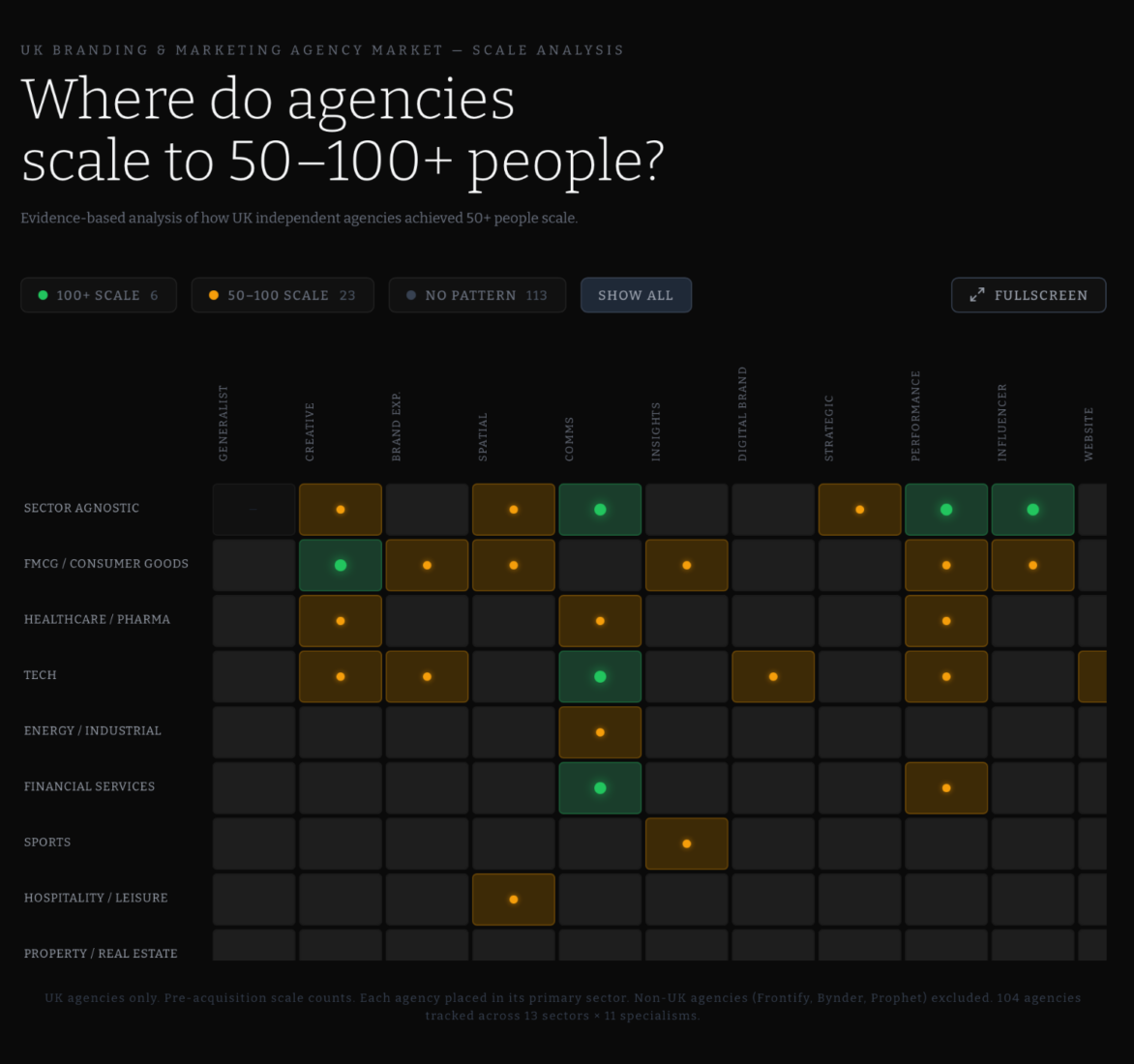
We studied hundreds of UK agencies and mapped the growth path of 100+ that achieved 50+ people in scale. The analysis focuses on what propelled each agency into scale during its independent phase. Many of these agencies have since been acquired and have expanded into multiple specialisms under network or PE ownership. What matters for this research is the positioning and model that created the foundation — not what the agency became afterwards.
We divided the market into 13 sectors and 11 disciplines. For each growth story, we asked two specific questions:
The heatmap makes the patterns visible. The majority of sector/discipline cross-sections did not consistently produce large agencies. This does not mean opportunities do not exist there — plenty of <50 people agencies built sustainable businesses. It just shows the larger market forces and client spend patterns historically did not support independent scale.
Important: the heatmap does not prescribe a formula. Every growth story has its own ingenuity and market backdrop; it’s too much to cover everything in this report, so we focus on the patterns in the results.
KEY INSIGHT The agencies that scaled all demonstrated strong discipline focus, they occupied positions where the market structure — client budget size, brief repeatability, knowledge barriers to entry — could support a large independent specialist. The breakout opportunities were often presented during significant changes in their target markets.
The heatmap shows five patterns that can be useful for agency owners’ thinking.
The agencies that reached 100 or more people consistently built around a specific positioning — a sector, a channel, a specific audience type, or a defined part of the value chain. Agencies that remained generalist rarely scaled.
This is not a coincidence. Specialist positioning does several things simultaneously: it commands higher fees than generalist alternatives; it creates genuine switching costs as the agency’s knowledge of the client’s world becomes embedded; it builds a reputation within a specific community that makes new business more efficient; and it provides a clear basis for senior hiring. Generalist agencies compete on execution and relationships. Specialist agencies compete on knowledge — and knowledge compounds in ways that execution does not.
FMCG, financial services, technology, and healthcare supported the largest number of scaled agencies. Other sectors attract significant agency activity without producing a meaningful number of agencies reaching 50 people or more.
Property, sports, education, and gaming all show this pattern. Strong creative communities exist. Talented agencies work in these sectors. But no consistent pattern of sizeable independent specialists has emerged.
They share common characteristics: client budgets are smaller or less consistent; brief types lack the volume and repeatability that supports a large team.
The heatmap makes this visible. For anyone considering a deliberate sector bet, this is important information — not a reason to dismiss the opportunity entirely, but a signal that the structural conditions may be working against you.
Looking across the last 3 decades, independent agencies have been consistently fast at capturing, and dedicating to, structural shifts in the broader economy. And such focus is frequently rewarded with scale.
In almost all of these cases, the work they delivered was already covered by existing agencies, but they brought a sharp focus that won the market over. For example:
With the exception of performance marketing, we found no visible examples of an independent UK agency reaching 100 people by focusing primarily on mid-market clients. Even startup-focused Koto has since expanded into digital-rebranding for enterprise customers.
This is a meaningful finding, because the mid-market is where many independent agencies get their early new business. Mid-market clients have smaller budgets, typically want a broader range of services than a specialist can efficiently provide, and tend to be more price-sensitive.
The agencies that scaled worked with large companies — often ones where global networks were also present on different parts of the account. The independent won a specific mandate, not the whole relationship. The brief was large enough to justify the expertise, and the client was sophisticated enough to value it.
This does not mean mid-market clients have no role. They are often where the specialism is first developed and proven. But scaling required moving up the client tier, not across it.
Brand strategy is a frequently used phrase to encapsulate the work by an agency. Intriguingly, very few agencies have reached scale by focusing on brand strategy/architecture alone (with limited/no creative), almost none in recent years.
This reflects the traditional high value segment for brand strategy (brand transformation, mergers & acquisitions driven brand consolidation, major rebrand) is increasingly taken by large global networks; yet the brand strategy spend by smaller companies is not sufficient to support an agency at scale.
There are smart angles such as Brand Finance turning brand valuation into a product (WPP has similar capabilities, but used more internally), but that’s more an exception than a pattern.
KEY INSIGHT The agencies that scaled built positions where the pricing power lived in their thinking, not their production. All three growth architectures involve execution capability — but in each case, the execution is the delivery mechanism for specialist knowledge, not the source of the value.
Across the agencies that exceeded 50 or more people independently, three distinct growth architectures emerge.
The growth paths across the architectures are similar. Deep knowledge commands premium fees. Premium fees fund specialist hiring. Specialist hiring deepens the moat. A deepened moat attracts international clients — and international clients create the natural demand for a second studio, which is typically the inflection point that changes the growth trajectory from linear to compounding.
These agencies consistently sold downstream into implementation as they scaled — packaging production, communications delivery, campaign execution — creating significant revenue volume on top of the strategic and creative fees. But their downstream offering is focused on their specialty, avoiding significant ballooning of headcount usually associated with downstream services.
An agency that builds institutional knowledge in a specific industry sector, and tangibly tailors how it approaches its specialist discipline — the clients regard it not as experienced, but as genuinely expert. The moat is the knowledge and demonstrable approach, perpetuated by a growing roster of highly relevant case studies.
The knowledge starts to live in the agency’s processes, methodologies, and people — not just in the founder. That is what makes it scalable.
This architecture is most commonly observed in creative and communications specialisms. Creative specialists focused on FMCG and consumer brands produced the most successes, for example:
Financial services communication specialists produced the second largest cohort of scaled agencies, for example:
Technology corporate communications specialists produced the third largest cluster, for example:
Healthcare and pharmaceutical is also worth a mention, supporting multiple communications specialists to above 50 people (e.g. Madano, Hanover Communications, etc.) and helped Lynx grow to 400 people.
Deeply expert in a specific audience type: consumers, investors, employees, a particular demographic or cultural community. Many scaled agencies focused further on an audience type within a sector (e.g. financial services shareholders).
The moat is built on audience insight and a methodology that’s visibly tailored for the audience. The positioning is: we know how to speak to this audience — and that understanding is proprietary, systematic, and often transferable across client sectors.
Some notable examples:
The audience-focused model is one of the most dynamic over time, heavily driven by the way people consume information and generational shift.
The sophistication of search and social channels increased in line with the rising usage by advertisers; extracting optimal performance started to require deeper channel-specific expertise.
Unlike traditional media buying, the concentration of the channels created large execution-focused agencies. It’s also one of the rare examples where mid-market clients provided growth engines given their significant and consistent performance marketing spend.
The winners are focused on data but also have knowledge about content-channel fit and deploy proprietary software to link campaign management data to the client’s systems. They usually work alongside creative firms, delivering content rather than creating it.
Scaled agencies in this model usually have high headcount (large offshore workforce to handle manual processes), some examples:
KEY INSIGHT The agencies that scaled most dramatically did not do so only through internal excellence. Their growth was typically punctuated by structural market changes that created demand for specific capabilities at the right moment. Multiple structural changes are unfolding in the UK in the next 1-2 years.
As we discussed in Section 4, seizing structural changes in the market has created a large number of scaled agencies.
Looking further back in history, this pattern holds extremely well. FMCG packaging specialists scaled on the back of globalisation. As brands expanded from domestic markets to international portfolio management in the 1990s and 2000s, the agencies that had built the deepest expertise in brand design and packaging found that the same global clients who valued their work in the UK needed it replicated in Amsterdam, New York, and Singapore. The agencies that followed their clients into new markets grew significantly larger than those that did not.
Healthcare communications specialists scaled on pharmaceutical deregulation and the global clinical trial boom of the same era. Corporate communications agencies scaled on the privatisation waves of the 1980s and 1990s, and more recently on the rise of ESG disclosure requirements that created volume demand for stakeholder and investor communications.
In each case, a structural shift in the market created conditions where a specific type of specialist expertise became substantially more valuable. Agencies already positioned in that space captured a disproportionate share of the resulting demand.
Structural changes in the UK to watch out for
Several structural changes are afoot in the UK at the moment. Below are a few that are unfolding in real time and could have systematic impacts on how companies approach branding and marketing.
UK HFSS restrictions on advertising of high-fat, salt, and sugar products — which came into force on 5 January 2026 for TV and online channels — are creating a material change in where major food and drink brands allocate their marketing budgets.¹⁴
A few reaction patterns are emerging:
Industries experiencing rapid AI-driven disruption — software, professional services, financial services, education — are under significant pressure to articulate their value proposition in a world where their investors expect their core offering to be impacted by AI. The brands that navigate this well need genuine strategic depth: the ability to reframe positioning, rebuild messaging architecture, and communicate clearly through a period of structural uncertainty.
This creates demand for strong communication capabilities and the ability to deal with the urgency of the situation (a broad spectrum of companies have suffered 20+% share price decline in the first two months of 2026). The window in which a brand can define its position in an AI-disrupted landscape is not indefinite — the categories are moving fast, and early positioning decisions will be difficult to revise.
AI chatbots have taken a visible chunk out of search activities, and the trend is likely to increase with the chatbot builders rapidly rolling out new use cases (e.g. shopping, travel planning, etc.).
This changes the way consumers access information, which will likely impact how brands communicate with them effectively:
Marketing and customer services are the first two areas that saw mass AI adoption. While this brings efficiency and gives customers a faster experience, the de-personalisation and the repetitive “AI tone” are also drawing customer resentment.
As AI adoption grows further, brands will most likely start to respond and seek to bring on-brand tones and communication approaches to their AI agents.
Multiple startups recently backed by Y Combinator are already focusing on delivering on-brand and personalised experiences via AI agent, indicating growing awareness of the issue. And Definition already lists a service that helps to tune their client’s AI agent.
KEY INSIGHT Most agency founders know what they believe they are best at, but market forces and competition could mean the commercial results look different. A commercially honest audit is the crucial foundation for strategic planning.
The market map and the three growth architectures are useful frames. But the actual paths have to be built from your own data. You have intuition about what you are good at, but that should be checked against what your business has won, charged and retained, and profited to clarify your genuine competitive advantages.
A structured way to surface that signal is to review the last three years of work through four lenses simultaneously.
Fee rates and margins by sector and service type. Where has pricing been strongest? Where have write-offs been lowest? The data almost always reveals concentrations the team has not consciously registered. If you have consistently charged more for a specific type of brief than any other, that is worth understanding.
Client lifetime value by segment. Which engagements led to extended relationships, expanded scopes, and referrals? Long-tenure clients are not just commercially valuable — they are evidence that the agency is delivering something the client cannot easily replace.
Close rate by brief type. Where does the agency win most consistently? High close rates in a specific category are a reliable signal of genuine competitive advantage. Low close rates in a category you are actively pursuing is a signal worth paying attention to.
Team energy. Which types of work generate genuine engagement from your best people? The alignment between what the team finds meaningful and what the market rewards well is the foundation of a durable position. Misalignment — strong commercial performance in areas the team finds draining — is a warning sign for sustainability.
The intersection of all four is where your positioning should be built. In most agencies at the seven-figure level, this intersection is considerably more specific than the agency’s current official positioning suggests.
Once you have identified your strongest intersection through the commercial audit, the next question is which paths you should bet on.
You are usually the main salesforce, and your time is limited, so it’s critical to identify 2-3 strategic bets that exemplify your strengths.
Home in on your star discipline, identify 1-2 sectors where you and your team feel strongly, and that have sufficient spend power. Create positioning ideas with your team that captures potential catalysts facing those sectors that you can address better than anyone else. This makes sure everyone is on the same page and attacks these angles at full energy.
No plan survives contact with the enemy. Adjustments will be necessary. That’s why it’s critical to have full visibility on progress in real time. When you feel the need to try a new angle, it means at least one of the existing angles should be shut down. This is critical to ensure you do not overstretch your resources and your own bandwidth.
Moat first. Scale follows.
1. AA/WARC Expenditure Report, April 2025 — UK total advertising expenditure £42.6 billion in 2024. Media spend proportion estimated by the authors. https://adassoc.org.uk/our-work/uk-advertising-records-42-6bn-spend-in-2024/
2. Omnicom Group and Interpublic Group merger announcement, December 2024; merger completed November 2025. Combined revenue figures per company disclosures. https://investors.interpublic.com/news-releases/news-release-details/omnicom-acquire-interpublic-group-create-premier-marketing-and
3. Moore Kingston Smith Annual Survey of UK Marketing Services Companies, 2025. https://mooreks.co.uk/insights/snapshot-annual-survey-on-the-financial-performance-of-marketing-services-companies-2025/
4. Historical analysis of Publicis/Saatchi and WPP/JWT merger periods; authors’ assessment.
5. Epoch Design company profile; client claims per company website. Employee count per 6sense and LinkedIn data, February 2026. https://epochdesign.com/
6. PMLiVE — Havas Lynx company profile and Campaign Healthcare Agency of the Year citations. https://pmlive.com/pmhub/havas_lynx/
7. Dentsu Aegis Network — Gyro International acquisition announcement, July 2016. https://www.dentsu.com/us/en/news-releases/dentsu-aegis-network-acquires-gyro
8. Emperor Design — company website and Companies House filings. https://emperor.works/about/ | https://find-and-update.company-information.service.gov.uk/company/03160710
9. Buttermilk — company website and Favikon employee data, February 2026; Unilever appointment per industry press, 2025. https://thinkbuttermilk.com/
10. Amplify — Brand Experience Agency of the Year 2024; financial figures per company announcement. https://weareamplify.com/
11. The Imagination Group Limited — Companies House filing, August 2024 accounts. https://find-and-update.company-information.service.gov.uk/company/02275977
12. Inflexion Private Equity — Goat Agency investment announcement, March 2021; WPP — Goat Agency acquisition by GroupM, March 2023. https://www.inflexion.com/portfolio/goat/
13. Brainlabs, Croud, and Jellyfish — company profiles and PE/acquisition announcements per company and investor disclosures. https://www.brainlabsdigital.com/ | https://www.croud.com/ | https://www.jellyfish.com/
14. ASA/CAP — HFSS advertising restrictions on less healthy food and drink, came into force 5 January 2026. https://www.asa.org.uk/news/new-rules-and-guidance-for-less-healthy-food-and-drink-advertising.html
Clide helps independent branding and marketing agency owners think through the strategic questions that will shape the next five years of their business.
getclide.com | © Clide 2026

McKinsey grade strategic advice adapted for growing agencies between 20-100 people
You need to load content from reCAPTCHA to submit the form. Please note that doing so will share data with third-party providers.
More Information