
We’ve seen how branded content evolves from campaign support into institutional infrastructure. At a certain point, what’s needed isn’t more output – it’s an engine.
There comes a point in many complex organisations when branded content stops being a marketing activity and starts becoming an operational, commercial responsibility.
The shift is gradual. Calendars fill up and channels multiply. Thought leadership, product storytelling, web content and social activity begin competing for attention. Regional teams interpret messaging in subtly different ways. Leadership asks for clearer evidence of impact. And the system begins to strain.
We’ve encountered this pattern repeatedly in global institutions and growth-focused organisations: nothing appears broken, but momentum becomes harder to sustain.
At that moment, the problem is rarely creativity or ambition. More often, it’s architecture.
Branded content has become central to reputation, growth and authority, yet it’s often still managed as a series of disconnected outputs – campaign by campaign, post by post, asset by asset. What’s missing isn’t volume, but continuity: a defined, constant engine that turns strategy into sustained, measurable narrative in market.
When branded content reaches that level of importance, it requires more than coordination. It requires a deliberate operating model behind it: a branded content engine.
Limits of the traditional approach
Most organisations respond to rising branded content demand in practical ways. They expand internal teams, commission freelancers, or engage agencies to support campaigns. Each approach can work, particularly in the short term, but none fully resolves the underlying question of operational design.
Internal hires bring proximity and brand familiarity, yet rarely encompass the full spectrum of skills required for sustained branded content leadership – editorial strategy, tone governance, digital optimisation, performance reporting and cross-channel adaptation. Freelancers offer flexibility but depend heavily on internal direction and oversight, which can create bottlenecks. Agencies often excel at campaign bursts, but episodic engagement doesn’t necessarily create institutional continuity.
Over time, this can lead to fragmentation. Tone drifts subtly between markets. Institutional knowledge resides in individuals rather than systems. Reporting becomes retrospective rather than forward-looking. The branded content function grows in importance, yet remains structurally underdeveloped.
Many marketing leaders recognise this – even if they don’t initially describe it in these terms. The challenge isn’t volume. It’s structure.
When branded content becomes infrastructure
As organisations mature, branded content stops being simply supportive. It becomes infrastructural. At that point, the question shifts from “Who can produce this?” to “How is this function designed to operate over time?”
Treating branded content as infrastructure means building a system rather than assembling outputs. It involves defined workflows, clear roles and accountable leadership. It calls for integration between editorial thinking, design execution, digital performance and governance requirements. It also requires financial visibility, predictable delivery rhythms and continuous optimisation.
In our experience supporting large-scale branded content programmes – from multi-market institutions to global campaign partners – the difference is rarely the idea. It’s the engine behind it.
In this context, branded content is no longer an occasional marketing initiative; it’s an ongoing organisational capability. Thought leadership programmes, executive commentary, website ecosystems, social storytelling and campaign narratives need to align under a coherent operating model. Without that model, even the strongest strategy risks dilution through inconsistent execution.
We’re also seeing this shift in organisations moving from service-based models into self-serve or SaaS products. Launch strategy is only the beginning; sustained growth depends on a consistent branded content engine that educates, reassures and converts over time.
Importantly, this doesn’t mean adding layers of bureaucracy. A well-designed structure doesn’t slow creativity; it supports it. When briefing processes are clear, approval pathways are agreed, and optimisation and reporting are embedded into the workflow, teams can focus on insight and storytelling rather than navigating friction.
Recognising the structural signals
Not every organisation requires a fully embedded branded content division. However, there are clear signals that a more deliberate model may be needed.
This moment often arrives when content demand becomes continuous rather than cyclical; when multiple markets need alignment around a shared narrative; when leadership expects performance data alongside brand storytelling; when procurement and finance require greater transparency around investment; and when internal teams find themselves managing coordination more than strategy.
These signals point to a structural reality: branded content has grown in strategic importance, but the operating model behind it hasn’t always evolved at the same pace.
Once that gap becomes visible, the solution isn’t simply to produce more material. It’s to design the system that sustains it.
Building the operating model behind branded content
A structured branded content function integrates several disciplines within a unified framework. Editorial leadership ensures narrative coherence and tone consistency. Design and digital expertise translate ideas into engaging, multi-channel formats. Optimisation and analytics provide visibility over performance and audience behaviour. Governance processes align the function with procurement, compliance and reporting structures.
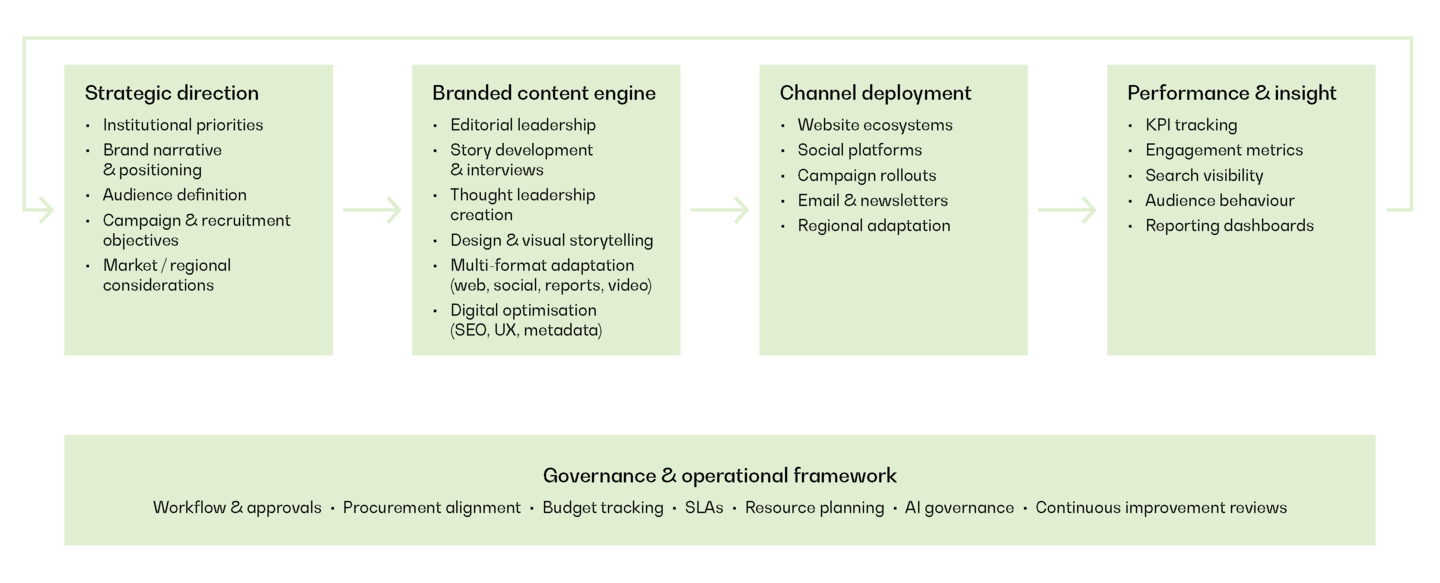
Rather than treating each campaign or article as a standalone project, this model establishes continuity. Planning becomes strategic rather than reactive. Reporting becomes a regular, forward-looking discipline rather than an afterthought. Institutional memory accumulates and strengthens the organisation’s voice over time.
For Marketing Directors and CMOs, the benefit lies in predictability and clarity. Branded content activity can align directly with organisational objectives, budget visibility improves, and cross-market consistency becomes achievable without heavy-handed control. Expertise scales without permanently expanding headcount, and the organisation retains the agility to respond to emerging opportunities.
This approach also provides a stable foundation for innovation. As technologies such as generative AI and advanced analytics become more prominent, a structured operating model ensures that new tools are integrated thoughtfully, with human editorial oversight safeguarding quality and credibility.
A more deliberate future
Over the past decade, many organisations have invested heavily in brand positioning and digital platforms. Increasingly, attention is turning to the systems that sustain those investments. Strategy defines direction and platforms extend reach, but operational design determines whether branded content can deliver sustained impact.
For organisations navigating complexity – multiple stakeholders, global audiences, formal governance and high editorial demand – the conversation is evolving. The issue is no longer whether branded content matters; its strategic value is widely understood. The more pressing question is whether the structure supporting it is robust enough to match its importance.
If branded content now shapes reputation, authority and growth, it deserves the same rigour applied to any other critical function.
Because in many organisations, the real challenge isn’t content at all.
It’s structure.
If your organisation is reaching the point where branded content needs more than coordination, we’d be pleased to continue the conversation. Explore more of our work, or contact us to discuss how we can help.

We use language to empower design.
You need to load content from reCAPTCHA to submit the form. Please note that doing so will share data with third-party providers.
More Information