The Human, the Animal, and the Feminine. Beyond Binaries in Nandipha Mntambo’s Art
Abstract: This article examines Nandipha Mntambo’s pieces, ‘Umfanekiso wesibuko’ (Mirror image) and ‘Titfunti emkhatsini wetfu’ (The shadows between us) in particular, and her use of cowhide through Bhabha’s concept of Third Space Thinking. I also use Salomé’s understanding of femininity to form a deeper understanding of the female corporeal figures present in her work. Bhabha’s Third Space Thinking is a space where binaries dissolve and expand into new perceptions and draws parallels between Salomé’s description of the fluid, limitless and ineffable nature of femininity. I investigate societal beliefs surrounding female body hair through Kristeva’s understanding of abjection, being the discomfort that arises from the instability of the boundary between the internal and external. Mntambo’s work combines human/animal, masculine/feminine, self/other, and attraction/repulsion. and therefore, sits in ‘The beyond’ that Bhabha defines as the liminal space between binaries. The sculptures create a sensory and conceptual space that destabilises Western binary logic and creates a third space where the human, animal and feminine converge. This invites the viewer to engage in the transformative experience of third space thinking that could reshape how we perceive our surroundings and ourselves.
Nandipha Mntambo is a South African artist, born in Mbabane, Swaziland in 1982 (‘Nandipha Mntambo – Zeitz MOCAA’, 2017), who completed a Fine Art MA at the Michaelis School of Fine Art, University of Cape Town, in 2007 (‘NANDIPHA MNTAMBO | Biography | Everard Read London’, 7 November). Mntambo explores themes of the female body through sculpture, photography, mixed materials, and video. This essay will examine how Mntambo’s practice can be understood through Homi Bhabha’s concept of third space thinking (Kalua, 2009) and Salomé’s understanding of femininity. Within Third Space Thinking, Bhabha describes ‘the beyond’ as the liminal space where fixed binary oppositions dissolve, allowing new meanings to emerge through the interaction of conflicting elements. Mntambo allows the binaries of masculine/feminine, attraction/repulsion, life/death, and self/other to coexist and interact within
her work. This encourages the viewer to confront and contemplate the discomfort of merging these dualities.
While focusing on her pieces ‘Umfanekiso wesibuko’ (Mirror image) and ‘Titfunti emkhatsini wetfu’ (The shadows between us), I will discuss the female experience within the human, the animal and the feminine. The term ‘Human’ refers biologically to Homo sapiens and to the cultural position that conceptualises humans through exceptionalism, meaning they are separate and superior to all other entities on Earth (Holden and Fennell, 2017, pp. 19). Humans technically fall under the animal category, and so the inclusion of both terms in my title
highlights a culturally enforced separation that puts animals in the ‘other than human’ category, a distinction critiqued in philosophical discourse (Haraway, 2008). The ‘feminine’ refers to cultural and psychological associations historically attached to women. I examine these by looking at body hair and the taboo surrounding it. I will psychoanalyse the term using Lou Andreas-Salomé as my key point of reference, who suggests femininity enters the realm of creativity, embodiment and fluidity. By immersing ourselves in Mntambo’s sculptural forms and her words surrounding them, we engage with the collaboration of our perspectives and hers, thus, entering what Bhabha calls ‘the beyond’ (Simba and Davids, 2020). Her work becomes a visual manifestation of ‘the beyond’, a space of tension and transformation.
Mntambo has repeatedly expressed her dislike for being known solely as a South African artist. She points out that art made by people of colour is often assumed to be influenced by colonialism and politics (Ecclestone, 2012). This generalises people of colour’s individual experiences and groups them into a collective one. This stunts the viewer’s understanding of the artist’s work by limiting areas that the artist could be exploring. She says ‘My work was never meant to be a direct exploration of the African Female body. I just happen to be African and female and use my body in my art-making process’ (Mntambo, 2007). Therefore, while I acknowledge that her identity as an African female may be part of her work, I focus my analysis on visual cues and the conceptual framework to avoid reductionist interpretations. I also acknowledge that, as a white female, my perception of Mntambo’s work is shaped by my own positionality and cultural context. I hope that, considering Mntambo’s stance on how she wishes her work to be received, this will not limit my analysis, as I am looking beyond racial frameworks.
Figure 1.
https://dailyartfair.com/exhibition/1843/nandipha-mntambo-andrehn-schiptjenko
Mntambo, ‘Umfanekiso wesibuko’ – ‘Mirror image’ (2013)
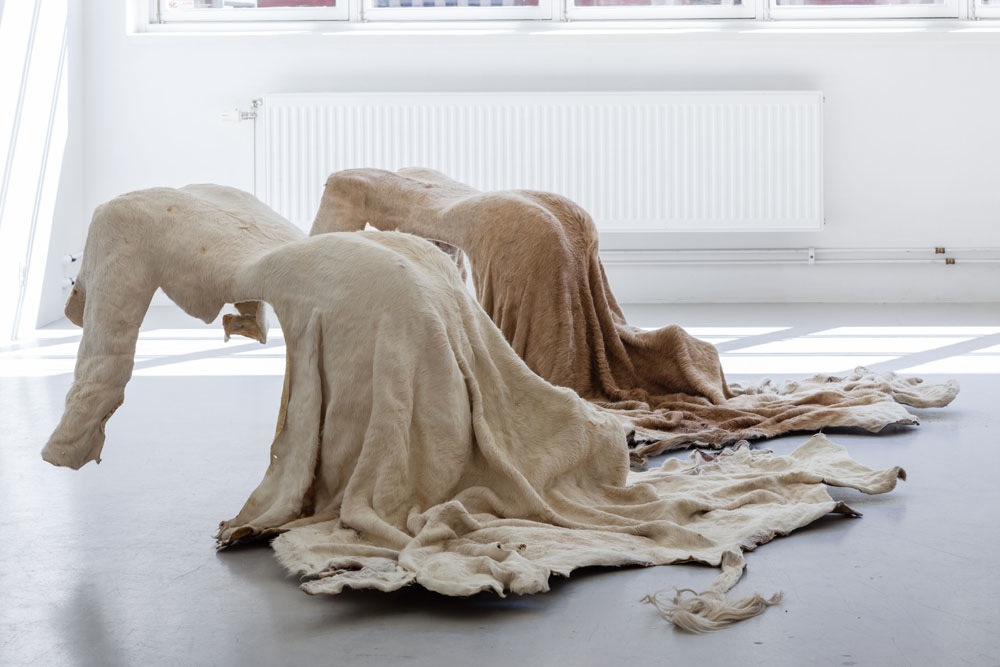
Figure 2.
https://dailyartfair.com/exhibition/1843/nandipha-mntambo-andrehn-schiptjenko
Mntambo, ‘Titfunti emkhatsini wetfu’ – ‘The shadows between us’ (2013)
Figure 3.
https://dailyartfair.com/exhibition/1843/nandipha-mntambo-andrehn-schiptjenko
Mntambo, Titfunti emkhatsini wetfu – The shadows between us (2013)
To Navigate the concept of ‘the beyond’ and how it differs from typical Western thinking, we must first acknowledge how our thinking has been shaped. Throughout Western society, because of Aristotelian philosophy, our way of thinking is based on ‘the law of identity, which states that A is A, the law of contradiction (A is not non-A), and the law of the excluded middle (A cannot be A and non-A, neither A nor non-A)’ (Fromm, 1995). In other words, ‘it is impossible for the same thing at the same time to belong and not to belong to the same thing and in the same respect’. This has been engraved in Western thinking and has become an unconscious habit to assume that saying ‘X is A and not A’ is wrong.
Positive paradoxical thinking, prevalent in Taoism (or Daoism) and Bhabha’s ‘Third Space Thinking’, states that X can be A and Non-A at the same time. In Taoism, a Chinese philosophy and religion, the world is full of overlapping opposites. Taoism is a way believed to free ourselves from the limiting structures of our thinking patterns shaped by ‘the law of identity’ as the Western language blinds us from areas that sit in the between (or ‘the beyond’. “There is a limit to what language can do, and that limit of language is paradoxical”(Tanaka 2004, 191).
Bhabha’s ‘third space thinking’ reflects these beliefs and, in doing so, rejects compartmentalised or binary constructions of cultural views. This thinking becomes political, aiming to involve opposing beliefs and systems in open and productive dialogue.
Mntambo first started using cowhide during her fourth year at the Michaelis School of Fine Art at the University of Cape Town (Ecclestone, 2012). She initially intended to study forensic pathology, so she has an interest in the corporeal, DNA, hair, and bodily fluids. She is also intrigued by how movement is illustrated in classical sculptures made from such hard materials (Moret, 2013).
The spark of her attraction towards cowhide came from a dream involving cows.
She was then trained by a taxidermist who assisted her with formulating the chemicals needed to tan and harden the skin. Before the skin is hardened, Mntambo moulds it into her desired shape. She sources the cowhide ethically from abattoirs and tanneries where the animals are already being slaughtered for consumption (‘Nandipha Mntambo: Creating mirror images of the human body | Design Indaba, 2025). She takes what is left behind and gives it another life.
In Figure 1, Mntambo has sculpted cowhide into the shape of two women on all fours. Being physically below the audience’s eye line, the figures become a symbol of submission. It is also a position associated with the inferior, the dominated, and therefore, the female (Hooks, 2014). It can also have sexual connotations.
The discussion of female sexuality is based on a language of phallomorphism (Irigaray, 1985). The vagina is an object of absence, missing the penis, or a penis turned in on itself, and its only purpose is that of pleasuring a penis. The vagina becomes the embodiment of the male gaze – a void in which men can fill with projective fantasies (Salomé, 2002), Fantasies that are often unattainable and unrealistic. In this way, the female created in a man’s thoughts does not exist. The projections they force upon us are fragments of a false reality. ‘In his attempts to understand woman, man comes only upon his own fantasies’ (Mazin, 2025). We become a prop on the stage of a man’s imaginary play. This narrative has become subconscious for most, meaning that writers, including women, use language that further pushes it into reality. Because of this, women’s desire belongs to and relies on men. This is perfectly depicted in Mntambo’s sculptures. The absence of bodily substance inside the skin of the feminine figure, in this context, represents the lack of identity and focus on eternal appearances in the male gaze. It also illustrates how women often lose a sense of identity and individuality to conform to male desires (Hernando, 2017), as Mntambo removed the internal body from the skin, ripping it from
its mind. This is emphasised by the feminine sculpture being displayed in front of an audience, in a nude and vulnerable state, only existing to be looked at.
‘Not knowing what she wants, ready for anything, asking for more, so long as he will take her as his object when he seeks his own pleasure. Thus, she will not say what she herself wants: moreover, she does not know or no longer knows what she wants’ (Irigaray, 1985).
This quote describes the diminished sense of desire shaped by the expectation of women to be passive objects without pleasure or agency. The differentiation between enjoyment and validation is blurred. Our desire is defined and manipulated by our environment before we know what desire feels like (Lina, 2025). Endless conditioning steals the joy from a sacred act of pleasure, connection and creation. Sexuality can become a means of connection with their untamed, undomesticated selves and reclaim a sense of freedom as it is rooted in a biological force shared across animal life. The all-fours position, while having sexual connotations, can also refer to animals. ‘Sex is a subset of nature. Sex is the natural in man’ (Paglia, 1990). Yet women are shamed and scrutinised for expressing their sexuality, while men are praised for it (Farvid & Braun, 2006). Have too much sex and we are sluts, and have too little and we are frigid. Wear too few clothes and we are asking for it, but wear too many and we become invisible. Display just the right amount of subtle and restrained sexuality to get their attention, without appearing as though we want it. The key expectation is that women must want male attention. After all, their attention is essential to feeling whole, because without being seen through the male gaze, we don’t exist at all (Salomé, 2002).
The combination of the sexuality of these sculptures and the use of cowhide creates a tension between attraction and repulsion. The positions and visibility of the arched back, all fours position, and visible glutes, alluding to the figure being nude, would seem to appeal to the male gaze. However, the skin being covered in hair would do the opposite (Smelik, 2015).
‘What functions psychologically as the abject – as an ultimate object of disgust – figures socially as a taboo’ (Smelik, 2015).
The response of disgust to female body hair, a societal taboo, sits in the abject. The ‘abject’ is defined by Julia Kristeva as a feeling caused by an unstable boundary between the inside and outside of the body (1982). Body hair is a visible boundary between the internal and the external, as it is both inside the skin at the root and outside the skin. This means it also sits in ‘the beyond’ as it is positioned between boundaries between the internal/external,
human/animal and masculine/feminine. Therefore, our abjection towards body hair reflects our desire for a strict boundary between these binaries. I believe abjection is the manifestation of our psychological need to define and categorise all of existence. Our extreme rejection of natural bodily objects and fluids signifies humans’ fear of the undefined, and therefore of ‘the beyond’.
The female cowhide sculptures encapsulate all the causes of abjection to body hair. The bodily sculpture is shaped into a human form but made of non-human material. So, the visual cues suggest it is a human covered in hair. Body hair is often perceived as unclean due to its association with sweat and the pubic region (Smelik, 2015). Additionally, it blurs the boundary between men and women due to societal acceptance of men’s body hair and the male hormone naturally producing more of it. It also threatens our cultural separation from animals, especially the ones we developed from. These aspects are all exaggerated in Mntambo’s material choices. The abjection we experience towards the body is heightened because of this.
Mntambo’s tedious process of scraping the cowhide of fat, chemically preserving it and physically manipulating its shape into a desired form mirrors the manipulation of females and their bodies in today’s society (Gaard, 1993). The ‘hairless body’ has become the ideal beauty standard because it further separates men and women, human and animal, and represses the power of female sexuality (Smelik, 2015). Hairlessness in the pubic region has meant that the
visibility of the vagina and all its ‘complexity’ has risen. ‘The absence of hair thus reveals the vulva entirely, turning it into a simultaneously vulnerable and sexual site/sight.’ In Freud’s view,
the vagina is the absence of a penis, making it ‘the horror of nothing to see’ (Freud 1955 [1922]): 273). Contemporary male reactions to the body were assessed by Gaillard and Windish (2012), and they concluded that the hairy female body ‘both fascinates and terrifies, attracts and repulses’. So, her sculptures are the embodiment of the contradictions within societal beauty standards.
The bodies are doubled in both installations, making the concept of the self and the other prominent (Andréhn-Schiptjenko, 2025). These can be linked to her earlier work:
Figure 4.
Mntambo, ‘Narcisuss’ (2009)
Figure 4 is an interpretation of the ‘myth of Narcissus’, a story of a man who becomes infatuated with and dies beside his own reflection, thus having a flower named after him. It is a prominent and rich means of inspiration within Western literature and art.
Lou Andreas-Salomé is a psychoanalytic writer who explored areas of religion, philosophy and gender theory (‘Lou Andreas-Salomé: A Brief Biography, 2024). For Salomé, the environment in which Narcissus’ desire arose is significant. The cause of Narcissus seeing himself is water
reflecting an image back to him. Water, being an essential element that gives life to nature, becomes the vessel that connects him with nature. Salomé refers to this reflection as ‘the mirror of nature’ where he is seeing himself as within, and the same as, nature. He saw ‘himself as all’ (. Thus, to Salomé, narcissism was a ‘maniacal condition of love towards oneself and towards the surrounding world’ (‘The Femme Fatale – Lou Andreas-Salomé – European Journal of Psychoanalysis’, 2002).
The binaries of self and other are combined in the myth of Narcissus and, therefore, in Salomé’s view, within Mntambo’s painting and sculptures. The self and the other become merged as the other, in the mirror of nature, becomes the self. The confines of the selfhood inside the body are expanded and dissolved into its surroundings.
Figure 2 shows two figures that, given gender norms, can be assumed to be female because they appear to be wearing dresses. The cowhide is folded and pleated in a way that suggests the figures’ dresses are blowing in different directions, as if mirroring one another. They are suspended above the ground, making the viewer gaze upward. This gives the figures a physical position of authority and power. The side view (Figure 3) reveals that the front of the body is missing, as if being cut in half to reveal nothing inside. The title of the artwork, ‘The Shadows Between Us’, implies a relationship between the two sculptures, bringing attention to the space and emptiness separating them. The sculptures have been placed in front of a window, filling the hollow space with light and the front of the sculptures with darkness. The sculptures, therefore, appear to be shadows themselves. The sculptures are life-like, making them more human and intimate. Instinct, when looking at figures, is to allocate emotion and identity.
However, the head and hands not being present take away the individualisation of the figures. Your focus is directed towards the physicality of the bodily form and its tactile surface.
In Mntambo’s Narcissus piece, she sees her reflection in the water and, metaphorically, sees her inner psyche. Because of the natural environment in which she appears, you can infer that she is also connecting with and seeing herself within nature. She is sitting in ‘the beyond’, that is, the inescapable overlap of the human and non-human.
Salomé’s interpretation sees narcissism and creativity as one and the same. To be able to mirror and replicate one’s own being is an action that requires a knowing of oneself. She explains that this capability is limited to one’s gender. For a female, Salome believes, the
creative psyche has less desire to look externally for a muse and finds one internally. She has more access to her inner self for inspiration. She believes that this is caused by women’s connection to the maternal ground of being, it being less ruptured than men’s, as they have a uterus. ‘Ground of being’ refers to the original form of self and the core layer of experience that identity grows from. Salomé believes that women are better connected to this core because they are better connected to their origin – the mother (‘Jane Feldman: Lou Andreas-Salomé’, 2025). The mother creates. It makes sense, then, that women have a greater sense of inner creativity if we are biologically designed to create and have a stronger connection to the creator within ourselves.
‘Our deepest entry into ourselves, a thousandfold solitude. But it is as if this individuated solitude were surrounded by a thousand gleaming mirrors and thus appeared expanded, being vaulted into an all-embracing world.’ (‘Jane Feldman: Lou Andreas-Salomé’, 2025).
Within Salomé’s interpretations, women are without boundaries. Women, as we are without boundaries – limitless, we are fluid, ever-expanding entities. We are spacious, singing flesh, objectless and ineffable. The emptiness that sits within Mntambo’s paintings is symbolic of the infinite mirrors that exist within the woman’s universe.
As previously stated, the Western language is seen as limiting our capability to navigate the beyond that lies between the lines of words. Salomé suggests that women, because we are without boundaries, our language ‘does not contain, it carries; it does not hold back, it makes possible.’ It is ‘the language of a thousand tongues which knows neither enclosure nor death.’ We speak the language of ‘the beyond’.
Mntambo’s sculpture blurs the boundaries between self/other, internal/external, human/nature through the concepts of narcissism in her ‘Narcissus’ piece, which bleed into the pieces ‘Umfanekiso wesibuko’ (Mirror image) and ‘Titfunti emkhatsini wetfu’ (The shadows between us). It is emphasised in ‘Umfanekiso wesibuko’ (Mirror image) because, as its title states, the sculptures are mirroring one another and become each other’s reflections. She encapsulates Salomé’s beliefs involving femininity and its inherent connection with nature through female corporeality, its anima material. Mntambo is therefore exploring ecofeminist perspectives (Gaard, 1993). We are within Earth but simultaneously discontinuous with it (Bataille, 1987, pp. 1-9). Women and Mother Earth both go under exploitation and domination because of overlapping traits – like being maternal, unpredictable, wild, loud, fluctuating, creative – that are
seen to need controlling (Gaard, 1993, pp. 1–12). The space that sits ominously inside Mntambo’s corporeal sculptures symbolises women’s limitlessness and simultaneously represents the empty void that men see within women. Men project the ‘femme fatale’ into that empty void. The emptiness that is seen within the feminine causes women to be seen as non-existent without the male gaze imposed onto them.
Cowhide is an unusual and almost impossible material to use in sculpture. Being a temporary medium, it will eventually rot and disintegrate. Its ephemerality is exaggerated by the pungent smell of dead animals that fills the gallery space. ‘They don’t smell like leather, they smell like a cow’ (Du Preez, 2010). This smell reminds the audience of the reality of how these sculptures came to exist. Not only are they conceptual shells of a female body, but they are also what is left of an animal’s life. The sensuous experience forces the audience into a space haunted by the presence of animals and women, symbolically present but physically missing. Inside ‘the beyond’ of these sculptures, life and death are at play. The sensual experience is a reminder of the material’s temporality because of its aliveness. The position of all fours conforms with the male fantasy but distinctly opposes it through abjection caused by body hair. The smell signifies decomposition and life decaying, which juxtaposes the lifeless objectivity of the male gaze. The uncanny combination illustrates that the male gaze is solely a fantasy and can never materialise into reality.
Mntambo’s cowhide sculptures reveal how the human, the animal, and the feminine can no longer be sustained as separate or stable categories. Through Umfanekiso wesibuko and Titfunti emkhatsini wetfu, Mntambo creates a space of unsettling but necessary conversations between conflicting elements where the viewer can experience a form of third space thinking. The work demonstrates how femininity, humans and non-humans are interrelated by overlapping layers of cultural projection, abjection and desire, all rooted in a need for the human brain to categorise its senses and ultimately gain control by defining the undefinable.
Mntambo’s art is a place where the undefinable flourishes. The empty interiors and sensuous materials embody an alternate form of existence that resists confinement. Salomé’s understanding of femininity resists boundaries by describing it as boundless, expansive and connected with nature, which is illuminated by the hollow bodies in Mntambo’s work. Kristeva explains that the discomfort that emerges when the boundaries between human and animal are dissolved is abjection. By integrating binaries into a shared space, Mntambo’s practice challenges the Western insistence on fixed identity and categorisation. She challenges the
audience to resist this and embrace the ambiguity and mystery of ‘the beyond’ without defining it. Ultimately, her work opens up a liminal zone of new meaning and transformation created through converging the feminine, the human and the non-human, resulting in new ways of seeing and understanding the body.
Hello! I am a Third Year Fine Art UWE Student who works with ceramics, photography, painting and writing to explore themes of Femininity, fluidity, consciousness, and corporeality. I conceptually explore how gender hierarchies have impacted women.
You need to load content from reCAPTCHA to submit the form. Please note that doing so will share data with third-party providers.
More Information