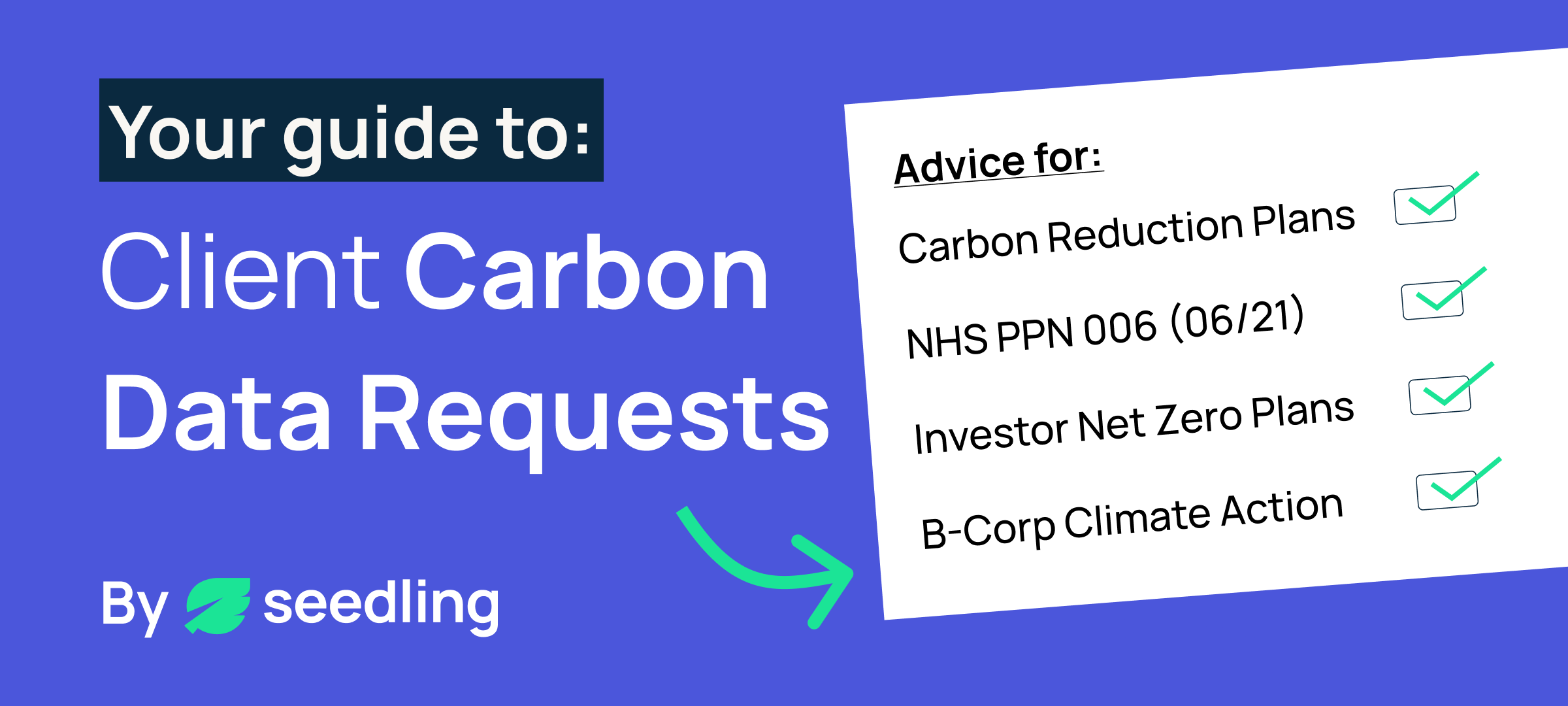
Navigating Client Carbon Data Requests: A Practical Guide for Agencies
If you’ve worked on a tender or supplier form recently, you’ve probably noticed the questions changing slightly. Alongside the usual sections on capability, pricing and references, there’s now a block on sustainability or social value that asks for things like:
For many agencies, that’s the point where the bid manager or new business lead has to go digging for information, or admit that the answers don’t really exist within the company yet.
This blog is to help make that moment less stressful. Not by turning you into climate experts, but by getting a few simple building blocks in place so you can respond to carbon questions calmly, consistently and without scrambling every time a client asks.
There are three big shifts behind the influx of carbon questions:
1. Clients are under pressure on their own emissions
Large brands, universities, councils and the NHS have public Net Zero commitments that they have to monitor and report on. Your agency’s emissions sit inside their own Scope 3 footprint, as a supplier to their operations. That means procurement teams are expected to look at environmental performance as well as cost and quality, to ensure no negative impact on their own emissions and progress so far.
2. Public sector rules are tightening
Many central government and NHS contracts now require a Carbon Reduction Plan that follows PPN 006 (06/21) – a set of rules and processes around carbon reduction plans, put in place by the UK Government. That applies to service providers too, including digital, creative and marketing agencies, and is on track to become a standard part of the bid process for all public sector tenders.
The short version: if you want to work with larger organisations or the public sector, these questions are not going away.
The language used when requesting carbon data can sometimes feel overwhelmingly technical, but most requests boil down to a few basics.
You’ll often see questions asking for:
Seen through an agency lens, that’s not a thousand different asks. It’s really four repeatable pieces of evidence:
1. A recent organisational carbon footprint.
2. A Carbon Reduction Plan, where relevant (public sector and NHS tenders).
3. A clear policy and point of ownership within your organisation.
4. A short, practical approach to carbon on the specific project itself.
Get those in place once and you’ve covered the majority of what tenders, portals and client questionnaires are looking for. Below are three simple steps on how to get started.
The starting point is a baseline carbon footprint for your agency.
For most creative and digital teams, that means pulling together data such as:
The goal isn’t perfection; it’s a structured, GHG-Protocol-aligned view of where your emissions actually sit, covering Scopes 1, 2 and the relevant parts of Scope 3.
Once you’ve done that based on a 12-month period, you can:
You can build this yourself using spreadsheets and publicly available government emissions factors, pulling in your energy, travel and spend data and converting it into tonnes of CO₂e, especially if you’re comfortable working with data and have a bit of capacity in ops or finance to own the process.
Many agencies however, use platforms like Seedling to do the heavy lifting: analysing data, aligning it with the Greenhouse Gas Protocol, and having an expert review the footprint so it’s robust enough to share in bids and reports.
Either way, the important thing is that you have one source of truth you’re comfortable reusing, for every requirement that might come your way.
Once you’ve done the work, turn it into a small set of reusable assets that make life easier for bid managers, new business and account teams.
This can be a simple PDF that includes:
You can attach this to tenders, link to it in supplier portals or adapt it as a slide in your credentials deck. You can also make this available on your website, or via a dedicated climate action/impact page.
If you’re bidding for central government or NHS work, it’s worth creating a Carbon Reduction Plan that follows the PPN 006 (06/21) structure from the outset.
Typically, that means:
You can manually pull this together from your footprint data and reduction plan, following government guidance yourself if you have capacity. Or work with an external partner like Seedling, who will be able to produce the reports for you.
The key is: once it’s written, approved and published, it becomes something you can then simply upload or reference whenever it’s requested.
None of this should live solely with ‘the sustainability person’. To avoid last-minute scrambling:
Make sure bid managers, new business leads and account directors all know:
Keep a short internal FAQ or crib sheet that covers:
That way, when a client or portal asks, ‘Do you have a Carbon Reduction Plan?’ or ‘How will you support our Net Zero goals?’, your team can answer consistently and confidently.
Handled well, carbon data and reduction plans, can be more than a compliance chore.
It can help you:
The important thing is to do this without greenwashing.
A few simple principles:
Most clients don’t expect you to have solved everything, but they do expect you to have made a start, and to not overclaim.
You can build a lot of this yourself if you have the time and appetite internally. But Seedling exists for teams who’d like some help.
We work with agencies and other growing organisations, by combining software and 1:1 expert support, to:
So you end up with carbon data that feels manageable, and evidence you can stand behind whenever a client asks for it.

Carbon footprinting software & expert 1:1 support, designed to get your growing business on the path to Net Zero. We help teams measure, analyse and reduce their carbon footprint, and report for government tenders, B-Corp, SECR reports, and much more.
You need to load content from reCAPTCHA to submit the form. Please note that doing so will share data with third-party providers.
More Information