The rapid growth of GLP-1 weight loss treatments across Asia is starting to reshape how consumers approach food, health and long-term wellbeing. In a recent feature with FoodNavigator, our Commercial Director Amy Stobie shared her perspective on what this shift means for food and drink brands.
In the article, Amy highlights how markets such as China are well positioned for this change, with an established focus on sustained weight management rather than short-term fixes. As she explains, “China’s health messaging has long framed obesity as a chronic disease, which has educated the population on the need to take a sustained approach to weight management.”
She also explores how GLP-1 treatments fit within a broader lifestyle approach. Rather than acting as a standalone solution, they are most effective when combined with lasting behavioural change. As the piece notes, “GLP-1 agonists could therefore serve as the catalyst for weight loss before those crucial lifestyle changes kick in.”
For brands, this signals a clear shift. As consumers become more health-conscious and intentional, there is a growing need to rethink how products, messaging and overall positioning support long-term wellbeing.
Click here to see the full article on our website
Looking to elevate your live event’s impact? Discover expert tips for filming and streaming that will maximize engagement and captivate your audience!
Maximize Engagement: Live Event Filming & Streaming Tips
Importance of Engagement in Live Events
Engagement is the lifeblood of any successful live event. It’s what transforms a passive audience into an active community. When people feel involved, they’re more likely to stay longer, interact with your content, and spread the word about your event. Increased engagement can lead to higher retention rates, more meaningful interactions, and ultimately, a more memorable experience for everyone involved. This is particularly crucial in today’s digital age, where distractions are plentiful and attention spans are short.
Moreover, engagement helps to build a sense of belonging among your audience. When participants feel like they are part of a community, they are more likely to participate actively and contribute to the overall atmosphere of the event. This sense of community can lead to the formation of long-term relationships and a loyal following, which can be invaluable for future events and initiatives. By prioritizing engagement, you are not only enhancing the immediate experience but also laying the groundwork for sustained interest and involvement.
Finally, high levels of engagement can provide you with valuable feedback and insights. When your audience is actively participating, you have a real-time gauge of what’s resonating and what’s not. This immediate feedback loop allows you to make on-the-fly adjustments to your content or delivery, ensuring that you are meeting the needs and expectations of your audience. In the long run, these insights can inform future event planning and execution, leading to continual improvement and greater success.
To achieve high levels of engagement, you need the right tools for the job. The cornerstone of any live event filming setup is a high-quality camera. While smartphones have come a long way, a dedicated camera with professional features can make a significant difference in the quality of your footage. Look for cameras that offer high resolution, excellent low-light performance, and robust connectivity options. These features will ensure that your footage is clear, vibrant, and easy to stream.
Audio quality is just as important as video quality. Poor audio can be a major turn-off for viewers, no matter how stunning your visuals are. Invest in high-quality microphones that can capture clear, crisp audio. Depending on the nature of your event, you may need a combination of lapel mics, boom mics, and handheld mics. Additionally, consider using a sound mixer to balance the audio levels and ensure that all voices are heard clearly.
Lighting is another critical component that can significantly impact the overall quality of your live stream. Proper lighting can enhance the visual appeal of your footage and ensure that your subjects are well-lit and easily visible. Invest in a good set of lights, including key lights, fill lights, and backlights, to create a balanced and professional-looking setup. Don’t forget to consider the color temperature of your lights to ensure a natural and consistent look.
Pre-Event Planning: Setting the Stage for Success
Effective pre-event planning is essential for a successful live event. Start by defining your goals and objectives. What do you want to achieve with your live event? Are you looking to educate, entertain, or inspire your audience? Having clear goals will help you make informed decisions about the content, format, and structure of your event.
Once your goals are defined, create a detailed event plan. This should include a timeline, a list of tasks, and assigned responsibilities. Make sure to account for all aspects of the event, from technical setup and content creation to marketing and audience engagement. A well-thought-out plan will help you stay organized and ensure that all team members are on the same page.
Rehearsals are a crucial part of pre-event planning. Conduct multiple dry runs to identify and address any potential issues before the event goes live. This will give you the opportunity to test your equipment, practice your content, and fine-tune your delivery. Rehearsals also provide a chance to familiarize yourself with the streaming platform and ensure that all technical aspects are working smoothly.
When it comes to live streaming, preparation is key. Start by choosing the right platform for your event. Different platforms offer different features, so it’s important to select one that aligns with your goals and audience preferences. Popular options include YouTube Live, Facebook Live, and Twitch, each offering unique tools for engagement and interaction.
Ensure that your internet connection is robust and reliable. A poor connection can lead to buffering, lag, and other issues that can disrupt the viewing experience. Conduct a speed test before the event to ensure that your upload speed is sufficient for high-quality streaming. If possible, use a wired connection instead of Wi-Fi to minimize the risk of connectivity issues.
Engage with your audience throughout the live stream. Encourage viewers to comment, ask questions, and share their thoughts. Respond to comments in real-time to create a sense of interaction and community. Use features like polls, Q&A sessions, and live chats to keep the audience engaged and involved. The more interactive your live stream is, the more likely viewers are to stay engaged and participate actively.
Techniques to Enhance Audience Interaction
Interactive elements can significantly enhance audience engagement during a live event. One effective technique is to incorporate live polls and surveys. These tools allow you to gather real-time feedback from your audience and make them feel involved in the event. You can use polls to gauge opinions, test knowledge, or simply add a fun element to your content.
Another powerful technique is to host Q&A sessions. Allow your audience to submit questions throughout the event and take the time to address them live. This not only provides valuable information to your viewers but also makes them feel heard and valued. Consider dedicating specific segments of your event to Q&A sessions to ensure that you have enough time to address a variety of questions.
Gamification is another effective way to boost interaction. Integrate quizzes, challenges, and competitions into your event to keep the audience engaged and entertained. Offer small rewards or recognition to participants to encourage active participation. Gamification not only adds an element of fun but also fosters a sense of community and connection among your audience.
Post-Event Strategies for Continued Engagement
The end of your live event doesn’t mean the end of engagement. Post-event strategies are crucial for maintaining the momentum and keeping your audience interested. Start by sending out a thank-you message to all participants. Express your gratitude for their participation and provide a summary of the event’s highlights. This small gesture can go a long way in building goodwill and encouraging future participation.
Share recordings of the event on your social media channels and website. This allows those who missed the live event to catch up and provides an opportunity for attendees to revisit their favorite moments. Use snippets and highlights to tease the content and attract new viewers. Encourage your audience to share these recordings with their networks to extend the reach of your event.
Solicit feedback from your audience to understand what worked well and what could be improved. Use surveys, polls, and social media comments to gather insights. This feedback is invaluable for planning future events and ensuring that you continue to meet the needs and expectations of your audience. By actively seeking and responding to feedback, you demonstrate that you value your audience’s input and are committed to continuous improvement.
Analyzing Live Event Metrics for Improvement
Data analysis is a powerful tool for understanding the success of your live event and identifying areas for improvement. Start by reviewing key metrics such as viewership numbers, engagement rates, and audience demographics. These metrics can provide insights into how well your event resonated with your target audience and where you might need to make adjustments.
Pay close attention to engagement metrics, such as comments, shares, and likes. These indicators can provide a deeper understanding of how actively your audience participated in the event. Identify patterns and trends to understand what types of content or segments generated the most interaction. Use this information to inform your content strategy for future events.
Don’t overlook qualitative data, such as audience feedback and comments. This information can provide valuable context and insights that quantitative metrics might miss. Analyze feedback to identify common themes and areas for improvement. Use this information to make data-driven decisions and continuously refine your approach.
Case Studies: Successful Live Event Filming and Streaming
Examining successful case studies can provide valuable insights and inspiration for your own live events. One such example is the annual Apple product launches. These events are highly anticipated and attract millions of viewers worldwide. Apple’s success can be attributed to their meticulous planning, high production quality, and effective use of interactive elements. They engage their audience with live demos, Q&A sessions, and behind-the-scenes content, creating a sense of excitement and anticipation.
Another notable example is the TEDx series. These independently organized events have become a global phenomenon, thanks in part to their emphasis on high-quality filming and streaming. TEDx events prioritize clear, concise content and use professional filming techniques to ensure that the viewer’s experience is as engaging as possible. They also leverage social media to extend the reach of their content and foster a sense of community among their audience.
The esports industry also offers valuable lessons in live event engagement. Major tournaments, such as The International and League of Legends World Championship, attract millions of viewers and generate significant interaction. These events utilize advanced streaming technology, interactive features, and engaging commentators to create an immersive experience. They also foster a strong sense of community among fans, encouraging active participation and long-term engagement.
Conclusion: Elevating Your Live Event Experience
In conclusion, maximizing engagement in live event filming and streaming requires a strategic approach and a commitment to quality. From pre-event planning and essential equipment to best practices for streaming and techniques for audience interaction, every aspect plays a crucial role in creating a memorable and engaging experience. By prioritizing engagement and leveraging the right tools and strategies, you can elevate your live event experience and leave a lasting impression on your audience.
Remember, the success of your live event doesn’t end when the stream goes offline. Post-event strategies, data analysis, and continuous improvement are key to maintaining momentum and ensuring that each event is better than the last. By learning from successful case studies and adapting their best practices to your own context, you can create a dynamic and engaging live event that resonates with your audience and achieves your goals.
So, whether you’re planning a small community gathering or a large-scale conference, these tips and strategies can help you maximize engagement and create a live event that stands out. Invest in the right equipment, plan meticulously, and prioritize audience interaction to make your event a success. With the right approach, you can transform your live event into an unforgettable experience that captivates and engages your audience.
Boomsatsuma, Bristol’s leading creative college, is launching a brand-new Art and Design course from September 2026, opening the door for aspiring artists and designers to turn their creativity into a career.
Awarded by the University of the Arts London (UAL), the course offers the UAL Level 3 Extended Diploma in Creative Practice: Art, Design and Communication. Designed around hands-on learning and real-world creative practice, the programme equips students with the skills, confidence and industry insight needed to progress directly into creative careers or higher education and to play an active role in Bristol’s thriving creative sector.
Aimed at students aged 16–18, the course is built for learners who want to explore, experiment and develop their creative identity through practical, industry-led learning.
In the first year, students explore a wide range of creative practices, helping them discover their strengths and passions across art and design disciplines, from illustration, fine art and graphic design to moving image and interior design. In the second year, students specialise in a pathway aligned with their personal creative interests, developing advanced practical skills and graduating with a strong, professional portfolio.
Strong Industry Connections
Boomsatsuma is known for its deeply industry-connected approach, working in close collaboration with Bristol’s creative community to give students meaningful real-world experience. This new Art and Design course is no exception.
Already confirmed to deliver masterclasses, workshops and Q&As to the first cohort are graffiti artist Inkie, multi-disciplinary artist Zöe Power, printmakers Ian Chamberlain and Jemma Gunning, Nick Hand, Founder of The Letterpress Collective, artist duo Copper Sounds, and illustrator Beth Suzanna, with further leading practitioners to be announced.
These sessions will give students direct insight into contemporary creative practice, spanning street art, printmaking, illustration and multidisciplinary design.
“This is an exciting and much-needed development for Bristol’s creative scene,” said Inkie, the well-known Bristol-based graffiti artist. “Boomsatsuma has a strong track record of supporting emerging creative talent, so I’m confident this programme will make a real impact. I’m looking forward to being involved and to seeing the next generation of artists develop in the city.”
By working closely with local artists, designers and studios, Boomsatsuma creates opportunities for students to collaborate and build the professional networks that matter when starting out in the creative sector.
“This is an incredibly exciting development for Bristol’s creative industries,” said Tom Sowden, Director of Education at Boomsatsuma. “We’re proud to be supporting the next generation of artists and designers through a course shaped by real creative practice, in one of the best creative cities in the UK. It’s about giving students the skills, experience and opportunities they need to thrive in Bristol — and beyond.”
The course will be taught at a Bristol city centre location, placing students at the heart of the city’s creative community. Applications for September 2026 are now open.
For more information and to apply, visit boomsatsuma.com/college-course/art-design
Here are 10 things you might not (but definitely should) know about Square Works…
1. Square Works is housed in a Grade II Listed Georgian townhouse
Square Works is tucked inside a beautifully preserved Georgian building on Berkeley Square – one of Clifton’s most iconic addresses. From the outside, it’s all Bristolian charm; inside, it’s a thoughtfully designed, modern workspace filled with art, natural light, and sleek interiors that blend heritage with contemporary flair.
2. It’s the only co-working space in Bristol with a private members’ club
Square Works is part of The Square Club, a private members’ club for creatives and professionals. This unique connection gives you access to exclusive events, industry talks, and a stylish bar and restaurant. Even better? You can order restaurant-quality food and have it delivered right to your desk.
3. You can work from a ‘Secret Garden’
Hidden behind The Square Club is a tranquil terrace that’s the perfect spot for a quiet call, an al fresco meeting, or just soaking up the sun with your laptop and a coffee in hand.
4. The events calendar is packed – and many are free for members
From creative breakfasts to pitch nights and Friday Pilates, Square Works hosts regular events to help members connect, grow, and get inspired. It’s networking without the awkwardness – and you never know who you’ll meet over coffee.
5. Members get 24/7 access — yes, even on Sundays
If you have an office or a Dedicated Desk at Square Works, you’re not limited to the standard 9 – 5. Whether you prefer early mornings or late nights, you gain access 24/7 so you can work when it suits you – even on weekends and Bank Holidays.
6. There’s a curated art collection
Art is part of the Square Works experience. You’ll find pieces from local and UK-based artists throughout the space – creating an inspiring, gallery-like atmosphere. Plus, head next door to The Square Club for the latest seasonal installations.
7. Memberships are built for flexibility
Whether you’re a freelancer, founder, or part of a growing team, Square Works has an option for you – from hot desking to private offices. You can scale up, scale down, or shift between spaces as your needs change, without being locked into a long-term lease.
8. Unlimited refreshments and weekly ‘Square Works Nibbles’
Members enjoy unlimited, high-quality coffee, tea, hot chocolate and more. But the real treat? Every Wednesday, the in-house chef surprises members with freshly made sweet or savoury bites. It’s the perfect midweek pick-me-up.
9. Dog-friendly work space
Square Works welcomes well-behaved dogs – because work is better with a furry friend nearby. It adds to the relaxed, homely atmosphere and means you don’t have to leave your pup behind when you’re working long hours.
10. It’s a true community – not just a desk
What sets Square Works apart is the atmosphere. Whether you’re chatting in the kitchen, attending an event, or collaborating on a project, you’re not just renting a desk – you’re joining a supportive, inspiring community of creatives, professionals, and entrepreneurs.
To book a tour of Bristol’s Best Workspace, get in touch with us today via:
E-mail: [email protected]
Phone: 0117 322 6635
Enquiry Form: Contact Us
Or, if you’re in the area, feel free to pop in and chat with our friendly team!
At Spark AI we are big believers in continuous market research – for us its to make sure our AI literacy and AI business transformation programmes are exactly on point to what the industry needs right now. Understanding where agencies really are – not where they think they are – helps us build the right support.
That’s why a couple of months ago we set out to research the future of skills and hiring in the age of AI alongside The Industry Club, and what we found reveals an intriguing dynamic playing out across UK agencies right now.
There’s a growing confidence-capability gap, and understanding it could be the key to unlocking your agency’s next phase of AI adoption.
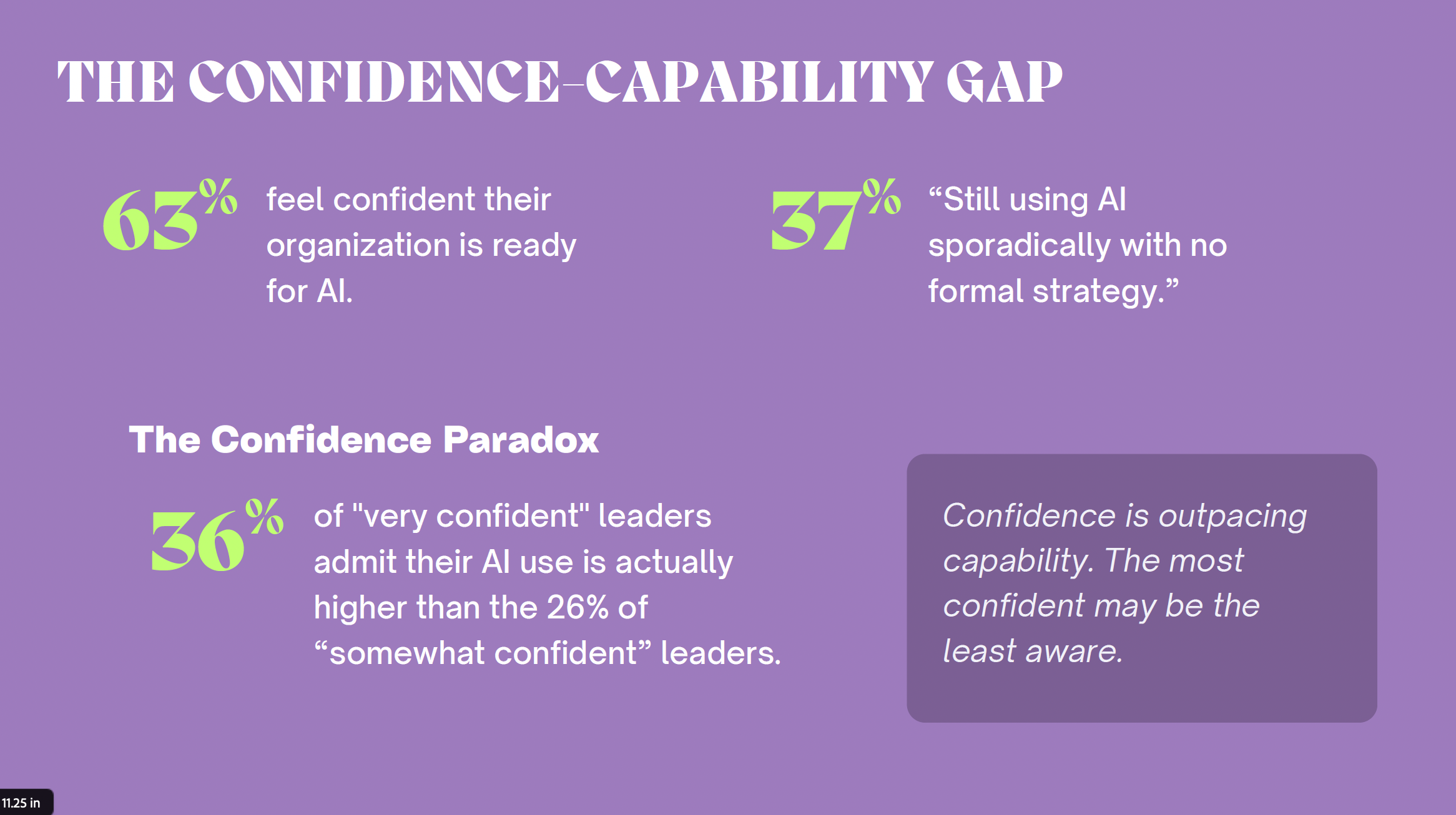
Our report surveyed 149 MDs, CEOs, founders and department heads to understand how AI is reshaping agency capability, hiring and culture. Whilst 63% of agency leaders feel confident their organisation is ready for AI, 37% admit their use remains sporadic with no formal strategy.
Here’s the paradox: amongst those who describe themselves as “very confident”, 36% admit their AI use is actually unstructured – a higher proportion than the 26% amongst “somewhat confident” leaders. Confidence is outpacing capability, and sometimes the most confident may be the least aware of what structured AI adoption actually requires. But this isn’t a problem – it’s simply different stages of the same journey.
Two Camps, Two Opportunities
The research shows agencies splitting into two camps: 37% are still experimenting ad hoc, whilst 19% are building structured programmes with measurable outcomes. The good news? Moving from experimentation to structure is entirely achievable with the right approach.
Laura Jackson, Board Director at Not Actual Size, saw this transition firsthand: “Before, everyone was experimenting on their own, one person on ChatGPT, another on Midjourney. It felt exciting but chaotic. Having a plan, even a light one, made it much more manageable.”
The confidence-capability gap isn’t a problem to fear – it’s simply about recognising that feeling ready and being structurally ready are different stages of the same journey.
Investment in Learning Is Driving Success
Here’s where the picture becomes genuinely encouraging: AI literacy has become a core business investment, and those who are committing to it are seeing real results.
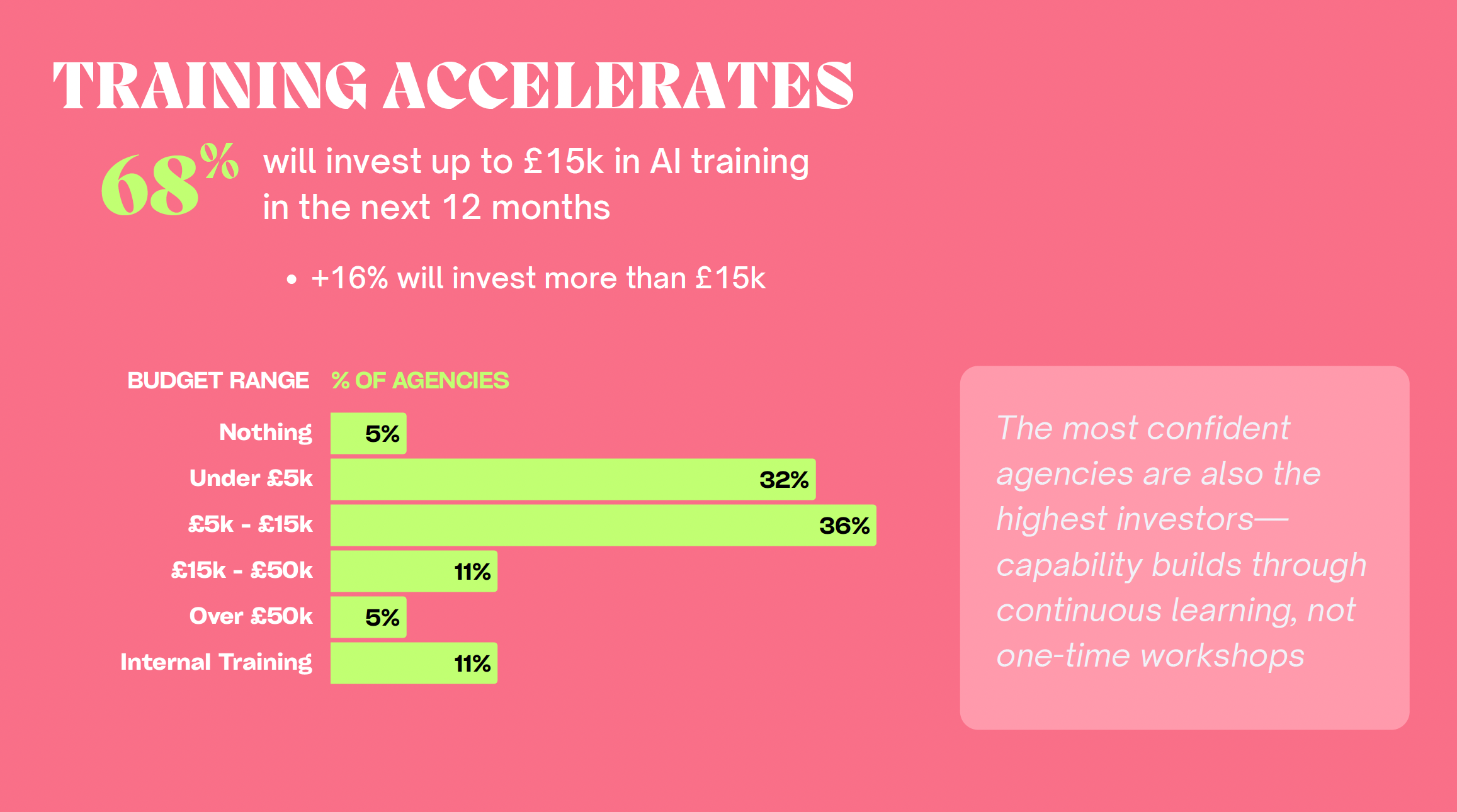
Two-thirds (68%) of agencies anticipate spending up to £15k on AI-related training in the next 12 months, with only 5% planning to spend nothing. Perhaps most tellingly, a further 16% are investing over £15k, with 11% in the £15k–£50k range and 5% investing over £50k.
The data reveals an important insight behind these spend figures: the most confident agencies are also the highest investors. Capability builds through continuous learning, not one-time workshops. These organisations are spending more because they understand that maintaining fluency requires ongoing development, and because they’re clear on how that learning links to client and commercial outcomes.
As one Head of Production at an independent agency puts it: “Getting (and understanding) the balance between the different types of AI applications and how they work together is more critical than ever. The consistent pace of application updates can make training ‘programmes’ hard to implement, so it needs to be a company-wide commitment to consistent, continuous learning opportunities.”
Hiring Is Changing–And It’s More Encouraging Than You’d Think
AI isn’t triggering a hiring boom, but it is reshaping whom agencies hire and why – and the findings here are genuinely positive for agencies.
Whilst 71% say AI hasn’t changed headcount, 46% have already hired or plan to hire specifically for AI capabilities. Here’s the encouraging part: when they do hire, 65% prioritise curiosity, adaptability and problem-solving over fixed expertise. Only 6% actively recruit for specific AI skills.
The detailed breakdown reveals a clear shift in priorities: 43% consider AI skills “nice to have, but not essential” at point of hire, whilst 22% say they’re “not important – we hire for aptitude”. A further 25% seek a mix of both aptitude and specific skills, with just 6% viewing specific AI expertise as “very important”.
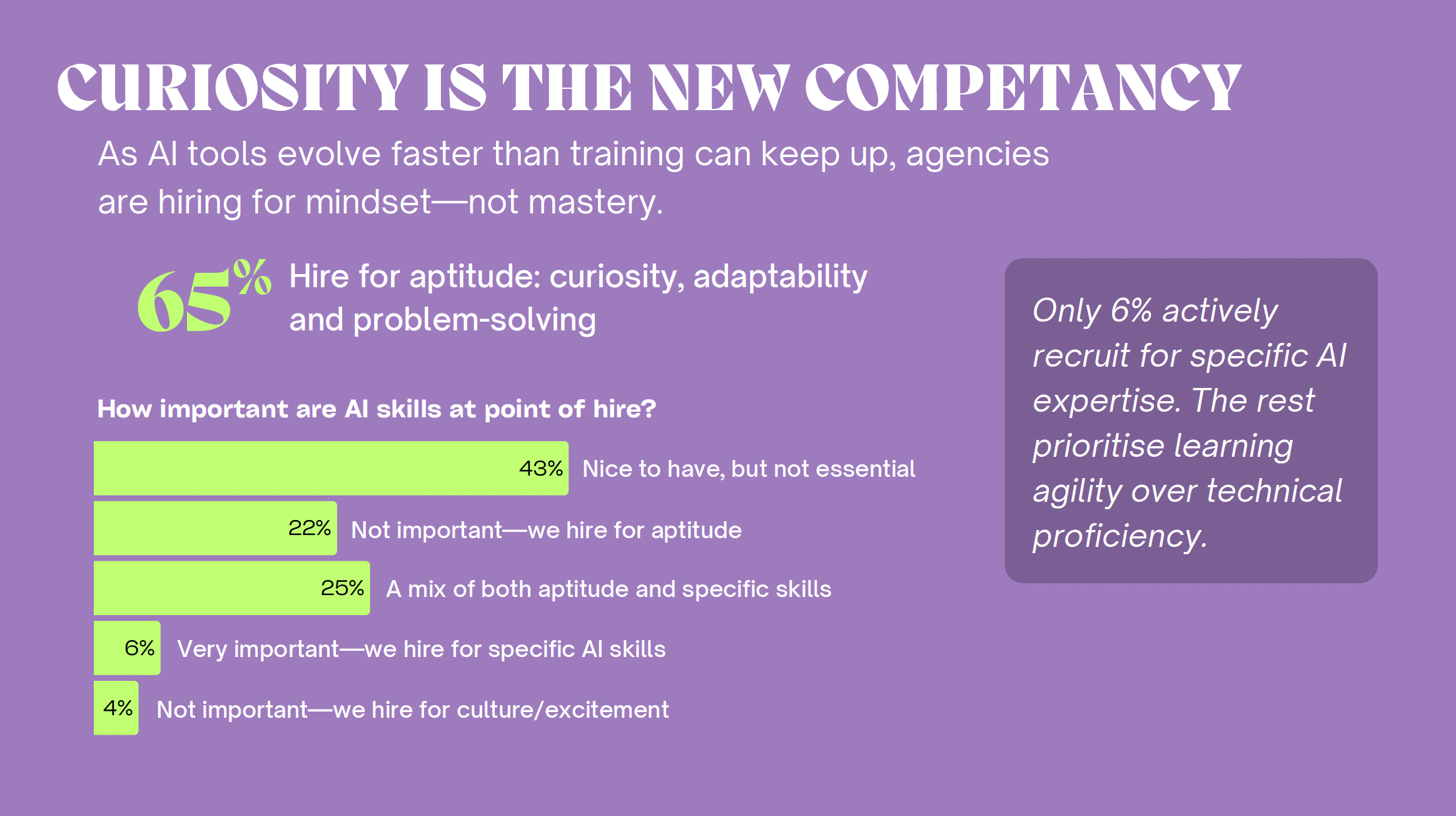
As AI tools evolve faster than people can keep up, agencies are recognising that mindset trumps mastery. Learning agility matters more than technical proficiency.
Vix Jagger, Head of Creative Innovation & AI at Droga5, captures this perfectly: “My 63-year-old retired mum got into AI, she’s proof curiosity beats credentials. AI is for people who learn faster not the ones who aren’t scared to break things.”
Technical Skills Aren’t the Barrier
The real opportunities for growth lie in mindset and approach, not technical proficiency. This has important implications for how agencies can approach AI readiness. You don’t need to hire data scientists or machine learning engineers – you need to cultivate curiosity, adaptability and strategic thinking across your existing team. Like it’s always been – success is down to how engaged your people are and the behaviours that underpin your culture.
The Next Wave: Operational Transformation
Whilst AI’s current impact is most visible in creative work – with strategy (13%), creative (13%), and design (12%) leading today – the research reveals that agency leaders are looking to operational areas next, transforming how agencies scope, price, and deliver work.
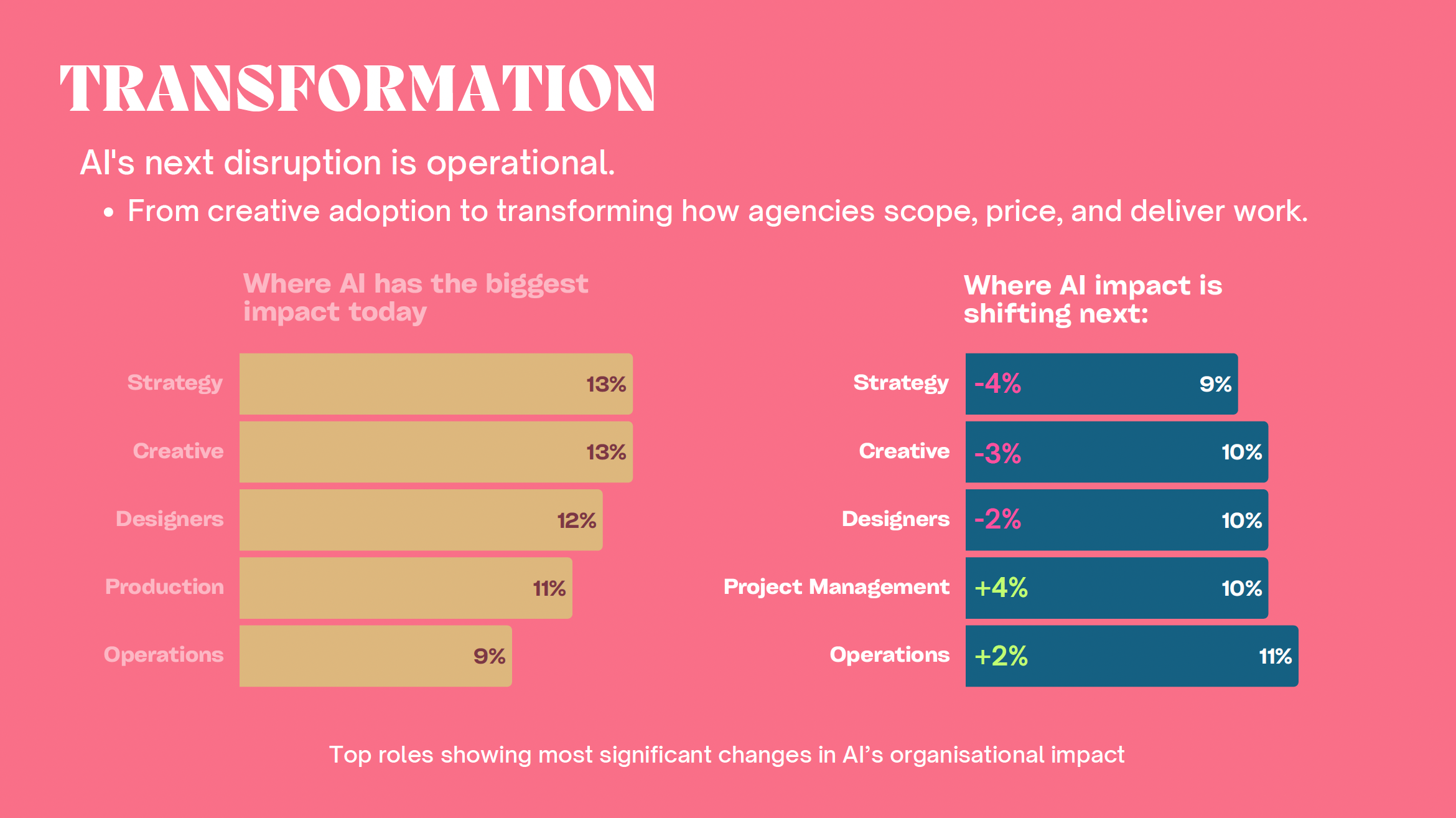
This evolution is particularly relevant for independent agencies with leaner teams and tighter margins. AI is becoming a competitive equaliser, helping smaller agencies deliver more strategic value per person and close the capability gap with larger network agencies.
What This Means for You
The agencies making the most headway with AI aren’t necessarily those with the most expertise today – they’re the ones building structured approaches, measuring outcomes, and prioritising learning mindsets.
If you’re feeling confident about your AI readiness, the next step is ensuring that confidence translates into structured implementation. When hiring for AI capabilities, focusing on adaptability and curiosity over specific technical skills will serve you far better in the long term.
The confidence-capability gap isn’t permanent, and with honest assessment and deliberate action, it’s entirely bridgeable.
Explore all the findings and see where your agency sits using the Spark AI Maturity Model framework: https://www.wearespark.ai/future-of-skills-hiring-ai-agencies
—
About Spark AI
Spark AI helps creative and brand leaders turn AI curiosity into confidence through structured training and business transformation. We have worked with 60+ agencies running AI Fundamentals workshops and AI Accelerator programmes based on our # 1 bestselling book in the UK and US Shift – AI for Agencies. Trusted by Oxford University Saïd Business School and backed by Innovate UK. https://www.wearespark.ai/
About The Industry Club
The Industry Club is one of the most trusted creative talent partners in London, specialising in matching the right talent to the right teams and helping the industry prepare for the future. https://www.theindustryclub.co.uk/
Weston College is pleased to launch a new Level 1 Awareness of Safeguarding & Prevent in the Workplace course designed specifically for employers, line managers, and staff supporting apprentices, T Level students, or King’s Trust work experience learners.
This one-day course provides essential knowledge on safeguarding and Prevent, tailored to each employer’s own policy. For those without one, we signpost to the NSPCC policy template to help get them started.
The qualification is fully funded for individuals earning under £25,000, or 50% co-funded (£88.20) through the Adult Skills Fund.
This training is ideal for roles such as receptionists, HR, pastoral, care, or education staff, and is a fantastic addition to your organisation’s commitment to safe and supportive learning environments.
Explore all our employer training opportunities here: Funded, Co-funded and Commercial Training for Businesses | Weston College
Having just completed our third six-monthly benchmark on AI in creative agencies, I’m fascinated by what we’re seeing emerge across the industry. We spoke to 60+ agencies and did an extensive review of all the recent industry studies, and whilst we found that 80% of creative agencies now actively use AI, only approximately 5% are genuinely innovating with it – building proprietary IP, launching new services, and completely transforming how they work.
The conversation has definitely shifted since our last report in the spring of 2025. Six months ago, agencies were asking “Should we use AI?” Now it’s “How do we transform client value with AI?” But whilst the questions have evolved, most agencies still feel stuck in what we’re calling “the experimentation trap.”
The journey from playing around to proper innovation
Through our work with creative agency clients, we’ve identified a four-stage AI maturity model that the most successful agencies follow:
Experiment – scattered dabbling with various tools
Adopt – structured training and AI taskforces
Optimise – automation and reshaped roles
Innovate – proprietary tools and new client services
What we’re finding is that it’s really easy to get stuck between stages one and two. Meanwhile, the 5% who’ve reached stage four are building capabilities that genuinely set them apart.
Some of these innovation-stage agencies are doing remarkable things. Brave Bison’s AudienceGPT creates synthetic audiences with award-winning accuracy, effectively replacing traditional focus groups. Eight&Four has built Platform12, a complete proprietary ecosystem. OLIVER’s Seance achieves 85% correlation with human focus groups, whilst Monks.Flow reports 97% cost savings through agentic AI workflows.
One agency leader we spoke to put it perfectly: “AI hasn’t made our work cheaper, but it has made it better. Now we are exploring more territories, testing more ideas, and then refining them more.”
What’s actually holding agencies back?
The barriers have shifted quite a bit since the first edition of this 6 monthly benchmark research 12 months ago. Early on, it was all about tool overwhelm – there were just too many options and people didn’t know where to start. Now it’s more fundamental: 43% cite lack of proper training, whilst 48% point to privacy and IP concerns.
The thing is, the ROI on structured training is genuinely compelling. Our research shows that just 4 hours of training can save each person 3-5 hours weekly. For a 50-person agency, that works out to 7,800-13,000 hours freed up annually – that’s huge.
Perhaps more telling is what happens when agencies get their governance right. Those with proper frameworks report 40% fewer client concerns, 60% more pricing confidence, and 80% stronger internal alignment. We’re seeing client conversations shift completely – from “Do you use AI?” to “What’s your governance framework?”
From efficiency to creative enhancement
One of the most interesting shifts we’ve tracked is in expectations around AI’s role. 95% of agencies now expect AI to enhance creativity rather than simply improve efficiency, with 85% expecting higher quality outputs. That’s a massive change in mindset from simply focussing on doing things faster and cheaper.
The agencies that are succeeding are reinvesting any time they save through AI into exploration and strategy. Instead of producing one polished pitch, they’re analysing thousands of data points and exploring 20 concepts in a day.
On the employment side, we’re seeing role evolution rather than job displacement. Demand seems to be growing for creative problem-solving, emotional intelligence, and strategy, whilst completely new hybrid roles are emerging: AI creative directors, prompt engineers, and creative technologists.
Three competitive camps are forming
Through our research, we’re seeing the early emergency three distinct competitive categories forming:
- Volume agencies using AI to scale content production at speed and lower cost
- Innovation leaders creating previously impossible experiences with proprietary tools
Craft specialists emphasising artisanal, human-first creativity
- It’s the middle ground that seems to be feeling the most pressure. Agencies that can neither compete on volume nor differentiate through innovation or craft may find themselves in a tricky spot.
Pricing models are evolving too. The old “time × rate = fee” approach is giving way to “impact × expertise = value.” Some agencies like Dept are experimenting with hybrid retainers and revenue share, whilst others like Pod London are moving to efficiency-based pricing.
Questions for all of us
This research raises some interesting questions for creative agencies. As the ~5% continue to build proprietary capabilities that competitors can’t easily replicate, what happens to traditional agency partnerships? When volume production becomes AI-driven and innovation requires significant investment in new capabilities, where does this leave full-service agencies?
What we might be witnessing is the emergence of a new agency landscape – one where the winners aren’t necessarily the largest or most established, but those who’ve successfully transformed their business models for the AI era.
If our findings are accurate, this is the window for competitive advantage, but it won’t stay open forever. Agencies need to move beyond experimentation to systematic skill development, with proper governance frameworks and structured AI adoption programmes becoming key differentiators to enable real innovation.
What’s your take on all this? Do these findings match your experience of how agencies are approaching AI? Are you seeing this kind of divide, or does the reality feel different from where you sit?
The Spark Report: AI in Creative Agencies A/W 2025/26 is available to download and includes the full AI Maturity Model, detailed case studies, and practical frameworks for agencies looking to move beyond experimentation. Download The Spark Report.
Having just completed our third six-monthly benchmark on AI in creative agencies, I’m fascinated by what we’re seeing emerge across the industry. We spoke to 60+ agencies and did an extensive review of all the recent industry studies, and whilst we found that 80% of creative agencies now actively use AI, only approximately 5% are genuinely innovating with it – building proprietary IP, launching new services, and completely transforming how they work.
The conversation has definitely shifted since our last report in the spring of 2025. Six months ago, agencies were asking “Should we use AI?” Now it’s “How do we transform client value with AI?” But whilst the questions have evolved, most agencies still feel stuck in what we’re calling “the experimentation trap.”
The journey from playing around to proper innovation
Through our work with creative agency clients, we’ve identified a four-stage AI maturity model that the most successful agencies follow:
Experiment – scattered dabbling with various tools
Adopt – structured training and AI taskforces
Optimise – automation and reshaped roles
Innovate – proprietary tools and new client services
What we’re finding is that it’s really easy to get stuck between stages one and two. Meanwhile, the 5% who’ve reached stage four are building capabilities that genuinely set them apart.
Some of these innovation-stage agencies are doing remarkable things. Brave Bison’s AudienceGPT creates synthetic audiences with award-winning accuracy, effectively replacing traditional focus groups. Eight&Four has built Platform12, a complete proprietary ecosystem. OLIVER’s Seance achieves 85% correlation with human focus groups, whilst Monks.Flow reports 97% cost savings through agentic AI workflows.
One agency leader we spoke to put it perfectly: “AI hasn’t made our work cheaper, but it has made it better. Now we are exploring more territories, testing more ideas, and then refining them more.”
What’s actually holding agencies back?
The barriers have shifted quite a bit since the first edition of this 6 monthly benchmark research 12 months ago. Early on, it was all about tool overwhelm – there were just too many options and people didn’t know where to start. Now it’s more fundamental: 43% cite lack of proper training, whilst 48% point to privacy and IP concerns.
The thing is, the ROI on structured training is genuinely compelling. Our research shows that just 4 hours of training can save each person 3-5 hours weekly. For a 50-person agency, that works out to 7,800-13,000 hours freed up annually – that’s huge.
Perhaps more telling is what happens when agencies get their governance right. Those with proper frameworks report 40% fewer client concerns, 60% more pricing confidence, and 80% stronger internal alignment. We’re seeing client conversations shift completely – from “Do you use AI?” to “What’s your governance framework?”
From efficiency to creative enhancement
One of the most interesting shifts we’ve tracked is in expectations around AI’s role. 95% of agencies now expect AI to enhance creativity rather than simply improve efficiency, with 85% expecting higher quality outputs. That’s a massive change in mindset from simply focussing on doing things faster and cheaper.
The agencies that are succeeding are reinvesting any time they save through AI into exploration and strategy. Instead of producing one polished pitch, they’re analysing thousands of data points and exploring 20 concepts in a day.
On the employment side, we’re seeing role evolution rather than job displacement. Demand seems to be growing for creative problem-solving, emotional intelligence, and strategy, whilst completely new hybrid roles are emerging: AI creative directors, prompt engineers, and creative technologists.
Three competitive camps are forming
Through our research, we’re seeing the early emergency three distinct competitive categories forming:
- Volume agencies using AI to scale content production at speed and lower cost
- Innovation leaders creating previously impossible experiences with proprietary tools
Craft specialists emphasising artisanal, human-first creativity
- It’s the middle ground that seems to be feeling the most pressure. Agencies that can neither compete on volume nor differentiate through innovation or craft may find themselves in a tricky spot.
Pricing models are evolving too. The old “time × rate = fee” approach is giving way to “impact × expertise = value.” Some agencies like Dept are experimenting with hybrid retainers and revenue share, whilst others like Pod London are moving to efficiency-based pricing.
Questions for all of us
This research raises some interesting questions for creative agencies. As the ~5% continue to build proprietary capabilities that competitors can’t easily replicate, what happens to traditional agency partnerships? When volume production becomes AI-driven and innovation requires significant investment in new capabilities, where does this leave full-service agencies?
What we might be witnessing is the emergence of a new agency landscape – one where the winners aren’t necessarily the largest or most established, but those who’ve successfully transformed their business models for the AI era.
If our findings are accurate, this is the window for competitive advantage, but it won’t stay open forever. Agencies need to move beyond experimentation to systematic skill development, with proper governance frameworks and structured AI adoption programmes becoming key differentiators to enable real innovation.
What’s your take on all this? Do these findings match your experience of how agencies are approaching AI? Are you seeing this kind of divide, or does the reality feel different from where you sit?
The Spark Report: AI in Creative Agencies A/W 2025/26 is available to download and includes the full AI Maturity Model, detailed case studies, and practical frameworks for agencies looking to move beyond experimentation. Download The Spark Report.
We are delighted to be a co-creator of BTF+, the Bristol Festival of Tech, Creativity and Culture, taking place in Bristol on 6-11 October.
It’s a bold expansion of Bristol Technology Festival, an event from techSPARK which first took place in 2019. With creativity and culture added to technology, it’s a huge celebration of all three in a city that specalises in all of them.
Introducing BCI House
For our part of BTF+ we are delighted to announce BCI House, a dedicated hub where creative, media and tech come together for four days of events. Workshops, talks, panel discussions and networking will spark collaboration and amplify the festival experience.
BCI House is open from 6-9 October at Unit 11, TCN Temple Studios, Temple Campus, Lower Approach Road, Bristol, BS1 6QA. Please note this is a different venue to the one we originally announced.
Tom Harber, founder of Aer Studios and Bristol Creative Industries board member, said:
“It’s finally here, and we couldn’t be more excited. Bristol Creative Industries is proud to play our part in bringing the city’s first festival of creativity, technology and culture to our members and the wider community.
“Our involvement marks a key milestone in our growing partnership with TechSPARK, as we work together to unite Bristol’s creative and tech sectors in meaningful ways.
“BCI House will be a vibrant hub at BTF+, hosting dedicated panels, keynotes and exhibits that showcase the power and potential of the creative tech scene in the region. It will be a place for our members, collaborators and the wider community to connect, share ideas and be inspired.”
Heather Wright, co-chair of Bristol Creative Industries, said:
“The convergence of creative and tech has now become embedded in many areas of business as we all strive for user friendly, AI driven tools, not only to improve our internal processes but also in the products and services we sell to clients.
“BCI House is the melting pot where we will look at how this works in practice and what the future looks like. We’re excited to swing open the doors of this new event programme to our members as well as looking forward to welcoming new connections.”
What’s happening at BCI House?
There are five BCI events at BCI House plus events staged by our fellow BTF+ creator and BCI member MyWorld.
The BCI events are as follows. Click on the links for booking details.
7 October, 9.30am – 11am: Roundtable – Harnessing AI for creativity and impact
An invite only event led by Jules Love and Emma Wharton Love from BCI member Spark AI
7 October, 1.30 – 2.30pm: Aardman – 50 years of tech and tradition
With Peter Lord, the co-founder of the legendary company and BCI member Aardman.
More details
8 October, 9.30 – 10.30am: Mindset shift – A journey from agency leadership to tech start-up
Dominic Mills, co-founder of Bristol-based experiences marketplace and BCI member Yuup, in conversation with Tom Harber.
More details
8 October, 1.30-2.30pm: A peek behind the curtain – What it takes to succeed at some of the world’s most creative companies
Ex-Apple creative director Sam Oliver in conversation with Laura Lear, managing director of PR led communications agency and BCI member AMBITIOUS.
More details
8 October, 5pm – 6pm: BCI House Happy Hour networking drinks
Sponsored by BCI members Aer Studios and Noble Digital Performance.
More details
MyWorld events will take place at BCI House on 6-9 October covering areas including immersive technologies, skills and training, and animation. See the BTF+ schedule for full details.
We can’t wait to see you at BCI House!
Also happening at BTF+
There’s loads of great stuff taking place at BTF+. Other highlights include:
BTF+ Summit
The BTF+ Summit is a five day event with premium sessions featuring national-level speakers and exclusive networking opportunities designed to inspire and connect the tech, creative and cultural community.
The Summit is one of the few paid elements at BTF+, but BCI members can take advantage of a 25% discount on tickets. Email [email protected] for your exclusive code.

BTF+ presents: Helios at Bristol Cathedral
Step inside the sun at Bristol Cathedral on 6-8 October with Helios, a stunning illuminated sculpture by Bristol-based artist Luke Jerram.
Measuring seven metres in diameter, this breathtaking installation features detailed imagery of the sun’s surface, allowing visitors to explore sunspots, filaments, and solar flares safely. There’s also a specially created surround sound composition by Duncan Speakman and Sarah Anderson.
Book tickets here.
While the advertising world obsesses over AI’s potential to revolutionise creativity, I witnessed the most brilliant campaign of the year this past weekend – and it had nothing to do with machine learning, programmatic targeting, or predictive algorithms.
I was ankle-deep in mud at End of the Road Festival (which, by the way, was as outstanding as ever even despite the deluges), when a waste management truck trundled past, emblazoned with luxury brand advertising. There I was, filthy, tired, probably (definitely) smelling questionable, and suddenly confronted with pristine imagery of the very lifestyle I’d temporarily abandoned for three days of musical bliss in a muddy field.
It was perfect. It was contextual. It was human.
The advertising industry is currently drunk on AI promises. Every conference, every pitch, every strategy document now includes some variation of “AI-powered personalisation” or “machine learning optimisation.” Don’t get me wrong – these tools have their place. But in our rush to embrace the algorithmic future, are we forgetting the fundamental truth that great advertising is about understanding moments, not just metrics?
That rubbish truck campaign worked because someone – a human someone – understood festival psychology. They knew that by Sunday, we’d all be romanticising our normal lives. They understood that luxury feels most appealing when you’re living without it.
AI excels at pattern recognition across vast datasets. It can tell you that 18–34-year-olds who attend music festivals also engage with luxury content 67% more in the week following the event. But it takes human insight to realise that the optimal moment to reach them isn’t through their Instagram feed – it’s when they’re watching that rubbish truck haul away their weekend of excess.
The advertising industry’s AI obsession reminds me of every previous “revolution” we’ve lived through – programmatic, social, mobile, time shifted tv (Sky +/Q), video, influencer marketing. Each time, we declared the fundamentals obsolete, only to rediscover that great advertising remains great advertising, regardless of the delivery mechanism.
The real revolution isn’t in our tools; it’s in remembering that context creates meaning, that timing trumps targeting, and that understanding human nature will always matter more than optimising algorithms.
AI will undoubtedly make advertising more efficient, more measurable, more scalable. But will it make it more memorable? More moving? More muddy-festival-rubbish-truck brilliant?
I’m not convinced.
This isn’t a luddite manifesto. AI belongs in our arsenal, particularly for data analysis, creative versioning, and media optimisation. But let’s not confuse operational efficiency with creative effectiveness.
The brands that will win aren’t those with the most sophisticated AI stacks – they’re those that use technology to amplify human insights, not replace them. They’re the ones who understand that the best algorithm for understanding people is still empathy, seasoned with experience, and deployed at exactly the right moment.
Sometimes that moment is when you’re standing in a muddy field, watching a rubbish truck, dreaming of clean sheets.
And no machine saw that coming.