[ This article was cross-posted to Bristol Creative Industries from my blog. ]
Thinking about having a new website built or redesigned can be intimidating, especially if it’s your first time working with a web designer or developer. You might not know what to expect or how to prepare. But don’t worry—most designers and developers (myself included!) are here to make the process smooth, enjoyable, and as stress-free as possible.
Here’s a handy guide to what you can expect during our first meeting, the kinds of things we’ll likely discuss, and how you can prepare to get the most out of it.
What We’ll Talk About
The first meeting is all about getting to know you, your organisation and your goals. It’s usually takes less than an hour and essentially amounts to a cup of tea and a chat, either in person or online. Here are some things we’ll likely talk about:
Your Business or Project
I’ll want to understand your business, project, or venture. What do you do? Who is your audience? What’s your unique selling point? This helps me ensure your website aligns with your goals and brand.
Your Goals for the Website
Is this a brand-new site or a redesign? What’s the main purpose of the site—selling products, promoting services, building a community? Knowing your goals helps shape everything from design choices to technical features.
Your Likes and Dislikes
Have you seen websites you really love? I can’t over-state how useful it is to have just a handful of screenshots or links to existing websites, even if it’s just a particular feature or tiny design touch. This really gives me a sense of your style and help us find a good jumping off point. If you already have a website, think about what your bugbears are with it, or what you like and want to keep.
Functionality and Features
We’ll talk about what your website needs to do. Do you need e-commerce functionality, an events calendar, a blog, or something more bespoke? It’s okay if you’re not sure, though. There may be features you don’t even know you want yet, simply because you might not know what’s possible—that’s what I’m here for!
Next steps
By the end of the meeting, you should have a good idea of whether you want to work with me on your project and I will be hoping I didn’t make a fool of myself. We’ll come up with a timeline for next steps, the first of which will likely be me writing up a quote for you.
Questions I Might Ask You
To tailor my work to your needs, I’ll likely ask questions like:
What’s your budget and timeline? Being upfront helps us stay realistic.
Who is your audience? This impacts design, content, and accessibility decisions.
How involved do you want to be? Some clients love to collaborate, while others prefer to step back and let me handle everything.
Who’s doing what? Will you be providing all the copy, images, videos and other content, or would you like me to source these? If we’re re-designing an existing site, will all of the blog posts and other similar content be kept?
Do you have branding? If you don’t already have a logo, fonts and colour palette, would you like me to work with you to develop these?
Questions You Might Ask Me
Your first meeting is also a chance to ensure I’m the right fit for you. Here are a few questions you might want to ask:
What’s your process like? I’ll happily walk you through how I work, from wireframes to the final launch.
What experience do you have? Feel free to ask about similar projects I’ve worked on.
How will we communicate? I prefer regular check-ins via email or video calls, but I’m flexible to your needs.
What happens after the site goes live? I’ll explain how I provide ongoing support or hand over the reins with training and documentation.
How much wood would a woodchuck chuck, if a woodchuck could chuck wood? Honestly, I might not be able to answer this one. 🤷♂️
How to Prepare for the Meeting
I know it can feel daunting to put your ideas into someone else’s hands, but rest assured, my job is to make this as smooth and collaborative as possible. By the end of our first meeting, you’ll have a clearer picture of the process and (hopefully!) feel excited about the next steps.
In summary, here are a few things you can do ahead of our chat to help make it as productive as possible:
Think About Your Goals
What do you want the website to achieve? Are there specific challenges you’re hoping it will solve? The clearer your goals, the easier it is for me to deliver what you need.
Gather Inspiration
Take note of websites you like, even if they’re outside your industry. It could be their layout, colours, or how they handle navigation. Visuals help spark ideas and guide the design process.
Know Your Audience
Think about who your website is for. If you have personas, data, website analytics, or insights about your customers, bring them along. If not, even a simple description of your ideal audience can be a great starting point.
Have a Budget and Timeline in Mind
You don’t need to have all the answers, but a rough idea of what you can spend and when you’d like the project completed is helpful.
So there you have it. Doesn’t sound too scary, right? If you’re considering working with a web designer or developer, I’d love to hear from you. Whether you’re ready to dive in or just exploring your options, let’s chat and see where it takes us!
Viney
Personalisation isn’t a new topic in digital marketing
But over the past year we’ve seen a surge in tools and capabilities that cater to customer demands and brand desires to connect with each other in more unique, tailored and impactful ways.
In fact, we’re now entering the era of ‘hyper-personalisation’ across many industries – from finance and e-commerce to education, healthcare and, of course, technology.
And the trend shows no sign of slowing – especially with the continued growth of artificial intelligence (AI) capabilities.
“An emerging trend in B2B marketing for 2025 will be the increased integration of artificial intelligence for hyper-personalisation and predictive analytics. AI will enable companies to analyse vast datasets in real time, tailoring content, recommendations and outreach strategies to individual clients with unprecedented accuracy.”
Website personalisation simply means tailoring content to your unique user. This can be achieved by using customer data, such as cookies to generate custom product and content recommendations. Alternatively, you might use a customer data platform (CDP) which will create unified customer profiles by collating data from multiple different sources. But it can also mean tailoring the experience, messaging, content, and even design elements for every visitor – without them needing to log in. This could be based on their location (localisation), their journey to the landing page, or the device used.
As AI tools mature, these customisations are only likely to improve. This is, in part, due to the generative AI’s ability to interpret data and create custom content at lightning speed. But it’s also because AI-driven business intelligence tools are giving us more in-depth analytics and audience insights.
“In 2025, advancements in data analytics and machine learning will enable even more granular segmentation, allowing businesses to target niche audiences with pinpoint accuracy.”
As digital marketing increasingly meets the customer where they are – on socials, during podcasts, audiobooks, streaming services and within the apps they use each day – user-centricity is everything. Customers expect brands to work much harder to become part of their lives and create seamless interactions. Personalisation is a great way to achieve this.
“Brands can bring value to individuals where they are and fit naturally in their daily lives if they maximise every micro-moment opportunity. To do so, brands must ensure their content and data is easily discoverable, use personalisation where possible, and be consistent in messaging over time and across environments.” –
In 2024, the New York Times updated its app to include a new ‘You’ tab, which adds an additional layer of customisation to the digital experience. They describe it as ‘a personalised, fully customisable space where readers can easily find their unique interests’ and ‘a consistent, reliable shortcut to each user’s interests– as well as suggestions based on reading habits.’
We know B2C and e-commerce consumers are the prime targets for more personalised messaging. A retailer already knows their buying habits and can easily use that data to make personalised recommendations. This is especially true of tech-literate Gen Z and Millennials, who are more willing to share their data in exchange for personalised experiences. But what about B2B markets?
Website personalisation in B2B markets
With varied customer profiles and engaged audiences, B2B website personalisation strategies can be very effective. Wherever the data expresses different challenges, drivers and intent per customer profile, we can create highly targeted messaging. And anywhere we’re lacking that data or relying on instinct particularly when it comes to the finer details such as design preferences, attention spans, and the way content is written or formatted, we can use martech to enable A/B testing capabilities. This unlocks a continuous improvement approach to website content and messaging.
We’re also seeing these tools become increasing popular with website developers, whether through integrations, plugins or optimisations available within the CMS itself.
Webflow recently updated its website personalisation capabilities – a move that is already helping us optimise client websites and landing pages based on audience insights.
“The objective is to personalise the experience of your visitors based on who they are or how they’re engaging with your site. You create tailor-made variations that only specific audiences will see, thus enhancing their experience and potentially driving engagement.”
It also showcases the capabilities of AI personalisation tools to make website optimisation automatic for dynamic websites that adjust according to your audience’s needs and desires. We predict these functionalities will really start to take off in 2025 – especially in B2B markets where the buying journey can prove more complex.
How to implement a website personalisation strategy with Webflow
Tailoring content can be a bit of a minefield. You need a really good grasp of your audience and their preferences, a great copywriter who can adapt the tone of voice to suit each profile, and the market insights to highlight the relevant benefits. This can put marketing teams under pressure and prevent them from adopting the latest personalisation and A/B testing capabilities.
But what you might not know is that even the smallest, most simple optimisations can make a big difference. Applying the principles of A/B testing to your user experience can be as granular as changing the colour of CTA buttons or the icon in a benefits section. It could mean swapping out the keyword in a headline, or trying out a new banner design to highlight your latest report. These subtle changes can all have a big impact on your conversion rate. Webflow offers a couple of different ways to implement these optimisations.
Manual website personalisation vs. AI optimisations
Manual personalisation means setting the rules for your customised element in advance and creating an alternative version of content that’s targeted to different customers. Essentially, you’re creating multiple versions of a page or section that is visible to these different audiences. Setting up your parameters will go something like this:
Define each audience you want to target.
Create rules for which audience sees which variation.
The rule stays in place, always showing the same variation to those set visitors, until you switch it off.
You can add new rules or variations to target different audiences.
AI-optimised personalisation uses machine learning to determine which variations perform best for each audience to create ever-evolving, dynamic pages or components. Once it has determined an approach that works for each audience, it will automatically route the traffic to the most appropriate variation. The AI adapts based on visitor engagement, whether you add new variations or their behaviour changes. AI-optimised personalisation will:
Automatically detect how visitors are different and bucket them into audiences.
Automatically learn which variations resonate with each audience and show them the most engaging variation.
Run optimisations indefinitely, dynamically adjusting to show the variation that yields the most conversions possible (even if visitor behaviour changes).
Allow you to add new variations of copy or image content to the mix of possible options your eligible audiences will see.
“Because it learns from your visitors in realtime, AI Optimize will automatically and dynamically personalise the experience for each unique visitor that comes to your site to help maximise engagement, and ultimately conversions.”
As a Webflow Enterprise Partner, P+S has all the experience and technical know-how to make your website requirements come true – whether that means migrating from a different system, a design refresh, a conversion rate optimisation (CRO) project, or an entirely new site.
The UK is home to a wide range of businesses, from a booming start-up scene, to established SMEs, an ever-evolving spectrum of specialist marketing agencies, and large blue-chip corporates. Whilst lots of businesses are choosing to grow their marketing resource in-house, marketing agencies play an essential role to organisations which call upon them for specialist consultancy, and to handle their heavy-lifting.
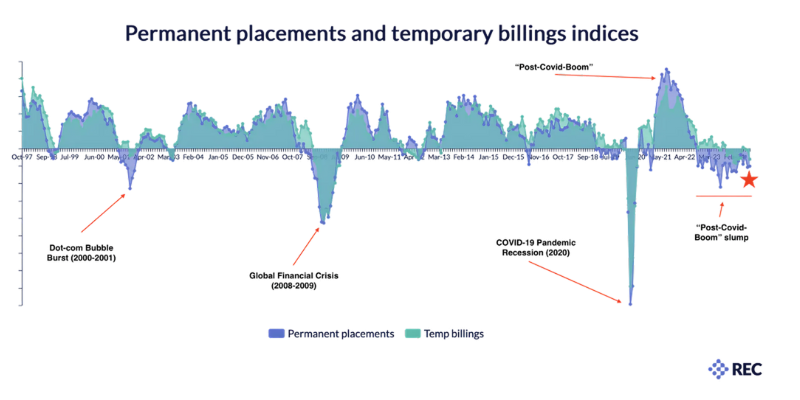
Many businesses regard Marketing as being fundamental to their success as they evolve and react to changing audience behaviours, especially in a challenging economy. However, it has undoubtedly been another challenging year for the recruitment industry, as illustrated in this graph by REC and annotated by The Savage Academy.
Source: the Savage Recruitment Academy
This is a graph showing recruitment billings over the past few decades and it’s a direct reflection of the job market.
We can see the various crashes and recessions, followed by booms and slumps, but the slumps don’t tend to last more than a few months… until more recently. The “Post-Covid-Boom” peaked beyond any other. It was the busiest time in my career to date – Oh to be back there! But the slump that has followed has lasted two years. Previous trends suggest the job market is due to return to normality. Personally, I cannot wait!
Talent Overview
Performance Marketing & Performance Content: Demand for digital marketing skills, in particular Performance Marketing has continued to rise, with generalist marketing roles usually requiring good digital expertise too.
Meta and TikTok are prolific among B2C marketing job specs where social media is a core channel, and we’ve seen more performance content roles coming our way than ever. Job specs for performance content roles vary a fair bit, but trending skills include videography and CapCut.
Chief Growth Officer & Growth Marketer: In 2024 we saw a rise in “growth” focussed roles both agency side and in-house. Many agencies opted for Chief Growth Officer (CGO) or Chief Client roles with a nuanced mix of business development, strategic client services and marketing/agency proposition development.
Demand for in-house Growth Marketers has increased too. Scale-ups and brands launching new products or growing in new markets have been seeking candidates with both strategy development and the ability to be hands on – usually requiring a test-learn-optimise approach to drive sales or generate leads through performance marketing channels.
Fractional Leadership: Fractonal roles have become a more frequent consideration as businesses seek strategic guidance at a Board level, on a part-time or flexible basis where a big permanent salary isn’t an option. We’ve seen a rise in strategic, senior appointments as a whole, and many candidates opting to take their many years of c-suite experience to market in a fractional capacity.
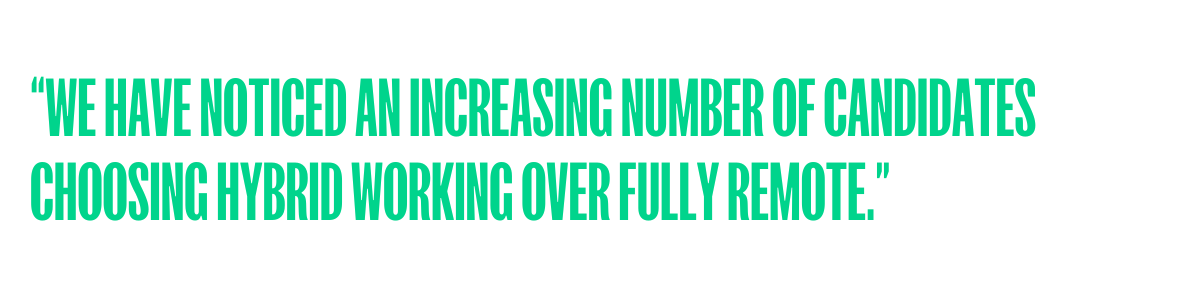
Remote-first vs Hybrid: Whilst remote-first jobs have the greatest pick of talent due to the large geographical pools available to them, we have noticed an increasing number of candidates choosing hybrid working over fully remote.
Remote-first is definitely here to stay and many of our clients do it brilliantly, maintaining every part of their culture, whilst enjoying sustainable growth during tough economic conditions. However, we are also hearing from job seekers wanting to spend a bit more time in an office environment, learning and collaborating with peers in-person, with 2-3 days in the office being the most common. Core hours and flexible working patterns make for a more inclusive environment. And it’s still very true that next-to-nobody wants 5 days in the office!
Salaries & Benefits:
Compared to 2023, which saw some of the highest rises in salaries of recent times, salaries over the last year appear to have begun levelling out. However, competition for the best talent still remains fierce and candidates are considering the entire package, financial and non-financial, your brand, your purpose, how inclusive you are.
This year, the ADLIB team has spent a lot of time and effort researching, surveying, and gathering insights around the range of benefits and flexibility that matters most. We’ve developed guides and processes to help clients benchmark themselves, and stand out as an employer of choice.
Purpose, Inclusion & Belonging: Candidates remain picky with many of them opting only to apply for businesses that are purpose-driven, who walk the walk when it comes to their values. If you’re a B Corp, it’s about your score, your impact report – your commitment to a journey of improvement, not just the badge.
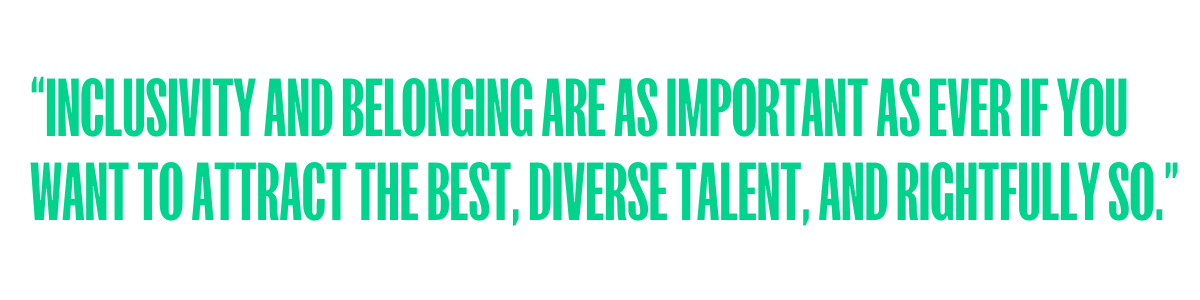
Inclusivity and belonging are as important as ever if you want to attract the best, diverse talent, and rightfully so. Businesses are having to work harder to demonstrate this in their employer brand.
Over the last two years we’ve developed a suite of resources and can offer consultancy in these areas. We’ve also given our True Diversity initiative a refresh and launched our EDI Directory which has already generated some great referrals for some of the featured organisations.
Passive Candidates vs Actively-looking: Because of the tough market and perceived risks that it brings, fewer candidates who are in roles are actively looking on job boards and LinkedIn, so the dynamic of talent pools has shifted. Of course, there are many talented people who are actively looking, but we’re also hearing lots of candidates telling us that they’re reluctant to apply for a role on LinkedIn with 200+ applications as they never hear back.
Our ‘Co-branded’ solutions leverage ADLIB’s brand, network and communities, and we’re explicit about the organisation we’re partnering with. It’s a curated approach with lots of add-ons which we can pull together in a bespoke way. There are no additional costs or up-front fees, and with a 100% success rate over the last two years, it’s the perfect solution for clients that want to stand out as an employer of choice.
Conclusion Despite it being a tough two years for the marketing sector and recruitment in general, we’ve delivered some of our best work, and lots of it. We’ve won more new clients than ever before, whilst continuing to invest in our purpose. We’ve evolved our proposition and service offering for clients, generating case studies we’re very proud of. And we’ve helped more businesses position themselves as an employer of choice, engaging passive talent who aren’t looking in the “usual places”.
I am excited to see what 2025 brings for the Marketing sector! If you’re an employer or a jobseeker, and you’d like to work with us, please get in touch.
Depending on your business type and even your individual career experience, hiring a copywriter might be second nature to you, or it might be something you didn’t even know you could do. In the industry I have worked in for most of my career, full-service PR and marketing agencies are in abundance, but copywriters, far less so. But when I attend networking events with other local PR and digital agencies, it’s part of the day-to-day running of their business. So, for the un-initiated, what sort of companies hire copywriters and what kind of things can they help with?
There are many unique variations of how a copywriter can be utilised in a business, but here is a selection to give you an idea.
Supplement agency deliverables
If a business has a fairly large marketing budget, they may decide to employ a full-service marketing agency to take care of all aspects of their marketing for them. The agency might work with the MD of the company, or an in-house marketing manager, to deliver a whole host of communications from PR and advertising, to e-mail marketing and social media management. However, sometimes, if there’s a wide scope of work, there are things the agency can’t help with.
For example, perhaps a company employs a B2B PR agency to place and write all of their trade magazine articles and press release, and build media relations on their behalf, while their in-house marketing team manages their social media channels. If that same company then wants a B2C blog to support their customer base, it might not be the best utilisation of time or resources of the agency or the in-house team. A third-party copywriter that is also an expert in that field, could research topics for them, make suggestions for new posts and deliver regular blogs every month to strategically suite in with the rest of their marketing activity.
It might not be blog posts that need supplementing, but it’s a great example of playing to different people’s strengths and building a team that can work seamlessly together to deliver everything you need.
Supplement in-house marketing teams
The same idea applies if you only have a directly employed marketing team and don’t use an agency. Your team might be fantastic at coming up with creative ideas for how to market your business, building relationships with magazines, and managing your social media channels. But perhaps they don’t have the time to dedicate to copywriting for longer pieces. Whether writing for e-shots, social media, blog posts, press releases or magazine feature articles, each channel requires something a bit different and rather than making do, you could supplement your in-house team resource with some additional copywriting support.
Support start-ups
When a business is first established, it often doesn’t have the in-house capacity to carry out all of the necessary marketing activities, nor does it have the budget to employ an agency. A copywriter can be an excellent interim solution, or even a sole solution in the beginning and then supplementary support as requirements and budgets increase. They will have the skill and expertise to guide you through what you need and to produce copy with impact. Whether it is populating your new website with words, establishing a business blog, or writing feature articles to promote your new business in trade magazines, a freelance copywriter can be a superb way to support your start-up business in the early days.
Marketing agencies in need of additional capacity
Copywriters are also utilised directly by marketing agencies who want some flexible additional capacity. They don’t necessarily need to employ an additional account manager or full-time or even part-time employee, but they do require some copywriting support across the accounts they manage.
I know from my own experience of working in a couple of different full-service marketing agencies, the amount of admin and juggling there is to do in agency life. It takes an inordinate amount of time to build and maintain client relationships as well as establish and nurture relevant media contacts. Add to this all the written work they need to supply across multiple accounts, and you can see why they need some extra help sometimes.
Copywriters can prove to be an excellent resource for agencies that want to ensure they deliver quality copy on time every time.
Different agencies work in different ways. Some assign copywriters to specific clients so they can become accustomed to that client’s objectives and learn what they like and what they don’t like in their copy, while other agencies prefer a scatter-gun approach to using copywriters as and when they need the additional capacity, across any and all clients. While I would argue the more a copywriter can understand the client, the better they can do their job, it’s horses for courses in terms of what works for the agency and the copywriter alike.
Marketing agencies’ own promotion
It’s quite a well-known phenomenon that marketing agencies are often poor at marketing themselves. It’s like the old tale of the cobbler who had terrible shoes. You spend so much time delivering the best service to customers that you don’t have the time to focus on your own needs. This is another area where external copywriters can offer peace of mind and remove hassle.
Whether it’s the business blog that never quite gets prioritised, or the feature articles in trade magazines to promote your wares, copywriters can take on this aspect of your marketing for you. Because you are a client to them, the work gets prioritised in a way it simply can’t be by in-house employees who have customers that must come first. And because copywriters generally only get involved in writing the copy, you still get to keep those media relationships that you have worked so hard to build, and full control over how your blog looks. In fact, no-one outside of the business needs to know that you haven’t written those words yourself.
Is partnering with a copywriter right for you?
Only you can answer this, but whether you are a full-service agency or a business wanting to market your wares, if you have identified a weak spot in your marketing delivery or know your team is pushed to the limit, it might be time to consider outsourcing some work to a third-party resource. Freelance support is flexible too, so if it doesn’t work out, you haven’t committed to a full employment contract. What have you got to lose?
If you would like a strong copywriter to join your team on a freelance basis, to help remove some of the pressure from your existing resources, I’d love to help. Drop me a line at [email protected] for a quote on any of your copywriting needs.
Most businesses now know about the power of content. But not all content is made equal.
Different types of content serve different purposes and audiences. So content, for content’s sake is not the best way to run your content marketing strategy.
What type of content marketing should you be creating? Which formats will work best for your audiences? Where should you be activating it for maximum effect?
These are all valid and common questions when approaching a content marketing strategy… and it all starts with understanding your audience.
Understanding Your Business and Audience
Knowing your audience is crucial to building out a strong and effective content strategy.
You need to know a couple of things before you start producing any content.
Firstly, you need to have a very clear understanding of your audience’s habits, behaviours and browsing patterns. What are the things they like? What don’t they like? What are their preferred channels?
There’s no benefit in creating a series of long-form blogs and whitepapers, when you’re audience prefers video content. There’s also little benefit if ploughing resources into channels and outlets that your audience simply does not exist in.
Understanding your business in relation to your audience is also very important.
You need to identify the needs of your audience; their pain points and what motivates them to take action. Then you have to overlay this understanding with content ideas on how you can answer those questions and fix their problems.
When you clearly understand these things, you’re on the first step to developing a content strategy.
How The Buyer Journey Impacts Content Marketing Efforts
Principles such as the 95 – 5 rule outline that only 5% of your audience is ready to purchase at any given time. 95-5 states, that because of this, you should not spend all of your time and efforts trying to convert that 5%. Rather, you should spend it engaging with the other 95.
Now the buyer journey does vary from business to business. For some, it can be days, for others, years.
So what this means, in real terms. Is reducing the amount of hard sales content marketing you produce, in favour of more content that builds relationships, andloyalty and fosters engagement.
Producing high-quality content is great. But if all that content does is try to land a sale, your audiences are going to become very fatigued, very quickly.
What Makes YOU, different?
Finally, you need to understand and clearly establish your unique value proposition (UVP).
What sets you apart from your competitors? What makes your products or services unique?
By understanding your UVP, you can create content that showcases your unique strengths and differentiates your business from others.
This is what’s going to make you stand out!
Shaping Your Content Marketing Strategy
With an understanding of your audience’s interests and your own UVP, it’s time to start thinking about what content you can make,
A well-planned strategy will help you create content that resonates with your audience, aligns with your business goals, and sets you apart from your competitors.
Content creation is an extremely helpful way to drive prospects through the buying process, but also an incredible way to build brand loyalty. Rather than think about the quick wins, you should be thinking more in the long term.
Think about ways you can engage, entertain, delight and educate your audiences, rather than just trying to make a sale.
It’s not about conversions… it’s about conversations.
What content should you be making?
So, the Million Dollar Question… what kind of content should you be making?
Well the answer to that question, should become apparent once you’ve done all the appropriate strategic research and planning.
Depending on the content format and type you choose, you can appeal to buyers at different stages of their journey. From awareness and consideration, through to the final decision, different content types can have varying effects.
The awareness stage
At the awareness stage, potential customers realise that they have an issue that needs a solution.
They won’t be looking for answers at this stage but will turn to search engines and social channels to contextualise their problem.
The best type of content that would help generate leads at this stage is top-level informative and relevant content that will explain their problem, concern or situation. It won’t seek to offer immediate answers and solutions or try to push the issue.
It’s about educating and informing… and you can do this in a number of ways.
Blog posts
A blog post or article falls under the category of awareness stage content. Writing blog posts allows a marketing team to target a specific pain point or problem that your audience is experiencing. You may also use search engine optimisation to target keywords that match the search turn. This will assist you in creating valuable content that search engine users may find, in turn potentially generating leads.
White papers
White papers are a form of long-form material, similar to blog posts. However, they differ from blogs in that they provide a comprehensive answer to a specific issue. They can be used to inform, clarify and educate prospects during the awareness stage. They are especially helpful for B2B companies because they cover specific issues related to the industry.
Video Content
For the awareness phase of the buyer’s journey, the following types of video content work best:
Brand films: These videos share your company’s values, mission and brand story to introduce yourself to potential customers.
Explainer videos or animations: These introduce your product or service by focusing on the audience’s pain points
FAQ videos: Short videos that answer common questions to educate searchers about their problems and potential solutions
Ads: Short, attention-grabbing videos that grab the viewer’s attention and send them to your website for more info
Keep these videos short, educating and engaging not hard selling. The goal is to present your best content, as the solution to the viewer’s problem and make them aware of your brand.
The consideration stage
This stage of the buying process is when your customer starts to think about which service or product to solve their issue.
With extensive research and careful consideration of all available options, it is regarded as the lengthiest phase of the buying process. During this phase, your content marketing strategy should include quality content that is as informative as possible, but content that also flexes your knowledge and expertise around the question at hand.
It can also be the place where your audience can discover more about your brand’s reputation. Social media has an impact on consumers at the awareness stage, but it can also move people from the awareness stage to the consideration stage.
Successful social media marketing, for instance, can show competitive value, increase brand awareness and facilitate decision-making.
Video content
For the consideration phase of the buyer’s journey, consider the following types of video content.
Explainer videos: tell your product or service story, and how it solves the customer’s problem.
Demo videos: give customers a full view of how your product works, so they know what to expect.
Webinars: give customers in-depth information and engage with them live.
Comparison videos: compare your product or service to others, andshow off your unique selling points.
Brand videos: show off your company’s values, culture and expertise to build trust and authority.
These videos should educate the audience about your solution, address their specific problems and differentiate your offering from competitors. The goal is to build trust, give detailed information and convince customers your product or service is the solution to their problem.
Email marketing
Email can be utilised at any point during the buying process, but it’s most effective during the consideration stage.
Your customer might not be prepared to make a purchase at this time. But any queries they might have can be addressed in your emails. Email also allows you to learn more about your audience. Click-through-rates, web traffic, bounce data, email opens and behaviours on your site can provide valuable insights.
To move buyers through the process, you can start introducing your product or service in more detail.
Decision time
This is the most valuable stage of the consumer buying process.
It’s where the buyer will evaluate all of their options and decide on the right provider for a solution. At this stage, your buyer knows about your brand through reading your social media network, digital content and high-quality blog posts, and now intends to make a purchase.
Here’s how you can make a difference at this stage
Free trial
Offering a trial is the best method to address any last-minute queries your customer may have about your service. It’s like how car dealerships give test drives. Many software companies free trials to potential customers to give potential customers increase their customer base and widen their market appeal.
Coupon or voucher
Because it appeals to your customer’s fear of missing out, a coupon or voucher is an excellent marketing strategy for the decision stage. Your customer is already fully informed about your company or product at this point in the process. They are now seeking an excuse to make a purchase. At this point, a short-term offer or deal can frequently earn their business.
Case study
A case study can be used in both the consideration and decision-making stages of the buyer’s journey. They’re essentially a kind of research report that focuses on how your solution helped business at another company. They’re excellent for demonstrating how and why your good or service is superior to those of your rivals. By analyzing these case studies, businesses can identify gaps and areas of improvement which can then be utilized to enhance their own strategy.
Video Content
For the decision stage of the buyer’s journey, the following types of video content work best:
Video testimonials: real testimonials from happy customers build trust and credibility and get the potential buyer to take action
FAQ videos: Answer any last questions or concerns customers may have before they buy
Product videos: show off your product’s features and benefits, so customers know why it’s the be
Comparison videos: Show a side-by-side comparison of your product or service vs competitors and your advantages
These should be high quality, short and focused on getting the prospect to buy your product or service. Get them to take action.
Timing is key
Creating content is always designed for the personality and interests of your target audience segments.
But always remember the 95-5 rule, not everyone is ready to buy from you right away. Warm up your audiences and work hard to endear them to your brand during this incubation period.
Wherever you post your content, be it on YouTube, LinkedIn orFacebook use proprietary analytics to monitor the reception of your content. Different channels often have different windows of opportunity for the most effective posting.
Test and learn with this, mix up your posting schedule and try to learn what times work best for you and your audiences.
The Prominence of Video
Now, you’ll likely have noticed the repeat mentions of various types of video content throughout the buyer journey.
Video is more than just a useful tool for conveying information. Video is one of the best ways to tell a story It also has the highest interest level out of any other content form. Making it one of the most valuable and effective parts of your content marketing efforts.
Video content is incredibly versatile and offers a wide variety of creative opportunities for video marketers. A YouTube video, for example, can educate customers on how to use a product, while also entertaining and engaging.
But, there can often be some confusion and concern about producing content like this. You want to be producing quality content. But a lot of people correlate quality content, with extremely high production value and an associated high cost. That’s not always the case.
For example, TikTok can be a very effective source of video content throughout the buyer journey. But TikTok videos don’t need massive production value… if anything, lower production value content works far better here, than something slick and shiny!
YouTube, is becoming increasingly important and quality is important here. It has to look great and something people always overlook, it has to sound great too!
If you’re committed to making video content, know also that sweating the assets is a good thing. Just because you’re making a YouTube video, doesn’t mean it should just be a YouTube video. Consider how you can slice and dice your assets to be used on different channels.
The greater your format variety, the greater your chance of cutting through.
Measuring and Improving Performance
Measuring and improving performance is critical for content marketing success. By tracking your performance, you can identify what’s working and what’s not, and make data-driven decisions to improve your strategy.
To measure performance, you need to track key metrics, such as:
Website traffic and engagement
Lead generation and conversion rates
Social media engagement and follower growth
Email open and click-through rates
Sales and revenue growth
By tracking these metrics, you can identify areas for improvement and make adjustments to your strategy.
To improve performance, you need to analyze your data and identify opportunities for growth. This may involve:
Refining your target audience and content strategy
Optimizing your website and content for search engines
Experimenting with new content formats and channels
Improving your lead generation and conversion rates
Enhancing your email marketing and automation efforts
By continuously measuring and improving performance, you can optimise your website content creation and activation, ultimately driving better results.
In summary
Content marketing isn’t about creating content for content’s sake – it’s about strategic storytelling that resonates with your audience. The key is knowing your unique value proposition and your audience’s journey, and focusing on the 95% who aren’t immediately ready to buy.
In the vast world of content creation, video content is king, it’s versatile and highly engaging across all stages. Remember, it’s about conversations not just conversions.
The ultimate goal? Content that educates, entertains and connects with your audience!
My name is Michael James, I am a driven postgraduate part of the Bristol UWE Alumni. I am known for:
Thriving in social environments and building strong professional relationships.
Demonstrating an unwavering work ethic and relentless pursuit of goals.
Embracing challenges as opportunities for growth and learning.
Balancing academic rigor with a love for sports and active lifestyle.
My current area of work is UX/UI design and digital marketing, with a passion for enhancing brand images in the digital space. Currently exploring opportunities to collaborate on projects that push the boundaries of digital design and marketing. Keen to contribute my skills to forward-thinking teams and exciting initiatives in this dynamic field.
If you would like to learn more about myself and have any positions open..
Yet, 48% of customers have described B2B marketing as ‘boring.’ So where does that leave your site? And what can you do to stand out as one of the interesting ones?
According to a Forrester report, 94% of survey respondents use at least one search channel for consideration/purchase, so the importance of having an engaging and appealing website should never be underestimated.
By creating a memorable digital experience, you can ensure your website users will remember and return to your website when they’re ready to buy a product or service.
Effective B2B web design
The term ‘website design’ has 49.5k searches monthly in the U.S. according to Semrush. Clearly this is a topic on plenty of people’s minds – and for good reason.
In fact, it’s reported that first impressions of a website are 94% design-related. And to top that off, these impressions can be formed in as little as 50 milliseconds.
People often see B2B website design as corporate, outdated, or just plain boring. Whether it’s because the products B2B companies sell are more specialist or niche or because of complex sales cycles.
But times are changing. With digital designers and web design evolving hand in hand, website design has never been so full of possibility.
However, it goes deeper than designing for appearance alone. The most successful websites also apply user experience (UX) best practices to ensure their functionality matches.
Peter Morville, President of Semantic Studios, coined the 7 principles of UX. These principles outline what affective UX should be:
This is because you should always be thinking about the user when it comes to your digital presence. This is how you make your audience feel valued and provide them with a stress-free digital experience.
Many business-to-business companies aren’t aware of the capabilities of their website, so they haven’t made moves to update their digital presence. This means if you take these steps, you’ll be setting yourself apart from the competition, and will stick in the mind of your customers.
What’s more, user experience is a big factor in Conversion Rate Optimisation – meaning the better your UX design, the more likely people will take actions that benefit your business. That could be booking a call or product demo, filling in an enquiry form, or making a purchase.
Outstanding content for a stand-out website
The content that sits on your website is important for so many reasons. If the content on your site isn’t clear, relevant or well thought out, you stand to lose customers.
Your website content also reflects who you are – your personality as a business. It gives you the opportunity to add a personal touch to your buyer’s journey and build a connection with your audience.
It also tells prospects exactly what you do and the services you provide. So, ensuring your website content is optimised is key.
Your content may include headings, body copy, blogs, product descriptions, reports, whitepapers/ebooks, videos, and an array of other assets.
SEO
Content isn’t just about entertaining and informing your visitors. It’s also key to boosting your search engine optimisation (SEO) score.
As Google Search Central puts it, SEO is ‘about helping search engines understand your content, and helping users find your site and make a decision about whether they should visit your site through a search engine.’
One of the main aims of boosting your SEO is to rank higher on search engine results pages (SERPs). This means your website will appear higher on the google search page when people search for certain terms.
A hurdle that many B2B companies face is getting ahead of competitors who may be operating in the same industry or selling similar services. But, by harnessing the power of SEO, you can increase your chances of outranking them and being discovered by more potential customers.
When deciding on the keywords you want to rank for as a business, it’s important to look for words that have a high monthly search volume, but low competition. This means people are actively searching for it, but not many other businesses are focusing on ranking for this term.
Unique content
Ensuring your website content is helping your site stand out isn’t purely about technical optimisation and analytics.
Making your content engaging and unique goes a long way when it comes to differentiating yourself. And with the rise of AI tools like ChatGPT, originality is set to become even more important (and more rare, perhaps).
When planning the content you want to include on the website, you need a strategy. This strategy should consider elements such as:
Your audience
Your competitors
The value you can provide through your content
Tone of voice
Visuals
Calls to action (CTAs)
By combining these personal aspects of your business, you are creating a recipe for a one-of-a-kind content plan.
So, you now must work even harder to capture the attention of your prospects without drowning in the sea of generic thought leadership.
Time to differentiate your B2B website
Business-to-business companies get an unfair reputation for being overly corporate and boring. It’s time to change that perception and start bringing more innovation and design flair to these markets.
Your website says so much about you as a business, so you can’t afford to let yours simply be ‘middle of the road’.
Using a combination of outstanding design and groundbreaking content, you can get ahead of the competition in a saturated market and gain new customers.
So, if your B2B website is looking like it needs a boost, get in touch with us at [email protected].
You might have read our recent blog post about the launch of SearchGPT and how it differs from Google search. In this post, we’ll dive deeper into its functionality and examine how AI powered search compares to conventional search algorithms. We’ll also explore how to stay ahead of the AI curve by examining ways to optimise websites and their content for SearchGPT.
SearchGPT Functionality: 5 Key Features Unique to AI Powered Search
1. Natural Language Processing
SearchGPT uses Natural Language Processing (NLP) to improve the way it understands, processes, and responds to user queries. NLP is a form of AI that focuses on enabling machines to comprehend and generate human language in a way that feels natural and intuitive. It helps ensure that search interactions are conversational, rather than simply providing closed-ended answers. As a result, AI powered search can handle more complex queries than traditional algorithm-based search engines, leading to more detailed and relevant results while also encouraging further exploration through follow-up searches.
With the use of NLP, SearchGPT appears to be adept at understanding not only complex, long-tail searches, but also broad and ambiguous search terms. This technology enables the AI powered search engine to recognise individual user patterns, which in turn helps identify user intent even when your search is very vague. While Google and Bing do also leverage NLP to enhance traditional search results, SearchGPT applies NLP in a more conversational, interactive, and contextually aware manner, thanks to its AI powered conversational model. As such, whether vague or overly complicated, SearchGPT seems to have the potential to better understand non-standard searches when compared to its more traditional competitors.
Example: After searching for multiple terms related to paper mâché projects within SearchGPT, Google and Bing, we ran a search across all three for a single word, ‘Tips’. Whilst Google returned results about tips for the workplace, the banking acronym TIPS, and advice on using the Apple app store, Bing returned results about tips for placing bets on horse racing, news articles related to tipping rubbish, and again tips for the workplace. In comparison, SearchGPT provided the following:
Note: The result contained 7 separate top tips specifically for paper mâché projects, from multiple different websites.
2. Real-time data integration
SearchGPT has the ability to pull in real-time data, providing insights on current events such as live sports scores, weather reports, breaking news and more. This feature gives SearchGPT an edge over standard search engines like Google and Bing, both of which rely on static indexing. Rather than being limited to pulling results from data that has been previously indexed and stored on a periodic basis, it has access to live data which can be dynamically integrated into its responses. This is especially beneficial when searching for time sensitive queries as it greatly reduces the risk of the information presented being outdated. Users can make informed decisions based on results at speed, rather than having to spend time sifting through static results that may not reflect the latest developments.
In summary, SearchGPT’s real-time data integration ensures that users get accurate, fresh information relevant to time-sensitive queries. This represents another potential advantage over traditional search engines, offering a more dynamic and relevant response, particularly in situations where timing and accuracy are critical.
3. Contextual, personalised responses
As touched upon above, SearchGPT offers an element of contextualisation previously not found within conventional search. As seen within the paper mâché example, it uses NLP to help provide context and personalisation to results. Google, Bing and similar search engines often provide the same results for all users, whereas SearchGPT tailors responses based on individual preferences, past searches, and contextual relevance. Not only does this help provide more useful results for its users almost as soon as you start searching, it also has the ability to evolve with each individual user based on their ongoing search behaviour. By continuously evaluating and learning from your search patterns, SearchGPT improves its understanding of your queries, accounting for variations in phrasing, slang, and synonyms. This enables it to offer increasingly precise and contextually appropriate responses with every interaction.
4. Combined insights and concise summaries
We are all familiar with the structure of organic Google search listings – multiple website listings containing a meta title and description, with an accompanying URL, website name and favicon. An example of this can be seen below:
SearchGPT has strayed from this traditional model, instead displaying detailed information in the form of conversational, contextually-rich responses. It presents answers directly within the SearchGPT interface, often providing concise summaries, relevant facts, and real-time data, all tailored to your specific query. This format eliminates the need for users to click through multiple links to find the information they need, making the search experience faster, more efficient, and again more personalised. Additionally, SearchGPT can offer follow-up prompts and adjust its responses based on user interaction, creating a more dynamic and engaging search experience compared to static search engine listings.
5. Advanced privacy and data protection
SearchGPT offers encrypted searches and minimal data storage, ensuring security and confidentiality for users. Whilst conventional search engines such as Google and Bing can retain personal search data for targeted advertising purposes, SearchGPT doesn’t. Users can enjoy a secure, ad-free experience – at least for the time being. SearchGPT is still very new and so who knows if this might change in the future.
SEO and SearchGPT: 5 Top Tips for Optimising Your Website for AI Powered Search
Now that we have a clearer picture of how SearchGPT delivers results, let’s explore how we can adjust our SEO strategies to align with AI powered search.
1. Include conversational keywords in your SEO strategy
SearchGPT is better at understanding natural language than its traditional counterparts, due to its advanced use of AI and NLP. Therefore, optimising your content for conversational queries is key. Rather than relying on short, traditional keywords, consider using long-tail, question based phrases that reflect how users actually speak. For example, instead of targeting generic keywords like “paper bags wholesale,” try phrases like “Where can I buy wholesale paper bags online in the UK?”. This type of long-tail, question-based query aligns more closely with how users naturally phrase their searches, and SearchGPT is better equipped to process and respond to such nuanced inputs.
By optimising content to reflect the way people naturally talk, you increase the chances of your site being displayed in relevant SearchGPT results, providing a more tailored and useful response to users. This shift towards natural language search is not only in line with how AI and NLP are evolving, it also helps improve user engagement by providing answers in a way that feels intuitive and conversational.
2. Structure content to answer specific questions
Similar to the above approach with keyword targeting, ensure the content following question based queries is structured to answer said question(s). AI-driven tools look to provide content that directly addresses users’ queries, so it is essential to format your content to answer questions clearly and concisely. Use headings, bullet points, and FAQ sections to make information easy to find. This way, AI can pull key insights from your content – whilst also making your content more likely to show up as a featured answer or snippet in Google search results.
3. Use schema markup for contextualisation
Schema markup, or structured data, helps search engines better understand your content’s context and relevance – this applies to AI powered search and conventional search engines alike. By tagging information such as events, products, reviews, and FAQs with schema, you make it easier for SearchGPT to interpret your site accurately. This can increase your chances of appearing in results, boosting both visibility and click-through rates / website traffic.
4. Ensure your content is fresh and relevant
As explained earlier within this blog, SearchGPT has access to real-time data, rather than having to wait for periodic crawling and indexation. As such, it is incredibly important to always ensure your content is relevant and up to date. AI based search, similar to traditional search, will also prioritise content that it knows is current and accurate – especially when it comes to topics that change frequently. Regularly updating your content not only shows that your site is active, but also signals to SearchGPT that your website is up to date. Frequent updates can also help you rank better for real-time queries, again further enhancing your visibility.
5. Don’t forget about user experience (UX)
Another factor that AI powered search will take into account when choosing content to display is the user experience provided by a website. Again, this is no different to traditional search engines such as Google and Bing. It is as important as ever to ensure that your site is fast, mobile-friendly, and easy to navigate. Accessibility is also important – if you are unsure of how accessible your site is, whether site speed is negatively impacting your results or if your content is mobile friendly, a Bespoke SEO Audit may be just what you need. We can review many different areas of your website in order to help ensure that it is equipped to rank effectively in AI-driven search results and organic Google SERPs, keeping you ahead in the ever-evolving SEO landscape.
SearchGPT and AI: Staying ahead of the curve
These are just a handful of the ways in which we recommend optimising your website for AI powered search. We have no doubt that we will be posting many more in the not-so-distant future. So keep your eyes peeled in order to stay ahead of the innovation curve.
There is still a lot to learn about SearchGPT, and the Innovation team here at Varn are busy at work testing and researching the impacts of AI powered search on SEO. If you would like to know more, check back regularly for our most recent SearchGPT articles. If you have any questions, please feel free to get in touch. We would love to hear from you.
In the rapidly evolving world of Digital PR, it’s easy to feel overwhelmed by the vast amount of information out there. To help you navigate this landscape, we’ve created a concise glossary that breaks down essential terms and concepts you need to know to strengthen your business’s online presence. This guide is designed to simplify Digital PR by focusing on the most relevant terms, explanations and examples that matter for today’s digital strategies.
A
A/B testing
A/B testing is a method of comparing two versions of content to determine which one performs better in engaging or converting an audience.
Example: Testing two different headlines for a blog post to see which one gets more clicks.
Amplification
Amplification in digital PR refers to the strategic sharing and promotion of content across various channels to increase its reach, visibility, and engagement with a wider audience.
Example: Sharing a blog post on social media and sending it in an email newsletter to increase visibility.
Anchor text
Anchor text is the clickable, highlighted text in a hyperlink that leads to another webpage, often optimized with relevant keywords to improve SEO and provide context for both users and search engines.
Example: In the sentence “Check out our Digital PR services to learn more,” the words “Digital PR services” serve as the anchor text.
B
Backlinks
Links from other websites that point back to yours, helping improve your search engine ranking and build authority.
Example: A popular blog links to your website in an article, that link serves as a valuable backlink.
B2B (Business to Business)
Marketing or providing services to other businesses.
Example: A media agency that sells its services to other companies rather than individual consumers.
B2C (Business to Consumer)
Marketing or selling directly to individual consumers.
Example: An online beauty store that sells directly to shoppers through its website.
Broken link
A hyperlink that no longer works and leads to a page that does not exist.
Example: Clicking on a link to a product page that shows a “404 Not Found” error.
C
Call to Action (CTA)
A prompt aimed at encouraging people to take specific actions, like signing up for a newsletter or making a purchase.
Example: A button that says “Subscribe Now” on a newsletter signup form.
Content curation
Content curation is the process of discovering, organizing, and sharing relevant third-party content to engage your audience and enhance your brand’s topical authority.
Example: Sharing trending or important articles on social media to engage followers.
Content marketing
A strategy that focuses on creating valuable content to engage the target audience.
Example: Writing blogs or making videos to educate potential customers.
Community engagement
Community engagement in digital PR involves actively interacting with an online audience through comments, industry forums, and social media to build relationships, trust, and brand loyalty.
Example: Engaging in a LinkedIn group related to your field and answering questions from other members.
D
D2C (Direct to Consumer)
When a company sells products directly to customers without middlemen such as retailers or wholesalers.
Example: A company directly selling its products on its website.
Domain Authority (DA)
Domain authority is a search engine ranking score that predicts how well a website will perform in search engine results, based on factors such as backlink quality and site structure.
Example: A website with a high domain authority is more likely to appear on the first page of Google search results.
Digital footprint
A digital footprint is the trail of data and online activity left by an individual or organization on the internet, which can influence public perception.
Example: Social media posts, comments, and website visits contribute to your digital footprint.
Do-follow link
A hyperlink that allows search engines to follow it to reach the linked website, passing value and authority.
Example: Your page is linked to another site, and inspecting the link shows if it’s a “follow” link.
E
Earned media
Free publicity gained through word-of-mouth or coverage in the media.
Example: A publication writing about your products without payment.
Engagement
How users interact with your content through likes, shares, comments, etc.
Example: A Facebook post with lots of likes and shares indicates strong engagement.
G
Geotargeting
Delivering content or ads based on a user’s location.
Example: Writing an article for a local newspaper, for the audience of that area.
Google Trends
A tool that shows how popular certain search terms are over time.
Example: Checking Google Trends to see how topics like “Minimalism” are trending.
I
Influencer marketing
Partnering with influencers to promote products.
Example: A skincare brand sending products to beauty influencers for review.
Influencer outreach
Contacting influencers to build relationships and promote campaigns.
Example: Sending an email to a blogger inviting them to review a new product.
K
Key Performance Indicators (KPIs)
Metrics used to measure the success of a marketing campaign.
Example: Measuring media mentions as KPIs to evaluate the impact of a digital PR initiative.
L
Link building
Getting other websites to link to yours to improve SEO and gain backlinks.
Example: Writing guest posts that include a link back to your site.
Link juice
The SEO value passed from one site to another through links.
Example: A high-authority site linking to your page can boost your site’s credibility.
N
No-follow Link
A link that doesn’t pass SEO value to the other site, denoted by HTML tag rel=”nofollow”.
Example: A link on a blog with a “no-follow” tag to prevent passing SEO value.
O
Online mention
When a brand is referenced in online content.
Example: A blog post discussing your company and including your brand name.
Organic search
Search results that appear based on relevance rather than paid ads.
Example: Your website appears in top results for “best running shoes” without paying for ads.
Outreach
Contacting media or influencers to promote a story or content.
Example: Reaching out to journalists to pitch a new product launch story.
P
Pitch
A proposal sent to journalists or influencers to promote a story or idea.
Example: Sending a press release to a reporter to cover your company’s new initiative.
Podcasts
A podcast is a digital audio program available for streaming or download, often featuring discussions, interviews, or storytelling.
Example: A marketing podcast discussing industry trends with expert interviews.
Press coverage
Press coverage refers to mentions and features in media outlets, helping build credibility.
Example: A newspaper article highlighting your company’s achievements.
Press release
A written statement to the media announcing newsworthy information.
Example: Announcing a new product launch through a press release.
R
Referral marketing
A form of marketing where businesses encourage customers to recommend their services or products.
Example: Sending a referral code to a friend.
Retention marketing
Retention marketing is a strategy focused on keeping existing customers engaged and encouraging repeat purchases through personalized communication, loyalty programs, and targeted content.
Example: Offering a coupon code when a customer hasn’t placed an order in a while.
S
Short tail keyword
Short tail keywords are brief, general search terms, typically consisting of one or two words, that have high search volume but also high competition, making them important for driving broad traffic.
Example: “Shoes” is a short tail keyword compared to “best-running shoes for women” which is a long tail keyword and drives niche traffic.
Social media engagement
Interacting with audiences and promoting content on social platforms.
Example: Responding to comments on Instagram posts and sharing user-generated content.
Social proof
Social proof is where individuals look to the actions and opinions of others to guide their own decisions, often leveraged in digital PR through testimonials, reviews, and endorsements.
Example: Displaying customer reviews and testimonials on your website to build trust and credibility.
UGC (User-Generated Content)
Content created by users or customers, often used in marketing.
Example: Resharing customer photos wearing your brand’s clothing on social media.
Still unsure? Speak to our experts
With this glossary, you are now armed with a foundational understanding of Digital PR terminology to support your business’s growth in the digital space. Remember, Digital PR is an ever-evolving field, so staying familiar with these terms will empower you to make informed decisions and adapt to new trends with confidence.
If you are still unsure about any of these terms, don’t hesitate to reach out to our expert team who are happy to help. Contact our expert SEO team.
If you’re building an e-commerce site, you’re probably wondering if your site even needs a blog. The short answer is yes, absolutely it does.
As it turns out, nobody is writing blogs for the sake of it. In fact, businesses with a successful blog generate 67% more leads per month than those without. There are tangible benefits to posting regular blog articles on your e-commerce site and I’m going to walk you through them now.
Why Do Websites Have Blogs?
Did you know that small businesses that blog get a whopping 126% more lead growth than those that don’t?
It’s important not to overlook blogs when thinking about your content marketing. They’re a great way of boosting traffic to your site, building your brand voice and engaging potential customers by informing them about your products.
It’s true that not everyone who visits your website will read your blog, but that doesn’t mean it should be overlooked. You’re probably the fountain of knowledge when it comes to your products, but it can be difficult to demonstrate your knowledge and credibility through product descriptions and landing pages alone. Converting your knowledge into long-form copy is a great way of sharing your expertise and building your brand.
Rather than simply promoting your products, your blog should serve as an information hub for potential customers and contain ‘top of the funnel’ content to target them in the discovery stage of their journey to buying your products.
Blogs should be educational and informative, and by providing expertise and insights into the value of your products, you’ll build your reputation as a trustworthy brand, engage customers and push them towards making a purchase.
How Does Blogging Boost SEO?
Take it from us – SEO is extremely important for any online business and blogging represents a fantastic opportunity to improve your SEO rankings and drive traffic to your e-commerce site.
By writing fresh, long-form copy for your site, you’ll target more keywords than you would on your product pages. What’s more, putting out fresh content is a good way of signalling to Google that your site is active. As a result, Google will push your content further up search algorithms, generating more traffic to your site and improving your SEO and conversion rates.
Blogs are also a great place to target long-tail search. When customers are in the awareness stage of the marketing funnel – that is, aware they have a problem but not of what the solution is or that you as a company offer it – they are more likely to be searching for informational keywords. These ‘top of the funnel’ keywords usually start ‘how’ or ‘why’ and are longer. Individually, they have a lower search volume but there are a lot more of them so this traffic can be substantial. Blogs can be used to cover a lot of informational ground, which will mean your e-commerce site is more likely to pop up when your target audience is researching anything to do with your industry or products.
Capturing this traffic will boost your site’s overall SEO but it will also build awareness around your brand and help funnel traffic to your product pages.
What Should an E-Commerce Blog Talk About?
When it comes to blog content, the sky’s the limit. If you think you’ve got nothing to say, start by stepping into the shoes of your potential customers. Ask yourself:
What questions are they asking?
How can you convince them your product is the best choice?
What expertise or insights can you share with them?
Keyword research can give you solid insights into the questions your customers are asking. However, competitor analysis is also your friend here. By reviewing what others in your niche are writing about, you can pinpoint content gaps and discover what’s generating the most engagement among your target audience (this is often called a ‘content gap analysis’). This approach can set the stage for you to attract consistent, high-quality leads.
To help you get the ball rolling, we’ve put together a quick list of blog ideas for your e-commerce site:
Manufacturing Processes: Dive into the process behind your products. Share details about materials, ingredients or manufacturing techniques that help tell the story of your brand.
FAQ Guides: Identify the most common questions your audience has and turn them into comprehensive FAQ-style articles. This can help answer customer concerns while building trust.
How-To Guides: Showcase your expertise with how-to guides. Walk your customers through using your products, addressing their pain points and offering solutions.
Recipes: If your products are food-related, offering recipe ideas will demonstrate their versatility while nudging visitors towards making a purchase.
Thought Leadership: Offer your opinions or expert insights on your products and industry, positioning yourself as a trusted authority in your field.
Industry News: Keep your audience in the loop by discussing the latest trends and developments in your sector, helping readers stay up to date.
Product Recommendations: Create lists of your top products or suggest pairings that enhance their value. This type of content can help guide undecided visitors to a purchase decision.
By tapping into these ideas, you’ll keep your blog relevant, informative and engaging.
How Often Should You Publish Blogs?
There is no one-size-fits-all answer when it comes to how often you should post blogs on your e-commerce site. While some companies pump out new content each day, others may only post a few times a month. The amount you post depends on your available time, budget and how much you genuinely have to say about your business.
What matters most is the quality and value of your content. If you find yourself churning out content just for the sake of it, it might be time to take a step back and reassess your content strategy. Often, fewer high-quality posts can deliver better results than posting more frequent, less valuable content.
You need to load content from reCAPTCHA to submit the form. Please note that doing so will share data with third-party providers.
 Meta and TikTok are prolific among B2C marketing job specs where social media is a core channel, and we’ve seen more performance content roles coming our way than ever. Job specs for performance content roles vary a fair bit, but trending skills include videography and
 Inclusivity and belonging are as important as ever if you want to attract the best, diverse talent, and rightfully so. Businesses are having to work harder to demonstrate this in their employer brand.
