JMP Partners with Wesport to encourage Women and Girls to get active through extension of ‘Bristol Girls Can’ Campaign
JMP, a Bristol-based creative content and campaigns agency, is thrilled to announce its partnership with Wesport to drive the inspiring ‘Bristol Girls Can‘ campaign forward into 2024 and 2025. This collaboration marks a new milestone in empowering women and girls across Bristol to embrace physical activity and lead healthier lifestyles.
‘Bristol Girls Can’, is the local activation of the widely acclaimed Sport England ‘This Girl Can’ campaign, has been successfully run for the past nine years under the stewardship of Bristol City Council. Now, Wesport, the Active Partnership for the West of England, takes the reins to continue the impactful work of encouraging movement, fostering confidence, and building community among women and girls in the region.
JMP’s responsibilities include campaign development, messaging, content creation, social media engagement, and website management.
The ‘This Girl Can’ campaign seeks to tell the real stories of women and girls who get active or play sport in the way that’s right for them, for all shapes, sizes and abilities. This campaign is aimed to create a supportive and inclusive environment where women and girls feel encouraged, empowered, and celebrated for their participation in physical activities.
“We believe in the power of community and collective action to drive positive change,” said Steve Nelson, CEO of Wesport. “Together with our key partners, we are committed to fostering a culture of inclusivity, fun, and empowerment that inspires women and girls across Bristol to lead active, healthy lives.”
Managing Partner at JMP, Matthew Joy, also added: “We are incredibly excited to partner with Wesport on the ‘Bristol Girls Can’ campaign. This initiative is not just about promoting physical activity; it’s about creating a sense of community across the Bristol area for women and girls and to inspire positive change and one we are excited to play a part in with other key local partners”.
The partnership invites community members to join the conversation, share their stories, and contribute to the campaign’s ongoing success.
Individuals are encouraged to reach out via email at [email protected] to share their experiences, and insights around the local challenges that women and girls face in accessing movement and physical activity, as well as those that are already active to share what works for you and what got you started.
As part of the campaign there will be a newly formed professional network community with an initial event being held on the 26th June. This network will be created to bring together organisations from across the city, all with a common goal of inspiring women and girls to get active across Bristol.
About JMP:
JMP is a Bristol-based creative content and campaigns agency dedicated to creating impactful storytelling and engaging content for brands and organisations. With a passion for creativity and innovation, JMP partners with clients to deliver compelling campaigns that resonate with audiences and drive measurable results.
About Wesport:
Wesport is the Active Partnership for the West of England, serving the communities of BANES, Bristol, North Somerset, and South Gloucestershire. As a sports charity, Wesport is committed to promoting physical activity, fostering inclusivity, and improving the health and well-being of individuals across the region.
For more information about the Bristol Girls Can campaign and upcoming initiatives, follow on social media and visit the website.
Web: bristolgirlscan.co.uk
Facebook: facebook.com/bristolgirlscan
For any inquiries, please contact [email protected]
At a Bristol Creative Industries keynote event in March, we were joined by Drew Benvie, founder of global social media agency Battenhall. He shared insights from the company’s 11th annual social media trends reports. In this post, Dan Martin summarises Drew’s brilliant talk.
When it comes to social media, Drew knows his stuff. At the age of seven, he taught himself how to code on an Amstrad CPC 464, and in 2006 he was the first to coin the term ‘social media’ on Wikipedia. Drew founded Battenhall in 2013 and now employs 120 people in the UK and overseas.
Opening his talk, he said:
“There are more places than ever to commit your time and your advertising money, so it’s important you know where to invest. You could stick to a few but the average person in the UK is active on six social networks. In India, it’s 10. If you’re trying to reach your target audience, you have to do more than ever before to really stand out.”
Social media is ubiquitous. Eight out of 10 people who use social media do so actively. Brits spend 75% of our working day looking at a screen of some sort, with teens spending around 5.3 hours a day on social.
But over the last year, Drew said, various things have happened, such as “the implosion of Twitter” following Elon Musk’s purchase of the platform, “that has made me feel that safety on social media is an important thing”.
“Social media is now toxic to many, whether it’s the stuff that we see that should be taken down, or the actions from one user to another that are allowed unfettered on social media.”
A million posts are removed by Meta every day, Drew said, while TikTok employs 40,000 people to moderate content.
Amid all this, social media owners are appearing in front of regulators around the world, as governments look to bring in new legislation that regulates social media.
So what does this mean for brands? Drew’s advice is:
“AI (artificial intelligence) is one of the most unstoppable forces,” Drew said.
See below for what ChatGPT created when he asked it to show a vision of Bristol in the future!
AI in action from @drewb in @Bristol_CI keynote.
“ChatGPT, show me a vision of Bristol in the future.”@brunelsbridge still going strong! @battenhall #Bristol #Battenhalltrends pic.twitter.com/r6E000jO4X
— Dan Martin (@Dan_Martin) March 12, 2024
AI helps to speed up creativity”, and you should think of it as “your brainstorm buddy”, Drew advised.
You can already use AI features on social media platforms to create or improve content, but Drew said “there is an important balance between making something authentic because it is created by a human and harnessing the power of AI to speed things up when you need to”.
He continued:
“I’m an advocate of using AI to augment what you do, not replace it. Get it to do the stuff that you shouldn’t really spend time doing.”
Drew said consider AI as your “brainstorm buddy”. He recommended experimenting with AI tools, such as ChatGPT and Google Gemini, and see which work best for you. Remember that AI isn’t just for generating content, you can also use it for tasks like analysing data.
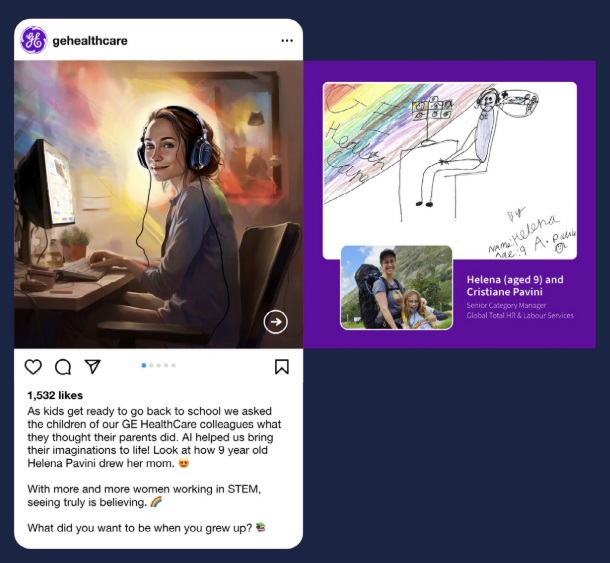
As an example of AI in action with creative content, Drew shared a campaign using AI that Battenhall delivered for a client.
The children of employees at General Electric were asked to draw what they thought their parents did for a job. Battenhall then used AI to create images based on the drawings that were used for social media posts.
On LinkedIn, the content delivered the top-performing post for the whole quarter, more than doubling the benchmark engagement rate for the quarter. In addition, the campaign contributed to a 12% increase in the number of new followers (month on month).
Drew warned that brands should also be aware of the ethical, regulatory and legal issues around AI such as who owns the content you produce using the technology.
The fallout from Elon Musk buying Twitter led to an exodus of users signing up for other social media platforms. Many people switched to Mastodon, the open source social network, and Meta launched Threads, an app linked to Instagram which became the fastest to reach 100 million followers.
“There are 35 social networks with over 100 million active users [see some of them on page 7 of the ‘Life after Twitter’ report] and endless niche communities. That is my biggest learning from what has happened to Twitter. Niche is now good. It’s ok to be small.”
The biggest beneficiary of “the carnage at Twitter”, Drew said, is LinkedIn. It reported a 41% increase in volume of content between 2021 and 2023.
Drew’s tips and insights for LinkedIn are:
But the most important tip for choosing where to engage on social media, is pay attention to your audience and where they hang out. There’s no one size fits all.
“Be really analytical. Figure out what your audience does, where they spend their time, what trends they follow.”
“TikTok calls itself an entertainment platform, not a social network, and it’s a places other social media platform are trying to emulate.”
Drew said TikTok has shown to brands the power of being entertaining. “I think every brand in 2024 has the ability to be more entertaining.”
“Any brand can do anything on social media. People expect a brand to be a person, to have a voice. The unhinged, entertaining and educational stream of content coming through on platforms like TikTok is creating opportunities for even the most boring brands to be entertaining, informative and educational.”
Drew said the three ways brands can be entertaining are:
One example of an entertaining brand that is “completely unhinged” is Duolingo on TikTok. “My kids want to spend their pocket money on learning languages on Duolingo beause the owl is so engaging.”
For an example of good educational content, Drew recommended Channel 4 on Threads.
“What makes social media content work is engagement, sentiment uptick, and visibility for people that are hard to reach. Entertaining content achieves on all those fronts.
“Think about how you can tell stories and answer questions. People want to learn new things. Think about the niches users might want to know about that are linked to your brand. Even with something a bit more corporate, there’s a story to tell and an audience looking for answers. Consider various different channels to reach your target audience.
“To create content that’s right for you, think about your brand personality. Place yourself in your audience’s shoes, and don’t be afraid to either stay in your lane and do one thing well, or branch out and try lots of different things. Social media is all about experimenting. Post things. Delete them. Start a channel. Let it go. That’s all fine.”
Drew said that the fatigue that many people have with influencers and the creation of content about something they are paid to say is good has helped bring about a creator culture:
“There are more people creating more things with more creativity on more platforms more often. Creators provide opportunities for any brand because your niche is out there somewhere.
“A creator’s goal is to produce high quality, authentic content. For that, they want to work with brands. If you find the right ones, they are usually cheaper to work with than influencers, you can do more meaningful projects with them, and they tend to be more authentic.
“A creator might have a smaller audience than an influencer but they often can do more with less. They also might not ask for money if there’s some other type of value exchange such as early access to a new product.”
Instagram and YouTube are the most popular platforms for creators, but delve into any channel and you’ll likely find a vibrant creator culture, Drew said.
Other networks to explore include spontaneous photo sharing app BeReal, communication platform Discord and livestreaming community Twitch. Private communities, such as Facebook and WhatsApp groups, are another format worth looking at.
To stay updated on future Bristol Creative Industries keynote events, sign up for our newsletter.
Globally recognised companies all owe a large part of their fame to the power of marketing.
When done right, marketing can be the biggest factor when it comes to business growth, strong ROI and overall sales revenue. Take Apple for example, in 2022 they generated £3.8 billion ($4.7 billion) from ad revenue alone.
Effective marketing also has the power to increase your brand’s mindshare. When you think of sportswear, Nike and Adidas will likely spring to mind. With fast food, McDonalds will no doubt enter your thoughts.
With revenues in the billions, these huge brands must have a secret formula to their marketing, right? Nope.
These businesses no doubt have marketing teams that pour countless hours into their campaigns and for the most part, it pays off. But what happens when it doesn’t?
In this blog, we’ll look at some famous marketing faux pas – not to gloat, but to learn from them – and help your business avoid making the same mistakes.
When it comes to marketing campaigns that failed to read the room, the Pepsi X Kendall Jenner advert was a particularly high-profile example.
The advert, which aired in 2017, depicted a group of protesters walking through the streets. Kendall Jenner joins the group and offers a police officer on the scene a Pepsi, defusing the tension between groups.
“…riding the coattails of a political movement founded by and for oppressed voices will always be seen to be in poor taste…”
At the time of airing, the Black Lives Matter protests were commencing around the globe, and viewers couldn’t help but notice the parallels drawn between the two. This didn’t work in Pepsi’s favour as people saw it as a trivialisation of a deep-rooted issue.
The backlash caused Pepsi to pull the advert – a sizeable blow to both budget and reputation. It just goes to show that – while it’s great to keep your marketing relevant – riding the coattails of a political movement founded by and for oppressed voices will always be seen to be in poor taste.
Our takeaway?
Always consider the political climate and check the news before you release an ad campaign into the wild (or sign off the budget).
Rebrands can offer huge potential for businesses. When a brand is becoming outdated, giving it a refresh grabs the attention of customers and, when done well, can attract new ones in the process.
Typically, in business, this kind of move is calculated, necessary and carefully takes into account the thoughts of the consumer. However, the same can’t be said of Gap’s 2010 rebrand…
In fact, it ended up costing them $100 million.
One reason this marketing stunt failed so spectacularly was that nobody was expecting it.
No prior announcements, launches, or updates were released. This meant that they hadn’t built up the necessary anticipation for such a big move. The logo change alone was so drastic it left people feeling bewildered at best.
Another major reason this change didn’t work out in Gap’s favour? They didn’t seem to have a reason to do it in the first place. With a loyal customer base spanning the globe, enviable revenue, and a famous brand identity, changing things up just didn’t seem to make sense.
“…while a rebrand could be just what your business needs, it must be underpinned by strategy…”
But alas, the change had been made and people were not happy. On top of the cost of the entire process, they were forced to revert to their old logo within less than a week.
So, while a rebrand could be just what your business needs, it must be underpinned by strategy, done with good reason, and signalled by pre-launch PR and marketing.
Our takeaway?
Always do your background research, build anticipation for the change, and make sure it aligns with the way your customers see you – they are, after all, the most important factor.
Climate change is a very real and important issue that we currently face. Many businesses are aware of this and are making changes to reduce their impact and greenhouse gas emissions.
That’s why you’ll often hear businesses talk about their corporate social responsibility (CSR) or environmental, social and governance (ESG) initiatives.
It’s also why vehicles are tested to ensure emissions are aligned with regulations.
In 2015 the Environmental Protection Agency (EPA) found that tens of thousands of Volkswagen’s diesel cars produced in the US each year were cheating emissions tests. And this was after a huge marketing campaign touting the car’s low emissions.
“…it only takes one false claim to lose your customer’s trust…”
Thanks to a device that could detect when the car was being tested and alter the way it performed, the manufacturer was able to falsify recorded emissions.
This meant that the engines of these cars emitted nitrogen oxide up to 40 times greater than the permitted limit in the United States, without it showing up in test results.
Upon this scandal coming to light, not only did Volkswagen lose the trust of a large portion of their current and potential customers. It also meant that in October 2015, the company posted its first quarterly loss in 15 years, which was over £2 billion.
Volkswagen issued a public apology but in spite of efforts to rectify the damage, the scenario remains fresh in people’s minds.
Our takeaway?
It only takes one false claim to lose your customer’s trust. Which is exactly why it’s so important to ensure your business doesn’t get caught in any greenwashing grey areas (or outright deceptions, in this case).
If you want to find out more about greenwashing risks and how to so you can avoid them, explore our CSR marketing series.
While we’ve only covered a handful of examples, marketing mistakes are all too common. And, as we’ve demonstrated, even some of the most famous brands in the world are not immune.
With the potential to cause a loss of revenues, customers, trust, and reputation, it’s important that all marketing and advertising campaigns are backed by strategy, and checked. And double checked. And triple checked.
Because once live, they can be near impossible to take back.
Nobody’s perfect, but we are thorough – both in strategy and quality assurance.
If you have a campaign idea you’d like to discuss, get in touch with our marketing team: [email protected].
How to use language to foster stronger, happier, more productive relationships.
Words: Simeon de la Torre, SIM7.
The language that an organisation uses in its content, copywriting and comms influences not just how it is perceived, but how it makes audiences feel. It’s a complex, nuanced arena, but there are a handful of golden rules to remember around using brand language that’s appropriate and inclusive.
First up: what’s DEI?
Diversity, Equity, and Inclusion (DEI) aims to make everyone within an environment, regardless of race, ethnicity, religion, ability, gender or sexual orientation, feel supported and welcome.
Why is it better to use inclusive language?
According to Deloitte, companies that embrace inclusivity and inclusive language have 22% lower turnover rates, 22% greater productivity and 27% higher profitability. Externally, those companies have 39% higher customer satisfaction.
Rule #1 Avoid certain ways of identifying people
Only use race, gender, gender identity, ability, age, sexual orientation, etc. to identify people when strictly necessary, otherwise doing so can draw attention to something about someone’s characteristics that might make them feel different or excluded.
Rule #2 Use people-first language
People-first language prioritises the individual. This is an especially useful point to remember when talking about people who have disabilities.
For example, it’s better to say ‘a person with a disability’ than ‘a disabled person’. The former implies that the disability is a secondary characteristic rather than a defining one. But as mentioned in #1, it’s best to simply avoid mentioning disability unless relevant or strictly necessary.
There are a few exceptions to this point. The deaf community, for instance, generally prefers the term ‘deaf person’ to ‘person with deafness’. If in doubt, it’s best to ask.
Rule #3 Be wary of connotations
Terms such as ‘sexual preference’ or ‘preferred pronouns’ can be problematic. ‘Preference’ implies choice, and that can create a false impression. It’s best to err on the side of caution and use the terms ‘sexual orientation’ and ‘pronouns’ instead.
Rule #4 Avoid inappropriate references
Try to avoid using terms such as ‘bipolar,’ ‘OCD,’ ‘ADHD’ or ‘ASD’ as metaphors, especially in a jokey context. These are real disabilities and disorders. Using their names to refer to things they aren’t can offend people who have them.
Rule #5 Use gender-neutral language
Yes, you may often use language with a specific audience in mind, but pronouns are generally best avoided.
When making a hypothetical point – ‘if he or she went for a walk’, for example – the ‘he or she’ clause is unnecessary, and including it can make non-binary, gender non-conforming or genderqueer folks feel excluded.
When in doubt or when using a pronoun is necessary, ‘they’ is a good choice. It’s gender-neutral and can be used to refer to an individual or a group, so has all bases covered.
Rule #6 Avoid universal phrases
Jargon is often best avoided and it’s a good idea to think before using idioms – not all translate well across cultures.
Rule #7 Avoid using your group as the reference group
Using your group as the reference group can imply it’s the norm and that other groups fall outside that norm. Terms like ‘non-white’, for example, imply that white people are the norm and everyone else, a deviation.
It’s best to take care when saying…
Guys
This term is best avoided when speaking to or referencing a group that contains non-male members.
Good alternatives: ‘Folks’, ‘you all’, ‘everyone’, ‘team’.
Girls/ladies/gals
If she’s over 18, she’s an adult. And take care when saying ‘ladies’ and ‘gals’, these terms can be patronizing. Good alternatives: ‘Women’, ‘people’.
Handicap/handicapped
Today, ‘handicapped’ is considered impolite.
Similarly, when talking about people with disabilities, avoid using terms like ‘afflicted by,’ ‘victim of’, ‘suffers from’, and ‘confined to a wheelchair’. ‘Challenged’, ‘differently abled’, and ‘specially abled’ are best avoided too.
Good alternatives: ‘Disabled’, ‘person with a disability’.
You might also consider…
Mentioning pronouns
Including pronouns – he/him, she/her, they/them – in email signatures can help non-binary, transgender and other folk feel more included.
Trigger warnings
If you’re going to publish content that has the potential to trigger people, it’s a good idea to add a trigger warning to that content. Forewarning people about potentially offensive content can help prevent causing offence.
Writing for web accessibility
People with certain disabilities can have difficulty navigating online content. We can all help ensure the content we create is accessible. See our designing for accessibility cheat sheet for useful tips.
Keeping up-to-date
Inclusive language best practice is constantly evolving. Periodic refreshers are a great way to stay up to date. Taking a moment to think about how the language you’re going to use is inclusive often goes a long way, too.
To learn more about creating an inclusive brand, visit https://sim7creative.co.uk/ or get in touch with Sim (he/him): [email protected]
In an era where businesses are increasingly expected to prioritise social and environmental impact alongside profit, Disruptive Thinking has taken a bold step forward by achieving B Corp certification. This certification marks a significant milestone for team Disruptive, reinforcing their commitment to fostering a diverse and inclusive workplace, minimising their environmental footprint and dedicating themselves to ongoing improvement.
Disruptive Thinking’s Founder, Yiuwin Tsang said “When founding Disruptive Thinking, I knew I wanted the business to be a force for good. Our company motto is “Good work for good people” and it’s really nice to join the ranks of other businesses who share the same vision, under such a well-regarded standard.”
“The decision to pursue B Corp certification was driven by a deep-seated belief in the power of business to drive positive change. As a team who pride ourselves on being forward-thinking, becoming a B Corp aligns so well with our core values of empathy, integrity, and sustainability.”
“One of the key benefits of being a B Corp is the opportunity to collaborate with like-minded businesses and organisations. We can’t wait to meet other B Corp organisations at local meetups – come over and say ‘Hi’ if you spot any of the team!”
About Disruptive Thinking
Disruptive Thinking is a small team with deep expertise in Marketing, Business Growth and CRM. Our team take on a variety of projects, from designing marketing strategies and executing delivery, to establishing sales processes, to delivering workshops and events.
We’ve worked with accountancy firms, agencies, startups, law firms, publishers, universities, the creative industries and healthcare providers – supporting them on strategic planning and execution across their sales, marketing and delivery efforts.
We work with any size of organisation, from large corporates through to startups, plus public bodies and not-for-profits. Our motto is doing good work for good people. We’re proud of the quality of work we deliver, and ultimately want to work with clients who are also passionate and driven about what they do.
Got any questions? Just want to connect? Reach out to the team at [email protected]
Specialist CRM agency Flourish was celebrating Thursday 18th April following the announcement at the Campaign Media Awards that their work for Pai Skincare had won ‘The CRM and Media Award’ category.
Award judges described the campaign, which utilised first party data to inform a media strategy which ultimately increased conversion and reduced CPA as, “…clever, rock solid.”
The achievement was even greater as Flourish was one of only six agencies up for an award that didn’t come from the Campaign Top 20 (Campaign School Report Billing 2023). Flourish’s Managing Director Ian Reeves commented: “I’m so proud of the team, but I’m not surprised by the win. With stricter privacy regulations in the UK and EU, and the death of cookies, first party data is becoming increasingly important. It provides marketers with ways of reaching customers with more relevant and engaging comms – something CRM specialists like Flourish have been championing for decades!”
Pai is a ‘clean’ skincare brand selling products direct to consumers via their website. Offers are a vital tool in securing a sale, but Pai wanted to reduce their CPA which had crept up over time.
The award winning work utilised Ometria’s Predictive Attributes to identify customer behaviours and classify them as active, at risk or lapsed. The ‘pot’ customers were put in determined the content of the email journeys they would then receive – with offers as a last resort.
In addition, instead of offer / discount messaging, web visitors were retargeted with product ads focusing on quality, to build brand value. Demographic data gained from CRM meant that only visitors who were most likely to buy were retargeted.
Flourish’s Managing Partner and Head of Media Steve Davis said: “This work shows how powerful media strategies driven by CRM insights can be. This campaign was absolutely transformative in terms of reducing CPA and increasing conversion for Pai and demonstrates the ROI agencies like Flourish can deliver for our clients.”
Notes for editors
Flourish is an independently owned, specialist CRM agency based in Bristol. Platform agnostic, the agency works with the tech clients have in place to deliver data-driven customer journeys to OPTIMISE, ELEVATE and ultimately TRANSFORM their clients CRM.
For more information contact Ian Reeves, Managing Director [email protected].
We’ve all heard the stereotype that business-to-business marketing is corporate and serious. More suited and square than boldness laid bare. Nothing like the glamour, humour and heroism of its B2C counterpart.
Because there’s no place for great, inspiring creative when you’re dealing with engineering, manufacturing, technology or professional services, right?
Wrong. Wrong on all counts, in fact.
“…it’s as much human-to-human as it is business-to-business…”
Even B2B marketing is all about making the right connections with people. So it’s as much human-to-human as it is business-to-business (the reason we’re always reiterating the importance of a marketing mix that balances brand building with lead generation).
As an agency that provides B2B marketing services to a range of clients within manufacturing, financial services, legal, healthcare, and many more industries, we’re no stranger to finding creative, innovative ways to add allure to corporate, industrial and even technical communications.
Research shows that B2B marketing should be just as, if not more, eye-catching, quick-witted and creative as B2C. In a recent LinkedIn study 69% of B2B marketers agreed that B2B purchasing decisions are as emotionally driven as B2C, and 39% said they use storytelling, humour and emotion to help make their campaigns resonate with their audience.
“…80% of B2B customers expect to have a buying experience with the same level of personalisation as B2C marketing…”
In a 2023 study, 92% of CMOs ranked creativity a top priority. And it may seem obvious, but even in B2B marketing, our audiences are made up of people – the same emotionally driven decision-makers as B2C audiences. Sure, they might also be looking for stats, social proof, solutions to very specific problems, and metrics such as ROI. But that doesn’t take away the appeal of striking creative.
“…there’s nothing safe about the ‘sea of same’ B2B marketing channels can become…”
In fact, you could argue it’s even more important to consider the psychology behind your creative decision-making. There’s certainly makes a strong case for personalisation. In fact, according to 6Sense, 80% of B2B customers expect to have a buying experience with the same level of personalisation as B2C marketing.
The takeaway? Being brave can help you stand out from the competition. And it really does pay.
Here are a few examples of clients we’ve worked with where we’ve used creative techniques to generate impressive ROI and results.

The world is on a race against time to reduce carbon emissions and limit the devastating effects of climate change.
Specialists in heating and cooling solutions, Daikin developed the Altherma heat pump as an alternative to fossil-fuel boilers – one with a significantly reduced environmental impact. To promote these benefits, the team needed a stand-out B2C campaign.
With a predominant focus on B2B products, Daikin had very little consumer presence in the UK and needed to persuade a broad audience to invest significantly more money to install a heat pump into their homes compared to a standard boiler.
We developed the Sustainable Home Network identity to align with Daikin’s renewable energy mission. We then created a multi-step, multi-platform campaign.
We developed an overarching message: ‘Be the energy for change” – the thread that ran throughout our persuasive ad campaign. At the heart of the creative was an aspirational vision of a comfortable, low-carbon lifestyle.
The campaign went to market on brochures, LinkedIn and social media advertising, national press and PR. We also developed a TV commercial, and Daikin even featured our designs on their fleet of installer vans.
The Energy for Change website attracted more than 216,000 visitors in three months
13,382 brochure downloads
1,887 requests for an Altherma heat pump to be installed
Phil Robinson, Creative Director:
“Great creative and B2B marketing aren’t always synonymous. We’re all so engrained in the traditional patterns of B2B thinking and speaking that creativity is often lost in the front-of-mind commercial arguments we’re inevitably drawn to.”
“But make no mistake – high-impact creative is essential if your B2B marketing is going to be effective. It’s the one sure-fire way to move hearts and minds.”

Known globally for its best-in-class printers and innovative office printing solutions, Epson needed a powerful brand campaign to promote the benefits of using Heat-Free printing technology.
Epson printers don’t require any heat in the ink ejection process, so they consume less energy. They provide improved performance, increased productivity and reduced environmental impact – which became the driving force behind our campaign.
We used cinematic shots of an Olympic skater to carve the key messaging from our campaign into beautiful ice forms. The powerful video content – paired with photography from Epson’s National Geographic collaboration – told the‘Heat-Free’ story beautifully.
The footage became the bedrock of our visuals, allowing us to draw emotive, evocative comparisons between the technology and its eco-credentials.
We saw 10% YoY growth in sales volume for the business unit from campaign launch.
Luke Waterman, Art Director:
“We work hard to create campaigns that stand out from the crowd. There’s no benefit to blending in – no reward for being professionally overlooked. But there should be a reward for the audience. So we aim to deliver the right visual cues that provoke an emotional response, be it humour, shock and awe, an empathic association, or simply aesthetic value – but (hopefully) it’s never vanilla.
“I think what we do well is to tailor our clients’ message to reflect the needs and interest of the audience, getting the visual look and feel just right to make marketing materials more relevant and interesting.”
Panasonic TOUGHBOOK

Panasonic TOUGHBOOK pioneered the rugged computing market. Its laptops, tablets and handheld devices are designed to withstand the harshest environments in a range of industries, from the military and emergency services, to manufacturing and industrials.
An already well-established brand, TOUGHBOOK wanted a campaign that resonated with its diverse target audiences. It needed to reach multiple sectors and countries, so being translatable was key.
And so ‘TOUGH is’ was born.
The messaging was developed to empower and relate to both the key-workers using the products and the devices themselves.
We formed emotive headlines such as ‘TOUGH is staying strong in mission-critical moments’ and ‘TOUGH is being where you’re needed most’ that would evoke a sense of what it’s like to work in these rugged environments, as well as demonstrating exactly how impressive and robust the technology needs to be. High-octane, dramatic photography brought this vision and the words to life for a striking campaign.
We introduced Video Ask to track the enquiries that came through from the campaign and to engage the website traffic.
63% of people engaged with the Video Ask interface
43% of people answered at least one question
20% of people finished the journey and completed required action
Robbie Masters, Senior Copywriter:
“It’s a misconception that B2B marketing is dull. But actually it can get samey if businesses aren’t careful. Our clients are doing brilliant things, producing ingenious products, and having a positive impact on people’s lives every day.These are stories worth telling.
“It’s our job to unearth those hidden gems, highlight the benefits and find creative ways to tell the brand’s story. Sometimes that’s more challenging than in consumer marketing, where the drivers are desire or aspiration. If anything, great B2B marketing can demand more creativity, more of a human touch, and more emotion – not less.”
So next time you reach for the safe option – whether it’s the same-old image library, your slightly vanilla email template or an ultra-light-touch website refresh –consider being brave and trying something new.
Because there’s nothing safe about the sea of same B2B marketing channels can become.
If you need help bringing a creative spark to your B2B marketing, we’re just an email away. Get in touch at [email protected]
To celebrate International Women’s Day, we are officially funding a second round of creative and marketing support to businesses dedicated to levelling the playing field for women.
Last year we offered creative support to a local business dedicated to making a positive impact for women in the South-West. The Women’s Work Lab based in Bristol, addresses the motherhood career gap by providing skills-based training to mums on benefits, enhancing their employability. Headed up by an all-female team here at Oakwood, we reviewed their brand identity and created evolved messaging and a new visual look.
Once again, we are interested in hearing from individuals, organisations or businesses who are led or owned by women who are committed to celebrating women’s achievements, championing women empowerment, calling for positive change to advance women, taking action to educate and raise awareness of women’s equality and those who are actively fostering and creating more inclusive workplaces, communities, or practices for women; to help drive forward the important message of this year’s International Women’s Day around inspiring inclusion.
If you think this sounds like you, please apply here: https://oakwoodagency.com/insights/iwd-2024
And don’t forget to spread the word!
Whether you’re a new start-up or the proud owner of a family-run bakery, the digital world can feel like a jungle of jargon and ever-shifting goalposts. But do not worry, my digital adventurers! Today, we’re embarking on an excursion to unravel the mysteries of SEO, minus the patronising tech language.
The wonderful world of Search Engine Optimisation (SEO) is all about making your website stand out in the eyes of search engines. Consider it as cleaning up your internet presence so that Google, like the most popular kid at school, can’t help but notice you.
Starting with keywords, those sneaky little things that people enter into search engines while looking for something, you need to know which ones will get you a nudge and a wink from Google. Then there’s on-page optimisation, which entails making your titles and meta descriptions both informative and appealing.
Next, don’t forget about backlinks, which are similar to online street cred; the more trustworthy sites link to yours, the more Google believes you’re the best. Last but not least, your site’s user experience must be slicker than a charmer’s chat-up lines, with mobile-friendliness, quick loading speeds, and material as fascinating as a natter at the pub.
For individuals looking to learn the fundamentals of SEO, check out Mastering SEO Fundamentals for Newbies. It’s similar to your trusted map to buried treasure, but in this case, the treasure is massive amounts of web traffic.
SEO isn’t something you do once and then forget about. Google wants to keep us on our toes with its continuous upgrades. And, like fashion trends, if you don’t keep up, you’ll rapidly appear as out of date as socks and sandals.
This year, Google has been busy tweaking the machinery with algorithm improvements, putting an even more focus on the quality of your content and the experience you provide to your users.
What’s the latest in the 2021 SEO scene? You have Google’s Page Experience Update, which focuses on topics like loading speed and mobile friendliness. And don’t underestimate the growing relevance of local SEO. With more people looking for neighbourhood delicacies, it’s a no-brainer to improve your local listings.
Curious about this year’s shake-up? Have a gander at the Beginner’s Guide to 2021 SEO Changes.
Change is the only constant, they say, and Google’s recent upgrades are as consistent as rain on a British summer’s day. Navigating these shifts does not require casting a magic spell; rather, it requires maintaining a steady hand on the tiller and adjusting your sails.
For example, Google now prefers websites that offer an excellent user experience (UX). This implies that your website’s usability, mobile appearance, and loading speed are more important than ever.
If you’re feeling a little lost, check out the link to Navigating Through Google’s Recent SEO Updates – it’s your go-to compass in the ever-changing world of SEO.
Think of your website like a store. You wouldn’t have a confusing layout or useless service in a physical store, and the same is true for an online storefront. SEO finesse begins with simplicity, such as crystal-clear navigation, a plethora of persuasive and instructive content, and some clever keywords scattered throughout like fairy dust.
From there, you may go into details like as image optimisation (ensuring that images aren’t so enormous that they slow down your site) and ensuring that each page has a specific function.
If you’re itchin’ to start enhancing your digital habitat, snag some pearls of wisdom from Enhancing Your Website’s SEO: The Basics.
Even the most daring adventurers require a guide while exploring new territory. And in the wilds of SEO, it pays to have a reliable ally who knows every nook and cranny of the terrain.
BrisTechTonic is not your typical SEO agency. We’ll take you under our wing and decipher the enigmatic hieroglyphs of Google’s algorithms with sophisticated knowledge and a pleasant wink. Our desire is to help your company advance in the search rankings with a plan designed specifically for you.
Eager to get the gears turning on your website’s SEO potential? Look no further than unlocking your future success with Unlocking SEO Potential for Beginners.
So, if you’re ready to unfurl the sails on your SEO voyage, why not book in for a discovery call? We’ll chat about your needs and plot a course for your online triumph. Until then, keep your wits about you and your SEO sharp!
Welcome to the digital labyrinth, where SEO mysteries are more complicated than Spaghetti Junction on a Friday afternoon. But do not be afraid! We’re here to light the way for your online adventure, much like a trusted flashlight in the depths of Wookey Hole.
Imagine SEO as the High Street of the digital world. It’s where you set up your shop (a.k.a. your website) to get the most footfall. Only, in this bustling metropolis, footfall is driven by the all-seeing eyes of search engines. Now, let’s Discover the essentials of SEO with our beginner’s guide and turn browsers into buyers!
Before you start building your digital empire, you should learn the fundamentals of SEO for your new firm. Here is the groundwork:
Keywords: These are the ‘Open for Business’ signs that catch your attention. These are the terms your prospective clients are feverishly putting into Google.
Content: The king, queen, and the entire royal procession. Quality content not only engages your target audience, but it also pleases Google.
Meta Tags: No, not a new superhero team, but important text snippets that inform search engines about the content of each page of your cyber castle.
Backlinks: These are your high-street recommendations. The more credible the source, the higher your street cred in the digital hood.
SEO is similar to a superb Bristol brew in that the appropriate ingredients must steep together to produce the ideal cup of tea. So, let us jumpstart your digital success with this simple SEO guide and propel your brand from startup to superstar.
On-page SEO is about making your store as attractive as possible from the start. This entails having a clear indication (your title tag), an appealing display (your photos and formatting), and an attractive pitch. It’s where you can learn about SEO: A beginner’s tutorial for those looking to impress passersby.
Off-page SEO is the equivalent of positive gossip; it’s how you get people talking about your business in the outside world. Earning backlinks from credible sites is like the local newsagent saying, “That’s a fine establishment!” It’s an important step towards unlocking the secrets of SEO for your growing business.
As any wise explorer knows, a map is essential. Let’s plot the course to Navigate the world of SEO: A starter kit for small businesses, marking the key destinations and avoiding the peckish trolls lurking beneath the bridges.
If your company is the large fish in a small pond, local SEO guarantees you don’t slip away. It’s about claiming your area on ‘Google My Business,’ and ensuring that when locals search ‘near me,’ your shop appears as a beacon on their digital map.
Consider technical SEO to be your tech team working in the background. They’re responsible for guaranteeing that your site’s rigging does not collapse during the performance. From loading times to mobile responsiveness, the unsung hero keeps the show running smoothly. By paying attention here, you will ensure that you start your SEO journey with our thorough beginner’s guide.
When you combine creativity and statistics, you have the recipe for online enchantment. It’s time to make your mark online with practical SEO ideas for new businesses and create a website that Harry Potter would be proud of.
Once your potions are bubbling beautifully, you should test their potency. Tools such as Google Analytics allow you to see how your audience interacts with your material. This knowledge allows you to fine-tune your spells for optimal effectiveness.
Remember that in the world of SEO, patience is more than a virtue; it is a requirement. Results may not be immediate, but with a persistent technique, you will see your online riches grow.
Ready to make your digital aspirations a reality? Embrace these simple SEO methods for new businesses and watch your brand ascend the ranks of Google’s enormous library.
For those willing to learn the intricacies of SEO and move their organisation forward, the adventure is only beginning. Remember, you don’t have to go through this digital journey alone. If you want to learn more about SEO for your growing business, schedule a discovery call. Together, we’ll devise a customised plan to make the Google gods smile upon your website.
You need to load content from reCAPTCHA to submit the form. Please note that doing so will share data with third-party providers.
More Information