While each client I work with is unique, there is a common thread that runs through so many of my coaching sessions: expectation.
We have expectations of others, and for the most part we consider these reasonable: to listen to us, to trust us, to treat us fairly. But how do we know when the expectation becomes unreasonable? To remember our birthday, our anniversary, the names of our pets and children; to show us patience when we’re late, or tired, and support us when we’re struggling… even when they are struggling too. The expectations differ based on the relationship, of course, and that becomes a minefield of its own. What more would you expect of your partner compared to your closest friends?
We have expectations of life. We expect it to be sunny on our wedding days, sports days and holidays (we know it’s silly, but we do); we expect the roads to be clear and the printer to work and that Whatsapp message to just… bloody… send. We expect these things because we are programmed to spot patterns, and if the pattern breaks and something lets us down, we don’t appreciate it.
And then there are the expectations of ourselves. If that fool at school can get a six-figure salary and that weird guy at the gym can get married, and he can get promoted and she can get pregnant, why can’t we? It’s not just that we want these things. We expect them.
We expect ourselves to have more energy than we have (despite what we’re eating and how many hours we’re sleeping) and we expect to be happy at least 99% of the time (unless that character dies).
Every day, we expect more of ourselves and others, and more of life, than could ever be considered reasonable. But it’s not our fault. We’d still be living in caves if we didn’t have high expectations. We’ve just forgotten how to manage them.
If this resonates with you, you might like to join my free workshop on expectations and blindspots:
https://whatsinyourblindspot.eventbrite.co.uk
When we learn to identify our expectations, to drag them from the subconscious and into the light, we can choose which expectations to act on, and which to let go.
And if you want to start exploring your expectations now, finding a little clarity and more peace in your day, drop me a message.
[As always, not written with AI. Yup, ‘resonates’ was all me…]
It’s no secret that creatives thrive on collaboration, culture, and team spirit. But when it comes to socials, too many of us fall back on the same old routine – a quick drink at the pub. Fun, sure. But does it really reflect the creativity and originality our teams live and breathe every day?
That’s where Yuup comes in. As a Bristol-based marketplace for local experiences, Yuup connects teams with independent hosts offering unique activities right here in our city. From hands-on workshops to unforgettable evenings out, Yuup makes it easy to plan socials that are as inspiring as the work your agency creates.
Here are 10 fresh ideas to inspire your next agency get-together:
Working with clay is hands-on, playful, and grounding – the opposite of digital screen time. For creatives, it taps into the joy of making, sparks conversation, and encourages collaboration in a calm, open setting.
Cooking together builds collaboration under pressure while leaving room for fun and improvisation. For agency teams, it mirrors the creative process: ideas, execution, and presentation – with the added reward of sharing a meal together.
Escaping the city resets creative energy and helps teams see each other outside of daily routines. Fresh air and shared discovery are powerful for agency teams who thrive on new perspectives and storytelling.
This hands-on workshop encourages teamwork through creativity, patience, and shared discovery. From kombucha to kimchi, teams will learn ancient techniques with a modern twist, sparking conversations about flavour, culture, and process. Just like agency work, it’s about experimenting, refining, and enjoying the results together.
Removing sight forces teams to rely on other senses – and each other. It’s an exercise in trust, problem-solving, and adaptability, making it a uniquely bonding experience for teams used to thinking outside the box.
Guided by an expert, teams explore local landscapes while learning to identify edible plants and herbs. It’s mindful, surprising, and deeply grounding – a perfect antidote to screen time. For creative teams, it offers fresh perspectives and inspiration drawn directly from nature.
A relaxed, low-pressure space to sketch, laugh, and share ideas. For creative teams, it encourages vulnerability (nobody expects perfection), which builds trust and sparks new conversations beyond project briefs.
Printmaking celebrates experimentation and bold expression – perfect for teams who work with design and ideas daily. It encourages individuals to create side by side, with instant visual results that celebrate group creativity.
It’s playful, surprising, and guaranteed to make people smile. For creatives, this light-hearted experience breaks down barriers, reduces stress, and encourages teams to see the world (and each other) differently.
Exploring the city’s independent food scene gives teams the chance to connect socially while discovering new stories and flavours. It’s an experience rooted in place and culture – something every creative agency can appreciate.
The right social can do more than fill a calendar slot. It can spark ideas, strengthen culture, and remind your team why they love working together. Whether it’s creating, cooking, exploring, or simply laughing side by side, these experiences go far beyond a night at the pub.
Explore Yuup’s Made for Teams and plan a social your agency will talk about long after the night is over.
In my role and a fellow member of Bristol Creative Industries, I often sit down with founders of small creative agencies. They grow their teams from two people around the kitchen table to a buzzing studio of 40. Business is good, clients are happy — but there is a nagging worry about staff turnover.
“I feel like we’ve got a great culture”, “We pay fairly, we’re flexible about working hours, but people still leave for bigger companies. I can’t compete with their salaries — but maybe I’m missing a trick with benefits?”
That’s where an employee benefits audit comes in.
What exactly is an employee benefits audit?
In simple terms, it’s a review of the perks and support you give your team. It looks at the obvious things — pensions, healthcare, life insurance — but also at the less visible, day-to-day benefits: training budgets, wellbeing support, cycle-to-work schemes, flexible working, and even perks like free coffee or social events.
The goal isn’t to overhaul everything. Instead, it’s to answer three key questions:
Why does it matter?
Last month was a crying example for a BCI Member. When we ran their audit, we found they was paying for a health cash plan that most of her staff didn’t know existed — and those who did weren’t claiming. At the same time, their team wanted something much simpler: access to mental health support and more training opportunities.
By reallocating spend, they ended up with a package that cost her less but delivered more. Staff engagement has improved, and they noticed fewer people scanning job ads for “what else is out there.”
For SME/Mid-sized organisations, the stakes are high. Recruitment is expensive. Losing a key person can disrupt client work. The right benefits package won’t stop every resignation, but it can tip the balance between someone staying or leaving.
Isn’t an audit complicated?
Not at all. It’s not a mountain of paperwork or a six-month consultancy project. For Bristol Creative Industries members, it’s simple and free:
That’s it. No jargon. No disruption to your business.
Why now?
The world of work has shifted. What employees expect from their employer in 2025 isn’t the same as it was even three years ago. Hybrid working, mental health, flexibility, and personal development now matter as much — sometimes more — than traditional “perks.”
An audit helps you see whether your benefits reflect that reality. It’s not about spending more, but about spending smarter.
The takeaway
For the BCI Member I mentioned earlier, the audit was a turning point. They didn’t need a bigger budget — just a clearer view of what worked and what didn’t. The result? A happier team, better retention, and money saved.
Your people are your biggest investment. A benefits audit is a small step that makes sure that investment is paying off — for them, and for you.
👉 BCI members can access a free audit via myself. It takes less time than your morning coffee run, but it could make a real difference to your business.
As a teacher, I had one hell of a timetable to follow. The entire day was mapped out in tidy little 50-minute boxes, and the vast majority of my time was allocated for me. But as a full time writer and when launching two businesses, I had the whole day to play with. Like several people I’ve spoken with in the past week, the downside of such blank-page flexibility is making the most of this time and not falling prey to procrastination.
Through a lot of trial and error (and maybe a dash of procrastination along the way) I found strategies that helped me write and self-publish two novels. I’ll share what worked for me, in case it works for you.
Make a list and put it in order: At the start of the day (for me, it’s while eating breakfast), I make a list of everything I would like to achieve that day. Nothing is too small a task – my list contains ‘Reply to X’s email’, ‘Send photo to Y’ – all the little things take time too, and we don’t want them to fall down the cracks. Next, put the list in order, starting with what ‘must’ be covered today, moving into what ‘should’ be covered, and then end with the ‘coulds’ – you’ll complete these if you have time but it’s not the end of the world if you do them tomorrow. It’s also a good idea to put ‘heavier’ tasks earlier in the day too, like that piece of writing you’ve been putting off because it’ll take some brainpower. Now you’ve got the list, that anxious part of your mind that’s worried you’ll forget something can sigh, take a back seat and let you get on with it.
Commit to a 3-hour block: In Stolen Focus, Johan Hari talks about how three hours of flow in the morning can really set you up for the day. We’ve all had days when we’ve done 3 hours of work in 5 or 6 hours, and we know we’re better than that. So find a three-hour window and stick to it. For me, that window is 8am – 11am each morning. I’ve had my breakfast, I’ve made my list. Phone in the kitchen, laptop open, here we go. Working through your list, you’ll do more in those three hours than you’d otherwise do in a whole day. Work like this, and you’ll do more in a week than most people do in a fortnight.
Find an app that works for you: I’ve heard great things recently about NotePlan, and if you want an app that syncs your calendars and gives you reminders, check it out. For me, it’s Notes and Google Docs all the way – I like something that will sync between my phone and laptop, and I like to create my bullet point lists and tables in my own way, so the blank pages work for me here. Whatever you choose, you want something that you can easily refer to when you’re on the go. When you’re having a chat with someone and they ask you to drop them that link – open the app and make a note. Then when it comes to planning your day, you can refer to the Note and bingo – you’re the person that gets things done.
If you’re managing your own time and would like someone to talk through what works for you and help to hold you accountable, get in touch and book a free clarity call.
One of the most common mistakes we see in immersive experience design is this: all spectacle, no soul. The lights are dazzling, the environment is beautiful, the tech is impressive. But something’s missing.
That something is story.
At Immersive Ideas, we believe narrative is the beating heart of a powerful experience. Whether it’s a theatrical show, a brand activation, a festival space, or an interactive exhibition, people need to know:
Why am I here? What is this world? What am I supposed to do with it?
Without those answers, even the most stunning environments can fall flat.

In traditional theatre, the story is front and centre. In immersive work, the story often surrounds you instead. But that doesn’t mean it should disappear. In fact, it becomes even more important, because the audience is no longer just watching, they’re in it.
A strong narrative:
Grounds people in the world you’ve created
Helps them understand their role or perspective
Guides behaviour and encourages meaningful interaction
Creates emotional connection and long-term impact
And here’s the key part: even if your audience never fully sees or understands the story, you and your creative team still need to know it inside out.
The internal logic of the world, the backstory, the rules, all of it matters. It acts as an invisible backbone. When everyone designing, performing, or producing knows why things are the way they are, the experience becomes richer, more coherent, more alive.
Audiences might not be able to articulate the story, but they’ll feel it. They’ll sense that this world makes sense. They’ll trust it. They’ll lean in.
In experiential marketing, the term immersive gets used a lot. But too often, what’s actually being built is just a visually impressive space or activation, cool, yes, but sometimes a lil shallow. A brand might commission an activation with high production values and creative flair, super photogenic, but if there’s no narrative underpinning it, audiences walk away remembering the look, not the feeling.
Immersion isn’t just about aesthetics, it’s about emotional logic. If a guest walks into your space and doesn’t understand why they’re there, or what they’re part of, the moment doesn’t land. It becomes a photo op instead of an experience.
Narrative in this context doesn’t mean writing a script. It means understanding the purpose, perspective, and emotional arc of the guest. It means layering in meaning and intention. A well-designed brand experience should tell a story through its structure, its pacing, its language, its atmosphere. It should feel like stepping into a world that has depth, even if that depth is only hinted at.
When narrative is an afterthought, audiences feel unanchored. They start asking questions that pull them out of the moment.
Am I allowed to touch this? Should I be doing something? Is this just for looking? Who am I meant to be?
This creates hesitation, not curiosity. Confusion, not wonder. It turns a space that should feel magical into one that feels awkward or unfinished.
We’ve worked on experiences that were visually stunning but emotionally hollow… until we added just a few layers of story. Suddenly, everything clicked. Audiences relaxed, interacted, cared. Because they understood their purpose in the space.
It’s tempting to lead with the big ideas, the set piece, the wow moment, the cool tech. But those should always serve the story, not the other way round. We always ask our clients the same three questions at the start of a project:
Why are people here?
What world are they in?
What do we want them to feel when they leave?
Those answers shape everything else. From the layout of the space to the way performers interact, from sound design to signage.
Whether you’re producing a theatre piece or a branded experience, story creates meaning and meaning is what makes people remember.

A well-crafted narrative doesn’t just support an immersive experience. It is the experience. It’s the glue that holds it all together. It turns audiences into participants, spaces into worlds, and moments into memories.
If you’re building an experience and want to get the story right from the start, let’s talk. We’ll help you craft a world that feels real, purposeful, and impossible to forget, whether you’re making a new experience, launching a product, or creating a space your audience will genuinely connect with.
Sarah Morris – Immersive Ideas Ltd
Introducing Eden Sinclair, UX Designer & Research Lead at the RSPCA! Eden ensures intuitive digital experiences for animal lovers, crafting impactful solutions that inspire action and promote animal welfare. Eden’s dedication shines through, leveraging the support of over 200 volunteers to conduct user research. ‘Designing for good’ has exposed Eden to the immense passion and drive in the charity sector, enriching design with inclusivity for all users.
The purpose of our ‘Design For Good’ content series is to shine a light on how creative innovation can be a driver for positive change. We feature those that are making it happen, those with grand potential. Businesses and individuals that are shaking up their sector and finding ways to do things better, for social or environmental good.
Can you please introduce yourself and tell us what your role is at your organisation?
My name is Eden, and I’m a UX Designer and UX Research Lead at the RSPCA. In my work life, I’m responsible for ensuring that all of our digital platforms, including websites and mobile applications, are intuitive, user-friendly, and meet all of the needs of our very diverse audience base! I work hard to create digital experiences that inspire action and promote animal welfare.
My work involves understanding user behaviours and needs through research and analysis, using wireframing and prototyping to create impactful solutions that encourage really meaningful and lasting engagement with our charity. I also spend a lot of time collaborating with teams across the RSPCA as a whole to ensure our digital platforms are not only user-friendly but also promote empathy, education, and action for creating a better world for animals.
Can you tell us a bit more about the work your organisation does, and how the UX teams support this?
The RSPCA is the world’s oldest and largest animal welfare charity, and we focus on rescuing, rehabilitating, and rehoming or releasing animals across England and Wales. We’re also campaigning around animal welfare laws, effecting change for animals in laboratories, improving farm animal welfare, educating young people and adults, and providing scientifically backed advice and information to support this.
The UX team, comprising three designers (including myself) and a UX manager, focuses on improving our digital offerings: the main RSPCA website, the RSPCA Education site, the politics site, and new and exciting projects. As a unit, we work closely with the public to ensure that our designs are user-centric and that our UX is tailored to not only encourage people to donate to support us, but also improve animal welfare themselves.
Can you share some challenges or barriers you had to overcome whilst working in a charity and ‘designing for good’?
I’d say that resource is the biggest challenge that I’ve faced. My last company was in the Technology sector, and so resource was never an issue due to very large budgets. However, working at the RSPCA, it’s imperative that we keep costs as low as possible to maximise the number of animals we can help. This is especially evident when attempting to complete user research, as usually a company would pay for research participants, but we have to rely on the generosity of the public.
Thankfully, the public are incredibly generous, and we have over 200 wonderful volunteers who help us test our designs every week. We couldn’t do it without them, and it’s heartwarming to see the commitment to animal welfare.
What has been the key thing you’ve learned about ‘designing for good’ and your target audience specifically?
I think the key thing that I’ve taken away from designing for good has been the incredible passion and drive in the charity sector, not only from the target audience, but also my colleagues at the RSPCA. It’s a fantastic and rewarding place to work.
My target audience is incredibly diverse, but they all share a common love and concern for animals. Whether they are long-time supporters of the RSPCA, or children being introduced to animal welfare for the first time, the passion for animals and kindness is clear.
One of the most rewarding things about working in the charity sector is getting to experience this first-hand. I get to work rather closely with our audience, through research, testing and interviews, and it is incredible to see how deeply people care, and how our supporters are making such a positive impact.
What’s more, the diversity in our target audience really enriches the work that we do for the RSPCA and challenges us to make our designs accessible and inclusive for all. Irrespective of physical or cognitive abilities, embracing the diverse nature of our users allows us to create a more meaningful experience for everyone.
I think the passion and commitment of our audience really drives us to continuously innovate, iterate and improve our designs. It’s amazing to work alongside and for people that are making such a tangible difference to the lives of animals.
This article originally appeared on the ADLIB Blog.
On a Wednesday evening in June – we hosted our first ‘Gather Round Presents’ event at the Trinity Church Gather Round. It was one for the books…
Whether it was the promise of an honest, open conversation about the challenges of working in the creative industries, or a need for the answer to the mutually felt question “Am I the only one feeling the pressure?” – tickets flew out in record time.
At 6.30pm we opened the doors to The Vestry and a new community of creatives flooded in, the vibe was electric. Backlit by a perfect summer’s evening and armed with their own stories to share, we saw people making instant connections, sharing contact details and engaging in deep conversations before we’d even sat down. This is something we all needed to talk about.
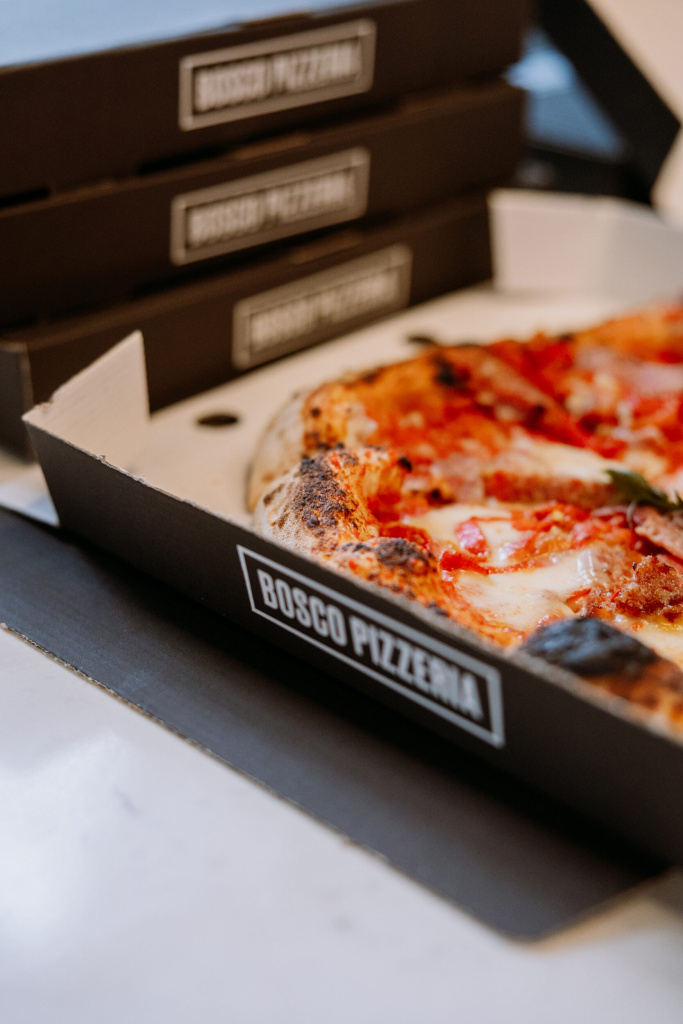
After a glass of free prosecco and some delicious free pizza from our partners Bosco, we moved through to The Great Hall bringing an air of focus with us, as our all-Gather Round-member panel took their seats to share their wisdom.
Bend, stretch, but don’t fold… become elastic. Your business depends on it.
A recurring theme from each of our speakers and touched upon in more depth by Jamie Ellul of Supple Studio, was Covid, a trying time to say the least. Jamie discussed how those turbulent years almost sent Supple down – something that, back then, was easy to take personally. This feeling was only made slightly more manageable due to the fact that his friends, colleagues & clients were all feeling it too. Jamie openly discussed how this felt like a great exercise in cutting the umbilical cord, once he realised how much of his self worth was wrapped up in the business. Something that he has since tackled through therapy and looking inward. This raw honesty was something that fuelled the rest of the evening, with equally inspirational testimony from the rest of our panel.
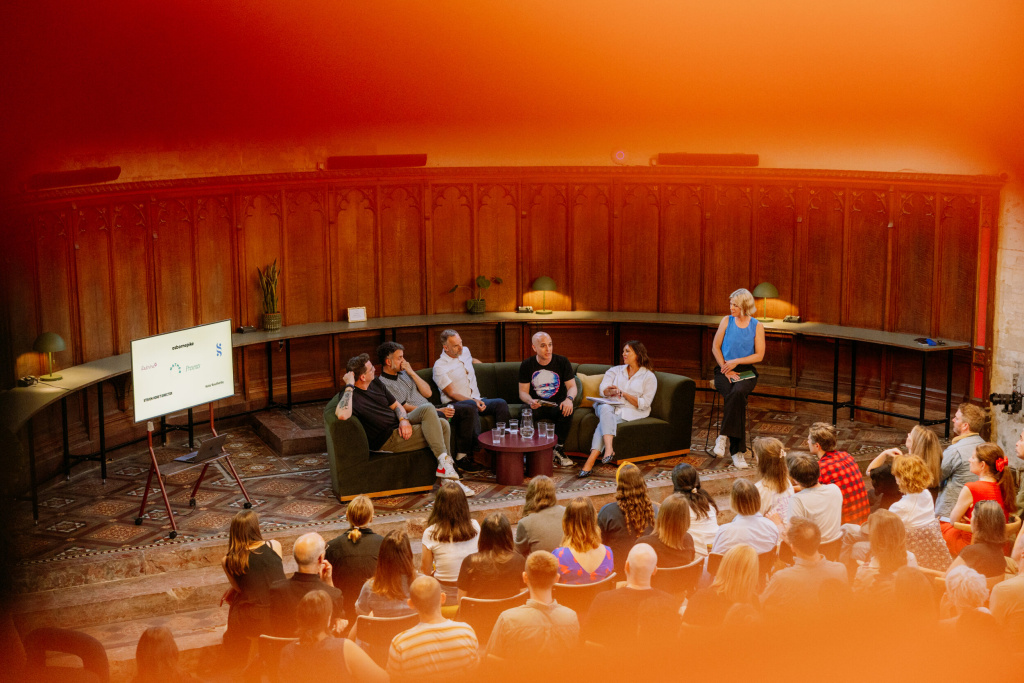
Tim Miness, Creative Director of Osborne Pike, shared a few mantras with the audience that have helped him stay flexible, creative and resilient. A statement that resonated was not being afraid to admit when something isn’t working. Bend the rules. What decision do I need to make in order to change my situation? How can I tap into that magic creativity and find the answer to this problem? Not only that, but how can I ask the right questions? Tim’s advice – hire people that are better than you. Expand that collective creativity, and together, you’ll find the right question.
Honesty is the best policy, and we definitely heard that from our panel. There were murmurs from the audience mentioning how refreshing it is to hear people being open about their downfalls, where they could improve and how they got through hard times. A refreshing perspective on managing a business, compared to older, more traditional ways of thinking.
Tim shared his dislike for the phrase “Fake it til you make it”. Something we’ve all encountered and tried to embody in some way, as we try to make sense of our place in the world. Sharing his love for the sentiment of trying new things, but ultimately landing on, why do we feel like we have to pretend to know what we’re doing? Perhaps one of his mantra’s “Learn it til you earn it” feels like a more sensitive way to approach things, although (in his own words) “…it doesn’t quite have the same punch.”
We heard Robin Worrall, Creative Director of Rednine open up about his heart-first approach to his work. Something he’s cultivated after pulling his business apart and asking the question, what am I really trying to achieve here? After getting the nudge he needed from a post he saw on LinkedIn, with the sticky phrase “old keys don’t open new doors”, he knew he needed to reposition and rebuild his entire creative offer. Looking at what he needed to keep, what he was prepared to lose and what would be great to add. Robin compounded this with the sentiment that being creative is emotional, and that’s something he pushes through his work, to find the heart of brands and tell their story with authenticity. It’s safe to say, a few tears were shed.
Ask for help, reach out, learn from others, share failures and compare challenges. It all starts with… “Can I chat to you about something?”.
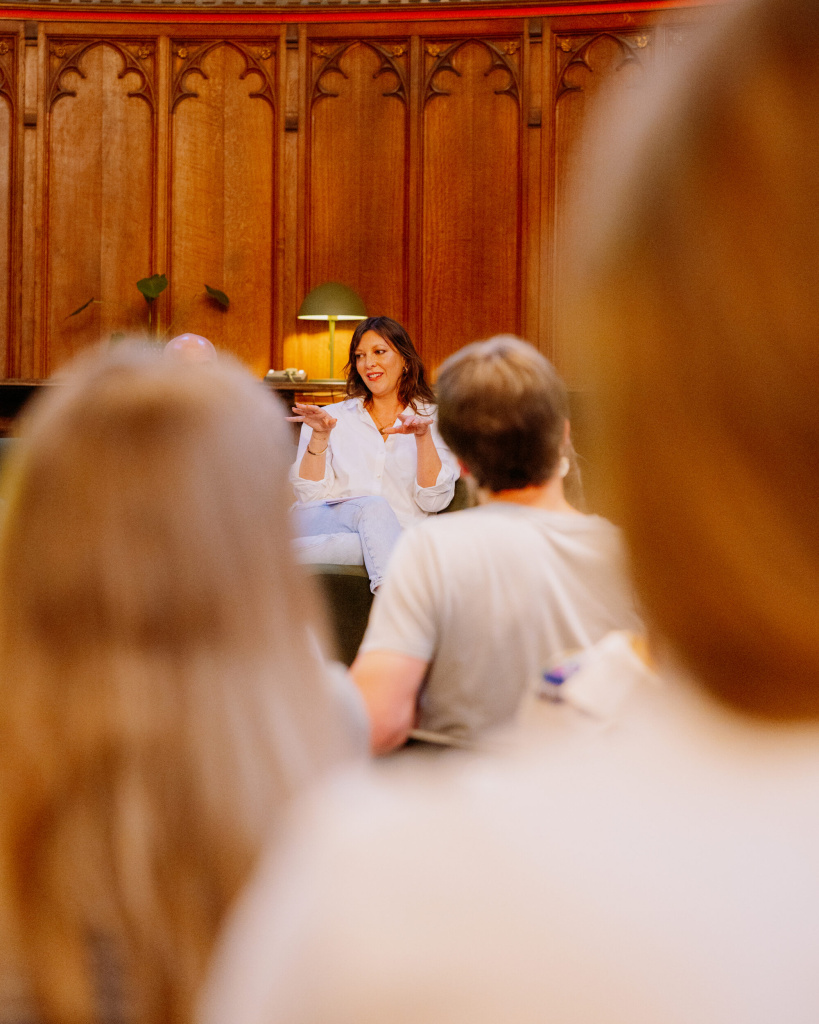
Robin left us with a perfect segue into Kate Southerby’s interactive section of the evening. Coaching with the brain in mind, Kate is a facilitator of insights. She guided the audience through her 7 step plan, asking everyone to score themselves out of 10 for each section: Sleep, Movement, Focus, Introspection, Daydreaming, Play, Connection. There was an overwhelming consensus that we aren’t looking after our brains as well as we could be, so this was a welcome exercise that left the audience with plenty of food for thought.
The importance of nourishing your mental and physical health was a thread followed by all of our panellists, as each person has faced certain difficulties of their own. As Steven Hore discussed, managing stress has elevated how he works. He and his family made the decision to leave London after more than 20 years in the city. Initially causing more stress than intended due to commutes, but, after Covid eliminated presenteeism, time usually reserved for long car or train journeys was swapped out for more time in nature, exercising and moving through beautiful spaces that nourish his soul.
Something more attainable than moving city that he shared with the audience though, and perhaps the most simple and obvious tip: get a good night’s sleep! Steven shared how implementing this one action has transformed his ability to handle combined stressors such as job insecurity, shifting budgets and demands of 16+ hour shoot days with ease.
It’s not all about work though, as we revisit a comment from Jamie Ellul on not letting your self-worth get too wrapped up in your business, the panel delved into the importance of finding things outside of work to nourish your creative side. Find a hobby you love and indulge in it as much as you can. Hustle culture is dying, now is the time for slow, intentional living.
Of course – it wouldn’t be a conversation about the state of the world right now without touching on artificial intelligence. A topic that roused the crowd, unsure on how to feel about this powerful new tool we’ve all been given. But the biggest question on everyone’s lips… What does this mean for creative jobs? Tim, Kate, Steven, Robin and Jamie all steadfast in their belief that creative jobs aren’t going anywhere. A sigh of relief. Steven shared some positive thoughts on how AI is a great democratiser. The barriers to entry now are lower than before, meaning more eyes, more screens and work happening in more places than ever before.
This being said, clients will always want emotional, relatable, human stories. From Jamie’s perspective, AI can only produce more of the same and will never be a match for the way humans think and create. We left that topic firmly closed with his mic drop moment – “AI won’t give you a drumming gorilla for a Cadbury ad”.
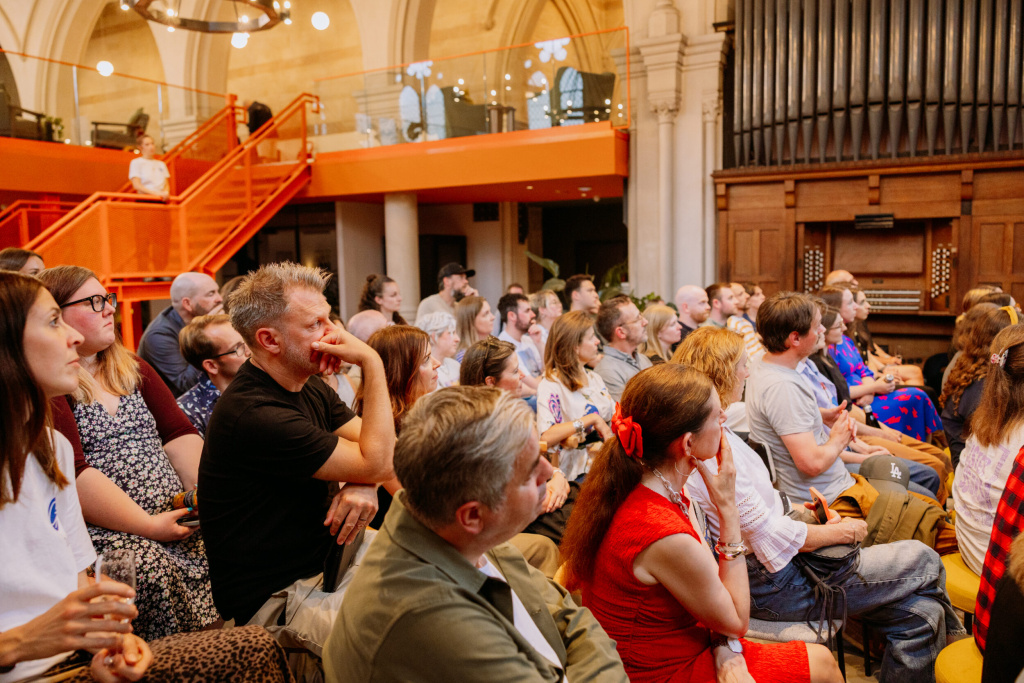
After a short break, we resumed the discourse in the form of an intimate Q&A. With questions from a concerned audience, on how positive the panel feel about the creative industries going forward – will we see an upturn? Leaving us with some final gems of knowledge, the panel discussed how being brave will ultimately lead to success. However you view success though, is up to you. Times have been difficult, really difficult, but they ARE changing. There are spaces, like Gather Round, where community is flourishing and people are coming together with ideas and strength beyond what they thought they were capable of, just a few years ago.
In the words of Anthony Burrill, “Work hard and be nice to people” – but most importantly, be brave, nourish your network, ask questions, take care of yourself and the rest will follow. Stay resilient out there!
If you want to get involved in our next event – make sure you’re signed up to our newsletter so you don’t miss out on tickets. They don’t hang around for long.
Standard benefits packages won’t cut it for Gen Z. Here’s how they’re raising the bar and what you can do to meet it.
In simple terms, the generation that won’t settle for more of the same. Gen Z is here and they’re changing the game.
Born between 1997 and 2012, they’ve grown up digital, purpose-driven, and ready to challenge how work works. By the end of 2025, they’ll make up 24% of the global workforce and here’s the thing: standard benefits packages aren’t cutting it anymore.
If you want to attract, engage, and retain Gen Z talent, you’ll need a benefits experience that feels as personal, digital, and values led as they are. So, what Makes Gen Z Different (And Why It Matters for Your Benefits Strategy)?
Firstly, Gen Z grew up with smartphones, social feeds, and instant everything. So, when they join your workforce, they expect the same seamless experience from your benefits. 91% of Gen Z say a company’s tech influences whether they want to work there, (according to deskbird). They expect business tools to be as intuitive as TikTok and as mobile-friendly as their banking apps. If any benefits platform feels clunky or old-school? You’ll lose them before they’ve even logged in.
Secondly, they care Deeply About Purpose. For Gen Z, work isn’t just a job. It’s a platform for impact. 74% say purpose at work matters more than their pay cheque, according to SHRM. And it’s not just talk, where 50% have turned down work that clashes with their personal values, according to SHRM and 44% have rejected employers with negative environmental or social impact, says ACCP. If your benefits don’t reflect your social and environmental commitments, you’re missing a massive engagement driver.
Thirdly they value Flexibility Over Hierarchy. Gen Z doesn’t measure success by hours logged. They care about outcomes and flexibility. 77% would choose more flexibility over faster promotion, according to Innovative Human Capital. They expect to work when and where they perform best, whether that’s fully remote, hybrid, or something in between.
Finally, there is the rise of flexible, personalised benefits. Forget cookie-cutter packages. Gen Z expects choice such as workplace flexibility, like remote work and compressed schedules, mental health support including teletherapy and wellness apps, financial wellbeing, such as student loan repayment and financial coaching.
Looking at that lens, mental health is non-negotiable. Gen Z has made one thing clear: mental health is essential, not optional. Only 15% rate their mental health as “excellent”, and 40% report feeling stressed or anxious most of the time, according to Handshake and Deloitte. What’s expected and what is out there? Dedicated mental health days, digital-first EAPs with real usage, and wellness tech, like meditation apps and digital resilience tools. In simple terms, ignoring mental health isn’t just risky—it’s a missed business opportunity.
It’s tough out there, however there are many creative ways to find money with employee benefits (if you do not salary sacrifice your pension…why not?). Focus them in a new and creative way. It will pay off when employees feel their benefits reflect their real-life needs, they stay longer and engage more deeply.
Earlier this year, Bristol Surf Cinema launched its very first event – a night dedicated to celebrating surf storytelling on the big screen. What started as a small, DIY project to bring people together around meaningful surf films quickly grew into something bigger, with almost 250 people buying for the inaugural screening in April.
The idea was simple: create a space to showcase surf films that go beyond the highlight reels, beyond the big brand edits – stories that dig into the social, political, and environmental threads woven through surf culture.
As a camera assistant working in film and TV and a lifelong surfer, I (Theo) set out to build something that connected those two worlds. In a time when the industry was unusually quiet, Bristol Surf Cinema gave me a creative project to get stuck into and a chance to pour energy into something that mattered. It was also a way to genuinely support filmmakers, every film we screen is fully licensed and paid for, and £1 from every ticket is donated to The Wave Project to help fund surf therapy for young people in the UK.
But perhaps what stood out most from the first event was how the Bristol surf community (and the wider ocean-loving crowd) showed up. Feedback from the night wasn’t just about the films, it was about the feeling in the room. People supported the event and made it clear they would like to see more. They wanted a space where all surf stories could be told, with better representation, better balance, and an even stronger connection to the community.
That’s where our second event comes in. On Saturday 12th July at Watershed Bristol, Bristol Surf Cinema returns with a matinee screening of Point of Change, a powerful documentary by acclaimed director Rebecca Coley. The film tells the story of Nias, Indonesia – a surf paradise that was ‘discovered’ in the 1970s and the environmental and cultural impact that unfolded for the local community as surf tourism in that area grew.
It’s a film that makes you think about the consequences of surf tourism — and we’re lucky to have Rebecca joining us on the day for a Q&A to explore those themes in more depth. Rebecca will be answering questions on her filmmaking process, handling delicate themes within documentary and the impact of tourism on the earth and native communities.
Alongside the feature, we’ll also be screening two UK-made short films:
Surfaced by Paul Stevenson, telling the story of Nick Corkill’s journey through addiction and mental health, and the grounding role that surfing and photography play in that journey.
Seb: A Surf Therapy Journey by Matilda Thompson, a beautifully observed short following a young surfer with ADHD and autism as he experiences surf therapy with The Wave Project Bristol.
For those who can’t make the main event, we’ll also be running a catch-up screening on Wednesday 16th July — same films, just without the Q&A.
Both events will offer the opportunity for networking and drinks at the Watershed bar after the event so you can minglew with like-minded film or ocean enthusiasts.
Bristol Surf Cinema was never meant to be a one-off. The ambition is to keep this platform going – to continue curating thoughtful, story-first surf films and to keep building a space where filmmakers feel supported and audiences feel connected.
Looking ahead, there are exciting plans for a national tour to bring these kinds of surf screenings to other UK cities and coastal towns. The vision is to grow Bristol Surf Cinema into a national platform, while always staying true to the ethos: supporting independent surf filmmaking, elevating underrepresented voices, and creating community-led spaces where ocean & surf centred stories, of all kinds, can be seen, heard, and shared.
Want to come along?
Tickets for the July screenings are available now via the Watershed website: https://www.watershed.co.uk/whatson/13320/bristol-surf-cinema-point-of-change
To stay up to date with future screenings or to get involved, follow @bristolsurfcinema on Instagram.
Bristol-made podcast, High Notes, returns on Monday 30th June, as it continues conversations around the art and business of voice, featuring the voice actors, directors and creatives who make it all happen.
Host Melissa Thom brings insightful conversations, illuminating perspectives and plenty of behind the scenes moments from the worlds of gaming and animation.
With six new episodes dropping every week, each lasting around thirty minutes, the podcast shines a light on the world of voice acting, for anyone who is already working in, hoping to break into, or simply fascinated by the business. The new series features professionals working in high level casting, voice acting and directing across AAA games.
Melissa Thom is an acclaimed voice actor with decades of experience voicing projects including Grand Theft Auto V for Rockstar Games, Elder Scrolls for Zenimax, LL COOL J, Google, Amazon, Nike and many more.
Melissa is also the Founder and CEO of BRAVA, and has trained thousands of people in voice from the UK and beyond – from rappers and reverends to ad creatives and countesses.
The first episode of the new season kicks off with a conversation with Kate Hansen-Birnbaum, Casting Director at Pixar, whose credits include animated films including Inside Out 2, Soul, Elemental and Luca.
Kate shares her unconventional path into casting, which began at a San Francisco talent agency under the mentorship of seasoned actors. She offers a rare look inside Pixar’s intricate casting process, highlighting the value placed on authenticity, natural vocal tone and the ability to truly inspire the animation team. The conversation touches on Pixar’s commitment to diverse and inclusive casting, including their practice of anonymised auditions to help reduce unconscious bias.
The full line up of episodes and release dates are as follows:
30/06/2025 – The Magic of Pixar: Voice Casting with Kate Hansen-Birnbaum
Kate brings memorable stories from her career – particularly the joy of working on Elemental – and shares thoughtful advice for aspiring voice actors.
07/07/2025 – Vocal Shapeshifting: Acting for Video Games with Andrew Whieldon Dennis
Andrew reflects on his expansive career as a voice actor in the videogame industry, from indie projects to AAA blockbusters.
14/07/2025 – Inside Aardman: Bringing Clay to Life – Characters, Voice & Performance with Merlin Crossingham, Creative Director for Wallace and Gromit at Aardman Animations
Merlin shares some surprising stories from his childhood that led him onto a very specific career path in animation, as well as thoughts on the timeless appeal of Wallace and Gromit.
21/07/2025 – Casting for Mocap, Games & Animation with Jessica Jefferies
Melissa sits down with Jessica Jefferies, a casting director who specialises in motion and performance capture for video games.
28/07/2025 – Directing Performance for Epic Games with Tom Keegan
Melissa talks to Tom Keegan, an acclaimed performance director behind major AAA titles such as Jedi: Fallen Order, Wolfenstein, Call of Duty, World of Warcraft and more.
04/08/2025 – Bob Bergen: The voice behind Star Wars, Spirited Away and Looney Tunes
Melissa is joined by five-time Emmy-nominated voice actor Bob Bergen, best known as the voice of Porky Pig – a role he’s brought to life for over 30 years.
Melissa Thom, High Notes’ host, said: “This season we’ll be lifting the curtain to reveal the reality of working within gaming and animation. Some key players in the business have shared their perspectives and experience to help the next generation of voice acting talent to break through. The voice acting world can seem like a mysterious closed shop, but the aim of High Notes is to demystify and remove barriers for those who would love to know more about this fascinating business.”
High Notes can be found at www.brava.uk.com/podcast and on all major podcast platforms.
Season 3 will be released later in 2025 and will focus on BRAVA Business and its corporate offering – how professionals can use their voice for impactful communication in the workplace and beyond.
You need to load content from reCAPTCHA to submit the form. Please note that doing so will share data with third-party providers.
More Information