This new and exciting programme is designed to equip individuals (aged 19+) with the technical skills, knowledge and understanding needed to produce digital content across several platforms, ensuring you can use social media most effectively for your small business, sports team or trade.
This course will provide a great opportunity for you to develop graphic design techniques, such as designing and producing a brand identity and branded graphics for Instagram, TikTok, Facebook and more. There is a host of exciting modules that your tutor will guide you through, including:
Planning your Project
Typography and Layouts
Working with Illustrator and Photoshop
Creating a Brand
Bristol Institute of Performing Arts
Our team is made up of industry professionals from all corners of the creative industries. Performers will be put through their paces by our academic team of performers, directors and choreographers which is supported by our Student Experience and academic support teams.
Our Purpose Built Campus
The Bristol Institute of Performing Arts is based at the SGS WISE Campus a £17.5 million pound campus designed for sporting, performing and visual arts excellence.
Olympus Theatre
The Olympus Theatre based at the Bristol Institute of Performing Arts/SGS WISE Campus has been producing and receiving theatre on a local and regional scale for almost 15 years. Since opening in 2005, the cultural and creative significance has exceeded expectations, making The Olympus a premier destination for theatre performance and education in the South West region.
Our Students perform in our 250 seat auditorium which holds over 35 productions a year through our in house production team.
Studio 22 Theatre
The Studio 22 Theatre is our most diverse performance space, kitted out with fully flexible seating which allows a variety of production design styles. Students will be immersed into a space designed for intimate productions, showcases and cabaret performances. The Studio 22 theatre can accommodate an audience of up to 80.
10 Studios & Workrooms
All our dance studios are equipped with sprung flooring, mirrors, barres and a speaker system. Our rehearsal rooms also feature a range of equipment and speakers
Studio 1 – Dance StudioStudio 2 – Rehearsal StudioStudio 3 – Dance StudioStudio 4 – Dance StudioStudio 5 – Dance StudioStudio 6 – Rehearsal StudioStudio 7 – Rehearsal StudioStudio 8 – Rehearsal StudioStudio 9 – Rehearsal StudioStudio 10 – Practice RoomWorkroom 1 – Scenic Design WorkshopWorkroom 2 – Technical TheatreWorkroom 3 – Costume & Scenic Store
If your understanding of the startup world is based on the series produced by (and starring) mid-noughties nerdy heartthrob, Adam Brody, it might surprise you to learn that most tech ventures aren’t funded by dubious dosh from the criminal underworld. That isn’t to say that StartUp isn’t an entertaining show, by the way, but it’s not exactly an accurate representation of how startup founders might seek investment.
While there are some great examples of companies that have ‘bootstrapped’ their way to billions, most successful tech businesses will raise equity finance at some stage in their scale-up journey — usually over several funding rounds. The right investment not only unlocks the cash you need to accelerate growth but also provides you with a new business partner who is aligned with your goals, brings business acumen and an invaluable network of industry contacts.
Knowing how to turn your venture into an investment magnet is key to getting the attention of the right type of investor while never feeling pressured to settle for a bad fit. So, how do you as a startup founder attract that perfect investor? Here are 6 qualities investors will be looking for in your tech startup.
As a startup founder, being passionate about your project should be a prerequisite. If not, then it’s probably the wrong venture for you. You need to truly believe in the product/service you want to provide and be confident that it’s either an improvement on what’s available on the market or an entirely new take on addressing an old problem.
Beyond your bright idea, you should also be mindful that investors are investing in you as much as they are in your business. Are you able to distil and describe the journey you’ve been on thus far? Can you showcase your passion, skill-set and creativity?
However, while passion per se is great, would you put your money where your mouth is? Most investors are looking for founders who are willing to invest their own capital — hypothetically, at the very least. After all, why should someone part with their hard-earned cash for your project if you’re unwilling to do the same? The same applies to investing your time. If you’re unwilling to work hard on your own project, then it’s unrealistic to expect anyone else to.
To get your business off the ground, you’ll have to — or will have had to — raise the initial capital yourself. This can come from your own savings, borrowings, or even friends and family. Either way, this is a concrete example of demonstrating that you believe in your product/service, so much so that you’re willing to invest money into it.
To be worthy of investment, any new product/service needs to have a proven market and be appealing to that market. Ideally, your venture will have begun operations and demonstrated an ability to sell that product or service — essentially, you need to have a robust ‘proof of concept’ to show investors. Investors will look for the following:
For a tech startup, the proof of concept is often an MVP (Minimum Viable Product) — a product with just enough features to satisfy early customers and provide adequate feedback for future product development. Through our experiences building brilliant launchpad apps for businesses, we’ve come up with a checklist to help you get started with your MVP ASAP.
Most investors are looking for business opportunities that have potential — primarily, for growth. This is all relative, of course, based on the size of your market, but ideally, you need to have a market with significant reach — regionally at least — depending on the nature of your product or service.
Not every product/service is going to have a worldwide market, of course, but a large enough market to increase scale and margins within your operations is typically a requirement for investors.
If your startup is a would-be disruptor in an existing, saturated market then the same rules apply. However, your growth potential is likely to be deeply scrutinised because any market share gained is being taken directly from a competitor, therefore your competitive advantage needs to be demonstrable.
Which leads us on nicely…
No matter what the product — whether it’s clothing, music or a new software platform — the same question always applies: what makes your product unique? To be worthy of investment, there has to be something that sets you apart.
If your product or service is genuinely the first of its kind (something that many founders wrongly convince themselves is the case), then that’s your competitive advantage. What’s more likely, however, is that your startup will be entering an existing market. This is where having a real differentiator is crucial for success.
Take German neobank, N26, for example. Voted ‘Best Bank in the World 2021’, N26 is by no means the only player in the online-only banking market — competitors include the likes of Monzo and Revolut. However, by taking a service that people have to consume and generally dislike (banking), and turning it into an enjoyable process by focusing 100% of its efforts on user experience, N26 has confidently positioned itself as ‘the bank you’ll love’.
To save on cost, most startups will have very limited staffing (at the start of their journey, at least), usually consisting of one or two founders. Whether it’s a team of two or ten, the number of staff isn’t an issue so long as the key areas of the business are covered. For example, if your business is centred around AI technology, do you have someone in the team who is a specialist in this area? It’s extremely important that you have an expert in the tech or market you’re entering.
Operating control is another area investors will be looking at before taking a punt on your startup. They’ll expect you as the founder to have developed (or be in the process of developing) policies and procedures to control the business and ensure their investment doesn’t go to waste.
It’s also important that as a founder, you’re able to ‘let go’ and delegate authority across your team. We get it, your startup is your baby, but over time, you need to trust someone else to take care of the proverbial nappies. Or bedtime story. You get the gist. Investors will take comfort in seeing expertise and autonomy spread across a fully engaged team.
The coldness with which investors approach this topic can be a bit of a shock, but getting into their mindset — ie. looking for a return, can keep you focused on what’s important for your startup. It’s important to know that from a financial perspective, investors will have two primary questions when looking at a project:
These questions can be answered by a thorough financial projection which you can do yourself, but if you’re struggling, there are people you can hire to help out.
Essentially, investors want to know what their ROI (return on investment) will be and when they’ll begin to see it, so including a full ROI analysis in any pitch to an investor is highly advised.
At Gravitywell, we love working with enthusiastic startups and help with prototypes, pitch decks, MVPs and conceptual work. If you’d like to discuss how we can take your idea to the next level, get in touch.
Digital is the status quo
We’re all doing our best to meet the ever-growing demand for organisations to ‘go digital’.
Whether we’re trying to reach more customers, more effectively market our products and services, minimise our carbon footprint or deliver more cost-effective business solutions, finding a digital – and in many ways more accessible – solution is pretty much today’s standard course of action.
The opportunities when we meet a new audience in a new space are obvious. But what about the pitfalls?
The potential for being misunderstood, taken out of context, or having your brand diluted across multiple platforms becomes more likely – especially when considering the speed at which online content is delivered.
And it’s for this reason that our brand identity becomes even more important.
What are brand guidelines?
Your brand guidelines are the rules which determine how your brand is presented to the world. It usually contains information about your brand name and how it’s used, your corporate logo, brand colours, fonts, tone of voice etc.
Your brand guidelines should clearly illustrate how your brand identity is portrayed and communicated to consumers, providing a reference point for employees and clients alike.
And we need them, because when your brand remains consistent, it remains recognisable.
Research has shown 86% of consumers say that authenticity is a key factor when deciding what brands they like and support. And when we think about it, it makes complete sense.
Imagine you nip into your local corner shop to buy a bottle of Coca Cola. Only, the label on the bottle looks strange. In fact, it’s not the typical Coca Cola red at all – it’s bright orange.
And, come to think of it, the font looks different too: It’s narrower than you remember. And not as cursive. Plus, the bottle’s neck is slightly longer. But the drink is still claiming to be authentic, traditional Coca Cola – what’s the likelihood this is a fake?
Maybe you risk it. Or maybe you pick the more familiar-looking bottle of Pepsi, instead.
According to PwC’s consumer insights survey, customers selected trust as their number one reason for choosing a retailer. And how can you expect customers to trust your brand if you don’t remain consistent?
The need for maintaining brand consistency across platforms is critical, because it promotes authenticity and trust. In fact, ensuring a consistent representation of your brand can increase revenue by as much as 33%.
With 80% of consumers agreeing that a signature colour increases brand association and recognition, the importance of sticking to your guidelines – is hard to overstate.
What about having a refresh?
There’s nothing wrong with intentionally refreshing your brand. In fact, updating your branding every few years ensures you stay modern, and reflects your company’s ability to evolve with the times.
But with any brand refresh, your guidelines need to be refreshed too.
Many organisations keep their brand guidelines in a PDF or printed format, meaning you’ll need to factor in time-consuming tasks: updating your documents, checking and proofing them, making amends, artworking them and having them signed off – all this on top of your rebranding process.
But there is a better way.
Digitising your brand guidelines allows for quick and resource-light updates to guidelines, that are quick to roll out and distribute to all relevant stakeholders.
Creating digital brand guidelines
A digital brand guideline ‘book’ can be accessed from anywhere, at any time, and on any device – without the trouble of having to locate a physical copy, or share a long-lost PDF that’s buried on your desktop. Simply share the link, and go.
At Proctors, we use Webflow to create and update our clients’ digital brand guidelines. Whether they’re used by your colleagues, your customers, media or external business partners, making your guidelines accessible on Webflow gives everyone clear direction on presenting your brand consistently.
Even better, with Webflow, elements such as your logos, fonts and colours can be downloaded by anyone you share the link with. So in today’s digital first world, your media partners or social media managers can remain responsive when it comes to pushing out branded content.
Plus, with digital-first increasingly the norm, companies who use motion graphics in their brand elements can demonstrate real, live examples in their digital brand guidelines book too – something which isn’t possible in other formats.
Even large organisations with lots of different sub-brands can benefit from Webflow’s flexibility. It’s a quick and efficient process to create and update your guidelines, whether you need to edit just one page or to build and deploy several branding ‘chapters’. Plus, any changes or updates can be highlighted on the landing page, so all employees are made aware of them.
With Webflow’s no-code format, any brand refresh updates can be easily executed by your marketing team, meaning you’ll save masses of time on updates. Not to mention avoiding the need to print – and that’s one big environmental benefit.
Scaling up with Webflow
If you want your brand to remain trusted in the digital era, you need to practice consistency.
With easily accessible guidelines, you’ll be able to ensure you’re presenting an authentic brand. So you can reach more customers, and more effectively market your businesses.
If you’d like to find out more about our digital brand guideline services, or any of the other services we offer, talk to us today at [email protected].
In his book on creativity, Dave Birrs (ex Poke, McCann, etc.) explores what creativity is and isn’t. He presents an approach to help individuals and organisations develop better ideas.
In the first half of “How To Get To Great Ideas” Dave debunks a few of the myths surrounding creativity. These include “creativity = art”, “creativity = originality,” and “you can’t develop creativity”. He concludes that creativity is more of a path to get to ideas. The book continues on to explore the relationship of creativity to human development from our neolithic selves to the present day. Along the way, we learn that the human brain is shrinking, curiosity is the foundation of creative thought, and that it may be almost entirely impossible for a single person to discover something new in the modern day.
The second half of the book focuses on the process. Dave introduces us to his R.I.G.H.T. thinking framework. While it would be great to have a little more meat on the bone in the form of activities and examples, overall, he delivers enough practical advice here to work into your own creative processes. The framework starts with Research. So often, we are put off of researching by its dry nature. However, it is a powerful tool. When data is given context by adding information and knowledge, we can get to wisdom. It is from this wisdom that good ideas take shape. Dave is keen to encourage us to create divergence from habits and routines, use play within our team sessions, develop our individual creativity, learn how to judge good ideas, and then hone them into great ideas.
I like the book because it provides a balance of insight and practical tips. These help you develop your creative thinking prowess and build out a culture of curiosity and creativity in your team. I found that I picked up quite a few points that I missed on the first reading. So, I recommend keeping it around to refer to while you tweak your ideas generating machine.
Head over to Amazon to get your copy.
If you would like to find out more about our creative process, check out Chris’s article on creative workshops.
This week sees the end of the Government’s ‘work from home’ mandate in England which has been in place since the start of the pandemic. We know anecdotally that many businesses within the region’s creative industries have taken this opportunity to review their flexible working policies and we’re keen to understand what the future looks like for the South West’s creative community.
We’ve pulled together a handful of questions that will give us a top-line view of the new normal. We’ll be more than happy to share the findings with BCI members who may like some guidance on shaping their future flexible working policies. Share your thoughts here.
Photo by Kevin Bhagat on Unsplash
Cookie acceptance pop ups might be driving us around the bend, but since the requirement to ask permission was introduced a couple of years ago, businesses and marketers have built their marketing strategies and systems around them.
Now things are all about to change again. It might have been predictable, but with Google telling us that 48% of consumers actually stop a purchase if they don’t trust the company to collect and manage data on them, it’s no surprise that Google are following the likes of Apple and Mozilla, and have announced that they were stopping third-party tracking in 2023.
This leaves businesses having to reset their marketing strategies, relying solely on any first-party data they hold, with many businesses, particularly in e-commerce, having to go back to more traditional marketing and brand building, but in a more digital world than before.
Any that fail to do so will find themselves simply giving their marketing keys to the tech providers with no real insight on their client base.
The option of doing nothing is a dangerous one, yet whilst Pimento research tells us that most marketing professionals intend to ‘do something about it’, 19 out of 20 acknowledge that they won’t be prepared for the great switch off.
Marketing will no longer be about stalking people across the web. We now have the opportunity where digital marketing can mature to become a real weapon to help brand building in a more meaningful way.
So, what’s the action plan? And what should all businesses, large or small, be lining up to do right now?
Action 1.
Do the gap analysis now. Work out what you currently use and need to achieve marketing penetration, and what will you have post the demise of third-party cookies. That’s the gap that needs filling.
Action 2.
Focus on the business infrastructure and get back to basics.
If you need support in doing the analysis, and in building the strategy going forward, make the move now to find it. Closer to the time, resources will be limited and remedial time scales will be longer.
Action 3.
Cement the data you have and get your consent strategy robust for the future, building the new approach around it. Undertake a cookie audit now.
Action 4.
Take a relook at customer experience and contextual for scale, so that you stay completely in touch with your customers’ buying triggers in the post cookie era.
This isn’t just a marketing challenge. It impacts the whole business spectrum, from SMEs to multinational corporates. Mid and large corporates will use their in-house resources to reposition, but small businesses will struggle in the absence of teams they can fall back on, and budget.
Pimento is well placed to be the surrogate team to look to though. With over 200 independent marketing agencies, covering most marketing disciplines, bespoke solutions are close at hand irrespective of size and sector.
This is not an issue for selective blindness. Businesses who fail to act will see their markets slowly dwindle away.
If your attention span is anything like mine, it takes little more than the buzz of a phone to kickstart an afternoon-long procrastination episode.
One moment, you’re replying to a quick text. The next, you’re three hours into a doom-scrolling session that’s somehow left you four years’ deep in Gordon Ramsay’s Twitter timeline.
Of course, businesses know this about the general public. And advertisers are more than happy to capitalise on it. But in the golden age of social media, most businesses are missing the most basic trick in the book – a ‘distraction-proof’ website.
One of the dominant trends in web page building is the ‘omni page’. And it’s existed since the internet began.
Just as it sounds, ‘omni’ describes a singular webpage structure. And each page contains content.

But between relevant content, imagery, videos, copy which tries to hit certain word counts in a misguided attempt to improve SEO rankings, not to mention the input of internal business stakeholders who want to promote their own departments, websites are becoming increasingly bloated.
Often, each webpage ends up hundreds – if not thousands – of words long, and takes minutes, rather than seconds, to scan. With multiple menus, widgets and pop-ups, it all ends up proving distracting and frustrating for your visitors.
In essence, web agencies are being asked to include more and more content into every page of a website they’re building, often for the purpose of ticking certain boxes, rather than thinking of the user experience (UX). And the result is akin to building an entire website on every single webpage.
You’d think, given our doom-scrolling habits, that one long, jam-packed page of information would lend itself to today’s consumer. However, the complete opposite is true.
Research conducted by Microsoft has shown that we have an average of between 7 and 8 seconds to catch our website visitors’ attention. That’s because many – if not most people – are in the habit of scanning a page for information before reading the detail.
If you’re looking for a paper supplier for your business, and you need to know that they meet the right sustainability credentials, how long would you spend trying to find that information on a page that’s endlessly long, filled with videos, links to download a whitepaper on the merits of different paperweights, photos of the team, a social media widget and a few case studies?
My guess is, not very long.
Because, like most users, you’d probably rather visit a page that leads with the header ‘Your local sustainable paper supplier’, followed by a list of sustainability credentials.
Maybe you then see a link to ‘Our recent case studies’, which you could choose to visit and dive into more info, if you’re interested. Or perhaps you’ll explore the site’s menu to find out more about the team via the ‘About Us’ page.
But if your boss is breathing down your neck, and you’re performing a search for ‘sustainable local paper supplier’, the chances are you won’t spend more than those precious initial 7 seconds to find the right info.
Web agencies like ourselves aren’t the only ones who’ve noticed this trend of over-complicated page structures.
Google has also noted a large detrimental impact on page performance, particularly when it comes to how it the mobile device experience.
Google Page Experience is a new measurement for a webpage’s UX – specifically, how users perceive the experience of interacting with a web page beyond its pure information value.
It includes Core Web Vitals – metrics that measure real-world user experience for loading performance, interactivity, and visual stability of a webpage – and also includes existing Search signals: mobile-friendliness, safe-browsing, HTTPS, and intrusive interstitial guidelines.
What this means is if you want a webpage that’s built for SEO, it can’t be overstuffed with keywords – something we’ve talked about before. Any page you consider important for your business needs to score highly on these additional metrics and be valuable to your visitors.
In short: Don’t overstuff your pages with content. Only provide the information that’s truly useful to your customers, and you’ll gain the most value from your website.
It’s time to more thoughtfully consider what’s actually needed on each webpage. This is what will help keep your visitors focussed, engaged, and more open to valuable cross-selling and up-selling opportunities – without the opportunity for distraction.
Ready to talk more about how your website could more skilfully direct prospects through your sales pipeline? Talk to Proctors, at [email protected].
Our friends at TechSPARK are celebrating the CreaTech sector this month so we thought we’d join in and highlight five awesome businesses from the Bristol Creative Industries member community.
As outlined in this article, CreaTech is the term used to describe where creativity meets technology. The Creative Industries Council defines it as “bringing together creative skills and emerging technologies to create new ways of engaging audiences and to inspire business growth and investment”.
The CreaTech sector is strong in the UK as a recent report by Tech Nation showed. Despite a very tough year in 2020, CreaTech companies raised a record £981.8m in 2020. That puts the UK third in the world for CreaTech venture capital investment, behind only the US and China.
The sector is big news in our region too with the South West having the highest median investment between 2015 and 2020, ahead of Scotland and London.
With that in mind, we thought it was the perfect excuse to showcase five businesses from the Bristol Creative Industries member community doing amazing things. Connect with them by visiting their member profile. If you want to join the community, you can sign up here.
This company describes itself as “changing the face of cyber security education for young adults” through its CyberStart product. The platform that gamifies cyber security education has been used by over 200,000 students. Teaching cyber security to 13-18-year-olds is hard so this is a really innovative way to do it. In the game, participants take on cyber-criminals by solving puzzles and using learning techniques like code breaking and password cracking,
The company has a US version of the product and it was recently part of the National Cyber Scholarship competition with over 10,000 high school and college students taking part.
Congrats to the 70 CA HS students named National Cyber Scholars! Thank you @CyberStartUSA @NCScholarship for nurturing + empowering our next generation of #cybersecurity experts. See full list of our rising stars https://t.co/OCBYY1nwfo pic.twitter.com/HGd8RI119W
— Dept. of Technology (@CADeptTech) June 8, 2021
Visit Helical Levity’s BCI member profile
In the midst of Euro 2020 (come on England!), it seems appropriate to include this Bath-based business. Founded in 2017, StatsBomb provides football data and analytics to clubs, media and gambling companies across the world. The company has developed its own proprietary, industry-leading data collection and analytics software with a user-friendly high-vis front end.
The business started out as a team of three but now has over 150 employees based in its head office in Bath and in the US and Egypt.
Yerson Mosquera, Atlético Nacional 2020 & 2021
Wolves have become the latest club to dip into the South American market 🇨🇴
Scouting from a global database has never been more important. StatsBomb customers can shortlist players from 80+ competitions 🌎https://t.co/TY2rzzCOBN pic.twitter.com/XxJ480y2uP
— StatsBomb (@StatsBomb) June 17, 2021
Visit StatsBomb’s BCI member profile
Bristol-based Gravitywell describes itself as using “technology and creativity to guide businesses through digital transformation and help startups blossom and achieve their goals”.
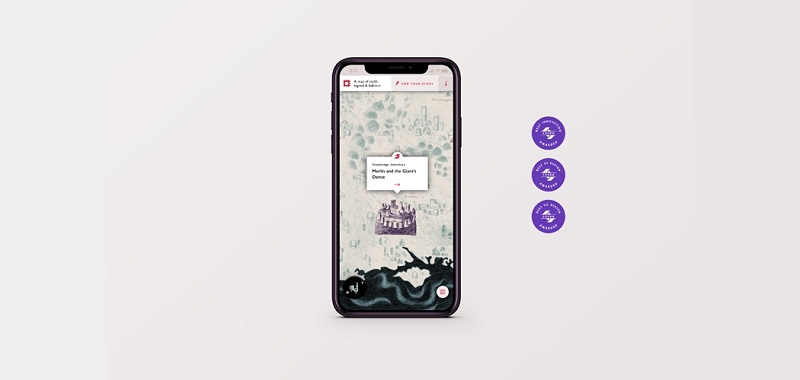
The company has delivered some impressive projects including working with English Heritage and artist Clive Hicks-Jenkins to creatre an interactive illustrated web app map of English myths and legends.
In just six weeks, the team designed, built and launched the web app. They turned Clive’s analogue artwork into a digital production that brought the creatures and characters to life. The map picked up a number of awards, including best digital design at the 2919 SPARKies, TechSPARK’s annual awards celebrating the best tech in the west.
View Gravitywell’s BCI member profile
We are all craving the return of international travel and here’s a company that can help when we can finally go on our next adventures. Bristol-based TravelLocal is disrupting and bringing online the huge tailor-made holidays market and pioneering the “buy local” movement in travel.
The company’s cutting edge web software platform connects locally-owned travel companies in more than 60 countries worldwide with a global client base of travellers, to create and deliver tailor-made holidays.
TravelLocal was started in 2008 by founders Tom and Huw who felt something was missing from the travel industry. Big tour operators were dominating the market and the local experts that planned the trips were treated as a “trade secret”. They started TravelLocal to change that.
View this post on Instagram
Visit TravelLocal’s BCI member profile
This Bristol-based company believes “there’s a brilliant storyteller in everyone but sometimes you just need a little help unlocking your superpower”. Sparkol was “born out of the simple belief that everyone should be able to share their stories quickly, easily and affordably (without any special skills)”.
The company’s flagship software, VideoScribe, has been used by over two million users worldwide. It allows users to quickly create professional-looking animations.
Another service is Scribley which gets you creating engaging video experiences in minutes using a browser on desktop or tablet.
If you don’t want to do it yourself, Sparkol Studio can help by taking your wildest ideas and transforming them into ‘share-worthy’ video content, and Sparkol Academy provides training on video skills and animation.
You are currently viewing a placeholder content from YouTube. To access the actual content, click the button below. Please note that doing so will share data with third-party providers.
Visit Sparkol’s BCI member profile
We love the creativity of Bristol Creative Industries members and there are hundreds more we could have shared. Meet them all in the member directory. If you want to be featured, join as a member.
The Creative Industries Council CreaTech Ones to Watch competition is celebrating inspiring companies and consortiums from across the UK. We’d love to see some BCI members featured. You can enter here until 28 June.
More and more businesses are taking sustainability seriously.
The Purposeful Company recently announced that 14 of the UK’s top companies have pledged to put employees, communities, and broader society higher on their boardroom agenda.
In the UK, on average, one company per day is gaining B Corp certified status. Even the FT has recently said that “rewards await those who put sustainability ahead of short-term gains”.
There has also recently been a wave of books devoted to the concept of ‘conscious capitalism’, from John Elkington’s Green Swans to Mark Carney’s Value(s) via Bill Gates’s How to Avoid a Climate Disaster.
The consensus is that we still need to make significant changes to the way we make, sell and buy our stuff; but change is happening, and businesses are realising that sustainability and profitability are not contradictions (in fact, they are often catalysts).
What can we, as advertisers and marketers, do to help? Well, according to the World Federation of Advertisers, quite a lot…
They’ve recently launched ’Planet Pledge’ in an attempt to create a framework to galvanize our industry to make a difference.
We need to stop thinking of ourselves as merely ’consumer drivers’ and look at the bigger picture – and who else is better placed to help shape consumer behavior and preferences than marketing and advertising specialists?
As someone who works in conversion optimisation, I’ve been considering how to add this way of thinking to our armory. We’re used to considering various heuristic frameworks, cognitive biases and persuasive mechanisms when seeking to refine customer journeys; let’s overlay the importance of sustainability factors too.
In order to do this, I found an incredibly useful resource from the Sustainability Accounting Standards Board: their ’Materiality Map’. It’s a detailed summary of the sustainability issues most likely to affect the performance of companies in different markets and industries.
These issues can act as a proxy for consumer preference and help us move away from just thinking about ’sustainability’ as a whole, and dig deeper into what really matters.
From the SASB Materiality Map we can see that under the building products and furnishings section, one of the key factors is product design and lifecycle management. As they state themselves, this relates to the way a company manages the product lifecycle, including end-of-life.
Our conversion optimisation experience also tells us that consumers respond well to reciprocity (will feel a need to give back to others if they’ve gained themselves) and also commitment (when someone publicly commits to doing something that aligns with our values).
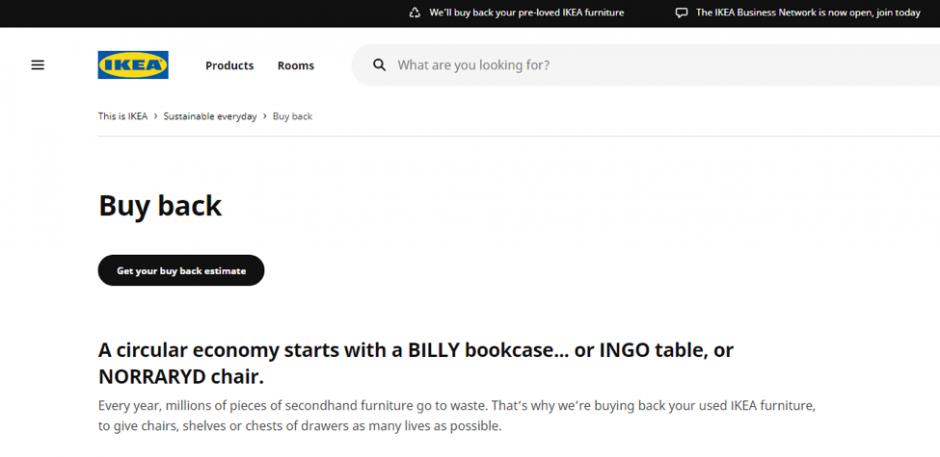
With this in mind, you can see why Ikea’s ‘buy-back’ service could be a great success for them… as well as generate some fantastic PR.
Nationwide has always created compelling messaging built on their heritage as a building society, hence their investment in community.
When it comes to typically persuasive messages that would align with this, we’d probably lead with social proof (evidence that other people have been here before) or liking (we like to buy from people and organizations that seem ‘similar’ to us).
But if we consider the sustainability factors, it reminds us that financial institutions are judged very closely on factors such as privacy and data security – remember, sustainability isn’t just about treating the environment well, it’s about treating people and society well too.
If you take a look at the Nationwide website, and many of their advertising campaigns, you can clearly see plenty of references to the crossover between data security, privacy and community. It’s not at all surprising why this is impactful.

Sustainability has always been a core part of the mission for Bamboo Clothing (you can read their story here), so messaging around sustainability obviously features significantly along the customer journey.
However (and I’m trying to be objective because they are a client of ours), they display these messages in some fantastic ways.
From a conversion optimisation perspective, the journey contains prominent, product-level, third-party reviews that provide reassurance.
The website has loads of great content around sustainability, which cements their value proposition as a leader in this area; plus, they do a great job of reducing anxiety by providing clear messages around their flexible delivery and returns policies.
But it’s one specific sustainability element that I want to highlight.
If we go back to the SASB Materiality Map, we can see that in the apparel, accessories and footwear sector, two of the key factors are supply chain management, and materials sourcing and efficiency; consumers want to know their product has been produced in a truly sustainable way.
What better way to do this than show the impact of every item’s production on the environment? Bamboo Clothing has worked with Green Story, a Canadian business specializing in supply chain evaluation in the fashion industry.
The objective credibility of this is great, but it’s the execution that’s brilliant. For each product, they then display the positive impact the consumer will have if they purchase this product from the supplier in question compared to a regular fashion retailer.
Sustainably-conscious customers can toggle between a view that shows the ‘equivalent’ impact (for example, water saved is shown in ‘days of drinking water’) or the ‘actual’ (water saved shown in liters)

Each of these businesses has taken an approach to sustainability that is more meaningful and widespread rather than using it simply as a tool to nudge someone along the customer journey; for an increasingly sustainability-conscious consumer, that authenticity is key.
However, it’s the way they are then leveraging that approach, inserting compelling signposts to improve their website performance, that is impressive.
I expect to see more and more of this over the coming year; as such, maybe those of us working in conversion optimisation just might be able to do our bit extra to help save the planet.
You need to load content from reCAPTCHA to submit the form. Please note that doing so will share data with third-party providers.
More Information