What’s the one thing Siri, Alexa, Cortana, and Google Assistant have in common?
In short, they’re all female.
At first, this may seem a harmless coincidence, but if we scratch the surface, the domination of the female voice in AI is far more problematic than it may appear.
Today, almost 3 billion people are currently using voice automated software to assist with daily tasks such as setting alarms, checking the weather, or even texting a friend. And the number of people opting to use voice assistants is not expected to decrease.
Yes, we all know this form of AI is beneficial for our ever-evolving digital world, but are these voice assistants causing more harm than we realise?
A greater number of consumers are starting to question the gender bias in voice automation, as they are starting to understand that opting for a female voice can reaffirm the social ideals that women are obedient, should do as they’re told, and most importantly, are here to serve the needs of others.
And because of these observations, many AI creators are now facing criticism for opting for female voices.
With all this in mind, we were intrigued as to why so many companies opt for female voices. Throughout this article, we uncover why there is such a strong gender bias in AI and map out the key steps we can take toward changing this bias.
The lack of male data is the most common reason most programmers opt for female voice when creating voice automated AI, and this is a problem that has been building for some time.
To create voice automation, you need to have a rich set of voice recordings within your text-to-speech system, and most text-to-speech systems have been trained using female recordings. Therefore, it’s much easier and cheaper to create female voice assistants.
So, why do we have so many recordings of female voices available to use?
Up until 1878 telephone operators used to be a solely male-dominated workforce, but they were often heavily criticised for being rude, abrupt, and unhelpful. In response to this Alexander Graham Bell suggested hiring a woman to see if her voice was better received.
Emma Nutt made history and became the first woman to be a telephone operator. Customers responded so well to her voice that she sparked an industry-wide overhaul, and by the end of the 1880s telephone operators were exclusively female.
It’s because of this industry-changing decision we now have hundreds of years of tried-and-tested female audio recordings available to us to create new forms of voice automated AI.
And this leads us on nicely to our next point…
This is probably the most contentious reason why AI programmers opt for female voices – we prefer the sound of female voices.
Many studies have suggested that our preference for the female voice begins when we are in the womb, as these sounds would soothe us even as a fetus.
Another reason why some researchers argue this preference exists is that women tend to articulate vowel sounds more clearly, making female voices easier to hear and understand than male voices.
An example of this can be seen as far back as World War II. Female voice recordings were used in aeroplane cockpits as they were easier to hear over the male pilots.
Up until now, this idea that female voices offer more clarity than a male voices remained unchallenged. Today, many researchers heavily dispute this claim and have found that the many studies that claim female voices are easier to hear when using small speakers or over background noise are simply not true.
There’s even more evidence to show that many people criticise women for their vocal ticks. For example, if you type into Google search “women’s voices are” the top suggested search will finish this sentence with the word “annoying” …
Clearly, AI programmers currently face a difficult challenge when asked to create male voice automation, and Google is a prime example.
Google Assistant was first launched in 2016, and many people were wondering why this AI product was not assigned a gendered name. The reason behind this choice was because Google wanted to launch its new voice assistant with both a male and female voice.
Unfortunately, Google’s text-to-speech system is what ended Google’s desire to launch a virtual assistant with a male and female voice.
Google’s initial text-to-speech system worked by joining segments of audio together from recordings, by using a speech recognition algorithm. It would add markers in different places in sentences to teach the system where certain sounds would begin and end.
As the text-to-speech system was trained using female data, Google Assistant performed better with female voices.
The global engineering manager for text-to-speech at Google, Brant Ward, explained why it was so hard to create a male voice for Google Assistant.
He said that the markers used in their text-to-speech system were not placed accurately for male voice recordings, this meant that it was more challenging to create a male voice assistant of the same quality as the female counterpart.
As it would have taken over a year to create a male voice for Google Assistant, the team at Google decided to run its Google Assistant with only a female voice.
As you can now see, the gender bias in voice automation has become an unshakeable paradigm because of a lack of data and societal acceptance over the preference of the female voice.
When a whole industry is stuck in its ways, even the notion of creating male voice automation can feel like an uphill battle.
It’s time we changed our approach to male voice automation, and there are some simple things we can do as an industry to eliminate the gender bias in voice automation and throughout the AI industry.
1. Inclusivity Is Key
Perhaps it’s obvious to say, but this is an issue that needs to be highlighted. Full stop.
Currently, “women make up an estimated 26% of workers in data and AI roles globally, which drops to only 22% in the UK”. And this percentage drops even further when you look at the number of people in AI who are transgender or non-binary…
It’s disappointing stats like these that show we need to do much more to encourage people of all genders to pursue a career in AI. We want our AI development teams to be more diverse, and this won’t happen if we don’t act.
Once we have a more diverse workforce, we will be able to pinpoint and resolve complex gender issues before and during the production stages of new AI products. Now, in order to attract more diversity, we need to start looking at ways to encourage all genders to follow a career path in AI in higher education.
This can be easily achieved by creating a strong educational foundation, with multiple learning channels available to all students, no matter their gender orientation.
We also need to encourage people of all genders to take an active role in the development of AI course materials. When students see they are being represented in courses they are studying, they are more likely to continue in further education.
2. Develop New Machine Learning Technology
Machine learning technology has come on leaps and bounds in the past few years, and there are now new text-to-speech systems available that create naturalistic male and female voices for AI.
After Google struggled to create a male voice for its virtual assistant, the tech giant joined forces with AI specialists DeepMind to develop a more advanced text-to-speech algorithm that significantly reduced the volume of recordings needed to simulate human voices.
Now known as WaveNet, this algorithm allowed Google to create a more naturalistic voice for all genders, which were then added to Google Assistant in 2017.
Today, America’s version of Google Assistant comes programmed with 11 different voices, and new users are assigned one of two basic voices – one male and one female – at random.
3. Industry-Wide AI Standards Need to Be Made
The domination of AI is not expected to slow down any time soon. In fact, the global market value of AI is expected to reach $267 billion by 2027!
When you think about how AI is becoming an integral part of our society in one way or another, it is shocking to think that there are still no standards in place concerning the humanization of AI.
To this day, most tech companies develop virtual automated systems with a female voice, and this can still enforce the stereotype that women are “assistants”. In order to combat this, we need to have AI standards in place to ensure our products are far more inclusive.
To create these industry-wide standards we must include people of different genders, sexual orientations, races, and ethnicities in the decision-making stages.
With a more diverse group of individuals, we can work together to define what “female,” “male,” “gender-neutral” and “non-binary” human voices sound like and when it’s appropriate to use such voices.
These industry standards should also include a basic set of protocols. Companies would then need to adhere to these rules when creating text-to-speech algorithms to ensure AI products are unbiased and sensitive to potentially harmful gender stereotypes.
It looks like voice assistants will be a part of our lives for the foreseeable future, and because of this, we need to address the gender bias surrounding this type of AI technology now.
Just by opening a discussion about gender representation in voice automation, we can actively begin to create a future of AI that’s more inclusive for all.
We all know how important it is to encourage equality through our culture in the workplace. But it’s no secret that women are underrepresented in senior leadership positions.
It’s everyone’s shared responsibility to become not only advocates, but champions of women from diverse backgrounds within their organisations – and in their lives at large. And in the creative sector, if we want to truly do our part to help women stake their claim, it means businesses taking ownership of their own equality scores in a number of ways – not least, by appointing women to the senior leadership positions we need them to be in.
At Proctor + Stevenson, we’re one of the UK’s longest-established independent marketing agencies. Despite this, we’ve never been conformists, and we’re a good step ahead of your traditional London-based agency in more ways than one.
Our Founder and Chairman, Roger Proctor, has always been an outspoken industry figure. He’s championed diverse young creative talent from the South West of England and Wales – an often neglected region for the arts – throughout his career.
Back in 1979, he laid in our bold and independent foundations in Bristol. And the rest is history. We’ve been challenging inequities and hiring diverse talent ever since – such as through hosting the South West Design + Digital Student Awards (which saw a particularly high volume of entries from young female designers this year).
In short, the talent is there. So what changes are being made?
At the start of 2021, Roger and the senior team restructured Proctor + Stevenson by splitting the larger brand into three companies: P+S Creative, P+S Technology and P+S Strategy, all overseen by the P+S Group (you can read more about these changes here). And this change marked a new milestone for the P+S team.
Our restructuring was the perfect opportunity to progress our own equality targets across the team at Proctors. It was at this point in our journey that we ensured the P+S Group met a target of 50/50 male-to-female directorship.
So, without further ado, meet our board…
· Joy Locke is our Company Secretary. She applies her 20+ years’ experience with us to take lead of everything operations, finance, accounts, and administration. She ensures that we were keeping on track with budgets.
· Ailsa Billington is one of our Directors. She leads our client services operations and takes charge of directing major global campaigns for our multinational portfolio of clients. She directs over all teams in the P+S Group to make sure that we deliver the best campaigns to transform our clients’ businesses for the better.
· Nikki Hunt is our Financial Director. CIMA-qualified, Nikki brings a wealth of experience in management accountancy, HR, payroll, and health and safety to our business, keeping us running efficiently and safely.
· Roger Proctor is our Chairman. He founded P+S in 1979 and has continued to lead its transformation ever since. Under his leadership, the business has grown from 2 people to more than 70, plus a network of freelance talent, and has won a global portfolio of clients such as Panasonic, National Grid, Saudi Arabian Airlines, and much more. He is passionate about the power of creativity to make positive change and is also heavily involved in strengthening the links between the creative industries and education.
· Mark Jamieson is another of our Directors. He helped establish our presence in the Middle East and is an expert in developing, building, and maintaining positive client relationships in across all sectors.
· Steve King is the final member of our current team of Directors. He leads our large-scale digital projects on everything concept creation, development, and project delivery. He’s worked on many innovative and world-first technology projects.
At Proctors, we’ve always taken equality and diversity extremely seriously. Because when we celebrate and empower women in business, it benefits everyone.
We strive to nurture careers amongst our female talent, building them up into more senior roles within our business. And we want to continue to progress further. We’re currently building a broader, transparent picture of our teams, our diversity, and our biases to discover how we can do better.
There’s lots more to be done to help narrow the gap between women in leadership across the UK. It’s a fact that only 5.6% of women in the UK run their own business and women only account for 33.8% of positions as directors on business boards in the UK, with only 16% of creative directors reported to be female.
We’ve just launched the first instalment of our Women in Business interview series. In it, our own Marketing Manager, Becca Peppiatt, sits down with Peaches Golding OBE CsJT, Her Majesty’s Lord-Lieutenant of the County and City of Bristol. This interview, like the rest of the series, delivers insight into the female perspective of working in business, so aspiring young women can see themselves represented in leadership roles. Stay tuned for more instalments of the series, coming soon.
We can all do our part to progress the important conversations which need to be had about an industry that is in many ways stuck in the past, ignoring some of its blatant inconsistencies. There’s lots more to be done and we intend to continue to work hard to narrow some of the gaps that exist. We need to think intersectionally about how we hire, and how we can create healthy, fair environments for women to succeed in.
For more information about Proctor + Stevenson, or to discuss our services or teams in more detail, please email us.
During a recent panel discussion, TMW CEO Chris Mellish made this statement on gender balance in leadership: “We shouldn’t just be talking about this on International Women’s Day, it needs regular dialogue.”
Yep, I went there – I opened with a quote from a man. But it may well take male support, particularly from those in leadership, to help push the agenda for women – and get all genders on board with it. According to leading scholar and anti-sexism educator Jackson Katz, the mere mention of the phrase ‘gender issues’ can lead men to switch off as they often see gender-related conversations as ‘women’s issues’, rather than anything to do with men. But genders don’t operate in isolation.
“We shouldn’t just be talking about this on International Women’s Day, it needs regular dialogue.”
– Chris Mellish

Put simply, because it makes businesses more effective. In 2019, Credit Suisse researched 3,000 companies across 56 countries to find that shares of companies with more women managers delivered higher returns, while a greater number of women executives also correlated with stronger revenue growth and higher profit margins. This was echoed by a report from consultancy The Pipeline:
“Companies on the FTSE 350 index would generate 195 billion pounds ($250 billion) of additional pre-tax profit if their margins matched that of the firms with greater female representation.”
But aren’t women hardwired to be the primary caregiver in the home? Cognitive neuroscientist Gina Rippon analysed the data on ‘differences by sex’ in the brain – and found there to be none. If gender alone has no impact on brain functionality, Rippon concluded that what we deem as typical male or female traits are, as she describes, the result of a “gendered world” – so nurture, rather than nature.
And yet LinkedIn research suggests a staggering 60% of female marketers have left or considered leaving the profession because of Covid-19. That’s more than any other industry. In heterosexual partnerships, women have taken on more duties in terms of caring and homeschooling, in addition to their careers, and are left feeling overwhelmed.
“60% of female marketers have left or considered leaving the profession because of Covid-19.”
There are signs of change with studies worldwide reflecting a shift in the balance of housework and caregiving from pre-pandemic times. But mothers still spend about twice as much time on caregiving and household labour, even as they’ve rapidly increased the number of hours they work outside the home – and even when they’re the primary breadwinner.
For International Women’s Day, Unlimited ran a panel discussion with women in leadership roles from across our group, joined by our male representative, CEO Chris Mellish. The panellists shared personal experiences of difficulties faced in getting to their position. Yet on the point of children, the panel questioned their own choices on who in their family took the role of primary caregiver. Some voiced concerns of being left behind during maternity, and recounted being judged as “not ambitious enough” for wanting children – or being seen as “too ambitious” for not having them at all, as if the two options were mutually exclusive.
“The panel shared . . . the general expectation that women must be better, sparkier, more articulate – and work harder than their male colleagues.”
But motherhood is not all that impacts a woman’s capacity to succeed in the workplace. The panel shared experiences of their confidence being damaged in all-male environments, having to use humour to ‘handle’ comments on their appearance, being asked to consider how men would feel if women were promoted over them, and the general expectation that women must be better, sparkier, more articulate – and work harder than their male colleagues.
These experiences are not new, and many echoed a 2019 report from the Government and Equalities Office. The report cited barriers to gender balance as lack of transparency in pay and promotion supporting biases that disadvantage women. Hostile or isolating organisational cultures, and a conflict between external responsibilities and current models of working – compacted by unpredictable work demands and alternative ways of working do not always offering parity of opportunity. Many women reading this post will be able to relate to each one of these.
The Unlimited panel covered a range of ways we can start to shift the dial and work towards gender balance in leadership. There are practical considerations around flexible working, recruitment processes, and transparency on pay and promotions, allowing more unbiased access to a seat at the table. Mentorship, coaching and workshops can serve to build confidence and address what holds women back.
“There are practical considerations around flexible working, recruitment processes, and transparency on pay and promotions, allowing more unbiased access to a seat at the table.”
But a theme that came out strongly from the panel is, as Chris said himself, to keep talking. That is the ambition we must work towards as an agency – for all genders to play their part. We want to create space for getting into the awkward stuff we don’t like to talk about. The often-cited reaction to the Me Too movement from men is fear, being nervous of saying the “wrong thing”, but this doesn’t serve any of us. I’m often struck by how even my most supportive male friends are simply unaware of the challenges of walking in my shoes as a woman. One positive that may come out of the tragic events surrounding Sarah Everard’s death, is the heightened awareness of the daily challenges women face. We can’t afford to maintain inertia. We deserve better for ourselves and future generations of women in the workplace and beyond it. And this is the challenge we have set ourselves – to continue the conversation, and back it up with action.
– Martin Luther King, Jr.
Yes, another man – but what a man.
Written by: Emma Woodrow, Group Account Director
Illustrations by: Paloma Kaluzinska, Junior Designer
This article first appeared on Marketing Gazette, May 2021.
Written by Yusuf Muhammad.
As Ramadan has drawn to a close, I’ve been reflecting on how the pandemic and consequent lockdowns have changed how agencies approach supporting their staff, particularly during the sacred time of Ramadan.
Working from home was a blessing for me through my fast this year and I believe the lockdown has taught us a great deal about understanding flexibility and blend. These values have allowed me to offer my best self in both important aspects of my life, my religion and my work, and moving forward I hope that these values are upheld by businesses for many Ramadan’s to come.
Before exploring these values in-depth, I would like to share a bit about the celebration of Ramadaitself. Ramadan is celebrated during the 9th month of the Islamic calendar. It’s based on the lunar cycle, and as a consequence, Ramadan migrates throughout the seasons. We fast from the beginning of sunrise to sunset (around 2am to 9pm at the moment) which means abstaining from food, water and drink throughout the day.
One of the reasons to fast is to experience the thirst, hunger, and weakness of those who don’t have luxuries we take for granted, such as unlimited supply of clean water from a tap and food from the supermarket whenever we need it. At the end of the fast we have cold water to quench our thirst and delicious food to indulge in, so we have light at the end of the tunnel and something to look forward to that keeps us going throughout the day.
However, those less fortunate than us don’t have that. What we feel during our fast is just a little taster of their experience and it makes us feel so grateful for the things that can often be taken for granted. For a small period of time, we are putting ourselves in their shoes, and it puts life into perspective. It is incredibly humbling and reminds us to think about the bigger picture, what is really important in life.
Of course, there are exemptions for those for whom it would be dangerous to fast. Children are not required to fast before puberty; however, they are often excited by the celebration going on around them and want to join in for shorter periods of time. My children have been taking part with their own miniature fasts, but health comes first.
It’s because health comes first that the values of understanding, flexibility and blend are so incredibly important at this time.
Understanding
There’s so much more to Ramadan than just fasting, such as giving to charity and other acts of kindness, but yes fasting is an important part of the celebration. Until you’ve experienced it, it’s difficult to understand how fasting effects the body and mind. Fatigue makes it difficult to concentrate or focus and it might be uncomfortable to speak for extended periods of time with a dry mouth. Not only is your body weary from lack of food and drink but often you will also get less sleep due to the timings of Suhur and Iftar, the beginning and ending of the fast. Working from home has been a blessing for me this Ramadan. Things that seem small, such as the commute to work, can be extremely tiring when fasting and I have found it a massive relief to not need to worry about travelling and the impact that will have on my body and mind.
Flexibility
Flexibility is absolutely key during Ramadan, particularly at work. I believe the past year or so has taught us all a great deal about flexible working and the necessity of flexibility as a whole. It’s incredibly helpful for those of us who are fasting to have flexibility in our schedules to allow time to pray and time to begin and end the fast etc. Some people may find they want to come into the office earlier, for example, as they are already awake due to Suhur, but then may prefer to leave early due to fatigue as a consequence in the afternoon. The opposite may also apply.
Blend
My work is very important to me, as is my religion, and having flexibility during Ramadan means I can offer my best self in both aspects of my life. We have all experienced an unusual blending of work and personal life throughout the pandemic. We all have different things going on in our lives and Ramadan is yet another reminder to think of those around us and provide them with support and kindness, remembering that they are neither just work colleagues or just parents etc, but both.
Ramadan is the most special time for my family, my community and me. It’s a time to reflect and work to be a better person. A time to help others and a time to grow closer with God. There are so many beautiful things about the celebration of Ramadan – the community and the giving, the special time dedicated to family, the lack of judgement; the knowledge that everyone’s journey is a personal experience shared between them and God alone.
Ramadan is yet another reminder to think of those around us and provide them with support and kindness. Following Ramadan, I hope you can reflect on how you can offer a bit of flexibility and care to those around you, including your employees or colleagues.
Article first appeared on Marketing Gazette, May 2021.
Written by Yusuf Muhammad.
New Group Diversity and Inclusion Officer is appointed to McCann Central Management Board.
McCann Central, which has an office in Bristol, has further strengthened its Management Board with the promotion of Ruepal Aujla to the newly created role of Group Diversity and Inclusion Officer.
Ruepal joined McCann ten years ago so brings a wealth of knowledge and experience about the agency, people and its clients to the role. Ruepal will add this new responsibility to her current role as Managing Partner within Media.
In the last 12 months, Ruepal has been a driving force in spearheading the agency’s diversity, equity and inclusion programme. As such, she will continue to draw together all the good work which is currently being done across the Central offices in Birmingham, Bristol, Milton Keynes, Leeds, and its London-based office, McCann Demand. Recent initiatives include setting up Conscious Inclusion Councils, launching a ‘Cultural Conversations’ series and introducing flexible annual leave policies around religious and cultural events. Ruepal will also continue to work with the rest of McCann Worldgroup’s DE&I teams to implement other initiatives locally. Most importantly, she will hold the leadership accountable for continuing the changes it is making to the business and it’s culture, from the work produced to the experience of all employees.
Dean Lovett, McCann Central CEO, said: “DE&I has become a key pillar of McCann’s philosophy, and whilst this has been driven within Central through a combination of HR initiatives and more recently the work of the Conscious Inclusion Councils (CIC), both of which will continue, we felt it was important that Conscious Inclusion becomes completely embedded in how we approach and run the business. I can’t take full credit for introduction of this role, as this was actually closely related to an idea which, fittingly, was originally suggested by our employees in our first Day For Meaning*.”
“Ruepal has already been a genuine asset in helping to drive positive change and create conditions of belonging throughout the business. Along with members of our Conscious Inclusion Councils, which she chairs, and guided by input from all of our employees, she has successfully steered our DE&I approach into the all-encompassing programme it is today. I’ve no doubt that under Ruepal’s leadership, we will continue to make further enhancements in this important area, and I am delighted to welcome her to the McCann Central Management Board.”
Diversity, Equity and Inclusion initiatives which have been introduced across McCann Central include; identifying and sharing best practice generally and across the advertising and media industry, including setting up a resource library and cultural calendar, working in collaboration with HR and Talent teams on benefits, career development, flexible working and inclusive social events; developing DE&I insights and processes for client work, across creative, casting and content; and advising clients on their external creative output and their internal communications.
*Day For Meaning is an annual McCann Worldgroup activation which brings together every employee to participate in a series of workshops designed to develop initiatives that will increase engagement and belonging by enhancing our diversity, equity and inclusion practices.
Bristol’s world-renowned product development agency Kinneir Dufort (KD), has launched a new initiative, XXEquals – the UK’s first majority female team designing products for women across the consumer, industrial and medical markets.
Fuelled by the growing need to design more female-centred products, and to improve the gender balance in the design industry, XXEquals is already working on projects including smart femcare solutions, sustainable period products, voice recognition software, and futures research.
KD has previously developed pioneering women-centred products including a revolutionary breast scanning bed.
Comprising a multi-disciplinary collective of KD experts – 75% of whom are women – XXEquals is pushing for better gender balance across product development, in a move which is set to potentially benefit millions of female consumers worldwide and KD’s global blue chip clients.
The initiative breaks new ground in the product design industry, and is helping to pave the way for young women interested in careers in product and industrial design.
KD’s CEO, Merle Hall, says: “We are incredibly proud to be the first UK consultancy in the product design industry with an arm which pro-actively focuses on products and experiences for women. It feels like there is truly a need to bring more women to the forefront of innovation and product design.
“XXEquals offers female-focused insight and an empathic design approach, resulting in innately intuitive products. We need to develop a deeper consideration of the physiological or psychological differences for female users.
“As an agency with a strong purpose – to design a better world – we feel it is our responsibility to instigate change. We are proof that a better gender balance is possible in the product design industry and we would love to support other businesses driving equality where possible.
“We’re not where we want to be yet, representative of the world around us, but we’re focused on our goals. It’s important to us to remember that men always need to be part of the solution too, so we draw on the brilliant expertise of our male strategists, researchers, designers, engineers and makers, who are well versed in allyship and also very engaged in the initiative.”
Around half of the world’s population is female and women buy 85% of household products, yet data shows only 5% of the product and industrial design industry is female.
With the femtech market predicted to reach $50 billion by 2025 and 93% of women currently buying over-the-counter healthcare products, the business case for gender balance in this industry is powerful.
Merle Hall continues: “Without expert female representation throughout the innovation and development process now, more opportunities will be missed to leverage real life experience and create brands and products which close the gap between assumption and reality.
“XXEquals launches as we are seeing women being adversely affected by Covid, and shortly after the issuing of a Government call-out for views to inform the new Women’s Health Strategy for England, which aims to change the male-by-default approach to health and care system.”
KD has longstanding partnerships to help solve the design industry’s gender balance issue. One is with Kerning the Gap, a campaign to encourage more women into leadership roles in the industry.
Founder, Nat Maher: “I think XXEquals will be highlighting an issue that has been long understood and long accepted, and it should be accepted no more. But also, what I think KD will do as pioneers is work with their peers to work out how they get better at it. KD wants change for the industry, and not just for itself. That is why XXEquals has my full and unbridled support.”
KD’s CDO, Craig Wightman adds: “As a man working in design, I have, for too long, felt uncomfortable about the number of situations I’ve observed or been directly involved with, where products used by women are conceptualised, designed and developed by men. That is not to say that male designers cannot design well for women, but why would you not want to have your audience and users better reflected in your design and decision-making team? It just makes sense.
“I have always felt that it’s important to have respect for the people we are designing for. It is about empathy and putting yourself in the shoes of the product user. Having a more gender-balanced team is an important part of achieving that goal.”
The below XXEquals podcast episode is now available:
Twitter: twitter.com/xxequals
Instagram: www.instagram.com/xxequals
For more information visit: www.XXEquals.com and www.kinneirdufort.com.
Over the past year there has also been a small increase in the percentage of black women working in IT positions, from 0.3% in 2019 to 0.7% in 20201, according to the BCS’ study based on Office for National Statistics (ONS) employment data.
However the founders of the Black Codher team (Image below: left to right Oyin Adebayo , Olaolu Dada and Charlene Hunter) believe there is a gold mine of talent amongst the black community that companies are not yet tapping into.
Black women are still heavily under-represented in IT and, by comparison, across other occupations their level of representation is 2.5 times higher (according to BCS chartered Institute for IT). The Black Codher programme specifically targets this issue head on by taking on women who would not be able to afford learning these skills by offering training and providing job readiness for the tech industry for free. The programme is facilitated by professionals who work in tech and is supported by the work of mentors who are also tech professionals to ensure the 50 women are fully immersed in a learning experience that empowers them and is attractive for higher paid employment.
In August 2020 , two Black female run Start-ups, Niyo Enterprise and Coding Black Females started the Black Codher programme a free 6-month coding bootcamp funded by West Midlands Combined Authority (WMCA) for black women unemployed or in low-skilled employment.
The Black Codher team comprised of the founders of Niyo Enterprise and Coding Black Females won a £250,000 fund to facilitate this coding bootcamp specifically for black females aged 18 and above, unemployed or in low skilled employment. The 50 women have spent 30 weeks immersed in an intensive learning experience that empowers them, and they are now ready for higher paid employment as Full Stack Developers.
“Black Codher is a way for black women who have always been curious about technology to explore their chosen career and make a good income.” This programme has attracted national attention and is on it’s way to bringing change to Black women who have committed to the 6 month intensive course.
40% of the UK’s black households experience income poverty or work in low skill employment and the tech industry is a very diverse industry that offers opportunities for people from diverse backgrounds to benefit from. The passion of the Black Codher directors is to directly improve life chances, increase career prospects and income.
The Bootcamp has opened applications for the 2021/22 cohort and will be bringing economic empowerment for black women through training them with skills useful in tech and digital occupations.
Features and benefits of this bootcamp include.
(Deadline 28th Feb 2021, to apply go to: https://blackcodher.com/apply)
Develop Me, working in partnership with Babbasa, are offering fully-funded tech bursaries for four young Black people living in Bristol to learn how to code and begin their career as software developers.
Develop Me’s programmes have a market leading, 95% post course hire rate into the tech industry. The bursaries aim to remove the social and economic barriers of entry for under- represented young people by providing opportunities and access to education connected to highly paid in-demand tech careers.
With 18% of tech employees from Black, Asian and minority ethnic (BAME) backgrounds; and specifically, only 2% from a Black, African, Caribbean or Black British background – a long climb to diversity remains for the industry (The Chartered Institute for IT/BCS 2020).
Al Kennedy, Director of DevelopMe, explains, “Now – more than ever – is the time to work together across the Bristol city region – to invest in local talent and to create supported high value career pathways that are accessible to everyone to become future leaders in the tech sector.”
Comprising of four fully-funded places (valued at £9,450 each) on Develop Me’s newly launched part-time 52 week Coding Fellowship Bootcamp, every student will have access to Career Coaches, full learning support, industry mentor community to help set them up for their future careers, as well as a loan of an Apple Laptop for the full duration of the course.
This initiative is co-funded partly via Develop Me’s Opportunity Fund supported by hiring partners, matched by Develop Me, plus the generous support from their mentor and alumni community. Bristol inner-city-based youth empowerment social enterprise, Babbasa, is supporting with recruitment and access to under-represented communities.
For further information head to their webpage: https://developme.tech/black-bristol-tech-pathway/
iO Academy is on a mission to help to address the gender imbalance in the tech industry, and give people the training they need for a career they’ll love.
Based in the South West, iO Academy is tackling this head on with a rebrand that speaks to their core values of inclusivity and accessibility. Working with Bristol-based creative agency, Fiasco Design, they’ve created a brand that reflects their ambitions of creating a more diverse and inclusive industry, bringing about meaningful change.
It’s no great secret that there is a representation gap for women in tech. More inclusive career pathways in the technology industry have been the focus of various initiatives, such as Tech Talent Charter, Code First Girls, and Tech She Can, along with the Department for Digital, Culture, Media & Sport’s Digital Skills Innovation Fund and the Academy’s own Diversitech Fund.
Over a quarter of women students say that they are put off a career in technology as it’s too dominated by men. (PWC)
The UK economy would benefit from an extra £2.6 billion each year if the number of women working in tech is increased.
83% of millennial British women stated that they actively seek out employers with a strong record on diversity, equality and inclusion. (PWC)
Women account for 50% of the UK working age population but only 16% of IT professionals are women. (BCS)

iO Academy is an award-winning coding bootcamp based in the South West. In 2015 it was set up by healthtech company Mayden – not initially as a business, but as a way to solve a problem. Like so many tech companies around the UK, they needed more developers to sustain their own growth. So a team of Mayden developers designed a programme that would train people with no coding experience to be industry-ready developers in just 16 weeks. Their direct tech experience led them to build a course with a new approach; one that gave students the up to date and practical skills that were needed most. A course that anyone, regardless of their gender, ethnicity or background, could come out of as the sort of developer that tech companies want to hire.
After five years in business, it was time to look at themselves and uncover the ingredients which would make them an innovative, purpose-driven brand.
The Academy reached out to Fiasco Design at the start of 2020 with a view to repositioning the company, reflecting their own growth from an idea to solve a talent shortage, to a company with an international reputation. The aim was for a fresh, future-proof identity that would appeal to a diverse range of prospective students and break down perceptions about the tech industry.
With graduates working in tech companies from Bath to Berlin, a 50:50 ratio of men and women trainers, and a strong work ethic towards diversifying the industry and creating an environment that facilitates opportunities for all, Fiasco Design and Mayden Academy embarked on a full strategic review of the current branding; assessing their DNA and defining their core values and company proposition.
Through a number of workshops conducted by Fiasco and Mayden, a new brand name was formed; iO Academy. On the one hand it’s a clear nod to coding language – IO is shorthand for input/output in computer programming. On the other it’s also the name of one of Jupiter’s moons, which seemed a good metaphor for the brand’s innovative, future-focussed outlook.
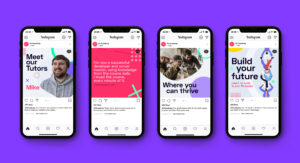
Margaret Davidson, Business Development and Marketing Manager at iO says, “Fiasco saw right to the heart of who we are as a brand and came up with a visual identity to represent us which we would never have thought of ourselves. In particular, what we wanted was to become more attractive and accessible to a wider range of people, with a core focus on diversity and inclusivity. Working as part of a new niche sector within a wider industry that often seems intimidating, this was a challenge. Fiasco came up with an approach where we now feel confident that an underpinning of inspiring inclusivity will be clear in everything we do, and help us to be part of bringing meaningful change.”
With the name and proposition came a new visual expression for the brand. The visual language is designed to reflect exploration, harnessing imagination and working towards a better future. The graphic shapes give a sense of wayfinding, collecting badges and new skills following a creative pathway. Verbally the tone is positive, ambitious and empowering, and speaks to the curious and willing.
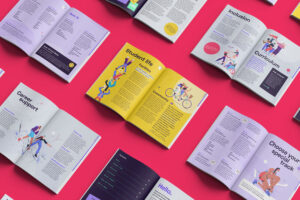
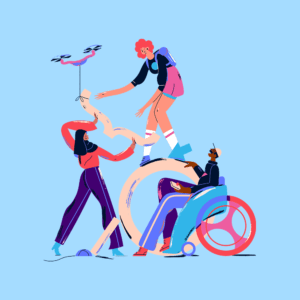
Working with Belgium-based illustrator Soren Selleslagh, the team created a suite of illustrations to depict aspects of the student journey across the course and into their new careers. Soren’s human-centred approach evokes joy and empowerment through positive representation of all types of people. With a devoted outlook to making meaningful illustrations, this partnership gave the brand identity the visual storytelling elements that demonstrate openness and inclusivity.
Ben Steers, Creative Director at Fiasco Design says about the project: “It’s been fantastic to work with the team at iO and help them towards realising their vision of leveling the playing field within the tech industry by creating a fairer, more diverse community of developers”
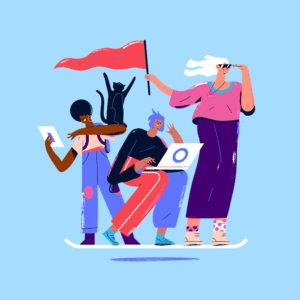
Business as Unusual – the webinar dedicated to inspiring marketers and business owners – returns!
Join Azeem Ahmad, Sunjay Singh and Joyann Boyce for a conversation about cultural diversity in the marketing sector on Thursday 17th September from 3pm – 4pm.
This webinar is perfect for marketers and business owners who want to make a start at being more inclusive at work.
We’ll cover:
– Practical ways to champion diversity in the workplace and get around the biases of your boss
– First hand experiences of cultural bias as told by our panellists
– The steps we can take as an industry and as individuals to make inclusive marketing the standard
– How we can encourage more young people of colour into the sector
There’ll also be a 15 minute Q&A where you can submit anonymous questions on the topic; so if there’s a question you have which you felt uncomfortable or a bit silly asking, this is your chance to ask it.
Register for the webinar and get the joining info here: mnky.bz/bau
Pre-submit your anonymous question using this form here: https://www.surveymonkey.co.uk/r/GKCM3BG
You need to load content from reCAPTCHA to submit the form. Please note that doing so will share data with third-party providers.
More Information