In the rapidly evolving world of Digital PR, it’s easy to feel overwhelmed by the vast amount of information out there. To help you navigate this landscape, we’ve created a concise glossary that breaks down essential terms and concepts you need to know to strengthen your business’s online presence. This guide is designed to simplify Digital PR by focusing on the most relevant terms, explanations and examples that matter for today’s digital strategies.

A
A/B testing
A/B testing is a method of comparing two versions of content to determine which one performs better in engaging or converting an audience.
Example: Testing two different headlines for a blog post to see which one gets more clicks.
Amplification
Amplification in digital PR refers to the strategic sharing and promotion of content across various channels to increase its reach, visibility, and engagement with a wider audience.
Example: Sharing a blog post on social media and sending it in an email newsletter to increase visibility.
Anchor text
Anchor text is the clickable, highlighted text in a hyperlink that leads to another webpage, often optimized with relevant keywords to improve SEO and provide context for both users and search engines.
Example: In the sentence “Check out our Digital PR services to learn more,” the words “Digital PR services” serve as the anchor text.
B
Backlinks
Links from other websites that point back to yours, helping improve your search engine ranking and build authority.
Example: A popular blog links to your website in an article, that link serves as a valuable backlink.
B2B (Business to Business)
Marketing or providing services to other businesses.
Example: A media agency that sells its services to other companies rather than individual consumers.
B2C (Business to Consumer)
Marketing or selling directly to individual consumers.
Example: An online beauty store that sells directly to shoppers through its website.
Broken link
A hyperlink that no longer works and leads to a page that does not exist.
Example: Clicking on a link to a product page that shows a “404 Not Found” error.
C
Call to Action (CTA)
A prompt aimed at encouraging people to take specific actions, like signing up for a newsletter or making a purchase.
Example: A button that says “Subscribe Now” on a newsletter signup form.
Content curation
Content curation is the process of discovering, organizing, and sharing relevant third-party content to engage your audience and enhance your brand’s topical authority.
Example: Sharing trending or important articles on social media to engage followers.
Content marketing
A strategy that focuses on creating valuable content to engage the target audience.
Example: Writing blogs or making videos to educate potential customers.
Community engagement
Community engagement in digital PR involves actively interacting with an online audience through comments, industry forums, and social media to build relationships, trust, and brand loyalty.
Example: Engaging in a LinkedIn group related to your field and answering questions from other members.
D
D2C (Direct to Consumer)
When a company sells products directly to customers without middlemen such as retailers or wholesalers.
Example: A company directly selling its products on its website.
Domain Authority (DA)
Domain authority is a search engine ranking score that predicts how well a website will perform in search engine results, based on factors such as backlink quality and site structure.
Example: A website with a high domain authority is more likely to appear on the first page of Google search results.
Digital footprint
A digital footprint is the trail of data and online activity left by an individual or organization on the internet, which can influence public perception.
Example: Social media posts, comments, and website visits contribute to your digital footprint.
Do-follow link
A hyperlink that allows search engines to follow it to reach the linked website, passing value and authority.
Example: Your page is linked to another site, and inspecting the link shows if it’s a “follow” link.
E
Earned media
Free publicity gained through word-of-mouth or coverage in the media.
Example: A publication writing about your products without payment.
Engagement
How users interact with your content through likes, shares, comments, etc.
Example: A Facebook post with lots of likes and shares indicates strong engagement.
G
Geotargeting
Delivering content or ads based on a user’s location.
Example: Writing an article for a local newspaper, for the audience of that area.
Google Trends
A tool that shows how popular certain search terms are over time.
Example: Checking Google Trends to see how topics like “Minimalism” are trending.
I
Influencer marketing
Partnering with influencers to promote products.
Example: A skincare brand sending products to beauty influencers for review.
Influencer outreach
Contacting influencers to build relationships and promote campaigns.
Example: Sending an email to a blogger inviting them to review a new product.
K
Key Performance Indicators (KPIs)
Metrics used to measure the success of a marketing campaign.
Example: Measuring media mentions as KPIs to evaluate the impact of a digital PR initiative.
L
Link building
Getting other websites to link to yours to improve SEO and gain backlinks.
Example: Writing guest posts that include a link back to your site.
Link juice
The SEO value passed from one site to another through links.
Example: A high-authority site linking to your page can boost your site’s credibility.
N
No-follow Link
A link that doesn’t pass SEO value to the other site, denoted by HTML tag rel=”nofollow”.
Example: A link on a blog with a “no-follow” tag to prevent passing SEO value.
O
Online mention
When a brand is referenced in online content.
Example: A blog post discussing your company and including your brand name.
Organic search
Search results that appear based on relevance rather than paid ads.
Example: Your website appears in top results for “best running shoes” without paying for ads.
Outreach
Contacting media or influencers to promote a story or content.
Example: Reaching out to journalists to pitch a new product launch story.
P
Pitch
A proposal sent to journalists or influencers to promote a story or idea.
Example: Sending a press release to a reporter to cover your company’s new initiative.
Podcasts
A podcast is a digital audio program available for streaming or download, often featuring discussions, interviews, or storytelling.
Example: A marketing podcast discussing industry trends with expert interviews.
Press coverage
Press coverage refers to mentions and features in media outlets, helping build credibility.
Example: A newspaper article highlighting your company’s achievements.
Press release
A written statement to the media announcing newsworthy information.
Example: Announcing a new product launch through a press release.
R
Referral marketing
A form of marketing where businesses encourage customers to recommend their services or products.
Example: Sending a referral code to a friend.
Retention marketing
Retention marketing is a strategy focused on keeping existing customers engaged and encouraging repeat purchases through personalized communication, loyalty programs, and targeted content.
Example: Offering a coupon code when a customer hasn’t placed an order in a while.
S
Short tail keyword
Short tail keywords are brief, general search terms, typically consisting of one or two words, that have high search volume but also high competition, making them important for driving broad traffic.
Example: “Shoes” is a short tail keyword compared to “best-running shoes for women” which is a long tail keyword and drives niche traffic.
Interacting with audiences and promoting content on social platforms.
Example: Responding to comments on Instagram posts and sharing user-generated content.
Social proof is where individuals look to the actions and opinions of others to guide their own decisions, often leveraged in digital PR through testimonials, reviews, and endorsements.
Example: Displaying customer reviews and testimonials on your website to build trust and credibility.
UGC (User-Generated Content)
Content created by users or customers, often used in marketing.
Example: Resharing customer photos wearing your brand’s clothing on social media.
With this glossary, you are now armed with a foundational understanding of Digital PR terminology to support your business’s growth in the digital space. Remember, Digital PR is an ever-evolving field, so staying familiar with these terms will empower you to make informed decisions and adapt to new trends with confidence.
If you are still unsure about any of these terms, don’t hesitate to reach out to our expert team who are happy to help. Contact our expert SEO team.
If you’re new to SEO or just want to learn the basics, this article is for you. As an expert team of SEOers , we understand that it can be difficult to understand all of the terminology, definitions and jargon that are often used in technical, off-page, and on-page SEO.
It’s important to know the different SEO terms because this knowledge enables you to inform and optimise your website’s content and practices. For example, if you know what backlinks, meta data, and keywords are, you can locate areas for improvement on your site and use each of these elements to help your website rank higher organically on a search engine.
We have compiled this helpful glossary to make it easier to get to grips with the basics. We hope this can help inform and build your knowledge around SEO, frequently used technical language to help you implement positive changes to your website that will get your business more visible online.
The glossary is split into three key sections below, to help you make sense of the different terminology used in SEO – Technical Terms, On Page Terms and Off Page Terms.

A-G
Caffeine
This is the name for Google’s modern web indexing system, created in 2010, enabling incremental indexing. As a result, there is a shorter delay between Google bots crawling your site and then being indexed, so Google can update its content more often and faster, and the SERP stays up to date. This is why it’s important that website content is kept fresh. See Crawling and Indexing.
Canonical tag
It’s a way to control duplicate content. When you have pages with similar content, you can add a canonical tag to the <head> section of the page, thereby telling search engines which version of a URL you want to appear in SERPs. Although, Google may not always choose the page you have designated the ‘master’ page. See Search Engine Results Page (SERP).
Content management system (CMS)
A software that helps you build a website without having to do all the coding. Various examples include Shopify, HubSpot, and WordPress.
CMS migration
The process of moving a website from one CMS to another.
Crawling
This is the process in which search engine bots will look (or ‘crawl’) through your website and explore its content. Crawlers follow URLs and download the content on their pages to view it.
H-P
Hreflang tags
These tags are used when your website has multiple languages. It allows google to present the correct version of a website depending on a users’ location.
HTML sitemap
Similar to an XML sitemap, though written for humans (and bots), a HTML sitemap lists all the pages of a website to improve navigability.
HTTPS
In comparison to HTTP, HTTPS occurs when a website is SSL-encrypted, and is therefore more secure. It is also one of Google’s ranking factors and is a way for search engine’s to verify that your website is secure, and a user’s data is safer.
Image compression
When images take up too much space, and slow down the speed of a page, their file can be compressed so they take up less storage.
Indexing
After a website has been crawled, the data viewed by search bots is stored and subsequently ranked by Google, though its ranking depends on various factors, and displayed on SERPs. See Crawling and Search Engine Results Page (SERP).
Log file
This contains a record of every interaction a bot and human have had with your site. They are an important aspect of technical SEO to understand how crawlers interact with a website and should be proactively audited to fix any crawl error issues.
Meta tag
A meta tag is an HTML tag used to provide metadata (information about the webpage) to search engines and web browsers. Meta tags are placed inside the section of an HTML document and are not visible to users. Instead, they give important information that can affect how the page is displayed or indexed.
NoIndex tag
This is a meta tag placed in the section of a page and allows a search bot to crawl a page, but not index it, so it will not appear on a SERP. This is useful for low value or non-public pages, because search engines still need to know these exist on your site, for example, ‘thank you’ or payment pages.
NoFollow tag
When a search engine bot comes across a link on your site, you can add a nofollow meta tag to the section of a page, instructing them to ignore that link and not follow that link trail.
Orphan pages
These are pages which have no internal links to them, making it very difficult for a crawler to find them. These pages are also a missed SEO opportunity, as they do not pass link equity. See Internal Links and Crawling.
Plugins
Software extensions for web pages, allowing its content to be customised, for example improving a page’s loading speed (although they can become a security risk if not added properly).
Q-Z
Redirecting URLs
These are used to direct an existing URL to another. For example, if you were moving your site to a new domain, using a redirect would simply transfer users from previous web pages to your new ones seamlessly. They are a key way to transfer existing authority and ‘juice’ your pages have.
Rendering
After a website has been crawled, a search engine will then render its pages. It takes information from HTML, JavaScript, and CSS to generate how a page will appear to a user.
Robots meta tag
A piece of HTML code that tells search engines how to crawl, index, and then display a web page’s content on the SERP. See Search Engine Results Page (SERP).
Robots text file (robots.txt)
Encompasses a set of instructions for bots, to understand which parts of your website to crawl and index, and which to leave out e.g., thank you pages.
Schema markup
Keeping up with AI algorithms, this is a good way of highlighting certain parts of your website to make sure they show up on SERPs.
XML sitemap
A list of all the pages on a website, written specifically for crawlers, in the form of coding.
A-E
Alternative text (alt text)
Text, included in HTML code, that is used to describe an image on a webpage, increasing a website’s accessibility.
Anchor text
This refers to the word or phrase of text you use when inserting a clickable link. In the example, ‘check out the new Varn website’, the anchor text is Varn website.
Breadcrumb navigation
A way to improve user experience by showing users how they got to the page they are on, so they don’t have to keep clicking the back button.
Cache
In SEO, a cache refers to a stored version of a webpage by search engines or browsers to improve load times and user experience by serving the saved content quickly instead of retrieving it from the server each time.
Click-through rate (CTR)
How many people have clicked on your ad divided by the number of people who saw it (impressions), presented as a percentage.
Commercial search intent
When a user has interest in certain products and is trying to educate themselves in order to decide what to purchase. See Search Intent.
Crawl budget
Search engine bots cannot crawl a page forever, they have a crawl budget and will only search through a certain amount of pages in a given timeframe.
Crawl demand
How often google wants to crawl a page – this is dependent on the authority of a page and how often it is updated. See Domain Authority.
Crawler directives
Crawler directives are instructions given to search engine bots (like via robots.txt or meta tags) to control how they should crawl, index, or avoid certain parts of a website.
Crawl rate limit
The rate at which a google bot can crawl site, without overloading your server, giving a poor User Experience. See User Experience (UX).
Cumulative layout shift (CLS)
The amount your webpage shifts as more content loads.
Traffic that has got to a website from entering its domain in the address bar. Essentially, a user doesn’t need to get to a website through a search engine, social media, or an external resource.
Eager loading is a web development technique where all necessary related data is loaded in advance, typically in a single query, to prevent the need for multiple database calls later, improving performance in certain situations. See Lazy loading.
Email traffic
Traffic directed to your website via clicking on a link on a marketing email.
Determined by content quality, visitor engagement, and backlinks. See Backlinks.
Expertise Experience Authoritativeness Trustworthiness (EEAT)
A website needs to prove it can be trusted and that it is legitimate. Showing reviews of products/services, adding information about authors, and adding relevant content to a website aligns with this criteria.
External links
Links on your website that point users to another site by another business. See Internal Links.
F-N
Features snippet
A featured snippet is a type of SERP feature. A short description of a search query that appears above a website’s URL on a SERP (they usually appear at the top). See SERP feature.
First input delay (FID)
The amount of time it takes for your website to respond to the first interaction with a users.
F pattern theory
Theory that the user will mainly look on the left side of the webpage, and examine the top of the page.
Fold of a website
The bottom of the screen and everything below it that requires the user to scroll.
Hero of a website
The part of the website that the user sees first when the website loads.
Image carousel
An image carousel is an example of a SERP feature. The sliding row of images that appears towards the top of a SERP, displaying a series of products with an image, short description, and price. See SERP feature.
Informational landing pages
Provide quality and in-depth content, describing a specific topic so users understand. Informational landing pages will ideally rank for keywords with informational search intent.
Informational search intent
When a user is visiting for the purpose of learning something – they are typically not interested in buying yet but could be open to it. See Search Intent.
Internal links
Links on your website that connect to other pages on your site. See External Links.
Interstitials
Full-screen advertisements, typically appearing as pop-ups.
Keyword cannibalization
This occurs when multiple pages on a website target the same or very similar keywords, so end up competing against each other in the SERP. See Search Engine Results Page (SERP).
Largest contentful paint (LCP)
The amount of time it takes for the largest piece of content to load.
Layer-cake pattern theory
Theory that the user will focus on the headings and subheadings, as they act as signposts for information.
Lazy loading
Lazy loading is a web development technique that delays the loading of non-essential resources (like images or videos) until they are needed, improving initial page load speed and performance. See Eager loading.
Local pack
A local pack is a SERP feature that appears towards the top of a results page, and includes a map of the closest businesses to the user, often with star ratings and links to their websites. See SERP feature.
Long-tail keywords
More specific phrases 3 to 6 words long that customers will search for, typically when the user is further along in the buying process. See Short-tail Keywords.
Meta description
The short description of the webpage that appears under the meta title on a SERP. See Search Engine Results Page (SERP).
Meta title
The title of each page of a website that appears on the SERP. See Search Engine Results Page (SERP).
Mobile-first indexing
The structure and function of a mobile site will hold greater value when determining the rank and visibility of a website because Google will put the mobile version of a site before the desktop version.
Navigational search intent
When the user already knows what they want and is searching for a specific website or product. See Search Intent.
O-Z
Organic content
Any content that users find by themselves that doesn’t rely on paid marketing techniques, for example, blog posts, social media posts, and user-generated content.
Organic search
The ‘natural’ ranking of websites, excluding all the paid search. See Paid Ads.
Organic traffic
Traffic to a website through unpaid, natural search engine results, as opposed to paid ads or direct traffic. It is driven by users searching for information and clicking on links that appear in the search engine results pages (SERPs).
Page speed
The amount of time it takes for a web page to load.
Pagination
Dividing a long list of content into multiple pages to stop infinite scrolling.
Paid ads
These will appear above the organic search results, marked by a little ‘Ad’ icon. See Organic Search.
Paid search traffic
All traffic that has arrived at your website from paid advertising in a SERP.
Pay per click (PPC)
A digital marketing strategy where businesses bid an amount of money on a certain keyword to have their ad appear on a SERP. See Search Engine Results Page (SERP).
Product landing pages
Have only as much information as you need to describe the product, and have breadcrumbs to other parts of your site.
Rich snippets
Add extra descriptions of the content on a site e.g., ratings or events information. See Snippet.
Referral traffic
Traffic to a website via a link on another website.
Schema markup
Coding on the site, that the user doesn’t see, to help search engines understand your content.
Search Engine Results Page (SERP)
The page that a search engine serves to a user in response to a query. The higher the position a link is on the SERP, the more likely it is to be clicked.
Search intent
The primary goal a user has when visiting your site. This is used in reference to keywords, and can usually be broken down into 4 categories. See Commercial search intent, Informational search intent, Navigational search intent, and transactional search intent.
Search generative experience (SGE)
Google’s use of generative AI to give users a summary answer to their search query, improving user experience.
Search volume
A metric showing the amount of people searching a certain query.
Search difficulty
Also referred to keyword difficulty, this is a metric that measures how hard it is to rank for a particular keyword in search results.
Seed keywords
Broad, core words and phrases that your customers will search for.
SERP features
Elements on a search engine results page (SERP) which add extra information to the simple list of URLS. Google uses these to improve user experience (UX).
Service landing pages
Describe the information about the product or service you offer and link to related information.
Short-tail keywords/head terms
Words that are 1 to 2 words long that refer to broad topics and have a high search volume. See Long-Tail Keywords.
Social traffic
This includes all traffic that has arrived on your website from social platforms.
Spotted pattern theory
Where the user will jump around the most interesting spots of the site, typically following website design.
Snippet
Offers a brief description of a website and often includes a map, contact details, videos, or photos (these are different from meta description).
Title tag
This is a piece of HTML code that gives a page its title. A H1 is the main title, and H2s and H3s are subtitles used to split up sections.
Transactional search intent
When a user is ready to buy (this is the best time for immediate action on a site). See Search intent.
URL
The address of a webpage. For example, https://www.varn.co.uk
User experience (UX)
How a user experiences a website, including their emotions, responses, and perceptions.
User experience design
The process of increasing a user’s level of satisfaction with a product or service by making improvements to its functionality, convenience and ease of use.
Website architecture/site structure
How a website is structured and organised.
Your money or your life content (YMYL)
Any content online that has potential to cause harm to the reader in any form – Google takes this content more seriously.
A-Z
Backlinks
Links on other websites that point to your website. They are a good way to increase the authority and credibility of your site.
Broken link outreach
Finding broken links on good quality third-party sites that can be fixed and retrieved.
Data-led content outreach
Involves researching a business in order to write a story backed up with data, with the primary aim of attracting press attention.
Guest posts
Where you publish an article on someone else’s website – it is a key way to gain more awareness of your business.
Image link building
Outreach through reverse image search tools targeting client-owned images that have been used without accreditation.
Inbound link acquisition
Creating and optimising onsite content that organically acquires links over time.
Link equity
The authority a link passes to its destination page. Links to a page act like a ‘vote’ from the origin page, and a higher quantity of links from trustworthy websites is a positive signal for Google.
Link profile
A link profile refers to the overall composition and quality of all backlinks pointing to a website, including factors like the number of links, the authority of linking domains, anchor text used, and the diversity of link sources, which together influence the site’s search engine rankings. See Backlinks.
Product outreach
A strategy where you send a product to bloggers in exchange for a review or link to your website.
Partner/client site outreach
Outreach to existing partner and owned websites.
Unlinked mentions
When your business is mentioned on the web but there is not a link directing users to your website.
Now you have taken a look at the key SEO terms you should have a better idea of what SEO involves, and you may even have ideas of elements you want to implement to your website. We understand there are a lot of key terms, so you may need to revisit this list multiple times before using them.
If you are still unsure about any of these terms, don’t hesitate to reach out to our expert team who are happy to help. Contact our expert SEO team
By Tracie Leahy, Assistant Principal for Apprenticeships, Weston College
In the evolving landscape of workforce development within the creative industries, businesses are constantly seeking innovative ways to attract, develop, and retain top talent. Degree apprenticeships have emerged as a powerful solution, offering a unique blend of practical experience and academic learning. At Weston College and University Centre Weston, we have witnessed firsthand the transformative impact that degree apprentices can have on businesses. Here’s why integrating degree apprenticeships into your talent strategy is a game-changer for the creative industries.
Secure the Best New Talent
In a competitive job market, securing top talent is more challenging than ever. Degree apprenticeships provide an opportunity to attract high-calibre candidates who are eager to learn and grow within your organisation. These individuals bring fresh perspectives and are equipped with cutting-edge knowledge from their academic studies, combined with practical skills honed through on-the-job training. By investing in degree apprentices, you are investing in the future leaders of your industry.
Upskill Existing Employees
Degree apprenticeships are not just for new hires. They offer a valuable pathway for upskilling your existing workforce. Many employees have untapped potential that can be unlocked through further education and training. By supporting your employees in pursuing a degree apprenticeship, you are fostering a culture of continuous learning and development. This not only enhances their skills and job satisfaction but also improves overall organisational performance.
Build a Culture of Learning and Development
A learning-oriented culture is a cornerstone of innovative and resilient organizations. Degree apprenticeships instil a commitment to personal and professional growth within your team. Apprentices bring new ideas and approaches, inspired by their academic learning, and share this knowledge with their colleagues. This creates a dynamic environment where learning is valued, leading to increased engagement and retention.
Reduce Recruitment Costs
The traditional recruitment process can be costly and time-consuming. Degree apprenticeships provide a cost-effective alternative by allowing you to train and develop talent tailored to your specific business needs. Apprentices are often more loyal to the organizations that invest in their development, reducing turnover and the associated recruitment costs. Furthermore, you can evaluate an apprentice’s fit within your company culture and operations throughout their apprenticeship, ensuring a smoother transition to a permanent role. Also, we do all the advertising, shortlisting, and recruitment support for your vacancies – saving you time and expense.
Maximise Government Funding
One of the significant advantages of degree apprenticeships is the availability of government funding. This financial support can substantially offset the costs of training and development. By leveraging these funds,
you can invest in your workforce without straining your budget. It’s a smart financial decision that benefits both your business and your employees.
Meeting the Demand
Weston College and University Centre Weston offer a diverse range of degree apprenticeships tailored to meet the needs of modern businesses, including those in the creative industries. Our programs include:
Attracting the Best: The Appeal of Degree Apprenticeships
There is a growing trend among students to choose degree apprenticeships over traditional degrees. This pathway allows them to avoid substantial tuition fees and student debt while gaining practical experience and earning a salary. As a result, employers have the opportunity to access ambitious, motivated individuals who are eager to start their careers sooner. By offering degree apprenticeships, you can attract the cream of the crop—talented individuals who are ready to contribute to your business from day one.
A Proven Pathway: From T Levels to Degree Apprenticeships
We are seeing a growing trend where employers begin by offering T Level student placements, which involve 315 hours of work experience annually, before progressing these students to degree apprenticeships. This approach allows employers to identify and nurture talent early, providing a seamless transition from education to full-time employment. It’s a strategy that not only ensures a steady pipeline of skilled workers but also strengthens the bond between the employer and the apprentice.
Speak to Us
Investing in degree apprenticeships is a strategic move that delivers long-term benefits for businesses. By securing new talent, upskilling existing employees, fostering a culture of learning, reducing recruitment costs, and making the most of government funding, you position your business for sustained success. We are committed to supporting businesses in unlocking their potential through our comprehensive T Level and Apprenticeship programs.
Discover how degree apprenticeships can transform your business. Learn more about our offerings here or give us a call at 01934 411594 or email [email protected].
Digital PR and traditional PR have the same goals and objectives; they both are about increasing brand awareness and building a brand’s reputation.
The difference between digital PR and traditional PR is in the inputs and tactics.
A digital PR campaign will use all the opportunities and channels that digital offers, from simple social media strategies and tactics to more technical and complex strategies like SEO and technical SEO strategy.
Consistency is key
A key part of digital PR is to have consistent messaging across all platforms to have coherent communication and brand recognition. Digital PR allows brands to reach more people and build more authentic relationships with an audience.
As long as you approach with authenticity and develop strategies that engage and enable the consumer to access your brand online.
So brands can build credibility, brand awareness, relationships and trust. Digital PR is no longer a nice to have for brands. It’s a must-have to raise awareness and grow.
Digital PR Benefits
Digital PR is powerful.
It can help you reach your audience, increase brand awareness and boost your reputation and visibility in the digital age. Digital PR is built to improve your brand’s presence in the digital age and this is how:
More website traffic
By increasing your website traffic you’re widening your scope, growing your audience and generally increasing your brand awareness. More traffic means more digital footfall which can bring in new customers and brand awareness.
More traffic means more digital footfall and more footfall and web traffic means more chance of conversion.
More engagement on social media
Real-time messaging, direct interaction with audiences and plenty of opportunities to build credibility and monitor social media channels and brand mentions helps to make your PR stronger. An engaged social media presence and positive following is a great trust signal to new prospects.
More leads more sales
Digital PR isn’t about selling your products but it can create the environment to nudge customers to buy. PR can increase brand awareness and build brand trust which is key to increased customer loyalty and sales. Trust is the key to sales.
Better brand image
A good reputation and online presence is good for you. People like to engage with businesses and brands. They don’t like faceless organisations that don’t care about their audience or user groups.
Digital PR Strategy & Tactics in Action
So we’ve looked at the outcomes of digital PR strategies. But what does it look like, in terms of tactics and deployment
Social Media
You need an active social media presence to maintain and grow your brand reputation. It’s part of building your online identity and part of your digital PR strategy.
While also being a major part of your digital PR strategy, social media is a major part of your overall customer service arm.
It’s your shop window. But it’s also more than that.
This is a place where potential customers can be influenced by your existing audiences. So positive, honest and authentic engagement is a must.
Content Creation
What does content creation mean to you? White papers? Blogs? News stories? writing press releases? Producing video content? Tweets (or should we say X’s) Instagram posts, even TikTok content?
To us, it means all of the above.
Content helps to build emotional connections with your audience. Great content engages, entertains and ultimately converts prospects into loyal customers. Building campaigns around great content, leveraged across multiple channels and formats is the most effective way to engage with your tribe
Link building strategies
Digital PR and link building go hand in hand. But this is a long-term game.
These strategies also help to differentiate your brand from other businesses in the industry.
These strategies increase overall visibility of your website through the placement of backlinked content on third-party sites with relevant links. This could be a simple press release, a news story on relevant websites and online media, or thought leadership in key sector titles.
It’s a traditional PR approach, engaging with media through press releases and putting a digital PR spin on it.
But the content and placement have to be relevant. Credible, high-quality backlinks – meaning backlinks to relevant and trustworthy – quality links will build brand credibility and authority.
Content and Channel Optimisation
Effective brand communications means all channels and assets are optimised for maximum visibility.
Everything needs to be connected for maximum online visibility. Whether it’s your Google My Business Profile, or making sure your social tags and handles are on your site, your social media presence is also optimised to boost organic rankings and increase your presence in the SERP.
You can’t build on your search ranking score if your owned channels aren’t optimised. To get more awareness and reach online PR requires a holistic approach, everything needs to be in sync.
Showing up to Google
This could get lengthy so we’ll try to keep it brief.
Google monitors and ranks online publications, websites, pages and content against its own set of rules. These are the E-E-A-T guidelines, they are a set of indicators that determine whether any given piece of on-page content is experienced, expert, authoritative and trustworthy – hence E-E-A-T. Consistent messaging across all content is key to meeting Google’s E-E-A-T guidelines.
E-E-A-T — or Double-E-A-T became part of Google’s search rater guidelines in 2022.
The main challenge with Google is it likes to move the Goalposts.
Core updates and other changes to the practice and protocol can make it hard to keep up with the latest best practices and requirements around search engines and content.
You can spend all the time in the world developing a digital PR strategy and digital marketing strategy. But if you’re creating content that Google won’t or doesn’t like, all that work will be for nothing. The further down the SERP you go, the more your website, organic traffic and brand visibility suffer.
This is where it pays to have an expert in your corner.
Conclusion
Ultimately, digital PR is a key part of any PR strategy.
Digital PR can lead to customer loyalty by building trust and credibility.
It may seem like a big ask to keep up with the ever-changing search engine algorithms and best practices. But the rewards of well-executed digital PR campaigns and strategies are worth it.
Google’s E-E-A-T guidelines say to create content that is Experienced, Expert, Authoritative and Trustworthy.
Build brand credibility, build relationships and build trust with your audience. By producing high-quality, relevant content and earning links from other reputable sources you’ll increase your website visibility, authority and overall search engine rankings.
But digital PR needs a long-term approach. It is not a quick win.
It requires a strategic and sustained effort. Which in turn requires patience and an ongoing commitment to the overall process on online brand building.
Content is king… and video is the king of content.
Through great video content, brands and businesses have a huge opportunity to engage with their audiences and build brand loyalty.
But how can you make video work for you?
Authenticity is the foundation of great video content. In an age of digital distrust, audiences want genuine brand experiences. So before you start production, consider:
Knowing the ins and outs of each platform is key to getting engagement:
There’s a lot of heat on AI production at the moment. The AI-created end product often comes under fire. But that doesn’t mean there isn’t a place for AI in your pre-production.
Use AI to speed up your video production in the following ways:
Example: if you’re looking for examples, inspiration or source material. You could spend mindless hours in Google, or the right prompts in a site like Perplexity could yield faster answers to your questions. Freeing up much more time to commit to the creative process.
Example: A travel agency creates a virtual tour where viewers can choose their path through a destination and the content they see next.
Example: A furniture retailer creates an AR app where customers can see products in their own homes through their phone.
Example: A B2B software company creates a weekly 60-second tip series, each one focusing on a different feature of their product.
Example: A tech startup documents its journey from idea to product launch, posting weekly updates on social media.
Example: A fitness app asks users to share their transformation stories and compiles the best into a video series.
Making content is one thing. But putting it to good use is another thing entirely.
You could spend so much time and effort in production, only to let your efforts fall at the final hurdle, by failing to effectively activate your content. So consider the following implementation and activation tactics:
Multi-Form Content: Create different versions of each video for different platforms and purposes. Not all content is made equal, different ideas and different themes will perform better, or worse, on different channels.
Live Streaming: Where applicable, you can seek to create a regular cadence of live content to engage with your audience in real time.
Video SEO: as video content becomes increasingly more present in search, it’s important that your online assets are properly optimised. This means optimised video titles, descriptions and tags to be discoverable on search engines and video platforms.
Localisation: consider how you can adapt content for different regions through subtitles, dubbing or culturally relevant versions.
Accessibility: consider how you can also use subtitling and dubbing to increase the overall accessibility of your content.
Ultimately, you’ll want your content to yield results. Use advanced analytics to track:
But note that not every piece of content needs to result in a sale or a conversion. Building brand loyalty and engaging with your audiences in a way that isn’t overly commercial or transactional is the way to go here.
That means pulling back on the amount of sales-driven content and publishing more content that engages, entertains and informs.
So when you do hit your audiences with a CTA, they’re far more likely to convert, because they’re more bought into your brand and your ethos.
If you’re building an e-commerce site, you’re probably wondering if your site even needs a blog. The short answer is yes, absolutely it does.
As it turns out, nobody is writing blogs for the sake of it. In fact, businesses with a successful blog generate 67% more leads per month than those without. There are tangible benefits to posting regular blog articles on your e-commerce site and I’m going to walk you through them now.
Did you know that small businesses that blog get a whopping 126% more lead growth than those that don’t?
It’s important not to overlook blogs when thinking about your content marketing. They’re a great way of boosting traffic to your site, building your brand voice and engaging potential customers by informing them about your products.
It’s true that not everyone who visits your website will read your blog, but that doesn’t mean it should be overlooked. You’re probably the fountain of knowledge when it comes to your products, but it can be difficult to demonstrate your knowledge and credibility through product descriptions and landing pages alone. Converting your knowledge into long-form copy is a great way of sharing your expertise and building your brand.
At the end of the day, it’s about convincing people to buy your stuff, and blogs will actively improve your conversion rate optimisation (CRO).
Rather than simply promoting your products, your blog should serve as an information hub for potential customers and contain ‘top of the funnel’ content to target them in the discovery stage of their journey to buying your products.
Blogs should be educational and informative, and by providing expertise and insights into the value of your products, you’ll build your reputation as a trustworthy brand, engage customers and push them towards making a purchase.
Take it from us – SEO is extremely important for any online business and blogging represents a fantastic opportunity to improve your SEO rankings and drive traffic to your e-commerce site.
By writing fresh, long-form copy for your site, you’ll target more keywords than you would on your product pages. What’s more, putting out fresh content is a good way of signalling to Google that your site is active. As a result, Google will push your content further up search algorithms, generating more traffic to your site and improving your SEO and conversion rates.
Blogs are also a great place to target long-tail search. When customers are in the awareness stage of the marketing funnel – that is, aware they have a problem but not of what the solution is or that you as a company offer it – they are more likely to be searching for informational keywords. These ‘top of the funnel’ keywords usually start ‘how’ or ‘why’ and are longer. Individually, they have a lower search volume but there are a lot more of them so this traffic can be substantial. Blogs can be used to cover a lot of informational ground, which will mean your e-commerce site is more likely to pop up when your target audience is researching anything to do with your industry or products.
Capturing this traffic will boost your site’s overall SEO but it will also build awareness around your brand and help funnel traffic to your product pages.
When it comes to blog content, the sky’s the limit. If you think you’ve got nothing to say, start by stepping into the shoes of your potential customers. Ask yourself:
Keyword research can give you solid insights into the questions your customers are asking. However, competitor analysis is also your friend here. By reviewing what others in your niche are writing about, you can pinpoint content gaps and discover what’s generating the most engagement among your target audience (this is often called a ‘content gap analysis’). This approach can set the stage for you to attract consistent, high-quality leads.
To help you get the ball rolling, we’ve put together a quick list of blog ideas for your e-commerce site:
By tapping into these ideas, you’ll keep your blog relevant, informative and engaging.
There is no one-size-fits-all answer when it comes to how often you should post blogs on your e-commerce site. While some companies pump out new content each day, others may only post a few times a month. The amount you post depends on your available time, budget and how much you genuinely have to say about your business.
What matters most is the quality and value of your content. If you find yourself churning out content just for the sake of it, it might be time to take a step back and reassess your content strategy. Often, fewer high-quality posts can deliver better results than posting more frequent, less valuable content.
Zest in Bath are a firm of local estate agents established in 2008, by Glen Perry, who runs it with his wife Beth. They have since achieved a Gold award at the British Property Awards, three years running, and been voted as Business of the Year by Best of Bath.
Zest were very interested from the outset in what we could achieve for them, especially in light of the results we’ve achieved for Bristol based letting agents, Hopewell.
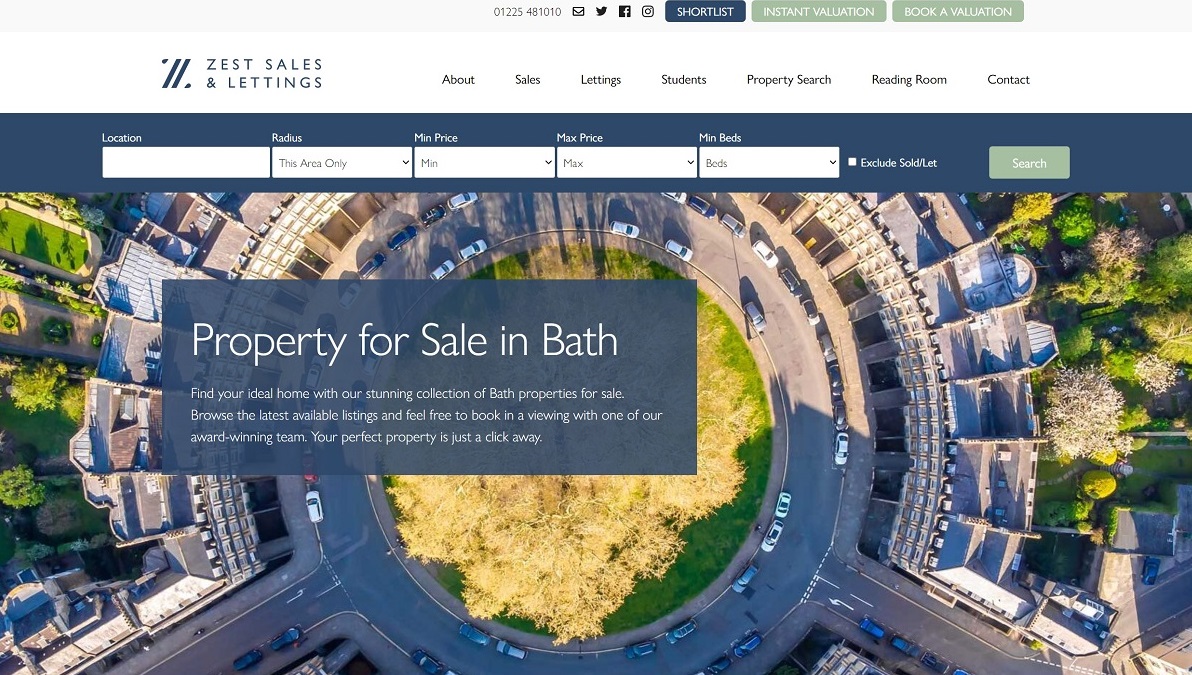
This wasn’t going to be a small website design project as the site had to integrate seamlessly with Vibra Alto, Zests’ in-house property management software. Having used the fantastic Property Hive suite of plugins on previous projects this was our go to choice for Zests’ new website.
In addition Zest required additional functionality, including an integration with Locrating, a tool that displays local amenities, sold prices, transport links and local school information such as catchment areas and Ofsted reports.
Zest has an increasing portfolio of student properties to let, so it was important to be able to display these on the website clearly. To that end we created a separate section of the website aimed at students and with distinct branding.
After the website build, we were tasked with growing the website’s search presence across a number of property related keywords in Bath. In a highly competitive and lucrative property market like Bath, that meant a lot of work to do.
The website was a custom design and WordPress build, based on Property Hive’s standard framework, that gave us the code with all of the hooks that we needed to integrate with their property management system. Once this was done we then set about importing the data and testing the site to make sure everything was working as it should.
With Zest’s local SEO strategy baked into the web build at the foundational level, all the initial keyword research and on-page optimisation was complete, meaning we were able to start writing additional content to go up on the new site, during the build phase.
Being involved at the web build stage allows us to really craft solid optimised websites that hold up really well and see immediate bounces in ranking when they launch (just of the many benefits of having an SEO agency build your website).
As well as creating their beautiful new website, the real benefit to Zest has come from our ongoing digital marketing work, specifically organic SEO and Google Ads. The results here have been excellent, with the site now ranking second for the coveted “letting agents Bath” keyword and getting onto page one for “estate agents Bath”.
Between the new site launching in August 2022 and January 2023, we saw a 60% increase in organic traffic, compared with the previous six months. Comparing the most recent data, from 2023 with 2024, we have seen these results really accelerate:
If you are looking to recruit a live events tech, Weston College can help businesses access fully funded* apprenticeship training for small and medium-sized enterprises (SMEs).
There is still a post pandemic impact on the sector, resulting in disruptions to staffing, increased costs, and significant supply chain delays. As the industry strives to recover, this new apprenticeship provides a timely solution by developing a new generation of talented technicians capable of supporting the growing demand for live events across the UK and beyond.
The exciting Live Event Technician Apprenticeship program, designed to address the critical shortage of skilled professionals in the live events industry begins starts in November so dont miss out!
Live Event Technicians work in a wide range of settings, including concerts, festivals, theatrical productions, exhibitions, and conferences. Their core responsibility is to prepare, build, set up, and operate industry-standard equipment to deliver seamless live performances. In this dynamic role, technicians interact with a variety of professionals, including venue staff, production managers, designers, performers, and producers..
The Live Event Technician Apprenticeship offers a structured pathway for both new entrants and existing employees to gain the necessary technical skills and practical experience. Employers can use this program to recruit new talent or upskill current staff, ensuring that they are equipped to meet the high standards required for live event production.
For those looking to secure the future of their business and contribute to the growth of the live events sector, this apprenticeship is an ideal solution. To find out more, contact [email protected]
*For 16-21-year-olds and up to 25 if a young person has an Education Health Care Plan.
Community-based youth charity Young Bristol has become the third South West charity to win a place on the region’s Noble Deeds programme.
Set up in 2021 by Bristol-based SME Noble, the Deeds programme provides digital marketing training & support to not-for-profits, helping them deliver vital services in the area. Increasing in-line with Nobles’ own turnover, this year the support package stands at £25,000. Young Bristol will use this to upskill its marketing team and ensure its services reach the young people who need them the most
Supporting children and young adults aged 8-25 during their critical out of school hours in some of the most challenging areas of the city, Young Bristol’s mission is to provide innovative programmes that create a positive and sustainable impact on the lives of young people
With eight community youth clubs across Bristol, a mobile youth club on wheels, outdoor activity centres and an employment programme just part of what the charity offers, the support from Noble will help the Young Bristol team prioritise where its digital marketing efforts will make the most impact. As well as helping the team to learn new skills and maximise their knowledge of social media, SEO and other digital promotion techniques for a lasting impact beyond the Deeds programme
Lucy Saunders, Head of Fundraising & Development, Young Bristol, explains; “We are thrilled to be the selected charity for this year’s Noble Deeds programme. It is an incredible opportunity for our organisation to gain valuable experience and support from a team of experts. Their support will make a big difference, not only by up-skilling our team and improving our digital marketing, but also by helping us to further our reach and services to even more young people.”
With numerous deserving causes across the city that could benefit from the Deeds programme, choosing just one recipient is difficult. Previous winners have included homelessness charity Emmaus Bristol and South Bristol social enterprise Heart of BS13
Lorenzo Campbell, chair of Noble’s UK Deeds committee, said; “It’s not easy to choose between the many worthwhile entries to Deeds we receive. However, Young Bristol gives us the opportunity to work with a charity that reaches the communities right across Bristol who need their help the most. Making sure young people get the right start in life is so crucial and the passion the Young Bristol team has for that is inspiring.
“The impact the charity has can be life-changing for young people and leaves a real lasting legacy. Hopefully by helping the team enhance their own knowledge and digital marketing skills we can help them make that impact as long-lasting as possible.”
The Noble Deeds initiative was originally started over twenty-years ago by Nobles’ parent [KS1] company in Nevada, North America. Mirroring the US programme, the winning not-for-profit is chosen by an employee-led committee, with the UK Deeds programme opening every June at a free ‘Be Better Bristol’ event for local charities and businesses
The Noble team then work alongside the winning charity from September through to February each year helping them to achieve their specific objective
To find out more about Young Bristol go to https://www.youngbristol.co
To find out more about Noble go to https://nobleperforms.co.uk,
Running an e-commerce store isn’t just about selling online, it’s about understanding how your visitors are navigating and interacting with your site and how you can use that data to inform KPIs, optimise your website and determine your marketing strategy moving forward.
If you run an e-commerce shop, chances are you’ve got questions about metrics. Don’t worry – in this guide I’m going to walk you through the metrics you should be tracking, why they’re so important and what you can do with them.
A conversion happens when a website visitor completes a desired action on your site (usually by making a purchase, clicking on a pop-up or filling out an enquiry form.) Conversion rates are measured by calculating the percentage of visitors who complete said action in relation to the total number of visitors to that page. Tracking these conversions determines your business’s Return on Investment (ROI) – the higher your conversion rate, the more chance you’ll have a positive ROI.
For e-commerce businesses, a conversion is usually the completion of a purchase on your website. Think of conversions as being the final piece of the digital marketing puzzle – while driving website traffic is important, the puzzle isn’t complete without said traffic leading to an actual purchase.
Conversion rates tell us a lot about what is going on in the minds of your website visitors. Measuring conversion rates is about tracking the performance of your e-commerce site and gaining an understanding of how potential customers are thinking and behaving so that you can shape your business strategy accordingly.
You might find you’re receiving a lot of traffic to your website but not seeing the conversions you’d like. Or maybe you’re receiving a lot of enquiries but no sales. The reality is that it doesn’t matter how much traffic you’re driving to your site because it’s worthless if visitors aren’t checking out.
If this is the case, it’s likely you have a conversion rate problem. In order for your e-commerce store to be a success, you need to think like a customer. What roadblocks are standing in the way of them making a purchase? Is there something wrong with your product or offering? Are you pitching to the wrong audience?
Identifying where the issue lies will help you to develop your business strategy to address the problems and inform your KPIs.
Now you’ve got an idea of the importance of tracking metrics on your e-commerce site, it’s time to break down some of the key metrics you should be keeping an eye on:
Segmenting your conversion rates can give a more detailed insight into the efficacy of your marketing efforts. There are a few ways to segment conversion rates:
By Traffic Source: Looking at where your conversions are coming from can give you an idea of where to direct your marketing efforts. Where is your website traffic coming from? Are people visiting via Google, Facebook, Instagram or LinkedIn? This enables you to improve your advertising or messaging on these channels. It also informs budgetary decisions. If you’re spending a ton of money on Facebook ads but all your customers are coming from Google, then maybe it would pay to divert budget to SEO.
By Device Type: Understanding what device visitors are using allows you to tailor the user experience. With mobile commerce accounting for 66% of global e-commerce sales, it’s important that your website is optimised for mobile devices to guarantee the same customer experience is being had.
New vs Repeat Visitors: You’ll usually find that repeat customers are more likely to make a purchase than those visiting for the first time. This is due to increased trust and loyalty in your brand. Identifying the difference can help you calculate how your acquisition campaigns are performing and where you should be directing your efforts.
So how do you optimise conversion rates on your website? This is where Conversion Rate Optimisation (CRO) comes in.
Conversion Rate Optimisation is about optimising your website to encourage visitors to make a purchase. This is done by improving the user experience, messaging and design on your site to ensure they have a positive experience. The more user-friendly your site, the more trust you will build with your potential customers.
For e-commerce stores, this might be things like creating easy-to-navigate product pages and a seamless checkout experience – essentially removing any friction your visitors might face. Don’t forget to optimise your website for different devices, too.
These things may seem minor, but they make a big difference in how customers navigate your site. It’s also a pretty cost-effective way of increasing your revenue, as it allows you to lower your cost per acquisition by taking advantage of existing traffic on your site.
Don’t know where to start? Check out our free Conversion Rate Cheatsheet and we’ll give your site a health score so you can get started on improving your e-commerce website and boosting sales.
For more advice, book a discovery call with us today and find out how we can help.
You need to load content from reCAPTCHA to submit the form. Please note that doing so will share data with third-party providers.
More Information