ADLIB, a B Corp certified recruitment business based in Bristol has become one of a handful of recruitment agencies in the UK to transfer 100% of its business to its employees. The company provides recruitment solutions across several core sectors, including Technology, Data, Engineering, Science, Sustainability, eCommerce, Marketing and Design. The business works with all manner of clients, from start-ups and scale-ups, through to global brands across the UK and increasingly overseas.
The Employee Trust will work alongside ADLIB’s Directors, to oversee strategy and growth, with an emphasis on ensuring that the business’s sense of purpose and values remains paramount.
ADLIB’s major shareholder, Nick Dean, will remain part of the Trust for the foreseeable future, whilst staff will play an increased role in directing business profits and inputting into the running of the business via the Trust, a model similar to that of the John Lewis Partnership.
A share ownership scheme will provide each and every employee access to share options based on length of service and responsibility. New employees will also be eligible to access the scheme and take advantage of a reward and ownership model that will significantly boost their earning potential, whilst creating a deeper sense of purpose and engagement.
Nick Dean “Over recent years we’ve been considering the future of ADLIB. We’ve always felt it would be a challenge to find a suitable buyer who would retain ADLIB’s ethos, substantiated by our B Corp certification in 2019, and the drive to balance profit and purpose. The most important factor was retaining our independence and the flexibility to invest into our growth, whilst ensuring we retain our B Corp certification. By far the best solution to ensure ADLIB has a long standing future, was to hand over the business to the people we know and have helped create it into what it is today, whilst adding an additional layer of employee attraction for those who will help spearhead our next phase of growth.”
For most companies, producing reports is a necessary evil.
It can be a dull, daunting and time-consuming task, with hours spent gathering data and creating graphs, formatting, fact-checking, and last-minute late-night copy editing. Additionally, if you’re printing a physical copy of a report, you face the additional stresses getting your report production and distribution-ready – not to mention the added costs involved.
Once your report is published and posted, it’s a case of hoping your recipients have the time to spare, the attention to give and enough interest to read it.
But publishing your reports isn’t a lost cause.
Businesses are increasingly using their reports as tools for lead generation, awareness building and trust amplification. Any report can be digitised: from market briefings, to sustainability and annual reports. But creating a report which stands out requires more than just designing a PDF.
Whether you create a microsite, or a new webpage which hosts your findings, as long as you have a clear strategy and vision you can turn every business report into a marketing tool that promotes your company and engages your audience all year long.
One of the best things about digitising a report is that you can study engagement more closely than with a print document. With a digital report, you can provide a much better user experience than via a printed report or a pdf, allowing for interactivity and responsiveness whilst providing greater clarity and impact.
There are a wide variety of different methods you can use to amplify your report’s underlying data and craft an improved story for your reader. Using interactive graphs or animations, you can provide a wealth of context to each chart, helping your audience to better follow and understand the core messages you want to share.
The global trend of mobile and tablet usage is continuing to rise, and a fully responsive report allows you to make the most of this opportunity. Not only will you reach new audiences across different devices, you’ll also improve the experience of your existing online audience too.
Tracking engagement and interaction is easier, too. The importance of mobile-optimised reporting is only going to continue its trajectory of growth, as ‘digital natives’ age and progress into more high-profile roles and senior appointments worldwide.
Crucially, it’s easy to make amends and additions to your existing online report, without having to reprint or republish. From small things such as copy amendments and imagery updates, to adding live, up-to-date information from an API, changes can be performed quickly and without needing to recall any existing reports. You’ll save time and money, whilst maintaining an audit trail to cover any legal requirements.
You can think of a digital report a little like a book: each chapter – or section – tells a different part of the ‘story’, while its overall title and theme remains the same. This is one of the key elements which make a digital report so valuable.
Think about a business’ sustainability report, for example. The overall theme is sustainability, and the report may be split into sections such as the corporate mission, sustainability goals, emissions reduction statistics, recycling statistics, employee engagement and waste, etc. Breaking a report down into these elements allows you to do two things: target additional, more specific audiences, and maximise your report’s longevity, relevance and impact.
By posting regular organic posts on social media and supporting them with paid (targeted) advertising, your report will reach new audiences who may have specific interests in themes contained within your report. You also boost your opportunity for increased press coverage and ongoing discussion on platforms such as LinkedIn, keeping your report – and your brand – front of mind for your readers and investors.
Digital reporting also offers increased accessibility. Multi-lingual functionality, left-to-right and right-to-left language support and text formatting optionality can all enhance your report’s accessibility – and therefore its reach to a wider audience, for global and regional coverage and relevance.
Localisation can even take this one step further, changing your report’s layout and content based on user behaviour, or third party data like their industry. This is another way to highlight different aspects of your report to drive even more engagement and boost your value to your reader.
When a search engine provider assesses your site, they use more than twenty different ranking factors. Their goal is to match people searching online with the content that’s most useful and relevant to them.
High engagement, other websites or ‘authors’ linking to your content, and online conversations about your content and your content’s quality are all among the ranking factors search engines use to determine your value. This is how more people will discover your content.
The more value you have, the more a search engine will increase your visibility to its users. Your ranking will improve across key search terms, in turn driving more traffic to your website and report.
Another key aspect of search engine ranking is your website’s authority. With an increased level of user engagement and a better user experience on your website, you send clear signals to search engines to increase the authority attributed to your page and website. You can also boost your authority by presenting search engines with a large volume of relevant, high-value content.
Increasing both page and domain authority is an excellent way to cement the trust people place in your website – and your business. Not only this, it can also improve your chances of ranking for a wider range of keywords associated with your site.
Creating a digital report will also allow external parties, such as press or investors, to link directly to your website, going even further to boost the authority of your page and domain in the eyes of a search engine.
Who are your readers? What do you know about them? Collating as much information about your audience – and desired audience – as you can will help you build a comprehensive report which meets their needs and captures their attention.
You may have different audience groups who will have different relationships to your content. Think about the sustainability report mentioned above: will one audience be focused on a specific section? Do they want more information on your figures or projections? Do they need to follow a certain format?
Unlike a pdf or printed report, tracking can be set up to monitor how people are actually interacting with your reports online, rather than just assuming their continued interest.
By identifying patterns and user behaviours, you’ll be able to understand the user journey through your report. In the long run, this insight will save you time and money, by allowing you to focus on optimising the sections and features that are the most important for engagement.
You can also use tracking to create audiences for your digital marketing. This might be useful should you wish to further publicise a particularly good result, product launch or outcome to people who have already shown an interest in your content.
At Proctor and Stevenson, we know a thing or two about crafting reports, and have been producing extensive, high-quality documents for over 40 years. From digital reports to microsites, we’ve designed bespoke content solutions for a range of clients, along with robust awareness-building campaigns to drive their audience numbers skywards.
When you digitise your report strategically, you have a marketing tool which promotes your company all year long – and with increased engagement and coverage, shorter production time and ultimately a stronger impact than ever.
When it comes to digital, our in-house team can take care of everything: from back-end development, to front-end and digital design, SEO, AdWords, automation, information architecture and content optimisation. And they’re led by our expert strategists, who’ll work with you to ensure we meet – and exceed – your expectations.
Get in touch, by emailing [email protected] today, and let’s discuss how to transform your business report into a brand beacon.
After 20 years specialising in B2B marketing, I’m about to make an uncomfortable admission. Possibly one that will put a few noses out of joint among my colleagues.
While it might not be up there with the invention of the wheel or the discovery of fire in terms of significance to the human race, this one breakthrough principle might help your branding – and so your business – become more effective than ever.
The essential problem is this. As soon as we put that B2B marketing hat on, all thought of people, of individuals, and the Pandora’s box of emotions that motivate them, goes right out of the (office rather than home) window. Instead, we become subsumed by the pursuit of sentiment-free business banality, and worship at the altar of corporate largesse.
And that’s wrong. For a brand to succeed – to be memorable, to resonate, to be the preferred choice – it needs to have humanity at its heart. Less business-to-business, and more human-to-human.
Before this theory is dismissed as an unmeasurable, intangible nice-to-have, there is some science to back it up. In 2019, Deloitte Digital conducted a report, The Human Experience: Quantifying the Value of Human Values. In it, the report writers concluded that the human condition is ‘universal and unchanging’, meaning it could be understood and measured.
Taking three core indices – customer values, workforce values and partner values –Deloitte was able to identify the ‘human centricity’ of an organisation, and predict those that were likely to grow faster and build stronger brand loyalty. Applying this measure to a testbed of brands in the fast-food sector, it found that those which focused on the human experience were twice as likely to outperform their peers in revenue growth over three years, and have 17 times faster store growth than those who don’t. Quite a prize then.
In carrying out the research, Deloitte also highlighted five ‘core human tenets’ that elevate the ‘human experience’ of a brand.
· Be obsessed by all things human
· Proactively deliver on human needs
· Execute with humanity
· Be authentic
· Change the world
But what does this mean for you when you’re developing and delivering your brand to the world? For us, it means considering the fundamental building blocks…
Great brands are built on great stories. And great stories are always about emotion. Things that capture our attention, stir our souls, fascinate or move us, leave us wanting to know (or feel) more. This is where your brand should begin, even if you’re operating in the most heavy-duty B2B markets.
Three or four years ago, I heard something said in a presentation that’s stuck with me ever since – ‘authenticity beats perfection’. And authenticity comes from us being human. When we’re authentic, we’re true to ourselves and the reality that lies behind our brands. Customers and prospects are able to trust us, to engage with us fully and to become familiar with what we stand for. They believe in us.
Technology drives today’s marketing. But technology should always be a means to create richer, deeper human-to-human connections through more intuitive and immersive digital experiences. Whether it’s AR, VR, AI, automation, or anything else, the way people experience your brand through technology must always bring them closer to you. And the same goes for the physical world. In creating a truly H2H brand, experience is everything.
The way your brand looks, feels, sounds and talks all have a part to play in its humanity. Have a personality. Avoid business jargon. Communicate like a person. Don’t use staid, cliched corporate imagery and stale, high-fiving commercial footage. Look for those unique, human moments in time that tell stories and create positive emotional associations. Be different. Be unique. Be you.
Getting to the heart of your brand’s humanity isn’t always an easy thing to do. We’re all so engrained in the traditional patterns of B2B thinking and speaking that it’s often lost amidst the front-of-mind commercial arguments we’re inevitably drawn to. But make no mistake – it’s essential if you’re going to invest in a brand that’s both measurable and memorable. And one that moves human hearts and B2B minds.
Want to know more about some of the brands we’ve helped build for our B2B clients? Take a look here.
Ifyou have an upcoming project you’d like to discuss with us, or learn more about the principles of H2H branding, please get in touch today by emailing [email protected].
This experimental interactive short by filmmaker Ru Howe is one of the first films crafted with trailblazing technology from Bristol based start up stornaway.io which lets filmmakers create story game experiences easily and creatively without coding. Released at Immersive Encounters this week, you can watch it here.
Part funny vlog, part game, the viewer gets to follow Wolfie all over Bristol, on multiple paths through the city – encountering and re-encountering memorable characters across two timelines.
Behind Howe’s signature jump cut editing and Wolfie’s wide eyed vlogging are layered some wonderfully meditative moments and conversations.
Life Moves Pretty Fast was made hand in hand with the creation of Stornaway.io itself. Originally mapped out on Howe’s kitchen wall with pieces of paper, he and producer Kate Dimbleby used the creative production process to design and prototype an authoring tool which would put the creative process at the heart of stornaway.io‘s revolutionary drag and drop vision.
The film was shot in 2 days with a cast and crew of professional friends on a minimal budget.
Life Moves Pretty Fast is designed to be watched and replayed multiple times – there are over 40 minutes of gameplay (if you find all the secret paths!) but allow yourself 15-20 minutes to take Wolfie through 2-3 different journeys of discovery.
If you are a filmmaker or business interested in making your own interactive content, please contact [email protected] or go to the website and sign up for a free 30 day trial and discounted licenses
https://www.lifemovesprettyfast.io
Could your business create a role to provide the start a young person needs in developing their career, whilst getting paid by the government to cover the costs? Find out more about the Kickstart Scheme for employers below.
The government has recently announced a new £2 billion Kickstart scheme to help create hundreds of meaningful jobs for young people aged 16-24 who are at risk of long-term unemployment. To apply directly, businesses need to be able to offer a minimum of 30 job placements.
We know this process will not work for many employers within the region’s creative industries. So we’re pleased to announce that Bristol Creative Industries is partnering with Business West and TechSPARK to enable small and medium sized business in our network to benefit from the scheme, opening up many more opportunities for young people across our region.
To make your initial enquiry please register via the Business West website.
Everyone who registers their interest will be invited to a one-hour Q&A session on Friday 9th October at 10am via Zoom.
Business West will talk through everything you need to know about the scheme, including details of the application process and FAQ’s.

Bristol Creative Industries is the membership network uniting Bristol, Bath and the South West’s creative sector. We are the largest creative network in the South West with over 500 members and a robust following across all the main social media channels. Industries include, advertising, marketing, design, digital, PR, graphic, film, TV, video, radio, photography, IT, software, createch, publishing, events and games.
Guess what? We are also open to students and graduates looking for work experience placements, short term contracts and full time jobs. It’s the place to join if you are looking to build a digital portfolio, make contacts and find employment. And, for students and recent graduates, it’s totally free to join.
Bristol Creative Industries brings together a community of like-minded individuals and creative businesses to promote opportunities and support sector growth. Each member gets an online profile in the membership directory which is a great place to get to know local employers. We also have a jobs board and host training and speaker events to inform and inspire our network.
As a Student / Graduate member you will get your own profile in the directory so employers can get to know you too. Also pick up discounts on training workshops and speaker events, and a host of other perks like money off your coffee fix!
All in all, it’s a great place to get noticed by employers, discover what’s going on in the creative sector and hear the latest industry thinking at our training and speaker events.
Sounds exciting? Sign up here.
Get involved, get connected and your career will start to take off.
Photo Credit: Access Creative College
Twitter @Access_Creative | Facebook @accesscreativecollege | Instagram @accesscreativecollege
We are pleased to announce the acquisition of Microserve, a Bristol-based Drupal development company specializing in cutting-edge website design-and-build projects, UX, strategy and website support and maintenance.
The acquisition of Microserve further bolsters Investis Digital’s ability to deliver on the company’s proprietary Connected Content™ approach, which relies on building and running intelligent websites and digital experiences that are rapidly deployed and strategically measured, all of which is underpinned by its secure Connect.ID technology.
Don Scales, Global CEO of Investis Digital, said, “As we continue to see an unprecedented rate of engagement online, embracing a digital-first world is paramount to driving business performance. This acquisition reflects our commitment to our clients to deliver against our 24/7 service model and to help them communicate the messages that matter most”.
Microserve is composed of 24 employees and has developed an exceptional reputation for developing robust digital solutions. Its team of accredited Drupal developers is one of the biggest in the U.K.
“We are so pleased to be joining the Investis Digital family, especially during a great period of growth”, said Dan McNamara, Managing Director, Microserve. “The opportunity to work alongside great talent, access a wider client base and use our technical skills to accelerate the Investis Digital vision makes this partnership the right choice. We’re also looking forward to offering our existing clients a greater breadth of services and strengthening our key relationships”
Like Investis Digital, Microserve has a strong client base, ranging from global blue-chip companies to charities, NGOs, local government and more. This portfolio of clients will add to Investis Digital’s own roster of ambitious clients, including ASOS, Anglo American, Rolls-Royce, Ocado, Heineken, Vodafone and more.
Following the transaction, the Microserve team will serve as an additional footprint in the U.K. and will continue to be based in Bristol. Dan McNamara, current Managing Director of Microserve, will take on a Business Director role leading the integration of Microserve into the Investis Digital business. He will be reporting into Adrian Goodliffe, Senior Managing Director, Europe.
Financial details of the transaction were not disclosed.
Over the last five years we’ve seen our US client base grow, with names such as the University of Pennsylvania, Oxfam America, and NASA. The Wagtail CMS has also gone from strength to strength, with thousands of US organisations now using it to power their digital estate. With this track record, and many more opportunities in the pipeline, it’s the perfect time to set up in the USA.
“You’re expanding and opening an office during a Pandemic?”
Expanding yes… but we’re not opening a new office.
We’ve been looking at setting up in the US for a number of years, but settling on a location has proved difficult. Our clients are located all over America – from New York to California – so committing to bricks and mortar in one state would still have meant committing to high flying miles if we were mainly collaborating on site.
This is something we wanted to avoid as much as possible, so we continued working with our US clients from our offices in the UK and with our distributed development team in North America. This has enabled us to refine our processes and become experts in delivering digital products remotely. As the world has become more borderless our US business has really grown, with over 20% of our revenue coming from North America.
When the Covid pandemic hit, like many businesses we were nervous what the future held – not only for us, but also our clients. As it turns out, Coronavirus has actually accelerated our growth because more organisations in the US are shifting to remote working, mirroring what we see in European markets. Teams are much more open-minded about the potential for working remotely. They still want to work collaboratively but being physically in the same location has become less important. But, whilst remote has become king, clients do still want to work with teams on similar timezones, so we are looking to expand our development team in North America.
All of this has led to our decision to incorporate in the US. Not only does this make it easier for American organisations to do business with us, but it also helps us grow our team stateside. We can continue to do what we do best – collaborating remotely with clients to turn their vision into reality.
If you’re keen to know more about our service offering in the US, or would like to become part of our team, please don’t hesitate to drop us a line.
The course objective is for you to enjoy your job more and to be an even better member of your team. You’ll learn collaboration and leadership skills, how to hold better meetings, and how to make better decisions faster. You’ll feel more comfortable giving feedback, know what’s getting in the way of being a great team that does awesome work, and have the mindset to help make change happen.
To do this we’ll borrow from the best sources. These include agile, self-management, organisational psychology, and the most progressive companies on the planet.
The course is led by me, Mark Eddleston. I’m a new ways of working consultant, coach, facilitator and founder of Reinventing Work. Since 2015 I’ve been practising new ways of working and synthesising the mountain of information that’s out there (you can learn more about me at the bottom of the page). New Ways of Working: Made Simpler is something of a greatest hits. We’ll fast forward to trusted, tried and tested patterns found in some of the world’s most progressive organisations.
On this course, you’ll be practising and learning all the way. You’ll get better at listening, teamwork, and self-organising. There will be pre-work ahead of each weekly meet on Zoom. You’ll have the chance to ask questions and to form a community on Slack. You’ll become familiar with Notion, where course content is shared, and with Focusmate which will help you to get through it. You’ll experience Mural and Liberating Structures. You’ll design experiments to be implemented in your own team. You’ll form partnerships with classmates who will help you, hold you accountable and be depending on you. Throughout, you’ll be experiencing some of the best collaborations tools and practices out there.
Throughout the course, you will learn structures that you can pop in your pocket, take back to work and use immediately.
Expect practical, interactive and participatory. Each week the format looks like this:
So it’s a weekly commitment of at least 5 hours per week, though some of this is during work time.
The five-week course begins on Monday, October 26 October. We meet every Monday at 18.00 – 20.00 BST, wrapping up on 23 November.
This course is for you if you are:
To secure your place double-check the eligibility criteria ☝️ then send me a note to confirm ([email protected]) and make your payment via PayPal. If you need to be invoiced I can generate one right away.
Please note that cohorts are limited to 12 places.
I came across new ways of working in New Zealand in 2015 after spending a decade in traditional workplaces. It was the first time I found consistent fulfilment in work. This experience was with a law firm and community organisation that features on the distinguished Corporate Rebels ‘bucket list’. Once you taste this way of working it is impossible to go back. I’ve since been a member of staff in two organisations that have departed from traditional management structures, so have plenty of lived experience.
I’m also co-founder of Reinventing Work, a decentralised global movement for people interested in more human-centred, purposeful and self-organised ways of working. So far we’ve gathered in 25 cities across five continents, including in Bristol (where it began) London, Berlin, Melbourne, Montreal and New York. I have delivered online content to hundreds, spoken about new ways of working at The University of Oxford, and facilitated at Meaning Fringe Conference. I’ve also appeared on the wonderful Leadermorphosis podcast and the University of the West of England’s MSc Occupational Psychology programme discussing the future of work.
You can check out my website (including testimonials) here: https://www.marco.work
This article was written at the outset of COVID-19.
Having gone through the set-up of home offices, and the adoption of new business practices, processes, and tools, many now can’t wait to get back into the office. Why is this?
It is because the choice to do so was taken away.
According to recent research by Forbes, millennials in particular have struggled to adapt to working from home, which is hardly surprising given that they had no choice in the matter. What is absolutely critical here, though, is that this is not a struggle to adapt to remote working, it is a struggle to adapt to isolation. The opportunity to go to the gym, see friends, eat out, visit family, or indulge in any of the escape mechanisms that life usually affords us has been curtailed, and this is a struggle that I’d guess most of us are feeling.
Despite running a creative agency specifically set up to work remotely, I too am desperate for a change of environment, and that is because this is not really remote working. However, there has been a shift in working practices which is unlikely to be completely undone even upon the return to the office, so how can we make the most of this moving forward?
If the role of the office is likely to change, along with greater flexibility and working practices what is the key to remote working success?
The difference between those organisations that have been forced into adopting new working practices and those already set up to operate remotely is choice. Do not underestimate how important a factor this is, and it works on two levels. Recently, the Harvard Business Review investigated the link between levels of motivation and working location, finding working from home to generally be less motivating. Critically, though, they also determined that this suffered a huge plunge when the option to choose the environment is taken away; being forced to work from home is the worst possible option. Human beings react negatively when their freedom to make a choice is removed, and this ‘psychological reactance’ generates such negative feeling that it’s unsurprising motivation dwindles as a consequence.
This leads me into the second branch of why choice is so important. As I mentioned previously, being forced to work from home is not true remote working. The effect on all of our lives has been drastic, and our psychological reaction has been one of stress and anxiety. But let me be clear, we must break the cognitive link that has been formed between forced isolation and remote working, because it is false. However unintentionally, we now associate it with this sense of cabin fever and lowered productivity that we are feeling, and this damages the true potential of authentic remote working.
98% want to work remotely at least some of the time for the rest of their careers.
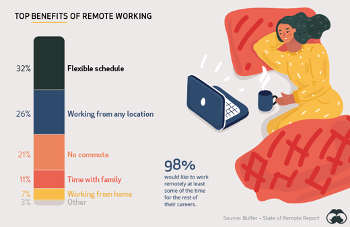
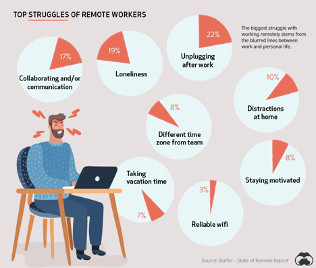
Source: Buffer – State of remote report.
For many that have chosen to forge their own path away from permanent employment and the office, the choice to do so has been made accessible to them as a consequence of their level of experience and expertise. Their years within industry enable them to both perform their roles with a greater degree of autonomy, and fit this around other aspects of their lives; family, exercise, hobbies, personal projects etc. The difference here is that, whilst traditional agencies may well be ‘pivoting’ (sorry I know that word belongs in a box with ‘Agile’) away from the office, they do not benefit from the intrinsic culture of an organization comprised of people that have chosen to work this way. Well before the Covid-19 crisis, which has confused the reality of remote working with forced home working, the majority of companies had flexible working policies in place, and an investigation by Vodafone back in 2016 found that 61% of respondents reported increased profits, and 83% reported increased productivity.
Setting up Sparro House Creative, flexibility and wellbeing have been at the forefront of my mind, and it’s clear to me that these are inextricably linked not only with each other, but with improved output and increased value. With the level of experience in my teams, it benefits neither myself nor them to impose a work routine that fails to take into consideration both the other important things in their life, and the fact that they may well do their best and most creative work at 5am, perhaps before their children have woken up (hopefully!), or at their local coffee shop, in our clients offices or collaborating in shared spaces. This is true remote working – the option to choose how the work thread weaves into the rest of your life. It’s important this message is clear, this freedom reduces workplace stress and increases productivity.
Of course, this structure is dependent on trust between team members, including myself, that the work will be completed efficiently and to the highest standard. In turn, this trust is reliant on industry experience. It is the senior team members who have the expertise that allows them to work in this way and make effective and timely decisions. With the acceleration of decision-making caused by the current crisis, this is vital.
You need to load content from reCAPTCHA to submit the form. Please note that doing so will share data with third-party providers.
More Information