Above & Beyond, the official charity for Bristol city centre hospitals, has launched its Bristol Against Cancer campaign to “talk about the other ‘C’ word.”
JonesMillbank, a Bristol-based video production company, have been working with the charity to create a series of films highlighting the personal stories of those affected by cancer and working in cancer care.
“We met such inspiring individuals and had the privilege of hearing honestly and openly about their journeys and the amazing people who helped them along the way” said Emma Baker, Producer at JonesMillbank.
“From Simon, who was alerted by his vet and went on to beat the disease, to Jonathan, a radiologist at Bristol Royal Infirmary who was asked by a 7-year-old if he would remember him before sadly passing away, we hope the films highlight the strength, struggles and dedication of their stories.”
One in two of us will be affected by cancer in our lifetime, and today, like every day, 2,500 new patients will take their first steps through the doors of one of Bristol city centre hospitals.
To find out more, or to donate to and support the amazing work carried out by Above & Beyond, visit www.aboveandbeyond.org.uk/appeal/bristol-against-cancer.
***
JonesMillbank are a passionate full-service video production company
They work exclusively in-house with a talented team of multi-disciplined creatives, all the while telling authentic stories long before it was cool for a range of clients such as University of Bristol, Battersea, The Royal Mint and IDLES.
jonesmillbank.com
01173706372
[email protected]
This article was written at the outset of COVID-19.
Having gone through the set-up of home offices, and the adoption of new business practices, processes, and tools, many now can’t wait to get back into the office. Why is this?
It is because the choice to do so was taken away.
According to recent research by Forbes, millennials in particular have struggled to adapt to working from home, which is hardly surprising given that they had no choice in the matter. What is absolutely critical here, though, is that this is not a struggle to adapt to remote working, it is a struggle to adapt to isolation. The opportunity to go to the gym, see friends, eat out, visit family, or indulge in any of the escape mechanisms that life usually affords us has been curtailed, and this is a struggle that I’d guess most of us are feeling.
Despite running a creative agency specifically set up to work remotely, I too am desperate for a change of environment, and that is because this is not really remote working. However, there has been a shift in working practices which is unlikely to be completely undone even upon the return to the office, so how can we make the most of this moving forward?
If the role of the office is likely to change, along with greater flexibility and working practices what is the key to remote working success?
The difference between those organisations that have been forced into adopting new working practices and those already set up to operate remotely is choice. Do not underestimate how important a factor this is, and it works on two levels. Recently, the Harvard Business Review investigated the link between levels of motivation and working location, finding working from home to generally be less motivating. Critically, though, they also determined that this suffered a huge plunge when the option to choose the environment is taken away; being forced to work from home is the worst possible option. Human beings react negatively when their freedom to make a choice is removed, and this ‘psychological reactance’ generates such negative feeling that it’s unsurprising motivation dwindles as a consequence.
This leads me into the second branch of why choice is so important. As I mentioned previously, being forced to work from home is not true remote working. The effect on all of our lives has been drastic, and our psychological reaction has been one of stress and anxiety. But let me be clear, we must break the cognitive link that has been formed between forced isolation and remote working, because it is false. However unintentionally, we now associate it with this sense of cabin fever and lowered productivity that we are feeling, and this damages the true potential of authentic remote working.
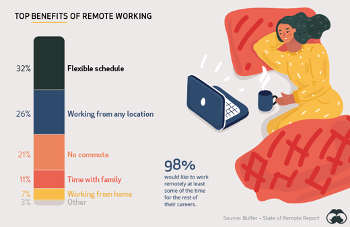
98% want to work remotely at least some of the time for the rest of their careers.
Source: Buffer – State of remote report.
For many that have chosen to forge their own path away from permanent employment and the office, the choice to do so has been made accessible to them as a consequence of their level of experience and expertise. Their years within industry enable them to both perform their roles with a greater degree of autonomy, and fit this around other aspects of their lives; family, exercise, hobbies, personal projects etc. The difference here is that, whilst traditional agencies may well be ‘pivoting’ (sorry I know that word belongs in a box with ‘Agile’) away from the office, they do not benefit from the intrinsic culture of an organization comprised of people that have chosen to work this way. Well before the Covid-19 crisis, which has confused the reality of remote working with forced home working, the majority of companies had flexible working policies in place, and an investigation by Vodafone back in 2016 found that 61% of respondents reported increased profits, and 83% reported increased productivity.
Setting up Sparro House Creative, flexibility and wellbeing have been at the forefront of my mind, and it’s clear to me that these are inextricably linked not only with each other, but with improved output and increased value. With the level of experience in my teams, it benefits neither myself nor them to impose a work routine that fails to take into consideration both the other important things in their life, and the fact that they may well do their best and most creative work at 5am, perhaps before their children have woken up (hopefully!), or at their local coffee shop, in our clients offices or collaborating in shared spaces. This is true remote working – the option to choose how the work thread weaves into the rest of your life. It’s important this message is clear, this freedom reduces workplace stress and increases productivity.
Of course, this structure is dependent on trust between team members, including myself, that the work will be completed efficiently and to the highest standard. In turn, this trust is reliant on industry experience. It is the senior team members who have the expertise that allows them to work in this way and make effective and timely decisions. With the acceleration of decision-making caused by the current crisis, this is vital.
Janine Woodcock; professional coach, speaker and author of The Power of Choices discusses ‘Conscious Leadership’ with Sparro House MD, Paul Kirkcaldy.
Why would the way we build and maintain our culture be any different to if we ran the agency out of an office? What a strange question, but one I was asked only recently.
Remote working absolutely does not mean the death of company culture, but rather an opportunity to reorient what drives us. Rather than reliance on surface level drivers, existing as activities or presenteeism, we should be ensuring culture is the core pillar from which stem all of our working decisions.
Working in an office or shared space does have the potential to establish relationships, especially for more junior team members, and this more social environment has its place in that respect. That said, just showing up is not enough to establish culture at a company’s core and it’s flawed to equate physical presence in an office with mental focus. Taking one step further, in the circumstance of employees silently suffering with a physical or mental illness but turning up anyway, buying into this belief in presenteeism not only damages productivity, but also employees’ relationships with their jobs and with each other.
So, how do we orient ourselves around culture?
Fundamentally, by ensuring that shared beliefs and values drive recruitment. Doing this, employees do not need to be in the same place to be connected, as they are instead linked by a much stronger bond: what they believe in. That behaviours reflect cultural values means these will also align and cultivate a virtual environment of synchronicity and trust. Pub quizzes, yoga and table tennis are really good fun, and are great at building friendships and a sense of camaraderie, but don’t mistake these for cultural drivers as it runs more deeply than that. It doesn’t just exist within the four walls of an office (or the four corners of a ping pong table!), but should be the nerve centre, binding everyone together, and informing our choices.
At Sparro House, our culture stems from our primary values. The first lies in investment in true remote working. By this I don’t mean working 9-5 from home, but genuine flexibility in how, when, and where you get it done. This feeds into our second core value – being purpose driven. Working style, location, and time do not matter to me as long as we fulfil the brief. Being driven by the objective means that if people want to take slightly different paths to get there, then go for it! Recruiting senior people who share these core values fosters a culture of trust that everyone will complete what’s needed on time and to a high standard. This manifests itself in care, learning, and commitment to one another.
This also means I feel good about increasing my time spent ensuring the welfare of my team members, rather than autocratically imposing rigid boundaries and counter-productive schedules. Encouraging genuine flexibility seems like a no-brainer to me as it allows us to benefit from the expertise of senior professionals whose personal and family lives wouldn’t necessarily allow them to work conventional hours.
This Covid crisis, for example, has hit working parents especially hard. Impacted disproportionately by challenges such as the need to care for children during the day following school closures, mean that they have been unable to dedicate as much focused time to work1. Even outside the context of a global pandemic, a few years ago my own wife found expectations to be in the office during standard working hours incredibly frustrating and stressful after having our children. The old-school timetable and expectation to be present just couldn’t be moulded to the life of a young family, despite her amazing talent and expertise. Throw in a global crisis and it’s unsurprising that we’re experiencing a loss of talented back–to-work parents, especially women, who would add much-needed value to our industry.
This is what Sparro House’s flexible model overcomes; I want to have experts on my teams, and if their core values align with ours, then I can! No matter their personal circumstances.
It’s a win-win situation.
So, we’ve established our shared culture by hiring the right people who share our values. But we mustn’t now disengage; it’s imperative that we constantly maintain and invest in it, and ensure that it’s always in the best condition to inform our decisions. I may not be able to pop over to your desk for a chat, but we are fortunate to be living in a time that technology allows us the luxury of instant face time at the touch of a button, should we require or desire it. Maintaining this contact strengthens our network, but this communication should no longer just be about work, and certainly not to check how many things you’ve ticked off your ‘To Do’ list today. Rather, it revolves around understanding that many of the enjoyments or pressures of our personal lives are also felt by the people we work with. People do not exist solely in their work role, this is just one element of their life, and I think we often forget both this, and the fact that outside of work we likely have many shared experiences. Therefore, contact time with employees should be frequent, but should also now be spent ensuring that all of the other cogs – such as family, children, and health – are meshing smoothly. Maintaining this culture of care feeds trust, which has a positive knock-on effect on work performance, leaving employees feeling fulfilled and motivated, and clients safe in the knowledge that value is being created for their business.
Of course, being able and trusted to work autonomously comes from a certain level of industry experience, and I’ve got to know you can deliver to feel comfortable stepping back. Successfully implementing this, though, fosters a culture that is pervasive and strong, because we have chosen to work in this way, and share the same values. To me, this runs deeper than a few stolen seconds at the water cooler, even if we are a hundred miles apart.
1 According to research by the Institute for Fiscal Studies and the UCL Institute of Education
Our industry has just experienced its worst quarter ever. With almost 64% of panel members registering a decrease in marketing spend and two-thirds forecasting a pessimistic financial outlook, July’s IPA Bellwether Report has given us the hard data to prove what we have previously surmised.
Agencies need to respond fast or risk being side-lined. Three areas where I think we can make an immediate impact are: measurability, speaking the CFO’s language and the contribution we can make to our clients’ bottom line.
Clients are faced with a bewildering range and volume of different agencies and Covid-19 has given brands a good excuse to prune – as Ramon Laguarta, PepsiCo’s CEO, also says: “Sometimes a crisis helps [a company] to be more selective and to be more impactful, to generate internal momentum against simplification and focus against fewer and bigger. That’s what we’re trying to do.”
There’s also a growing threat to agencies of clients bringing elements in-house – both as a potential cost-saving exercise and as a response to ‘always on’ marketing communications. As Laguarta acknowledges: “[through in-housing] we can actually get the same or more value for less money, which is obviously a terrific outcome for the company.”
However, brands disrupted by Covid-19 need transformative ideas more than ever. Agencies are in a unique position. DDB founder Bill Bernbach sums it up well, gendered pronouns aside; “We think we will never know as much about a product as a client. After all, he sleeps and breathes his product…By the same token, we firmly believe that he can’t know as much about advertising. Because we live and breathe that all day long.”
Historically, our industry has not been brilliant at drawing a line between what we do and things the brand’s CFO would recognise and value. We now need to get better at developing this dialogue. In tough times this is harder, but even more important.
As agency people, we need to ask ourselves if we really understand the goals and objectives of the finance people amongst our clients. Have we got under the skin of their targets? These will be different to those of the CMO.
We need to establish what our common ground is and communicate our value in their language. Marketing done well can make a significant difference to a business’ bottom line. You only need to look to companies like Coca Cola to see how the intangible value of its brand value underpins the net worth of the company.
How much of the marketing jargon that we use in our industry day-to-day resonates with the CFO, and, in turn, how much financial shorthand do we understand? If having direct access to them is proving difficult, let’s look to our own resources. Are we making good use of our own finance people, for instance? They have all been schooled in same language – use proxies where it’s helpful to do so.
Equipping everyone with a basic grounding in the business side of the industry we’re involved in is important – a course like the IPA’s Commercial Certificate can really help with the fundamentals.
Demonstrating measurement and effectiveness is nothing new. However, given that client budgets won’t be getting back to pre-Covid levels any time soon, marketing departments and their agencies will be under more pressure than usual to deliver tangible results. That means even greater scrutiny for every pound spent.
We are up for that challenge at Armadillo. Our focus has always been on cost-effectiveness – it’s baked into our DNA . We are lean and results-driven and have consistently delivered good value for clients which has led to long-term relationships with clients such as McDonald’s and Disney. Despite working with a major client in the severely-impacted eating out sector, we’ve seen them double down on CRM activity. For example, while other channels have been cut hard, our budgets have grown. That’s mainly thanks to proving strong ROIs on a continuous basis pre-crisis.
We believe the goal should be to have an end-to-end relationship with customer – tracking all the way through from first point of interaction through to purchase, to help influence the decision-buying journey.
Now is the time for agencies to create clearly defined market positions in line with commercials. We need to fulfil our role of trusted advisors, drawing on and demonstrating specialist expertise, experience and performance. We need to stay focused and be even more open to collaboration.
Whilst this is not a time to be naive, we must also try to balance our pragmatism with optimism. The world is not coming to an end just yet. Take our worst hit client in the travel sector. We prioritised pivoting to meet a dramatically different set of challenges – by thinking like stakeholders in their recovery rather than hard-done by suppliers, we’ve seen projects start to flow again far sooner than we might have expected.
Agencies must keep scanning the horizon for opportunities and be prepared to move the business in new directions to stay in the game. We’ve long positioned ourselves as nimble and responsive – those that can now display those attributes will prove invaluable.
This has not been an easy time, but we need to avoid giving in to nostalgic defeatism. A crisis like this could kill agencies off, but equally, if we could get more on the front foot, learn from past successes and fuse those learnings with the good things we’re doing now, this could also be the start of our renaissance.
This article was written by Chris Thurling for the IPA on 17 August 2020.
In the early days of lockdown Bristol Media set up “Pay it Forward”, a collection of offers of free help from our community for those in the region’s creative industries reeling from the economic impact of Covid-19.
With lockdown easing and the focus moving from survival to revival, “Pay it Forward” is now winding down. However, before it closes Bristol Media would like to say a huge thank you to all those businesses that volunteered to help others; those that gave their time and expertise to listen and advise. We had volunteers providing mentoring and business support, HR and legal support, business development and marketing advice to financial tools, all free.
What do you do when most activities stop? The answers are not simple and have involved conversations and many actions to reduce overheads and claim government support, for those eligible. We contacted some of the people involved in the initiative to find out how it went from their side of things:
Simon Barbato, CEO at Mr B & Friends had a huge response from his LinkedIn post, “I was expecting maybe two or three people would respond to my offer of help around positioning and marketing, but I was overwhelmed when I received 19 requests for appointments. I decided to meet with them all, and the conversations ranged from a friendly peer to peer chat to some real advice sought on positioning businesses to survive the crisis. One thing I was particularly pleased with was making introductions from one person to the next and business opportunities maturing from that. I also really got something from each discussion and felt it was a fantastic use of my time”.
Jack Thompson, who specialises in helping agencies with business development, volunteered for Pay it Forward. “In the early stages it was all about coping with the immediate effects of lockdown in relation to business development. There was a broad range of impacts from ‘I’ve lost everything’, through to, ‘we’re doing OK’. I advised talking to current and recent clients, reviewing pipelines and reforecasting for the year, and then looking at what people could do to start some new conversations too.”
“All businesses will have gone through the initial shocks, and they will know where they stand with regard to all the moving parts of their business, so most are now planning for ‘what next?’. Of course easier for some, more than others, depending on how hard they have been hit, but there is definitely a sense that we’re over the worst, so it’s time to think about growth again.
Sandeep Roy, director of Innovate2grow.com, a strategic digital advisory firm reported that “For most companies, lockdown caused a switch to a shorter-term focus; preserve cash and ‘keep the lights on’. Strategic visions went on hold. There was an accelerated focus on digital innovations and a move to virtual models in order to reach, acquire and serve customers online.
As the lock-down relaxes, employers are concerned about liability if employees fall ill after returning to work, and are exploring having teams in low physical contact scenarios. Covid-19 has definitely triggered a rethinking on the future of business and the workplace.”
“I have worked with clients on repositioning their services,” said Susie McFarland, business strategist and mentor, “a lot of businesses have had to move quickly with refocused service offerings, revised financial plans and restructured operating models. I’ve been so impressed by their resolve and determination, not losing sight of why they started in the first place, but keeping true to their core and working from there. No mean feat in challenging times.”
Amy Wilkinson, Disruptive Thinking, another Pay it Forward company said, ”The conversations started as a discussion on how to pivot your sales and marketing strategy in the context of coronavirus, and we ended up discussing topics such as how to build your sales pipeline, how to implement a business development strategy, and how to get started and winning your first clients. We ended up having really honest, open discussions about how we’re all doing at the moment. Everyone was very upfront about what challenges they are experiencing during COVID – it was refreshing.”
James Lucas, Creative Plantation commented on Pay it Forward, “I was blown away with the openness and willingness to chat. I contacted a few on the list around mentoring and coaching for input on my new business proposition. The feedback and inspiration I got back from the discussions was great and gave me hope that after lockdown, the enthusiasm and interest to continue to connect with peers will continue. Thanks to Bristol Media and everyone I spoke to!”
Thank you once again for all the free support via Pay it Forward; in tough times it’s good to know the community support is here. Bristol Media is continuing with our mission to keep the creative community connected. We are offering a series of new events to help businesses move forward. These are in the new online format, book direct via our Events page. We are also supporting networking and business development with online Virtual Lunches, if you wish to join in please contact a[email protected]. We do hope you will join us in the coming months.
Whether you’re looking for guidance on your business strategy, 1-2-1 mentoring/coaching sessions, financial tools and advice, or employee communications support from an experienced HR professional, take a look below at the free offers of support for agencies and creative businesses in the South-West.
Share your Pay it Forward initiatives with us and we’ll add them to this article. Keep checking back as we’ll be updating this page as we hear of more initiatives for the creative community in Bristol, Bath and the South West. Please help us #payitforwardBristol
Are you a Bristol Media member offering free drop-ins for creative businesses? Have you set up a virtual networking event to help people connect? Have some available time to help a young creative with their portfolio? We want to hear it.
Send Alli an email with details of your initiative, including a summary of what you’re offering, who would find it useful, your online link (this can be a LinkedIn post, tweet, blog etc), plus details for how people can get in touch. We’re focussing on support offers from individuals and organisations within the Bristol Media membership community.
We’ll be regularly adding to this blog so keep checking back for updates.
#payitforwardBristol
The above information is being provided as a convenience and for informational purposes only; it does not constitute an endorsement or an approval by Bristol Media Group CIC of any of the services, products, or opinions of the individuals or organisations mentioned.
(Photo by “My Life Through A Lens” on Unsplash)
This summary first appeared on the SearchStar blog on 24th March 2020…
All of you, no doubt, have been thrown a curveball or two – or perhaps more – by the unfolding COVID-19 outbreak. SearchStar is no different, with the future of ADFUTURES20 cast into doubt and our event partners making murmurings – rightly – of cancellations.
What a shame it would have been to cancel ADFUTURES20, give the success of FacebookXADFUTURES earlier in the year. So, turning a challenge none of us were expecting into a positive for everyone involved, we decided to take YouTubeXADFUTURES online.
What a fantastic decision that turned out to be. With just two weeks to work with, we took what was going to be an intimate in-person event at Google HQ and turned it into a webinar for all, welcoming a far larger 150 people into the “room” for a morning of insight and product announcements.
With Google and YouTube involved, this was no ordinary webinar; NDAs needed to be signed, addresses gathered for swag and prizes to be won.
Unfortunately, because of the required NDA we’re unable to simply share the video in this blog post. But if you would like to watch and discover more about the future of YouTube and video advertising, and don’t mind signing on the dotted line, please just get in touch >>>
As a quick teaser of all the glorious content inside, below you’ll find a quick summary of everything Dan talked about, followed by the synopsis of each of the talks from Google and YouTube. What isn’t below is Rob Langan’s Intrepid Travel case study, to see that you’ll have to watch the webinar!
Dan Fallon, SearchStar
Dan started his State of Youtube presentation by highlighting just how shrewd Google’s $1.6bn 2006 purchase of the business was. Indeed, the platform took $15bn in ad revenue in 2019 alone, and that figure is growing.
But why is it so successful, and why does it continue to grow?
Firstly, tv simply isn’t what it used to be – its ability to reach and deliver ROI is eroding. To illustrate that, achieving an 80% reach in 2013 cost £1.1m. Today, that reach would cost £2.7m. Addressable YouTube makes far more sense to get the reach.
Secondly, YouTube is far more accessible to smaller businesses. A huge number of “start-up” businesses have seen huge success on YouTube. For them it simply makes sense. They can push very targeted content out to a closely defined audience. With YouTube you can be a big brand to some people – those who matter – and totally unknown to audiences who aren’t in your target market.
The other joy of YouTube, for Dan, is the platform’s ability to work across the entire funnel. You can craft creative that targets every step of the customer journey, from brand awareness, to more in-depth explainer videos, right through to sales messaging.
Roxanne Brownlee, Google
YouTube is not just an online streaming platform. Every day, a billion hours of content are consumed on YouTube – this incomprehensibly large number is 6x the daily global watch time of Netflix. YouTube is a cultural phenomenon which has disrupted linear TV, community building, social influence and consumer behavior. This talk will show you how. Welcome to the weird and wonderful world of YouTube.
Kelsey Bowers, YouTube UK
“On YouTube, people watch what they want to watch. And they aren’t an easy audience—the entire internet and every other video on YouTube are just a click away.” What makes a great YouTube creative? Kelsey will deep-dive into the ABCDs of effective YouTube creative; how to attract, brand to, connect with and direct action from your audience.
Subir Majumdar, YouTube Ads
You can’t always outspend your competitors, but you can out think them. Subir will talk through what success on YouTube looks like, the best in class features, and how you can construct a winning strategy, whatever your marketing goal.
This summary first appeared on the SearchStar blog on 24th March 2020…
We want to let our members and the community know that we are still very much in operation during this challenging period. Whilst our keynotes, member lunches, workshops, and initiatives are currently on pause, we will continue to deliver value and support the local creative community by sharing advice and positive stories via our digital network.
We recognise that this will be a very difficult time for most of us and to get through it we all need to support each other. Remote working can be challenging but it’s been heart-warming to see some brilliant initiatives appearing within the network.
We’ve already come across some great examples of ideas to help creative businesses get through these turbulent times. For instance, ‘Digital Guzzle’ Friday’s from the Noisy Little Monkey clan, Virtual Book Clubs with Armadillo, and members offering free services such as copywriting, tips for remote working and how to manage your finances.
Our region is known for its unique collaborative spirit, so, we have an ask: share your initiatives and offers of support with us and we’ll add them to this blog page where we’re compiling positive news and stories to keep you going.
Are you offering free drop-ins for creative businesses? Have you set up a virtual networking event to help people connect? Written a blog about weathering the storm? We want to hear it!
Let us know by emailing Kirsty with details of your initiative, including a summary of what you’re offering, who it’s for, your online link (this can be a LinkedIn post, tweet, blog etc), plus details for how people can get in touch. We’ll be regularly adding to the blog so keep checking back for updates.
If you’re a member, we’d encourage you to self-publish your own articles and share the positive activity and good news with the network. Please also continue to post your job opportunities and virtual events to our website over the coming months. The more positivity we can circulate the better.
To kick things off, Chris Thurling (our Chair, business coach, mentor and serial networker!) is opening a virtual drop-in where members can book a free 20-minute coaching and mentoring session. Chris has earned multiple battle scars through surviving three periods of recession, so can provide useful advice and words of wisdom he’s learned throughout his journey.
Slots are available on Wednesday afternoons (between 2pm – 4pm) on 25th March, 1st April and 8th April. If you’re a Bristol Media member and would like to book, please email Chris.
If you’re a local business offering a short-term or freelance role for people working within the creative industries, please get in touch. You can advertise the vacancy for free on our Jobs board until the end of April.
We appreciate that for the smaller businesses and self-employed amongst you, it’s going to be a particularly testing time. The environment is changing at a rapid rate, so we’ve created a Slack channel for our freelance members to share info, resources, opportunities, and anything that will help support the local gig economy through the current situation. If you’d like an invite, please email Alli.
We will continue to work with local businesses and networks to ensure we are all actively supporting the creative industries in our region. If you are an organisation who can offer your services to support creative businesses in Bristol, Bath and the South West, please let us know.
If you have any questions or would like to speak to one of the team, please get in touch.
Together, we are greater than the sum of our parts.
Why clients need agencies now more than ever before
By Chris Thurling, Executive Chairman at Armadillo.
Since I entered the industry in the mid-Nineties, the “agencies are dead” trope has periodically done the rounds. Various extinction events have been predicted: the Internet, off-shoring, in-housing, disintermediation, artificial intelligence and so on.
And yet, through all the challenges agencies have faced over the past 25 years trying to convince the corporate world that they “are not dinosaurs on the brink of extinction” or fighting back against the presumption that they aren’t “fit for purpose”, the agency model stubbornly refuses to die.
If anything, the evidence points to something that is instead very much alive. Despite the Brexit turbulence, UK agencies – especially niche independents and smaller groups – are flourishing. According to the annual Benchpress survey, 34% of agencies grew by more than 25% in 2017 and agencies turning over more than £1m per annum averaged a healthy 16% net margin.
Despite the data, a lot of the MDs and CEOs I speak to are worried that extinction is imminent and that an asteroid is about to hit planet-agency. And when you read comments from industry rainmakers such as P&G’s Marc Pritchard, who criticised many agency models as “archaic” and “overly complex”, you can understand why people continue to fret.
“There are bucket-loads of opportunities if agencies are smart, agile, gritty and willing to adapt.”
A bit of fear isn’t a bad thing in business, it keeps you on your toes, and a drop of cortisol in the right doses can improve performance. But as a sector, we mustn’t let our fear of the future cause us to freeze. Some tough challenges have come our way, and there are probably more of them arriving at a higher speed than ever before. However, there are also bucket-loads of opportunities if agencies are smart, agile, gritty and willing to adapt.
All those headwinds that your business is facing, well, guess what? It’s likely that your clients are facing them too, tenfold. Imagine, for example, if you were running a high street retail operation right now, you would think being the CEO of an agency was a walk in the park. There are thousands of brands disrupted by the likes of Amazon, Uber and Google. These firms aren’t going to re-invent themselves by employing more accountants and lawyers or by just cutting costs – they need transformative ideas, and that’s where agencies come in.
My clarion call is for agencies to create clearly defined market positions, stay focused, be open to collaboration, have faith in the power of creativity and remain infectiously optimistic.
In another 25 years, I suspect that most of today’s agency brands will have disappeared, but I am pretty confident that the agency model, in some shape or form, will still be with us. Vive le agency!
This article first appeared in Decision Marketing.
You need to load content from reCAPTCHA to submit the form. Please note that doing so will share data with third-party providers.
More Information