
Is your digital marketing agency profitable on purpose, or by accident? At Digital Agency Coach we’ve worked with hundreds of agency owners over the years, some of whom were unaware of their profitability stats.
Many agencies end up being profitable by accident, as a positive consequence of the year’s work. In this article, we share our insights on turning an intentional and deliberate profit.
As a busy agency owner, it can be easy to prioritise managing the day-to-day operations and allowing your profitability to become an afterthought. With this mindset, it’s difficult for you as an owner, to have that profit-oriented, strategic mindset that is key to growing your agency.
At Digital Agency Coach, we always recommend approaching profitability with intention and purpose. This approach can feel foreign and a little acquisitive at first, but it’s important to remind yourself that it’s completely genuine and moral to design your business in such a way that it earns you money.
Having a profit-driven mindset enables you to reinvest into your business, enhance the quality of your service and grow your agency.
When it comes to an agency’s profitability, there are typically three different degrees of intent and three defined profit groups as an outcome.
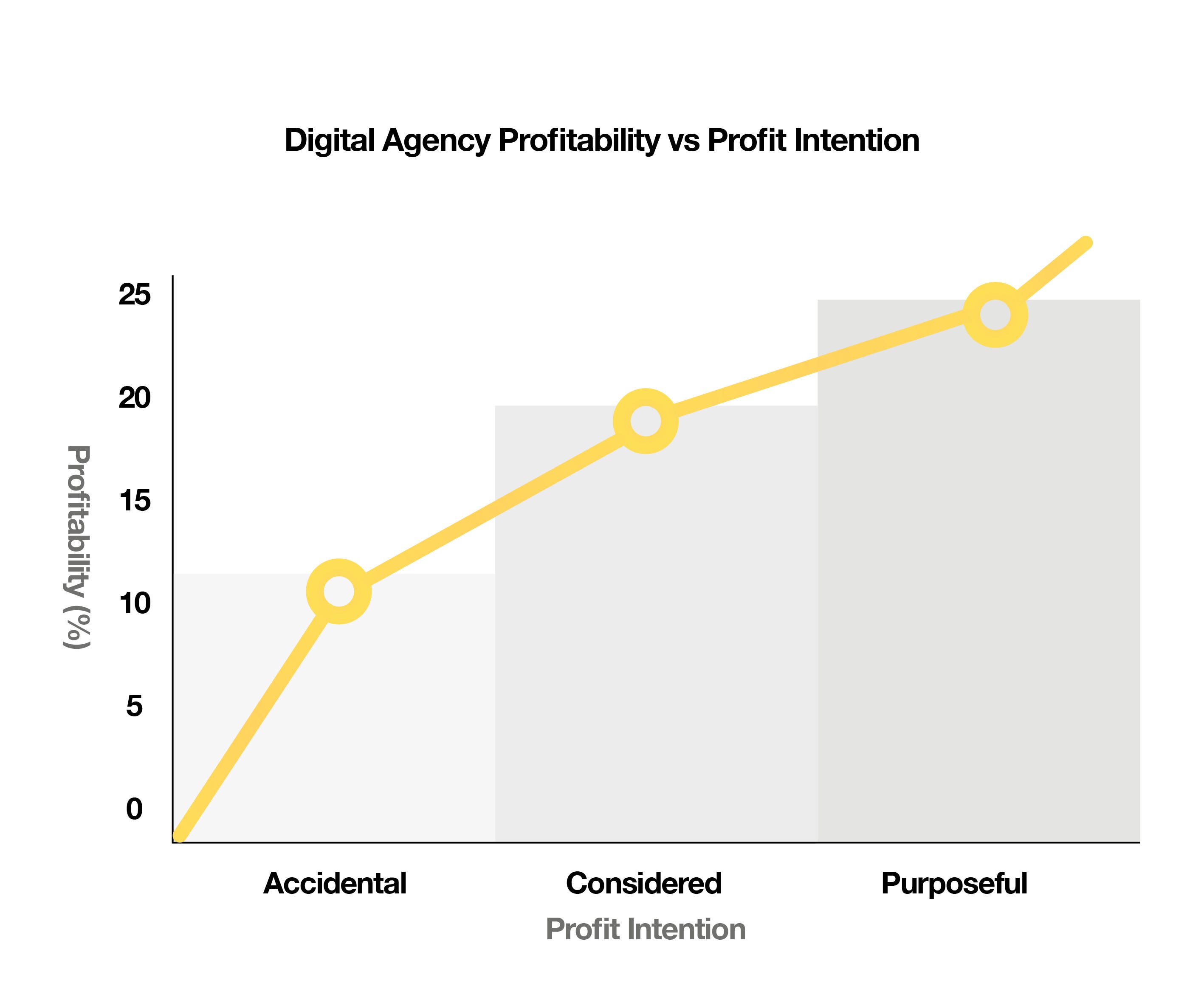
Agencies who generate anywhere from 0–12%* profit are generally doing so by accident. These agencies usually no profit strategy in place and the year-end results are unpredictable and often speak for themselves.
Those digital agencies turning anywhere between 13–22%* profit, are almost always doing it on purpose. The closer the number lies to 22%, the more deliberate and considered the profit is. The lower the number, the less intentional their outcomes have been.
And as for those generating a profit percentage anywhere north of 22%*, we classify those guys as purposeful, profit machines. These digital agencies know their services, their clients, their team, and their business like the back of their hand. Their sales pipeline and financial systems are geared toward driving high volume, quality leads which convert.
*These figures are general only, actual profit margins will depend on the agency size. Large organisations with substantial overheads typically will have tighter margins.
Address these six top-line areas and improve your agency’s profitability today.
Take a close look at your gross margins. If they’re outside the range of 50–60%, unfortunately, you’re not profitable enough. Your gross margins are calculated by taking the overall revenue of your agency, less the sum of those direct salaries and/or contractor and freelance fees required to deliver your particular service.
As a service-based business, your agency sells time — utilisation looks at how many billable hours you have available to your clients. If you are operating at less than 72% capacity, there is scope to improve your profitability by maximising your utilisation.
These can be either your employees or clients. If you attract and retain poor performers, this will lead to inefficiency and low profits within your agency. It might be that you need to address some of those long-standing, legacy clients from your start-up days, or certain team members who are less efficient than others. The solution? Try raising your fees or developing the skills and/or expertise of your employees.
Usually, those agencies who fall into the 0–12% profitability category, have no insight or oversight on their financial or sales reports and forecasts. Having a robust sales pipeline and reporting structure in place will allow you to understand when, where and how you can maximise your revenue and minimise your expenses — which we know will lead to a direct increase in your profitability.
For digital marketing agencies within the UK, it’s recommended you charge £90 per hour as an absolute minimum for your services. At Digital Agency Coach, we advocate charging anywhere between £100 — £150 an hour and ensuring you bill all for those all hours at your full rate in order to maximise your profitability.
Is the service you provide right for the current market? This is a big question for web design agencies who are competing against the likes of Wix and Squarespace. These ‘done-for-you’ website builders have significantly devalued the product to where it’s now within the reach of many small businesses and small budgets. As a specialist agency with a highly skilled team, you need to be bold and honest with yourself and ask if there is a future within your market. If the answer is no —you have to innovate and change with the times.
Remember, it’s perfectly moral and genuine to gear your agency to become a profitable, money-making business. As a business owner, you are doing your customers, employees, and your market a disservice if you are unable to reinvest your profits back into your industry.
Ready to begin? Start by asking determining which of the three levels of profit and intention describes your agency. If you’re turning a profit anywhere south of 20%, it’s time to change your mindset and address these six ways to increase your profitability.
Watch Our Free Video Class: Profit On Purpose (7min) & kickstart your journey toward profitability
Of course, if you have any questions or would like to chat with one of our Digital Agency Coach Consultants, please Get In Touch — they’d love to help.
Mr B & Friends has scored a hat trick of wins at this year’s Transform Europe Awards.
At the event, held on Wednesday 23rd June, the agency won Gold and Bronze awards for its work with Accsys, as well as a Young Contender award for designer Kieran Hawes. The awards recognise and celebrate the best of the best in brand strategy, development and transformation- how a company, brand or product’s visual identity, story and proposition can make an impact.
The Gold award for the ‘Best Visual Identity from the engineering or manufacturing sector’ and the Bronze award for the ‘Best rebrand of a digital property’ reflect the work that Mr B & Friends has done with Accsys over the last year for its sustainable wood product Accoya. The new positioning, branding and best-in-class website connect business and consumer customers to both the product and each other, making the decision and purchase easier and smoother than ever before.
Midweight designer Kieran was awarded Distinction in the Young Contenders category, which recognises the best up and coming creative and strategic talent in the business.
Members of the Mr B & Friends team attended the event with the client team from Accsys.
The full Accoya case study can be found here.
Since my earliest years, I’ve been a fan of athletics. Long-distance running in particular. I’ve watched it on TV. Chatted about it with friends. Followed its greatest exponents with fascination and even become something of an (armchair) expert on the subject.
But until a year or two ago, I’d never taken the plunge and given it a go myself. It felt like something reserved for others. Something that you needed to prepare for meticulously, before ever getting out there and hitting the pavements for yourself. It just seemed altogether too difficult to try.
Then something changed. I was persuaded by a friend to join them on the journey from ‘couch to 5K’. And, at the risk of being that annoying running evangelist, I’ve never looked back.
For many in the marketing world, account-based marketing holds the same appeal – and presents equally erroneous perceived obstacles. It looks great. It seems to work brilliantly for others. But it can also appear prohibitively complicated and quite possibly hideously expensive.
Happily, if you get account-based marketing right, those negative perceptions are some way wide of the mark. And in this article, I’ll explain why it’s an approach you can’t afford to ignore.
There are websites, books, research papers, even degree courses devoted to an explanation of account-based marketing. But for our purposes today, I’m going to keep things straightforward. At Proctor + Stevenson, we view ABM as marketing that identifies high-value companies within defined sectors, and focuses on generating quality sales leads through targeted strategy and pinpoint messaging.
It’s an approach we’ve employed to great effect over the past few years, helping clients including Panasonic outperform campaign goals by as much as 100%. And we’re not alone: Forrester research reports that 62% of marketers have reported a positive impact on their marketing performance since adopting ABM.
It comes with strong credentials then. But if that isn’t enough to help you persuade your colleagues that account-based marketing is the way forward, here are those five key reasons that should really turn the argument in your favour…
The pandemic has taught us that certain sales and marketing approaches are affected by external conditions and factors beyond our control. Exhibitions and events being an obvious one. Account-based marketing remains impervious to those irresistible forces, replacing sales meetings and product demonstrations with digital outreach and online communication. It also has the flexibility to incorporate more ‘traditional’ tactics (personalised direct mail, for example) when the time and targeting is right, making it the marketing strategy for all seasons.
The beauty of ABM lies in its focus. Unlike other broad-brush strategies that make marketing a numbers game, account-based marketing is lean and keen, ensuring that your financial resources are allocated only where they’re going to have maximum, direct impact. Even in those longer B2B buying cycles, there’s no wastage. Communications and marketing collateral are sent to those prospects you’ve identified as interested, via the channels they use, carrying messages you know will resonate with them.
Most ABM strategies are built with digital communication at their core. So you can account for every penny or euro you spend, and attribute every click, reply, meeting booking, expression of interest or sales opportunity you elicit directly back to the activity you’ve instigated. And there’s little that will make your board-level colleagues happier than that.
Ah, the old sales vs marketing conundrum. Should be best of friends, very rarely are. In this respect, you can think of account-based marketing as the United Nations. Employed properly, an ABM strategy achieves that holy grail – a harmonious collaboration in which marketing and sales work in tandem, generating interest, qualifying leads and nurturing prospects until they’re ready to hit ‘buy’ (and beyond, if your ABM strategy is far-sighted enough).
As I mentioned a little earlier, our clients have enjoyed great success with account-based marketing over the past year or two. Working with them, we’ve doubled projected lead targets, improved ROI, achieved better conversion rates, even generated six-figure sales pipeline. And all within the parameters of tight marketing budgets.
The final advantage of ABM that I’ll mention here is that it isn’t an all-or-nothing strategy. It looks different for every business. And we can help you take those first steps towards making it work for yours. So if you’d like to know more, don’t sit on the side lines any longer. Lace up your shoes, get in touch and let’s see where account-based marketing can take you.
“We should definitely launch a podcast, more people than ever before are listening, and we’ve got budget to spend as we’re no longer running that big outdoor campaign”
This is the sort of conversation going on within brands and agencies in 2020 (well, at least we hope it is). It is a really exciting time to be launching a podcast, and so it’s really easy to go all in on imagining what podcast might sound like, who’s going to present it or how you’re going to get it produced. But before you’ve allocated your entire budget before you’ve even started, to get an idea of the costs it’s worth take a little step back and looking at the bigger picture.
We chat to a lot of brands about podcasts and hear some amazing ideas, but there’s a few vital podcast costs to consider that it’s easy for brands to overlook when you’re planning to nudge Joe Rogan down the charts. So, we thought we’d share them with you:
Hands up who has ever (literally) judged a book by it’s cover? 🙋 Or, bought a bottle of red saying ‘i love that grape variety’, when really it was the colourful art or on-trend font that really swung it? 🙋 Then we can all appreciate the value of having podcast artwork that pops. With a patchwork of podcasts in any given podcast app, it’s worth ensuring that your artwork isn’t an afterthought or ends up being your company logo hastily pasted onto a background in Photoshop.
Hosting is the means of getting your podcast out there to the world and the best and easiest way of doing this is with a good hosting provider. At its most basic you should expect your podcast to be distributed to every listening platform (the big three of course being Apple Podcasts, Spotify and Google Podcasts). But, for brands especially, getting insight into who is listening and how they’re listening via a great set of analytics, is the added value that your podcast needs.
We know that most people listen to podcasts via a podcast app on their smartphones (around 65% according to Edison Research), but that doesn’t mean it’s not important to have somewhere online for people to listen. Having a dedicated podcast page on your existing site, or it it’s more relevant, a standalone site is important for a few reasons:
At its most basic, the site can be a list of all your episodes with an embedded audio player, which all the top hosting platforms provide for you. The more added content you can then add, the better.
The hard work doesn’t end when you hit publish and put your podcast out there to the world, in a way it’s only just beginning. There are a lot of podcasts out there for listeners to choose from (we’ll be reaching one million active podcasts at some point soon), so they’re going to need a helping hand finding yours, no matter how great it is. We like to talk about how brands are going to promote their podcast and how it fits into a wider strategy right from the start, it’ll have an impact on your production and release schedule and maybe even the content too. There’s lots of things you can that don’t cost (apart from time), earned media such as creating engaging assets to share on social media and good old fashioned plugging on other podcasts, blogs or media. But increasingly important is assigning some budget to run podcast ads on other podcasts, a great way of attracting listeners who are already into the same podcasts as yours.
when we’re working with brands, we’re having these conversations from day one
A well known host or having notable guests on your podcast can be a great draw for listeners, giving you a boost to your promotional efforts. Someone with presenting skill or experience sets a high bar in terms of professional quality as well as making for better script delivery and guest interviews. Ultimately however the decision, like many you’ll make, should be based on your audience, the sweet spot is finding someone who your listener will connect with and who has a natural curiosity and interest in the subject matter, even if they’re from a different walk of life (and often they’re the best ones). However, people don’t expect to work for free, so have a think about who might be a good fit, it goes without saying that the more well known they are, the higher the fee, but there’s no harm in aiming high!
There’s a lot to think about when creating a podcast from scratch that not only stands out from others but fits seamlessly into your wider content strategy. That’s why when we’re working with brands we’ll make sure that we’re having conversations about all of the points in this post from day one. Nothing should be an afterthought, and finding the right approach all depends on the objectives, the audience and the budget available, but knowing what’s required from the outset means that budget is spent in the most effective ways.
Enter, Digital Agency Coach’s Agency Accelerator Canvas, or AAC, for short.
Put simply, the Agency Accelerator Canvas is a template for designing your very own growth strategy. Designed to help you and your digital marketing agency create a considered, thorough and actionable roadmap for stratospheric growth.
The AAC prompts thinking and understanding across ten core elements of your agency growth strategy; Purpose, Customer, Value Proposition, Services, Vision, Goals, Strategy, Objective, Milestones & KPIs.
With handy guiding questions along the way, the AAC is easy to follow and easy to complete.
Our Agency Accelerator Canvas demands focus, defines your vision, establishes what it is your agency is trying to achieve, but most valuable of all – it produces an actionable roadmap to get you there.
Free from business school jargon and written in plain English – the AAC is designed to be helpful, straightforward, and easy to follow. At each of the ten stages, you’re offered a handful of guiding questions to formulate thorough and rounded definitions for each component.
While it all sounds so simple and straightforward, the results that populate from the AAC are powerful. At the end of your AAC strategy workshop, you will have defined objectives and measurable KPIs to drive your digital marketing agency forward and measure your success along the way.
Finally – a business strategy document that you can take action on!
The Digital Agency Coach consultants recommend hosting a workshop with your fellow directors or senior management teams to complete the AAC as a group.
Once you have defined your strategy, share it with your employees and wider team – print and mount it within the studio to encourage daily interaction from your cohort.
If there is anything the last two years have taught us, it’s that our world can change in an instant and we, as business owners, must be nimble and adapt our strategy accordingly.
While your AAC will be right for the time, as the seasons change, your strategy will require regular revision. We recommend reviewing your AAC quarterly, asking if any changes need to be made and if you and your team are meeting the objectives.
Use these quarterly reviews to nudge your agency’s strategy back in the right direction, then host a full review workshop and overhaul the overall strategy annually.
First things first, print out the blank AAC template and supporting documents and begin your workshop with our short explainer video to get your meeting off to a productive start.
The AAC is then separated into two focus areas;
We start by defining your digital agency’s purpose. There’s no right or wrong answer here, but it’s important your purpose aligns with your passion – so keep it true to yourself.
Secondly, the AAC takes a look at your customers. You’ll define a specific and targeted niche that your digital agency can approach and service.
Then, we ask about your value proposition. Which problems and pain points do you solve for your clients?
Then finally, – you’ll define your services. This is super important, as this defines your agency’s skill set and the work you agree and disagree to take on.
Then, we move on to…
The AAC then asks you to define your digital agency’s vision and articulate top-level, measurable goals.
Next, strategy. You’re encouraged to think about how you are going to achieve these goals? What are the big moves you’re going to make this year?
Once the big moves are defined, it’s all about the objectives. What daily tactics and functions will your team carry out in order to make the strategy happen.
Then you define growth milestones, or success indicators. What will illustrate that you’re on your way to success?
And then finally, what are the KPIs? How will you measure success and keep your team accountable? We’ll help you define realistic, aspirational and measurable Key Performance Indicators to pull your entire AAC together and ensure it’s the actionable document we promised.
Now you know how it works, it’s time to download the template and start formulating your growth strategy.
Each download includes a ready-to-complete AAC template, a supporting document with key questions to kick-start your thinking and a link to a short explainer video to walk you through the process.
Of course, if you need any help or guidance or you would like a Digital Agency Coach consultant to host an AAC workshop for you and your marketing agency please get in touch via our website.
The number one challenge digital marketing agencies face when it comes to scaling their business is attracting and signing more, high-quality clients.
Digital agencies, on average, win only 13% of their sales-qualified leads.
That’s a pretty low number and a fairly serious problem when you’re trying to scale your agency and grow your clientele base.
As a digital agency owner, you believe in the quality of your work and you know your team can deliver great work for your clients — so why is it so hard to articulate this to a prospective client?
The number one question our Digital Agency Coach clients ask is ‘How do we win more, better clients?’ The answer, it’s all about your pitch.
Over the years, we’ve asked over 250 agencies ‘’Why should I buy from your agency and not from anyone else’? Almost every single one had the same response.
What does your pitch sound like? Is it full of jargon and buzzwords, like ‘Creative Thinkers’ and ‘Trusted Advisors’? Or maybe you differentiate your marketing agency as being ‘Full Service’ or ‘Not Full Service’? We’ve heard it all, and to be frank, so have your clients.
When a client is scouting for a new digital agency, they often interviewing 3–5 simultaneously, before they sign just one. They’re sitting through pitches and wading through phrases like ‘Partners Not Clients’ and ‘Open. Honest. Transparent.’ to find a true connection with the agency they think is the right fit.
Put yourself in the client’s shoes. If all the presentations and offerings look and sound the same, and are filled with cheesy buzz words, it’s hard to tell each agency apart. Chances are, the client will simply choose an agency they feel they have chemistry with. Or, more likely, they’ll make their decision based on price.
So, how can you create a sales pitch that’s guaranteed to win clients? We’ve looked at the work of Doug Hall — a chap who analysed over 4000 propositions and discovered three key common denominators in an agency’s sales pitch that increased the likelihood of landing a sale by up to 40%.
Understand your customer in detail. Get to know their niche, their industry and their product, and then offer a measurable and overt business benefit as part of your pitch. Make sure your value proposition meets their needs.
Pull together two or three dramatic points of difference your marketing agency has against your competitors. Avoid overused agency jargon and make sure these differences will genuinely separate you from the rest. Most importantly, tailor your differences to the pain points of the client and their business.
Agencies are typically really good at this bit. Wrap up your pitch with evidence that you are able to deliver on your promise. This is where you use your awards, case studies and testimonials to prove you are the team for the job.
Now you know what makes a good sales pitch — it’s time to implement these changes and start growing your digital agency!
If you need support or guidance growing your agency and would like personalised, 1:1 help achieving your goals; Digital Agency Coach offers bi-monthly Mastermind Groups.
You’ll collaborate with a team of like-minded professionals, access powerful resources and templates, and benefit from 1:1 coaching sessions, all designed and guaranteed to scale your agency.
9 June 2021, Bath, UK: Abode PR, the Bath-based, award-winning global B2B technology public relations agency, is delighted to celebrate an outstanding year for the business with new international clients, a growing headcount, and an exciting brand refresh.
Abode PR was created in 2017 by Founder & Director Jessica Gillingham, also a former director of Visit Bath, after identifying a niche in the short-term rental market for a quality public relations service. “I grew up in Bath, which is not only a beautiful city but has a strong tech industry,” says Jessica. “It was a fantastic place to launch a tech startup that, in turn, serves tech startups in the hospitality, travel and real estate industries all over the world.”
Guesty and Rentals United were some of the first clients on the books, both leaders in their sectors. Fast forward to 2021 and Abode PR’s client roster includes companies located as far flung as Boston, Milan, Seattle and Toronto. Reside Worldwide, a leading provider of professionally managed accommodations is one of the newest additions to Abode PR’s portfolio along with Breezeway, a leading property operations platform for holiday homes and hotels, and Operto, creators of hotel and vacation rental automated technology.
Abode PR provides media relations, strategic communications services, content marketing and thought leadership development within its niche market, often working directly with the CEOs of their clients as they grow from their startup phase. With her insight into the industries they operate in, Jessica is frequently asked to contribute her expertise on global panels and conferences.
Until recently, Abode PR was an all-woman team comprised of Helen Wedgewood, Jen Childs and Laura Bolton, with Jen and Laura having joined as PR Managers in 2021. Aaron Finn is the newest junior member of their growing team having graduated from nearby UWE with a degree in journalism last year.
In light of this success, Abode PR has also rebranded and launched a new website to reflect its standing as leading experts in the sector.
Jessica adds: “It’s been an exciting and busy time for Abode PR, which has been worth celebrating. We’re especially proud to have carved out a name for ourselves in the industry internationally from our hub in the South West and hope to inspire other local startups in doing so.”
For more information about Abode PR, please visit https://abode-pr.com/
The team at Noisy Little Monkey have welcomed a new addition to the Senior Leadership Team this month. Charlie Hunt will be responsible for managing people, processes and money for the organisation.
For the past seven years, Charlie worked at one of the largest SEO agencies in the UK, progressing from Finance Director to General Manager and overseeing the day-to-day running of the business.
Alongside the appointment of a new Operations Director, Noisy Little Monkey has welcomed another two new hires to the team including Andy Thornton (Digital Marketing Executive) and Alexandra Keyworth-Wright (Inbound Marketing Manager). They’ll both be supporting clients with all aspects of their digital marketing including SEO, marketing automation and HubSpot.
We can’t wait to see how the new team members will help the business thrive.
At Proctors, our people make us who we are. Bold. Brave. Imaginative. Resilient. But resilience doesn’t mean things are always easy.
It’s truly taken a village to see us through the last 12 months. And this article explains more about how our team spirit and collaborative culture have helped us to balance the books throughout these difficult times – and flourish, rather than just float.
When COVID first hit in the beginning of 2020, the consensus was this epidemic would be around for three months in the UK, and we should start to see signs of economic recovery beginning in July 2020. (No comment!)
At the time, we’d just finalised our financial forecasts for the year ending March 2021, but it was clear we needed to review these figures.
After revisiting our forecasts, we worked on a realistic model which would see a dip of around 30% in the company’s income for the first quarter of 2020, before gradually returning to 100% by the summer. We then expected we’d see an uptick in work – to around 130% by the end of the year – as clients rushed to spend already -approved budgets.
Despite knowing now that the information on the pandemic’s duration proved to be inaccurate, this approach placed us in excellent stead.
Our biggest challenge was managing cashflow. With fee income dropping, we still had to cover our business costs. It became crucial to cut costs wherever we could – and quickly.
We reviewed our overheads, and any payments deemed non-essential were stopped or placed on hold. The government also launched an initiative called the CBIL Scheme, and allowed us to defer our PAYE and VAT payments, helping us manage cashflow.
We also made the decision to place any money received from loans or PAYE and TAX deferments into a savings account. As we knew the funds were always going to have to be repaid in March 2021, we decided to only use them if we had to.
Employee utilisation is something we’ve always used to measure productivity across the business at Proctors. It describes how much time any staff member is spending on achieving paid work each month.
During the pandemic, we were able to use our employee utilisation data to forecast upcoming work, and quickly identify the staff members who would be under-utilised over the coming weeks and months, and the skillsets where there wouldn’t be a lot of work coming in from our clients. We could then place those affected employees on furlough, whilst ensuring all other staff had high utilisation levels, reducing our costs while keeping our clients happy.
Over the last few years, we’ve introduced a number of KPIs to ensure we’re always performing efficiently, aiming to be within the top 10% of agencies of our size, financially. This has given us a strong financial foundation, allowing us to continue to support our clients who were also struggling though uncertainty.
Our relationships
Externally, we’ve been part of a working group of Financial Directors within creative agencies for the last four years. Pre-COVID we would meet quarterly, discussing all things financial and operational as well as sharing ideas, best practice tips, and KPIs.
At the beginning of the pandemic we met via Zoom, and as usual shared our latest updates – only this time, we discussed how to approach the upcoming challenges which would affect all of us.
Many agencies cut back on their non-fee earning staff, including new business and marketing. But our own stance differed: as long as we weren’t at a net loss, we would continue to look for new clients and deliver new initiatives to our existing ones.
We kept our new business and marketing team together, giving them the creative and technology staff needed to work on pitches and ideas – and for us, it paid off, resulting in new clients and new business.
Despite a number of businesses in the aforementioned Financial Directors group making different decisions based on what might work best for them, being part of a community that shares knowledge, resources and support has been invaluable.
Those invaluable relationships have extended to our clients too. Like many other businesses, we’ve been there for our clients – and vice versa – during an incredibly testing year. In most cases, we’ve gotten to know each other even better, and have built even stronger business and personal relationships with many of them.
A challenging time for the world, for our business, and for our people. It was so important to us to ensure our employees felt valued, informed – and were able to have just a little fun wherever possible.
Over the last year we’ve introduced a number of new staff initiatives, including our Quarantine Quiz. We originally introduced the quiz to raise money for the Quartet Community Foundation, donating to their Coronavirus 2020 Response Fund, as well as to boost our teams’ morale while we’ve all been forced to work remotely.
And unlike many of the Zoom quizzes we might have held in our personal lives, to this day The Proctors Quarantine Quiz lives on! The format has now evolved slightly, with different staff members hosting each Wednesday, and one lucky winner claiming a £50 Amazon voucher in a nice little midweek boost.
We’ve been rewarding staff for more than just their general knowledge, too. 2021 has seen the return of our famous Proscars awards. The Proscars are our quarterly awards by employees, for employees, with every staff member able to vote for three colleagues they believe should be rewarded for their hard work. Our three winners then get to choose a prize – either £250 in cash or £400 in vouchers.
To get us all moving, we’ve been further breaking up the working week with weekly lunchtime fitness and yoga sessions, hosted by a personal trainer online. And if you’d rather gin than gym, on Fridays our weekly virtual social kicks off at 5pm – although, it’s strictly BYOB!
If all that wasn’t enough, each Friday afternoon our Chairman, Roger Proctor, sends out his weekly ‘Good News’ email. Just as it sounds, it’s a cross-department weekly catch up about all things good – inside and out of work – and an informal welcome to the weekend.
As well as looking after our finances, it was also critical our staff had access to the support they needed to look after their personal wellbeing.
We engaged a psychotherapist and Mental Health Consultant to run a series of wellbeing workshops and Q+A sessions with all Proctors employees. This was followed up with a further series of workshops with our managers, providing them with additional tools to guide and support their team, as well as handouts on working from home, managing stress and more.
Throughout the pandemic, we’ve continued to promote our Employee Assistance Programme, offering 24/7 GP, legal and financial helplines, with options for counselling and psychiatric therapy available through our private medical insurance.
We also felt it was important to offer extra help to those who might be struggling with the pressures of family life in lockdown. Therefore, we sought to share helpful guidance and tips to P+S parents for effective home school and balancing with work as well as providing additional flexibility for maintaining work balance and wellbeing during additional childcare and home schooling. We even set up regional and international remote working agreements for those who benefited from being with their family outside of Bristol.
Christmas looked different in 2020, but we still managed to celebrate in style. In lieu of our traditional knees-up, we sent a hamper brimming local treats and bubbles from The Mall Deli in Clifton to each of our staff. But it was also important for us to give back too.
We joined forces with Caring in Bristol to donate a video in aid of homelessness in our city, helping to raise over £20,000. And we’ve kicked off the new year in a similar way by sponsoring Lebeq Ladies – a local women’s football team, in our community of Easton, Bristol.
Our future
None of the positive action we’ve taken should be viewed as temporary.
We intend to continue treating Wellbeing as a priority across the Group, and are continuing with initiatives in this area, such as with Mental Health First Aid training for select staff in June.
Above all, our people will continue to steer our direction moving forward: whether that’s via team surveys, policy and process updates or with lots of creative ideas. Because this has been one of the hardest times in recent memory to manage and market a business. And tough times lie ahead. But with a strong foundation, and an overwhelming commitment to your original values, it is possible to stay above water – even in the most testing of times.
If you’d like to talk to a truly ‘people first’ agency, we’re herewith a listening ear. So talk to us, at [email protected].
After the year or so we’ve all had, the mental wellbeing of employees is increasingly concerning. As human beings, our state of mental health is always in fluctuation but the pandemic and consequent lockdowns, working from home and homeschooling have all had a serious impact on mental wellbeing across the globe.
The statistics are shocking. According to the Nuffield Trust, at any time, one in six adults has a mental health condition and one in 100 has a severe mental illness.
The reality is that one could be anyone.
Including your employees or members of your team.
The pandemic has exacerbated our everyday stressors and concerns. Loneliness, in particular, has become a big issue as we’ve been separated from our loved ones and colleagues and asked to work from home. It’s becoming increasingly evident that we won’t necessarily be returning to the office life we knew before, and while there are of course a number of benefits to home working, there are plenty of people out there who are struggling with the change.
With the introduction of this new normal, it’s not enough for businesses to simply throw in a few new procedures and call the job done. It’s time to change the culture completely and destroy the taboo surrounding mental ill-health. Businesses owe it to their employees to take responsibility for its role in their well-being. And you, as an employee, owe it to your colleagues to ensure no one suffers in silence.
So how can you ensure that?
It starts with the culture. Have you created a safe and supportive environment for your employees and colleagues? Have you made it clear, leading by example, that mental wellbeing is a priority? Have you provided channels of support or steps that can be taken by any employee who may be struggling, and do you promote a positive and supportive digital culture?
It’s important to strive towards an environment in which any member of the team feels comfortable coming forward with their concerns and sharing their feelings. This starts with being willing to share your own and being honest about your own difficulties.
Equally, you can’t always expect others to come to you. You must make it a priority to check in with employees and colleagues proactively. Working from home can be isolating and it’s not as easy to get a sense when something may be wrong. While you may notice a colleague looking a bit down or stressed grabbing a coffee in the breakroom, it’s much less likely you’ll notice the same subtleties during an online meeting. Make time to chat on an informal basis. It will be just as crucial to the success of your business as any other meeting, if not more so.
Normalise dealing with poor mental health before it reaches crisis point. Make mention of the mental health support available part of the everyday conversation and put an emphasis on the normalcy of asking for help. At Armadillo we provide a dedicated employee assistance programme through Health Assured. They provide both emotional and practical support through qualified and experienced counsellors and legal advisors. Not only do they offer 24/7 confidential support through telephone counselling, as a one off or a reoccurring structured service, but can support employees through things such as writing a will, immigration information and divorce procedures. They also provide the ‘My Healthy Advantage’ app which holds a range of valuable materials for employees such as videos and podcasts with celebrities on dealing with anxiety, stress and traumas, 4-week well-being plans and the opportunity to live chat with their support team.
It’s so important that staff know the services that are available to them and are encouraged to take advantage of what’s offered. There can be a stigma around things like calling a helpline when feeling overwhelmed but it’s important to make it clear that your business does not endorse that kind of thinking. A great way of showing this is by leading from the top and ensuring your senior management team are promoting what’s available and using it themselves.
Crises happen. Are you prepared?
As an employer you owe it to your employees to know how to help and support them when help and support is needed. And as a colleague (and hopefully friend) the same applies. We don’t want to think of crisis situations happening, but the truth is, sometimes it’s largely out of our control. But that doesn’t mean you can’t do something about it if it should happen.
Again, it comes down to creating a work culture that cares. At Armadillo we’ve offered mental health first aid training to ensure staff feel equipped.
Krisztian Szabo, Account Manager at Armadillo, is one of the team members who attended a two-day, mental health first aid training course run by Mental Health First Aid England. A mental health first aid training course is a wonderful way to empower staff and the business as a whole to feel confident taking action in a variety of mental health related crisis situations. The first aid training covers a variety of topics such as suicidal ideation and self-harm. All participants are briefed before the course begins to ensure their own mental health is protected and are also provided with an action leaflet at the end of the course to support them should they ever need to put their learnings into practice.
We really try to emphasise the course as an opportunity for Armadillo staff to learn valuable skills and techniques to protect their own mental health and support and nurture that of others.
Kris is passionate about making discussions surrounding mental ill-health as normal as those around physical ill health and ultimately that’s where you need to be as a business. You can only achieve this by making massive changes to work culture. Without this, amazing support procedures like phone lines and mental health first aid training go to waste because if your culture suggests mental health isn’t important, your staff won’t value it or feel it’s valued either.
We’re living in a new world. It’s time for a new attitude towards mental health in the workplace.
This article first appeared on Business Leader, May 2021.
By Holly Sorensen, Finance Manager.
You need to load content from reCAPTCHA to submit the form. Please note that doing so will share data with third-party providers.
More Information