This week sees the end of the Government’s ‘work from home’ mandate in England which has been in place since the start of the pandemic. We know anecdotally that many businesses within the region’s creative industries have taken this opportunity to review their flexible working policies and we’re keen to understand what the future looks like for the South West’s creative community.
We’ve pulled together a handful of questions that will give us a top-line view of the new normal. We’ll be more than happy to share the findings with BCI members who may like some guidance on shaping their future flexible working policies. Share your thoughts here.
Photo by Kevin Bhagat on Unsplash
Bristol based digital marketing agency, DNRG, previously Digital NRG, has had an exciting brand update. The graphic ‘D’ brings together 8 triangles that represent the company’s eight solutions. When reorganised together, the triangles form the split hexagon – denoting the top to lower marketing funnel. Combining DNRG’s solutions, through the consumer journey when all used together, creates a robust, smarter digital marketing strategy.
With its Head Office in Bristol, DNRG encompasses 53 team members with some of the most powerful brains in the business. DNRG’s rebrand has been driven by the desire to always be leaders in digital marketing and offer a strategy-led approach, rather than off-the-shelf solutions. The company’s business model is built on tailor made integrated digital solutions for any sized business, creating a competitive digital presence for SMBs to support lead generation and local sales to complex National brand led campaigns or Nationwide ecommerce solutions.
As Google Premier Partners, Facebook Business Partners and Microsoft Advertising Elite Partners, DNRG is always implementing the latest advancements in automation, AI and reporting with the support of their partners. DNRG has developed solutions accessible for businesses who do not have the budget for in-house experts or depth of knowledge within a marketing department. With a 96% retention rate in the last 5 years DNRG is clearly getting something right for their clients.
Along with the rebrand DNRG has responded to the digital evolution following the challenging period that the pandemic has presented by adding to their client product portfolio. To support its Website, SEO, Paid Media and Social propositions DNRG will be launching Smarter Performance, Rapid Talk, LinkedIn Accelerator, NRG Connect and a CRO proposition in July 2021.
With a strong focus on their team’s learning and development, DNRG has also set up an in-house academy which devotes 10% of hours a month for each employee to grow their knowledgebase and skills, so that they’re always ahead of the curve. Employing several apprentices, members of their team have made it from ‘The Apprentice’ to director within that five-year period. This all filters through to an enriched client experience.
Neil Rogers, DNRG’s CEO said: “Our rebrand is representative of our continuous growth in services, clients and team members. We offer our clients strategy-led solutions that are driven by their business goals and objectives. DNRG has developed award-winning campaigns that utilise technology, automation and highly skilled digital professionals to increase the return on our clients’ investments. It is our DNRG team players’ incredible support and adaptation to their clients’ goals alongside the delivery of effective digital strategies that has made DNRG the successful agency that it is today.
We truly have become the outsourced marketing department for 1000’s of UK based businesses and we know how to match the right digital solutions to their incredibly varied briefs and objectives. For the agency it is about building partnerships whilst delivering proven value results led by data driven decisions.”
DNRG is proving to be one step ahead of the game with the implementation of new techniques and operational processes in this rapidly changing industry. It is difficult for any business to stay abreast of digital updates, consumer demands and the online experience digital users expect, but DNRG offer extremely competitive solutions to ensure their clients can adapt to these requirements.
Let’s face it….after almost 18 months of many of us being tied to our desks in our home offices feeling a little Zoomed out, we could all do with some fresh air and thinking space.
Our members’ lunches have long been a firm fixture in the BCI events calendar – the perfect opportunity for a small group of members to connect and exchange information about their businesses. That said, these sessions are way more than just pitching; they offer a shared space for connecting with your peers to share successes and discuss challenges….and boy, there’s been a few of those in recent times!
As the world starts to open up once again, we’re keen to offer our members more creative ways of networking so we’re teaming up with Outside for a BCI Walk & Talk session on Friday 17th September. Similar to our members’ lunches, we’ll gather a group of 12 people who are keen to don their walking boots and explore the beautiful countryside around Bristol and Bath.
Over the course of a 3 hour circular walk, you’ll get to spend 10-15 minutes chatting to each of your fellow walkers. No agenda as such, just clear open space for thinking, connecting, sharing experiences and exploring possibilities. Chris Thurling (BCI’s Chair) and Alli Nicholas (BCI’s Membership Manager) will be joining the group too so it’s a great chance to chat to them about getting the most out of your BCI membership.
The starting point for our first Walk & Talk will be in the beautiful Mendips, just south of Bristol. We’ll meet in the car park at Burrington Combe ready to leave at 9am. If this format proves popular, we’ll look to arrange future walks starting from different locations around the area.
This event is exclusively for BCI members. There’s no charge but you do need to register in advance here.
Agency culture is something that is typically easy to manage and foster within a small, start-up organisation. When your team is small, you’re able to communicate your values and ethos more easily and directly encourage your employees to embody the right behaviour for your agency.
This becomes more challenging as your agency grows and your teams grow and disperse between line managers and agency pods.
At Digital Agency Coach, we’ve helped over 200 growing digital agencies overcome their company culture nightmares — and in this article, we’re going to tell you exactly how we do it.
First thing’s first — it’s important to note that a good agency culture is not about ping-pong tables and fresh fruit deliveries. A good agency culture is about the values and behaviour of the individuals within your team.
How your team behaves and interacts with one another, is dictated by the overarching company culture — and as the agency leader, this has to start with you.
As the captain of the ship — the behaviour of your agency and your people begins with you. With this in mind, the first step to creating a great agency culture is to embody this within yourself first.
Once you become the agency culture example, demanding and expecting this from your team becomes much easier.
An agency’s behaviour is defined by its values. It doesn’t matter what those values are, as long as you and your team can honour them and they’re the right characteristics for your agency’s purpose.
Some agencies are driven by philanthropic, social or environmental values, while others are heavily sales-driven and are motivated by competition and commercial values. These are two very different examples of strong values, both of which are equally as valuable when it comes to creating the right culture for your agency.
To define your values, think about the overarching direction of your agency (as above) and consider what your ideal employee or manager looks like.
We advocate thinking about those standout individuals in your current team or people you have previously worked for or with, and pluck out the key attributes that made them great. Use these to build a base of 7–10 core values and let these dictate the behaviour and culture of your digital agency.
Poor-fitting employees will impact the productivity and morale of people around them. Addressing any ‘bad apples’ within your team is key to improving your agency’s culture.
At Digital Agency Coach, we advocate using a ‘Cultural-Fit First’ approach within your recruitment process. Prioritise the cultural fit and core-values screening early on in your recruitment process, and if a candidate doesn’t fit the bill, don’t continue with the hiring process.
Building the right team, with the right values, from the very beginning is the easiest way to foster a sustainable, scalable agency culture.
With that being said, it’s never too late to address the values and culture within your existing team.
One of the key Coaching & Mentoring exercises we work with agency owners on is analysing the culture and values within your current team. This exercise helps to Identify any ‘bad apples’ that could be impacting the morale, productivity and ultimately, the performance of your agency.
To do this, we use an Entrepreneur Operating System tool called The People Analyser.
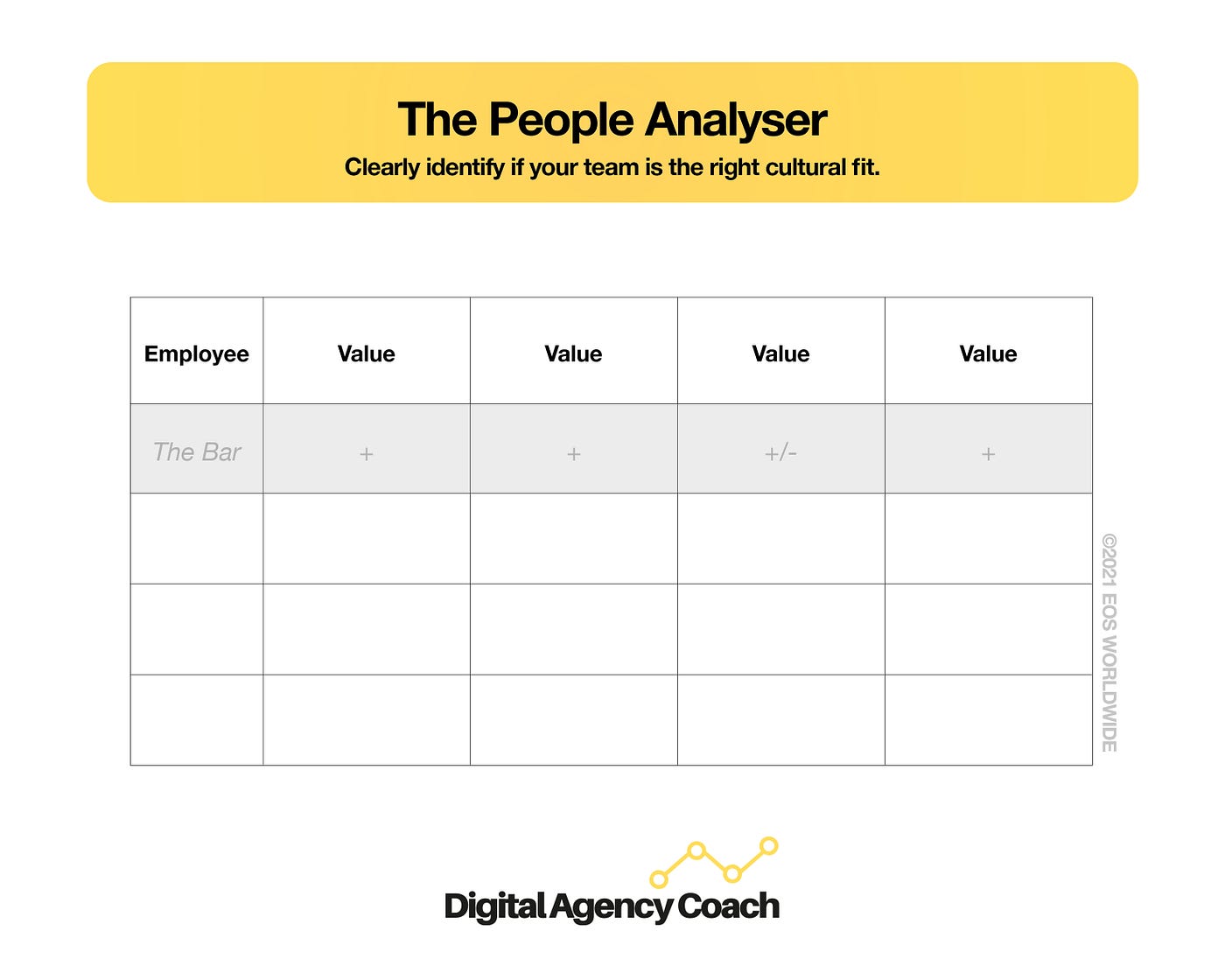
This is a simple template you can create yourself within a Google sheet or Excel workbook. Start by listing your 7–10 values along the top and a list of all your employees down the left-hand side. The trick is to make sure you set ‘The Bar’ as the minimum standard of what you require from an employee.
Once you have this set up, measure each individual against your values and determine whether this is something they Always, Sometimes or Never demonstrate. Once complete, you’ll have created a visual representation of employees who are a good cultural fit and those who aren’t.
Implementing these five steps will guarantee positive changes to your agency’s culture and ensure that you are able to scale your business and grow your team with the right people.
As always, if you have any questions about fostering a great agency culture or would like some help using The People Analyser tool, please Get In Touch with the team at Digital Agency Coach, we’d be more than happy to help.
We all know how important it is to encourage equality through our culture in the workplace. But it’s no secret that women are underrepresented in senior leadership positions.
It’s everyone’s shared responsibility to become not only advocates, but champions of women from diverse backgrounds within their organisations – and in their lives at large. And in the creative sector, if we want to truly do our part to help women stake their claim, it means businesses taking ownership of their own equality scores in a number of ways – not least, by appointing women to the senior leadership positions we need them to be in.
At Proctor + Stevenson, we’re one of the UK’s longest-established independent marketing agencies. Despite this, we’ve never been conformists, and we’re a good step ahead of your traditional London-based agency in more ways than one.
Our Founder and Chairman, Roger Proctor, has always been an outspoken industry figure. He’s championed diverse young creative talent from the South West of England and Wales – an often neglected region for the arts – throughout his career.
Back in 1979, he laid in our bold and independent foundations in Bristol. And the rest is history. We’ve been challenging inequities and hiring diverse talent ever since – such as through hosting the South West Design + Digital Student Awards (which saw a particularly high volume of entries from young female designers this year).
In short, the talent is there. So what changes are being made?
At the start of 2021, Roger and the senior team restructured Proctor + Stevenson by splitting the larger brand into three companies: P+S Creative, P+S Technology and P+S Strategy, all overseen by the P+S Group (you can read more about these changes here). And this change marked a new milestone for the P+S team.
Our restructuring was the perfect opportunity to progress our own equality targets across the team at Proctors. It was at this point in our journey that we ensured the P+S Group met a target of 50/50 male-to-female directorship.
So, without further ado, meet our board…
· Joy Locke is our Company Secretary. She applies her 20+ years’ experience with us to take lead of everything operations, finance, accounts, and administration. She ensures that we were keeping on track with budgets.
· Ailsa Billington is one of our Directors. She leads our client services operations and takes charge of directing major global campaigns for our multinational portfolio of clients. She directs over all teams in the P+S Group to make sure that we deliver the best campaigns to transform our clients’ businesses for the better.
· Nikki Hunt is our Financial Director. CIMA-qualified, Nikki brings a wealth of experience in management accountancy, HR, payroll, and health and safety to our business, keeping us running efficiently and safely.
· Roger Proctor is our Chairman. He founded P+S in 1979 and has continued to lead its transformation ever since. Under his leadership, the business has grown from 2 people to more than 70, plus a network of freelance talent, and has won a global portfolio of clients such as Panasonic, National Grid, Saudi Arabian Airlines, and much more. He is passionate about the power of creativity to make positive change and is also heavily involved in strengthening the links between the creative industries and education.
· Mark Jamieson is another of our Directors. He helped establish our presence in the Middle East and is an expert in developing, building, and maintaining positive client relationships in across all sectors.
· Steve King is the final member of our current team of Directors. He leads our large-scale digital projects on everything concept creation, development, and project delivery. He’s worked on many innovative and world-first technology projects.
At Proctors, we’ve always taken equality and diversity extremely seriously. Because when we celebrate and empower women in business, it benefits everyone.
We strive to nurture careers amongst our female talent, building them up into more senior roles within our business. And we want to continue to progress further. We’re currently building a broader, transparent picture of our teams, our diversity, and our biases to discover how we can do better.
There’s lots more to be done to help narrow the gap between women in leadership across the UK. It’s a fact that only 5.6% of women in the UK run their own business and women only account for 33.8% of positions as directors on business boards in the UK, with only 16% of creative directors reported to be female.
We’ve just launched the first instalment of our Women in Business interview series. In it, our own Marketing Manager, Becca Peppiatt, sits down with Peaches Golding OBE CsJT, Her Majesty’s Lord-Lieutenant of the County and City of Bristol. This interview, like the rest of the series, delivers insight into the female perspective of working in business, so aspiring young women can see themselves represented in leadership roles. Stay tuned for more instalments of the series, coming soon.
We can all do our part to progress the important conversations which need to be had about an industry that is in many ways stuck in the past, ignoring some of its blatant inconsistencies. There’s lots more to be done and we intend to continue to work hard to narrow some of the gaps that exist. We need to think intersectionally about how we hire, and how we can create healthy, fair environments for women to succeed in.
For more information about Proctor + Stevenson, or to discuss our services or teams in more detail, please email us.
Leading Bristol–based digital marketing agency, DNRG, is working with AI search company Yext to provide businesses with modern solutions to boost their discoverability in search and stay ahead of the competition.
The UX focused platform, NRG Connect, is easy to do business with, offering a central cloud-based system to manage and update business listings. Google, Facebook, Yell, Apple Maps and Waze are a few of the 100+ apps, search engines, maps and directories customers can access. This generates opportunities for businesses of all sizes to be digitally competitive and present their company to potential customers searching for their services.
DNRG is supporting their existing customers, as well as independent businesses, with a solution that saves time, increases efficiency, and allows for excellent reporting and measurement. NRG Connect forms as part of a larger digital marketing strategy for businesses. The platform interlinks with other digital solutions such as user experience–led web design, SEO–focused content, Conversion Rate Optimisation and more, to offer a complete digital package.
Marketing agencies can partner with DNRG to receive access to a white-labelled platform, where they can offer the solution as their own to their clients. DNRG provides comprehensive training and support to the agencies and their end-users, ensuring they are fully equipped to make the most out of the platform.
In an age where digital reputation is more important than ever for businesses, DNRG customers will have access to view and respond to all their customer reviews, as well as edit company details all in one central location. This saves hours of trolling through different sites adding listings, responding to reviews, and making updates.
We’ve spoken to Joe Reid, Account Services Director at DNRG, “We’re delighted to announce our collaboration with Yext, which presents us with a unique opportunity to work with like-minded marketing agencies and offer an additional solution to our direct customers.
“In 2021, we all search online for products and services, so making sure that our customers can be found, wherever they are searched for is essential to us. This product forms as part of a much wider digital marketing solution, to allow businesses of all shapes and sizes to be competitive.
“It’s so important for all businesses to have the ability to be digitally competitive. At DNRG we specialise in offering solutions to SMBs who may not have unlimited budgets or the option for in-house digital marketing expertise. We believe in allowing smaller businesses to compete with the bigger companies and build them a digital presence in order for them to do that.”
“For SMBs, a solid strategy for managing and optimizing listings is vitally important — it can mean the difference between appearing on the search results page and not showing up at all, between winning over a customer and losing them to a competitor,” said Luis Baptista-Coelho, Executive Vice President, Global Partner at Yext. “We’re excited to team up with DNRG so that even more SMBs can tap into Yext’s modern, AI-powered platform — the same technology that the biggest brands in the world trust — to keep their information up-to-date across platforms, improve their discoverability, and win more business.”
When you think about the negative connotations surrounding the word “persuasive”, you can understand why a lot of us in the industry are afraid to use persuasion to influence the customer journey.
We’ve seen this first-hand. Brands will avoid persuasive design as they are under the impression it uses “dark patterns”, which is a term used for a type of design that manipulates the unassuming customer into completing a call to action for financial gain.
This is simply not the case.
Persuasive design is not about manipulation, it’s about catering to your users’ best interests and anticipating the needs of your customers from discovery to purchase. You are essentially guiding your customer to make a decision that will, in the end, be beneficial for both you and your customer.
In short. Throughout the entire customer journey.
Once you understand the different types of customers that could be attracted to your services, you should use persuasive design or “nudges” across various parts of the online experience to subtly steer their judgment resulting in a successful conversion.
You should always try to make the customer journey simple… but not too simple. You want to create a seamless experience, but you also don’t want to illicit self-defeating behaviour, as this could impact customer retention.
If you’re still unsure how to use effectively use persuasive design, there are four key elements to think about when designing a journey your customers will not be able to stay away from.
A persuasive experience is more than one linear journey. Customers can connect with your brand in more ways than ever before, and you need to see each initial interaction as an opportunity to build a rapport and create an emotional response.
Failure to recognise these points of interaction leaves you with no indication of how your customers are feeling before, during, and after they complete their journey.
Whether your customer begins their journey through Google Search, social media, or even through a newsletter you should always map and follow the customer journey to see if and/or when their emotions change.
In just one journey a customer can fluctuate from excited to frustrated, or from hopeful to disappointed, and a map will allow you to see what caused these sudden changes. With this information, you can add positive reinforcements to parts, which caused the greatest emotional response.
If you wanted to keep a high retention rate, sending a “thank you” message or a reward to your customer after they’ve completed a purchase can be very effective.
For customers that you want to reassure, you could add a “final check” before purchasing, which allows them more time to finalise their details.
Persuasive design is not about deceiving the customer, it’s about helping them reach their desired end goal in the quickest and most efficient way.
There’s a great deal of truth to this, especially for eCommerce brands, as almost every customer will use the website that allows them to successfully complete a purchase in the shortest amount of time.
To ensure the transaction process is kept to a minimum, brands need to allow users to feel they are in control by stepping aside and giving the user the freedom to do what they want.
For this type of journey to be successful, your usability and UX hygiene needs to be on point! Slow loading speed, illegible fonts, and too many advertisement pop-ups can dramatically decrease your conversion rate.
You should always run thorough tests into what is not working on your website and fix it quickly before your customers turn to your competitors.
At the end of the day, your users are not just a number, they are human beings with ranging emotions and needs, and if you don’t grasp that concept then opting to use persuasive design is pointless.
The needs of a person looking to book a summer holiday abroad are going to be different from a person looking to take out a loan, so we can’t expect their experiences to conjure up the same needs or emotional responses.
When it comes down to it, the main reason your persuasive design will fail is if you haven’t anticipated your customers’ expectations or considered how you can cater to those specific expectations.
The more you can tailor the experience to your customers’ goals, needs, and frustrations, the better the retention rate.
Take the time to research your customers and use this data to create core personas, which will help you design a more targeted customer journey. If you don’t have these personas in mind, your design won’t be relatable to your desired users, and will not trigger the emotional response you desire.
When thinking about persuasion there are three things that are applicable to all brands: USPs, reassurance and incentives.
To start you need to show your customers what makes you unique and more appealing than your competitors. To do this you can highlight your benefits clearly on your website, so users will be able to quickly understand your value.
Next, you need to reassure your customer that you are the best option. If users do not trust you, then they will not convert. To demonstrate your value and trust as a company you could include positive customer reviews, ratings, third-party testimonials, and logos from trusted payment providers on your website.
The final thing you need to consider is including some form of incentive, and this could be the difference between losing a customer or successful retention.
When customers feel like they are getting something for free, they are more likely to complete a purchase and buy from you again. For example, offering free delivery or a gift if they spend over a certain amount will always be an enticing offer.
While the idea of persuasion and persuasive design may sound deceptive and difficult to get right, the reality is that this form of marketing is all about trying to understand and empathise with your customer.
When you understand what makes your users’ tick you can create a seamless customer journey that meets their needs. Once you have achieved this, what follows is a customer journey that users will trust and return to again and again.
It’s as simple as that!
If you take a look around Digital Agency Coach’s website you’ll see the two core services we offer to digital agency owners: Mastermind Groups and Coaching & Mentoring Programs.
Digital Agency Coach’s bi-monthly Mastermind Groups provide a peer-to-peer learning and networking environment for agency owners and are a brilliant way to share ideas, learning and insights with other like-minded professionals. Watch our Mastermind Group Explainer Video (1min) for a detailed look at how this service benefits busy digital agency owners.
Our Coaching & Mentoring Program is by far our most comprehensive and rewarding service, where our agency owners benefit from extensive 1:1 consultancy and expertise guaranteed to scale and grow their digital marketing agencies.
In this article, we share how our Coaching & Mentoring Programs work and what you, as an agency owner, will experience both during and as a result of the program.
1:1 coaching provides a dedicated space to solve problems, gain accountability, design and execute business plans through external, expert advice. You’ll make decisions faster, build better teams, deliver higher quality work and your digital agency will grow, and you’ll enjoy the journey.
All Digital Agency Coach Mentee’s have the opportunity to become one of our successful agency owners who:
Grew Their Revenue & Profit
You’ll achieve significant growth in both your revenue and your profit within the first 12 months of working with us.
Won More Leads, Clients & Awards
You’ll develop the skills to convert more leads, grow your client base and win noteworthy, genuine industry awards as part of your recognition.
Bought, Merged Or Sold Businesses
Want to grow quickly through Mergers & Acquisitions? We’ll guide you through the processes and purpose behind these growth strategies so you can benefit from the results faster.
Gained Freedom And/Or Early Retirement
You’ll be able to spend less time in your business and start working on it. Our mentees now have more time and freedom to do the things they enjoy, and many have been able to reap the rewards of their lifetime’s work and step into retirement.
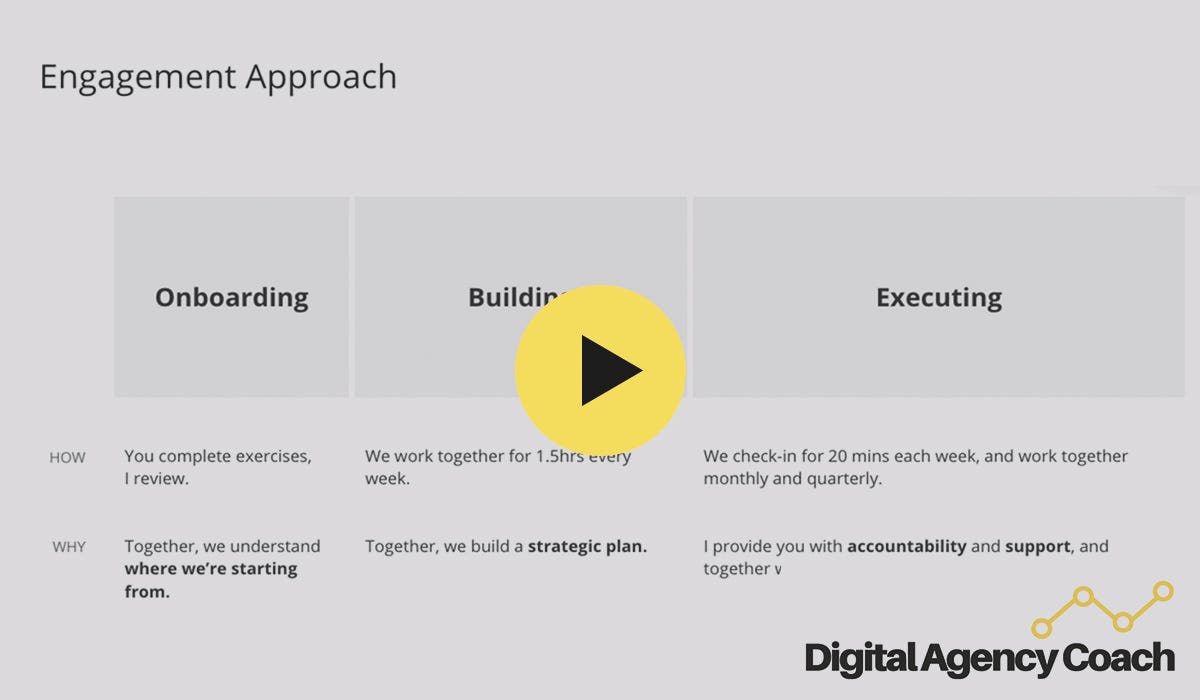
Participating in our Coaching & Mentoring program generally follows this engagement process:
Onboarding — This where the scope of work is agreed and all our reciprocal learning and understanding is carried out.
Building — Together, we put together a strategy and a plan based on our learnings from Step One
Execution — As the name suggests, Stage Three is where we execute the plan and start to grow your agency.
This is where we get to know each other. We’ll begin with a discovery session, where our consultant will ask you to share details and insights about your agency’s current status and any plans, aspirations and goals you have for the future.
This then is reviewed, packaged and shared with you. We’ll put together a presentation that summarises your goals, business position and the strengths, weaknesses and opportunities for your agency. We’ll also detail a top-level roadmap and a handful of quick wins for you to implement then and there which are guaranteed to have an immediate effect on your business from day one.
This onboarding phase usually takes about a month to complete and once we have this understanding we can put together a plan and roadmap for us to move forward with.
This is where we put together your growth strategy. We’ll use our Agency Accelerator Canvas to break down your business plan into achievable, bite-sized objectives, milestones and KPI’s for you and your team.
Our consultants will work with you to formulate a plan and share insight, context, benchmarks and tactics from our portfolio of the 250 digital agencies we’ve worked with. Creating these objectives and key results and writing your business strategy usually takes about 6–8 weeks to complete.
Stage three – execution, makes up around 75–85% of our program. This is where we put our planning into practice and start to make big, impactful changes to your agency’s operations.
You’ll chat with your consultant weekly for 10–15 minute accountability meetings to check in and make sure things are running smoothly. Between these sessions and our ongoing, ‘always-on’, ad-hoc support, you’ll execute the daily and weekly tasks in your business plan.
Every four weeks we’ll set aside a few hours to plan for the coming month and set the KPI’s to make sure the overarching plan is still in sight. Then each quarter, we’ll orchestrate a full review of the work completed and the work ahead and make any necessary changes to the master plan.
At Digital Agency Coach, we work deeply with a small roster of agencies at any one time as our Coaching & Mentoring Programs are long-term relationships that deliver long-term, long-lasting results. The average timeline for these programs is anywhere between 12 to 18 months, depending on your capacity.
Now that we’ve unpacked our Coaching & Mentoring Program and how our services can help you achieve stratospheric growth for your marketing agency — it’s time to ask yourself if this is the right fit for you and how you like to work.
If the answer is yes, please get in touch and Arrange A Free Consultation with one of our friendly consultants. We’ll be happy to answer any questions you might have and get you on the path to success.
During a recent panel discussion, TMW CEO Chris Mellish made this statement on gender balance in leadership: “We shouldn’t just be talking about this on International Women’s Day, it needs regular dialogue.”
Yep, I went there – I opened with a quote from a man. But it may well take male support, particularly from those in leadership, to help push the agenda for women – and get all genders on board with it. According to leading scholar and anti-sexism educator Jackson Katz, the mere mention of the phrase ‘gender issues’ can lead men to switch off as they often see gender-related conversations as ‘women’s issues’, rather than anything to do with men. But genders don’t operate in isolation.
“We shouldn’t just be talking about this on International Women’s Day, it needs regular dialogue.”
– Chris Mellish


Put simply, because it makes businesses more effective. In 2019, Credit Suisse researched 3,000 companies across 56 countries to find that shares of companies with more women managers delivered higher returns, while a greater number of women executives also correlated with stronger revenue growth and higher profit margins. This was echoed by a report from consultancy The Pipeline:
“Companies on the FTSE 350 index would generate 195 billion pounds ($250 billion) of additional pre-tax profit if their margins matched that of the firms with greater female representation.”
But aren’t women hardwired to be the primary caregiver in the home? Cognitive neuroscientist Gina Rippon analysed the data on ‘differences by sex’ in the brain – and found there to be none. If gender alone has no impact on brain functionality, Rippon concluded that what we deem as typical male or female traits are, as she describes, the result of a “gendered world” – so nurture, rather than nature.
And yet LinkedIn research suggests a staggering 60% of female marketers have left or considered leaving the profession because of Covid-19. That’s more than any other industry. In heterosexual partnerships, women have taken on more duties in terms of caring and homeschooling, in addition to their careers, and are left feeling overwhelmed.
“60% of female marketers have left or considered leaving the profession because of Covid-19.”
There are signs of change with studies worldwide reflecting a shift in the balance of housework and caregiving from pre-pandemic times. But mothers still spend about twice as much time on caregiving and household labour, even as they’ve rapidly increased the number of hours they work outside the home – and even when they’re the primary breadwinner.

For International Women’s Day, Unlimited ran a panel discussion with women in leadership roles from across our group, joined by our male representative, CEO Chris Mellish. The panellists shared personal experiences of difficulties faced in getting to their position. Yet on the point of children, the panel questioned their own choices on who in their family took the role of primary caregiver. Some voiced concerns of being left behind during maternity, and recounted being judged as “not ambitious enough” for wanting children – or being seen as “too ambitious” for not having them at all, as if the two options were mutually exclusive.
“The panel shared . . . the general expectation that women must be better, sparkier, more articulate – and work harder than their male colleagues.”
But motherhood is not all that impacts a woman’s capacity to succeed in the workplace. The panel shared experiences of their confidence being damaged in all-male environments, having to use humour to ‘handle’ comments on their appearance, being asked to consider how men would feel if women were promoted over them, and the general expectation that women must be better, sparkier, more articulate – and work harder than their male colleagues.
These experiences are not new, and many echoed a 2019 report from the Government and Equalities Office. The report cited barriers to gender balance as lack of transparency in pay and promotion supporting biases that disadvantage women. Hostile or isolating organisational cultures, and a conflict between external responsibilities and current models of working – compacted by unpredictable work demands and alternative ways of working do not always offering parity of opportunity. Many women reading this post will be able to relate to each one of these.

The Unlimited panel covered a range of ways we can start to shift the dial and work towards gender balance in leadership. There are practical considerations around flexible working, recruitment processes, and transparency on pay and promotions, allowing more unbiased access to a seat at the table. Mentorship, coaching and workshops can serve to build confidence and address what holds women back.
“There are practical considerations around flexible working, recruitment processes, and transparency on pay and promotions, allowing more unbiased access to a seat at the table.”
But a theme that came out strongly from the panel is, as Chris said himself, to keep talking. That is the ambition we must work towards as an agency – for all genders to play their part. We want to create space for getting into the awkward stuff we don’t like to talk about. The often-cited reaction to the Me Too movement from men is fear, being nervous of saying the “wrong thing”, but this doesn’t serve any of us. I’m often struck by how even my most supportive male friends are simply unaware of the challenges of walking in my shoes as a woman. One positive that may come out of the tragic events surrounding Sarah Everard’s death, is the heightened awareness of the daily challenges women face. We can’t afford to maintain inertia. We deserve better for ourselves and future generations of women in the workplace and beyond it. And this is the challenge we have set ourselves – to continue the conversation, and back it up with action.
– Martin Luther King, Jr.
Yes, another man – but what a man.
Written by: Emma Woodrow, Group Account Director
Illustrations by: Paloma Kaluzinska, Junior Designer
Since our MBO in late 2017, Armadillo has been through a period of sustained growth, with 21.28% Compound Annual Growth Rate (CAGR) of fee income in the past three years.
We are forecasting this growth to continue through 2021, and with that consistent growth, we have needed to make a number of key hires. We will need to recruit more skilled professionals to join us as we continue to use our expertise to harness the power of data to change customer behaviour and deliver unrivalled ROI. So here are some things that I have learnt and am still learning that you might want to consider during the recruitment process.
Ensure candidates understand your company’s values
We all know that it’s cheaper to retain customers than win new ones, and the same can be said of employees. High staff turnover can be a killer for culture and the bottom line, not to mention the lost knowledge and relationship bonds which walk out the door every time someone leaves. So first of all, work towards making a team culture where people want to stay, commit and contribute to overall success.
Cultural fit is so important for long term success of a candidate or employee, so ensure your values and all those little things you do come across in your job adverts. As well as trying to convey the company’s values, during the recruitment process it is important to draw out from candidates if they share those, or if not, whether they are likely to stay in post for long. However, try to be mindful of subconscious or unconscious bias – for example affinity bias; the subconscious thought that might make one candidate more appealing because you share something in common with them; it could be a former workplace, university or even something as trivial as following the same sports teams. Each of those things do not mean one candidate would be more qualified or suitable for the role than another, but it might affect your decision making. Be watchful for biases such as these and consider a wider range of other biases too (I find this list helpful). Having diversity of thought, experience and background within a team will create opportunity for healthy challenge and new ideas.
Think of different ways of bringing out skills at interview stage
Find ways to test for skills or values which are most important for the job, and not just discuss previous experiences. For more junior roles, consider asking ‘what if’ questions to give candidates a chance to explore how they would approach a challenge in the future, which could be more revealing than asking them what they have already done.
I once had an interview for a Finance role where I was provided with the Group’s management accounts, statutory accounts and next year budgets on arrival, and given 45 minutes to prepare a presentation for the Group FD. Amongst other things, they were testing my ability to work under pressure, time management, my accounting knowledge, my numerical and analytical skills and my presentation skills. Fortunately for me I was offered and accepted the job, and we went on to implement and address four out of my five recommendations.
Software can help you streamline the process
Working in a business like Armadillo, it won’t come as a surprise that another recommendation I’d offer would be to utilise software and data management. Regarding software, there are some great SaaS tools (like Workable for example) which can help you securely (and compliantly) store applicants’ information and documents, share access (on a per candidate or per role basis) to relevant colleagues without compromising the privacy and control of the candidates’ personal data. Especially for businesses currently working remotely or from home, interviewing candidates on screen with one or more interviewers can prove a challenge, whether it’s managing a large volume of candidates, not having CVs and applications in inboxes, or losing track of that data.
Someone might not be right for this role now, but could still be a good fit
Get GDPR-compliant permission from candidates to keep their details on file. A candidate who was a cultural fit but did not quite have the right experience may be right for a different role, or in time may have gained the experience they previously lacked. Keeping a record of their details and application could be a component of an “always-on” approach to recruitment.
In summary, communicate the cultural values of the business, and how you value employees. Try to be mindful of unconscious biases in both job adverts and interviewing. Test for key skills as well as facilitating discussion. Especially when recruiting for a number of roles, or at scale, consider using cloud-based software to practically help and keep a (GDPR compliant) database and records of strong candidates who you may want to speak to again in the future for ‘always on’ recruitment.
This article first appeared on Ambition, May 2021.
By Andy Brown, CFO
You need to load content from reCAPTCHA to submit the form. Please note that doing so will share data with third-party providers.
More Information