
WithinDigital is an almost monthly digital marketing podcast, featuring in-depth interviews with experts in digital advertising, SEO, social media, and everything in between.
Click here to listen and subscribe to WithinDigital on iTunes>>>
Click here to listen and subscribe to WithinDigital on Spotify >>>
In episode 10 of WithinDigital, Nick Livermore is joined by Incubeta‘s Head of Measurement Consultancy, Kate Jervis, to chat about the ‘first-party data renaissance’ of 2022.
Data is at the heart of everything we do in marketing. And first-party data has been around for a long time. So, why in 2022 are we talking about first-party data like it’s this new thing?
Together, they cover…
This podcast first appeared on the Adapt Website here >>> https://www.adaptworldwide.com/insights/2022/withindigital-episode-10-the-first-party-data-renaissance
Launch is delighted to announce the appointment of Stephanie Iles as its first ever Sales Director. Steph joins the agency from SearchStar (now Adapt Worldwide), where she worked for over 5 years as a New Business Director.
Steph will help Launch to reach new prospects, aligning the agency’s services with individual business goals, and being a first port of call for brands to learn more about how Launch can help them achieve their aims with clever digital strategy and paid media.
Steph says: “I’ve worked and travelled across the world during my career, but my heart is in the South West. I’m very excited to have joined Launch, where the team has the same passion as I do for championing businesses across the region. Launch is filling a gap in the market for a reputable agency that’s at the very top of its game. We’re curious, ambitious and personable and we understand how to marry South West individuality with success online.”
Jaye Cowle, Managing Director of Launch, says: “Steph is an experienced operator who is perfectly placed to continue the excellent growth we have experienced over the past few years. We have a very strong contingent of South West clients, and with Steph on board we’re looking to grow that further with a focus on results, transparency and team work. We’re excited about the year ahead!”
Steph is the latest appointment in a year that’s seen Launch grow from 7 to 20 people to meet the growing demand for digital marketing services.
But what appears to be a shiny new toy for some marketers has actually been the mainstay for specialist CRM agencies like Flourish for years. Since its inception in 2003 Flourish has used data to drive customer journeys that help brands to be more relevant with their messaging.
At the back of 2021 Flourish delivered a personalised end-of-year round up campaign for Twitch, the global streaming site. Over 45 million Twitch users, viewers and creators received the email campaign which was translated into 28 languages.
These uber-personalised comms didn’t simply include the customer’s name or what they just bought. We’re talking whole-email personalisation; with eight different creative variants, based on a contact’s level of platform engagement, each in-turn sharing cool and interesting personal stats based on their year with Twitch. The decision to allocate individual users to different creative variants was driven by real world data insights that identified the type of user they were, the relationship they had with Twitch and their future potential.
Every email was personalised to the recipient, reflecting their year with Twitch. Users and viewers could see the creators and channels they’d watched most, what they’d supported with subs and follows and even what their favourite emote was. Creators could see how many hours they’d streamed, how many viewers they’d picked up, how they interacted with them and who their biggest fans were.
The roundup was a big hit with recipients and saw 500K+ shares on social media. As the campaign landed Twitch saw a 67% increase in traffic to the site as users and viewers reconnected with their favourite content. So much so that there was a 971% incremental increase in the number of hours watched.
Rich James, Managing Partner at Flourish and Twitch client lead said: “We’re always striving to help Twitch be as relevant to their audience of users and viewers as possible. But we’re also conscious for the need to support the content creators that do so much to make Twitch what it is. The end-of-year campaign did both perfectly. Presenting a summary that hyped creators, helped them understand their impact and achievements, whilst viewers were given a timely reminder of everything they’ve loved on Twitch. The campaign was the perfect example of how every member of the Flourish team lives and breathes personalisation in everything they do. The project was led by the amazing Sanni Haltunnen (Senior Account Manager) and Glenn Carver (Technical Campaign Manager) with the wider support of the agency. We’re really proud of what they and the team have delivered for Twitch”
If you’d like help to take your communications beyond personalisation and into relevance, you can get in touch with Rich James. Alternatively, you can take a closer look at Flourish.
Mental health issues do not discriminate. They can affect anyone at any time, and reflecting on the last two years, it comes as no surprise it is being experienced by more and more people.
In the UK alone, 1 in 4 will be affected by a mental health problem of some kind each year. Leaving more and more people searching for support from charities, the NHS and healthcare providers.
For the second year in a row, we have decided to raise awareness and help fundraise for a chosen charity by donating our Christmas Card video.
We did lots of research into which charity we wanted to raise money for, and the decision wasn’t easy. There are so many organisations fighting for important causes, and that’s just in Bristol and South Gloucestershire alone.
The chosen one
We finally came to an agreement on OTR, a mental health movement for young people in the region.
Their mission?
To defend, promote and support the mental health of people between the ages of 11-25. This incredible organisation focuses on breaking the stigma around mental health and their aim is to get people talking about it.
Their approach?
OTR runs a number of workshops, 1:1 therapy sessions, support projects and much more.
They run Resilience Lab workshops, helping young people develop the tools to manage stress.
And host Acts of Activism sessions, where young people can go to socialise, express their frustrations about inequality and come together to encourage small and big acts of activism.
They also hold a 6-8 week Nature Works project, which teaches young people the importance of nature for their mental health, and how connecting with it can be a very beneficial tool for stress-relief.
And their work doesn’t stop there.
OTR works tirelessly to make mental health an aspect of life that people can talk about without any feelings of shame. They believe in the power of partnerships and collaboration and that the world around us, also impacts our wellbeing.
Ultimately, they provide a help and support network so that young people can develop tools to cope with day-to-day life and the challenges that may come their way.
The OTR fundraising video
We worked closely with OTR to develop a video that represents their personality, demonstrates their mission, and spurs people to get talking (and donating).
And once you’ve watched the video, we hope you can help. With your donation, you can help a young person gather the tools they need to shape their own futures. You can help change the game.
A wellbeing pack is just £5. But the self-esteem it brings is priceless. Please donate what you can here.
After almost a year of a basic holding page, Noughts & Ones have launched a new low-impact website as they look to further establish themselves as the go-to Shopify agency for planet-friendly ecommerce brands in 2022.
“2021 was all about laying the foundations for growth and it’s great to see it all come together on our new website. We’ve got some really exciting plans in place as we look to continue working for real change by helping planet-conscious brands to sell their products in the right way.” – Tom, Creative Director
The new website was born of their own Conscious Development™ framework, which guides (and will constantly evolve) all aspects of the Shopify stores and JAMstack websites they deliver.
Further to case studies on projects for incredible conscious brands such as fussy, OceanSaver and Hunter & Gather, the new Noughts & Ones website also serves as a platform to educate and spark conversation around the very real concern of digital sustainability.
Putting their website into “Super-Eco Mode” not only switches the site into even-more-efficient design mode, but also showcases tips on reducing the environmental impact and carbon footprint of websites.
Digital agency Torchbox has gathered the SEO data of over 50 charity websites across eight sub-sectors to provide a benchmark of organic SEO performance across the not-for-profit space.
Torchbox has measured success against six SEO metrics, including technical health, backlink profile, and content. The data has been presented as a card game, allowing you to play your nonprofit against other charities operating in a similar space.
As well as a physical pack of cards, there is also a Super Trumps website, where you can play the game, read the state of the sector review, visually compare the performance of all included charities and read the individual sector reports. The eight subsectors analysed are:
“We hope this gets some conversations started internally about the value of SEO at charitable organisations, and if not, we hope this at the very least raises a smile!”
Phil McMinn, Digital Marketing Director, Torchbox
The Super Trumps project was launched at an exclusive webinar, with guest speakers from Oxfam, Sightsavers, and NHS Digital – with a panel discussion around SEO utilisation in the nonprofit space.
“It was a really great session. Very informative and has given us plenty to consider for 2022.”
Kim Watson, Head of Marketing, Versus Arthritis
The response to the project has been incredible, with positive feedback from charities that are and are not included in the analysis. Also, requests from other nonprofit sectors, such as Think Tanks, to be included in the next benchmarking analysis!
“Absolutely nerding out over these #TorchboxSuperTrumps. Who knew SEO benchmarking could be this fun?”
Dan Papworth-Smyth, Head of Digital Engagement, Breast Cancer Now
Torchbox’s overarching goal is that this benchmarking exercise will help to highlight where opportunities lie to utilise SEO and provide the data to illustrate what is possible in the not-for-profit sector.
Join the discussion #TorchboxSuperTrumps
For many of us, sales and business development is the one part of running a digital agency that just doesn’t come easily. Sales calls can feel awkward, forced and sometimes completely disingenuous, and so, we avoid them altogether. But what if the most effective sales calls weren’t sales calls at all?
In this article, I’m going to share my top tip for helping you conquer the fear of communicating with your potential, existing or lapsed clients to land sales. I’ll also prove just how well it works with my very own, very real example.

In my experience, some of the most successful, fast-growing agencies are led by innovative, intelligent and tech-savvy operators. These agency leaders were obviously so successful in their specialist field, that they were able to form their own agency and offer their service to businesses and brands on their own terms.
The trouble is – being a brilliant developer, software designer or digital strategist means you’re often very comfortable behind a computer screen and usually not so comfortable making sales calls. And after all, the best sales and BD strategies usually involve a lot of face-to-face conversations, networking events and generally spending time without your noise-cancelling headphones on.
The good news is, there’s a hack to checking in with your clients & prospects while still being able to avoid those awkward sales calls (this is where I get to the part about chicken wings).
At Digital Agency Coach, my fellow coaches and I don’t take an awkward role-play or scripted approach to helping agency owners develop their sales skills. For years now, we’ve been helping agency owners circumvent the system and land sales without making awkward sales calls.
The trick is to a) remember that your clients are human beings – they’re people with hobbies, favourite sporting teams, pet peeves and favourite restaurants; and b) communicate casually, genuinely and informally with them on a regular basis – chat about your common interests or things that are important to them in order to build a relationship.
It sounds simple, and that’s because it is – but it genuinely works. If you’re dubious, take this real-life conversation below as an example:
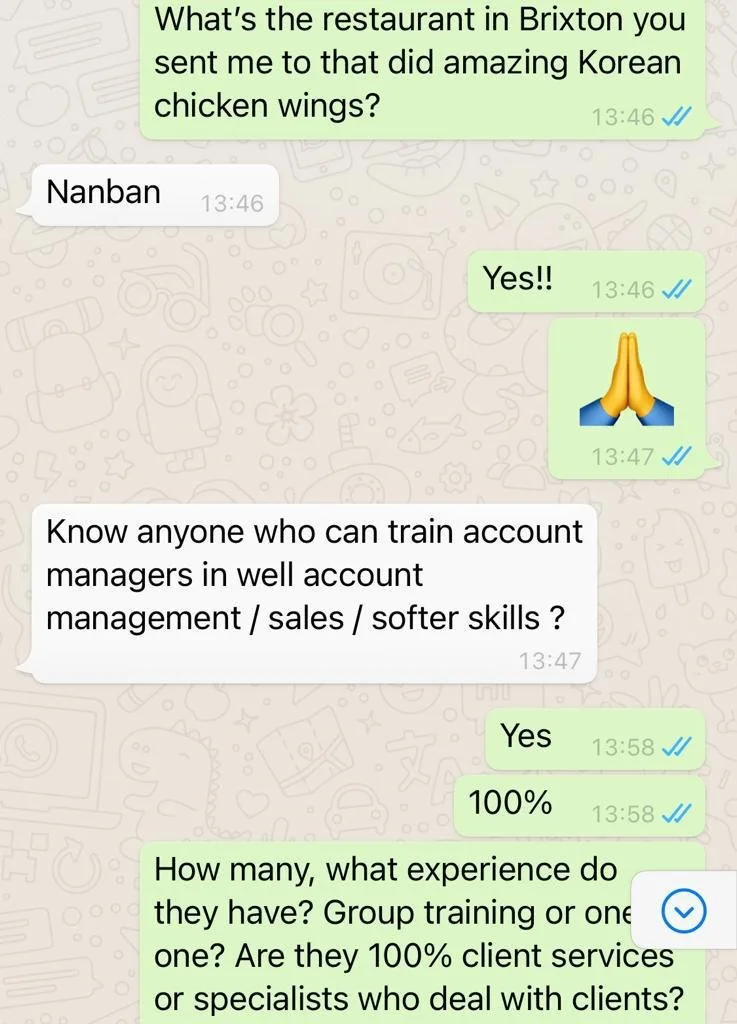
Just this week, I had reached out to a former client to simply ask about the name of a restaurant he recommended.
This short, simple and motive-free message nudged me to the front of his mind and prompted a response about coaching.
This simple example perfectly demonstrates how building relationships and checking in with your contacts to spark friendly and non-business related conversation is a great way to make sales calls, without making sales calls.
Pro-Tip: Like all sales efforts this one works best when paired with manageable KPIs. Set yourself a target of 3-6 messages, calls or interactions per day and keep yourself accountable. For tips on setting effective KPIs, check out this article about Lagging vs Leading KPIs.
At Digital Agency Coach, we understand that while agency owners are all brilliant, they are human too (just like their clients).
That’s why we use tactics just like this one to help all agency owners land more sales and achieve stratospheric growth for their agency to gain more profit, more time and less stress – no matter where their strengths may lie.
Lockdown puppies. Admit it. You considered one. A little companion to keep you company working from home, a playmate for the kids and a reason to get out for your 10,000 steps each day. And if you did end up getting one? You’re not alone.
According to the BBC more than 3.2 million more pets were bought during lockdown. Veterinary charity PDSA’s research shows nearly 2 million of these were puppies, with many owners saying it was the first time they had owned a pet.
Over the same period 1.4 million more claimants registered for financial support as the pandemic effectively stopped people being able to earn a living. More pets, more first time owners and more economic uncertainty. A perfect storm for PDSA who treat the pets of owners who cannot afford veterinary treatment.
PDSA turned to CRM specialists Flourish to develop a campaign to raise awareness and money to meet the forecast jump in demand for their services. The resulting Give Pets a Fighting Chance campaign went live in late November 2021.
An initial priming film was shared on social and via email underlining just how much pets mean to us and have enriched our live during lockdown. This was followed by a fundraising phase on social, email and via direct mail to existing supporters.
The campaign celebrated pets, paying homage to just how amazing they are for our physical and mental wellbeing. This celebration provided the platform from which to ask for donations witch communications suggesting that: “For all pets do for us, they deserve a fighting chance.”
The response to the campaign has been incredible, with celebs including Ricky Gervais, Michaela Strachan, Alesha Dixon and James from the Vamps showing their support on Twitter.
Preliminary results are incredibly encouraging with the campaign being well on track to meet its financial targets to make sure any increase in need for PDSA services will be met.
Laura Tovar Senior Account Director at Flourish said: “The potential increase in need for PDSA services had to be addressed, and quickly. We’ve been working with PDSA for 3 years now and in that time our campaigns have always hit their targets and often smashed them. Our Give Pets a Fighting Chance campaign has been well-received and I have no doubt that many pets lives will be saved as a direct result of it”.
If you have a CRM project you’d support with, you can get in touch with Flourish by contacting Steve Davis. Alternatively take a look at some of our work.
Those extra special legacy clients were the reason you were able to build your agency up to what it is today…but are they now limiting your continued growth? Hear me out.

In my experience, a lot of digital agency owners have a number of legacy clients on their books, clients they’ve worked with for years and years, with who they love and who have really positive relationships. The trouble is, these clients have been around since day-dot and all these years later, they’re still paying day-dot prices which are breakeven at best, and entirely unprofitable at worst.
This is troublesome for a few reasons, some more obvious than others.
Firstly, these clients are unprofitable and are costing the agency money – but the long-standing relationship actually means the agency owner feels beholden to them so they keep the work and grin and bear the cost of doing so – which impacts your bottom line.
Secondly, in an agency environment, the service on offer is essentially time – time spent by your employees to complete certain tasks for your clients. When these legacy clients, who are already getting an absolute bargain, start to encroach on their fair share of the agency’s team and billable time, the loss to the business compounds.
Suddenly these breakeven clients are costing money, and worse still, everyone in the team is tied up servicing them and there’s no capacity left to service the profitable ones.
I’m referring to the Pareto Principle (or 80/20 Rule). Which in this instance, means that 20% of an agency’s clients, should be generating 80% of the overall revenue.
While this is essentially just a model, in my experience the Pareto Principle absolutely rings true for digital agencies – if you have doubts, export your own client list and test this out for yourself!
With that in mind, and given what we’ve just unpacked in the paragraphs above, it’s clear that the revenue potential and the path to success lies in the hands of an agency’s top 20% of clients.
Allocating your resources (human or otherwise) to servicing those highly profitable clients, rather than the unprofitable/breakeven clients, is what’s going to grow your agency.
This doesn’t mean over-servicing these clients and doing more billable work for free. Instead, think about what your team can offer in order to maximise your client’s business. Perhaps you have a PPC team, who up until now were tied up servicing an unprofitable client – you could pitch your PPC service to your profitable client to complement the SEO work you already might be doing.
Offering more services to these clients will a) make your client’s know you have a genuine interest in the success of their business and b) generate more profitable revenue for your agency.
Raise your prices, drop your unprofitable clients & make the profitable ones feel like royalty.
Start by exporting your client list, sort them by revenue and then calculate their gross margins. You’ll be able to see quick-smart which accounts are profitable and which ones are not. From there, your next step is to raise your prices to a profitable level so that both your clients and your business are winning.
In my experience, there are three potential outcomes when it comes to proposing a price increase – so here’s my advice for every eventuality:
Everybody Says Yes – Great, now all your clients are profitable and your agency will continue to grow, and they’ll continue to receive high-quality service as you can now afford to do so.
Some Say No/Some Say Yes – Fine, losing a handful of unprofitable accounts won’t impact the profitability of your agency. The reality is, they were costing you money, so by letting them go, you’re still in the black.
The ones you have retained, have agreed to your price increase. You’re now making a healthier margin that covers the cost of any clients you had to let go of.
Even better, the time your team were spending to deliver the service for the unprofitable clients, can be reallocated so you can give back to your top 20% of clients who are generating 80% of your revenue.
Worst Case Scenario, They All Say No – Another positive outcome. These clients were costing you money and now they’re out of your hair. With fewer clients, you might have to slim some costs and reduce the size of your team – now you have a leaner agency that is easier to manage.
This might sound a little counterproductive, but you’re still guaranteed to be generating the same profit because you’re no longer losing out on the unprofitable clients.
What I’m trying to get at is, don’t fret about losing some clients who aren’t prepared to pay you the margin that a) your work deserves and b) you need in order to grow your agency. Chances are, your loyal, legacy clients will want to support your business and continue working together and will happily agree, which will cover the cost of any who might say no.
If you need any help increasing the profitability of your agency then Get In Touch with my team at Digital Agency Coach.
We’ve helped hundreds of clients achieve stratospheric growth through strategies just like this and we’d love to help you too.
Me and my team of experienced and dedicated Coaches are here to help you understand your business better and the best growth strategies for you, your agency and your team.
In a recent value-packed webinar about what the high performing agencies do, I shared the importance of knowing, understanding and keeping on top of your gross margins and the impact this has on your agency’s long-term success.
I’ve plucked out the key takeaways from the presentation and put together a valuable and actionable guide to gross margins, to help you accelerate your agency’s growth.
In this article, I’ll unpack exactly what gross margins are (and are not), what a good gross margin looks like and how to fix your gross margins if they’re not up to scratch.

When it comes to digital agencies, gross margin is a simple calculation using the direct costs of delivering a specific service and the price at which you sell it out – the gross margin is what’s left in the middle.
In a product-based business, like a chippy, the gross margin will be what the customer pays for the chips, less the cost of the potato and the labour required to peel & cut them. It might cost the chippy £1 to buy the potatoes and 50p in labour to prepare them, which means when they sell them for £2 the gross margin is 50p (or 25%).
Whereas in an agency, where the offering is service-based, the question is how much are we selling our time for and how much does that time cost?
It’s crucial you calculate your gross margin against the separate groups of revenue within your agency. For some, this might be geographically (UK vs US) or by industry (eCommerce or Lead Generation), while for others this could be the individual services (PPC, WebDev, Design etc.)
For example, if you’re an agency that delivers PPC, and you charge £1000 per month for PPC, and the salaries and freelancer fees for your PPC team are £500, then your gross margin is £500 (or 50%).
Your gross margin considers the revenue the service generates and the direct costs associated with getting the job done. What your gross margin won’t include, is all your general overheads, like your office, accountancy fees, utilities and so on. These still have to be deducted in order to understand your Net Profit.
In order to make sure there’s still plenty leftover in your net profit, you need to ensure your gross margin is healthy enough to allow for all your general expenses. If your services are unprofitable at a gross margin level, then there’s no hope for your agency to be making any money at a net profit level.
In my experience, a lot of agency owners muddle the waters when it comes to their gross margins, direct costs, overheads and net profit – which is how they end up providing unprofitable services and losing money.
The key learning here is that your salaries and contractor or freelancer fees must be attributed as direct costs to the associated service, not in your general overheads. Remember you can also factor in partial salaries of team members such as account managers, who spend only a portion of their time on chargeable client work.
This enables you to look at your services objectively and understand which ones are actually profitable. Rather than taking note of a huge gross margin number on your P&L sheet that tricks you into thinking your services are 95% profitable because you haven’t calculated the wage bill.
Now to the bit we’re all here for – what does a good gross margin actually look like, what should you be aiming for in order to grow your agency and become one of the high performers?
In our experience, agencies with gross margins anywhere above 50% are doing great. North of 60% and you are doing brilliantly. On the contrary, if you’re numbers are anywhere less than 40% then you have some serious work to do to ensure your agency is still profitable once you get to your net profit.

Now that you’ve calculated your gross margins and know exactly what each of your services is generating, you can take an objective view about what’s actually making your agency money (and what isn’t for that matter).
For any services that are underperforming – ie. the cost (salaries & tools) associated with delivering them are higher than the revenue they bring in, you need to ask whether you can fix them. If you can increase your prices and/or decrease your costs by making the service more efficient and your team more productive and grow your gross margins back up to 50-60%, then brilliant.
If you can’t make these changes, then it’s time to drop the service and refine your offering to focus on the services that are actually generating a healthy gross margin. Without taking this action, your agency won’t be growing anywhere.
Digital Agency Coach is a team of coaches, consultants and mentors servicing digital agencies across the globe. Led by me, Janusz Stabik, we’ve helped hundreds of agencies transform their agencies to achieve more revenue, more profit, more time and less stress.
My team and I use this blog to publish insightful, valuable and actionable insights on a weekly basis. To make sure you never miss a tip – subscribe to our newsletter to be the first to know once a new article arrives.
You need to load content from reCAPTCHA to submit the form. Please note that doing so will share data with third-party providers.
More Information