JonesMillbank, Bristol-based video production company, worked with Matter to help launch a Kickstarter campaign for their product, Gulp; the world’s first microplastics filter for washing machines.
Every time we do our laundry, up to 700,000 microfibres are released from our washing machines and pumped into our waterways.
Gulp captures these microplastics before the ocean does.
It’s the first, sustainable, long-lasting solution, with zero additional filter costs and no disposable parts.
JonesMillbank worked with Matter’s team, including Founder Adam Root and Product Director Lucas Horne to bring Adam’s story and Gulp’s technology to an audience across Kickstarter and social.
“Working closely with the team at Matter was a great experience; it’s always nice to work with a client who are open to and trustful of your ideas” said Russell Jones, Director at JonesMillbank, who was also scriptwriter and assistant director of the production.
“The fact that the story and product is green-purposed and aligned with our strategy and net zero credentials was a benefit to boot”.
Lucas Horne, Product Director at Matter said “JonesMillbank did a fantastic job in pulling together a compelling creative that really told the story of Gulp and Matter’s development in a captivating way and the campaign was fully funded in under 30 minutes.”
You can view and back the campaign at www.kickstarter.com/projects/aroot/gulp-self-cleaning-washing-machine-microplastic-filter and view the campaign content at jonesmillbank.com/work/matter/gulp-kickstarter.
***
JonesMillbank are a passionate full-service video production company
They work exclusively in-house with a talented team of multi-disciplined creatives, all the while telling authentic stories long before it was cool for a range of clients such as University of Bristol, IDLES, NHS England, The Royal Mint and Battersea.
jonesmillbank.com
01173706372
[email protected]
The company, which became employee-owned in 2019 and which has offices in Bristol and Oxfordshire, scooped the EO Stories 2022 Delivering Good Leadership award at a Celebration Dinner at the ACC in Liverpool after coming out on top in a public vote.
It showcased in its entry how, having been founder-led, it set out to become more sustainable for the future after transitioning by finding ways to develop leaders across the company.
Torchbox transformed the way it works so employees can play a crucial role in its success – investing in training and leadership coaching to ensure the team leads and inspires each other.
These changes in leadership and culture helped make Torchbox more sustainable, with better communication, and with increased productivity, enabling it to double its profit margin and become financially free within three years.
Torchbox CEO James Leavesley said: “Winning this award for the Good Leadership category is the icing on the cake for a significant year for all of us at Torchbox, as we are celebrating becoming financially free two years early!
“Our business has fundamentally changed; not only in our constitution and funding but most importantly in our mindset. Each and every one of us are owners and our focus is on creating value for existing and future Torchbox employees.
“Like many agencies, we were very much founder-led, but over the last three years, we’ve been channelling this owner mindset to develop our people into leaders and custodians of the business. It’s a massive credit to the whole team for pulling together and working so hard. I feel proud of all we have achieved and excited about what’s ahead.”
In total, six businesses were crowned as EO Stories award winners at the EOA Conference Celebration Dinner.
The accolades highlighted best practice in ways in which businesses develop an effective employee ownership culture that leverages the benefits of employees having a stake and a say in the business.
The EO Stories 2022 competition celebrated the stories of employee-owned businesses and the impacts they are having on employees, the performance of the business, and on the economy and society.
The 28 insightful and inspiring stories submitted were put live for the public vote on EO Day, June 24, and thousands of votes were cast to establish a winner in each of the four categories – good leadership, good engagement, good governance or an outstanding EO culture.
Additionally, there were also two special prizes judged by EOA Trustee members and Celebration Dinner sponsors GLIDE and Gripple, and the President’s Pick award chosen by EOA President Patrick Lewis.
James de le Vingne, Chief Executive of the EOA, said: “The growth of the employee-owned sector in size and impact during such turbulent social and economic times highlights its relevance as a model for the future for the benefit of employees, business and communities.
“The impact of the sector is greatly strengthened by the stories people are willing to share, which aids the learning and development of businesses looking to activate their employee ownership.
“I’d like to congratulate Torchbox on its award and for the exceptional insight it has provided into one of the key pillars of good employee ownership – good leadership – which helps to unlock the potential of future employee-owners and businesses.”
South West performance marketing agency, Launch, has been named the best paid media agency in the UK at the national Agency Awards.
Launch was recognised as the Best PPC Agency and won Best Campaign for its work to drive global revenue for an ISO provider based in the UK.
The UK Agency Awards took place in London at the end of September. The awards celebrate large and small agencies working across all verticals, from creativity and design to digital and technology, from marketing and advertising to public relations and media.
In the last year, Launch has grown dramatically, with thirteen new recruits to the team and over fifteen industry awards achieved for its work driving online revenue for its clients. Its own revenue this year has grown by over 50%, a new office in Exeter has been opened and the Bristol office expanded to accommodate its burgeoning team.
The judges praised Launch for its focus on their people. “Launch is clearly a happy agency with great team morale. It is an agency that cares about the human element first and has big ambitions which they are delivering on in return on investment for their clients.”
Jaye Cowle, Founder of Launch was delighted with the awards; “Our mission is to be the happiest performance agency. I believe that happy people do great work, and by empowering our team to do their best, we can get great results for our clients. So, I am absolutely thrilled that as we enter the final quarter of the year the whole team is recognised for their hard work.”
ENDS
6 Oct 2022
Pictures:
L-R, Host Tori Campbell, Jaye and sales director, Steph Iles, accept the Best PPC Agency in the UK Award.
The Launch team.
About Launch
Launch is the paid media agency for ambitious businesses. We provide online advertising, data insight and conversion optimisation services to clients, helping them take their digital marketing to the next level with fresh thinking and a transparent, strategic approach.
We’re a Google Partner and Verified Amazon Advertising partner, and have been recognised as a Top 10 UK Digital Agency for 2022 by The Drum.
Visit us at https://www.launchonline.co.uk/
Lately, it seems that creatives everywhere have been doing double takes as AI-powered tools start to seep into mainstream media. With DALL-E creations hot on the heels of graphic designers and free copywriting sites like Jasper looming over busy marketing teams, now’s not the time to stick our heads in the sand. Instead, we want to find out whether this new wave of computer-controlled craft is really a cause for concern – or if we can make it work in our favour.
First things first: When talking about AI potentially replacing us creatives, it’s worth examining what creativity really means. Albert Einstein defined it as “seeing what others see and thinking what no one else ever thought.” Many, including a lot of us here at saintnicks, are in agreement, viewing creativity as inventiveness, as our inherent ability to use imagination to originate something new. In fact, the Cambridge English Dictionary’s definition of creativity is “the ability to produce or use original and unusual ideas.” This human ingenuity is difficult to replicate – and the reason why icons like Beethoven, Maya Angelou, Matisse, the Wright brothers, or Wes Anderson are so revered.
On the contrary, others (like Steve Jobs, for example) view creativity from a more practical point of view. Jobs said, “Creativity is just connecting things. When you ask creative people how they did something, they feel a little guilty because they didn’t really do it, they just saw something.” That implies creativity is just a skill that can be learned and developed over time using reference points as inspiration. If humans, therefore, only build on what they have learned and what others have done in order to be creative, then it’s easy to argue that AI, too, can be creative. Because that’s essentially what AI does – it takes existing information (data) and, using clever algorithms, generates fresh, new content. But we’ll get to that a bit later.
In the defence of creatives, I believe there’s more to it. Sure, creativity is original, inventive, ingenious – maybe even learned. But it’s also intentional. It’s emotional. It’s contextual. As a copywriter, for example, I’m able to write with foresight and intuition. I know that an audience is likely to prefer one tagline over another, or laugh at a certain word, or be touched by a speech, simply because I share the same human experience as the people I’m talking to. I’m sentient. I consciously want my readers to feel something, I can intend for my words to elicit a response.
As humans, our thoughts, our memories, our physical sensations and the environments that surround us play huge, important parts in our lives. It’s our creativity that enables us to make connections between these things. When we create art – and I mean art in its loosest sense here, i.e. anything that’s an expression of creativity – we are either trying to discover something about ourselves, make sense of the world, affect our audience or express our thoughts and feelings. We have an innate human desire, an urge to create something meaningful.
A machine can’t do that. It doesn’t have the capacity for free thinking, nor does it have emotional intention. It can’t look at its audience and think, “I want my art to make you laugh or cry, I want to start a discussion around this topic, I want to comment on the state of the world.” Even the smartest AI can’t independently create art with meaning.
So, how can AI still be a threat to creatives if it can’t have an intention? Well, let’s look at the world of visual art for a moment.
Those who recently attended Glastonbury Festival may have crossed paths with Ai-Da, an artist who created portraits of the four headlining acts during a live painting demonstration. Although ‘live’ may not be the right word for it. You see, Ai-Da is a robot. The world’s first ultra-realistic artist robot, in fact. She uses cameras in her eyes, AI algorithms and a robotic arm to draw, paint, sculpt and perform poems. For years, she’s travelled the world, displaying her artwork in galleries, talking about her experience as a humanoid artist. You can even follow her on Instagram.
While, at first glance, Ai-Da could be mistaken for something from the year 3000, the AI she uses to create her art is quite simple. Allow me to get a bit technical here. You see, there are two different types of algorithms that can be used to create images through AI. The first one is Neural Style Transfer – where AI applies the style of one image to another. The Mona Lisa recreated in the style of Kandinsky. A photograph of an avocado re-styled as Warhol’s pop art. A pencil sketch turned into a Picasso. In order to function, the Neural Style Transfer needs both images as reference points to create its final product. This is what Ai-Da does, too. Using her ‘eyes’, she receives a reference image which she then replicates in her own, pre-programmed style. To really wrap your head around it, you can think of Neural Style Transfer as a fancy Instagram filter. Still with me?
Then there’s Generative Adversarial Networks – or GAN, for short. Unlike Neural Style Transfer, GANs can create original images from scratch. Well, sort of. GANs work by predicting an outcome based on a certain prompt. Using a set of data, they generate new examples that could plausibly fit in with the original data. So if the dataset is Van Gogh’s 900 paintings, the GAN would generate a new original image that looks like it could fit into a Van Gogh collection.
The results of GAN are pretty successful. So successful in fact, that, in 2018, Christie’s became the first auction house to offer a work of art created by an algorithm – which sold for a whopping $432,500. The artists behind Edmond de Belamy, as the artwork is called, are French collective Obvious. Using a dataset of 15,000 portraits from WikiArt, painted (by humans) between the 14th and 20th century, Obvious’ GAN created a new piece of art depicting a somewhat-blurry gentleman.
DALL-E is currently not available to the public – but the concept quickly took on a viral life of its own when Boris Dayma, a machine learning engineer, created the more accessible DALL-E mini (now called craiyon). Trained on much smaller amounts of data than DALL-E, craiyon’s machine learning improves day by day based on information inputted by its millions of users. For now, the resulting images are, at best, suited to meme culture – but as these technologies develop, it’s easy to see how they could become a part of everyday professional life. Print ads, book covers, blog headers, social posts, stock imagery, web content… the possibilities are endless. So where does that leave us?
I think the answer lies within the execution. All of these technologies, from DALL-E to Jasper, rely on prompts. They require us – the humans – to do the big thinking before they can switch on and start churning out their art. And it’s within the prompt that true creativity really lies. It’s not the machine that came up with the idea to have steampunk teddies go grocery shopping, it’s the person. The prompt satisfies both our aforementioned definitions of creativity – it requires imagination, and an ability to come up with something original, but it also requires a connection to be made, as Steve Jobs said. AI is the executioner, the maker, but we are the originators, looking at things differently, thinking up unimaginable things. To find the perfect image, you need to provide the perfect prompt. If AI can’t originate, then we creatives are still needed.
Now that we’re safe in the knowledge that AI, for the time being, isn’t going to come for our jobs entirely, we might even be able to look at how it can enhance our work and make us better. As OpenAI’s CEO Sam Altman described it in an interview with the New Yorker, AI can – and should – ultimately just be treated as “an extension of your own creativity.”
In agency life, a lot of time can be wasted during the original concepting phase when all you really want to do is spit-ball ideas and get your clients’ reaction. Tools like DALL-E can be a great help to you if you’re short on time but want to present a few visuals to illustrate an idea. Even if it’s just a word on a shop front or a puppy wearing a hat. It gives a lot more power to the “What if?” when suddenly that question can be answered in minutes, rather than having to mock it all out on photoshop for hours. Plus, you’ll never have to trudge through a stock image library ever again.
One of the most remarkable features of DALL-E is its ability to make edits to an image it has already created. Want to see what a flamingo would look like inside of the pool rather than next to it? Just tell DALL-E to move it around. Boom. Little tweaks that can take up annoying amounts of time can be executed with a few verbal prompts.
Writer’s block can be one of the most debilitating experiences for someone whose livelihood depends on how many words they can get down in an hour. AI tools like Copy.ai can act not only as a timesaver when deadlines are looming but also serve up inspiration when you’ve been staring at a blank page for far too long. Using a link, a couple of words or a simple description, Copy.ai can generate headlines for Facebook, brand mottos, meta descriptions and more. It even lets you rewrite existing text in a different tone. The output is never final-product worthy and definitely needs a human eye – and hand – to finish it off for a client, but it’s a great tool for getting that pesky first draft out of the way. Full disclosure: I actually used Copy.ai myself recently to come up with some alternatives for a Call to Action button – and it worked a treat.
So, there you have it. Whilst AI might come off as a bit of a scary, magical beast at first, it can actually serve as a handy little tool to keep our creative juices flowing. And no, I don’t think it will be replacing our creative team anytime soon. We’re far too much fun in the office.
To chat with our team or learn more about saintnicks, head to www.saintnicks.uk.com.
Five new recruits, including Business Director and Media Director, join UM, McCann Bristol’s media operation
UM Bristol, part of McCann Bristol is strengthening its media operation with the appointment of five new team members, including a Business Director and Media Director, following a successful first half of the year for the agency.
The media team form part of the overall integrated creative services offer at McCann Bristol and provide media buying consultancy and delivery across all channels.
Georgia Vine-Thomas joins the team as Business Director, bringing with her a wealth of experience working in planning and managing media buying for a number of leading global network agencies across clients in entertainment, automotive, banking, tech, retail and travel. Her experience includes working with blue-chip brands such as P&O Cruises, Netflix, HSBC and Paramount.
Meanwhile, Aled Schell joins as Media Director, bringing over ten years’ experience working at independent media agencies and media owners.
In addition, the agency also welcomes Grace Perrett as Senior Media Manager, Beth Cooper as Media Executive and Shabrina Hidayat as Digital Media Executive.
Managing Director at McCann Bristol, Andy Reid, said: “The Bristol media operation has achieved great things so far this year and these new appointments are a reflection of the success and growth we are seeing in the business right now. It’s great to welcome five new members who will strengthen the Bristol team and drive even more success in the future.”
Georgia Vine-Thomas added: “I’m really excited to have joined Bristol’s media operation. It’s a brilliant opportunity to be a part of a growing media team which is producing excellent work for its clients, whilst evolving with a number of new joiners. Together, there is huge enthusiasm for what’s ahead!”
South Bristol charitable organisation, Heart of BS13, has been announced as the first winner of the city’s newly launched ‘Noble Deeds’ programme. The initiative will see Heart of BS13 receive a £12,000 package of digital marketing support. This will help it develop its social enterprise work to further support a healthy, thriving community in Hartcliffe and Withywood.
Already well established in North America, the Noble Deeds programme was launched at an event in Bristol in June by the Noble Performs UK team. Local charities and not-for-profits were invited to attend and hear more about the programme before crafting their entries.
Despite receiving entries from a number of extremely worthwhile organisations, the Noble Deeds UK committee had to select a winner. Heart of BS13 was chosen due to the crucial role it plays in the community to support people through the cost-of-living crisis and to improve health equality in the area.
Lorenzo Campbell, Noble Performs and chair of UK Deeds committee explains; “It was of course a tough decision to make with so many deserved Noble Deeds winners. However, after seeing the amazing work they are doing and how we could help them really engage people in the local community to build on this, it became an obvious winner.
“Not only does Heart of BS13 strive to become self-funded through social enterprise initiatives such as selling produce from its flower farm, on-site kitchen ready meals and unique outdoor event-hire space, it puts the benefit gained directly back into the community. The community fridge, outdoor volunteering and social opportunities are all focused on improving the health and wellbeing of the local community. There’s also a climate action and community stewardship of the local environment element to Heart of BS13, which really resonates with our own values at Noble Performs.”
The digital marketing support from the Noble Deeds programme comes at pivotal time for Heart of BS13 as it accelerates is social enterprises to offer more to the community.
Georgina Perry, chief executive, Heart of BS13 explains; “We are all thrilled to be the first UK community organisation to become part of the Noble Deeds programme. The past couple of years have seen us take stock of what we’re doing and which of our initiatives will help us most efficiently achieve the health outcomes we want in our local community. There’s so much passion and support for what we’re doing, the next stage in our evolution is about how we harness that and focus our efforts for maximum positive impact.
“Working with outside digital marketing experts will really help us to sharpen up our thinking around this and where we should focus our efforts to promote what we are doing. It’s also a great opportunity for our team here to build their digital skills through working with the Noble Performs team. We’ll be able to retain these skills for the future and make more informed decisions when we’re considering marketing activities.”
Helping clients such as Adobe, Rolls Royce, Air Asia and Yosemite with their international digital presence, Noble’s ambition is to replicate the scale of its Nevada Noble Deeds programme in Bristol as its UK footprint grows.
To find out more about Noble Performs go to https://nobleperforms.co.uk, to find out more about Heart of BS13 please visit https://heartofbs13.org.uk/
Bristol based agency, Flourish Direct Marketing, have been recognised as the ‘Best Email Marketing Agency’ in the South West of England in the Acquisition International Research & Development Awards.
Acquisition International launched the Research & Development Awards to acknowledge the work that goes into an often-overlooked industry. Indeed, many of the extraordinary advancements the public sees are due to the incredible efforts of the teams that worked tirelessly to bring a vision to reality. Awards Coordinator Holly Blackwood commented on the eve of the announcement: “It has been an absolute pleasure to speak to you all and find out how you continue to innovate and create in your respective industries. I wish you a fantastic rest of the year ahead.”
Flourish was first established in 2004 and has since built a team of around 50 specialists to deliver innovative customer journeys to their wide range of business clients. The news of their industry recognition comes alongside their recent announcement about joining independent agency collective, Harbour, as the dedicated CRM agency.
Paul Hammersley, Managing Partner, Harbour, said: “The understanding and management of customer journeys and experience are key parts of today’s marketing plans, so it’s essential that we have this capability at the heart of our offering. Flourish are one of the best independent agencies in this space, with an impressive leadership team, a strong client base and an excellent skillset across strategy, creative and media, making them the ideal CRM partner for Harbour Collective.”
Ian Reeves, Managing Director, Flourish, added: “We’re genuinely delighted to have received recognition for our contributions to improving best practice in the email community. We aim to help improve and implement a universal approach to email marketing that will not only benefit our clients, but all user experiences too. A huge thanks goes to our team for all their hard work.”
By all regards, the businesses featured in the 2022 edition of the Research & Development Awards showcase the importance of innovation, creativity, and future-thinking to the greater business landscape.
Acquisition International prides itself on its awards and winners. The awards are given solely on merit and are awarded to commend those most deserving for their ingenuity and hard work. To learn more about our award winners and to gain insight into the working practices of the “best of the best”, please visit the Acquisition International website http://www.acquisition-international.com) where you can access the winners supplement.
About Flourish
Flourish is a specialist CRM Agency, focused on the development and delivery of data-driven and creative communications and content in the B2C, B2B, B2G and NFP sectors. Based in Bristol, UK, the business opened its doors in March 2004. Since then, Flourish has extended its footprint with teams in both London and Dubai to support regional economic growth and a Global client portfolio.
With a heritage in Direct Marketing, Flourish has sector-leading CRM expertise, focusing on driving action at every stage in the Customer Journey, whilst acknowledging individual customers’ needs and circumstances. Flourish has helped brands like Samsung, Twitch, Coca-Cola, Nissan and Crisis revolutionise their approach to customer communications and, in-turn, maximise lifetime value through a blend of data, technical and activation solutions across a range of audiences, channels and touchpoints.
If you’d like to discuss how Flourish could help your business maximise the value of your customer audience then reach out to Ian Reeves via email on [email protected]
About Harbour
Harbour is an independent brand communication consultancy that sits at the heart of a collective of specialist agencies. It was launched in 2017 by Paul Hammersley (Managing Partner) who was joined by Mick Mahoney (Creative Partner) and Kev Chesters (Strategy Partner) in 2019. Its unique structure and client offering are designed as a contemporary alternative to the large legacy agency groups. Clients include McCarthy Stone, Tilney Smith & Williamson, The Athletic, BT, Match.com, Fitbit and John Lewis.
Our latest survey has found that most people (68.2%) do not recognise a Google Ad in their search results. This means that almost a third of us DO recognise the Adverts in our search results and almost 80% of those people (78.6%) will then refuse to click on the Ads.
Over the past six years , Varn have conducted research every six months to measure the degree to which people can recognise the Adverts within the Google Search results.
We work with our clients to hypothesise and evaluate holistic click through rates with and without the presence of a paid ads in the SERPs. Where possible we review the revenue per click generated by each channel in the context of search competition to identify the best search strategy. We are often reviewing data about click through rates on Adverts vs Organic listings, and we have always wondered who actually recognises a Google Ad when they search and what do they do then?
We all know how important advertising revenue is to Google. In 2021, Google’s ad revenue reached a staggering $148.9 billion. Add in YouTube advertising revenue and Google Networks advertising revenue, we have a total of £208.7 billion. This amounts to 81% of Google’s total revenue so, perhaps unsurprisingly, advertising and paid search is vital to Google. But how much do people recognise it’s advertising they see when they do a Google search?
We have been curious about this for some time and for the last 6 years, every six months in the UK, we have conducted a survey online asking over 1000 people across all age groups:
“Do you know which links on the Google search results page are paid adverts?”
Our research has highlighted that the majority of searchers (68.2%) still do not realise it is an Advert that is appearing at the top of their Google search results.

This is good news for advertisers, as this large proportion of searchers won’t be put off by anti-advertising perceptions, before clicking on your website. However, it does pose the question that if 68.2% don’t realise they are looking at an Advert, then 31.8% do recognise they are seeing Adverts in their SERPs.
Well, based on our latest findings, 25% of people do recognise it’s an Ad. They will then refuse to click on it. Only 6.8% of the people that recognise a Google Advert will then actually go on to click.
This means that 78.6% of the people that recognise Google Adverts, refuse to click on them!
This implies there is a large chunk of your potential market deliberately choosing to ignore your advert. With an estimated 3.5 billion searches per day in the UK alone, based on our findings, 31.8% of those searches, (1.1 billion) will know that there are Ads in their search results. Of those 1.1 billion searches, almost 80% of those searchers could be actively choosing not to click on your Ad. This is a large amount of people searching and making a conscious choice to ignore your Advert, precisely because it is an Ad.
Given we know these searchers will knowingly refuse to even look at your paid Ad, this means your business will need to try and engage with these people with other ‘search’ tactics. You simply can’t just throw budget at a paid media strategy alone, instead organic search will have an important role to play and a combined or hybrid search marketing strategy is needed.
From Google’s perspective they state that:
“Google’s first responsibility is to provide Search users with the most relevant possible results. If businesses were able to pay for higher rankings in the search results, users wouldn’t be getting the information they’re looking for.”
We examined how Google have presented Adverts to the searcher over time. Interestingly, since 2013, Google has changed it’s adverts over time to be less obvious. In the graphic below you can see how Google search Ads have evolved. The format and styling change frequently and it could be suggested that the graphic signposting of Adverts has become much more subtle over time and more in line with a standard organic listing.

When we look at our Varn research over the last 6 years, the ability to recognise an Advert hasn’t changed a great deal, even though theoretically people are getting wiser to how search engines work. It has remained between about 57% and 65% since 2017 and you can see how this may be influenced by the design of the Google Ad labelling which has since transformed to look more like regular Google listings. This year we see that figure at 68.2%, at a time when the Ad design really is very similar to an organic search listing.
Can you spot the difference…?
It really is not surprising that the majority (68.2%) of people still don’t recognise Ads, as if you line up a paid Advert and an organic search result and see how they actually look to a searcher, you can see there is not much difference at all:
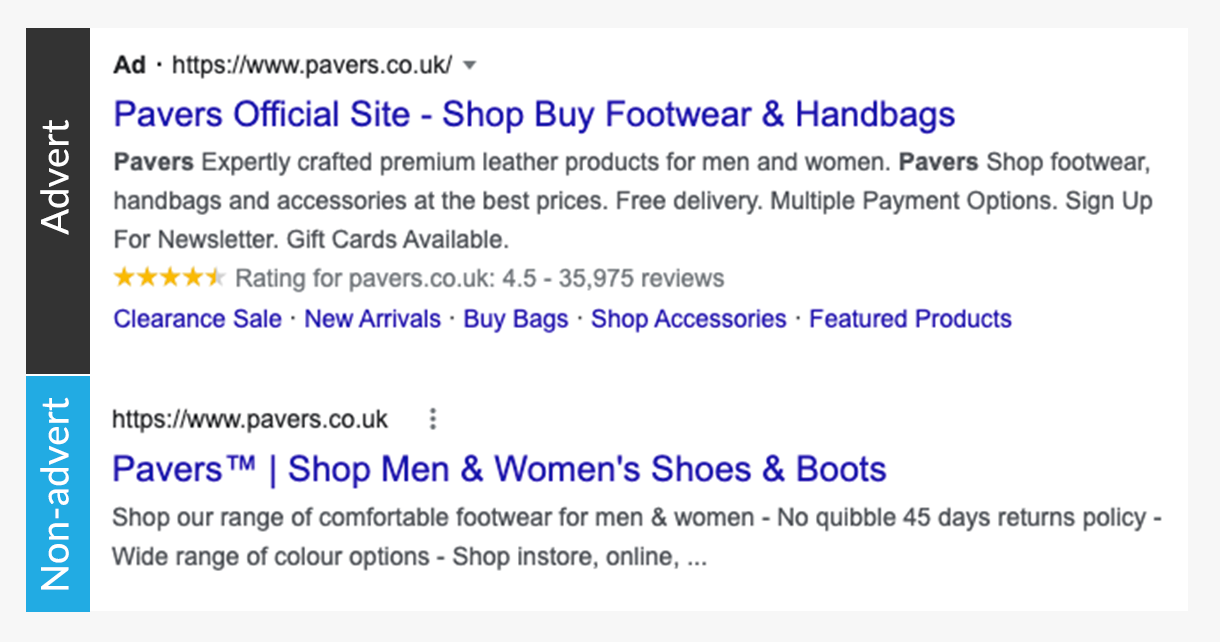
We have also seen that Ads can often take up most of the page of a search result. Combine this with the subtle design cues used to indicate the Advert status, you can see why people may not understand they are looking at just Ads rather than organic search results.
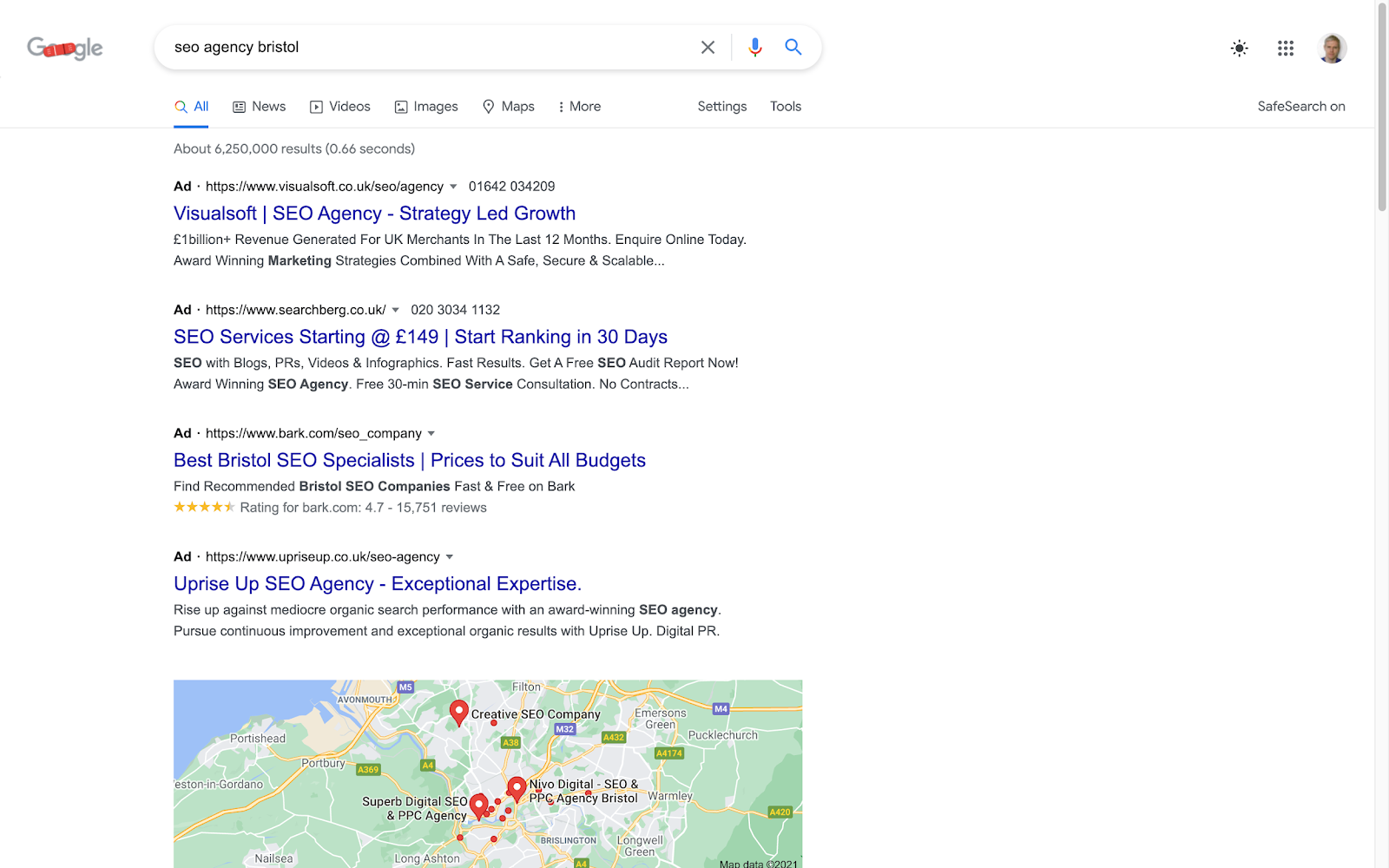
A good example is, if you search something close to our heart…. ‘SEO agency Bristol’. As you will see the paid Ads take up your whole screen when you initially search and you have to actively scroll down to get to the first organic search results. Given that 75% of people don’t scroll past page 1, those Adverts can really take up people’s attention and clicks.
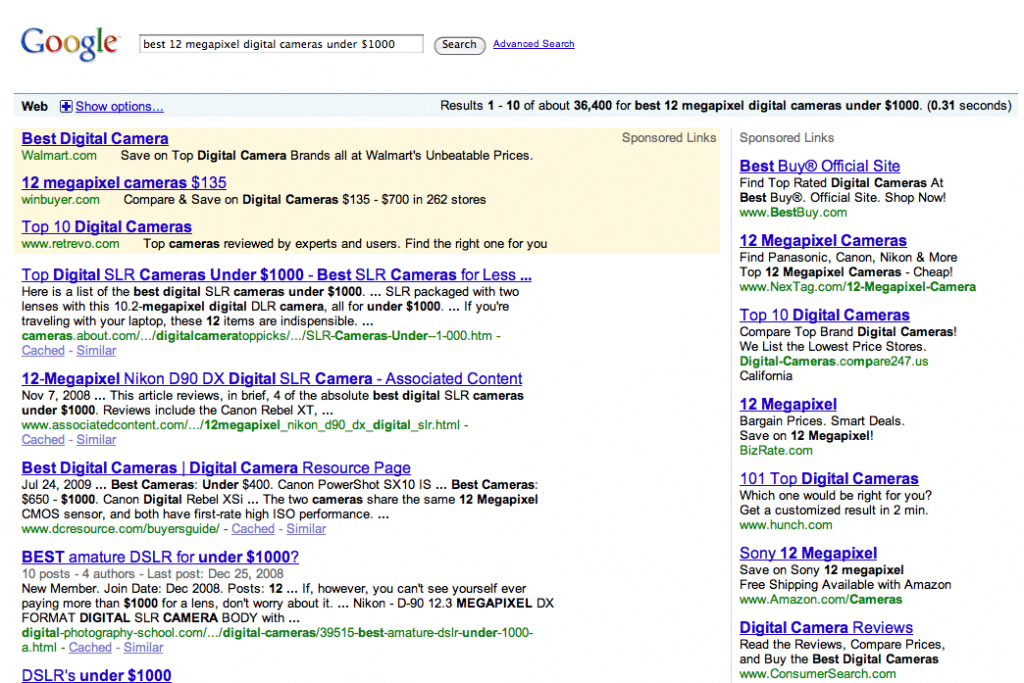
When we compare that back to 2009, these were the sorts of results you would see. It is really quite noticeable the the ‘Sponsored links’ are very clearly labelled.
In order to make sure your website is visible to the biggest search audience possible, it really is vital to make sure you have a search marketing strategy that embraces both SEO (organic search results) and PPC (paid search advertising).
We know from our ongoing research that the majority of the search market will not even recognise the Ad, and we can see from the examples of how Advert styling has evolved over time, why that has remained high. However, we know that we can’t ignore the large proportion of a target market who do know an Ad when they see one, especially as almost 80% of these searchers will then decide not to click. Therefore, it is critical to execute both SEO and PPC in the most optimal way possible, to ensure you are not missing out on potential clients.
Data suggests that approximately 53% of all website traffic comes from organic search and 27% from paid media,so it really is a sensible idea to not put all your eggs in one search basket. Neither organic nor paid search is inherently superior to each other and whilst paid ads do have a cost, you should be trying and testing both paid search and SEO, (with organic search optimisation, you’ll have to test for at least six months). By testing, reiterating and learning from both paid media and SEO, you can see what works for you and your business, short and long term, ensuring you capture all the possible clicks out there.
Given our latest research findings combined with the need to have a strategy that ensures you speak to the widest possible target search audience we have a clear recommendation. The best way to optimise reach and drive rankings and clicks, is to adopt both SEO and PPC strategies and tactics and to ensure you carefully plan and structure both for optimal results.
And Google seems to agree so we will leave the last word to them…
“Using SEO and Google Ads together may give you the best chance of bringing traffic to your site in the short term, and enhancing your business’s presence online for long-term success.”
Get in touch here to find out more about how to perfect your own hybrid model of optimised organic SEO combined with paid search media.
Flourish Lead Developer, Hussein Alhammad, is a founding member of the Email Markup Consortium (EMC). The EMC is a community-led group working to improve the user experience, accessibility, performance, consistency, and reliability of email markup. They have recently published an insightful report on the state of accessibility in HTML emails based on their analysis of over 35,000 emails.
More than 99% of the analysed emails had accessibility issues. This means most businesses are sending emails that are made difficult for a percentage of their audience to consume. Whether you are trying to increase conversion or simply communicate better with your customers, sending accessible HTML emails to your audience can make a huge difference.
Accessibility in email makes your products and services available to customers who are blind, colour blind, dyslexic or need to use assistive technologies or alternative input device – potentially a large proportion of your customer base.
Automated testing is immensely helpful, but more attention is required to truly produce accessible HTML emails. Accessibility work should be a core part of all stages – not only implemented during development, after everything has been decided already.
For example, design has a major impact on the accessibility of your email. Designers should consider colour choices and typography, as well as the dark mode friendly images.
There are also best practices to apply when writing copy for your emails, such as avoiding ‘click here’ calls to action, optimising SEO for email, and making the most of personalisation and creative subject lines.
Your unique audience could be more diverse than you think. Therefore, translation software can be considered an assistive technology. And when it comes to email, many email clients including Gmail and Outlook have a built-in translation feature. Ensuring any text that is critical to delivering your message is not embedded in an image is crucial here. Translation software is not going to translate embedded text for the user. You could make key information inaccessible by embedding it in an image.
Do you need help with improving your email accessibility, deliverability or generally your CRM practices when it comes to communicating with your audience? The Flourish team are here to help. Working alongside our in-house experts like Hussein, we can help you optimise, elevate and transform your use of email to deliver the best customer experience. Get in touch to discuss your challenges and to request a free email review.
Having a strong organisational structure in place is key to growing your digital agency.
Whether your agency is brand new or has 100 employees, the structure of the team is going to have a direct impact on your overall efficiency, culture, client satisfaction, and scalability. Without a considered organisational structure in place, many agencies suffer from poor communication and frustrated team members and clients.
So, what are your options when it comes to structuring or restructuring your agency? How do you know which structure is going to guarantee both employee and customer satisfaction and give you the permission to scale your marketing agency?
Get more brilliant advice from Janusz at the 12-month Mastermind group for agency leaders. Gain momentum, resolve and focus to achieve your goals, with the support, accountability and insight of GYDA experts and like-minded peers. Find out more.
1-Flat
A flat team structure is common in smaller agencies and start-ups. Flat structures have only a couple levels, if any at all, between management and employees. These organisations tend to require employees to ‘wear many hats’ and as such, often produce a lot of generalists but no specialists.
2-Functional
Then we have functional structures — in which teams are organised by services. For example, a digital agency with a functional structure could have a Social Team, an Email Team and a PPC Team, and so on.
A functional structure concentrates the expertise and knowledge within those services or groups. As such, this structure often falls down when the client requires more than one service from the agency, forcing disjointed communication between the executives in each team.
As the agency grows, communication and coordination between these teams is only more and more convoluted and scaling becomes very clunky and difficult.
3-Matrix
A matrix structure is similar to a functional one, with added levels of management and communication weaved into the mix, hence matrix.
This structure involves side-ways communication between team members, like account managers who coordinate other functions. Like the functional structure, the matrix is limited to a team of a certain size, as this web of communication is difficult to scale.
4-Holacracy
Holacracy organisational structure is where there are no clearly assigned roles. Employees are given the flexibility to take on any duty or role and move between teams freely. A holacracy can work well within some industries, but broadly speaking, this structure is a poor fit for all digital agencies as having expertise and specialism within your personnel is essential.
5-Pods
A pod organisational structure is where an agency arranges their teams by client type or sector, rather than the agency function or service.
This creates specialist teams, which function similarly to sports teams. For example, each ‘Pod’ would have a PPC expert, an SEO specialist, and a Social Media manager and this pod would service a particular category or type of clients, such as Automotive Clients or the Legal Sector.
Watch: A detailed look at Functional Structures Vs Pods (4min)
Utilisng a pod structure allows you to lean into your niche and achieve a deeper level of industry or sector specialism from each pod.
Pod structures also have no dependencies on other teams within the agency, thus there is no web of complex internal communication. This creates friction-free workflows within your teams and an enriched experience for your clients at the other end.
Finally, a pod structure creates accountability and responsibility among your team members. As employees are being regularly challenged by exciting projects within their specialism, they are likely to have increased job satisfaction levels.
At Digital Agency Coach, we advocate running weekly or bi-weekly workshops for all specialist executives, hosted by a technical lead. Keep the agency focused on strategy, process improvement and professional development and create a conversation the other experts from each pod.
Regularly hosting these casual, friendly and engaging workshops with employees of the same skill set promotes an easy and productive conversation with relevant learning and take-homes for each employee.
There’s no denying restructuring your digital agency can be a disruptive process in the early days and it probably won’t happen overnight. But once the hard groundwork is done, growing and scaling your agency can simply be a matter of copy and pasting a new pod.
This team structure eliminates the complex web of communication just as effectively as if you have a team of 30 or a team of 300 people.
If you are a full-service agency and your clients are purchasing multiple products or services from you, perhaps it’s time to reconsider your organisational structure.
Watch Our Quick Functional Structures vs Pods Explainer Video (4min)
If you feel you’d like any help or guidance with restructuring your agency, get in touch with Digital Agency Coach to arrange a consultation, we’d be delighted to help.
Get more brilliant advice from Janusz at the 12-month Mastermind group for agency leaders. Gain momentum, resolve and focus to achieve your goals, with the support, accountability and insight of GYDA experts and like-minded peers. Find out more.
You need to load content from reCAPTCHA to submit the form. Please note that doing so will share data with third-party providers.
More Information