Quantock have recently welcomed Werner Zeelie to our line-up. Werner will head up our ongoing client activity, as well as our business development strategies.
Werner is an enthusiastic marketeer with over seventeen years of experience across multiple marketing channels in both the corporate and consumer sectors. He has successfully helped establish and grow leading global brands for clients such CBRE, Unilever, Reckitt, Coca-Cola, Levi’s and IHG.
Originally from South Africa, Werner arrived in the United Kingdom in 2006 to further his international career in marketing, only to find himself now settling in the beautiful Somerset countryside.
Werner comments, “Attracted to Quantock’s creative flair, long-standing heritage, and ever-expanding client base, joining the team was a no-brainer”.
Outside of work, Werner loves to spend time with his children and friends and go for the odd run to keep fit.
Don’t worry. This isn’t your typical self-congratulatory post.
What this means is we can help clients to grow and scale their businesses on AWS. So you could geta cost saving, industry-leading and super secure application.
To achieve our AWS Select Tier status, we had to demonstrate a whole lot of team knowledge and prove the strength of our experience too. So, over the past 4 months, we’ve delivered High Availability architecture for clients like Osborne Clarke and the UK Hydrographic Office.
So, we’ve written this blog to tell you just why you should take note about what AWS has to offer, and answer a few of the questions you might have.
Why is AWS your chosen cloud service provider?
Because they’re the industry’s leading cloud provider.
AWS offers a huge list of services and a robust global infrastructure that we knew could serve our clients around the world. If it’s good enough for 90% of the world’s Fortune 100 companies and the majority of Fortune 500companies, it’s good enough for us.
And now our partnership status is testament to our experience and knowledge when it comes to designing and implementing cloud architecture.
As an application implementation, development and infrastructure partner, we can achieve a very close link between your applications’ functionality and its environment, ensuring you always get the very best performance.
What can you do for me?
We can save you time and money.
It’s likely you already know on-premise infrastructure can be hugely expensive. Or you might be using cloud computing, but finding it’s still costing you a fortune. With the right cloud architecture in place, not only can you gain a huge price advantage, you could also save countless hours of time, too.
Commissioning just one new server can take several days and thousands of pounds of hardware investment. But in the cloud, the same process takes just a few seconds. Plus, you can spin servers up and remove them again easily, and without having to worry about hardware.
Our use cases are normally centred around creating web architecture, where this flexibility is useful for creating cost effective solutions. A traditional web architecture might consist of several web servers behind a load balancer, where traffic is distributed across the instances according to some rules.
Figure 1: Application Load Balancer routing traffic to 3 web servers.
The problem with this traditional set up is that during lulls in user activity, e.g., overnight or over the weekend, you end up with more servers than you need – you’re just haemorrhaging money.
Conversely, during traffic spikes, you might not have enough capacity to meet demand, putting your application’s performance at risk.
Auto-scaling prevents this by automatically adding more servers to the group if demand requires it. When the demand drops, these servers are removed.
Figure 2: The difference between configurations as Autoscaling increases the number of servers to meet demand.
Why is High Availability architecture so important?
Because in the words of Werner Vogels, “Everything fails, all the time”.
All technological solutions – no matter how perfect we might like them to be – will have points of failure anddowntime. In fact, even cloud solutions within AWS are subject to the same risks.
By creating an infrastructure that anticipates this failure, we can overcome the risks and mitigate the impact before a failure ever happens.
For example, the AWS network consists of several geographical regions based around the world. These regions are further divided into Availability Zones. An Availability Zone is made up of separate physical data centres that are connected within a region.
You can then split your services across Availability Zones, so should one develop a problem, you’ll hardly notice – your application will still be up and running.
At P+S we follow the AWS principals for High Availability across all of our clients’ architecture to ensure there are no single points of failure, and recovery is automatic wherever possible.
Figure 3: Load Balancing across multiple servers in different Availability Zones.
Is AWS’ Cloud Service secure?
Yes. In fact, at AWS, they have a saying:Security is Priority Zero.
This is for good reason, given the critical nature of data security and harsh penalties for businesses who breach regulations.
There are multiple features in AWS’ tools and services ensuring every design meets stringent compliance requirements, with our own architecture including many of these features as standard.
For example, we deploy AWS CloudFront as a CDN as standard in front of all our sites, together with AWS Web Application Firewall and AWS Shield to protect your site against web vulnerabilities and attack vectors, including the OWASP Top 10 – globally recognised by developers as the top 10 risks to application security – and Distributed Denial-of-Serviceattacks (DDoS), which you may have seen recently taking a number of the Belgium government’s websites offline. It also ensures you’re compliant with Data Protection standards such as ISO 27001.
AWS also provides the ability to create entire virtual networks and subnets within the cloud, with complete control over data and user access and flow. This gives you the ability to lock down access to subnets, instances, and services to only authorised sources. For example, you can block physical access to web application servers, ensuring access can only be gained from the load balancer or approved IPs.
So I don’t need servers?
No. One of our favourite methodologies in cloud infrastructure is ‘server-less architecture’.
Server-less architecture means the servers or machine resources used to run a particular task are handled by the cloud provider. So you don’t have to worry about provisioning a server or maintaining it. This saves a lot of time and money; we can simply spin up a database or run code.
This methodology is extremely useful when working on prototypes, for example, allowing us to quicker develop and verify our ideas. It’s also useful for running Continuous Integration workloads to speed up deployments (useful for Autoscaling groups) and helping you manage repetitive tasks or queues.
For example, we successfully offloaded some database queue processing from the application into AWS Lambda. This meant we could configure a smaller database instance than would otherwise have been necessary.
Our summary
At P+S, we believe every business should be able to offer an excellent digital service to their customers.That means creating flexible digital architecture that grows as you – and your customers – need it to. It’s faster, more adaptable, and because it’s flexible, you won’t waste money on servers you don’t need.
Your application shouldn’t go offline unexpectedly. And we don’t believe you should have to pay more for a secure website, so we’ll ensure both your data and your customers’ info is protected at all times.
And our newly earned AWS Select Consulting Partner badge proves that commitment.
Want to find out more? Talk to [email protected] for a no-obligation chat.
During our Digital Marketing Futures series earlier this year, we gave a conceptual view of the marketing trends those in our industry need to keep their eyes firmly trained upon.
Following on from this, we’ve picked out seven specific trends that we’ve seen change or accelerate during the recent lockdown, and that we think you should watch out for over the next 12-24 months. So here’s our list of seven post-pandemic trends to look out for in 2021 – and beyond.
Video covers such a huge range of mediums, including live streaming, one-to-one videos, long format, short format – the list goes on.
In lockdown, we’ve seen huge gains in people using over-the-top media. The most mainstream example of this is YouTube, but it also encompasses all the paid searches such as Netflix, Amazon, Disney+ and HBO.
It’s no surprise this has increased over lockdown, however what is surprising is why people are doing it. More than half of 13-39 year-olds planned to watch TV series and films on these streaming services as a way to maintain their mental health in lockdown.
Now even TV remotes have buttons installed for Netflix and other streaming services. We can now programmatically get at users with video on these connected TVs through different over-the-top media outlets – and this is pushing forwards the decline we are seeing in linear TV.
Visual search
This again isn’t a trend that’s new to us, but it’s something that has become much more mainstream. Nowadays, 62% of gen Z and millennial consumers want visual search more than any other technology.
We are fundamentally getting much lazier in how we do day-to-day activities, and users now are choosing to search for information through pictures. Google, Pinterest and Microsoft are all leading the way with their various technology features that allow you to find similar products based on things that you upload.
These days, it’s not uncommon for you to take a photo of clothing, furniture or kitchenware at home and then use available systems to find similar products that are available to purchase. Or you can use your camera to take a picture of a barcode and then use a system to find that product online and where you can buy it from.
It’s going to grow as consumers become more familiar with these systems post-lockdown, and it will likely be used by many on a daily basis. You will need to start thinking about how this will play into your marketing strategy over the coming months. To start with you should ensure your structured data is sound and you have high-quality imagery, and make sure your site is optimized for speed.
Voice search
This is a trend that has crept up on us; it’s really everywhere now and demand for it is going to accelerate beyond lockdown. Research shows people are now more comfortable chatting away to Google Assistant, Siri, Alexa or Cortana. Predictions now are suggesting that 50% of searches are expected to be carried out through voice activation over the next few years.
Voice commerce is also expected to drastically increase as these types of sales are expected to hit the $45bn mark by 2022 in the UK and US. Another recently-released survey from YouGov showed that one in four Britons reported owning some sort of smart speaker.
When implementing voice search into your strategy, you need to consider the types of searches that are most common among users – for example, ‘near me’-type searches are huge. In this instance, you should make sure that you’re a local entity and you’ve used localized keywords in your web copy.
From a technical perspective, over 50% of these searches are going to be on mobile, so your mobile site needs to be up to date. With the Core Web Vitals update just around the corner, they become much more important.
Artificial Intelligence (AI)
AI has gone from being a buzzword to very much a reality, and marketers’ use of AI soared to 190% between 2018 and 2020. With the likes of Microsoft Azure’s cognitive services, it’s very much now something that’s within reach of every website and every developer.
The API is there and designed to make it accessible, and from a pure marketing perspective AI is baked into the platforms that we’re using. It’s used to collect data, generate insights and anticipate customer trends and moves.
Until now, we’ve taken this kind of automation for granted. Bidding strategies and responsive ads all use forms of AI and machine learning to adapt to the signals that are coming in to improve results in real-time.
One of the other interesting areas where AI will play a huge part is how it’s currently being explored as an alternative to cookies and other third-party trackers as we transition into this cookie-less world over the coming years.
The IAB is expected to release some guidelines and best practices for the use of machine learning at all the different levels of digital advertising production. In a post-pandemic world, leveraging AI becomes even more important as we see these trends shifting all the time as lockdowns come and go. It’s about them being able to react to those changes in real-time.
The need to lean into AI more means this sector will continue to grow to the point where we’re not talking about AI because it’s something we all expect.
Conversational marketing
Conversational marketing is a way of moving buyers or customers through a marketing or sales funnel by using real-time conversations. It’s about fast, real-time interactions, and a lot of businesses are now turning to chatbots.
Over 50% of customer queries may be managed today via AI chatbots. These bots are not necessarily new, but the uptake has accelerated the technology behind them and it’s helping marketers to establish and maintain relationships during the pandemic.
More and more brands are turning to chatbots and conversational marketing to do some of the heavy lifting exercises around support inquiries or sales, and a great example of this is Facebook’s Messenger bots.
However, these bots can be used for more than just support inquiries. Lidl’s wine bot called Margot informs you of the different types of grapes that are used in their wine and will give you wine pairings based on what you are planning to eat. You’re invited to have fun with these chatbots and use it all the way through the funnel, from sales activation to more of a brand-building exercise. We will soon get to the point where it’s hard to determine whether or not you’re talking to a chatbot.
Extended reality
This may be a new term to you, but it’s actually an umbrella term for three immersive technologies that you certainly know. Those terms are:
Virtual Reality – this is where you place a user in a 100% artificial environment, like Oculus Rift.
Augmented Reality – this uses overlays to display virtual objects but in a real-world environment like Pokémon Go, where you’re outside chasing Jigglypuff or Squirtle.
Mixed Reality – this is a bit of a combination of the first two that goes beyond just overlays by anchoring virtual objects into the real world that you can interact with. The best example of this is Microsoft’s HoloLens.
This is a trend that’s growing at lightning speed, as the global market size of extended reality is estimated to increase 7772% to over $3.7bn by 2025.
These may not seem applicable to the marketing world, but in reality it’s a technology that has been thrust forward in the past 12 months by the reduction in the hardware costs, the availability of them, and the increased demand from people trapped at home looking for some alternative ways of engaging.
It’s not just big, heavy headsets now. It’s using YouTube’s 360-degree videos or the augmented reality filters that come with Snapchat, Instagram and TikTok, all the way through to DIY VR equipment. These are changing the conception of this immersive experience so that it is available to all.
Marketers need to meet this demand quickly by upping their game in terms of engagement, interactive content and the personal experiences they produce. Users can now connect with a brand with the kind of intensity and emotional response that hasn’t been possible with one-way traditional media.
Neuromarketing
For those who are unfamiliar with this term, neuromarketing is a strategy that analyzes and measures people’s brain activity and reactions from their nervous systems to determine which types of content they find engaging.
Essentially, you’re checking when a user has an emotional response to something. Thanks to the advances in tech over the last few years, it’s becoming much more of a reality that these types of tests can be accessible to all.
A good example of this is eye-tracking. This is where you use technology to track eye movements to understand where someone fixates on a particular point of a website, or to count the number of blinks that are occurring, which can be an indicator of how much attention someone is paying to your ad. You can also use emotional response analysis, which is where you use technology to identify whether there has been an emotional response to an ad.
A successful neuromarketing campaign that used emotional response analysis was created by Always in 2014. The brand took the phrase ‘like a girl’, flipped it on its head and turned an insult into a movement of confidence. This brought the emotional response that you would expect, it generated revenue and popularity and even won the Brandon Emmy for their campaign.
Advances mean that this kind of marketing has gone from being a more sci-fi way of marketing to something that’s very much mainstream.
Final thoughts
If you’re looking to get ahead of your competitors in 2021 and beyond, then you should definitely consider implementing these trends into your marketing campaigns where possible.
While these trends have emerged as the ones to watch in recent months, we do have to bear in mind the circumstances in which they have appeared.
One of the key things we will have to do over the next 12 months is to identify which of these trends are actual trends and which are just passing fads born out of necessity from lockdown.
This article first appeared on MarComm News May 2021.
By Catrina Law, Armadillo.
To say it’s been a turbulent year for the travel industry (and us all) is an understatement. But with the end of lockdown insight and the travel ban looking to be lifted, the industry is beginning to reawaken and make plans for the future.
But attitudes and behaviours have changed as a result of the last 12months. So, to plan for our best comeback, as marketeers we must recognise and reflect the changed landscape.
Go Big or Stay Home
The latent demand for travel is unquestionable, with ABTA stating that 70% of UK holidaymakers plan to travel in 2021.
And it makes sense. After this year we are all looking for some escapism. A chance to leave our homes and now repetitive lives, and see something new, experience some excitement and reconnect with those we care about.
But with so much lost holiday time, UK holidaymakers are wanting to come back with a bang. This is the time for bucket list style holidays and experiences. Whether that be trekking in the Andes (once we can), a round-the-world cruise or treating ourselves to 5-star luxury closer to home.
With money saved from staying at home, holiday credit banked and credit cards looking light, those not financially affected by Covid are set to travel in style as soon as they are able. And as marketeers, we need to show them we have that extra special experience for them.
Try parking the budget holiday message for a change and dial up the wow factor you can offer. Use communications to inspire and excite. Show them how to go that extra mile, whether it be exotic long-haul or a luxury glamping site in Devon. Use the time now to build the anticipation, so when the world opens up, they are revved up and eager to travel with.
Slow Fast Slow
In the UK with the vaccination programme going well, not surprisingly it’s the over 50’s who are most likely to have booked a holiday so far – they know when they will have been vaccinated and feel most free to take time out.
But for families and under 50’s the story is different. Whilst the demand is just as strong, the unknowns are greater. Will they need a vaccine to travel? What about children’s vaccines? And what about summer school?
Whilst now this is leading to stagnation, as soon as these questions are answered holiday planning for families and under 50’s will quickly turn into bookings.
As marketeers we’ll need to be ready. Keeping travellers inspired, excited, and keeping us front of mind whilst the unknowns exist. Then bamm! – ready to drive bookings when the moment is right. And if things change, back again to slow – inspiration and front of mind.
The same is true for the destinations we promote. Just two weeks ago Greece was pipped as a “safe” bet for 2021 holidays, but with case numbers across Europe on the rise, and France entering its 3rd lockdown, even 2020 travel corridors are looking uncertain for 2021.
Planning for a 2-speed approach will allow to adjust your message quickly as external factors change. Adjust your speed and sales focus to take advantage of opportunities as they arise, then dial back and refocus on inspiration and information as new challenges emerge. Plan for it now, as one thing is certain, it will not be a straight road out of this crisis.
Trust and Familiarity Triumph
Trust has always been a key factor for travellers choosing a holiday company to book through and/or travel with. But over the years, with independent travel confidence growing, low-cost holidays emerging and online operators sprouting, travellers have been increasingly happy to choose untrodden paths for the sake of saving money or to experience something new.
That’s changed, at least for now.
Keeping me safe and getting me home are huge influencers now for travellers choosing who to book with and where to travel. As such, companies and destinations that are tried and tested will win. Whether it be a household name travel operator or the same cottage in Cornwall they’ve visited before. Don’t underestimate the power of the familiar and safe at present.
Therefore, as marketeers we need to focus primarily on our past customers, now more than ever, over winning new business or growing market share.
We have already an element of trust with these travellers but building upon this will help to ensure they choose us, over other familiar brands they have travelled with, when the timing is right.
Keep talking to customers even when you have nothing to sell – it shows you care.
Remind customers of your relationship and your time together – whether that be simply sharing your famous scone recipe they enjoyed onboard.
Remind customers of why others trust you – showcase your years in service, the scale of your operation, awards you have won or simply highlight testimonials of other happy customers.
Use data to personalise their experience – show you know and understand your customers.
Don’t just sell a holiday, but also sell you. Ensure your past customers are left feeling you are still right for them, and you are right for right now.
This article first appeared on MarComm News May 2021.
A customer journey map visually brings your customers’ journeys to life, making it much easier to see how their experiences flow across your brands’ touchpoints. It’s a strategic approach to optimising your customer experiences – far more effective than trying to understand and improve individual touchpoints at a tactical level.
Your customers don’t see your touchpoints as separate entities – for them, their experience with you should be seamless. The only way you’ll truly understand your business from the perspective of your customers is to take a step back and review their journey from end to end. Armadillo Innovation Director, Rob Pellow, spoke with Feefo about customer journey mapping and why it’s key:
“The key is to understand what to do when you have the information, especially around personalisation. The journey needs to be holistically joined up. It’s good to know that your customer is moving from email X to website Y and then seeing social post Z, but the real key is making those journeys as consistent as possible.
In our CRM-focussed world, this is always the most important thing to us – someone who has identified themselves by hard data gathering or observed behaviour will always have that reflected back to them. This regularly presents tech challenges as very few brands have the oft-sought after single customer view powering every bit of their tech stack. So, while you are creating these user journey maps, you should also have an eye on optimising your data flows so that at worst, customers aren’t seeing conflicting messages and, at best, you use every touchpoint to leverage relevance and engagement.
Quite often, that means we build connectors – ways for us to gather the data and then distribute that to wherever it’s needed in order to deliver the best possible ROI on all campaigns, short and long term.”
When and why is a customer journey map used?
Customer journey maps can be used to meet many objectives. It’s a good idea to have a clear set of goals for your mapping project before you begin, to make sure that you maintain focus and mine the most relevant data. Some of the most popular examples of when and why a customer journey map might be used include:
To help your business better understand your customers.
To identify gaps in the customer experience
To improve your products and processes
To deliver relevant, meaningful and impactful communications
To prevent churn
To close the deal
How to create a customer journey map
Now you know what a customer journey map is, why it’s important and how it can help your business, it’s time to create your own.
List the touchpoints.
Identify your customer personas.
Gather research.
Identify which elements to include in your customer journeymap.
To see the full article and hear from other experts go to Feefo.
Recently, Armadillo Chairman, Chris Thurling, spoke to South West Business Insider on the topic of choosing your marketing agency. When dealing with creative abstracts such as brand, message, creative strategy, digital engagement and design, it can be difficult to know what exactly it is you should be looking for. Chris provides his advice on what to consider when seeking out a marketing agency that’s suitable for your business.
Should you look for sector specialisms?
Even though there can be good reasons to select a sector specialist agency, there are strong arguments the other way. One of the main benefits of using an agency with broad sector experience is its ability to bring fresh perspectives compared to in-house teams or agency specialists. Generalists have learnings from brands in different sectors that they bring to a brief, and ultimately the skills are transferable. Partnering with an agency that works across various sectors also decreases the chances of merely rehashing your competitors’ work and increases the likelihood of innovation.
The importance of ROI
An agency’s ability to indicate potential ROI ahead of the project depends mainly on how much information you are willing to divulge. The more transparent you are, the more accurately an agency can indicate the potential outcome. However, without detailed insight upfront, this can be difficult.
Think long-term
Crises such as the one we are living through often see brands choose to abandon strategy and go into panic mode. For example, brand building activities get dialled down in favour of budget savings or short-term customer acquisition approaches. Smart and confident companies tend to hold their nerve and continue investing in their brands with the long-term in mind.
These comments originally featured in the South West Business Insider, April 2021. Follow the link to read the full article, including comments from a variety of other business leaders and industry professionals.
Google Ads is a largely daunting and confusing platform. There’s no way to just ‘hop in and try it out’ with Google Ads, forcing new people on the platform to use their Ads Wizard, a tool better used as a cure for insomnia.
For those of you who want to bypass the training and get stuck into it, here are the essential need-to-knows for planning and running a successful Ads campaign first time. So with that, we’ve assembled a list of 10 essential features you didn’t know you could use with Google Ads.
1) Keyword Planner
Whether you’ve heard about the Keyword Planner before or not, it’s important to know how to use it effectively. We’ve already covered some of the ways you can use the Keyword Planner when it comes to writing website copy and a content strategy for SEO, but its actual purpose is for Ads. The Keyword Planner shows you search volumes and bids for the keywords and phrases you’re thinking of adding to your campaign – but it also shows you a large list of other, similar keywords and phrases that you can add to your list. It’s worth investing time into looking through the Keyword Planner – if you think you know every search term used to find your business, think again! Some keywords and phrases might not have the search volume you thought they did, or you might find that bidding on certain keywords will blow your budget.
2) Negative Keywords
These are equally as important as your keywords as you don’t want your Ads showing in searches that aren’t relevant to your business. The Keyword Planner tool can bring to your attention keywords that might be similar but aren’t what your business offers. For example, your business might be offering space for a ‘workshop’ – is this the kind of studio workshop where someone could create their art, or is it a meeting room for training? Using the Keyword Planner, Search Console, ‘Searches’ data in your Ads dashboard (if you are running or have run a campaign), and your own knowledge, you can compile a pretty good list of keyword search terms you definitely don’t want your Ads to appear on. Again, these have the same rules as keywords in that you can apply broad match, phrase match, and exact match modifiers to refine your keyword. Don’t know what that means? Check out our blog on keywords here.
3) Radius Targeting
Yes, you can target by location, but did you know you can also target by radius? This little trick is perfect for businesses who know that they have a local audience, such as a restaurant or hairdressers, or a flower shop with a local delivery option, and will therefore want to target those in the area. It’s a rather unique feature in the sense that not a lot of advertising platforms have this option. You can also set bid adjustments to increase depending on how close the person making the search is to your location – getting comfortable with bid adjustments, and knowing whose view or click is worth paying more for, is an important key to success.
4) Sitelink Extensions
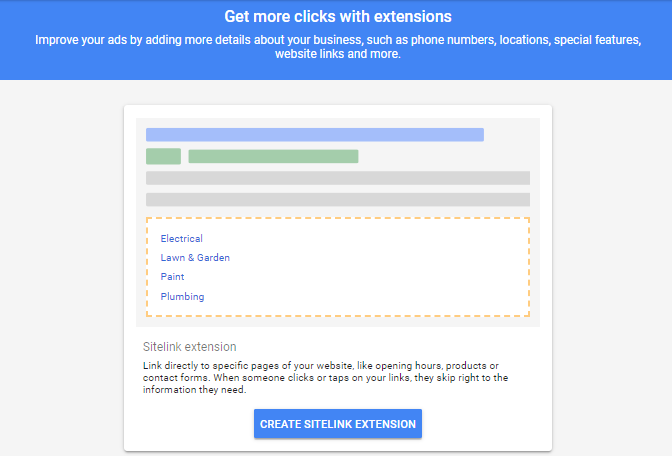
Everyone wants their Ad to stand out which is why Sitelink Extensions are essential. With those you can add a phone number, locations, special features and direct links to pages of your website. All of these are totally trackable, so you’ll be able to see how many people clicked on your telephone number to give you a call based on your ad as well as having data that shows where on your ad people clicked through to.
Did they click on the main link to your specified landing page, or did they click through one of the sitelink extensions because it was more helpful? Sitelink Extensions are really easy to set up so we suggest they become a staple of your Ads.
5) The Display Network
You may have heard of the Display Network, but what is it exactly? The Google Ads Network is split into two: The Search Network: where your Ads are displayed in Google and Google partner search results, such as AOL and Yahoo (if you opt-in) The Display Network: where your Ads appear on websites across the internet There’s a couple of major differences. The Display Network requires you to create image ads as well as text ad so they can be shown across their network – image Ads have an average of 0.1% higher click through rate than text Ads alone, so it makes total sense to ensure you have Display Ads created for each variable so you can maximise the reach. Ads are also charged based on Cost per Click not by impressions. According to Google, Display Ads are said to reach 90% of internet users, as the vast majority of websites seem to host Ads, but with this reach comes complex management – such as placements and audiences – if you really want to maximise your reach.
6) Managing Placements
With Display Ads you do get some say as to where those Ads will be placed, but you need to manage it. If you have specific websites in mind then great! If not, we suggest you use the Audience targeting options to get an idea of where your audience is and where your Ads might go. You can start by adding your competitors to the exclusions list and keep a close eye on where Google is placing your ads. Always check out your placements’ website and be in control of where your ad goes.
7) Audience Interests
Under the Audience’s tab you’ll notice that you can add audiences – this is only applicable if you’re running Ads on the Search and Display Network. Audiences can be targeted based on their interests and will ensure that your Ads appear on websites that are hosting content that matches the interests specified in the Audiences tab. They work alongside keywords, so it’s not a case of one or the other. We recommend you have a look through all the different interests available. Some might be an obvious choice for your campaign and some may spark inspiration. If in doubt, run the campaign with the Observations setting so you’ll gain more insights into the interests your audience may have, and set bids for these accordingly.
8) Bid Adjustments
Bid Adjustments are one of the most important features you need to be comfortable with. It might seem like an ‘advanced strategy’ but it’s really not. Bid Adjustments ensure your bid is increased on platforms, placements, locations and keywords that you want your ad to place highly on, and decreased where you aren’t so fussed about having your ad place at the top. You can run an automatic bid strategy, where you can set an upper cap on the maximum bid, and use bid adjustments, ie +10% or -10%. But in order to manually bid on keywords you must have a manual bidding strategy set up overall. We don’t suggest this for beginners or for those testing a campaign as it’s hard to know what you’d expect to pay for clicks/impressions on those keywords without having any real-time data based on your actual budget.
9) Ad Schedule (Time of Day)
Setting the times of day you want your Ads to run is necessary to ensure you’re maximising your budget and Return on Investment. If you’re a B2B company, you can safely assume that employees of other businesses will likely be working between 9am-5pm when making a search relevant to your business – but remember, if your audience is global, you’ll need to take into account time zones. However, we’ve found that office workers, particularly within tech, will be searching between 8am-8pm, Monday to Friday. For B2Cs it’s harder to predict the time of day when search volumes will be highest; we’ve found that people aren’t typically searching between 2am and 6am but, as always, when in doubt… test!
10) Quality Scores
It’s really easy to overlook Quality Scores when it comes to writing Ads. You might think that your amazing Ad copy is sure to get your bid low and your placements high because that’s the ultimate goal, but, in some respects, you have to forget what you know and instead write your Ads based on the keywords in your campaign. It’s really the keywords that dictate your entire campaign and what you pay, so your keywords need to be present in your Ads – headlines and descriptions – and on your landing page (the page you want people to click through to). Otherwise you’ll get a low Quality Score meaning higher bid cost, lower overall placement, and Ads not being placed frequently. You can check the quality score of each Ad in the Ads and Extensions tab. If it’s anything less than a 7 you need to take a look at your keywords, ad copy, and landing page to ensure that they’re cohesive.
Conclusion
We hope that this beginner’s guide to Google Ads has taught you some things that you didn’t know before. You can head over to your Ads account and try some of these features out for yourself, or we’re more than happy to take the stress out of Ads for you. The OggaDoon team have done the hours and certifications, and have worked on a number of successful Ads campaigns for clients across a range of businesses. If you’d like to discuss Ads for your business, we’re more than happy to set up or manage a campaign for you – just get in touch.
Advertising in 2030 will be fundamentally different to how it has been for the past 10 years.
Of course, we accept that for the most part, the same tried and tested methods will continue to work for a while yet – entrenched approaches don’t change overnight.
But individuals and organizations that fail to adapt over time will gradually fade out of relevance. They will slowly become less equipped to support and grow their employees, to help them in their careers and, therefore, the business they are part of.
As customers increasingly embrace digital platforms, the challenge is on.
The challenge is on for business owners to embrace the changes in advertising over the coming years. Doing so enables us to remain relevant and able to foster enduring relationships with customers in cost-efficient ways.
“All failure is failure to adapt, all success is successful adaptation” – Max McKeown
The Trends and Topics Shaping the Future of Advertising
The one thing I will say before I get into these trends is that they are exactly that…
It is critical we monitor how advertising evolves, but a lot of these topics are fueled by folklore.
These topics change as the facts become clearer. We are in danger, as an industry, of creating that folklore through loud herd debate, which then becomes misunderstood fact.
It is our job as an agency to monitor these topics, contribute positively to the conversation, establish our own stance through investments and ensure we can support our clients as the future becomes clearer.
But be in no doubt – these trends and topics are driving the future of advertising and we need to embrace the conversation.
Marketing Clouds
Marketing clouds will become indispensable elements in the advertising processes of the future. They control the creation and management of marketing relationships with your customers and manage campaigns.
This is already best practice, but it will become standard to integrate solutions for customer journey management, email, mobile, social, web personalization, advertising, content handling and analytics.
Artificial Intelligence
AI is ubiquitous in the advertising space. It supports our decision-making and analyzes consumer behaviour.
Enriched with data about how consumers interact with advertising, it substantially optimizes campaigns to perform better. Implemented consistently and to its full extent, AI understands consumers better than they do themselves.
This is very clearly tied to the performance improvements that we have seen in recent years by increasing our adoption of AI within campaigns.
The large tech vendors will continue to embrace artificial intelligence because of the opportunity to scale and, in the future, perform better than humans.
As an agency, we will spend less time in the future on the implementation of administration (eg search query reports) and more time on strategic conversations with our clients to support their business growth.
Programmatic
Programmatic will be standard for digital advertising. It is also the future of more traditional advertising methods.
Think first-party data collected through radio stations (like Sonos radio) and how that could be used over time for programmatic purchasing of audio.
It’s already used for TV and outdoor. Expect to see this more.
Context
Digital advertising is predominantly contextual. This will grow – cohort advertising, for example, is still contextual.
Ads will be selected and placed by automated systems, based on ever more detailed user-profiles and the content displayed. There will be a continued increase in mobile and location-based advertising, which will strengthen this trend.
Consolidation of Adtech
The fragmented supplier landscape within adtech will consolidate. Large adtech players will acquire almost all their smaller but highly specialized competitors that manage to evolve.
Alternatively – and more likely in my view – is that these smaller vendors will be rendered redundant through policy and legislation evolution.
The desire for improved services, additional scale and more first-party data will be the main driver behind any M&A activity.
Working With the Right People
The agency model is changing and the type of people we need in our agency will change over time too. Client-side, supplier-side, agency-side – everyone will be competing for the same kind of job profiles.
It will create a battle for the best talent and create a requirement to deliver the best training.
Employers will compete for experts with scarce, specialized skill sets.
As is the case now, agencies and vendors will be breeding grounds for some of the best talent and we have a responsibility to embrace that change and train people in their careers to create the best outcome for clients, but also the best opportunities for our colleagues in the future.
Demand for data scientists, analytics experts and creative minds is huge at present and will remain high or become more competitive in the future.
Large digital platform companies generate similar reach through video-on-demand, social or messaging functionalities.
This reach combined with first-party data and artificial intelligence will create incredibly efficient opportunities to reach audiences at scale through digital platforms.
It goes without saying, 2020 was just a small departure from the norm for most of us. But there were a few silver linings peppered throughout the year.
Here at Proctors, for example, our video department experienced the highest growth we’ve ever seen. We’ve been moving into new markets, offering entirely new products and generally adding more polish.
So better late than never – yes, we know it’s a quarter of the way into 2021 – here’s a look at some of 2020’s more notable projects.
TOUGHBOOK vs. Sam Warburton – Panasonic
Tackling COVID head-on
Cast your mind’s eye back to the heady days of January 2020. After months of planning and strategic plotting, we’d just begun to organise a full contact rugby-inspired shoot for Panasonic TOUGHBOOK. What could possibly go wrong?…
We’ll let you fill in that particular blank.
Not to be defeated, we turned to industry union BECTU’s superb COVID webinars and guides to get ourselves up to speed on how to plan and run a COVID-safe shoot.
Shooting under COVID restrictions comes with its challenge, but that doesn’t have to mean bloating up a lean budget. So, we set a small, tight-knit group to work. Clear communication is key, and after a quick socially-distanced scrum we formed a new plan: turn the shoot into a training day, and put ex-British and Irish Lions Captain and all-round rugby legend, Sam Warbuton, through his paces, alongside our leading Panasonic TOUGHBOOK tablet.
One risk assessment, a few tracing forms and a quick change into PPE later, we were ready to go. Shot across two days, we produced a huge amount of video content –enough for a full, multi-channel campaign showing how TOUGHBOOK and Sam ‘Lead from the Front’.
The results:
Fourth-bestperforming Panasonic landing page ever
Outperformedmain TOUGHBOOK website
Energy for Change – Daikin
We made the small screen
After getting to grips with COVID shooting, we met our next challenge: to produce a TV ad which would promote Daikin’s range of eco-friendly heat pumps.
This time, we had a number of parameters upfront: A list of features we needed to advertise, a total run length to the frame, the need to push content through Adstream and Clearcast to ensure it was TV-ready, a Mosaic profile of consumers to target, plus the need to make the ad look like it was shot in the winter months, whilst filming it on one of the hottest days of the year.
Oh, and did we mention we had just four weeks to turn it all around?
A solid team effort pieced the ad together in record speed: it was written, prepped, casted, shot, edited, titled and graded, ready for delivery in just under four weeks. The result is testament to our team’s perseverance and the great relationships which allow them to accomplish huge amounts, together.
The results:
Second most-viewed Daikin YouTube video ever
630,000 page views from 216,000 visitors
All-new Training Management – Bud Systems
Not just a pretty (inter)face
How do you make a film about software that’s akin to a Mary Poppins’ magic bag of employee training – without losing your viewers’ attention by explaining every last detail?
Bud’s training management platform is built to solve the pain points that training providers are up against. But with online attention spans sitting between the 2 to 3-minute mark, our challenge was to wrap up the platform’s benefits into a succinct, engaging video and encourage people to book a demo for more info.
Luckily, we had the Bud team’s great branding to work with as a jumping-off point. Their bold, clean appearance meant we could use some technicolour flair to design an equally bright and brilliant visual style. We extended Bud’s multi-coloured logo form into a visual suite of colourful geometric shapes and key lines which would simply and elegantly represent the simplicity of the platform. We then brought these shapes to life with various motion techniques and sound editing, interspersed with shots of the platform in action.
The resulting video echoes the vibrancy, enthusiasm and enjoyment Bud’s users rediscover in their work with the help of this all-in-one platform. It’s not just any old, animated infographic. It’s a masterclass in engaging video.
The results:
Bud have only just launched their film, so right now we can only wax lyrical about how chuffed they were with our work. But watch this space for soon-to-come results…
Multiple Clients – Panasonic, UKHO, Sanlam
Video Toolkits
2020 was the year of video calls and streaming. The working day became a flurry of Zoom calls, Teams meetings, Skype sessions, webinars and virtual conferences – not to mention the evenings spent helping your nan figure out FaceTime.
But there was something missing: a way to professionally and consistently brand your self-generated videos, ready for recording, live-streaming and sharing. So we put together a video toolkit for our clients.
These toolkits pull some of the most commonly required and useful assets into one package; from lower thirds, to intro and outro sequences, title screens and transitions, along with a few extra, bespoke assets depending on what our clients need. We provide them in an editable format, so they work with pretty much any software you use, meaning you’re always on-brand.
They’ve proven truly cost-effective – both to produce, and for our clients to deploy. Meaning less room for errors (like accidentally becoming the world’s first Lawyer Cat).
Results
A comprehensive Video Toolkit for Panasonic, Sanlam and P+S
Fully-branded virtual conferences for Panasonic and UKHO
One City, Zero Homelessness – Caring in Bristol
Giving a little, achieving a lot
2020 was a struggle for any business. But some services were hit harder than others.
Rather than produce our typical Christmas video of jolly japes, we donated our time and resources to local charity, Caring in Bristol. Their amazing work includes providing hot meals, shelter, medical care and support to people experiencing homelessness within Bristol. But donations often suffer during times of national hardship, so we needed to rally the local troops and call them to donate to this well-deserving cause.
So we created a film. But don’t expect your typical ‘pulling on the heartstrings’ donation message. We wanted to celebrate Bristol culture: the edgy, vivacious spirit of our city, calling our Bristolian family to action, and secured their much-needed donations in the run up to Christmas. But with COVID restrictions meaning we weren’t able to film the city and its people in action, we had to get creative.
We went full force with a script and art direction that entertained, with plenty of nods to local celebrities, inventions and fabulous quirks, while delivering the cold hard stats about people experiencing homelessness. Using graphics and animation to make the message as uplifting and entertaining as possible, we were able to create a powerful film which called for an end to homelessness in our city – for good.
From the tech behemoths and the multi-international market leaders, right down to local, grassroots charities changing the world one view at a time. Whatever story you have to tell, we’ll help you share it with the world. Talk to Proctors, today.
Bristol-based reforestation and climate action platform Ecologi has teamed up with purpose-driven agency Enviral to launch a powerful campaign for Earth Day 2021.
Featuring the award-winning spoken word artist, George The Poet, the campaign aims to raise awareness around collective action and highlight the role of natural solutions in solving our climate crisis. The powerful video script, which was crafted by George The Poet, reflects the themes of hope and momentum and celebrates the role of nature in safeguarding our home. Watch the full video here.
Having taken Ecologi nine months to plant its first one million trees, it took less than ten days to plant its last million, and the platform plans to plant over 3 million trees this Earth Week.
Launching on Earth Week, Ecologi and Enviral are looking to bring a hopeful and optimistic narrative to climate action, showcasing the power we have if we all work together.
Elliot Coad, Co-founder of Ecologi comments: “It’s been amazing to team up with such an incredible artist in order to shine a spotlight on global climate action. Over the last three months, we’ve grown by over 25% with nearly 18,500 subscribers and over 5,100 businesses now on the platform, our impact is increasing and our voice is getting louder. We wanted to use this campaign to amplify our messages around climate action and raise awareness of the benefits of these natural solutions on both our planet and local communities around the world. This Earth Day, we’re planting hope.”
Joss Ford, Founder of Enviral comments: “As a communications agency we spend our days communicating the ways in which we can tackle the climate crisis and empowering brands and consumers to act. This campaign and the message its conveying is the reason we exist. We loved working alongside Ecologi and George The Poet to help bring together a powerful piece which reflects the feelings of hope and optimism and shows the power of collective action.”
It’s hoped the impact of this campaign lives on long after Earth Day and works to inspire people to join the movement.
Throughout Earth Week, Ecologi will plant 100 free trees for every new sign-up. If 1,000 people were to sign-up, over their lifetimes, every 100 trees planted would absorb the CO2 equivalent of: