Bristol-based Gather Round is a growing family of unique, soulful, creative workspaces, purposefully designed for creatives by creatives. Its mission is to build remarkable co-working spaces where creative thinkers and doers can connect, collaborate and thrive.
Founded by Fiasco Design owners, Ben Steers and Jason Smith, Gather Round’s flagship workspace, in the Cigar Factory, Southville, opened its doors to Bristol’s curious creative community in 2019 and it will be opening the doors to a second venue, in Brunswick Square, St. Pauls, in early September 2021.
Its members are creative industry professionals; designers, writers, filmmakers, publishers, photographers, brand strategists… A truly eclectic and talented bunch, and the diverse mix of businesses within its member community is valued as highly by members, as the beautifully designed workspaces themselves.
New Gather Round, Brunswick Square
Gather Round, Brunswick Square, breathes new life into 15-16 York Street, a unique, historic building in one of Bristol’s most vibrant neighbourhoods. From early September 2021, a supportive community of 80-90 creative professionals will take residence here; freelancers, self-employed and micro-businesses, from the surrounding areas of St Pauls, Montpelier, Easton, St. George, Kingsdown, etc.
The space will provide flexible areas with fixed and casual desks, a mix of small to medium-sized studios, private meeting rooms, hang-out areas, communal kitchen tables and quiet areas for thinking. It will also have a dedicated public event space with room for 50-60 person events.
Gather Round offers private studio, resident and co-working membership options, with part-time flexible co-working costing £110 per month plus VAT, and full-time memberships from £195, plus VAT.
First month’s membership FREE
Knowing that signing up to a co-working space can feel like a big step, Gather Round are offering new members who join Brunswick Square before Monday 16th August, their first month free.
Community Support Commitment
Gather Round creates nurturing environments in which local creative businesses flourish and it is also committed to supporting its neighbouring communities in the following ways:
Founders Ben Steers and Jason Smith say, “By design, Gather Round provides an intimate, supportive creative environment. We know that a nurturing community makes all the difference to our members’ businesses and we’re delighted to be extending what we offer in Southville to residents of North Bristol. Our aim is to open the doors at Brunswick Square in September, with a ready-made creative community.”
Find out more about Gather Round’s latest creative co-working space and membership options, or contact Amie Thompson, Community Manager for Gather Round – [email protected]
*Image: Gather Round members attend a ‘Campfire Talk’ at Gather Round, Cigar Factory, Southville
Since my earliest years, I’ve been a fan of athletics. Long-distance running in particular. I’ve watched it on TV. Chatted about it with friends. Followed its greatest exponents with fascination and even become something of an (armchair) expert on the subject.
But until a year or two ago, I’d never taken the plunge and given it a go myself. It felt like something reserved for others. Something that you needed to prepare for meticulously, before ever getting out there and hitting the pavements for yourself. It just seemed altogether too difficult to try.
Then something changed. I was persuaded by a friend to join them on the journey from ‘couch to 5K’. And, at the risk of being that annoying running evangelist, I’ve never looked back.
For many in the marketing world, account-based marketing holds the same appeal – and presents equally erroneous perceived obstacles. It looks great. It seems to work brilliantly for others. But it can also appear prohibitively complicated and quite possibly hideously expensive.
Happily, if you get account-based marketing right, those negative perceptions are some way wide of the mark. And in this article, I’ll explain why it’s an approach you can’t afford to ignore.
There are websites, books, research papers, even degree courses devoted to an explanation of account-based marketing. But for our purposes today, I’m going to keep things straightforward. At Proctor + Stevenson, we view ABM as marketing that identifies high-value companies within defined sectors, and focuses on generating quality sales leads through targeted strategy and pinpoint messaging.
It’s an approach we’ve employed to great effect over the past few years, helping clients including Panasonic outperform campaign goals by as much as 100%. And we’re not alone: Forrester research reports that 62% of marketers have reported a positive impact on their marketing performance since adopting ABM.
It comes with strong credentials then. But if that isn’t enough to help you persuade your colleagues that account-based marketing is the way forward, here are those five key reasons that should really turn the argument in your favour…
The pandemic has taught us that certain sales and marketing approaches are affected by external conditions and factors beyond our control. Exhibitions and events being an obvious one. Account-based marketing remains impervious to those irresistible forces, replacing sales meetings and product demonstrations with digital outreach and online communication. It also has the flexibility to incorporate more ‘traditional’ tactics (personalised direct mail, for example) when the time and targeting is right, making it the marketing strategy for all seasons.
The beauty of ABM lies in its focus. Unlike other broad-brush strategies that make marketing a numbers game, account-based marketing is lean and keen, ensuring that your financial resources are allocated only where they’re going to have maximum, direct impact. Even in those longer B2B buying cycles, there’s no wastage. Communications and marketing collateral are sent to those prospects you’ve identified as interested, via the channels they use, carrying messages you know will resonate with them.
Most ABM strategies are built with digital communication at their core. So you can account for every penny or euro you spend, and attribute every click, reply, meeting booking, expression of interest or sales opportunity you elicit directly back to the activity you’ve instigated. And there’s little that will make your board-level colleagues happier than that.
Ah, the old sales vs marketing conundrum. Should be best of friends, very rarely are. In this respect, you can think of account-based marketing as the United Nations. Employed properly, an ABM strategy achieves that holy grail – a harmonious collaboration in which marketing and sales work in tandem, generating interest, qualifying leads and nurturing prospects until they’re ready to hit ‘buy’ (and beyond, if your ABM strategy is far-sighted enough).
As I mentioned a little earlier, our clients have enjoyed great success with account-based marketing over the past year or two. Working with them, we’ve doubled projected lead targets, improved ROI, achieved better conversion rates, even generated six-figure sales pipeline. And all within the parameters of tight marketing budgets.
The final advantage of ABM that I’ll mention here is that it isn’t an all-or-nothing strategy. It looks different for every business. And we can help you take those first steps towards making it work for yours. So if you’d like to know more, don’t sit on the side lines any longer. Lace up your shoes, get in touch and let’s see where account-based marketing can take you.
More and more businesses are taking sustainability seriously.
The Purposeful Company recently announced that 14 of the UK’s top companies have pledged to put employees, communities, and broader society higher on their boardroom agenda.
In the UK, on average, one company per day is gaining B Corp certified status. Even the FT has recently said that “rewards await those who put sustainability ahead of short-term gains”.
There has also recently been a wave of books devoted to the concept of ‘conscious capitalism’, from John Elkington’s Green Swans to Mark Carney’s Value(s) via Bill Gates’s How to Avoid a Climate Disaster.
The consensus is that we still need to make significant changes to the way we make, sell and buy our stuff; but change is happening, and businesses are realising that sustainability and profitability are not contradictions (in fact, they are often catalysts).
What can we, as advertisers and marketers, do to help? Well, according to the World Federation of Advertisers, quite a lot…
They’ve recently launched ’Planet Pledge’ in an attempt to create a framework to galvanize our industry to make a difference.
We need to stop thinking of ourselves as merely ’consumer drivers’ and look at the bigger picture – and who else is better placed to help shape consumer behavior and preferences than marketing and advertising specialists?
As someone who works in conversion optimisation, I’ve been considering how to add this way of thinking to our armory. We’re used to considering various heuristic frameworks, cognitive biases and persuasive mechanisms when seeking to refine customer journeys; let’s overlay the importance of sustainability factors too.
In order to do this, I found an incredibly useful resource from the Sustainability Accounting Standards Board: their ’Materiality Map’. It’s a detailed summary of the sustainability issues most likely to affect the performance of companies in different markets and industries.
These issues can act as a proxy for consumer preference and help us move away from just thinking about ’sustainability’ as a whole, and dig deeper into what really matters.
From the SASB Materiality Map we can see that under the building products and furnishings section, one of the key factors is product design and lifecycle management. As they state themselves, this relates to the way a company manages the product lifecycle, including end-of-life.
Our conversion optimisation experience also tells us that consumers respond well to reciprocity (will feel a need to give back to others if they’ve gained themselves) and also commitment (when someone publicly commits to doing something that aligns with our values).
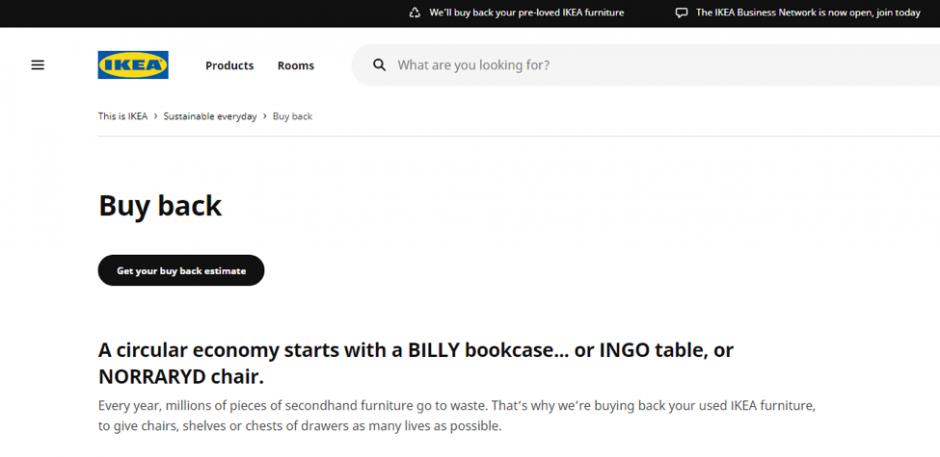
With this in mind, you can see why Ikea’s ‘buy-back’ service could be a great success for them… as well as generate some fantastic PR.
Nationwide has always created compelling messaging built on their heritage as a building society, hence their investment in community.
When it comes to typically persuasive messages that would align with this, we’d probably lead with social proof (evidence that other people have been here before) or liking (we like to buy from people and organizations that seem ‘similar’ to us).
But if we consider the sustainability factors, it reminds us that financial institutions are judged very closely on factors such as privacy and data security – remember, sustainability isn’t just about treating the environment well, it’s about treating people and society well too.
If you take a look at the Nationwide website, and many of their advertising campaigns, you can clearly see plenty of references to the crossover between data security, privacy and community. It’s not at all surprising why this is impactful.

Sustainability has always been a core part of the mission for Bamboo Clothing (you can read their story here), so messaging around sustainability obviously features significantly along the customer journey.
However (and I’m trying to be objective because they are a client of ours), they display these messages in some fantastic ways.
From a conversion optimisation perspective, the journey contains prominent, product-level, third-party reviews that provide reassurance.
The website has loads of great content around sustainability, which cements their value proposition as a leader in this area; plus, they do a great job of reducing anxiety by providing clear messages around their flexible delivery and returns policies.
But it’s one specific sustainability element that I want to highlight.
If we go back to the SASB Materiality Map, we can see that in the apparel, accessories and footwear sector, two of the key factors are supply chain management, and materials sourcing and efficiency; consumers want to know their product has been produced in a truly sustainable way.
What better way to do this than show the impact of every item’s production on the environment? Bamboo Clothing has worked with Green Story, a Canadian business specializing in supply chain evaluation in the fashion industry.
The objective credibility of this is great, but it’s the execution that’s brilliant. For each product, they then display the positive impact the consumer will have if they purchase this product from the supplier in question compared to a regular fashion retailer.
Sustainably-conscious customers can toggle between a view that shows the ‘equivalent’ impact (for example, water saved is shown in ‘days of drinking water’) or the ‘actual’ (water saved shown in liters)

Each of these businesses has taken an approach to sustainability that is more meaningful and widespread rather than using it simply as a tool to nudge someone along the customer journey; for an increasingly sustainability-conscious consumer, that authenticity is key.
However, it’s the way they are then leveraging that approach, inserting compelling signposts to improve their website performance, that is impressive.
I expect to see more and more of this over the coming year; as such, maybe those of us working in conversion optimisation just might be able to do our bit extra to help save the planet.
At Proctors, our people make us who we are. Bold. Brave. Imaginative. Resilient. But resilience doesn’t mean things are always easy.
It’s truly taken a village to see us through the last 12 months. And this article explains more about how our team spirit and collaborative culture have helped us to balance the books throughout these difficult times – and flourish, rather than just float.
When COVID first hit in the beginning of 2020, the consensus was this epidemic would be around for three months in the UK, and we should start to see signs of economic recovery beginning in July 2020. (No comment!)
At the time, we’d just finalised our financial forecasts for the year ending March 2021, but it was clear we needed to review these figures.
After revisiting our forecasts, we worked on a realistic model which would see a dip of around 30% in the company’s income for the first quarter of 2020, before gradually returning to 100% by the summer. We then expected we’d see an uptick in work – to around 130% by the end of the year – as clients rushed to spend already -approved budgets.
Despite knowing now that the information on the pandemic’s duration proved to be inaccurate, this approach placed us in excellent stead.
Our biggest challenge was managing cashflow. With fee income dropping, we still had to cover our business costs. It became crucial to cut costs wherever we could – and quickly.
We reviewed our overheads, and any payments deemed non-essential were stopped or placed on hold. The government also launched an initiative called the CBIL Scheme, and allowed us to defer our PAYE and VAT payments, helping us manage cashflow.
We also made the decision to place any money received from loans or PAYE and TAX deferments into a savings account. As we knew the funds were always going to have to be repaid in March 2021, we decided to only use them if we had to.
Employee utilisation is something we’ve always used to measure productivity across the business at Proctors. It describes how much time any staff member is spending on achieving paid work each month.
During the pandemic, we were able to use our employee utilisation data to forecast upcoming work, and quickly identify the staff members who would be under-utilised over the coming weeks and months, and the skillsets where there wouldn’t be a lot of work coming in from our clients. We could then place those affected employees on furlough, whilst ensuring all other staff had high utilisation levels, reducing our costs while keeping our clients happy.
Over the last few years, we’ve introduced a number of KPIs to ensure we’re always performing efficiently, aiming to be within the top 10% of agencies of our size, financially. This has given us a strong financial foundation, allowing us to continue to support our clients who were also struggling though uncertainty.
Our relationships
Externally, we’ve been part of a working group of Financial Directors within creative agencies for the last four years. Pre-COVID we would meet quarterly, discussing all things financial and operational as well as sharing ideas, best practice tips, and KPIs.
At the beginning of the pandemic we met via Zoom, and as usual shared our latest updates – only this time, we discussed how to approach the upcoming challenges which would affect all of us.
Many agencies cut back on their non-fee earning staff, including new business and marketing. But our own stance differed: as long as we weren’t at a net loss, we would continue to look for new clients and deliver new initiatives to our existing ones.
We kept our new business and marketing team together, giving them the creative and technology staff needed to work on pitches and ideas – and for us, it paid off, resulting in new clients and new business.
Despite a number of businesses in the aforementioned Financial Directors group making different decisions based on what might work best for them, being part of a community that shares knowledge, resources and support has been invaluable.
Those invaluable relationships have extended to our clients too. Like many other businesses, we’ve been there for our clients – and vice versa – during an incredibly testing year. In most cases, we’ve gotten to know each other even better, and have built even stronger business and personal relationships with many of them.
A challenging time for the world, for our business, and for our people. It was so important to us to ensure our employees felt valued, informed – and were able to have just a little fun wherever possible.
Over the last year we’ve introduced a number of new staff initiatives, including our Quarantine Quiz. We originally introduced the quiz to raise money for the Quartet Community Foundation, donating to their Coronavirus 2020 Response Fund, as well as to boost our teams’ morale while we’ve all been forced to work remotely.
And unlike many of the Zoom quizzes we might have held in our personal lives, to this day The Proctors Quarantine Quiz lives on! The format has now evolved slightly, with different staff members hosting each Wednesday, and one lucky winner claiming a £50 Amazon voucher in a nice little midweek boost.
We’ve been rewarding staff for more than just their general knowledge, too. 2021 has seen the return of our famous Proscars awards. The Proscars are our quarterly awards by employees, for employees, with every staff member able to vote for three colleagues they believe should be rewarded for their hard work. Our three winners then get to choose a prize – either £250 in cash or £400 in vouchers.
To get us all moving, we’ve been further breaking up the working week with weekly lunchtime fitness and yoga sessions, hosted by a personal trainer online. And if you’d rather gin than gym, on Fridays our weekly virtual social kicks off at 5pm – although, it’s strictly BYOB!
If all that wasn’t enough, each Friday afternoon our Chairman, Roger Proctor, sends out his weekly ‘Good News’ email. Just as it sounds, it’s a cross-department weekly catch up about all things good – inside and out of work – and an informal welcome to the weekend.
As well as looking after our finances, it was also critical our staff had access to the support they needed to look after their personal wellbeing.
We engaged a psychotherapist and Mental Health Consultant to run a series of wellbeing workshops and Q+A sessions with all Proctors employees. This was followed up with a further series of workshops with our managers, providing them with additional tools to guide and support their team, as well as handouts on working from home, managing stress and more.
Throughout the pandemic, we’ve continued to promote our Employee Assistance Programme, offering 24/7 GP, legal and financial helplines, with options for counselling and psychiatric therapy available through our private medical insurance.
We also felt it was important to offer extra help to those who might be struggling with the pressures of family life in lockdown. Therefore, we sought to share helpful guidance and tips to P+S parents for effective home school and balancing with work as well as providing additional flexibility for maintaining work balance and wellbeing during additional childcare and home schooling. We even set up regional and international remote working agreements for those who benefited from being with their family outside of Bristol.
Christmas looked different in 2020, but we still managed to celebrate in style. In lieu of our traditional knees-up, we sent a hamper brimming local treats and bubbles from The Mall Deli in Clifton to each of our staff. But it was also important for us to give back too.
We joined forces with Caring in Bristol to donate a video in aid of homelessness in our city, helping to raise over £20,000. And we’ve kicked off the new year in a similar way by sponsoring Lebeq Ladies – a local women’s football team, in our community of Easton, Bristol.
Our future
None of the positive action we’ve taken should be viewed as temporary.
We intend to continue treating Wellbeing as a priority across the Group, and are continuing with initiatives in this area, such as with Mental Health First Aid training for select staff in June.
Above all, our people will continue to steer our direction moving forward: whether that’s via team surveys, policy and process updates or with lots of creative ideas. Because this has been one of the hardest times in recent memory to manage and market a business. And tough times lie ahead. But with a strong foundation, and an overwhelming commitment to your original values, it is possible to stay above water – even in the most testing of times.
If you’d like to talk to a truly ‘people first’ agency, we’re herewith a listening ear. So talk to us, at [email protected].
After the year or so we’ve all had, the mental wellbeing of employees is increasingly concerning. As human beings, our state of mental health is always in fluctuation but the pandemic and consequent lockdowns, working from home and homeschooling have all had a serious impact on mental wellbeing across the globe.
The statistics are shocking. According to the Nuffield Trust, at any time, one in six adults has a mental health condition and one in 100 has a severe mental illness.
The reality is that one could be anyone.
Including your employees or members of your team.
The pandemic has exacerbated our everyday stressors and concerns. Loneliness, in particular, has become a big issue as we’ve been separated from our loved ones and colleagues and asked to work from home. It’s becoming increasingly evident that we won’t necessarily be returning to the office life we knew before, and while there are of course a number of benefits to home working, there are plenty of people out there who are struggling with the change.
With the introduction of this new normal, it’s not enough for businesses to simply throw in a few new procedures and call the job done. It’s time to change the culture completely and destroy the taboo surrounding mental ill-health. Businesses owe it to their employees to take responsibility for its role in their well-being. And you, as an employee, owe it to your colleagues to ensure no one suffers in silence.
So how can you ensure that?
It starts with the culture. Have you created a safe and supportive environment for your employees and colleagues? Have you made it clear, leading by example, that mental wellbeing is a priority? Have you provided channels of support or steps that can be taken by any employee who may be struggling, and do you promote a positive and supportive digital culture?
It’s important to strive towards an environment in which any member of the team feels comfortable coming forward with their concerns and sharing their feelings. This starts with being willing to share your own and being honest about your own difficulties.
Equally, you can’t always expect others to come to you. You must make it a priority to check in with employees and colleagues proactively. Working from home can be isolating and it’s not as easy to get a sense when something may be wrong. While you may notice a colleague looking a bit down or stressed grabbing a coffee in the breakroom, it’s much less likely you’ll notice the same subtleties during an online meeting. Make time to chat on an informal basis. It will be just as crucial to the success of your business as any other meeting, if not more so.
Normalise dealing with poor mental health before it reaches crisis point. Make mention of the mental health support available part of the everyday conversation and put an emphasis on the normalcy of asking for help. At Armadillo we provide a dedicated employee assistance programme through Health Assured. They provide both emotional and practical support through qualified and experienced counsellors and legal advisors. Not only do they offer 24/7 confidential support through telephone counselling, as a one off or a reoccurring structured service, but can support employees through things such as writing a will, immigration information and divorce procedures. They also provide the ‘My Healthy Advantage’ app which holds a range of valuable materials for employees such as videos and podcasts with celebrities on dealing with anxiety, stress and traumas, 4-week well-being plans and the opportunity to live chat with their support team.
It’s so important that staff know the services that are available to them and are encouraged to take advantage of what’s offered. There can be a stigma around things like calling a helpline when feeling overwhelmed but it’s important to make it clear that your business does not endorse that kind of thinking. A great way of showing this is by leading from the top and ensuring your senior management team are promoting what’s available and using it themselves.
Crises happen. Are you prepared?
As an employer you owe it to your employees to know how to help and support them when help and support is needed. And as a colleague (and hopefully friend) the same applies. We don’t want to think of crisis situations happening, but the truth is, sometimes it’s largely out of our control. But that doesn’t mean you can’t do something about it if it should happen.
Again, it comes down to creating a work culture that cares. At Armadillo we’ve offered mental health first aid training to ensure staff feel equipped.
Krisztian Szabo, Account Manager at Armadillo, is one of the team members who attended a two-day, mental health first aid training course run by Mental Health First Aid England. A mental health first aid training course is a wonderful way to empower staff and the business as a whole to feel confident taking action in a variety of mental health related crisis situations. The first aid training covers a variety of topics such as suicidal ideation and self-harm. All participants are briefed before the course begins to ensure their own mental health is protected and are also provided with an action leaflet at the end of the course to support them should they ever need to put their learnings into practice.
We really try to emphasise the course as an opportunity for Armadillo staff to learn valuable skills and techniques to protect their own mental health and support and nurture that of others.
Kris is passionate about making discussions surrounding mental ill-health as normal as those around physical ill health and ultimately that’s where you need to be as a business. You can only achieve this by making massive changes to work culture. Without this, amazing support procedures like phone lines and mental health first aid training go to waste because if your culture suggests mental health isn’t important, your staff won’t value it or feel it’s valued either.
We’re living in a new world. It’s time for a new attitude towards mental health in the workplace.
This article first appeared on Business Leader, May 2021.
By Holly Sorensen, Finance Manager.
On June 16th, Adapt is hosting a webinar in conversation with Head of Ad Tech at IAB UK, Tina Lakhani, about how businesses can start preparing for life after third-party cookies. Register here…
Third-party cookies are soon to be a thing of the past.
This – we hope – shouldn’t be brand new information, as Google announced in February 2020 they were going to begin phasing out third-party cookies on Chrome next year.
What’s caused a stir more recently is Google’s further announcement that they are not going to create “alternative identifiers” to track users and will not use these in their products.
And that was not the way many marketers wanted the third-party cookie to crumble.
For marketers, these trackers were our bread and butter – they allowed us to not only track our website users, but we used them to improve user experience and, most importantly, to ‘collect data that helped us target ads to the right audiences’.
It’s obvious that we need to go, at least partly, back to the drawing board and properly prepare for life after third-party cookies. But a lot of us don’t know where to start, despite the fact many of the points below are, arguably, best practice already.
To help you better prepare for life after third-party cookies, we’ve put together a list of the 11 ways we think you should be readying your business for the incoming data gap.
This again is one which we hope you have begun exploring. If you haven’t then now is the time to start.
Google’s customer match is a very nifty tool. You can use information that your customers have shared with you to create targeted ads across search, the shopping tab, Gmail and YouTube. It will also help target new customers who have similar interests to your existing users.
Another great tool to have in your wheelhouse is Facebook’s custom audiences. With this, you can opt for your chosen ad to target your desired audience among Facebook users. It also allows you to utilize Facebook’s customer lists and website traffic to develop a tailored audience of users who have engaged with your brand.
Now is the perfect time to get creative and come up with new ways that will encourage users to share data with you. Here are three ways you could grow your database:
This shouldn’t be a new concept for you since GDPR came into effect.
Be sure to check the data you already have in order to gain a clear insight into what data you’ve got, and then update your privacy policy to shed light on how you are using this data.
Permission management tools should be on your radar, and you can add these to your website so users can take control of their consent and data.
As we are now losing valuable data, we need to start thinking beyond the usage of cookies. We can do this by optimizing our usage of the data we still have.
Now is the perfect time to experiment with various management strategies to see which ones are most effective. Once you have found which strategies work best you should make these bulletproof for the future.
Many industry-leading tech companies are developing new ways to harness first-party data, so it’s worth taking an active role in as many tests as possible.
Google is encouraging businesses to lean into using privacy-focused solutions, and one they are championing in particular is the use of ‘value-based bidding’, as well as a new first-party cookie solution to assist with conversion tracking.
Contextual targeting is often overlooked, but it’s a great strategy to use as it doesn’t use third-party cookies.
While it does involve dedicating a great deal of time to figuring out where best to place your ads on certain platforms, it is certainly worth the effort.
Your targeted audience is more likely to respond to these ads as they won’t feel as though their privacy has been breached. Once you have gained the trust of your customers, you will be able to build strong lasting relationships.
These relationships can help you further as you will soon be able to spot patterns and user behavior within specific groups, which will provide you with vital data you can track.
MartechSeries defines people-based marketing as “a means to create a customer-centric, cohesive marketing system that revolves around customers and their real-time behavioral data”.
When you combine this data with your first-party data you will be able to target your desired audience in real-time across a variety of channels. People-based marketing is a great solution as it does not rely on third-party cookies and it also allows you to engage with users directly at a time that suits them.
According to BounceX, a successful people-based marketing strategy has three key elements:
GA4 will be an excellent tool to use as it is being developed with stronger cloud-based, machine-learning modeling and will pair nicely with server-side tracking.
While GA4 won’t be a replacement for the current iteration of GA, having both these analytics tools at your disposal will have a considerable impact on your data tracking.
Or you can use other systems like Google Tag Manager that focus on site-wide first-party tagging. These are designed to drastically increase the volume of the conversion data you already have.
To put it simply, you really should be using these, as these ad platform tools have been created to help optimize these conversions.
With this amount of data, you will be able to distinguish in more detail what campaigns are proving effective, and which need to be restructured.
It’s not just about quantity when it comes to collecting data, it’s also about quality. So rather than worrying about what data you don’t have, work with the data that you have now.
Focus your energy on hiring the right people who will be able to go through your data with a fine-tooth comb and optimize your business models.
We also recommend giving your contact lists a refresh on a regular basis to ensure you don’t have irrelevant contacts. You could make this automatic by creating a system that deletes contacts who haven’t reacted to your messages for a pre-determined period of time.
Allowing your users to have the power to opt in or out of their subscriptions is another great way to maintain the quality of your database. Those that leave are contacts you do not need, and this opt-in system shows users you comply with the data protection legislation.
If you want to get ahead in a cookie-less world, you need to understand what identifiers your business is using, and with this information you can begin to profile your visits.
Create ‘collection points’ throughout your website and then you can use this collected data to understand your audience in a more detailed light.
CookiePro, for instance, is talking about two types of User IDs that could be used in the future. And while we’re not confident enough to make the same claim ourselves, they do offer an interesting glimpse at the types of solutions that are incoming.
The first is Probabilistic ID, which is a type of ID used to reap the rewards of anonymous data points. You can use this type of data to find behavioral parallels between these anonymous users and your known users.
Deterministic ID is basically a form of identifiable data. Examples of this type of ID are log-in data, offline data, or information the user has agreed to share with you.
The departure of third-party cookies is something that we can’t ignore – it’s going to drastically change the digital marketing landscape as we know it.
But we still have time to re-think and re-model our marketing strategies, and the earlier we start to implement these changes, the more prepared we will be when third-party cookies have gone stale.
Are you looking for a way to drive connection through narrative? Want to tell the story of your company or messaging? In this blog, we’re discussing all things video storytelling – including brands who do it best and actionable advice on how you can get started.
Businesses of today don’t have it easy. With such a fierce world of competition, even having a solid business plan, a stellar product and visionary leadership isn’t enough to ensure raging success. To truly cut above the noise, what’s needed is an unrivalled marketing strategy that not only gets people to listen, but gets them talking too. Enter: the art of storytelling.
Storytelling is an ancient technique in grasping the attention of those around us. Cave dwellers used pigment to paint on walls with their hands to create stories and myths, and ancient Greeks carved their language into walls to tell how history was moving forward.
Fast-forward to 2021 and storytelling remains the epitome of engagement. Though unlike our ancestors who had to rely on horse-carriage-delivering letters and old-fashioned word-of-mouth marketing (which could take months and even years to get across the message) today we are privileged with the advancements of technology.
The internet and social media has made it far easier than ever before for brands to tell their story. Marketing through storytelling is a sure-fire way to garner attention due to the fact it elicits emotion. Stories can tug on our heartstrings, influence who we trust, take us back to nostalgic memories, and help us make sense of otherwise complex information. A captivating story can communicate a brand’s core messaging in less than two minutes – and using video as a vehicle to deliver this message far and wide has proven to be incredibly successful.
From motion-graphics and animation, to documentary-style video; brands from all shapes and sizes have experienced the results that can be derived from telling their stories through engaging content.
Let’s take a look at some of the ways brands are harnessing the power of video storytelling to build deeper connections with their target audience.
Stroll your way down a street and it’s likely it’ll only be a matter of minutes before you come across the much-recognisable Nike Swoosh. The success of Nike, which has a lifespan of over 50 years, can much be attributed to the brand’s ability to foster connection through emotive storytelling.
“Why do people get married—or do anything?” Phil Knight, the founder of the shoe giant, posted to the Harvard Business Review in 1992. “Because of emotional ties. That’s what builds long-term relationships with the consumer, and that’s what our campaigns are about. Our advertising tries to link consumers to the Nike brand through the emotions of sports and fitness. We show competition, determination, achievement, fun, and even the spiritual rewards of participating in those activities.”
This mantra has long been woven into Nike’s marketing strategy, from TV ads and magazine features, to the social media clips we find ourselves mesmerized by today.
Watch: https://www.youtube.com/watch?v=WA4dDs0T7sM&t=14s
Last year, shortly after the inception of the Coronavirus pandemic, the shoe giant released a particularly emotive video that has so far garnered just under 60 million views on YouTube alone. The split-screen masterpiece has been highly praised for its emotive message of inclusiveness and perseverance at a time when much of the world was under lockdown and organised sports was upended by the pandemic.
Key takeaway: Building stories around emotion is a far more effective strategy for brand building than overbearing messages of features and benefits.
A great example of a brand that truly understands the importance of storytelling to connect with its audience is Airbnb. The tourism business even has an entire YouTube playlist dedicated to videos showcasing their community of both guests and hosts. From capturing the heartwarming story of a family adventure to an MTV Cribs style video with a quirky Superhost and their unique home – this window into their member’s lives enables viewers to become truly invested in the brand and its ethos.
Watch: https://www.youtube.com/watch?v=7fIMpheDNSw&feature=emb_logo
Positioning the customer at the center of the brand – in effect, letting the customer be the brand – is essential to the Airbnb philosophy.
This technique works for Airbnb not only because it helps consumers to build an affiliation with the Airbnb brand, but because it helps them overcome one of the biggest pain points of using a service like this: who are the people I will be staying with, and what will the experience be like? The stories woven into engaging brand video provide the answers.
Key takeaway: This example shows that sometimes the best brand stories don’t come from the brand at all, rather the passionate community that supports it.
Global fast-food chain, McDonald’s, has come up with some truly remarkable marketing campaigns over the years, using creative digital content to drive customers towards those magically comforting Golden Arches.
The campaigns are not only designed to increase footfall but also to increase brand loyalty and engagement. Once a single burger joint, McDonald’s now dominates the world of fast food and is worth an estimated US$106.4 billion.
Consumers flock to familiarity, and the fast-food chain delivers just that wherever you are in the world. The familiar branding of yellow and red can be found in countries across the globe, from Bristol to Tokyo.
Instilling this feeling of comfort and nostalgia is something that drives McDonald’s video marketing strategy. Their ads communicate relatable storylines throughout, making the consumer feel more connected to the brand as a result.
A recent example is the brand’s “Inner Child” Christmas advertisement from 2020.
Watch: https://www.youtube.com/watch?v=QJntbYytPz8
The animated tale, created by Leo Burnett, tells the heart-warming story of a mother desperately trying to encourage her teenage son to put down his screens and take part in family rituals in the run-up to Christmas. The storyline is, no doubt, a scenario recognised by families everywhere.
Key takeaway: Your storyline should communicate something relatable to the audience in order to build a connection.
How you tell your brand story goes a long way in how consumers engage with your product or services. From the messages conveyed across TV ads, social media advertisements, and pretty much every form of marketing content, customers pick up pieces of this story and internalise them with every interaction that they have with your brand.
To build a strong connection with your current audience and attract new customers, it’s important to craft and share content that tells your story both creatively and authentically. Video marketing is the optimal medium for innovative brand storytelling. Video captures the details of your brand stories and conveys them in memorable and engaging ways.
Looking to learn more about brand storytelling through video? Get in touch today.
Paul Feldwick worked at the legendary creative agency Boase Massimi Pollitt for over 30 years. His latest book, Why Does The Pedlar Sing?, examines what creativity really means in advertising. In April, he joined Bristol Creative Industries to share some of his insights. Dan Martin summarises the fascinating event.
Paul Feldwick has a distinguished career in advertising and has worked on some of Britain’s most famous advertising campaigns including the PG Tips chimpanzees, Rowan Atkinson promoting Barclaycard and the Sugar Puffs Honey Monster. What all those ads have in common is entertainment, a factor which Paul believes is essential in successful advertising.
But there is actually a long-held belief by many that entertainment actually doesn’t work. Claude C. Hopkins famously argued in his book Scientific Advertising in the 1920s that people don’t buy from clowns. “Advertising pictures should not be eccentric”, he wrote. “Don’t treat your subject lightly. Don’t lessen respect for yourself or your article by any attempt at frivolity. People do not patronize a clown. There are two things about which men should not joke. One is business, one is home. An eccentric picture may do you serious damage. One may gain attention by wearing a fools cap. But he would ruin his selling prospects.”
“Father of Advertising” David Ogilvy was a big fan of Hopkins and Sergio Zyman, who worked for Coca-Cola in the 1980s and helped launch the Diet Coke brand, said that advertising that merely entertains does not work.
But Paul Feldman is a big fan of entertainment in advertising, a subject of his book, Why Does The Pedlar Sing?
“The tradition of advertising that works by entertaining is not a new one, it probably is very ancient indeed”, he said during the event. “I see it as going right back to the medieval peddler, who would travel from house to house from village to village with what he was selling. He was a travelling entertainer, he would sing songs, he would tell jokes and he would dress in a funny way. He was all purpose, general entertainer.
“Entertainment as a way of selling things contradicts all those arguments about people not buying from clowns and selling a serious business. How is it that despite the fact that so much advertising through the ages has used entertainment, have we got saddled with the ongoing belief that selling ought to be a serious business?
Before he tackled why entertainment and humour are good for advertising, Paul acknowledged that Claude C. Hopkins’ argument does hold up for direct response advertising, the kind of ads that you see in Sunday newspapers.
“It tends to be very sober,” he said, “it tends to be giving you the facts, it tends to be avoiding jokes and it doesn’t do anything that is eccentric or odd. If it’s well done, it works absolutely brilliantly. You know it works because the advertisers know exactly how much each insertion sells and exactly what the responses are.
“The split-run technique used by direct response advertisers originated back in the 1890s. It was based on using coupon responses that Hopkins evolved his give the facts, give the information argument around.”
“We used to tend to believe as a default that advertising works by a matter of rational persuasion; it has to give reasons why, it has to give consumer benefits. That’s the language that we still use a lot. If you look at most people’s creative briefs, they still have the idea of the central proposition. There has to be a single-minded proposition, we are telling people why the product is better.”
But Paul said that idea was turned on its head by the work of marketing specialist Andrew Ehrenberg and then Australian professor called Byron Sharp, who wrote the influential book, How Brands Grow.
“He had the radical idea, which was originated by Ehrenberg, that advertising doesn’t really work by persuading people or giving information at all. It works by creating something that they call mental availability. To put that very simply, it’s like fame. All that needs to happen in order for a brand to grow is that it needs to come to more people’s minds, more often, and then they’re more likely to choose it.”
Paul continued that this is also why people choose one brand over another. “Why do more people buy McDonald’s products than Burger King? Because more people think about McDonald’s more often than Burger King, and they have more associations with McDonald’s than they do with Burger King because they’ve had more experience of it.”
Paul said neuroscientists like Antonio Damasio have shown that what underpins our decisions is something that’s emotional. If we don’t have an emotional response, we simply cannot make decisions so there’s no such thing as an entirely rational decision. “That’s why so much advertising has done something different, and what it has done differently is using entertainment”, he added.
So why does entertainment work?
It makes us feel good and simulates an emotional reaction, Paul said.
To illustrate the point he used the example of the massively successful advertising campaign by tea brand PG Tips which used anthropomorphic chimpanzees dressed in human clothes. It started in 1956 and ran until 2002.
You are currently viewing a placeholder content from YouTube. To access the actual content, click the button below. Please note that doing so will share data with third-party providers.
The brand remained a bestseller throughout that period despite lots of advertising by other tea brands and the introduction of much cheaper own brand products by supermarkets. Paul explained: “PG Tips maintained a significant business advantage, not by telling people why their tea was better, but because people remembered it more, it was more top of mind, and they felt more positive about it. That was through doing advertising that was entertaining and fun.”
Another example is the Compare the Meerkat advertising campaign from Compare the Market which Paul says uses the principles of entertainment.
https://www.youtube.com/watch?v=CIfWCrAdtX4
“It has characters, it has drama, it has incident, it has talking animals, it’s childish, it’s ridiculous.” It is also massively successful.
Holding his own cuddly meerkat, Paul Feldwick said the brand has gone one step further by using merchandise that generates even stronger consumer connections with the brand. The Kevin the Carrot campaign by supermarket chain Aldi is another example of a business linking merchandise to its entertaining advertising.
Another brand ticking the entertainment box is Premier Inn and comedian Lenny Henry.
https://www.youtube.com/watch?v=yeZI_p2_dYw
“It has to distinguish itself from the very similar business Travelodge and it has been hugely succeeded in doing that,” Paul Feldwick said.
The use of Lenny Henry also epitomises the use of a ‘distinctive asset’. It’s something or someone that is unique, distinctive and recognisable. The meerkats and Kevin the Carrot are other examples.
“If you create something that is trying to say something about your product, the chances are you’ll produce something that looks pretty much like what all your competitors are doing,” Paul advised. “But if you produce something that has nothing whatsoever to do with your product, like a meerkat, then you have got something that is unique and is part of the psychology of what lodges in people’s memory.
Good distinctive assets are those that follow the rules of what makes good entertainment, Paul Feldwick said.
Upcoming Bristol Creative Industries events:
Establishing and maintaining a business blog is unfortunately not as easy as sitting down and writing the first things that pop into your head. As in daily face to face conversations we can all be guilty of going off on a tangent now and then, and the same can be true of our blog posts. A little bit off centre this way and that can be interesting and add depth, but the most successful blogs offer a service and don’t deviate from that purpose. Here is how to keep your company’s blog on track.
Your blog, website and business will remain the ‘go to’ source of information, as long as you keep your end of the bargain and continue to publish useful content consistently.
There are endless reasons why creating video content should be on your marketing to-do list. But, if you wanted a single reason as to why it’s so imperative for your business or brand, let it be this one: search engine optimisation.
SEO is essentially the foundation of your entire online marketing presence, referring to what you do in order to grow your visibility on online search engine results pages (SERPS). In a hypercompetitive world, SEO is one of the best ways for businesses to be seen by their target audiences.
Many of the common SEO strategies centre around keyword-focused blog writing to a comprehensive link-building strategy. But a successful SEO technique often overlooked by many marketers is the use of video content.
In fact, SEO is impacted by video collateral far more than a lot of people realise. With this in mind, we’ve pulled together four ways video content can help your business climb the rankings of Google.
You’ve probably noticed that when you make a quick search on the Google, video thumbnails appear as results quite frequently. Videos are a great medium for storytelling and with the human brain hardwired to be distracted by moving images, more and more consumers are watching video content at an alarming rate. Google acknowledges this fact, and as such, consistently ranks this kind of visual content in its search results.
When it comes to video content improving SEO, Google’s internal algorithm for generating search engine results has a lot to do with it. As well as taking text into account when assessing the relevancy of a web page to a specific keyword, Google takes into account other media content you have to offer searchers.

If your web pages have a nice mixture of copy, imagery and video, this will show Google that your content is varied, valuable and informative. The trick is to ensure your video content is optimised for search by doing your keyword research and ensuring these keywords are in your video’s meta tags.
Another quality that Google takes into account when ranking your website is the amount of incoming traffic you have. If you’re regularly getting a great number of visitors, they’re quite clearly coming for a reason, and other people making similar searches are likely to feel the same about your content.
Social platforms and video hosting sites such as YouTube and Vimeo are also great ways to drive traffic back to your site. In fact, people are more likely to visit your website through watching video on social media channels than through any other type of content.
By creating regular, engaging video content that draws your target audience in, the more traffic you can drive to your pages. This eventually will boost your SEO rankings.
Did you know that blog posts which include video content attract three times more inbound links than posts without video? This statistic from Moz highlights the powerful role video can play in earning more backlinks to your website.
Getting quality backlinks helps your website build authority. To sum backlinking and SEO up, in a nutshell, the more people share your links, the more credible Google will see you as. And with this higher credibility and authority, the better ranking you will attain.

It’s not about simply building numerous links in order to rank highly though. It’s vital to create high-quality content that will lead to organic links over time. Originality will always be one of the main factors of success in using videos to build links. Just like any other content, you must consider how to make your videos stand and thus earn more backlinks.
When ranking web pages, Google also pays close attention to how long users are staying on your site once they arrive there. If people are staying on your site for a good amount of time, this clearly indicates to Google that there is useful and valuable content on this page. Following this, Google is likely to reward the website via its search positioning. On the other hand, if you have a poor bounce rate, this communicates to search engines that your content isn’t all that great and users are leaving your website to seek answers elsewhere.
Video, when done right, is an incredible tool in keeping visitors on your page longer. The fact is, today’s modern consumers are far more likely to watch a video on a subject than read a lengthy block of text. We just have to look at the rise of video-first social platforms such as TikTok to understand just how vital video content has become. If you’re not already incorporating video into your marketing strategy, you risk losing your target audience to competitors who do.
Social media marketing plays a vital role in video promotion and distribution. According to Buffer App, video content on Facebooks receives, on average, 135 percent more engagement than a photo.
Social media is not only a sure-fire way to get more eyes on your content and create conversations online, but it can also play a key role in giving your SEO efforts a boost. While social engagement doesn’t directly impact search rankings, a strong correlation has been shown between a higher number of shares on social media content and higher positions in search engine results pages. While the authority of a social account doesn’t directly impact search engine rankings, it is possible that links shared on social media (conjoined with engaging video) could be marked as credible back-links and therefore influence a page’s rank.
You need to load content from reCAPTCHA to submit the form. Please note that doing so will share data with third-party providers.
More Information