
Digital PR is the practice of using creative campaigns, content and outreach to earn online coverage that builds brand authority and improves search visibility (and also drives more awareness with LLMs and AI search).
This guide is written for marketers who want to grow their brand online, founders looking to make a splash in their industry and in-house SEOs keen to strengthen their off-page strategy. Below you will find a clear framework for building a digital PR strategy, practical tactics you can try straight away, tips on how to measure success, handy templates to save you time and real examples that show what works in practice. We will cover the trends in the industry for 2025, how you can go about creating a digital PR strategy and the tactics and campaign formats that can be part of that strategy.
A digital PR agency is a specialist marketing partner that helps brands build authority, visibility and trust online through creative campaigns and targeted outreach. Unlike traditional PR agencies that focus mainly on print, TV and radio coverage, digital PR agencies concentrate on online publications, news sites, blogs, podcasts, influencers and social media.
A strong digital PR agency will also connect activity directly to measurable business outcomes. That includes improving search rankings through earned links, increasing referral traffic from coverage, and building brand reputation by securing placements in relevant outlets. Many agencies work closely with SEO teams to align campaigns with keyword targets, ensuring digital PR not only builds awareness but also supports long-term organic growth. At Varn, our digital PR and content is backed into the technical and wider SEO strategies we implement for clients, ensuring any messaging and campaigns are aligned to SEO and AI optimisation goals.
As stated the industry is moving beyond just links, with brand mentions online, coverage in high-authority media and brand sentiment becoming more intertwined with digital PR. This creates a melting pot if benefits that many brands proactive in the space are taking advantage of:
Proof point: Digital PR is the most common modern method of ‘link-building’, being used by 67% of marketers.
Proof point: Nearly 4 in 5 marketers say earned media is now more effective than traditional advertising methods when it comes to creating a point of difference.
Proof point: A typical PR placement can drive 100 to 500 referral visits, while high-performing ones often exceed 1,000 visits, directly contributing to conversions and revenue growth.
At its core, digital PR is a creative discipline but we find that a combined approach of systems and creative space develops the best ideas for our client. Broadly speaking all of our campaigns tend to follow the below structure with bespoke developments for more creative/off the wall campaigns:
Decide what you want to achieve, whether that is more backlinks, stronger rankings for a set of keywords, or broader brand visibility.
Understand who you want to reach and build journalist, influencer and customer personas to guide content choices and pitching style.
Brainstorming (where you use collective minds to ‘storm’ a subject) campaign concepts that are newsworthy, relevant to your industry and engaging enough to spark coverage. This can include seasonal hooks, data studies or creative stunts.
Back up your idea with credible insights. This might involve running a survey, pulling figures from open datasets, or combining multiple sources into a unique story. Some stories may be more creative, so be mindful that in some instances less is more.
Turn your research or idea into a tangible asset such as a press release, infographic, video, article or interactive tool that journalists can use.
Pitch your story to the right journalists and influencers, share it across owned channels, and consider repurposing it for social media or other platforms.
Track results such as links earned, referral traffic, rankings and brand mentions. Feed these insights into the next campaign to refine what works best.
We find it is always good to have some campaigns within your editorial calendar that are repeatable over longer periods of time, not only is it quicker to update an older campaign instead of launching an entirely new one, you can also reuse the same (updated) media lists and tactics. A lot of digital PR is about timing, and we have had great results over a 2-3 year period with a campaign or idea that didn’t meet the coverage target in the first iteration, it’s all about thinking long term.
Key tip: When planning ideation sessions or shaping client campaign pitches, bring in a mix of team members but remember that everyone’s brain works differently. Some people prefer doing research in advance, while others thrive on thinking in the moment. One person might come up with their best idea on a walk, another over a coffee or even a pint. The point is, variety matters, so give space for different working styles within the group.
Whilst it is difficult to definitively say a given tactic is better than another there are some that we have had greater success with at Varn and some that have better results in certain industries.
When to use: Best for campaigns that need credibility, unique angles, or strong SEO impact. Data-driven content often performs well with journalists because it offers evidence rather than opinion.
How to pitch: Lead with one standout finding that is easy to summarise in a headline. Provide the full dataset and methodology so journalists can trust the source. Offer visual assets like charts or infographics to make the story easier to publish.
Link target: Whitepapers, landing pages, or blog posts that house the full data set or interactive content.
Risk watchouts: Ensure sample sizes are statistically valid and methodology is transparent. Weak or misleading data can harm brand trust. Always add a notes-to-editors section with research detail.
When to use: Effective for ecommerce, retail, or lifestyle brands looking to get products in front of audiences with high purchase intent. Particularly useful around peak trading periods such as Christmas or seasonal launches.
Getting your brand mentioned online is crucial and for certain industries, reviews make all the difference. We run guest stay campaigns with Woolacombe Bay Holiday Parks which are great at generating online reviews and coverage which is crucial for LLM appearances.
How to pitch: Offer products to journalists and influencers with clear gifting policies. For major launches, consider offering an embargoed press pack or exclusive early access. Provide high-quality images and usage guidelines.
Link target: Direct product pages or collection hubs where conversions can be tracked.
Risk watchouts: Be transparent with gifting to comply with ASA and advertising standards. Avoid over-pitching to irrelevant journalists which can damage long-term relationships.
When to use: Works well for service-led businesses or industries where authority and expertise build trust. Use proactive thought leadership for planned campaigns, and reactive commentary (newsjacking) when timely events arise.
How to pitch: Build a bank of expert quotes that can be quickly tailored to breaking news. Proactively reach out with unique perspectives or data that add value to current debates. Media training ensures spokespeople stay on message.
Link target: Author profile pages, company leadership pages, or service pages that reflect the expertise being highlighted.
Risk watchouts: Commentary must be relevant and aligned with brand positioning. Jumping on the wrong story can appear opportunistic. Always fact-check and align with compliance or legal teams before publication.
When to use: Ideal for squeezing more value from existing assets. Repurposing works when you have research, blogs, or thought leadership that could perform better in a new format or reach new audiences.
How to pitch: Share an updated or reformatted asset with media or on owned platforms, making sure it feels fresh. For example, turn a blog into an infographic for journalists, a LinkedIn carousel for professionals, or a short video for social media.
Our client BullionVault has had tremendous success with this, updating an infographics page with interactive content on the gold buying habits of the world’s central banks which acts as great content for outreach and is now driving organic links too.
Link target: Resource hubs, campaign landing pages, or evergreen blog posts that collate formats together.
Risk watchouts: Repurposed content must add value. A simple rehash risks being ignored. Ensure visuals are accessible and branded subtly so they appeal to journalists.
When to use: Strong for campaigns targeting consumer audiences, especially in fashion, lifestyle, food, and fitness. Social content helps amplify earned coverage and can drive additional referral traffic.
How to pitch: Create detailed briefs for influencers and creators that outline the campaign narrative, disclosure requirements, and preferred hashtags. Pair influencer activity with earned coverage for a wider footprint. Use UTM links to measure performance.
Link target: ecommerce collection or lead generation pages.
Risk watchouts: Always comply with disclosure rules and platform guidelines. Vet influencers for audience authenticity and brand alignment. Track results carefully to avoid inflated metrics from bots or fake engagement.
Top tip: With all of the above campaign formats, be sure to consider timing and seasonality, some campaigns can work really well in the summer whereas others may be more suited to the winter. If you are looking for insights into what the press are writing about and how you can take advantage with a digital PR campaign, get in touch.
Coming up with campaign ideas that cut through the noise is one of the hardest but most rewarding parts of digital PR. Strong ideas tend to share the same qualities: they are timely, relevant to the brand, easy to explain in a headline, and backed by credible data or insight.
Techniques to spark ideas
Pre-pitch testing
Before investing too much time in production, run ideas through a filter:
At Varn, we find scoring ideas also helpful when it comes to working out which campaigns to run; some may be more ‘linkable’ e.g the BullionVault example worked well because lots of people were after useful content and found it through Google, whereas others may be more ‘newsworthy’ e.g our campaign on the impact of weather forecasts on the hospitality industry with our client Woolacombe Bay Holiday Parks landed with regional journalists due to topical relevance and timing around the bank holidays.
Idea scorecard

Scoring ideas against these factors helps keep creativity grounded in strategy, ensuring you back the stories most likely to deliver coverage and links.
Even the best ideas fail without effective outreach. Successful campaigns depend on building relationships and pitching stories in ways that respect how journalists work.
Start by mapping beat lists (what journalists are covering) for each journalist rather than chasing high Domain Authority sites alone. Relevance is always more valuable than size. Consider offering exclusives to top-tier outlets or a “first look” to a journalist you want to build trust with.
Subject lines should be clear and concise, ideally under 60 characters, and highlight the hook. Keep the body of the email to five lines:
Always attach or link to high-quality visuals, quotes, or embed codes. Make life easy for the journalist to say yes.
Factor in time zones if pitching internationally. For big announcements, use embargoes so journalists can prepare. Limit yourself to one or two follow-ups—more than that risks damaging relationships. If you are confident the story is a good fit and haven’t had a reply, a polite phone call can sometimes make the difference.
Every outlet has its own style, image rights policy, and linking rules. Some will add a link as standard, others require you to request attribution. Check house styles before pitching and tailor your submission accordingly.
Digital PR must be measured in a way that reflects its broader impact, not just the number of backlinks gained. A structured approach to reporting helps prove value to stakeholders and improves future campaigns.
Not all coverage is created equal. Assess:
Look at how coverage influences search performance by tracking:
Measure what the coverage delivers to your site:
Although PR and digital PR are not a direct performance marketing channel, it can support commercial outcomes. Useful approaches include:
Set up dashboards so reporting is consistent and visible:
By measuring across these levels you demonstrate the full value of digital PR, from awareness and authority right through to commercial impact.
Has the above got you interested in running a digital PR campaign for your brand? Great. But there is one thing worth noting, it takes time, expertise and persistence to create and then land coverage with a great campaign. If you are looking to work with an expert partner that can earn coverage that supports your business and resulting SEO/GEO goals then contact a member of the Varn team today.
In the world of SEO it’s easy to get caught up in the metrics, links, conversions, clicks, impressions, it’s a cliché, but there are people behind all of these, and when creating content, keeping this front of mind is crucial. In the world of link-building and digital PR having content and a story that has genuine interest from human readers makes all the difference when it comes to landing coverage. So how do you go about creating content that people actually want to link to? Well if you keep reading, you may just find out.
Relevance is one of the most important factors in a modern SEO approach, yet it is often where brands make their first mistake. Too many businesses jump straight into competitor backlink analysis without first considering their own goals, ambitions, and key objectives.
By taking the time to understand your priorities, you can ensure that every SEO and content decision aligns with your wider business strategy. For example, imagine you are a clothing retailer specialising in the climbing niche. A competitor may be generating significant links to their general outerwear pages through a strong digital PR campaign. While you can certainly learn from their approach, replicating it may not deliver the best return if outerwear is not a core focus for your business.
If your board has identified climbing footwear as a high-priority area, then creating and promoting content that earns links in this category will achieve far more impact. This creates the sweet spot — valuable links combined with strong relevance between the content being linked to and your overall business goals.
But how do you identify the types of content with the highest link potential?
The classics are classic for a reason, competitor backlinks are a great place to start when it comes to ideation around content to create. Look at the competitors with the most quality backlinks (do not just look at domain authority, consider traffic, relevance and other metrics too) and see what pages and areas of the sites those links are pointing to. Cross-reference this with your current content (LLMs can speed up this process) and give loads of context around the links you want to build, angles you can go down as a business and any other areas you think could develop the best response. Once you have this list of linkable content from the competition, you can get to work.
Bonus tip: Use a tool like SEMRush to analyse when the links have come in for the content, it will give you an idea of potential (which can help when it comes to making a business case for activity) but also show potential seasonal trends to get ahead of (if a particular bit of content gets loads of links in Jan for a competitor every year, you may not want to leave getting this live a few weeks before Christmas. An example graph we developed for one of our clients competitors can be found below, and this has rightly shifted the order of our content production.
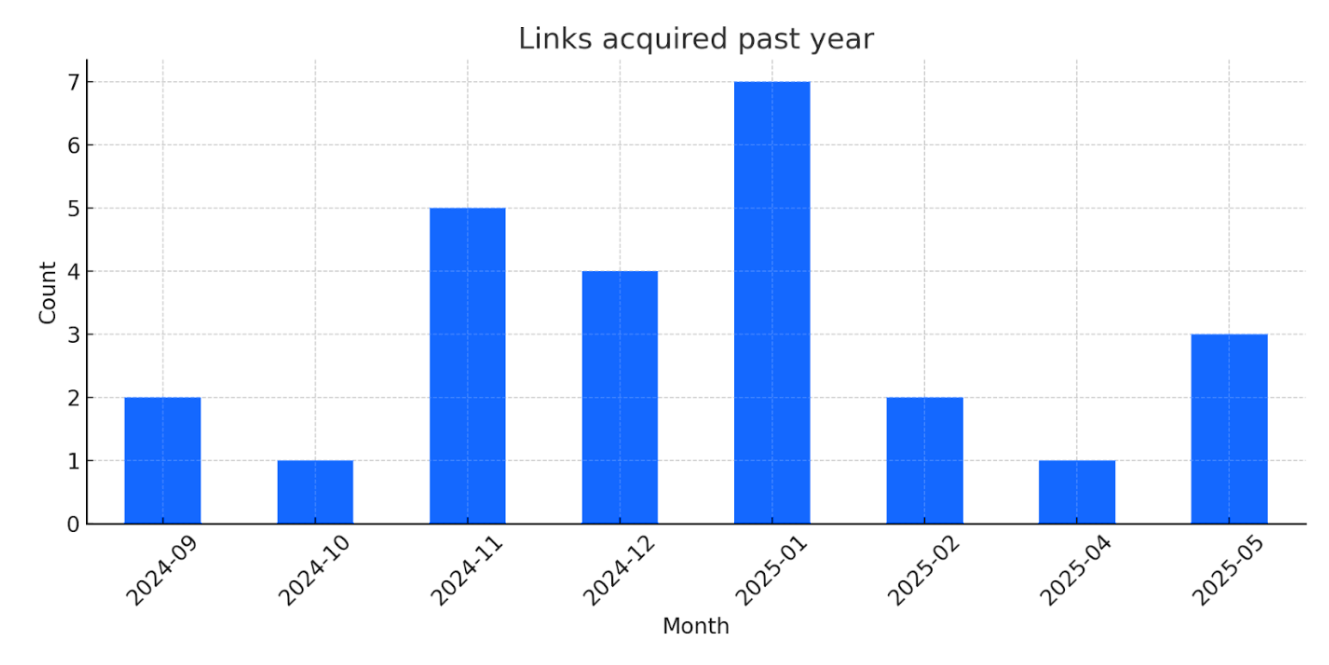
A linkable asset content plan provides a structured roadmap for creating resources that naturally attract attention, shares, and citations. With that in mind and your data from the competitor analysis, create a plan that prioritises based on link driving potential (base this on the links competitors and other sites ranking for corresponding keywords are getting from the content in question), and also the relevance to your business objectives. Beyond that, include the target keywords, commonly asked questions (you can get these via an SEO tool or Google itself), determine content length (based on the average length of the top 5 content pieces in Google for the corresponding keywords) and go from there!
Creating linkable content is a must when it comes to generate awareness and coverage online, combining proactive outreach of the content with long-term organic link driving potential will help you have the maximum impact on your SEO and business performance.
If you’re looking for help building your portfolio of linkable content, or improving your off-page SEO, get in touch with our specialist Off-page SEO team.
Understanding how users interact with your website is essential for making smart, data driven decisions. But collecting, interpreting, and acting on that data requires the right setup. We often help clients implement best practice analytics that deliver clarity and insight. Here, we’ve summarised key takeaways from the Google Analytics 4 (GA4) and Google Tag Manager (GTM) training that we support our clients with, which shares practical advice for improving your website tracking and data strategy.
Google Analytics 4 (GA4) is Google’s latest analytics platform, designed to give you a deeper and more flexible understanding of your website and app performance. It is not just a new version of Universal Analytics, it’s a completely reimagined platform designed for cross device tracking, event based measurement, and deeper insights into user behaviour. It enables more flexible, privacy conscious data collection and customisation.
Once GA4 is set up on your site, navigating its interface and knowing where to find the right information is essential. GA4 offers a series of built in reports that are grouped by topic and can be customised based on your needs.
In addition to these core reports, GA4 allows you to dig deeper by using the filters on existing reports or by navigating to the explore section, where you can build reports tailored to you.
It’s important to remember that GA4 processes data differently than its predecessor, and many reports can take 24 to 48 hours to fully populate. So when you’re analysing data, allow for this delay and always ensure you’re looking at complete datasets.
Google Tag Manager (GTM) is a powerful tool that allows you to set up advanced tracking without having to change your website’s source code. It’s the bridge between your website and GA4, enabling you to track user interactions with precision. GTM works through:
Tags: Code snippets that send specific data to GA4 when users take an action, like clicking a button or submitting a form.
Triggers: Rules that determine when a tag should fire (e.g. on a page view, scroll event, or successful form submission).
Variables: Pieces of information that tags and triggers rely on, such as button labels or page URLs.
One of GTM’s key components is the Data Layer, a JavaScript object that temporarily stores structured data about user interactions. This allows GTM to collect data from the website and use it to trigger tags or populate reports in GA4. The platform also helps with version control, showing you exactly what changes were made and when, which is useful for debugging or rolling back if needed.
Once the Google Tag Manager code has been added to the site by a developer, setting up custom tracking can be done entirely within GTM’s interface, below is an example for setting up a tag on GA4:
To support accurate testing, we recommend using browser extensions such as:
These tools help you debug and verify that your tags are firing correctly and passing data to GA4 as expected.
Not everything is tracked automatically in GA4. Using GTM, you can create events that give you more insight into how users are engaging with your website. By choosing meaningful actions to track, you can better understand how users move through your site and where improvements can be made. Popular actions to track include:
As privacy regulations like GDPR become more rigorous, it’s essential that your tracking setup respects user consent. Google’s Consent Mode V2 introduces a more granular approach, allowing for each tag to be configured based on the specific type of consent it needs; such as for advertising, analytics, or personalisation.
In GTM, you can:
If a user does not give consent, GA4 can still collect limited, non-personally identifiable data using what are known as “cookieless pings.” These include basic detail, this is enough to provide high-level insights while respecting privacy settings. Google has also introduced behavioural modelling, where machine learning is used to estimate user behaviour based on data from users on your site. This modelling requires your GA4 property to meet certain data thresholds, such as a minimum number of daily events from users who denied and granted consent.
To benefit from this, your GA4 property must:
As third-party cookies become less reliable and privacy-focused browsers become more common, businesses need alternative tracking methods that preserve insight without compromising compliance. Cookieless tracking via GA4 and GTM is one solution, but server-side tagging offers an even more robust approach.
Server-side tagging shifts the responsibility of data collection from the user’s browser to a secure server environment. This gives organisations more control over how data is collected, processed, and shared. This makes it especially valuable for industries like healthcare or finance, where data sensitivity is high.
Because server-side tagging avoids many issues caused by browser restrictions or ad blockers, it can also improve data accuracy, ensuring that valuable user behaviour insights aren’t lost. It’s a particularly useful option for websites that don’t have the traffic volume to meet GA4’s behavioural modelling thresholds, as it offers more reliable data capture without relying on cookie consent.
In summary the benefits of server-side tagging include:
Whether you’re setting up analytics for the first time or refining an existing setup, GA4 and GTM provide the tools you need to understand your audience, measure performance, and drive smarter business decisions. From custom event tracking to consent management and cookieless solutions, these platforms can be tailored to your specific business needs; if you know how to use them.
At Varn, our Data team specialise in helping businesses get clarity from their data. If you’d like to review your current setup, implement better tracking, or explore server-side tagging options, send us a message as we are here to help.
At Varn, we’re hearing the same questions again and again:
“Will ChatGPT cite my product if someone asks a relevant question?”
“Are we invisible to AI search platforms?”
“What do we need to do now to show up in AI search results?”
These are the right questions to ask, because the homepage of the internet is no longer just Google. AI search tools like ChatGPT and Perplexity are reshaping how people discover information. So how can you make sure your brand is visible in this new search landscape?
In this short video, Tom Vaughton shares practical steps from our AI Visibility Framework to help businesses audit and improve their performance in AI-driven search. Watch below to hear his take on what matters most right now.
Search is no longer just about Google rankings. AI tools generate answers by pulling from multiple sources across the web, selecting content they see as clear, credible, and authoritative. This means if your brand isn’t being mentioned, or worse, if your competitors are, it’s time to take action.
Here are three starting points Tom highlights in the video:
1. Check where you’re being mentioned
AI platforms don’t operate like traditional search engines. Start monitoring where (and if) your brand is cited in AI-generated responses. This gives you a performance baseline and an opportunity to compare against competitors and our benchmark report can highlight these opportunities.
2. Focus on building authority
Being visible in AI results relies on being trusted. That means consistently producing high quality, accurate content and reinforcing your expertise across your digital footprint.
3. Structure content for AI
AI systems favour content that is clear, well-structured, and backed by reliable sources. Reviewing your content through this lens can reveal important gaps and this will help you adapt for better AI discoverability.
Google has recently introduced a major shift in how it tracks search activity: data from AI Mode is now reflected in Google Search Console. This update means content shown within Google’s generative AI search experience is starting to factor into traditional performance metrics like clicks, impressions, and average position.
This change goes beyond a simple reporting tweak – it reflects a deeper evolution in how search visibility is defined, tracked, and ultimately, optimised.
Websites whose content features in AI Mode generated results will now see that exposure show up in their Search Console performance reports. This includes:
And when someone asks a follow-up within AI Mode? That counts as a brand new search, with fresh metrics tied to the new query.
However, there’s a catch: while this data is included in Search Console, you can’t yet filter or isolate AI Mode performance separately. For site owners trying to understand exactly where their traffic is coming from, that presents a real challenge.
The addition of AI Mode tracking is one example of how AI is becoming foundational to how search operates. Google is also currently piloting a feature that delivers audio summaries of search results, generated by its Gemini AI model.
These brief clips are accessible for users who have Search Labs enabled. are displayed as prompts directly within the results page, with users choosing to play the audio-generated summary if they wish. Beneath each clip, Google displays related web content, offering users a path to explore more deeply – if they want to. It’s a fresh take on how search results are consumed, and another signal that Google is layering AI more heavily into the search journey.
In some content niches, the effects of AI-powered search are already being felt. In the recipe space, certain keyword searches with recipe-intent are now triggering AI-generated overviews instead of traditional rich snippets. However, keywords using the word ‘recipe’ are triggering the traditional recipe rich results. The twist? These AI results often show up on desktop but not on mobile, making the experience – and traffic patterns – highly inconsistent.
As a result, some food bloggers are beginning to notice a dip in desktop traffic, likely due to users getting quick answers from AI instead of clicking through to full recipe pages. Compounding the issue is the fact that AI-related clicks and impressions aren’t yet broken out in reporting tools – leaving creators to guess what’s driving the change. Given that AI Overviews are not being triggered in mobile for recipe-intent keywords, this may be a call to leverage the display of traditional SERP features such as recipe rich results, ensuring proper structured data is implemented and optimising the user experience for mobile.
Adding AI Mode data into Search Console is a clear step toward greater transparency, but it also highlights how traditional performance metrics are becoming less straightforward. As AI continues to shape how users interact with search results, understanding where your content appears – and how it’s framed – is more important than ever.
The rise of audio answers, AI summaries, and layered search experiences shows that Google is reimagining what it means to “rank.” Success in this new environment means optimising not just for blue links, but for AI exposure, context relevance, and new interaction models.
With AI Mode data now feeding into your core metrics, it’s clear that generative AI is no longer a side experiment – it’s baked into the architecture of search. Whether it’s spoken responses, visual summaries, or carousel-style results, AI is changing how users engage – and how you measure success.
Make sure you’re paying attention, because this isn’t a test phase. It’s the next phase of search.
If you want to get ahead in AI Search, get in touch with our innovation team.
AI technology is evolving rapidly, transforming how users interact with digital assistants and how search traffic is delivered across different devices. In this blog, we explore two emerging trends that shed light on the current state – and near future – of AI-powered experiences:
A recently filed Google patent outlines how AI assistants might be evolving beyond simple keyword detection, tapping into real-world context to craft more engaging and relevant responses. While filing a patent doesn’t guarantee active implementation, it offers a fascinating glimpse into where the technology may be headed.
Here are the five contextual signals identified:
Breaking it down:
Why it matters:
This highlights how AI systems are being designed to go beyond static responses, offering more adaptive, human-like interactions rooted in real-time awareness.
Takeaway:
Google’s patent showcases how future AI assistants could become deeply personalised, using contextual signals to enhance both relevance and user engagement.
A recent analysis of traffic sources for AI-generated search reveals a surprising trend: the overwhelming majority of referrals are coming from desktop devices. The lone exception? Google Search.
Key referral stats:
Why desktop leads in AI referrals:
BrightEdge suggests that mobile AI apps like ChatGPT often display in-app previews of content, requiring an extra tap to visit external websites – potentially deterring mobile users from clicking through.
On the other hand, Google Search maintains a mobile majority in referral traffic, which could stem from its long-standing integration as the default search engine on Apple’s Safari browser.
The Apple factor:
With Apple’s Safari controlling the default search experience on nearly a billion devices, any shift in search engine partnerships announced at WWDC could have seismic implications for mobile search traffic and referral strategies.
Takeaway:
Marketers should keep a close eye on Apple’s decisions around Safari’s default search engine. Meanwhile, AI search traffic continues to skew heavily toward desktop, reinforcing the importance of optimising web experiences for larger screens – even in an increasingly mobile world.
These insights underscore two big shifts:
As always, staying ahead means understanding how these innovations affect user behaviour – and being ready to adapt.
To keep up with our AI and SEO news, please consider subscribing to our Innovation newsletter.
Earlier this year, Google opened up testing of a new AI-powered search feature, AI Mode – designed not just to enhance the search experience, but to compete with rising conversational search tools like ChatGPT and Perplexity AI. As AI continues to transform how people find and interact with information, Google’s market share has faced pressure. This introduction of AI Mode may be Google’s strategic response to reassert its dominance in this evolving space.
Unlike traditional search updates, AI Mode introduces a fully conversational, in-search experience – allowing users to ask complex queries and receive dynamic, AI-generated responses directly within Google. This reduces the need to click through to websites, reinforcing the trend of zero-click searches that has already contributed to declining organic traffic across many industries over the past year.
This shift doesn’t just impact queries of an informational nature – Google is already exploring ways for AI Mode to assist with transactions, including purchasing products on users’ behalf. Combined with ChatGPT’s recent partnership with Shopify and their upcoming in-app checkout capabilities, we can see that even ecommerce websites and transactional searches are likely to be impacted by reduced search-driven website visits.
In light of these changes, traditional SEO metrics such as rankings and traffic volumes are no longer enough. Search impressions, visibility, and overall conversions (especially for ecommerce) are becoming the true indicators of performance in an AI-driven search landscape. To stay ahead, it’s crucial to optimise your website for this new mode of discovery – and that’s where we can help.
Sign up to our Innovation Newsletter to stay in the loop, or get in touch with our Innovation team to discuss how your brand can remain visible and competitive in the age of AI.
It’s no surprise to anyone that Google now displays AI-generated answers in search results when they believe these responses can be helpful to the user. We’ve been aware of this addition to SERPs since the Search Generative Experience test launched back in May 2023, but a lot in the SEO industry has changed since then.
As search engines evolve, so too do the strategies for optimising content. With the recent increase of AI-generated summaries, and the new AI Mode addition to Google search results, many businesses are left wondering: is it worth optimising for these AI Overviews (AIO)? How do I prepare my website to make the most of these new AI features?
At Varn, our Innovation team carried out an analysis of how Google’s AI Overviews are impacting search visibility across different industries. This article delves into the findings of our research, where we reviewed the search results associated with thousands of keywords in order to uncover frequency of AI appearance, how often they overlap with traditional organic listings and SERP features, and what this means for SEO strategies moving forward.
Our previous AI Overviews analysis was carried out when this feature was still called Search Generative Engine (SGE), in January 2024. At that moment, across a smaller dataset, we found that overall 55% of the results overlapped with the organic listing results, which meant that over half of the AI Overviews citations were drawing from content already ranking on page one. This gave us an early indication that traditional optimisation efforts were still playing a role in AI-powered visibility.
However, since then, Google has rebranded and expanded AIO significantly, both in terms of geographical reach and algorithm complexity. Overall, the AI industry is evolving at an unprecedented pace, where advancements in AI technologies are impacting industries globally even beyond SEO:
With the introduction of Gemini 2.0, changes in citation behaviour, and the reduced overlap between AI and organic results reported after the March 2025 core update, it seems clear that the landscape has quickly shifted. As such, a fresh round of research was needed to assess the current state of AI Overviews, further emphasising the need for agile strategies in this fast-changing space.
At Varn, we have gathered a keyword set of around 7K keywords split into different industries: Ecommerce, Health & Pharma, Travel & Tourism, Insurance, Finance, SEO & UX and B2B. These have been run through google.com in April 2025, with a VPN set in California, USA, to ensure a fair comparison with our previous test.
The new research includes a few different angles. We will be answering the following questions:
Our research explored several key dimensions. These were our findings.

Different industries exhibit varying patterns when it comes to AI Overview triggers and understanding these can provide businesses with a competitive edge. By tailoring content to address these unique triggers, companies can optimise their chances of appearing in AI Overviews, thereby enhancing their overall search visibility.
With this angle, we wanted to provide a valuable insight into how Google’s AI Overviews compile and attribute information, particularly how many distinct URLs are referenced in each AI-generated summary. The findings shed light on the complexity, diversity, and trust signals that may be influencing AIO composition.
AIOs citing only 1 or 2 sources are extremely rare, implying that Google intentionally avoids overly narrow sourcing, likely to mitigate incomplete information.
On the opposite end, AIOs citing 10+ sources may correspond to more complex or ambiguous queries, where a broader range of inputs is needed to form a satisfactory summary, though they still represent a relatively small share.
This data reinforces the idea that AI Overviews are not simply pulling from top search results, but instead curating from a contextually relevant pool of sources. With limited citation slots available (typically between 5 and 8), not all “Page 1” results will be included. Sites that demonstrate clear expertise and trustworthiness are more likely to be chosen. And given that Google pulls from diverse URLs or domains, being cited in third-party content such as industry blogs, forums or thought leadership pieces, may increase your chances of an indirect inclusion in AIOs.
The most critical aspect of the new research is again the overlap between URLs featured in AI Overviews and those appearing in traditional organic search results. Below is a graph that demonstrates how often a URL cited in AIOs has appeared within traditional Google rankings, for the same keyword(s). Overall, we see that the URLs cited in AI Overviews are not ranking in traditional results 78.6% of the time.

However, the substantial share of cited URLs that do not rank at all across all industries indicates that AIOs are pulling in sources beyond the top organic results. This fragmentation creates uncertainty for SEO visibility and makes AIOs a critical new layer of SERP analysis.
In the Insurance, Travel and Retail industries, the picture is even more extreme. Only a few URLs cited are on Page 1, while a sizable 70%+ are not ranking at all. This suggests that in these commercial spaces, Google is pulling from alternative sources such as community content, or niche publishers that provide unique value or context not captured in traditional SERPs.
This points to a broader trend where ranking well no longer guarantees visibility in AI-generated summaries.
Obviously, as AI Overviews are rolled out, the general concerns are whether these will reduce website traffic from SERPs, or more importantly, whether people are actually interacting with the sources cited in AIOs. This brings us to the question: is it worth optimising your content or strategy to target AI Overviews?
As mentioned before, Google is currently tracking clicks and impressions in AI Overviews, however, there is no way to isolate these within Google Search Console reports. This means that producing insights into visibility and click through rates has become a real challenge. While data is still emerging, early studies and industry experiments suggest:
From our dataset, we have also reviewed the average CTR for the keywords where AI Overviews are present in March 2025 vs March 2024.

One conclusion we can draw from this table is that the lower your organic Google ranking, the more your organic CTR is likely to drop since the introduction of AIOs. Whilst CTR typically drops in line with your ranking position anyway as a general rule of thumb, this drop appears to have increased over the past 12 months, potentially due to the impact of AIO search results.
In short, here at Varn we believe AI Overviews are reshaping the click landscape, not eliminating it. The sites that reshape their content strategy to be both informative and AI-digestible will be best positioned to retain, and even grow, visibility in the evolving SERP environment. Contact us if you would like us to support you with your AI visibility.
Since their rebrand and rollout in 2024, AI Overviews (AIOs) have rapidly expanded globally, now appearing in 36.3% of searches, with particularly high prevalence in Health & Pharma (47.49%) and SEO & UX (44.31%) sectors.
URLs cited in AI Overviews are not ranking in traditional results 78.6% of the time. This confirms that while SEO best practices remain valuable, AIOs also pull from a wider, more diverse set of sources, often bypassing traditional Page 1 rankings entirely.
AIOs frequently source from Featured Snippets, People Also Ask, and high-EEAT domains, even if they aren’t ranking on page 1. Getting cited indirectly via trusted third-party domains is a still viable off-page strategy.
Most AI Overviews reference between 5 and 8 unique sources, suggesting a need for content that is both authoritative and concise. Overly narrow or overly complex content appears less likely to be featured.
Despite Google logging AIO clicks and impressions, Search Console lacks dedicated AIO reporting, making it difficult for brands to isolate and optimise for this feature. This limits clear attribution and necessitates more agile analytics solutions.
While broader studies suggest AIOs reduce clicks, our own data shows CTR improvements at position #1 year-on-year for sites already implementing strong SEO and content strategies.
With the launch of Gemini 2.0 and Google AI Mode, the shift towards conversational and summarised results is accelerating. Early adaptation will be key to long-term visibility.
So, to answer the main question of this article – is it worth optimising for AI Overviews? We’d say yes, but with a strategic mindset. Our research suggests that AIO visibility does not come from high-ranking pages alone but from contextually relevant, authoritative, and diverse sources. Therefore, there are many ways to approach an AI-driven strategy, such as refining on-page content to better match informational intent, or strengthening off-page signals through authoritative backlinks and citations. As AI Overviews continue to reshape the SERP, brands that align their content with these principles will be best positioned to maintain and even grow their visibility. If you are struggling with the new AI advancements, get in touch with our innovation team – we’d be happy to support your strategy for maximum AI visibility.
Bristol-based creative agency saintnicks has been awarded Gold at the Digital Impact Awards, recognising its work with POSCA, part of Mitsubishi Pencil Co. The win came in the ‘Best Community Development’ category, celebrating the agency’s success in growing and nurturing an engaged creative community on social media.
The Digital Impact Awards highlight excellence in digital stakeholder engagement and the power of online brand communication. saintnicks’ campaign for POSCA focused on building authentic relationships with artists and makers across the UK, showcasing their creativity while amplifying the brand’s cultural relevance in the creative community.
Fraser Bradshaw, CEO at Saintnicks, said:
“We’re incredibly proud of this recognition. It celebrates not just great creative work, but the genuine connections built between brands and the people who love them. The POSCA community embodies everything we believe in – creativity, authenticity and engagement that lasts.”
The award-winning campaign brought together art, culture and community to celebrate creative expression and inspire participation. A full case study of the work can be viewed below.
If you’d like a chat about your challenges or request a complimentary social audit, drop them an email and say hello. You can find out more about their social media and content expertise here.
You need to load content from reCAPTCHA to submit the form. Please note that doing so will share data with third-party providers.
More Information