Even with consistent performance marketing growth for the last decade and worldwide digital ad revenue predicted to grow by 85% by the end of 2026, performance marketers can’t afford to rest on their laurels. Customer journeys are becoming less linear, and competition can be internal as well as external – it’s adopting a performance mindset that ensures results.
Take a telecoms provider, for example. With different departments (for example, broadband sales vs phone contract sales) using performance marketing to drive towards its own goals, two internal messages are competing for the same customer attention. A performance mindset solves this problem by taking performance marketing from a strategy to an attitude – a way of thinking. Empowered by good use of first-party data, it could be the difference between a brand achieving an ROI target or not.
As marketers, we should all be adopting the key attributes of a performance mindset, including those working across different departments. These include:
Maximising efficiency across all channels
First and foremost departments should be communicating frequently and there needs to be strong channel integration. Perhaps the answer is to have one budget with one goal and then to decide across all channels what the make-up of the activity should be? A mix of these different channels and departments can work together to achieve the initial overarching objective.
Always looking at the bigger picture – never just granular detail
With so many different, smaller components to marketing, businesses can sometimes forget to focus on looking at the bigger picture and working towards a wider marketing strategy. Focusing on the macro not the micro allows everyone to be more agile, keep stronger customer connections and maintain consistent branding.
Galvanising everyone toward the same north star using first party data
Much of this comes down to galvanising everyone under one north star. Assets and learnings should be shared across teams and across the business. This is where the data comes in.
With an ever-expanding mix of channels and platforms to communicate and interact with customers through, it is even more important for agencies and marketing teams to work collaboratively. First-party data (data collected directly from customers) is a route to bringing teams together. This data can help all marketers understand how their activity nudges customers along the value chain; how it impacts results and delivers more personally relevant customer connections. And, again using first-party data and measurement, attributing performance across channels, everyone in the mix understands how they impact and deliver results.
By sharing regularly, the team can become more invested in the goals not just their part of the process or their individual objectives, but of the whole.
Performance planning – using data as a guiding light
Data ensures you can put your best foot forward. It’s a guiding light in the creative process. It shifts the focus from subjectivity to objectivity. You can involve everyone in every stage of the process – show the creatives how assets are performing so they can see what they should do more of and what they should do less of.
Testing is critical to this as it gives you your concrete impact of what happens if we try X vs Y and what should we do more or less of, to drive a better performance. By showing the impact of using data to understand, intelligently target and communicate to your audience and the increase in success metrics it brings, you can unify business and marketing goals with customer level objectives that drive better results.
Customer-first decision making – what should we be saying/asking our customer to do?
Having a performance mindset ensures alignment across channels, thinking about how to maximise each one in relation to the other, and asking ‘What do we want the customer to do?’ and ‘How can each of these channels contribute to our efforts in encouraging them to do it?’
Too often there is internal competition, and business goals, which leads only to mixed messaging and confusion around what customers are being asked to do, and ultimately impacts engagement, response and conversion.
Through the deep understanding of your base that first-party data allows, customers can be encouraged along their value journey and the brand can look to measure and optimise to the right metric for that customer. Let the data direct that at a customer level – be it the download of an app, obtaining one more visit, registering on your website, sales of a product or simply driving awareness. by optimising in the right way you can direct your customers to their next best, and most logical, action.
A performance mindset brings unity and a shared focus: it’s a relay team, not a group of individual sprinters. And by putting customer and first-party data at the heart of your decision making across teams, your performance marketing will perform even better – leading to unrivalled ROI.
The article was first published on Performance Marketing World, May 2022
Written by Andrew Terry, Head of Strategy
Congratulations to our CFO, Andy Brown, and chairman, Chris Thurling, who have both qualified with the Institute of Directors as Chartered Directors. With fewer than 2,000 Chartered Directors worldwide, the qualification demonstrates their commitment to investing in continual development, as well as the business’s dedication to corporate and social governance.
Chris Thurling comments: “We understand that strengthening our skills as chartered directors should mean we are able to better serve Armadillo, supporting sustainable, long-term growth. A company director is a profession (as much as an accountant for example) therefore why shouldn’t we be qualified for the role?”
Andy Brown adds: “I’m really pleased that Chris and I have been able to complete this training and qualification together. As well as learning more about strong leadership, governance and strategy, we’ve had the advantage of the shared experience of completing this together and bringing ideas back to enhance Armadillo’s Board effectiveness.”
Chris and Andy will also be joining the South West chartered directors network. With members representing agriculture, aerospace, tourism and manufacturing, IoD South West reflects the vibrant and innovative sectors in the region. The Institute of Directors (IoD) is a British professional organisation for company directors, senior business leaders and entrepreneurs. It is the UK’s longest running organisation for professional leaders and is an extremely prestigious qualification to hold. Armadillo are really moving forward and prioritising career development, so for our directors to represent this is great for our employees to see. There’s always an opportunity to develop your career, no matter what position you’re in. We are very proud of Andy and Chris’ dedication to improve their role as part of Armadillo’s board of directors.
We’re delighted to announce that Armadillo CEO, James Ray, has been appointed one of the three agency heads boosting the Institute of Practitioners in Advertising (IPA) leadership team and will be joined by OMD’s chief operating officer, Christian Byron and Republic of Media’s head of client services, Gill Jarvie.
James’ role will be as City Head for Bristol, Cardiff and the South West. He’ll serve as a figurehead and champion for the Industry in the region. He’ll engage with, and represent, the outstanding talent in the community, and provide a voice for IPA members in the areas.
Paul Bainsfair, director general, IPA comments “I’m delighted to welcome Christian, Gill and James into their new positions. I know they will provide valuable guidance and expertise to our wider agency community as we continue to recover from the pandemic.
James says: “It’s a great privilege to have been appointed as your new City Head for Bristol, Cardiff and the South West, not least as I have some big shoes to fill. I wanted to start by thanking Mike Leeson for his superb stewardship over the last few years, and I hope I can step up to his high standard.
I’m really excited to be taking on the role. With the uncertainty and disruption of the last few years driving a shift towards a more hybrid and even more accessible mix of benefits and support, there’s never been a better time to be an IPA member – especially for those of us outside of the capital”.
Armadillo joined the IPA in March 2020. We were incredibly pleased to join an organisation that, with over 266 agency members, who are responsible for over 85% of all UK advertising spend, supports and celebrates the best in the industry. We have thoroughly enjoyed working with them over the past two years and are incredibly excited to continue to develop this relationship further as the advertising industry continues to innovate and grow.
Having a flexible working policy is one thing and providing real flexibility for employees is another. As we head into Ramadan 2022, what can agencies do to offer true flexibility to their participating staff?
Ramadan is a time for us to reflect, connect and better ourselves. It is an important and sacred practice, and it requires a great amount of dedication and patience. During Ramadan, Muslims experience a complete change of routine and schedule. These changes have a big impact on our daily lives and will inevitably affect us at work. Agencies need to understand that during Ramadan, Muslim staff will need a greater level of flexibility to ensure they are performing as best they can.
It starts with communication
We’re in advertising, and so we should be good at communicating, right? Agency leaders need to be communicating with their Muslim employees and hearing what each individual will need from them during this time and beyond (a prayer space will be needed throughout the year by some, for example).
Not only should leaders have a good understanding of the challenges and nuances of fasting for Ramadan, but so should the agency as a whole. It’s not about singling anybody out as the lone educators but creating an open environment where Muslim staff feel they are given the space to express their faith.
I have found in the past that colleagues will express feelings of guilt when eating in front of me during my fast. This isn’t necessary. I’ve been fasting for Ramadan since I was a child and I’m very used to it. Having conversations with my colleagues about this at Armadillo has really helped and knowing I have the support of agency leaders is incredibly valuable.
Understand it goes beyond abstaining from food
Most people seem to understand that Ramadan is a religious practice that includes abstaining from food. Fewer people, however, understand that the celebrations go far beyond that. Ramadan is about togetherness, kindness, self-improvement, and faith. During Ramadan, we try to be better versions of ourselves. We try to avoid negative habits such as complaining or using bad language, and many will use Ramadan to give up bad habits.
In many ways, it is about a fresh start and the opportunity to do better. Ramadan is a time to be grateful, give to others and come together with community, family and friends. Much like a celebration such as Christmas, Ramadan includes big family gatherings, presents and celebrations.
Understanding Ramadan as a whole is key in enabling agencies to better support their staff. Many people don’t realise how difficult it can be to book time off work for Eid, for example. Eid al-Fitr marks the end of the month-long dawn-to-sunset fasting of Ramadan and is a day of celebration with loved ones. Typically, the day starts with prayers and a big meal is usually the main event but there’s lots of other ways people celebrate too. The reason it can be hard to book off from work is that the date changes every year!
Because Ramadan and Eid are based on cycles of the moon, not only do dates vary, but different people celebrate on different days. Some will follow Saudi Arabia’s example (where Mecca is) and others will go off of the moon stages seen in their country. So you may have two different Muslim employees celebrating Eid on two different days.
A changed body-clock is going to have an impact
Eating at sunset results in the body digesting food well into the night, disrupting our natural sleep cycles and body clocks. The increase in energy that is gained after “iftar” (the breaking of fast), combined with Ramadan being a very social practice means that most people stay up a lot later than they usually would, leading to us getting a lot less sleep than we’re used to.
As we are no longer following a traditional 24-hour cycle, changes in demeanour are common. I find that my energy levels can drop, and it is harder to maintain the consistent level of concentration and patience that I usually have. In terms of work-life balance, patience is a keyword as it is required from both parties, those who are fasting and for others to be patient around those who are fasting, some tasks may take longer for example.
Having a truly flexible schedule works wonders to combat this. Having the flexibility to work around these dips and spikes in energy allows me to continue to produce work of the highest quality. I know some people prefer having the ability to leave early and take a shorter lunch break, for example, which allows them to work at their best.
Real flexibility is, well, flexible. This Ramadan I encourage industry leaders to reflect on their and ask themselves if true flexibility is being prioritised. Adland is changing; this Ramadan is a chance for agencies to be an integral part of positive change.
Agencies and brands can also communicate their support publicly. Over the years I have seen many campaigns launched in aid of Ramadan and Eid. For example, leading up this month, you will see supermarkets advertising and stocking up on dates as this is what a lot of Muslims open their fast with. As each new month is determined by the new moon and looking for the crescent, you may have seen the moon and star logo feature quite a lot. Coca Cola used this crescent and created a moon logo with their brand.

Not in the UK, however McDonald’s did a sand time concept (waiting for time to open fast):
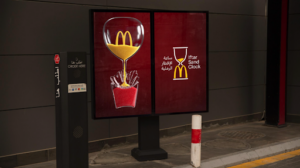
A lot of brands use Ramadan/Eid to show diversity and reach out to different religions/cultures.
Tesco also launch Ramadan recipes: https://realfood.tesco.com/ramadan-and-eid-recipes.html
The article was first published on Campaign in April 2022
We are delighted to announce that we have appointed Joanna Penn as our new Managing Director (MD). We’ve chosen to invest in our senior leadership by creating the new MD role to lead the operational management of the agency. The move will allow our CEO, James Ray, to focus on strategies to continue our fantastic momentum.
Jo joined us at Armadillo two years ago from a successful career working on global brands such as Nike, Unilever, and Pernod Ricard to become Client Partner on the McDonald’s account. In that time, she has excelled at building and nurturing a high-performing, motivated and happy team and leading them to focus on delivering the best work for its clients. In her new role, she’ll be applying these skills across the business and continuing to deliver against our proposition for existing and new clients.
When asked about the role Jo said: “A big part of me never thought this would happen, because I never thought I would find the right agency in which to take on this role. Armadillo has fantastic clients, the right leaders, great, supportive and highly talented teams, and, most importantly, a great ethos and culture. I am both grateful and proud I have been given this role and really look forward to helping the agency deliver unrivalled ROI for all our award-winning clients and future partnerships.”
As well as celebrating the addition of Managing Director, we’re also thrilled to welcome our new Client Partner, Emma Watson. Emma joins us from her previous role as Business Director at Edit where she ran their flagship account with Jaguar Land Rover, delivering commercial success and multiple award wins (including two Golds at this year’s DMAs). Emma brings a pedigree in data and CRM to add to the team, with deep experience working strategically with data and MarTech to deliver compelling campaigns and customer experiences with proven results.
Emma says: “Armadillo continues to go from strength to strength and I’m excited to be part of their next phase of growth. I’m passionate about working in partnership with clients and, along with the talented Armadillo team, am looking forward to pushing CRM boundaries to achieve innovative work, which delivers amazing results.”
James adds, “Jo was the natural choice for the MD role: her energy, intelligence, commitment and natural instinct for leadership have been a huge part of our success, and I’m excited to see her apply that across the whole business. Emma brings with her a wealth of experience and skill in delivering commercial success for clients through orchestrating engaging, data-driven customer experiences: a perfect fit for our proposition and a fantastic addition to the team.”
…
We were over the moon to pick up five awards at this month’s national Data and Marketing Association (DMA) Awards. We took the top spot in the ‘Travel and Leisure’ category for Cunard: Navigating the Route to Recovery campaign, and secured further wins in Marketing Automation, Data Storytelling, Customer Journey and Integrated Campaign categories with McDonald’s campaigns.
At the core of the GOLD-winning Cunard campaign was giving Cunard customers ‘permission to daydream’. Delivered through their letterbox was an ‘Invitation to Exploration’. Gilt-edged, on heavy stock, and worthy of a place at the Captain’s Table – this beautiful piece inspired guests to look ahead with positivity. It reminded them of the reasons they loved to travel with Cunard and encouraged them to start dreaming about their next voyage. Over £2m incremental revenue was attributed to the campaign, resulting in a 25:1 ROI.
The SILVER winner in Best Customer Journey and SILVER winner in Best Use of Marketing Automation was our Feel-Good Customer Journeys campaign. We were briefed to establish the My McDonald’s app as the customer’s channel of choice. To inspire and incentivise people to come back to the My McDonald’s app again and again, we used early behaviour data signals to determine customer propensity to use the app. Then, we worked to overcome inertia and reinforce frequent use with an automated nudge programme running on Adobe Campaign, which adapted in real time to customer response. ROI stands at 50:1 and growing.
BRONZE in Best Data Storytelling was our App Anniversary Programme for McDonald’s. It was developed to celebrate customers’ first year of being part of the My McDonald’s app family and show an engaged audience what they already mean to the brand, while encouraging them to try more of the menu. We celebrated each customer’s individual relationship with McDonald’s. Playful storytelling turned data into a picture of their own unique McDonald’s story and encouraged exploration of how that compares to other customers. Designed to recognise and reward, this bright, graphic thank-you note stands out in a busy inbox and generated a 14% increase in order frequency, amongst other results.
And BRONZE in Best Integrated Campaign was I’m Lovin’ It Live. Customers flocked back to McDonald’s when restaurants reopened after lockdown one. But with digital targets under pressure and another lockdown looming, we needed an activation strategy to boost adoption and retention on the My McDonald’s app and give customers a lift. As part of an all-agency team effort, including Leo Burnett, Red Consultancy and OMD, we launched I’m Lovin’ It Live – a once-in-a-decade live music event hosted via the My McDonald’s app and supported by a series of generous digital offers and moments to motivate downloads and ordering. All while bringing back the feel-good factor in the safety of customers’ homes. In response, we saw a 304% increase in app acquisition, 178% increase in app orders, and ROI of 44:1.
The five awards mark the most received in one night over our 29-year history. The DMA Awards is the annual best in class awards covering all areas of direct marketing across the UK.
James Ray, our CEO, summed up what this meant to us all: “What a fantastic result for our brilliant Armadillo team and our clients, Cunard and McDonald’s. It’s so incredibly well deserved and I’m so proud of what we’ve achieved together.”
See all of our award-winning work in full.
First published by PerformanceIN, November 2021.
By Hannah Waters.
Creative, being the use of imagination, and data, being fact and statistics, are typically seen as opposites. However, when combined, these opposites can create a more exciting and engaging user experience.
In the world we work in, creative is used to help users to complete tasks. Whether that is to aid their understanding of a message, its relevance, or to provide enjoyable ways of navigating content. And while there will always be a level of subjectivity over anything ‘creative’, this means it becomes more of a tool to be used as part of a solution, not the solution in isolation.
Likewise, data by itself is just a collection of information. You could just present all of that data to a user… but what would they do with it? You have to turn it into a story in order for it to be meaningful. The best way to make your story? Enter into a clear and mutually beneficial relationship with the user where both sides get a roughly even value exchange, they let you know them, and you serve them relent content.
Let’s look at an example of a sample brief:
You could use pure creative to design a social post or email to do this, but how would you know what to include? What makes it relevant? By using data gathered from other people who have been on this journey, or a similar one, we can start to understand:
Straight away you have some actionable insights that will inform the basic approaches you might take, but it wouldn’t stop there. The best creatives don’t work in absolutes and certainties. They are curious. They want to know more about how effective their work is. Introducing segmentation or multi-variant testing, and constantly iterating approaches to maximise engagement, helps refine the creative solution. Data is the only way to do this objectively.
It’s also important to consider that no brief exists in isolation; everything you learn from the execution of one can be applied to the next. Without a good collaboration between data analysts and creatives, you can’t ever be sure you’re telling the story in a way that resonates or has the desired impact.
There are much more complex examples of the two working together. It could be that you want to build affinity with users by celebrating their relationship with the brand, or something more functional, like helping users stay engaged with an app by looking at common pain points and how to overcome them. However, the process is the same and still requires there to be a clear objective, coupled with data and creative working together to bring the ideas and story to life.
Working in CRM means we are within an area that is rich in first-party permissioned data sets. It’s great to have a creative team that is obsessed with the numbers and a data team that is passionate about creative being rooted in real data. This means we can always be objective about our creative solutions, ensuring that they have a purpose far beyond looking ‘pretty’. We measure our campaigns in proven behavioural change as well as pounds and pence, and that’s only possible because of the alignment between data and creative.
By Molly Rushton
This article first appeared was first featured by New Digital Age, August 2021
From starting my career in an agency, moving to in-house client-side, and then making the move back to being in an agency, I’ve learned a lot about the differences between the two environments. Both client-side work and agency work have a lot to offer, but as I’ve most recently made the switch from client-side work back into an agency setting, I wanted to cover the reasons why. Working in an agency is exciting, and if you’re anything like me then there’s a good chance you would benefit from the switch too. Here are five reasons why going from client-side to agency might be the right move for you.
You’re a keen learner
One of the main draws for me to move back to an agency was the learning opportunities and chances to develop that an agency setting provides. In an agency, you could be working across a number of clients or projects in a day, or you could spend the whole day focusing on a single one. The variety of clients and projects means you’re always learning new skills and approaches, and having new experiences within your role.
Being keen and willing to learn new things is absolutely vital when working for an agency. You need to be open and ready to face new kinds of challenges and learn along the way.
You’re ready for a challenge
New challenges are inevitable when working in an agency setting. With a variety of clients and different projects coming in all the time, you need to be ready for your role to be challenging on occasion.
If you’re looking to push your skills to new levels, refine what you do, and get even better at it, then an agency might be the place for you.
You thrive on critical feedback
When moving from client-side to agency, the truth is you do lose a bit of autonomy when it comes to decision-making. You’ll have to refine your decisions to combine what you think is the right choice with what the client is looking for. This means that even if you think something is fantastic creatively if the client doesn’t see it, then it will have to be adapted to find the right solution for them.
The positive of this is that you get lots of critical feedback on your work. And yes, this is a positive. Learning to take critical feedback and grow from it speeds up your abilities to create the best work possible. This means you can create something that really works for the client this time, and something even better next time. When you’ve got it right, it’s a real buzz, and when you’ve got notes on what you can improve on, you get a drive to do better and better.
I get far more critical and, most importantly, constructive feedback now working at an agency than I did when I was client-side. If you thrive on feedback and you’re ready and willing to improve then an agency setting is a good place to be.
You like variety
The variety of work that an agency provides is incredibly exciting to be a part of. You can be working on different projects all the time, keeping things fresh and interesting, ensuring you’ll never get bored. Working across different industries, with exposure to a large variety of markets will mean you’re always adapting, problem-solving and upskilling in your role. No two days are ever the same.
You enjoy being busy
The pace of an agency is perhaps the biggest thing to be aware of when switching from client-side to agency. It’s much faster. You have to be ready and enjoy being busy. There are often quick turnarounds on projects and the variety means you can never get complicit. But for that reason, it’s a benefit! Being busy is creatively fulfilling. And don’t worry, it’s not all work and no play. A cool thing about agency’s is they often come with lovely employee perks. At Armadillo, we have Summer Fridays where we leave early to enjoy some extra time in the sun once a month over the summer.
The switch to agency work has been a good one for me. It pushes me to be my best, provides me with plenty of creative challenges, and offers a great sense of fulfilment.
Are you ready for a change?
Then maybe an agency is the place to be.
Almost a decade and a half after the debut of the iPhone, does your brand actually need an app, when an excellent mobile website might do the same job?
I bought a foldable mobile last month (yes, I am that person). When it comes to tech, I’m a researcher. I covered a lot of ground to make sure I didn’t miss the best one. But, if I’d downloaded the app of every website that offered me one during the search, I’d have about 10 new apps clogging up my shiny foldable screen by now that I would have no regular use for.
Apps can provide a brilliant customer experience for users, and unrivaled behavioral and transactional data for brands. But it seems to have become almost a foregone conclusion that every business needs an app. If you’ve got a well-designed and user-focused website that works perfectly on any device or screen size, what are you actually adding to your customer’s journey or experience by offering them an app? I strongly believe that every app, and brand, has to work hard to earn a place on a user’s phone/tablet/watch/fridge.
An app can be a great core way to connect with your customers and can provide a brand with really fantastic data insights, especially when used in conjunction with other channels such as email, SMS, and social. This, in turn, is great for driving measurable and attributable ROI.
However, you should only commit your time and resources to developing an app if you’re offering something to me as a user that makes my life easier – a cool or slick customer experience that is elevating what I could get from your website – or you’ve already proven to me that your brand is one I trust and has become one of the main places I will always look for that service or product.
That’s it. Follow those rules and, for a brand, there is loads to be gained.
Take fast-food ordering, for example. If a customer orders in person or over the phone then you get the money but no personal insights. If they order on your app then you get usable first-party, transactional data plus behavioral data. So it’s super tempting to dive into developing an app.
For the user, the experience of using the app to complete a transaction has to have tangible benefits; quick access to their favorites, contact-free payment, order history, Apple or Google Pay, or loyalty rewards.
It’s got to be really great because you’re asking the user to accept less choice and, instead, come straight to you. Conversely, if I Google something, I have an immediate set of results from multiple brands and I can compare and find the offering that matches my full set of criteria.
It’s those tangible benefits that are key. If all an app is doing is taking a mobile website and putting it on your home screen, that’s not a worthwhile investment.
Think of a retailer that sells one thing, such as electronics. What benefit is it to have that app on my home screen?
How about a 10% discount if I download it? If you’re offering that alone, it’s a one-hit-wonder in the making. It’s not the intangible benefit that persuades me to download the app. There’s no point in offering unrelated discounts or perks and not actually looking at customer behaviors. That could be done with emails or flyers. If it’s a bribe, it’s snackable value and not meaningful in the long term.
Your app must be easier to open than the website. Offer your user a slick experience and ensure they get more out of it than they are putting in. Value can be added in the form of easy access to customer service through video calls or chat; push notifications that provide useful info, not just more marketing messages; or being able to use your camera to scan products or your biometrics to log in, for example.
First, ask yourself, is the website utterly amazing? Apps aren’t there to make up for shortcomings with your website. Ensure it’s nice to use, that it’s easy to find everything you want and that users feel serviced. Are you adding to brand equity every time someone’s in your world?
Next, ask how an app is going to elevate that. What’s better for the user about using your app? Through consistently good brand experience – in-store, on social media, CRM – prove to your users that they are valuable and that they will get out more than they put in.
If you’ve done your app well, it becomes that key touchpoint of the relationship between you and your users. An app has to build upon the amazing service you already provide and be used more than once. An app for app’s sake will only frustrate.
By Rob Pellow, Innovation Director. Originally featured by The Drum, June 2021.
We’re delighted to announce that we’ve appointed Wunderman Thompson’s Andrew Terry as the new Head of Strategy. Andrew will work across all of our big-name brands including McDonald’s, Disney and Carnival UK.
Andrew joins us with a rich history of work in the marketing and advertising industries. Most recently Data Strategy Director at Wunderman Thompson, he spent three years working across Shell Drivers’ Club globally, and two subsequent years on its multi-million-pound BT account.
At Wunderman Thompson, Andrew trained up the global team and worked across a wide range of different international markets, optimising the model to be as efficient as possible. Always starting with the question ‘How do we understand customers better?’, Andrew was responsible for using data to inform personalisation and measurement; loyalty and membership benefits being at the forefront of his role.
With in-depth knowledge of data acquisition and optimisation, social and digital data strategies and CRM data optimisation, Andrew career has spanned the B2B and B2C sectors, with a firm focus on driving excellent ROI.
Previous roles also included Data and Marketing Specialist at Newsquest, the UK’s second-largest publisher of local media, in which Andrew worked with internal and external data to support the centralised recruitment ad sales process and deliver business intelligence garnered from transactional information from both regional and economic trends.
As our Head of Strategy, Andrew will work across all our accounts with a focus on putting data at the heart of decisions made for customers, using data creatively to change customer behaviour and deliver unrivalled ROI; reaching the right people, the right way at the right time. Keen to involve each part of the agency in achieving this, Andrew will ensure results are used to feedback into strategy for maximum effect.
CEO, James, comments: “With the rapid growth trajectory of Armadillo, we value outstanding strategy at the heart of all of our campaigns. From the moment we met Andrew we were blown away by his passion and enthusiasm for results-driven strategy. His vast experience and knowledge were exactly what we were looking for and we’re thrilled to welcome him to the team.”
Andrew adds: “The people at Armadillo are very, very good at what they do. Their long-lasting relationships with big-name clients are a fantastic indication of just how strong they and their operations really are. It’s an incredibly exciting time to be joining the agency.
“Like most of the UK over the last 18 months I’ve established a relationship with more new brands than ever before & this presents a huge opportunity for brands entering the CRM space. CRM is a big, big world but Armadillo is at the forefront. They have the unique ability to pull people together and form teams around the client with remarkable pace and effectiveness. Armadillo is a fantastic blend of passion and enthusiasm; skill and talent and I can’t wait to dive in.”
You need to load content from reCAPTCHA to submit the form. Please note that doing so will share data with third-party providers.
More Information