Less Wrong Than Last Time.
What sketching Kit Atlin’s talk at BCI taught me about being wrong on purpose
Most speakers spend their opening minutes proving they belong on stage. Kit Atlin spent hers stepping down off the pedestal.
At BCI she promised six mistakes. The first: trying to be the cleverest person in the room. In a creative industry, that one stings like good comedy… because it’s true.
Kit described years of wanting to be the hero, the one who cracked the problem. Then she realised her real job was less glamorous and far more valuable: building momentum for everyone else.
The room nodded.
Sketching a feeling, not a speaker
I don’t watch the speaker. I’m glued to my iPad, sketching what I feel.
I listen for stories I can put a character through: a dilemma, a contradiction, a confrontation, a small realisation. My characters are simple and a bit absurd. Kit’s ideas are hard-won. So how do I sketch ego without drawing a villain? How do I sketch momentum? How do I sketch the difference between a truth that’s felt and one that’s merely correct?
Behind the pen
For “the cleverest person in the room”, I sketched something new: a figure on a pedestal of blocks engraved with E = mc². That figure is Kit, back when she was obsessed with being right. She’s up high, and everyone else keeps their distance. The more correct she insisted on being, the fewer people wanted to stand next to her.
Her antidote was to ask better questions. For that, I turned to a two-beat scene I’ve sketched many times. Beat one: a dense cornfield, a wall of noise nobody can get through. Beat two: the same field with a path cut through it. This time, for the first time, I filled the path with speech bubbles full of questions. Kit’s point: keep asking until you reach the spark that gives the creative team momentum.
She described strategy, brief and design as a sequence with blurred edges, messy and back-and-forth. On one project involving flamingos, after all that mess, it clicked in a small moment of her morning routine. Afterwards everyone says, “Well, that was obvious.” It was, eventually.
That’s Steven Johnson’s “slow hunch”: you pick an idea up like a Rubik’s cube, turn it for a while, and put it down again. It’s the jigsaw my daughters and I have been doing since the summer, ten minutes before dinner, a few pieces at a time. The messy middle isn’t a rush for gold. It’s patient return.
Frameworks get the same treatment. Kit sees them as a compass bearing, not the journey. Pour an idea into a model and it won’t come out better on its own. The value comes from pushing against it and bending it.
Then came my favourite: “True is BORING.” I drew it big. At home we’ve been reading Calvin and Hobbes, and one strip ends in a gloriously hand-lettered BORING. My eight-and-a-half-year-old read it out at full volume. For her, if it isn’t K-pop or Scooby-Doo, it’s boring. I couldn’t resist filling the page with characters sighing, face-palming and dozing off.
Kit’s way out of boring was tension, which leads to “emotional dynamite”. I drew the whole chain: fuse, blast, mushroom cloud, cinders. Strategy lights the fuse, and the creative work detonates in a way that connects with its audience.
The landing
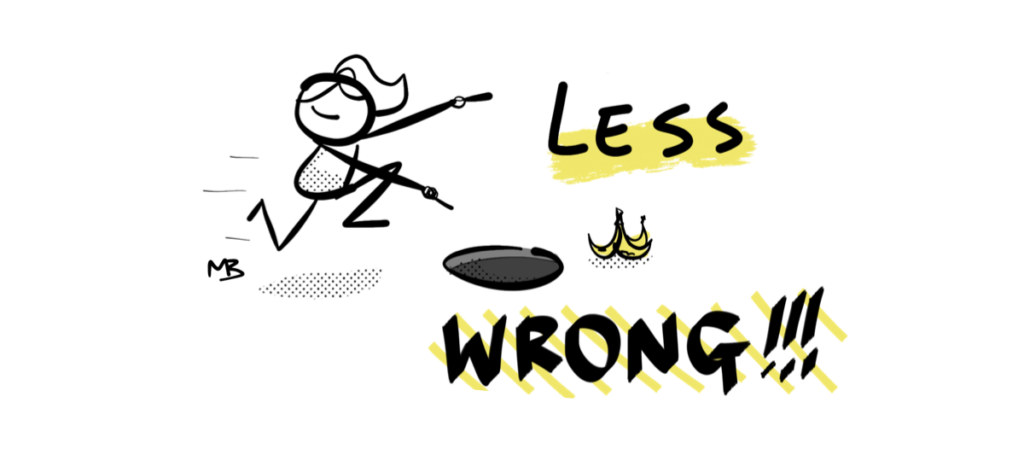
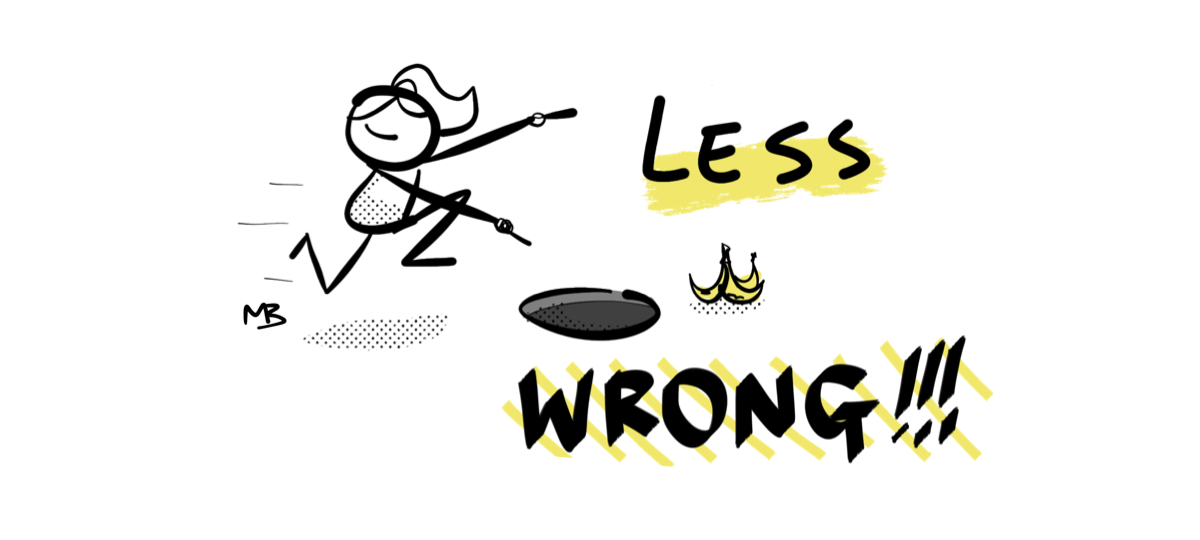
Kit closed by looking back on how far she’d come. She’d once expected expertise to feel like enlightenment, a Jedi calm where you simply sense the answer. It doesn’t. You just get “less wrong”.
So I crossed out my meditating figure and drew a character running flat out. One arm points the way, and they’re looking back at the team: I don’t know exactly where we’re going. I’ve done this many times. It won’t be perfect. We’ll be less wrong than last time.
That also describes my own practice. Live sketching is always a sentence behind the speaker. While I was finishing the boring scene, Kit moved on to “flat action”, and I only caught the edge of it. I sketched it anyway: a strong opinion on the page, ready to be revised. Exactly what she was asking us to do.
The sketches aren’t a transcript. They’re a record of what it felt like to hear her, and that feeling is what makes a message stick.
Want to see all the sketches? Download the PDF from Dropbox.
Drop me a message if you want me to sketch your event.

Executive communication coach helping business leaders use speaking to drive growth. My 5 Steps of Intentional Communication turns every stage, meeting, or keynote into a business opportunity.
You need to load content from reCAPTCHA to submit the form. Please note that doing so will share data with third-party providers.
More Information