
Digital agency Torchbox has gathered the SEO data of over 50 charity websites across eight sub-sectors to provide a benchmark of organic SEO performance across the not-for-profit space.
Torchbox has measured success against six SEO metrics, including technical health, backlink profile, and content. The data has been presented as a card game, allowing you to play your nonprofit against other charities operating in a similar space.
As well as a physical pack of cards, there is also a Super Trumps website, where you can play the game, read the state of the sector review, visually compare the performance of all included charities and read the individual sector reports. The eight subsectors analysed are:
“We hope this gets some conversations started internally about the value of SEO at charitable organisations, and if not, we hope this at the very least raises a smile!”
Phil McMinn, Digital Marketing Director, Torchbox
The Super Trumps project was launched at an exclusive webinar, with guest speakers from Oxfam, Sightsavers, and NHS Digital – with a panel discussion around SEO utilisation in the nonprofit space.
“It was a really great session. Very informative and has given us plenty to consider for 2022.”
Kim Watson, Head of Marketing, Versus Arthritis
The response to the project has been incredible, with positive feedback from charities that are and are not included in the analysis. Also, requests from other nonprofit sectors, such as Think Tanks, to be included in the next benchmarking analysis!
“Absolutely nerding out over these #TorchboxSuperTrumps. Who knew SEO benchmarking could be this fun?”
Dan Papworth-Smyth, Head of Digital Engagement, Breast Cancer Now
Torchbox’s overarching goal is that this benchmarking exercise will help to highlight where opportunities lie to utilise SEO and provide the data to illustrate what is possible in the not-for-profit sector.
Join the discussion #TorchboxSuperTrumps
Lockdown puppies. Admit it. You considered one. A little companion to keep you company working from home, a playmate for the kids and a reason to get out for your 10,000 steps each day. And if you did end up getting one? You’re not alone.
According to the BBC more than 3.2 million more pets were bought during lockdown. Veterinary charity PDSA’s research shows nearly 2 million of these were puppies, with many owners saying it was the first time they had owned a pet.
Over the same period 1.4 million more claimants registered for financial support as the pandemic effectively stopped people being able to earn a living. More pets, more first time owners and more economic uncertainty. A perfect storm for PDSA who treat the pets of owners who cannot afford veterinary treatment.
PDSA turned to CRM specialists Flourish to develop a campaign to raise awareness and money to meet the forecast jump in demand for their services. The resulting Give Pets a Fighting Chance campaign went live in late November 2021.
An initial priming film was shared on social and via email underlining just how much pets mean to us and have enriched our live during lockdown. This was followed by a fundraising phase on social, email and via direct mail to existing supporters.
The campaign celebrated pets, paying homage to just how amazing they are for our physical and mental wellbeing. This celebration provided the platform from which to ask for donations witch communications suggesting that: “For all pets do for us, they deserve a fighting chance.”
The response to the campaign has been incredible, with celebs including Ricky Gervais, Michaela Strachan, Alesha Dixon and James from the Vamps showing their support on Twitter.
Preliminary results are incredibly encouraging with the campaign being well on track to meet its financial targets to make sure any increase in need for PDSA services will be met.
Laura Tovar Senior Account Director at Flourish said: “The potential increase in need for PDSA services had to be addressed, and quickly. We’ve been working with PDSA for 3 years now and in that time our campaigns have always hit their targets and often smashed them. Our Give Pets a Fighting Chance campaign has been well-received and I have no doubt that many pets lives will be saved as a direct result of it”.
If you have a CRM project you’d support with, you can get in touch with Flourish by contacting Steve Davis. Alternatively take a look at some of our work.
Anne Thistleton, the founding partner of LIGHT Consulting who has spent over 20 years as a marketing practitioner in the field of mind science, joined us from South Africa for an online event where she shared fascnating insights about how understanding the way the human mind works can help creatives build more effective campaigns. Dan Martin summarises her brilliant advice
Anne opened her talk with the story of the 2007 experiment which saw world-renowned violinist Joshua Bell pose as a busker in a Washington DC subway. Despite usually being able to command audiences paying thousands of dollars to see him play, out of 1,097 people that passed by, just 27 gave him money, and only seven stopped and listened for any length of time. In total, he made $52.17, $20 of which was from one person who did recognise him.
You are currently viewing a placeholder content from YouTube. To access the actual content, click the button below. Please note that doing so will share data with third-party providers.
So why did that happen? “People didn’t hear him because we don’t hear with our ears,” Anne said. “We listen with our ears, but we hear with all of our senses. They are constantly sending information into our mind, enabling us to connect the outside world with our memory and make sense of the world…influencing how we act and how we react.”
The people in the subway, Anne explained, were getting clues about what was going on at an unconscious level. They were telling them that they were in the subway and connecting with memories of seeing past performers who they passed by and didn’t have time to stop and listen to. Joshua Bell was just another busker.
Anne shared more examples of mind science in action:
In Australia, Mcdonald’s increased the price of a cup of coffee from $1 to $2 and sales doubled. A colleague of Anne’s visited and said the “coffee even tasted better.”
A study of a Cinnabon store found when someone was close enough to take in the aromas of the bakery products, they were three times more likely to help someone with a problem or question compared to customers in other parts of the shopping centre.
In a print ad for a delivery company, a clock was put on the wall in the image. It was “a clock that no one can consciously recall but when asked to describe what they remember from the print ad, expectations of speed and service increased by 50%”.
During a two week experiment in a supermarket, French music was played for the first week and 77% of wine sales were French wine. The next week they played German music and sales of German wine increased by 73%.
A study by a team of Yale professors showed that when an offer price by a customer to pay for a new car was rejected by the salesperson, buyers sitting in a soft chair at a car showroom increased their offer by 40% compared to those sat on a hard chair.
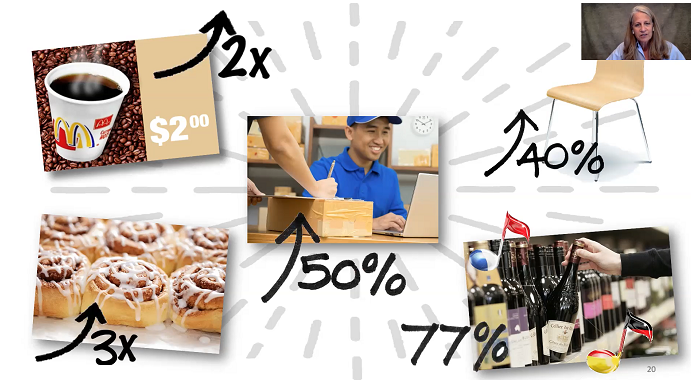
Why did all that happen?
“While we as marketers have been stuck in the dark ages of decision making, the good news is that there has been a complete explosion in mind science and how the brain works,” Anne said. “And the undeniable headline is humans are not rational decision makers. We’re not even rational thinkers.”
Take the example below. If you were asked out of the two tables which one you’d like to take a nap on and which you’d prefer to eat pizza from, you’re likely to pick the one on the left for the first question and the one right table for the second. But as the image shows, they are exactly the same size.

This file is licensed under the Creative Commons Attribution-Share Alike 4.0 International license.
“Even though the image shows the tables are the same size, you still can’t see it,” Anne said. “It demonstrates that in many instances we are still unable to see things in a logical, rational manner.
“Our mind is the most complex system in the world. But with just a few basics, I believe it can materially change how you look at communication.”
The science behind why the above results occurred can be explained by mind science. Watch this video with Anne outlining it in detail:
You are currently viewing a placeholder content from YouTube. To access the actual content, click the button below. Please note that doing so will share data with third-party providers.
Now we know how the science works, here’s why the results above in the five examples occurred:
McDonald’s $2 cup of coffee: “Over time, our minds have been trained to know that a high price means high quality and vice versa. And at that point in time $2 was an abnormally high price for a cup of coffee in McDonald’s, but not in Starbucks. As the “Starbucks node” has already been created in the mind of the audience, where expensive coffee means good coffee, then the $2 primes them for a good cup of coffee. McDonald’s can’t sell a bad cup of coffee, make it expensive and pass it off for a great cup of coffee, but they can make a good cup of coffee that can become a great cup of coffee because of the cues that they’re priming their audience with.
Cinnabon: “Aromas of fresh baked goods lights up powerful memories of home and family which makes you feel good. So when someone asks you for help with something, you’re going to do it because you’re already in a much better mood.”
Delivery company print ad: “In Western society, clocks have become associated with timeliness. The clock implicitly lights up this idea and the core message of speed and service, which is exactly what the company is trying to do with that print ad. Even the background items, the ones you can’t recall, are picked up by our non-conscious processor and can have a significant impact on the message.”
Wine sales: “Just like the clock on the wall was bypassing the customers’ conscious visual processor, the French and the German music wasn’t consciously registering either but it was lighting up those ideas via people’s auditory processor. French or German-related memories were guiding customers to those specific shelves.”
Car buying: “We take on information through our sense of touch all the time, whether actively as we’re touching something or passively such as being seated in a chair. It turns out that the hard chair equals a hard heart. It triggers feelings of duty, stability and toughness. For your next salary negotiation, may I suggest you look for that hard chair so that you don’t give it too easily.”
Anne concluded: “The important thing for all of this is that it’s the non-conscious processor that’s wielding the enormous influence. That’s what’s driving so much of our decision making. That’s where the power lies.”
So what steps can you take to use mind science to improve your marketing and creative campaigns?
For every piece of communication you send out, ask what are you lighting up and do it from all of the five senses. Do a sensory audit, Anne said. “Think through every single single sense and it’ll be amazing what it will eliminate.”
Although an exaggerated example, Anne said say you were running a condom brand. Your options for a message on the front of the packaging are ‘5% failure rate’ or ‘95% success rate’. “If you ask the question of what are you lighting up, do you want to be lighting up failure or do you want to be lighting up success?”.
“Focus groups, online mobile surveys, brand tracking. The problem is these traditional methodologies are all talking to the conscious processor because we thought that’s what drove action. But remember, when you talk to the conscious processor and you ask people who’ve just bought either French or German wine did music influence your choice, 86% are going to say no. But that’s isn’t the case because you monitored the behaviour and the only thing that changed between one and two was the music.”
Examples of research which led to failures include Heinz’s green ketchup. The company failed to understand how colour influences a decision, Anne said.
‘New Coke‘, a new recipe for Coca Cola, is another example. “It was the most highly researched new product of its time; 40,000 interviews and $4m spent. It was an incredible disaster because they didn’t realise they were talking to the conscious mind. The brand is so much more than just what is inside the can and defined by a taste test.”
Anne said methodologies that can help you surface what’s happening in the non-conscious processor include metaphor elicitation, implicit association testing, biometrics, eye tracking and facial coding.
The first principle for connecting is that it must be easy, tell simple stories and don’t make them hard to understand. “Stories are the glue of our memories,” Anne said. “It is how knowledge was transferred before the written word. Stories speak to the rhythm and the patterns of our mind.”
Secondly, it must be sticky. Make it memorable. “It’s got to get into long term memory to drive behaviour,” Anne said.
Thirdly, you must then repeat and repeat until it makes a strong connection.
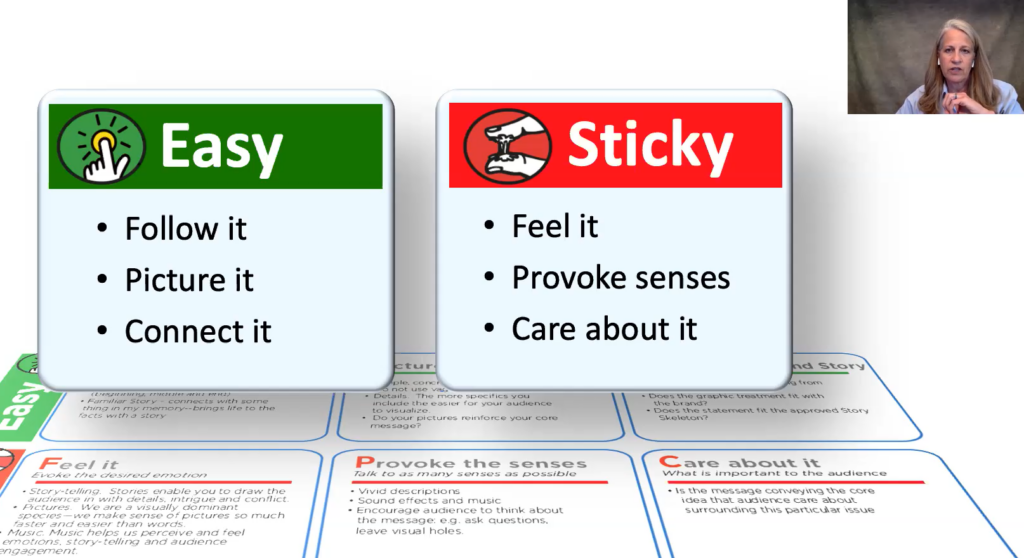
An example of an advert that follows the principles above is this one:
You are currently viewing a placeholder content from YouTube. To access the actual content, click the button below. Please note that doing so will share data with third-party providers.
“The ad tells a story,” Anne said, “but they also weren’t afraid to leave things out and because they did that we can co-create, we can picture ourselves in it and we can feel it.”
Marketers and creatives should harness the power of their own non-conscious processor because that’s where your creativity and your imagination lies.
Anne said: “You have got to find your mental playground. Find a consistent time and place with no phones, no music, no friends, just you so you can cultivate your creativity and your imagination. That’s the core of your livelihood.
“One thing you don’t want to do is brainstorms. They go so quickly that you’re only tapping into your conscious processor. That’s not where your power for ideas lies. Also, a typical rule of brainstorming is no criticism. You actually want criticism. I know this almost sounds like sacrilege, but you want criticism because you’re trying to expand your mind. You’re trying to get to the parts of the mind that don’t often get tapped into.
“You need to use criticism because when you hear something, it lights up a different part of your mind, it fires in new ideas, and you start to connect that to what you already know.”
Taking us back to the first story at the start of her amazing talk, Anne concluded: “We are all Joshua Bells. We all need to be heard and mind science provides that powerful learning to enable us to be heard.
The creative industries contribute to making Bristol and Bath amazing places to live and work. But how can they grow and prosper? Tell us in our survey here.
The new ‘Intro to Game Art’ short course will give you an insight into the world of game art, exploring the range of roles and essential skills needed to get you started when exploring a potential future career in game art. There is a host of exciting modules that your tutor will guide you through, including:
Planning and producing work to a design brief.
Working in the games industry
Concept art for computer games
Modelling for computer games
This new and exciting programme is designed to equip individuals (aged 19+) with the technical skills, knowledge and understanding needed to produce digital content across several platforms, ensuring you can use social media most effectively for your small business, sports team or trade.
This course will provide a great opportunity for you to develop media production techniques, such as camera operating (on mobile devices, DSLR cameras and broadcast cameras), video editing, graphics and motion graphics to produce content for Instagram, TikTok, Facebook and more. There is a host of exciting modules that your tutor will guide you through, including:
Planning your Project
Camera Production Techniques
Sound Recording Techniques
Editing Techniques
This new and exciting programme is designed to equip individuals (aged 19+) with the technical skills, knowledge and understanding needed to produce digital content across several platforms, ensuring you can use social media most effectively for your small business, sports team or trade.
This course will provide a great opportunity for you to develop graphic design techniques, such as designing and producing a brand identity and branded graphics for Instagram, TikTok, Facebook and more. There is a host of exciting modules that your tutor will guide you through, including:
Planning your Project
Typography and Layouts
Working with Illustrator and Photoshop
Creating a Brand
We can’t think of many businesses that don’t need some sort of digital presence these days. For many a dedicated business website is essential to sell, collect leads, provide brand awareness, or company information.
For this website to work well for the business it needs to be found, and it needs to stand out from competing websites. This is where the search engines come in, and SEO. Unfortunately, the world of SEO can seem impenetrable to the inexperienced, with its secret algorithms, computer languages and technical knowhow. It is a highly specialised discipline that most companies need help with on a regular basis. A particular challenge is often how to get the balance right between SEO, eCommerce and usability in your page content. You may need the support of SEO experts for this, hence a proliferation of national and local SEO Agencies.
All SEO Agencies promise higher rankings and more traffic for your site, so how can you be sure you are hiring the best, the one that will be able to deliver on that promise and more? There are no professional accreditations, no formal qualifications for SEO. But there are things you can do to make sure you are hiring a great SEO Agency to work with you.
Step 1 – Research SEO Agencies that have a similar client profile to your business
This might be similarities in the industry you work in, or in company size or budget size, or even in ethical outlook or company vision. Have a detailed look at their website – is it professional, useful, knowledgeable, and engaging? And where do they rank for terms relevant to their business like ‘SEO Agency in [INSERT CITY THEY ARE IN]’, ‘SEO Agency in [INSERT INDUSTRY THEY WORK WITH]’
If they can get their own website to rank well for highly competitive terms like these then they know what they are doing!
Step 2 – Make a short list
Research and make a shortlist of 3 or 4 agencies, including a mixture of maybe regional and national, or large and small SEO firms and call them to arrange a telephone or face to face interview.
Step 3 – Watch this excellent video
Have a watch of ‘How to Hire an SEO Agency’ from Maile Ohye, who was a top Google representative. If you don’t have time to watch it below, (11 minutes) we have outlined all the main points in the next section of this article.
Step 4 – Ask for references
Testimonials and case studies are useful however, these may not always give a complete picture. Ask for a few references of their current or past clients and drop them a line or call. If other clients are willing to take a few minutes to recommend the agency’s services, then that is a great thumbs up.
Step 5 – Be prepared to give it time
SEO is a mid to long term marketing strategy. It is unlikely you will see positive results immediately – we recommend 6 to 9 months is the absolute minimum time you should wait before assessing the outcomes and next moves with your chosen agency. If you jump ship too early you may end up losing all the SEO advantages you have just invested in. But do expect to be kept fully informed on progress on a regular basis.
If you have not got the time to watch the video, then do have a read of our synopsis of the advice from Maile Ohye, in the official Google video on finding the best SEO company for you. You can read the helpful tips and advice all about selecting the right SEO agency for your business.
If you would like any more advice, or to discuss a technical SEO audit or what we feel our SEO agency can offer you, then please give us a call and talk to our SEO experts. We are a specialist SEO agency for Bristol and would like to understand your business and help you to achieve your goals. We have SEO clients who are happy to provide references for us and give you the low down on their results and what it is like to work with us, so if you would like to chat to one, we can put you in touch.
If you’re considering using a copywriter, whether for your business blog, writing features for trade media, or penning longer thought pieces for social media, but aren’t quite sure how it works, here are some of the questions I’ve been asked, that might help you decide the best route forward for you and your enterprise.
Most copywriters will start by learning about your company. Whether that means reading through your website, looking at any hard copy marketing materials you have, talking to you and your team about your business and why it’s different from competitors offering the same product or service, a good copywriter will immerse themselves in your business world.
Once they have a good knowledge of your offering, they will ideally then create a schedule of content ideas – a plan as to what you could be talking about on your chosen medium and when. This plan may need to be flexible as new things crop up and priorities change, but it is useful to create visibility and transparency about work that has been completed, is in progress or is in the pipeline for a future date.
By having an informal chat up front, copywriters can glean all the information they need. What seems ‘every day’ and ‘not exciting’ to you is often gold dust from a marketing perspective. It’s hard to see it when it’s your own business, but a third party looking in can see all the benefits you have to offer.
Of course, some input from you will be required, but it shouldn’t be a hassle for you to pass this information across. For example, perhaps you work it into your working week or month, to jot down some thoughts about what you would like your company to be talking about, depending on what’s cropped up throughout the week. This shouldn’t be an extensive essay, just some scribbled notes or typed bullet points of headings or topics you would like your copywriter to explore on your behalf. For example, if you’re a yoga business, perhaps a client asks for advice on which yoga postures they could explore to help them sleep better. If you make a note of it and fire it off to your copywriter, they can place it in the schedule and when the time comes, research that topic and write a post for your approval.
No problem! Whilst I have come across a few copywriters that are precious about their work to the point they’d rather not make any changes, most of us are happy to work collaboratively because we understand that each piece of writing needs to reflect your business and your values. It’s very unlikely you would find yourself in a situation that you need a complete re-write, because hopefully you will have seen samples of your copywriter’s work before engaging them and you will have approved the subject matter before writing even commences., but if their writing style consistently isn’t working for you, or you feel you are having to have too much input, it might be worth looking around for someone else to replace them. Working with a copywriter is meant to make your life easier, not harder!
Every copywriter will be different but on the whole, if you have found someone that offers a copywriting service for business blogs, they will be happy to post your blogs too. They may need a bit of training on your particular blog admin system, but for a small amount of effort up front, you could be saving yourself a lot of time in the future. And if you’d rather keep control of posting the blogs yourself, that’s fine too. A good copywriter will be eager to work with you in a way that suits your business and fit in with the way you like to work.
Again, each copywriter will offer a different service when it comes to supplying images with the posts they write. Some have subscriptions in place with image websites such as www.shutterstock.com, so can usually find something suitable to accompany written pieces. Some may not use a subscription service but are happy to check on royalty free sites for images such as www.pixabay.com or www.pexels.com. These searches may or may not be fruitful depending on your line of work and how specific the search.
Do bear in mind though, that some feature articles or blog posts will require photography or imagery from you. If you want feature posts on your blog to introduce your team for example, or highlight a new product offering, you will need to take on responsibility for sourcing those photos yourself.
You should absolutely check any copy that has been ghost written for you before it goes live on your site or is printed in a magazine. At the end of the day, it’s your business being promoted, and you must be happy with how you’re being represented. Hopefully, when you have found the copywriter that works best with your business, it will be a quick read, and all will be well. Worst case scenario, you spot a couple of minor tweaks you’d like to make before the piece is published.
Again, if you find you are constantly making considerable changes to the writing you are presented with, it probably means you haven’t found the right copywriter just yet. Do keep looking because we all have different strengths, specialisms and interests that we can bring to the table.
Of course! Some businesses use copywriting services to complete ad hoc blog posts or feature article writing, in which case this won’t be relevant. However, if you are looking to partner with a copywriter for your features or business blog for the long term, you may be concerned about signing up for a set amount of work each month, for example two features a month, or four blogs a month. There shouldn’t be any need to worry about this as most copywriters are flexible with their output as long as they have some notice. So, if you sign up for four blogs a month and you find this is too much for you, talk it through with your writer and they will more than likely be able to switch you onto a different package. You may need to alter your contract with them, but this should be perfectly reasonable request. Similarly, if you agree to two features a month from the outset and find you have plenty more to say, ask if they have the capacity to take on more. If the answer is no, you may be able to find another copywriter to supplement the work.
These are some of the most common questions I have been asked when I start working with a new client, but if you have any other questions about outsourcing copywriting to an external copywriter, please drop me a line at [email protected] and I would love to help.
When many people think of SEO they think of Google and other search engines and how to higher up in the ‘rankings’ on their results pages.
Whilst this is still crucial and for many the cornerstone of the industry as a whole, there has been a lot of evolution in other platforms as well and the phrase SEO now covers optimisation strategies and techniques on a wide range of different platforms and sites including:
Essentially, you should be thinking of SEO whether you are uploading your latest company podcast or sending out your next company tweet. There are plenty of opportunities to get your content in front of a wider audience without focusing too much on the orderly nature of rankings.
Here we have compiled a guide of actions, strategies and quick wins that you can implement to improve the SEO of your Instagram page and start to create an audience that will support your growth as a business.
For the sake of time we will assume that you already have an Instagram page set up and ready to go with a good idea of the content you are looking to share, so where do you start with your SEO on the site?
One of the main steps you should take is to optimise your Instagram profile page. Not only will this help your SEO, but it will also add valuable content that will help visitors to the page work out who you are and what you are about. Below we have listed some of the steps to take to optimise your Instagram page for SEO.
If you want to optimise your profile for Instagram then including some primary keywords within your name and username will help increase your searchability, although it should be stated this is not the be-all and end-all for Instagram SEO. It is also worth noting that snippets from the profile bio’s are also pulled through, strengthening the case for having some target keywords within the first line of your Instagram bio.
Try to avoid ‘keyword-stuffing’, just like Google, this can be a spammy tactic that will not get you anywhere on a platform like Instagram where content is key and optimisation comes in as a supporting function.
Captions are a big part of Instagram SEO, and if you write keyword optimised captions you will make it easier for the Algorithm to pick up your posts and share them with the relevant people. It is worth noting that the content will be shown to different people depending on their interests, if you are a coffee company, your posts will be more likely to be shown to people who have expressed an interest in coffee, particularly if you are including relevant keywords within your captions.
Alt tags are fantastic if you are looking to upgrade your Instagram SEO, and whilst they are less important in the eyes of Google, they can still have a considerable impact on the social media platform. Much like on your website, alt tags will help visually impaired audiences and you can use #hashtags and competitor handles in your alt tags to improve visibility and be found alongside your competitors and other relevant content. Make sure the alt tag is descriptive enough to be of value to potential audiences.
Additionally, a recent talk from Digital AdDoctor’s Freya Jones at BrightonSEO confirmed that #hashtags should be included within the caption of your Instagram posts as opposed to the first comment to drive better engagement. This is crucial if you want your #hashtags to be picked up by the Algorithm to improve your Instagram SEO.
Whilst #hashtags are very important in Instagram just like other social media networks, you no longer need #hashtags to search for people or accounts, the information you have in your username and bio has become more important.
Whilst you may be tempted to use certain ‘black hat’ SEO tactics in Instagram like buying followers and likes, we recommend avoiding it at all costs. Much like Google, the Instagram algorithm will get better at weeding out companies employing poor tactics and punishing them accordingly.
Once you have implemented a good Instagram content plan optimised for SEO you will want to find a way of tracking your progress. Find a good analytics provider and measure your results, we recommend not putting too much focus on vanity figures like followers as these can be misleading, although they are still very useful as a starting point.
Look at your engagement and find out if your SEO efforts are helping you get greater coverage on Instagram, this will help you work out what the next steps are and how to use the additional coverage to drive better results and revenue for your business.
If you are looking to drive leads and traffic to a site, then make sure you consider that aim when it comes to your Instagram SEO. Whilst this should not be the end goal, getting users off the site and into your databases and lead funnels will help give you more control over your channels, although it is worth noting that engagement on the platform is just as important. Try not to view Instagram purely as a means of driving leads and signups for your business and potential clients.
Whilst having a strong Instagram presence will not directly impact your SEO in Google, it will help you build an audience and drive relevant and engaged traffic to your site, which will help build your overall digital visibility and following.
Make sure you keep an eye on your Instagram and keep up to date with any new SEO changes and tactics the site may be making to ensure you stay ahead of the competition. Of course, if you would like any information on SEO and how we can help, then feel free to get in touch with a member of the Varn team today.
What does the future of PR and marketing look like? Business leaders are planning ahead for 2022 in one of the most unique situations that people have faced. How do you prepare your business for life when dealing with a pandemic?
AMBITIOUS and Insider Media spoke to business leaders in the South West to find out what their approaches to PR and marketing will be in 2022. Which areas will be their focus? Where are they increasing their investment? And, where they’ll be choosing not to spend.
The answers show that business leaders in the South West are planning to invest: engaging with their core customers and visitors more than ever before. And not just their customers. Thanks to a skills shortage across many sectors, using online to source new recruits is alo where businesses will be investing. As a result, online activity is becoming more important than ever for PR and marketing activities.
Life really did move online during the last 12 months and while in-person events are starting to come back, digital has taken the lead on many aspects of businesses. As well as B2C companies, B2B businesses are seeing the value of social media and how to use it for success.
Mike Ribbeck, Insider Media Editor said: “As the purse strings tighten, business leaders look at expenditure and decide which are the most important functions to protect and which areas of the business are expendable.
“The reality is that, rather than bringing the world to a standstill, the pandemic has accelerated many of the trends that were reshaping the world that we all live and work in. The digital revolution has picked up pace and businesses from all sectors and different sizes have made the transition to operating virtually.
“All of that means that the need to get the message out about your business and the services it can offer has never been more important.
“And the channels of communication to potential clients and business partners have continued to multiply with social media playing an even more important role when it comes to marketing and PR.
“According to our survey, the majority of businesses have maintained the level of spending or even increased.
“One of the most interesting findings was where businesses will be concentrating theory efforts. The two main areas that stood out were content creation and social media.”
Our survey has found that there are six core areas where business leaders will be focusing their PR and marketing efforts, including content, PR and SEO. Results from our survey include:
Phil Smith, Managing Director, Business West, said: “In the past 18 months, South West businesses have wrestled with a unique and complex set of challenges as a result of Brexit and the pandemic.
“Whilst business impacts such as social distancing measures are temporary, labour shortages and inflationary pressures look set to continue (at least in the medium term) and could have a stymieing effect on our economic recovery.
“As the government looks to recoup some of the £300bn+ that it spent during the pandemic, SW businesses will no doubt be anxious about potential tax hikes and rate increases.”
It is encouraging that businesses recognise the huge part that PR and marketing play not only in boosting their brand and growing sales but generating awareness of new products and services too.
It is also evident that marketing has a vital role in attracting, engaging, and recruiting talent into the business (as well as helping to retain talent). Indeed, today’s job candidates discover and weigh up potential employers in the same way they find consumer goods, restaurants, and hotels. It is mission critical that marketing budgets reflect this digital shift.
The amount of online content consumed by the average person doubled to seven hours a day. Social media activity increased by 12.3 per cent with the average person spending nearly two and a half hours on social sites.
A clear, resounding message from the businesses we spoke to is that we are going through an accelerated pace of significant change.
The pandemic hit the fast forward button, transforming consumer perceptions, expectations, and behaviours almost overnight. There are no pause or rewind buttons – consumers and the world have moved on. This has profound implications for how we market ourselves. Failure to keep up with the pace of change could mean being left behind forever.
Download your copy of the white paper now.
You need to load content from reCAPTCHA to submit the form. Please note that doing so will share data with third-party providers.
More Information