The new year has continued on a high with Mr B & Friends appointed as the primary brand and marketing agency following a pitch.
Regina is part of the Sofidel Group, one of the leading global manufacturers of tissue paper for hygienic and domestic use. Regina is its most recognised range of products, with Blitz household towels, Seriously Soft and Seriously Strong toilet tissue and XXL kitchen roll among its core brands. The agency will lead the brand, creative and campaigns for Regina as it seeks to grow its share of the UK market.
Simon Barbato, CEO of Mr B & Friends, says, “We’re delighted to be chosen as Regina’s lead brand agency in the UK. The appointment marks a strong start to the year for us and we’re pleased to add Regina to our growing portfolio of FMCG clients.”
Mr B & Friends previously worked with Regina UK on a standalone project for pet cleaning towels, before being invited to pitch for the primary range at the end of 2020. The agency will be providing expertise in strategy, communications and campaign planning, as well as developing creative and digital campaigns and delivery.
Graeme Bralsford, Marketing and Sales Director at Sofidel UK said, “Having previously worked with the Mr B & Friends team, we felt they understood our brand and values. We love their clarity of thinking and creative excellence. We’re excited to see what we’ll achieve together.”
Executive Creative Director at Mr B & Friends, Steve Richardson, says, “We love FMCG work. Sofidel have some much-loved household brands and to renew acquaintances with the client team has provided brilliant chemistry and spark to our work. Looking forward to 2021 and beyond.”
Work has begun work on the account with virtual introductions to the Regina team and agency partners as well as developing campaigns for the coming year.
What do a Bristol-based integrated marketing agency and a team of world-leading wet blasting experts have in common?
No, this isn’t the start of the world’s worst joke. It was, however, a topic of discussion at Proctors HQ recently, as we talked about a series of surprising discoveries during Vapormatt and Proctors’ first year of working together.
But what similarities could there possibly be between a business who engineers and manufactures technology for some of the world’s most high-tech sectors; motor racing, aerospace, additive manufacturing/3D printing, medical implants and surgical tools; and a business whose bread and butter is creating marketing campaigns with a gut-punching impact?
40 years of expertise
Vapormatt and Proctors’ working relationship started in 2020, otherwise known as The Year We All Want to Forget (But Can’t). Rather than this challenging 12 months compounding the pressure placed on our first projects together, it instead highlighted a number of the incredible qualities shared by both businesses.
From our ethos, to our team spirit, to our niche specialisms – there’s a lot to be said for what we share. And one of the most apparent surface-level similarities between our businesses is our age.
Both Vapormatt and Proctors have more than four decades of expertise, cementing both companies among the longest established within their respective fields.
Stewart and Terry Ashworth founded Vapormatt in 1978, growing quickly after a move from Guernsey to Taunton. Before long, Vapormatt had outgrown their new facility and discovered their niche: they wanted to build their own machinery, to their own high standards, so it matched the teams’ exceptional skill and proficiency.
This shift marked the true birth of Vapormatt’s wet-blasting business as it looks today. Vapormatt is a true pioneer of wet-blasting technology, offering world-leading tech complemented by unrivalled capability.
Similarly, Proctors has spent the last four decades refining its knowledge, practice and gaining unrivalled experience in the marketing sector. From the heart of Bristol, our 70-plus team is made up of award-winning creative, strategy and technology professionals – all of whom are experts in their own specialisms.
Measured and controlled success
For those not in the business of marketing and advertising, it can seem as though concepts are produced at random. A unicorn promoting an energy company? Meerkats pushing insurance products? There is, in fact, method among the madness. Every marketing decision has been researched and calculated in order to create the desired impact on its audience.
At P+S, we like to think we take things even further. We take a learn > build > measure approach to marketing strategy – meaning our work doesn’t stop when the campaign has launched. Instead, we continue to refine our marketing efforts on an ongoing basis.
And Vapormatt are much the same with their approach to engineering the right technology for each of their customers. Their design philosophy is ‘if you can measure it, you can control it’. And as a result of this focus, Vapormatt are leading the way when it comes to repeatable and reliable processing.
If you don’t already know, at its most basic level, wet blasting is a precision-driven process which uses water and slurry to refine an object’s surface with microscopic accuracy. It leaves nothing to chance. And the reason for Vapormatt’s esteemed reputation is largely due to their measured approach and exceptional attention to detail, powered by their understanding of every clients’ business.
Vapormatt’s patented technology and Proctors’ meticulous marketing strategy have a similar foundation: eliminating error and achieving the best results for our customers.
Our relationships set us apart
Any business worth its salt knows it’s not just a single product or function which is responsible for success. And both Vapormatt and Proctors value their customer relationships above everything else.
Vapormatt may be a world-leading technology business, but it’s their aftermarket service which offers the most value to their customers.
Because Vapormatt’s technology is highly specialised, much of their machinery is custom built – meaning it can take more than just ‘plug and play’ approach to use it. But Vapormatt’s promise is that they will work with every single client, offering hands-on guidance and remote assistance, individual expertise and teams of professionals to support every project. In fact, once the team have committed to a project, they don’t just find their clients the right tech and leave them to it: they stand by their side at every step of their production journey until they’re satisfied.
It’s a similar relationship to the one Proctors has with its clients. We don’t just push out marketing campaigns for our clients and leave. In fact, we view every job as an opportunity: to build deeper relationships between our clients and their customers, to open up new channels of brand-customer communication, or to simply assess what we can change to make our communications even more powerful.
And testament to the strength of our relationships? We’ve been working with many of our clients for decades, as we continue to bring them new ideas, fresh proposals, and identify innovative, relevant opportunities for their businesses.
For both Proctors and Vapormatt, our success lies in not just serving our clients: but in helping them realise new potential beyond what they ever thought they could be capable of.
Never afraid to be bold
When it comes to surface treatment and finishing, dry blasting is still the world’s dominant technology. Even companies who do offer more advanced, precision-driven wet-blasting processes will still offer dry blasting as a service in order to try and secure a larger market share – to capture those customers who may be resistant to trying something new.
However, Vapormatt focus solely on wet blasting – for today and for the future. And rather than seeing this as a limitation, the team knows it pays dividends. As a result of focusing purely on wet-blasting technology, Vapormatt are world leaders in their field. They’re the go-to name for wet-blasting machinery across the globe. And as a result, the team have complete confidence in both their ability and their technologies, so they can guarantee the quality of their machines’ output for every single project.
And at Proctors, we’ve never been afraid to be bold either. Whether through larger-than-life messaging or extraordinary creative, our mission is to make our clients stand out from the crowd, whatever it takes.
From implementing brave B2B messaging, to innovating with Augmented Reality, digitalised direct mail and interactive online content. Whether the brief is to create a simple email or to discover the most effective way to market a new product, we dedicate ourselves to finding more exciting ways of engaging our clients’ customers and showing off their products and services.
Building the world of tomorrow, today
As it happens, this particular integrated marketing agency and Vapormatt’s world-leading high-tech wet blasting business have more in common than you might think.
No matter how niche, technical or specialised your business is, you deserve to get more from your marketing. So if you have an ambitious marketing plan, big dreams for your next product launch, or just need a bit of a boost when it comes to a creative social strategy, talk to Proctors. We’ll be more than happy to put our heads together with yours and see where the year takes us.
Bristol-based technology business, Sparkol, has made a strong start to the new year with a new brand created by Mr B & Friends.
Sparkol provides its customers with innovative software and video tools that help create inspiring presentations and storytelling, together with studio services that turn the mundane into the magical.
Mr B & Friends were appointed to deliver a new brand positioning and identity to increase its marketing effectiveness, whilst retaining the well-established product brands as part of its portfolio. The agency delivered this project through its Beta brand acceleration programme, which resulted in a complete rebrand in less than eight weeks.
The strategy centres on the new Organising Thought: Turn up the WOW! This idea conveys the product capability, creativity and audience reaction of this fast-growing SaaS and services business.
Senior Designer Nathan Crosby commented: “Our creative vision was to capture the spirit of the Sparkol company and the capability of its products. Expressive imagery alongside a bold type and colour system to make a real impact. The new logo design captures the reaction to Sparkol’s products in a clever graphical way.”
Sparkol products are already used in over 160 countries by educators, promoters and communications professionals. The brand refinement further strengthens Sparkol’s position as it targets wider adoption.
Zoe Taylor, Sparkol Owner and CEO, says, “Mr B & Friends helped us to get to the crux of what makes Sparkol special and translated that into a brilliant brand idea, visual identity and tone of voice that really stands out. We exist to help our users achieve surprise, delight and wonder, and the new brand really brings that to life.”
The agency has delivered the new brand strategy, identity, guidelines and key assets during lockdown working virtually with the client. The project was managed by Brand Producer Matt Joy and strategy by Planning Director Adam Partridge.
Simon Barbato, CEO at Mr B & Friends says, “We love the Sparkol story. It’s a story of hard work, innovative thinking and great entrepreneurship. What Sparkol has achieved globally from a modest Bristol base is incredible and we are proud to be able to deliver this platform for their ongoing growth and success.”
Bath-based digital media buying agency, SearchStar, and London-based multilingual digital marketing agency, Adapt Worldwide, have announced that they will now operate as one company, retaining the Adapt name while launching a new-look brand and proposition for 2021.
Both agencies had previously been acquired by international localisation company, Welocalize, with SearchStar the most recent acquisition in 2018.
Together, SearchStar and Adapt become a global Digital Performance Marketing Agency, with an expanded list of services focusing on delivering growth for ambitious clients domestically and internationally. Adapt’s service offering now includes: Paid Search, SEO, Programmatic, Paid Social, Content Marketing, Conversion Optimisation and Web Analytics.
Importantly for Bath and the wider area, the new launch of one of the South West’s largest agencies brings with it new and exciting employment opportunities in the digital sector. With growth ambitions of its own, Adapt will continue to hire aggressively at all levels a it seeks to expand its teams across its entire service offering.
Speaking of the merging of both agencies Managing Director, Jon Greenhalgh, said:
“The integration of SearchStar under the Adapt Worldwide name, and launch of a new agency brand is a huge milestone in an incredibly positive period of alignment within the wider digital marketing operation of our parent company, Welocalize.
“It’s the culmination of two years of progress – the coming together of two highly talented teams of digital marketers into an agency capable of delivering ‘growth without boundaries’, domestically and internationally.
“And it’s not only the growth this move will be able to deliver for our clients that excites me – it also creates fantastic opportunities for the team. An opportunity to truly broaden their horizons and take further steps in their careers.
“Importantly, retaining our identity as a distinct digital brand means we have been able to preserve the agility of operating as an independent. And one able to take full advantage of the truly multi-market nature of Welocalize to assemble teams specifically aligned with each client’s needs globally.
“It is with that support that we find ourselves in a unique position to meet the expectations of today’s most ambitious brands, whatever they want to achieve – be it to launch internationally, bolster growth in existing markets, or identify opportunities for global expansion.”
The launch of the new Adapt brand and integration of SearchStar is effective from 13th January 2021.
POPcomms recently completed work on developing an entirely new interactive sales tool for Bacardi Martini to be used by the reps across the UK when meeting with customers.
The challenge
Bacardi own 62 spirit brands and is the world’s largest privately-owned spirits company.
Sales reps for Bacardi will regularly meet with a diverse customer base from bars, pubs and clubs to restaurants and hotels and within those establishments, they may be meeting with bartenders, managers and business owners, all with different requirements and understanding of Bacardi and its brands.
Meetings might involve introducing the customer to a new brand they haven’t stocked, giving advice on how to upsell premium brands through to in-venue activations, sponsorship, branding and best practices as well as the latest market research and data.
For each Bacardi brand they have a wealth of valuable content from tasting notes, heritage, brand videos and guidelines, associated cocktails, social media assets, as well as business case information.
In the short time a rep has with a customer they often struggle to have more meaningful conversations around any challenges Bacardi can help them with and introducing them to new brands, activations and market research that they can profit from.
Finding the right content at the right time depending on a customer’s needs and the conversation was very difficult.
How we helped
- Our objective was to help those sales reps have more productive and profitable conversations with customers no matter their role or business.
- We wanted to help Bacardi’s customers get more out of those meetings by arming the reps with a more customer-focused narrative and giving them a tool with instant access to relevant and timely supporting content.
The result
From our workshops with Bacardi and their sales reps we mapped out a customer narrative and created an interactive sales tool that let reps personalise the conversation no matter who they were talking to.
The tool gave them access to valuable content, important to the customer, within a couple of taps.
This meant reps could quickly access what mattered to the customer such as market research, best selling cocktails, up-selling best practice, latest brand activations etc. within seconds saving precious time meaning more time for the customer.
Sales reps now have exactly what they need, precisely when they need it.
iO Academy is on a mission to help to address the gender imbalance in the tech industry, and give people the training they need for a career they’ll love.
Based in the South West, iO Academy is tackling this head on with a rebrand that speaks to their core values of inclusivity and accessibility. Working with Bristol-based creative agency, Fiasco Design, they’ve created a brand that reflects their ambitions of creating a more diverse and inclusive industry, bringing about meaningful change.

It’s no great secret that there is a representation gap for women in tech. More inclusive career pathways in the technology industry have been the focus of various initiatives, such as Tech Talent Charter, Code First Girls, and Tech She Can, along with the Department for Digital, Culture, Media & Sport’s Digital Skills Innovation Fund and the Academy’s own Diversitech Fund.
Women in tech – key stats
-
Over a quarter of women students say that they are put off a career in technology as it’s too dominated by men. (PWC)
-
The UK economy would benefit from an extra £2.6 billion each year if the number of women working in tech is increased.
-
83% of millennial British women stated that they actively seek out employers with a strong record on diversity, equality and inclusion. (PWC)
-
Women account for 50% of the UK working age population but only 16% of IT professionals are women. (BCS)

The New Brand
iO Academy is an award-winning coding bootcamp based in the South West. In 2015 it was set up by healthtech company Mayden – not initially as a business, but as a way to solve a problem. Like so many tech companies around the UK, they needed more developers to sustain their own growth. So a team of Mayden developers designed a programme that would train people with no coding experience to be industry-ready developers in just 16 weeks. Their direct tech experience led them to build a course with a new approach; one that gave students the up to date and practical skills that were needed most. A course that anyone, regardless of their gender, ethnicity or background, could come out of as the sort of developer that tech companies want to hire.
After five years in business, it was time to look at themselves and uncover the ingredients which would make them an innovative, purpose-driven brand.
The Academy reached out to Fiasco Design at the start of 2020 with a view to repositioning the company, reflecting their own growth from an idea to solve a talent shortage, to a company with an international reputation. The aim was for a fresh, future-proof identity that would appeal to a diverse range of prospective students and break down perceptions about the tech industry.
With graduates working in tech companies from Bath to Berlin, a 50:50 ratio of men and women trainers, and a strong work ethic towards diversifying the industry and creating an environment that facilitates opportunities for all, Fiasco Design and Mayden Academy embarked on a full strategic review of the current branding; assessing their DNA and defining their core values and company proposition.
Through a number of workshops conducted by Fiasco and Mayden, a new brand name was formed; iO Academy. On the one hand it’s a clear nod to coding language – IO is shorthand for input/output in computer programming. On the other it’s also the name of one of Jupiter’s moons, which seemed a good metaphor for the brand’s innovative, future-focussed outlook.
Margaret Davidson, Business Development and Marketing Manager at iO says, “Fiasco saw right to the heart of who we are as a brand and came up with a visual identity to represent us which we would never have thought of ourselves. In particular, what we wanted was to become more attractive and accessible to a wider range of people, with a core focus on diversity and inclusivity. Working as part of a new niche sector within a wider industry that often seems intimidating, this was a challenge. Fiasco came up with an approach where we now feel confident that an underpinning of inspiring inclusivity will be clear in everything we do, and help us to be part of bringing meaningful change.”
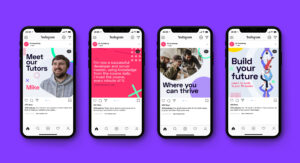
With the name and proposition came a new visual expression for the brand. The visual language is designed to reflect exploration, harnessing imagination and working towards a better future. The graphic shapes give a sense of wayfinding, collecting badges and new skills following a creative pathway. Verbally the tone is positive, ambitious and empowering, and speaks to the curious and willing.
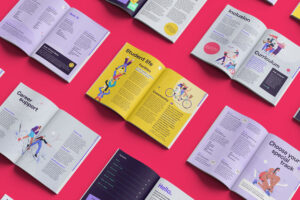
Working with Belgium-based illustrator Soren Selleslagh, the team created a suite of illustrations to depict aspects of the student journey across the course and into their new careers. Soren’s human-centred approach evokes joy and empowerment through positive representation of all types of people. With a devoted outlook to making meaningful illustrations, this partnership gave the brand identity the visual storytelling elements that demonstrate openness and inclusivity.
Ben Steers, Creative Director at Fiasco Design says about the project: “It’s been fantastic to work with the team at iO and help them towards realising their vision of leveling the playing field within the tech industry by creating a fairer, more diverse community of developers”

Welcome back to the second blog in our three-part series on Augmented Reality (AR). In our first segment, we introduced AR technology and explored its potential impact on our lives over the coming years.
But the technology already exists. And so, this poses an opportunity today.
Any brand who considers themselves a true tech pioneer, who is looking to distinguish themselves from their industry competitors, or is ready to forge an unrivalled relationship with millennial and Gen-Z customers, should consider grasping the opportunity AR presents for marketing and customer engagement, today.
Preparing for launch
When it comes to experiential marketing, there’s no better vehicle for delivering an unforgettable brand experience than AR. As mentioned in our previous blog, the possibilities are limited only by your imagination – but there is one decision you’ll need to make early on: how you’ll deliver the experience to your viewers.
For those looking to get started today, there are two methods of AR access to choose from: by building an app, or using WebAR.
For many, apps are the option of choice. In-app augmented reality enables you to control the entire experience from end-to-end, maximising elements such as branding.
Take Pokémon Go, for example. The combination of technology, art and culture to form a real-life treasure hunt was arguably one of the most successful experiential campaigns to date.
During its peak, as many as 20% of Pokémon Go players were using the app every day, and by March 2019 it had been downloaded more than 1 billion times. Those are some vast numbers.
The ease of use was a key factor in the app’s success – and it’s worth noting, there’s no doubt that downloads would have been significantly lower had the app required specialist technology, i.e. had it required additional headwear like ‘Snapchat Spectacles’-type tech to play. But every one of us has a smartphone in our pocket at all times, leaving a near-zero barrier to taking part.
The other option for creating an AR experience is to use WebAR.
Sometimes referred to as WebXR due to its ability to support AR, VR and MXR (Mixed Reality) functionality, WebAR allows you to use an AR experience directly within your browser – without having to download an app.
Most smartphones are WebAR-enabled, making it arguably even easier to access than downloading an app. However, you may have less control over some elements of the design.
So how do you choose the right platform for your audience? At P+S, we believe it comes down to your intent.
If you’re looking to integrate an AR experience into your website, maximise the ‘wow factor’ of your marketing materials or offer an AR experience in real-world locations, WebAR is a great choice. It removes barriers and offers instant access for anyone using a compatible device – without the need for having to stop and download an app.
However, if you’re looking to run a more complex experience – a game, or a more developed user interface like map overlays – then launching an app offers an excellent self-contained, immersive experience with unlimited customisation options. And you’ll have the added benefit of being able to update and push new content without disruption to your other content and materials.
Predicting the future
Apart from creating the next gaming sensation, how can augmented reality actually be applied for brand marketing purposes?
For those businesses promoting a product, it could be as simple as creating the ability for customers to ‘see’ a 3D visualisation of your merchandise face-to-face – all from the comfort of their own sofa. IKEA have recently begun offering just this, enabling customers to view furniture in their homes before ever making a purchase. And with COVID-19 set to disrupt the store experience the foreseeable future, now has never been a better time to offer virtual product experiences.
For those businesses who offer a service rather than a physical product, this is an opportunity to think laterally about marketing.
Let’s take an airline, for example. While enabling customers to view a Boeing 747 in their own living room isn’t necessarily offering value, they could offer an augmented ‘map’ of airline routes across the sky instead.
Or, they could look closer at the in-airport experience. In larger international airports, offering an augmented map that leads customers from the security gates to the airline’s private lounge, or straight to their flight gate, would be a breath of fresh air.
Architectural firms can use AR to show their projects to a client in real-time. Financial services can demonstrate abstract concepts in a more tangible visualised form. And what’s more, the data shows that AR visualisations improve B2B buyer confidence, and help to speed up sales cycles.
Let’s seal the deal and get engaged
From marketing, to product visualisation, to making invisible concepts visible, the AR experience creates higher levels of engagement, increases conversions, and offers a powerful branding opportunity. When done well, it’s inherently social media friendly, shareable and creates a powerful lasting impact.
But that’s not the limit of what AR will bring to brands.
Our next blog, and final instalment of our AR series, is coming soon – stay tuned.
Get in touch
Why not contact us today at [email protected] to discuss your goals with our team.
With COVID-19 meaning social distancing is the new norm, we’re seeing profound effects on our lives. Face-to-face meetings, gatherings and events aren’t possible, making this a difficult time for the general population and most industries. For many businesses, budgets are under increasing pressure as revenue streams are cut and operational and marketing methods undergo huge upheaval.
As a society, we’re worried about our health, our families’ health, our wellbeing and our job security. Now is not the time for brands to choose a hard-sell approach, or to appear to be ‘cashing in’ on – or even preying on – social insecurity, as audiences become less receptive and more critical of insincere marketing.
So how can businesses maintain those physical interactions that are so vital to customer engagement, and promote their services in as effective and relevant a way as possible?
One option for connecting with your customers is through hosting a digital event.
Digital events have become more prominent in the last few years, and offer a range of benefits:
- They’re quick and easy to set up
- They’re interactive and allow two-way communication
- They help maintain your position as category experts and market leaders
- They’re great lead-generation tools and provide a touchpoint with your customers
- Any digital assets created for the event can be used for ongoing marketing purposes, maximising your available resources and budget
A digital event for every business
Two of the primary forms of digital events are webcasts and webinars. The terms are often used interchangeably, but in fact, they both feature a distinctly different approach to hosting an online event.
If you want to engage with a larger audience, featuring tens or even hundreds of participants, a webcast is an ideal way to broadcast your message.
Webcasts are typically a one-way flow of information shared over the internet, delivered like a lecture or speech. In cases where there are a large number of participants, a webcast gives you the opportunity to deliver a valuable presentation with minimum disruption.
If you’re looking for a higher level of engagement with your audience, a webinar might be a better option. A webinar more closely resembles a meeting, often with fewer participants who are more involved in the content. In this two-way, interactive option, your audience can ask questions, and there’s more opportunity for you to drive direct interaction.
For the very highest level of engagement where creativity and collaboration is needed most, virtual workshops create an effective environment within the digital sphere. In ‘real-life’ face-to-face creative workshops, structure is often more fluid, but this can be difficult to achieve in an online environment. To successfully deliver a virtual workshop, you should have a clearly-defined process for organising and managing participation, and use easy-to-implement, highly intuitive technology, to smooth the delivery process.
If you’re looking to fully replicate an existing conference or event, then a virtual tradeshow could be well suited for you. Virtual tradeshows can be hosted indefinitely, taking place online with on-demand information. By using live chat options and providing customer support, your visitors can experience the same feeling of instant, responsive communication as they would in a face-to-face expo.
In a virtual tradeshow, you can host digital exhibition halls, booths and auditoriums, helping you to replicate the immersive experience of a real-life event. However, it’s worth noting that this type of event the longest lead time, and can be costly to set up.
In this blog, we look at the different types of digital events, how you can build your audience for your events, and provide some top tips for success.
Building an audience
Different events will attract different audience sizes and levels of engagement. Its success will often rely on the quality and number of participants in the audience you manage to attract.
Traditionally, digital events are split into two audience segments; your existing database contacts, and audiences built through new lead generation.
Unless you have a well-managed and maintained database of contacts, GDPR and other data legislation, such as CCPA, can restrict the opportunity for direct email invitations to your event. So you’ll need to check this, and consider alternative lead-generation tactics if this is the case.
Social media is a great tool for driving lead generation when used creatively, and can be supplemented through media partnerships or other paid media channels – for example, search engine advertising.
Going beyond the main event
One of the greatest benefits of a webinar or a webcast is that either one can be held live or made available on-demand, depending on the platform you choose to host your event. By making an event recording available after it’s taken place, you can make connections with customers and prospects who can’t necessarily attend in real-time, or who may be researching the subject after the event has already taken place.
In fact, with any online session you’ll want to consider post-webinar activity – just as you would with a live event. Your digital session is just the beginning of potential engagement, and with strategic follow-up activity you can continue to nurture leads and maintain interest. Repackaged content following a webinar can be an ideal way to sustain the conversation with customers, as can additional ‘exclusive’ materials.
With a combination of session playback and additional content, your sessions gain additional longevity – and that means maximum impact for your brand.
Our tips for delivering successful digital events
At P+S, we’ve been hosting digital events for years, both for our own brand, and for our clients too. Our top tips for success include:
- Ensure the content you plan on delivering is relevant, interesting and useful to your target audience
- Prompt participants to think about your session and gather their initial thoughts and questions in advance to ensure your content is in-line with their expectations
- Maintain audience engagement during your session to discourage multi-tasking, or session abandonment
- Ensure everyone’s contributions are collected, and consider using a virtual whiteboard to allow people to record their own thoughts
- After the session, write up and distribute your session outcomes, and provide a session recording to ensure maximum event longevity and effective lead follow-up
When it comes to digital events, our in-house team can take care of everything: from determining the strategy and execution of lead generation campaigns, to designing and copywriting your presentations and content. And it’s all tied together by our expert strategists, who’ll work with you to ensure we meet – and exceed – your expectations.
If you’d like to find out more about what type of digital event would best suit your business, and how we can help you deliver it, get in touch today, by emailing [email protected].
After 20 years specialising in B2B marketing, I’m about to make an uncomfortable admission. Possibly one that will put a few noses out of joint among my colleagues.
In creative branding terms, B2B marketing is not a helpful phrase.
While it might not be up there with the invention of the wheel or the discovery of fire in terms of significance to the human race, this one breakthrough principle might help your branding – and so your business – become more effective than ever.
The essential problem is this. As soon as we put that B2B marketing hat on, all thought of people, of individuals, and the Pandora’s box of emotions that motivate them, goes right out of the (office rather than home) window. Instead, we become subsumed by the pursuit of sentiment-free business banality, and worship at the altar of corporate largesse.
And that’s wrong. For a brand to succeed – to be memorable, to resonate, to be the preferred choice – it needs to have humanity at its heart. Less business-to-business, and more human-to-human.
Before this theory is dismissed as an unmeasurable, intangible nice-to-have, there is some science to back it up. In 2019, Deloitte Digital conducted a report, The Human Experience: Quantifying the Value of Human Values. In it, the report writers concluded that the human condition is ‘universal and unchanging’, meaning it could be understood and measured.
Measuring the human experience
Taking three core indices – customer values, workforce values and partner values –Deloitte was able to identify the ‘human centricity’ of an organisation, and predict those that were likely to grow faster and build stronger brand loyalty. Applying this measure to a testbed of brands in the fast-food sector, it found that those which focused on the human experience were twice as likely to outperform their peers in revenue growth over three years, and have 17 times faster store growth than those who don’t. Quite a prize then.
In carrying out the research, Deloitte also highlighted five ‘core human tenets’ that elevate the ‘human experience’ of a brand.
· Be obsessed by all things human
· Proactively deliver on human needs
· Execute with humanity
· Be authentic
· Change the world
But what does this mean for you when you’re developing and delivering your brand to the world? For us, it means considering the fundamental building blocks…
Stories
Great brands are built on great stories. And great stories are always about emotion. Things that capture our attention, stir our souls, fascinate or move us, leave us wanting to know (or feel) more. This is where your brand should begin, even if you’re operating in the most heavy-duty B2B markets.
Authenticity
Three or four years ago, I heard something said in a presentation that’s stuck with me ever since – ‘authenticity beats perfection’. And authenticity comes from us being human. When we’re authentic, we’re true to ourselves and the reality that lies behind our brands. Customers and prospects are able to trust us, to engage with us fully and to become familiar with what we stand for. They believe in us.
Experience
Technology drives today’s marketing. But technology should always be a means to create richer, deeper human-to-human connections through more intuitive and immersive digital experiences. Whether it’s AR, VR, AI, automation, or anything else, the way people experience your brand through technology must always bring them closer to you. And the same goes for the physical world. In creating a truly H2H brand, experience is everything.
Tone
The way your brand looks, feels, sounds and talks all have a part to play in its humanity. Have a personality. Avoid business jargon. Communicate like a person. Don’t use staid, cliched corporate imagery and stale, high-fiving commercial footage. Look for those unique, human moments in time that tell stories and create positive emotional associations. Be different. Be unique. Be you.
Breathing life into your brand
Getting to the heart of your brand’s humanity isn’t always an easy thing to do. We’re all so engrained in the traditional patterns of B2B thinking and speaking that it’s often lost amidst the front-of-mind commercial arguments we’re inevitably drawn to. But make no mistake – it’s essential if you’re going to invest in a brand that’s both measurable and memorable. And one that moves human hearts and B2B minds.
Want to know more about some of the brands we’ve helped build for our B2B clients? Take a look here.
Ifyou have an upcoming project you’d like to discuss with us, or learn more about the principles of H2H branding, please get in touch today by emailing [email protected].
Typically, we print brochures which contain product and service information about our businesses. We might hand them out at events, take them to meetings or even send them in the post to customers and clients in order to spread brand awareness, stir up new interest, and offer discounts and alluring offers.
But most printed brochures become out of date after a certain period of time, rendering them obsolete – and they’re not the most environmentally friendly solution. Add to this the world’s changing consumption habits as the scales tip towards increasingly digital experiences, and a printed brochure is no longer the most efficient solution for getting the word out about your brand.
Instead, there’s a growing demand for digital brochures.
Digitalising your brochures is a natural evolution that will help you keep up with changing consumption habits, as the world becomes more reliant on technology and virtual experiences.
Take a look for yourself at how to meet consumer expectations at the touch of a button, and read on to explore the benefits which have clients approaching us to create their digital brochures, today.
Always accurate, always relevant
Information in a brochure can become quickly outdated – particularly if you’re part of a brand that prides itself on meeting the highest standards of quality, adapting to changing markets or staying one step ahead of regulations. If new industry standards come into play, or the government launches a new initiative that’s in line with your values, print brochures lack the agility you need to spread the word.
One of the main benefits of producing a brochure digitally rather than in print is the ability to be able to edit, amend and add to your content long after it’s been released.
Whether you’re launching a new product, reacting to market changes, new consumer habits or real-world events, you can edit your content in real-time, ensuring you’re always disseminating the latest and most accurate information.
And if your content is always up to date, it’s always relevant to your customers’ lives.
There’s no longer a need to think of a brochure as a standalone or one-off piece of content.
Instead, it becomes a dynamic document that can be built up over time and be integrated with your other digital offerings.
Your ongoing lead-generation tool
When it comes to your marketing, a digital brochure opens up opportunities by providing data that you just can’t get from paper.
You can gather information on who is looking at your digital documents, where they come in and drop off, and even calculate which pages are most popular. Not only this, you can track where the traffic visiting your brochure is coming from – whether it’s directly from your website, from an email campaign you’ve sent, or an internet search engine – giving you invaluable information about your audience.
This data can be used to optimise your marketing efforts. If you can see that people drop off from your brochure at a certain page, it may be worth redesigning it or rearranging your content. If most people visit via your email campaigns, but you’re only sending them once a month, you can make an informed decision to send them more frequently.
Perhaps most beneficial of all, your brochure can also become a powerful marketing and lead-generation tool in itself.
By placing calls to action (CTAs) throughout, you can direct your readers to take action: whether it’s clicking through to more information on your website, to campaign landing pages or driving them to contact you.
Take a look at the ‘last word’ in our digital brochure, for an example.
It’s even possible to embed forms within your document, so you can collect customer data while encouraging them to sign up to future brand engagement opportunities, such as webinars, newsletters and brochures.
Grow your audience organically
Take advantage of the power of social media and reach an even wider audience with a digital brochure.
With some clever promotion, you can encourage people inside and outside of your business to share your document. Sharing it via a URL link –rather than in a download – can be especially useful in an age where people are sceptical of downloading unknown content.
You can even embed share buttons in your brochure, so then people who read it and find its content useful are able to share it to their own followers, growing your potential audience much wider than you could achieve with a printed version.
Engagement and interaction
Accessibility is a key concern and is become much more standardised across web-based content. Digital brochures have the benefit of offering ‘zoom’ features, and even translation options where needed. And when it comes to accessibility, instead of making several print brochures in different formats, you can adjust contrast ratios, font sizes and offer speech-reader friendly content too.
Engagement is much more versatile with digital brochures, too. In fact, you can grab your readers’ attention in a number of ways.
Embedding video in your document can help bring information to life, and add personality which makes your content even more memorable. You can add animated infographics, transitions and interactive elements to maintain curiosity throughout the user journey, and maximise the impact of every page.
Plus, you can even design brochures which are entirely responsive, with an optimised appearance for every device it’s displayed on.
Linking the dots
Have you ever received a physical letter, business card or leaflet with multiple URLs or complicated email addresses written on them? With a digital experience, there’s much less room for user error – and a much larger chance of people visiting the content you’re asking them to.
In fact, using live URL links makes brochures easier to navigate in more ways than one. You can cross-reference pages, chapters and sections within your brochure, wherever they’re relevant, or link externally to additional information – whether on your website, or creating a mailto: link, making it easier than ever for your readers to get in touch. You can explore all these examples in our digital brochure.
Savings for the environment – and on your costs
By removing the need for printing and delivery, you can save considerably on your production costs.
Not only can you remove the additional costs of paper, production, print and distribution, you can skip out on the stress that comes with potential errors, print deadlines and handling reprints – not to mention you’ll have a much, much lower environmental impact.
All you need to do with a digital brochure is provide the link.
Save money and improve your impact in one move
Digital brochures have many features and benefits that make them a great alternative or addition to the traditional print brochure. If you haven’t already, just take a look at our newest digital brochure for an example of how interactive, memorable and engaging they can be.
Ready to open up new possibilities for marketing and audience reach? Or want to speak to us about the role a brochure could play in your promotional and marketing strategies?
Talk to us today at [email protected].