
In the short video below, we share an example of a virtual underground station designed to replicate a real-world experience. As you will see, the possibilities are almost limitless. We can design a fully immersive virtual experience, unique to your brand.
Within the tour, multiple features are shown that allow your brand to communicate core messages and keep your attendees engaged throughout their virtual journey.
If you would like to explore the full tour, amongst other virtual experiences, please contact [email protected] to request an interactive demonstration.
–
We anticipate the future to be a hybrid model offering both physical in-person exhibits and events, as well as virtual versions. These dual online and in-person meetings require having a platform that can complement both.
Intelligent design is at the heart of everything we do. We balance strategy with creativity to create beautiful branded environments & communications. It simply means the thinking comes before the doing, every time.
Phoenix Wharf, the Bristol-based interior design and branding agency specialising in hospitality and retail, has announced the completion of a new scheme for innovative bakery business The Bristol Loaf, who, together with other local artisanal partners, has launched a new community foodie hub in Bedminster, in the south of the city.
The Bristol Loaf was initially set up in 2017 by entrepreneur Gary Derham, whose background includes working for local hospitality operator The Assemblies. The Bristol Loaf ‘s first outlet was a single-unit bakery and café in the Redfield area, before expanding into a second unit and becoming a successful, high-end, artisanal bakery products supplier to many other local businesses, with a retail and wholesale product range that includes sourdough bread and great-looking pastries. ‘The first bite is with the eyes’ remains a founding credo of the business. The retail arm of The Bristol Loaf also built a reputation for serving outstanding coffee.
The ongoing success of the Redfield site led to the expansion into additional premises, taking the opportunity to re-locate the business’s baking operations at the same time, with the original Redfield site remaining open as a café. The new venue will also host an expanded food and drink offer, sourced not only from The Bristol Loaf, but from a number of other specialist operators, effectively creating a mini foodie hub for Bristol. Located on Bedminster Parade, the café-store sits within Engine House Developments, a boutique, mixed-use development, taking up the entirety of the site’s ground floor, with 240 sq m front-of-house space and 90 sq m back-of-house.
‘The vision for the new undertaking’ Phoenix Wharf Associate Creative Director Emma Carter commented, ‘is an ethical supermarket that is accessible to all, where customers feel very welcome to spend time and relax.’
The Bristol Loaf will be retailing its own takeaway bakery produce in the space, as well as offering café customers a menu that includes coffee and pastries and a deli offer encompassing soups and sandwiches, quiches and salads, plus drinks such as smoothies and kombucha. All the produce will be locally-sourced and all dishes made from scratch on-site. Local operator Hugo’s Greengrocer is taking a 25 sq m space within the offer and there will be two other specialist producers present: The Bristol Loaf’s new sister brand, wine specialist The Bristol Vine, and local cheesemonger Two Belly.
Design Brief
The brief for the new site was to create a community foodie hub that widened The Bristol Loaf’s offer but was still visibly linked to the original venue. The business’s commitment to sustainability meant initiatives such as using heat generated by the kitchen ovens to heat the whole space, with the smell of freshly-baked bread also filling the air. A fully-digitised order system will prevent any paper wastage, whilst the timber from former baker’s tables from The Bristol Loaf’s first premises has also been sanded back to minimise signs of wear and tear before being re-constructed as tables for the new venue’s café.
‘For the interior look and feel, the client asked for planting to be a really stand-out, nature-inspired element, building on the presence of plants in the original Redfield site’, Emma Carter commented. ‘The materials palette is both rustic and tactile and includes white tiling and the extensive use of solid ash timber for shelving, corridors and even ceiling panels, alongside brick and raw, exposed concrete, ensuring the overall aesthetic is the antithesis of a slick, super-polished look.’
The café area includes 58 covers in total: 44 at the tables and 14 at perch/bar seating along the scheme’s full-height storefront glazing, with a wooden ledge counter and upcycled stools. The tables are in a variety of 2- and 4-seater arrangements, coming together easily to cater for larger groups. Bi-folding windows along the glazed wall enable the site to have evening opening presence onto the street front, whilst signage and branding is mostly hand-scripted and low key, allowing the company’s products to do the talking.
Visitor Journey
As visitors enter, they’re greeted by a floor-to-ceiling bread display, so that the bakery offer is clearly communicated. The entrance area is glazed and open with plenty of room for buggy-parking. The planting is visually-dominant from the get-go. ‘We blacked out the 4.1m high ceiling’, Emma Carter explained, ‘and created troughs almost a metre down, clad in ash timber slats and travelling the whole ceiling perimeter, housing a number of large, trailing plants. The troughs also conceal the electrical cabling, whilst criss-cross wiring creates structural support for the irrigation system.’
Immediately to the left is the Hugo’s Greengrocer store, followed by the main café counter service area, with the café itself taking up the rest of the open space. The two additional offers are The Bristol Vine, which includes a wine-tasting station, featuring all colours of wine, along with expert reviews and guidance and cheesemonger Two Belly, offering a curated selection of cheeses and suggested beers to accompany them, both of which are located against the rear wall.
The bakery area includes a takeaway sales area; a central freestanding bread display behind the counter; a pastries area for customers to help themselves en route to the till; a chiller for the display of the deli café food offer; a hot-food area under heat lamps; a 3.5m coffee station with ample space around it for collecting drinks and the till area. Care has been taken to avoid pinch points for kitchen staff, waiting staff and customers collecting coffee, whilst at the same time separately zoning out the kitchen, counter and bakers’ spaces.
Lighting over the café seating area features clustered paper lanterns to create a soft and homely feel, whilst feature lighting over the counters is in the form of reconditioned factory pendants, offering a soft, lower level glow above the service and coffee counter areas. Flooring is an existing concrete-look tiling, which, where damaged, has been additionally concrete-screeded to ensure a safe overall level. All the counters are clad in white tiling apart from the rear counter, which is made up of wooden slats.
The back of house area includes large-scale fridges, loaders, ovens, mixing areas and shaping tables and is out of sight of customers, although some areas of prep are visible front of house to provide an element of theatre, for bread shaping, for example and lunch prep.
‘The whole design process has been a joy’, Gary Derham commented. ‘Emma from Phoenix Wharf really understood our company’s ethos and has been able to turn our ideas and vision for the space into something practical and very beautiful.’
Photography credit: Franklin & Franklin
By Jacob Topp-Mugglestone, Junior Developer & Wagtail Consultant
When I joined Torchbox as a developer, I was worried. I had no previous web development experience. I was coming from a very different background of laser and plasma physics, where I’d used Python to simulate what kind of conditions hitting a sample with a laser might get, or analyse just what kind of densities my latest experiment might have reached – but never to manage someone’s website!
After finishing my Physics Masters at the University of Oxford and then trying out research, I found that what I loved most was coding – so I started looking for a job where I could do that full-time. Torchbox jumped out at me as somewhere I’d have the opportunity to try a range of different projects, and I was excited about their ethical focus as well – so I applied. Thankfully they were willing to train me up on the web development side of things.
In the month before I started, I was able to meet some of the team at a Wednesday lunch and for a punting trip (in turn, they were also introduced to my baking obsession). During this time, I did some reading up on Django and database design, but once I started in earnest, this got a lot more practical. My line manager, Nick Smith, and the head of the Tech team, Helen Warren, came up with some requirements for a test website to build to get the hang of Django fundamentals, as well as arranging code reviews from the rest of the team. While building that, I also got involved in a little support work for our existing client sites.
Soon, my first big project began. The Motley Fool were sponsoring extensions and development on the open source Wagtail CMS, which Torchbox founded. I was excited to get the opportunity to work on such a big open source project – I started contributing in small ways, with documentation updates, then minor feature changes like adding a way to disable moderation, but quickly was able to gain experience with the support of Karl and Matthew, the other developers on the project. I always felt supported, no matter what I was taking on.
Before long, I was able to get stuck in to developing Wagtail Content Import: an app for importing documents from Google Docs into Wagtail StreamField (since then I’ve had the opportunity to expand it to Word documents as well). From then on, I was nearly full time on this work (as well as some support work for our existing clients). I loved the diversity of it, since it gave me opportunities to pick up experience in all sorts of areas. Over my first year at Torchbox, I’ve developed apps like Wagtail Image Import (my first React-heavy project), Wagtail Content Import and Wagtail Draftail Anchors, helped on others like Wagtail Transfer, and worked on big features for Wagtail itself – of which the biggest, Workflow (a fully-customisable moderation system) has just been been officially released as part of Wagtail 2.10. Early this year, I also joined the Wagtail core team, responsible for keeping the project going, so I’m looking forward to staying involved with Wagtail’s development, with work on features like inline commenting in the edit view and page analysis tools planned for the near future.
I’ve just finished my first year, and thinking back on it, I couldn’t have asked for a better combination of a supportive environment and constant new technical challenge in which to grow into a developer role. The tech team has always been keen to provide advice and learn from each other, and on the other side, there’s always interesting new requirements from clients driving development.
Over the last five years we’ve seen our US client base grow, with names such as the University of Pennsylvania, Oxfam America, and NASA. The Wagtail CMS has also gone from strength to strength, with thousands of US organisations now using it to power their digital estate. With this track record, and many more opportunities in the pipeline, it’s the perfect time to set up in the USA.
“You’re expanding and opening an office during a Pandemic?”
Expanding yes… but we’re not opening a new office.
We’ve been looking at setting up in the US for a number of years, but settling on a location has proved difficult. Our clients are located all over America – from New York to California – so committing to bricks and mortar in one state would still have meant committing to high flying miles if we were mainly collaborating on site.
This is something we wanted to avoid as much as possible, so we continued working with our US clients from our offices in the UK and with our distributed development team in North America. This has enabled us to refine our processes and become experts in delivering digital products remotely. As the world has become more borderless our US business has really grown, with over 20% of our revenue coming from North America.
When the Covid pandemic hit, like many businesses we were nervous what the future held – not only for us, but also our clients. As it turns out, Coronavirus has actually accelerated our growth because more organisations in the US are shifting to remote working, mirroring what we see in European markets. Teams are much more open-minded about the potential for working remotely. They still want to work collaboratively but being physically in the same location has become less important. But, whilst remote has become king, clients do still want to work with teams on similar timezones, so we are looking to expand our development team in North America.
All of this has led to our decision to incorporate in the US. Not only does this make it easier for American organisations to do business with us, but it also helps us grow our team stateside. We can continue to do what we do best – collaborating remotely with clients to turn their vision into reality.
If you’re keen to know more about our service offering in the US, or would like to become part of our team, please don’t hesitate to drop us a line.
Why Bristol? It’s a vibrant, forward-looking city with a strong creative and media sector. And with our clients concentrated in the South and South West, it makes perfect sense to have a presence in the region’s largest city.
Since our main aim is to give our clients a competitive advantage, our new Bristol office not only offers a great geographical location, it also allows us to build on our resources to develop the Drupal and Magento websites, and the marketing campaigns in which we specialise.
It’s 25 years since Strange was founded in Bournemouth. In that time we’ve built a great agency, helping clients with all kinds of development and marketing challenges, many of which have been very complex.
Now we’re ready to help more businesses achieve their marketing objectives through access to our high performing PPC, SEO, social, display, affiliate and email marketing campaigns, along with our specialist Drupal, Magento and WordPress website development services.
Our new Bristol office is in the heart of the BS1 district, an internationally recognised hub for the creative industries. It’s also famous for its food markets and restaurants.
Bristol has a lot to offer both us and our clients. The creative sector accounts for around 10% of the city’s thriving local economy. It has been named as one of the world’s top 10 cities, the best city in which to live in Britain and Britain’s coolest city. It also won the EU’s European Green Capital Award in 2015.
To find out more about Strange, please visit our website To contact us, email [email protected].
Above & Beyond, the official charity for Bristol city centre hospitals, has launched its Bristol Against Cancer campaign to “talk about the other ‘C’ word.”
JonesMillbank, a Bristol-based video production company, have been working with the charity to create a series of films highlighting the personal stories of those affected by cancer and working in cancer care.
“We met such inspiring individuals and had the privilege of hearing honestly and openly about their journeys and the amazing people who helped them along the way” said Emma Baker, Producer at JonesMillbank.
“From Simon, who was alerted by his vet and went on to beat the disease, to Jonathan, a radiologist at Bristol Royal Infirmary who was asked by a 7-year-old if he would remember him before sadly passing away, we hope the films highlight the strength, struggles and dedication of their stories.”
One in two of us will be affected by cancer in our lifetime, and today, like every day, 2,500 new patients will take their first steps through the doors of one of Bristol city centre hospitals.
To find out more, or to donate to and support the amazing work carried out by Above & Beyond, visit www.aboveandbeyond.org.uk/appeal/bristol-against-cancer.
***
JonesMillbank are a passionate full-service video production company
They work exclusively in-house with a talented team of multi-disciplined creatives, all the while telling authentic stories long before it was cool for a range of clients such as University of Bristol, Battersea, The Royal Mint and IDLES.
jonesmillbank.com
01173706372
[email protected]
This article was written at the outset of COVID-19.
Having gone through the set-up of home offices, and the adoption of new business practices, processes, and tools, many now can’t wait to get back into the office. Why is this?
It is because the choice to do so was taken away.
According to recent research by Forbes, millennials in particular have struggled to adapt to working from home, which is hardly surprising given that they had no choice in the matter. What is absolutely critical here, though, is that this is not a struggle to adapt to remote working, it is a struggle to adapt to isolation. The opportunity to go to the gym, see friends, eat out, visit family, or indulge in any of the escape mechanisms that life usually affords us has been curtailed, and this is a struggle that I’d guess most of us are feeling.
Despite running a creative agency specifically set up to work remotely, I too am desperate for a change of environment, and that is because this is not really remote working. However, there has been a shift in working practices which is unlikely to be completely undone even upon the return to the office, so how can we make the most of this moving forward?
If the role of the office is likely to change, along with greater flexibility and working practices what is the key to remote working success?
The difference between those organisations that have been forced into adopting new working practices and those already set up to operate remotely is choice. Do not underestimate how important a factor this is, and it works on two levels. Recently, the Harvard Business Review investigated the link between levels of motivation and working location, finding working from home to generally be less motivating. Critically, though, they also determined that this suffered a huge plunge when the option to choose the environment is taken away; being forced to work from home is the worst possible option. Human beings react negatively when their freedom to make a choice is removed, and this ‘psychological reactance’ generates such negative feeling that it’s unsurprising motivation dwindles as a consequence.
This leads me into the second branch of why choice is so important. As I mentioned previously, being forced to work from home is not true remote working. The effect on all of our lives has been drastic, and our psychological reaction has been one of stress and anxiety. But let me be clear, we must break the cognitive link that has been formed between forced isolation and remote working, because it is false. However unintentionally, we now associate it with this sense of cabin fever and lowered productivity that we are feeling, and this damages the true potential of authentic remote working.
98% want to work remotely at least some of the time for the rest of their careers.
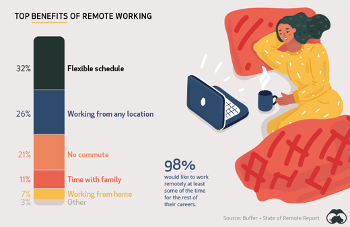
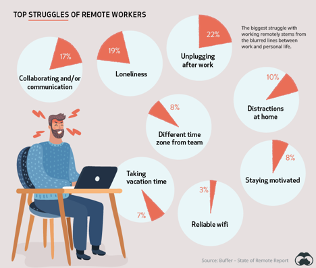
Source: Buffer – State of remote report.
For many that have chosen to forge their own path away from permanent employment and the office, the choice to do so has been made accessible to them as a consequence of their level of experience and expertise. Their years within industry enable them to both perform their roles with a greater degree of autonomy, and fit this around other aspects of their lives; family, exercise, hobbies, personal projects etc. The difference here is that, whilst traditional agencies may well be ‘pivoting’ (sorry I know that word belongs in a box with ‘Agile’) away from the office, they do not benefit from the intrinsic culture of an organization comprised of people that have chosen to work this way. Well before the Covid-19 crisis, which has confused the reality of remote working with forced home working, the majority of companies had flexible working policies in place, and an investigation by Vodafone back in 2016 found that 61% of respondents reported increased profits, and 83% reported increased productivity.
Setting up Sparro House Creative, flexibility and wellbeing have been at the forefront of my mind, and it’s clear to me that these are inextricably linked not only with each other, but with improved output and increased value. With the level of experience in my teams, it benefits neither myself nor them to impose a work routine that fails to take into consideration both the other important things in their life, and the fact that they may well do their best and most creative work at 5am, perhaps before their children have woken up (hopefully!), or at their local coffee shop, in our clients offices or collaborating in shared spaces. This is true remote working – the option to choose how the work thread weaves into the rest of your life. It’s important this message is clear, this freedom reduces workplace stress and increases productivity.
Of course, this structure is dependent on trust between team members, including myself, that the work will be completed efficiently and to the highest standard. In turn, this trust is reliant on industry experience. It is the senior team members who have the expertise that allows them to work in this way and make effective and timely decisions. With the acceleration of decision-making caused by the current crisis, this is vital.
Janine Woodcock; professional coach, speaker and author of The Power of Choices discusses ‘Conscious Leadership’ with Sparro House MD, Paul Kirkcaldy.
Why would the way we build and maintain our culture be any different to if we ran the agency out of an office? What a strange question, but one I was asked only recently.
Remote working absolutely does not mean the death of company culture, but rather an opportunity to reorient what drives us. Rather than reliance on surface level drivers, existing as activities or presenteeism, we should be ensuring culture is the core pillar from which stem all of our working decisions.
Working in an office or shared space does have the potential to establish relationships, especially for more junior team members, and this more social environment has its place in that respect. That said, just showing up is not enough to establish culture at a company’s core and it’s flawed to equate physical presence in an office with mental focus. Taking one step further, in the circumstance of employees silently suffering with a physical or mental illness but turning up anyway, buying into this belief in presenteeism not only damages productivity, but also employees’ relationships with their jobs and with each other.
So, how do we orient ourselves around culture?
Fundamentally, by ensuring that shared beliefs and values drive recruitment. Doing this, employees do not need to be in the same place to be connected, as they are instead linked by a much stronger bond: what they believe in. That behaviours reflect cultural values means these will also align and cultivate a virtual environment of synchronicity and trust. Pub quizzes, yoga and table tennis are really good fun, and are great at building friendships and a sense of camaraderie, but don’t mistake these for cultural drivers as it runs more deeply than that. It doesn’t just exist within the four walls of an office (or the four corners of a ping pong table!), but should be the nerve centre, binding everyone together, and informing our choices.
At Sparro House, our culture stems from our primary values. The first lies in investment in true remote working. By this I don’t mean working 9-5 from home, but genuine flexibility in how, when, and where you get it done. This feeds into our second core value – being purpose driven. Working style, location, and time do not matter to me as long as we fulfil the brief. Being driven by the objective means that if people want to take slightly different paths to get there, then go for it! Recruiting senior people who share these core values fosters a culture of trust that everyone will complete what’s needed on time and to a high standard. This manifests itself in care, learning, and commitment to one another.
This also means I feel good about increasing my time spent ensuring the welfare of my team members, rather than autocratically imposing rigid boundaries and counter-productive schedules. Encouraging genuine flexibility seems like a no-brainer to me as it allows us to benefit from the expertise of senior professionals whose personal and family lives wouldn’t necessarily allow them to work conventional hours.
This Covid crisis, for example, has hit working parents especially hard. Impacted disproportionately by challenges such as the need to care for children during the day following school closures, mean that they have been unable to dedicate as much focused time to work1. Even outside the context of a global pandemic, a few years ago my own wife found expectations to be in the office during standard working hours incredibly frustrating and stressful after having our children. The old-school timetable and expectation to be present just couldn’t be moulded to the life of a young family, despite her amazing talent and expertise. Throw in a global crisis and it’s unsurprising that we’re experiencing a loss of talented back–to-work parents, especially women, who would add much-needed value to our industry.
This is what Sparro House’s flexible model overcomes; I want to have experts on my teams, and if their core values align with ours, then I can! No matter their personal circumstances.
It’s a win-win situation.
So, we’ve established our shared culture by hiring the right people who share our values. But we mustn’t now disengage; it’s imperative that we constantly maintain and invest in it, and ensure that it’s always in the best condition to inform our decisions. I may not be able to pop over to your desk for a chat, but we are fortunate to be living in a time that technology allows us the luxury of instant face time at the touch of a button, should we require or desire it. Maintaining this contact strengthens our network, but this communication should no longer just be about work, and certainly not to check how many things you’ve ticked off your ‘To Do’ list today. Rather, it revolves around understanding that many of the enjoyments or pressures of our personal lives are also felt by the people we work with. People do not exist solely in their work role, this is just one element of their life, and I think we often forget both this, and the fact that outside of work we likely have many shared experiences. Therefore, contact time with employees should be frequent, but should also now be spent ensuring that all of the other cogs – such as family, children, and health – are meshing smoothly. Maintaining this culture of care feeds trust, which has a positive knock-on effect on work performance, leaving employees feeling fulfilled and motivated, and clients safe in the knowledge that value is being created for their business.
Of course, being able and trusted to work autonomously comes from a certain level of industry experience, and I’ve got to know you can deliver to feel comfortable stepping back. Successfully implementing this, though, fosters a culture that is pervasive and strong, because we have chosen to work in this way, and share the same values. To me, this runs deeper than a few stolen seconds at the water cooler, even if we are a hundred miles apart.
1 According to research by the Institute for Fiscal Studies and the UCL Institute of Education
Our industry has just experienced its worst quarter ever. With almost 64% of panel members registering a decrease in marketing spend and two-thirds forecasting a pessimistic financial outlook, July’s IPA Bellwether Report has given us the hard data to prove what we have previously surmised.
Agencies need to respond fast or risk being side-lined. Three areas where I think we can make an immediate impact are: measurability, speaking the CFO’s language and the contribution we can make to our clients’ bottom line.
Clients are faced with a bewildering range and volume of different agencies and Covid-19 has given brands a good excuse to prune – as Ramon Laguarta, PepsiCo’s CEO, also says: “Sometimes a crisis helps [a company] to be more selective and to be more impactful, to generate internal momentum against simplification and focus against fewer and bigger. That’s what we’re trying to do.”
There’s also a growing threat to agencies of clients bringing elements in-house – both as a potential cost-saving exercise and as a response to ‘always on’ marketing communications. As Laguarta acknowledges: “[through in-housing] we can actually get the same or more value for less money, which is obviously a terrific outcome for the company.”
However, brands disrupted by Covid-19 need transformative ideas more than ever. Agencies are in a unique position. DDB founder Bill Bernbach sums it up well, gendered pronouns aside; “We think we will never know as much about a product as a client. After all, he sleeps and breathes his product…By the same token, we firmly believe that he can’t know as much about advertising. Because we live and breathe that all day long.”
Historically, our industry has not been brilliant at drawing a line between what we do and things the brand’s CFO would recognise and value. We now need to get better at developing this dialogue. In tough times this is harder, but even more important.
As agency people, we need to ask ourselves if we really understand the goals and objectives of the finance people amongst our clients. Have we got under the skin of their targets? These will be different to those of the CMO.
We need to establish what our common ground is and communicate our value in their language. Marketing done well can make a significant difference to a business’ bottom line. You only need to look to companies like Coca Cola to see how the intangible value of its brand value underpins the net worth of the company.
How much of the marketing jargon that we use in our industry day-to-day resonates with the CFO, and, in turn, how much financial shorthand do we understand? If having direct access to them is proving difficult, let’s look to our own resources. Are we making good use of our own finance people, for instance? They have all been schooled in same language – use proxies where it’s helpful to do so.
Equipping everyone with a basic grounding in the business side of the industry we’re involved in is important – a course like the IPA’s Commercial Certificate can really help with the fundamentals.
Demonstrating measurement and effectiveness is nothing new. However, given that client budgets won’t be getting back to pre-Covid levels any time soon, marketing departments and their agencies will be under more pressure than usual to deliver tangible results. That means even greater scrutiny for every pound spent.
We are up for that challenge at Armadillo. Our focus has always been on cost-effectiveness – it’s baked into our DNA . We are lean and results-driven and have consistently delivered good value for clients which has led to long-term relationships with clients such as McDonald’s and Disney. Despite working with a major client in the severely-impacted eating out sector, we’ve seen them double down on CRM activity. For example, while other channels have been cut hard, our budgets have grown. That’s mainly thanks to proving strong ROIs on a continuous basis pre-crisis.
We believe the goal should be to have an end-to-end relationship with customer – tracking all the way through from first point of interaction through to purchase, to help influence the decision-buying journey.
Now is the time for agencies to create clearly defined market positions in line with commercials. We need to fulfil our role of trusted advisors, drawing on and demonstrating specialist expertise, experience and performance. We need to stay focused and be even more open to collaboration.
Whilst this is not a time to be naive, we must also try to balance our pragmatism with optimism. The world is not coming to an end just yet. Take our worst hit client in the travel sector. We prioritised pivoting to meet a dramatically different set of challenges – by thinking like stakeholders in their recovery rather than hard-done by suppliers, we’ve seen projects start to flow again far sooner than we might have expected.
Agencies must keep scanning the horizon for opportunities and be prepared to move the business in new directions to stay in the game. We’ve long positioned ourselves as nimble and responsive – those that can now display those attributes will prove invaluable.
This has not been an easy time, but we need to avoid giving in to nostalgic defeatism. A crisis like this could kill agencies off, but equally, if we could get more on the front foot, learn from past successes and fuse those learnings with the good things we’re doing now, this could also be the start of our renaissance.
This article was written by Chris Thurling for the IPA on 17 August 2020.
You need to load content from reCAPTCHA to submit the form. Please note that doing so will share data with third-party providers.
More Information