
Leading Bristol–based digital marketing agency, DNRG, is working with AI search company Yext to provide businesses with modern solutions to boost their discoverability in search and stay ahead of the competition.
The UX focused platform, NRG Connect, is easy to do business with, offering a central cloud-based system to manage and update business listings. Google, Facebook, Yell, Apple Maps and Waze are a few of the 100+ apps, search engines, maps and directories customers can access. This generates opportunities for businesses of all sizes to be digitally competitive and present their company to potential customers searching for their services.
DNRG is supporting their existing customers, as well as independent businesses, with a solution that saves time, increases efficiency, and allows for excellent reporting and measurement. NRG Connect forms as part of a larger digital marketing strategy for businesses. The platform interlinks with other digital solutions such as user experience–led web design, SEO–focused content, Conversion Rate Optimisation and more, to offer a complete digital package.
Marketing agencies can partner with DNRG to receive access to a white-labelled platform, where they can offer the solution as their own to their clients. DNRG provides comprehensive training and support to the agencies and their end-users, ensuring they are fully equipped to make the most out of the platform.
In an age where digital reputation is more important than ever for businesses, DNRG customers will have access to view and respond to all their customer reviews, as well as edit company details all in one central location. This saves hours of trolling through different sites adding listings, responding to reviews, and making updates.
We’ve spoken to Joe Reid, Account Services Director at DNRG, “We’re delighted to announce our collaboration with Yext, which presents us with a unique opportunity to work with like-minded marketing agencies and offer an additional solution to our direct customers.
“In 2021, we all search online for products and services, so making sure that our customers can be found, wherever they are searched for is essential to us. This product forms as part of a much wider digital marketing solution, to allow businesses of all shapes and sizes to be competitive.
“It’s so important for all businesses to have the ability to be digitally competitive. At DNRG we specialise in offering solutions to SMBs who may not have unlimited budgets or the option for in-house digital marketing expertise. We believe in allowing smaller businesses to compete with the bigger companies and build them a digital presence in order for them to do that.”
“For SMBs, a solid strategy for managing and optimizing listings is vitally important — it can mean the difference between appearing on the search results page and not showing up at all, between winning over a customer and losing them to a competitor,” said Luis Baptista-Coelho, Executive Vice President, Global Partner at Yext. “We’re excited to team up with DNRG so that even more SMBs can tap into Yext’s modern, AI-powered platform — the same technology that the biggest brands in the world trust — to keep their information up-to-date across platforms, improve their discoverability, and win more business.”
When you think about the negative connotations surrounding the word “persuasive”, you can understand why a lot of us in the industry are afraid to use persuasion to influence the customer journey.
We’ve seen this first-hand. Brands will avoid persuasive design as they are under the impression it uses “dark patterns”, which is a term used for a type of design that manipulates the unassuming customer into completing a call to action for financial gain.
This is simply not the case.
Persuasive design is not about manipulation, it’s about catering to your users’ best interests and anticipating the needs of your customers from discovery to purchase. You are essentially guiding your customer to make a decision that will, in the end, be beneficial for both you and your customer.
In short. Throughout the entire customer journey.
Once you understand the different types of customers that could be attracted to your services, you should use persuasive design or “nudges” across various parts of the online experience to subtly steer their judgment resulting in a successful conversion.
You should always try to make the customer journey simple… but not too simple. You want to create a seamless experience, but you also don’t want to illicit self-defeating behaviour, as this could impact customer retention.
If you’re still unsure how to use effectively use persuasive design, there are four key elements to think about when designing a journey your customers will not be able to stay away from.
A persuasive experience is more than one linear journey. Customers can connect with your brand in more ways than ever before, and you need to see each initial interaction as an opportunity to build a rapport and create an emotional response.
Failure to recognise these points of interaction leaves you with no indication of how your customers are feeling before, during, and after they complete their journey.
Whether your customer begins their journey through Google Search, social media, or even through a newsletter you should always map and follow the customer journey to see if and/or when their emotions change.
In just one journey a customer can fluctuate from excited to frustrated, or from hopeful to disappointed, and a map will allow you to see what caused these sudden changes. With this information, you can add positive reinforcements to parts, which caused the greatest emotional response.
If you wanted to keep a high retention rate, sending a “thank you” message or a reward to your customer after they’ve completed a purchase can be very effective.
For customers that you want to reassure, you could add a “final check” before purchasing, which allows them more time to finalise their details.
Persuasive design is not about deceiving the customer, it’s about helping them reach their desired end goal in the quickest and most efficient way.
There’s a great deal of truth to this, especially for eCommerce brands, as almost every customer will use the website that allows them to successfully complete a purchase in the shortest amount of time.
To ensure the transaction process is kept to a minimum, brands need to allow users to feel they are in control by stepping aside and giving the user the freedom to do what they want.
For this type of journey to be successful, your usability and UX hygiene needs to be on point! Slow loading speed, illegible fonts, and too many advertisement pop-ups can dramatically decrease your conversion rate.
You should always run thorough tests into what is not working on your website and fix it quickly before your customers turn to your competitors.
At the end of the day, your users are not just a number, they are human beings with ranging emotions and needs, and if you don’t grasp that concept then opting to use persuasive design is pointless.
The needs of a person looking to book a summer holiday abroad are going to be different from a person looking to take out a loan, so we can’t expect their experiences to conjure up the same needs or emotional responses.
When it comes down to it, the main reason your persuasive design will fail is if you haven’t anticipated your customers’ expectations or considered how you can cater to those specific expectations.
The more you can tailor the experience to your customers’ goals, needs, and frustrations, the better the retention rate.
Take the time to research your customers and use this data to create core personas, which will help you design a more targeted customer journey. If you don’t have these personas in mind, your design won’t be relatable to your desired users, and will not trigger the emotional response you desire.
When thinking about persuasion there are three things that are applicable to all brands: USPs, reassurance and incentives.
To start you need to show your customers what makes you unique and more appealing than your competitors. To do this you can highlight your benefits clearly on your website, so users will be able to quickly understand your value.
Next, you need to reassure your customer that you are the best option. If users do not trust you, then they will not convert. To demonstrate your value and trust as a company you could include positive customer reviews, ratings, third-party testimonials, and logos from trusted payment providers on your website.
The final thing you need to consider is including some form of incentive, and this could be the difference between losing a customer or successful retention.
When customers feel like they are getting something for free, they are more likely to complete a purchase and buy from you again. For example, offering free delivery or a gift if they spend over a certain amount will always be an enticing offer.
While the idea of persuasion and persuasive design may sound deceptive and difficult to get right, the reality is that this form of marketing is all about trying to understand and empathise with your customer.
When you understand what makes your users’ tick you can create a seamless customer journey that meets their needs. Once you have achieved this, what follows is a customer journey that users will trust and return to again and again.
It’s as simple as that!
If you take a look around Digital Agency Coach’s website you’ll see the two core services we offer to digital agency owners: Mastermind Groups and Coaching & Mentoring Programs.
Digital Agency Coach’s bi-monthly Mastermind Groups provide a peer-to-peer learning and networking environment for agency owners and are a brilliant way to share ideas, learning and insights with other like-minded professionals. Watch our Mastermind Group Explainer Video (1min) for a detailed look at how this service benefits busy digital agency owners.
Our Coaching & Mentoring Program is by far our most comprehensive and rewarding service, where our agency owners benefit from extensive 1:1 consultancy and expertise guaranteed to scale and grow their digital marketing agencies.
In this article, we share how our Coaching & Mentoring Programs work and what you, as an agency owner, will experience both during and as a result of the program.
1:1 coaching provides a dedicated space to solve problems, gain accountability, design and execute business plans through external, expert advice. You’ll make decisions faster, build better teams, deliver higher quality work and your digital agency will grow, and you’ll enjoy the journey.
All Digital Agency Coach Mentee’s have the opportunity to become one of our successful agency owners who:
Grew Their Revenue & Profit
You’ll achieve significant growth in both your revenue and your profit within the first 12 months of working with us.
Won More Leads, Clients & Awards
You’ll develop the skills to convert more leads, grow your client base and win noteworthy, genuine industry awards as part of your recognition.
Bought, Merged Or Sold Businesses
Want to grow quickly through Mergers & Acquisitions? We’ll guide you through the processes and purpose behind these growth strategies so you can benefit from the results faster.
Gained Freedom And/Or Early Retirement
You’ll be able to spend less time in your business and start working on it. Our mentees now have more time and freedom to do the things they enjoy, and many have been able to reap the rewards of their lifetime’s work and step into retirement.
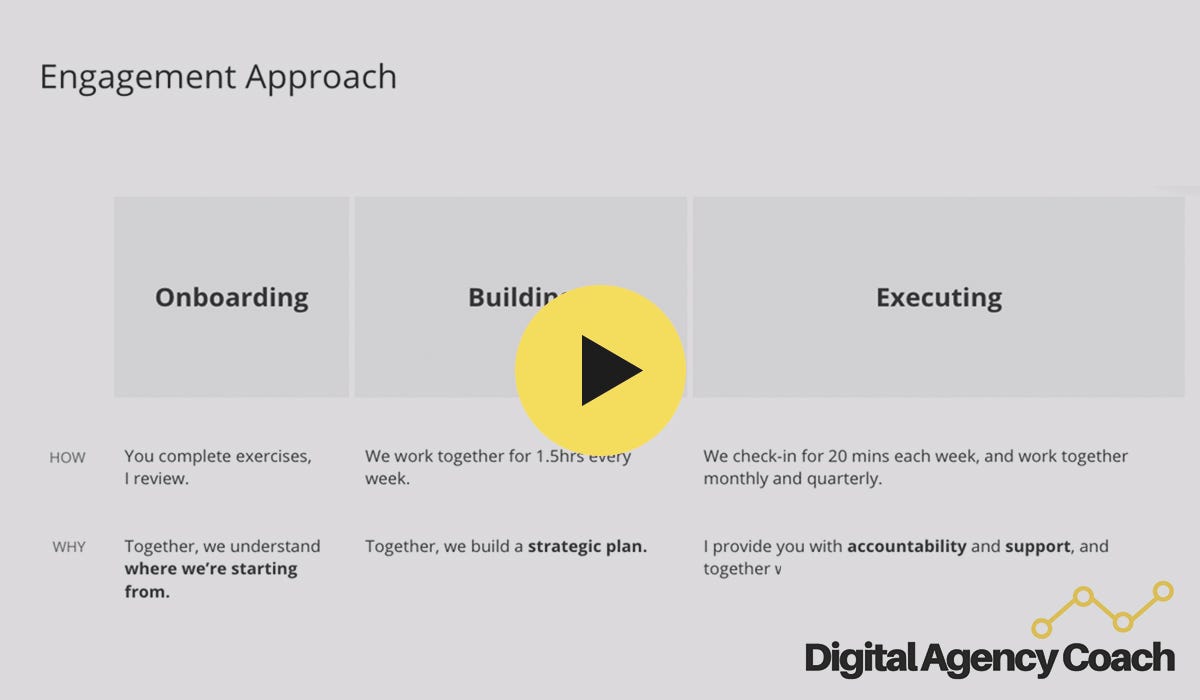
Participating in our Coaching & Mentoring program generally follows this engagement process:
Onboarding — This where the scope of work is agreed and all our reciprocal learning and understanding is carried out.
Building — Together, we put together a strategy and a plan based on our learnings from Step One
Execution — As the name suggests, Stage Three is where we execute the plan and start to grow your agency.
This is where we get to know each other. We’ll begin with a discovery session, where our consultant will ask you to share details and insights about your agency’s current status and any plans, aspirations and goals you have for the future.
This then is reviewed, packaged and shared with you. We’ll put together a presentation that summarises your goals, business position and the strengths, weaknesses and opportunities for your agency. We’ll also detail a top-level roadmap and a handful of quick wins for you to implement then and there which are guaranteed to have an immediate effect on your business from day one.
This onboarding phase usually takes about a month to complete and once we have this understanding we can put together a plan and roadmap for us to move forward with.
This is where we put together your growth strategy. We’ll use our Agency Accelerator Canvas to break down your business plan into achievable, bite-sized objectives, milestones and KPI’s for you and your team.
Our consultants will work with you to formulate a plan and share insight, context, benchmarks and tactics from our portfolio of the 250 digital agencies we’ve worked with. Creating these objectives and key results and writing your business strategy usually takes about 6–8 weeks to complete.
Stage three – execution, makes up around 75–85% of our program. This is where we put our planning into practice and start to make big, impactful changes to your agency’s operations.
You’ll chat with your consultant weekly for 10–15 minute accountability meetings to check in and make sure things are running smoothly. Between these sessions and our ongoing, ‘always-on’, ad-hoc support, you’ll execute the daily and weekly tasks in your business plan.
Every four weeks we’ll set aside a few hours to plan for the coming month and set the KPI’s to make sure the overarching plan is still in sight. Then each quarter, we’ll orchestrate a full review of the work completed and the work ahead and make any necessary changes to the master plan.
At Digital Agency Coach, we work deeply with a small roster of agencies at any one time as our Coaching & Mentoring Programs are long-term relationships that deliver long-term, long-lasting results. The average timeline for these programs is anywhere between 12 to 18 months, depending on your capacity.
Now that we’ve unpacked our Coaching & Mentoring Program and how our services can help you achieve stratospheric growth for your marketing agency — it’s time to ask yourself if this is the right fit for you and how you like to work.
If the answer is yes, please get in touch and Arrange A Free Consultation with one of our friendly consultants. We’ll be happy to answer any questions you might have and get you on the path to success.
During a recent panel discussion, TMW CEO Chris Mellish made this statement on gender balance in leadership: “We shouldn’t just be talking about this on International Women’s Day, it needs regular dialogue.”
Yep, I went there – I opened with a quote from a man. But it may well take male support, particularly from those in leadership, to help push the agenda for women – and get all genders on board with it. According to leading scholar and anti-sexism educator Jackson Katz, the mere mention of the phrase ‘gender issues’ can lead men to switch off as they often see gender-related conversations as ‘women’s issues’, rather than anything to do with men. But genders don’t operate in isolation.
“We shouldn’t just be talking about this on International Women’s Day, it needs regular dialogue.”
– Chris Mellish


Put simply, because it makes businesses more effective. In 2019, Credit Suisse researched 3,000 companies across 56 countries to find that shares of companies with more women managers delivered higher returns, while a greater number of women executives also correlated with stronger revenue growth and higher profit margins. This was echoed by a report from consultancy The Pipeline:
“Companies on the FTSE 350 index would generate 195 billion pounds ($250 billion) of additional pre-tax profit if their margins matched that of the firms with greater female representation.”
But aren’t women hardwired to be the primary caregiver in the home? Cognitive neuroscientist Gina Rippon analysed the data on ‘differences by sex’ in the brain – and found there to be none. If gender alone has no impact on brain functionality, Rippon concluded that what we deem as typical male or female traits are, as she describes, the result of a “gendered world” – so nurture, rather than nature.
And yet LinkedIn research suggests a staggering 60% of female marketers have left or considered leaving the profession because of Covid-19. That’s more than any other industry. In heterosexual partnerships, women have taken on more duties in terms of caring and homeschooling, in addition to their careers, and are left feeling overwhelmed.
“60% of female marketers have left or considered leaving the profession because of Covid-19.”
There are signs of change with studies worldwide reflecting a shift in the balance of housework and caregiving from pre-pandemic times. But mothers still spend about twice as much time on caregiving and household labour, even as they’ve rapidly increased the number of hours they work outside the home – and even when they’re the primary breadwinner.

For International Women’s Day, Unlimited ran a panel discussion with women in leadership roles from across our group, joined by our male representative, CEO Chris Mellish. The panellists shared personal experiences of difficulties faced in getting to their position. Yet on the point of children, the panel questioned their own choices on who in their family took the role of primary caregiver. Some voiced concerns of being left behind during maternity, and recounted being judged as “not ambitious enough” for wanting children – or being seen as “too ambitious” for not having them at all, as if the two options were mutually exclusive.
“The panel shared . . . the general expectation that women must be better, sparkier, more articulate – and work harder than their male colleagues.”
But motherhood is not all that impacts a woman’s capacity to succeed in the workplace. The panel shared experiences of their confidence being damaged in all-male environments, having to use humour to ‘handle’ comments on their appearance, being asked to consider how men would feel if women were promoted over them, and the general expectation that women must be better, sparkier, more articulate – and work harder than their male colleagues.
These experiences are not new, and many echoed a 2019 report from the Government and Equalities Office. The report cited barriers to gender balance as lack of transparency in pay and promotion supporting biases that disadvantage women. Hostile or isolating organisational cultures, and a conflict between external responsibilities and current models of working – compacted by unpredictable work demands and alternative ways of working do not always offering parity of opportunity. Many women reading this post will be able to relate to each one of these.

The Unlimited panel covered a range of ways we can start to shift the dial and work towards gender balance in leadership. There are practical considerations around flexible working, recruitment processes, and transparency on pay and promotions, allowing more unbiased access to a seat at the table. Mentorship, coaching and workshops can serve to build confidence and address what holds women back.
“There are practical considerations around flexible working, recruitment processes, and transparency on pay and promotions, allowing more unbiased access to a seat at the table.”
But a theme that came out strongly from the panel is, as Chris said himself, to keep talking. That is the ambition we must work towards as an agency – for all genders to play their part. We want to create space for getting into the awkward stuff we don’t like to talk about. The often-cited reaction to the Me Too movement from men is fear, being nervous of saying the “wrong thing”, but this doesn’t serve any of us. I’m often struck by how even my most supportive male friends are simply unaware of the challenges of walking in my shoes as a woman. One positive that may come out of the tragic events surrounding Sarah Everard’s death, is the heightened awareness of the daily challenges women face. We can’t afford to maintain inertia. We deserve better for ourselves and future generations of women in the workplace and beyond it. And this is the challenge we have set ourselves – to continue the conversation, and back it up with action.
– Martin Luther King, Jr.
Yes, another man – but what a man.
Written by: Emma Woodrow, Group Account Director
Illustrations by: Paloma Kaluzinska, Junior Designer
Since our MBO in late 2017, Armadillo has been through a period of sustained growth, with 21.28% Compound Annual Growth Rate (CAGR) of fee income in the past three years.
We are forecasting this growth to continue through 2021, and with that consistent growth, we have needed to make a number of key hires. We will need to recruit more skilled professionals to join us as we continue to use our expertise to harness the power of data to change customer behaviour and deliver unrivalled ROI. So here are some things that I have learnt and am still learning that you might want to consider during the recruitment process.
Ensure candidates understand your company’s values
We all know that it’s cheaper to retain customers than win new ones, and the same can be said of employees. High staff turnover can be a killer for culture and the bottom line, not to mention the lost knowledge and relationship bonds which walk out the door every time someone leaves. So first of all, work towards making a team culture where people want to stay, commit and contribute to overall success.
Cultural fit is so important for long term success of a candidate or employee, so ensure your values and all those little things you do come across in your job adverts. As well as trying to convey the company’s values, during the recruitment process it is important to draw out from candidates if they share those, or if not, whether they are likely to stay in post for long. However, try to be mindful of subconscious or unconscious bias – for example affinity bias; the subconscious thought that might make one candidate more appealing because you share something in common with them; it could be a former workplace, university or even something as trivial as following the same sports teams. Each of those things do not mean one candidate would be more qualified or suitable for the role than another, but it might affect your decision making. Be watchful for biases such as these and consider a wider range of other biases too (I find this list helpful). Having diversity of thought, experience and background within a team will create opportunity for healthy challenge and new ideas.
Think of different ways of bringing out skills at interview stage
Find ways to test for skills or values which are most important for the job, and not just discuss previous experiences. For more junior roles, consider asking ‘what if’ questions to give candidates a chance to explore how they would approach a challenge in the future, which could be more revealing than asking them what they have already done.
I once had an interview for a Finance role where I was provided with the Group’s management accounts, statutory accounts and next year budgets on arrival, and given 45 minutes to prepare a presentation for the Group FD. Amongst other things, they were testing my ability to work under pressure, time management, my accounting knowledge, my numerical and analytical skills and my presentation skills. Fortunately for me I was offered and accepted the job, and we went on to implement and address four out of my five recommendations.
Software can help you streamline the process
Working in a business like Armadillo, it won’t come as a surprise that another recommendation I’d offer would be to utilise software and data management. Regarding software, there are some great SaaS tools (like Workable for example) which can help you securely (and compliantly) store applicants’ information and documents, share access (on a per candidate or per role basis) to relevant colleagues without compromising the privacy and control of the candidates’ personal data. Especially for businesses currently working remotely or from home, interviewing candidates on screen with one or more interviewers can prove a challenge, whether it’s managing a large volume of candidates, not having CVs and applications in inboxes, or losing track of that data.
Someone might not be right for this role now, but could still be a good fit
Get GDPR-compliant permission from candidates to keep their details on file. A candidate who was a cultural fit but did not quite have the right experience may be right for a different role, or in time may have gained the experience they previously lacked. Keeping a record of their details and application could be a component of an “always-on” approach to recruitment.
In summary, communicate the cultural values of the business, and how you value employees. Try to be mindful of unconscious biases in both job adverts and interviewing. Test for key skills as well as facilitating discussion. Especially when recruiting for a number of roles, or at scale, consider using cloud-based software to practically help and keep a (GDPR compliant) database and records of strong candidates who you may want to speak to again in the future for ‘always on’ recruitment.
This article first appeared on Ambition, May 2021.
By Andy Brown, CFO
Is your digital marketing agency profitable on purpose, or by accident? At Digital Agency Coach we’ve worked with hundreds of agency owners over the years, some of whom were unaware of their profitability stats.
Many agencies end up being profitable by accident, as a positive consequence of the year’s work. In this article, we share our insights on turning an intentional and deliberate profit.
As a busy agency owner, it can be easy to prioritise managing the day-to-day operations and allowing your profitability to become an afterthought. With this mindset, it’s difficult for you as an owner, to have that profit-oriented, strategic mindset that is key to growing your agency.
At Digital Agency Coach, we always recommend approaching profitability with intention and purpose. This approach can feel foreign and a little acquisitive at first, but it’s important to remind yourself that it’s completely genuine and moral to design your business in such a way that it earns you money.
Having a profit-driven mindset enables you to reinvest into your business, enhance the quality of your service and grow your agency.
When it comes to an agency’s profitability, there are typically three different degrees of intent and three defined profit groups as an outcome.
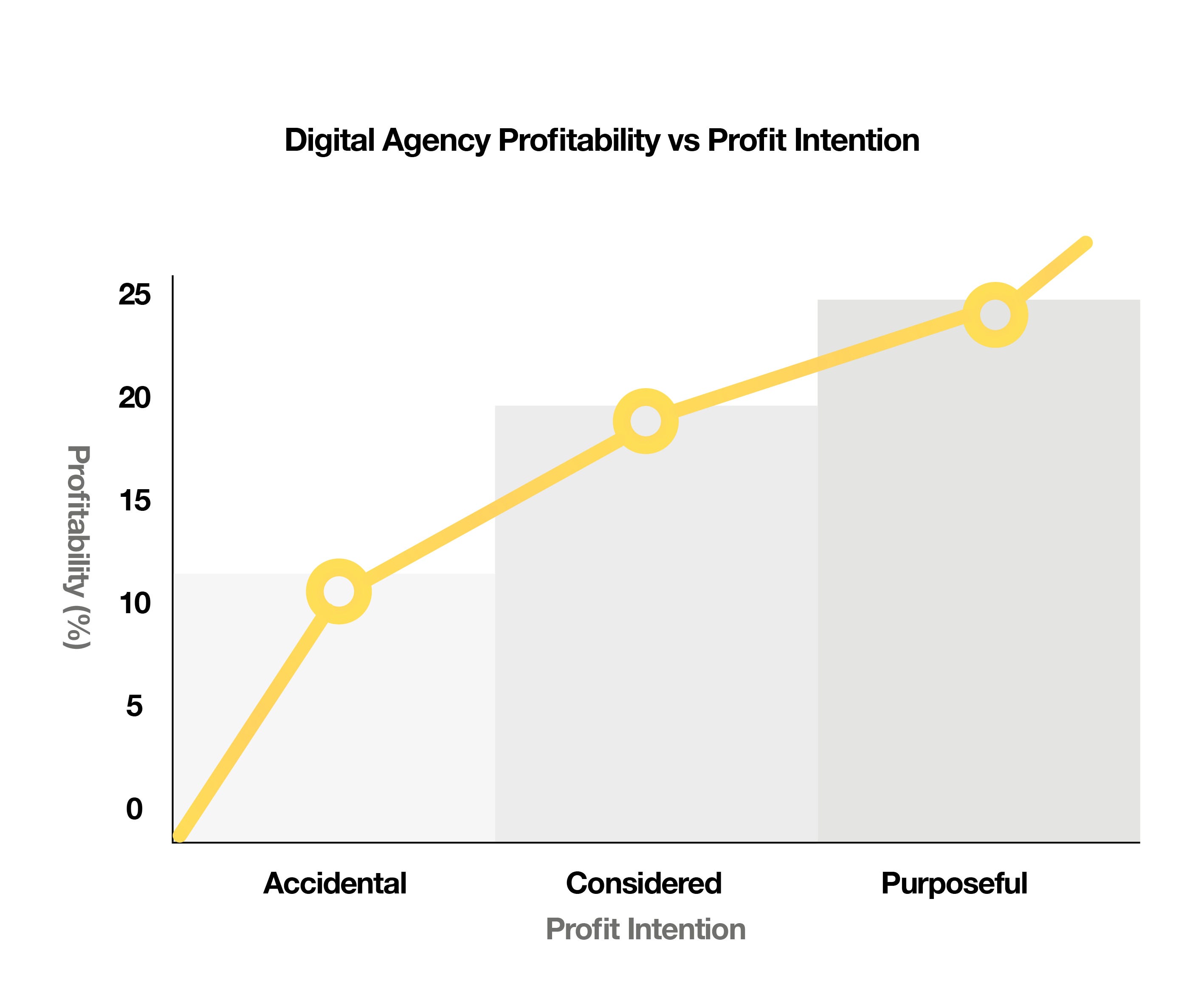
Agencies who generate anywhere from 0–12%* profit are generally doing so by accident. These agencies usually no profit strategy in place and the year-end results are unpredictable and often speak for themselves.
Those digital agencies turning anywhere between 13–22%* profit, are almost always doing it on purpose. The closer the number lies to 22%, the more deliberate and considered the profit is. The lower the number, the less intentional their outcomes have been.
And as for those generating a profit percentage anywhere north of 22%*, we classify those guys as purposeful, profit machines. These digital agencies know their services, their clients, their team, and their business like the back of their hand. Their sales pipeline and financial systems are geared toward driving high volume, quality leads which convert.
*These figures are general only, actual profit margins will depend on the agency size. Large organisations with substantial overheads typically will have tighter margins.
Address these six top-line areas and improve your agency’s profitability today.
Take a close look at your gross margins. If they’re outside the range of 50–60%, unfortunately, you’re not profitable enough. Your gross margins are calculated by taking the overall revenue of your agency, less the sum of those direct salaries and/or contractor and freelance fees required to deliver your particular service.
As a service-based business, your agency sells time — utilisation looks at how many billable hours you have available to your clients. If you are operating at less than 72% capacity, there is scope to improve your profitability by maximising your utilisation.
These can be either your employees or clients. If you attract and retain poor performers, this will lead to inefficiency and low profits within your agency. It might be that you need to address some of those long-standing, legacy clients from your start-up days, or certain team members who are less efficient than others. The solution? Try raising your fees or developing the skills and/or expertise of your employees.
Usually, those agencies who fall into the 0–12% profitability category, have no insight or oversight on their financial or sales reports and forecasts. Having a robust sales pipeline and reporting structure in place will allow you to understand when, where and how you can maximise your revenue and minimise your expenses — which we know will lead to a direct increase in your profitability.
For digital marketing agencies within the UK, it’s recommended you charge £90 per hour as an absolute minimum for your services. At Digital Agency Coach, we advocate charging anywhere between £100 — £150 an hour and ensuring you bill all for those all hours at your full rate in order to maximise your profitability.
Is the service you provide right for the current market? This is a big question for web design agencies who are competing against the likes of Wix and Squarespace. These ‘done-for-you’ website builders have significantly devalued the product to where it’s now within the reach of many small businesses and small budgets. As a specialist agency with a highly skilled team, you need to be bold and honest with yourself and ask if there is a future within your market. If the answer is no —you have to innovate and change with the times.
Remember, it’s perfectly moral and genuine to gear your agency to become a profitable, money-making business. As a business owner, you are doing your customers, employees, and your market a disservice if you are unable to reinvest your profits back into your industry.
Ready to begin? Start by asking determining which of the three levels of profit and intention describes your agency. If you’re turning a profit anywhere south of 20%, it’s time to change your mindset and address these six ways to increase your profitability.
Watch Our Free Video Class: Profit On Purpose (7min) & kickstart your journey toward profitability
Of course, if you have any questions or would like to chat with one of our Digital Agency Coach Consultants, please Get In Touch — they’d love to help.
Mr B & Friends has scored a hat trick of wins at this year’s Transform Europe Awards.
At the event, held on Wednesday 23rd June, the agency won Gold and Bronze awards for its work with Accsys, as well as a Young Contender award for designer Kieran Hawes. The awards recognise and celebrate the best of the best in brand strategy, development and transformation- how a company, brand or product’s visual identity, story and proposition can make an impact.
The Gold award for the ‘Best Visual Identity from the engineering or manufacturing sector’ and the Bronze award for the ‘Best rebrand of a digital property’ reflect the work that Mr B & Friends has done with Accsys over the last year for its sustainable wood product Accoya. The new positioning, branding and best-in-class website connect business and consumer customers to both the product and each other, making the decision and purchase easier and smoother than ever before.
Midweight designer Kieran was awarded Distinction in the Young Contenders category, which recognises the best up and coming creative and strategic talent in the business.
Members of the Mr B & Friends team attended the event with the client team from Accsys.
The full Accoya case study can be found here.
Since my earliest years, I’ve been a fan of athletics. Long-distance running in particular. I’ve watched it on TV. Chatted about it with friends. Followed its greatest exponents with fascination and even become something of an (armchair) expert on the subject.
But until a year or two ago, I’d never taken the plunge and given it a go myself. It felt like something reserved for others. Something that you needed to prepare for meticulously, before ever getting out there and hitting the pavements for yourself. It just seemed altogether too difficult to try.
Then something changed. I was persuaded by a friend to join them on the journey from ‘couch to 5K’. And, at the risk of being that annoying running evangelist, I’ve never looked back.
For many in the marketing world, account-based marketing holds the same appeal – and presents equally erroneous perceived obstacles. It looks great. It seems to work brilliantly for others. But it can also appear prohibitively complicated and quite possibly hideously expensive.
Happily, if you get account-based marketing right, those negative perceptions are some way wide of the mark. And in this article, I’ll explain why it’s an approach you can’t afford to ignore.
There are websites, books, research papers, even degree courses devoted to an explanation of account-based marketing. But for our purposes today, I’m going to keep things straightforward. At Proctor + Stevenson, we view ABM as marketing that identifies high-value companies within defined sectors, and focuses on generating quality sales leads through targeted strategy and pinpoint messaging.
It’s an approach we’ve employed to great effect over the past few years, helping clients including Panasonic outperform campaign goals by as much as 100%. And we’re not alone: Forrester research reports that 62% of marketers have reported a positive impact on their marketing performance since adopting ABM.
It comes with strong credentials then. But if that isn’t enough to help you persuade your colleagues that account-based marketing is the way forward, here are those five key reasons that should really turn the argument in your favour…
The pandemic has taught us that certain sales and marketing approaches are affected by external conditions and factors beyond our control. Exhibitions and events being an obvious one. Account-based marketing remains impervious to those irresistible forces, replacing sales meetings and product demonstrations with digital outreach and online communication. It also has the flexibility to incorporate more ‘traditional’ tactics (personalised direct mail, for example) when the time and targeting is right, making it the marketing strategy for all seasons.
The beauty of ABM lies in its focus. Unlike other broad-brush strategies that make marketing a numbers game, account-based marketing is lean and keen, ensuring that your financial resources are allocated only where they’re going to have maximum, direct impact. Even in those longer B2B buying cycles, there’s no wastage. Communications and marketing collateral are sent to those prospects you’ve identified as interested, via the channels they use, carrying messages you know will resonate with them.
Most ABM strategies are built with digital communication at their core. So you can account for every penny or euro you spend, and attribute every click, reply, meeting booking, expression of interest or sales opportunity you elicit directly back to the activity you’ve instigated. And there’s little that will make your board-level colleagues happier than that.
Ah, the old sales vs marketing conundrum. Should be best of friends, very rarely are. In this respect, you can think of account-based marketing as the United Nations. Employed properly, an ABM strategy achieves that holy grail – a harmonious collaboration in which marketing and sales work in tandem, generating interest, qualifying leads and nurturing prospects until they’re ready to hit ‘buy’ (and beyond, if your ABM strategy is far-sighted enough).
As I mentioned a little earlier, our clients have enjoyed great success with account-based marketing over the past year or two. Working with them, we’ve doubled projected lead targets, improved ROI, achieved better conversion rates, even generated six-figure sales pipeline. And all within the parameters of tight marketing budgets.
The final advantage of ABM that I’ll mention here is that it isn’t an all-or-nothing strategy. It looks different for every business. And we can help you take those first steps towards making it work for yours. So if you’d like to know more, don’t sit on the side lines any longer. Lace up your shoes, get in touch and let’s see where account-based marketing can take you.
“We should definitely launch a podcast, more people than ever before are listening, and we’ve got budget to spend as we’re no longer running that big outdoor campaign”
This is the sort of conversation going on within brands and agencies in 2020 (well, at least we hope it is). It is a really exciting time to be launching a podcast, and so it’s really easy to go all in on imagining what podcast might sound like, who’s going to present it or how you’re going to get it produced. But before you’ve allocated your entire budget before you’ve even started, to get an idea of the costs it’s worth take a little step back and looking at the bigger picture.
We chat to a lot of brands about podcasts and hear some amazing ideas, but there’s a few vital podcast costs to consider that it’s easy for brands to overlook when you’re planning to nudge Joe Rogan down the charts. So, we thought we’d share them with you:
Hands up who has ever (literally) judged a book by it’s cover? 🙋 Or, bought a bottle of red saying ‘i love that grape variety’, when really it was the colourful art or on-trend font that really swung it? 🙋 Then we can all appreciate the value of having podcast artwork that pops. With a patchwork of podcasts in any given podcast app, it’s worth ensuring that your artwork isn’t an afterthought or ends up being your company logo hastily pasted onto a background in Photoshop.
Hosting is the means of getting your podcast out there to the world and the best and easiest way of doing this is with a good hosting provider. At its most basic you should expect your podcast to be distributed to every listening platform (the big three of course being Apple Podcasts, Spotify and Google Podcasts). But, for brands especially, getting insight into who is listening and how they’re listening via a great set of analytics, is the added value that your podcast needs.
We know that most people listen to podcasts via a podcast app on their smartphones (around 65% according to Edison Research), but that doesn’t mean it’s not important to have somewhere online for people to listen. Having a dedicated podcast page on your existing site, or it it’s more relevant, a standalone site is important for a few reasons:
At its most basic, the site can be a list of all your episodes with an embedded audio player, which all the top hosting platforms provide for you. The more added content you can then add, the better.
The hard work doesn’t end when you hit publish and put your podcast out there to the world, in a way it’s only just beginning. There are a lot of podcasts out there for listeners to choose from (we’ll be reaching one million active podcasts at some point soon), so they’re going to need a helping hand finding yours, no matter how great it is. We like to talk about how brands are going to promote their podcast and how it fits into a wider strategy right from the start, it’ll have an impact on your production and release schedule and maybe even the content too. There’s lots of things you can that don’t cost (apart from time), earned media such as creating engaging assets to share on social media and good old fashioned plugging on other podcasts, blogs or media. But increasingly important is assigning some budget to run podcast ads on other podcasts, a great way of attracting listeners who are already into the same podcasts as yours.
when we’re working with brands, we’re having these conversations from day one
A well known host or having notable guests on your podcast can be a great draw for listeners, giving you a boost to your promotional efforts. Someone with presenting skill or experience sets a high bar in terms of professional quality as well as making for better script delivery and guest interviews. Ultimately however the decision, like many you’ll make, should be based on your audience, the sweet spot is finding someone who your listener will connect with and who has a natural curiosity and interest in the subject matter, even if they’re from a different walk of life (and often they’re the best ones). However, people don’t expect to work for free, so have a think about who might be a good fit, it goes without saying that the more well known they are, the higher the fee, but there’s no harm in aiming high!
There’s a lot to think about when creating a podcast from scratch that not only stands out from others but fits seamlessly into your wider content strategy. That’s why when we’re working with brands we’ll make sure that we’re having conversations about all of the points in this post from day one. Nothing should be an afterthought, and finding the right approach all depends on the objectives, the audience and the budget available, but knowing what’s required from the outset means that budget is spent in the most effective ways.
Enter, Digital Agency Coach’s Agency Accelerator Canvas, or AAC, for short.
Put simply, the Agency Accelerator Canvas is a template for designing your very own growth strategy. Designed to help you and your digital marketing agency create a considered, thorough and actionable roadmap for stratospheric growth.
The AAC prompts thinking and understanding across ten core elements of your agency growth strategy; Purpose, Customer, Value Proposition, Services, Vision, Goals, Strategy, Objective, Milestones & KPIs.
With handy guiding questions along the way, the AAC is easy to follow and easy to complete.
Our Agency Accelerator Canvas demands focus, defines your vision, establishes what it is your agency is trying to achieve, but most valuable of all – it produces an actionable roadmap to get you there.
Free from business school jargon and written in plain English – the AAC is designed to be helpful, straightforward, and easy to follow. At each of the ten stages, you’re offered a handful of guiding questions to formulate thorough and rounded definitions for each component.
While it all sounds so simple and straightforward, the results that populate from the AAC are powerful. At the end of your AAC strategy workshop, you will have defined objectives and measurable KPIs to drive your digital marketing agency forward and measure your success along the way.
Finally – a business strategy document that you can take action on!
The Digital Agency Coach consultants recommend hosting a workshop with your fellow directors or senior management teams to complete the AAC as a group.
Once you have defined your strategy, share it with your employees and wider team – print and mount it within the studio to encourage daily interaction from your cohort.
If there is anything the last two years have taught us, it’s that our world can change in an instant and we, as business owners, must be nimble and adapt our strategy accordingly.
While your AAC will be right for the time, as the seasons change, your strategy will require regular revision. We recommend reviewing your AAC quarterly, asking if any changes need to be made and if you and your team are meeting the objectives.
Use these quarterly reviews to nudge your agency’s strategy back in the right direction, then host a full review workshop and overhaul the overall strategy annually.
First things first, print out the blank AAC template and supporting documents and begin your workshop with our short explainer video to get your meeting off to a productive start.
The AAC is then separated into two focus areas;
We start by defining your digital agency’s purpose. There’s no right or wrong answer here, but it’s important your purpose aligns with your passion – so keep it true to yourself.
Secondly, the AAC takes a look at your customers. You’ll define a specific and targeted niche that your digital agency can approach and service.
Then, we ask about your value proposition. Which problems and pain points do you solve for your clients?
Then finally, – you’ll define your services. This is super important, as this defines your agency’s skill set and the work you agree and disagree to take on.
Then, we move on to…
The AAC then asks you to define your digital agency’s vision and articulate top-level, measurable goals.
Next, strategy. You’re encouraged to think about how you are going to achieve these goals? What are the big moves you’re going to make this year?
Once the big moves are defined, it’s all about the objectives. What daily tactics and functions will your team carry out in order to make the strategy happen.
Then you define growth milestones, or success indicators. What will illustrate that you’re on your way to success?
And then finally, what are the KPIs? How will you measure success and keep your team accountable? We’ll help you define realistic, aspirational and measurable Key Performance Indicators to pull your entire AAC together and ensure it’s the actionable document we promised.
Now you know how it works, it’s time to download the template and start formulating your growth strategy.
Each download includes a ready-to-complete AAC template, a supporting document with key questions to kick-start your thinking and a link to a short explainer video to walk you through the process.
Of course, if you need any help or guidance or you would like a Digital Agency Coach consultant to host an AAC workshop for you and your marketing agency please get in touch via our website.
You need to load content from reCAPTCHA to submit the form. Please note that doing so will share data with third-party providers.
More Information