To receive a successful return from your link-building efforts, it’s important to ensure effective outreach lists are created targeting the correct publications and bloggers for the client. Without an effective outreach list, you may not receive the number of high-quality backlinks you hoped for. Websites with higher quality backlinks from authoritative sites are also likely to rank better, therefore it’s important the outreach lists are created to deliver on increasing the number of offsite links.
Here at Varn, we use a range of tactics to ensure outreach lists created for our clients are successful in increasing the number of backlinks, so when outreach is performed clients see an increase in rankings for relevant landing pages.
An outreach list is defined as a list of contacts that can be journalists, publications, influencers, independent bloggers, and magazines. It’s one of the first steps when conducting outreach because the list will include prospects you wish to work with. This can include hosting content about a PR campaign, product reviews, and guest posting. It’s vital to also bear in mind the target audience for the publication as well as its domain authority, and trust/citation flow.
Here at Varn, we use a software called Buzzstream to help us search the web using appropriate keyword search phrases. Not only does the software allow us to search the web for PR-friendly publications to reach out to, but it also gives us the ability to reach out to our lists and send automatic follow ups.
Buzzstream also helps us to select sites that have a good domain authority (DA), a search engine ranking score that predicts how likely a site is likely to appear on SERPs. In most cases, we set a filter at 20 and above. If the website’s domain authority is on the lower side, the intention is that over time the domain authority of this site will grow organically.
Here are a few key considerations to take into account when creating effective outreach lists for digital PR.
It’s important to consider your client’s target audience when putting together your outreach lists. Of course, strong links from good quality websites bring the SEO benefit, however the traffic may not be relevant to your client, and the publication may not post your content at all.
For example, if your client is in the watersports industry, targeting watersport bloggers and publications will not only increase the likelihood of a reply, it will drive relevant traffic back to your client’s site which can build brand awareness as well as a higher conversion rate.
This is a really important step when building your outreach lists because if you are asking bloggers to review products, you need to ensure they are open to receiving items in exchange for a review.
The obvious way of doing this is to browse their site yourself to see if they receive gifted products, however, there are other ways you can narrow down your search in Google, as well as outreach software like Buzzstream.
You can search for an exact match by putting a keyword in quotation marks. An example could include: Lifestyle Blogger [‘PR friendly’]
The screenshot below shows two keyword search phrases on Buzzstream, and how you can narrow down your web search:

If you are creating an outreach list for guest posting, it’s important to ensure the targeted websites accept guest content. Some websites have specific guidelines to follow also.
Building warm prospects increases the likelihood of your content being posted, and you can add them to outreach lists for future clients. For example, bloggers will be open to review multiple client products over time. If a blogger decides your campaign isn’t suited to their blog audience, they may know a blogger who will be a good fit and give you their contact details. This helps increase the quality of content being posted to relevant sites.
If you would like more advice on creating effective outreach lists for Digital PR, get in touch with a member of the Varn team today.
Google Search Console is a valuable tool for understanding your website’s performance on Google Search. At Varn, we use it almost daily for a variety of search-related tasks for our clients; take a look at some easy ways to use Search Console for SEO to get started with the tool. Recently, Google introduced a new feature called Bulk Data Export, which allows users to export their Search Console data into BigQuery. This enables you to access historical data and combine it with other data sources, to perform advanced analysis and gain deeper insights into your website’s performance and search traffic. In this blog post, we will explore the benefits of Search Console Bulk Data Export and how it can enhance your SEO strategy.
The introduction of Search Console’s Bulk Data Export feature has opened up new possibilities for in-depth analysis. By exporting data from Search Console to BigQuery, we can leverage the capabilities of this powerful tool to uncover trends, patterns, and correlations that may go unnoticed in the standard Search Console reports. This enhanced analysis can provide a more comprehensive understanding of website performance and inform actionable SEO strategies.
The process of setting up bulk data exports is straightforward and user-friendly. However, there are a few too many steps to include in this blog, so visit the full setup instructions from Google for more detail. You will need to open your Google Cloud Console on your desired project. Enable BigQuery by accessing APIs & Services and selecting the relevant options. Next, you can grant permission to Search Console to export data to your project through the Admin section. Finally, in Search Console, navigate to Settings and locate the Bulk Data Export option for your property.
Once the data export is successfully set up, you can begin extracting valuable insights from your Search Console data within BigQuery. With the ability to run complex queries on large datasets, you can identify trends, evaluate performance over time, compare different data sources, and gain a deeper understanding of your website’s visibility and search traffic. These insights can guide strategic decisions to optimise your SEO efforts and drive organic growth.
While the Bulk Data Export feature is free, it’s important to note that there are costs associated with storing and manipulating data within BigQuery.
The introduction of Search Console Bulk Data Export brings a wealth of possibilities for advanced analysis and insights. By integrating Google Search Console with BigQuery, we can unlock the potential of their data and gain a deeper understanding of a website’s performance on Google Search. Embrace the power of Bulk Data Export and harness its capabilities to propel your website’s success on the search engine results page.
Need some help with BiqQuery, Google Search Console, or understanding how to turn raw data into actionable insights that will feed into a powerful SEO strategy? Talk to the team at Varn for friendly, expert advice.
Guest posting as a tactic within SEO has gotten a bit of a bad rap over the past few years with many using it as an exercise to get links and that’s about it. There are a lot of sites out there that offer paid for guest posts and this has contributed to the bad image of this particular tactic of digital PR.
Despite the image issues, we are still a massive fan of guest posts for clients and provided you are doing it in the right way it can help you get some coverage on some amazing websites and drive some great value links for your client.
In this week’s blog we chat about all things guest posting, and how to do it right to leverage good results for your digital PR campaigns.
Guest posting is the act of writing content for another website, it can come in the form of a writer looking to promote their work or a company looking to add to their field through publications. Sites often indicate that they accept guest posts and these are often good places to reach out to if you are looking to get coverage for your website.
When it comes to SEO, guest posting gives you the chance to link back to your site in relevant content form an authoritative and relevant site, this is a good tactic to use early on when your content may not be getting as many links as you would like.
As discussed, this area of digital PR can be tricky to get right, but following the below dos and don’ts will keep you and your rankings on the right track.
Content is the backbone of any website, and it’s what will ultimately attract and engage your audience. By focusing on creating quality content, you can establish yourself as an authority in your niche and those you are reaching out to will appreciate it, increasing the chances of you earning placements through guest posts.
While it may seem like a quick and easy way to build links and improve your search engine rankings, paying for links is a violation of Google’s webmaster guidelines and can result in penalties, including being removed from search engine results altogether.
When reaching out to guest bloggers, be clear that you are after content only placement.
Linking to your target pages can help improve your site’s rankings and drive traffic and SEO value to the pages that matter most. It’s important to ensure that the links you include are relevant to the content and provide value to the reader; this is the key part when it comes to guest posting. Don’t include links if they are not relevant for the reader of the blog.
Exact match anchor text refers to the use of the exact keyword phrase you want to rank for in the anchor text of a link. While it can be helpful in improving your rankings for that particular keyword phrase, overusing exact match anchor text can lead to a penalty from Google for over-optimisation, so make sure you are using logical anchor text that incorporates keywords, but not in a spammy way.
Building long-term relationships with other bloggers in your niche can be incredibly valuable for growing your website. By establishing a relationship with other bloggers, you can collaborate on projects, exchange ideas and guest posts, if you are working in an agency you can also write content for different sites depending on the relevance, and having that pre-existing relationship in place will help massively.
When it comes to assessing the value of a website for your backlink profile, it’s important not to rely solely on domain authority as a metric. While domain authority can provide a general idea of a website’s authority and influence, it’s not always an accurate measure of the website’s quality or relevance to your niche, look at other metrics like Trust and Citation Flow from Majestic and your judgement of the relevance of the website to your niche.
If you are unsure on where to start when it comes to guest blogging then get in touch with a member of the Varn team, Our SEO team have been combining digital PR tactics for years and driving great results for clients, just make sure you focus on content and you can’t go far wrong.
At the end of last year, Open AI released ChatGPT, a first-of-its-kind machine learning chatbot. The revolutionary chatbot experienced explosive growth, reaching 1 million users in just 5 days.
In January we posted our blog “How ChatGPT will impact search marketing”, here we explored some possible use cases for ChatGPT across the four core teams at Varn. We also wrote about some of the potential limitations of the technology. Over a month on, we have now had some time to experience using ChatGPT to aid in our SEO work.
As a team at Varn, we have identified three key use cases where we have seen the most value in using ChatGPT.
No matter if you love Regular Expressions or are terrified of them, this tip will help all of you!
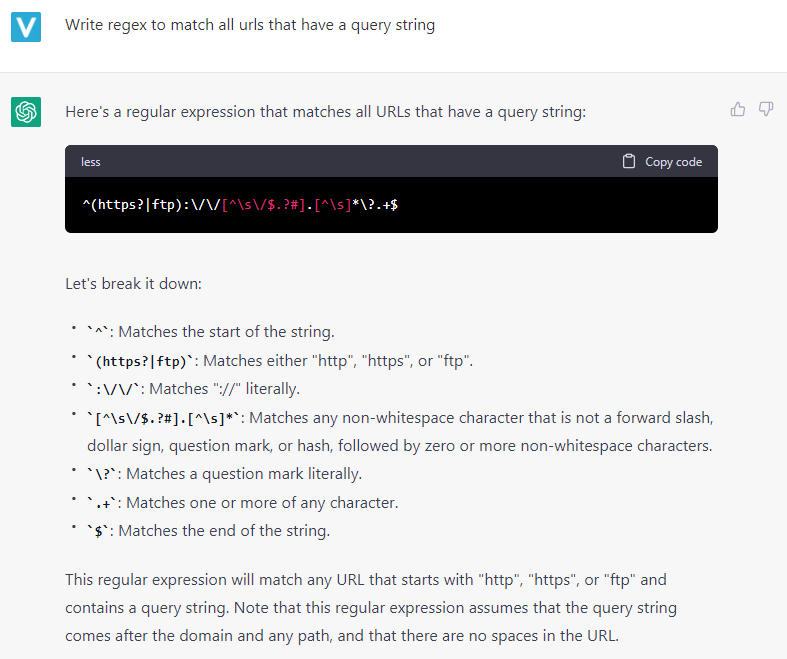
Regular Expressions (Regex) can expand the possibilities of important SEO tools like Google Search Console, Screaming Frog and more. For example, we recently wanted to filter out all the URLs in Screaming Frog so that only those containing a query string would display. This is exactly where we would want to reach for a regular expression.
However, with all the rules and complexities, writing Regex is very difficult. Even using documentation, writing a simple regex string can be incredibly time-consuming. This is where AI tools like chat GPT can come in extremely handy. Because AI has an understanding of what a user is asking, and can use this to write the Regex for us.
Here is an example chat log with chat GPT:
As you can see, we simply asked the chatbot (in plain English) how we would like to sort our URLs. Within seconds it gave us the working regex code, along with a handy description of how it works. By copying and pasting this regex into the Screaming Frog filter, we were able to sort URLs so that only those containing query strings were showing.
The true power of this feature comes from its flexibility. As SEO professionals, we could easily be presented with any number of pages or queries that we may need to filter down. But with the analytical abilities of AI, we can convert any written command into a working regular expression in seconds.
This use case has improved the way we use Regex at Varn, but it does come with limitations. ChatGPT will always try to do the best job with the prompt you have provided, but it will rarely ask for more information if it feels your query is inadequate. This means that when writing your prompts for ChatGPT you should always be as specific as possible, leaving no room for a different interpretation.
Additionally, you should be very careful to not just copy and paste this code if it’s being used for something important, like a client-facing Looker Studio filter. Instead, you should use a tool like regex101.com to test the regular expression against any unusual edge cases it may encounter.
One of the most challenging parts of writing SEO-friendly blogs is coming up with an engaging idea. But Chat GPT can help!
Chat GPT is extremely versatile, and it is also able to assist with more creative processes, as well as technical tasks such as writing Regex.
Blogs can be a great way to improve the Search Engine ranking of a site. They also provide value to visitors which helps to keep them engaged. However, we will often find ourselves racking our brains for a blog idea that is both engaging to a user and will also tick all the boxes for SEO.
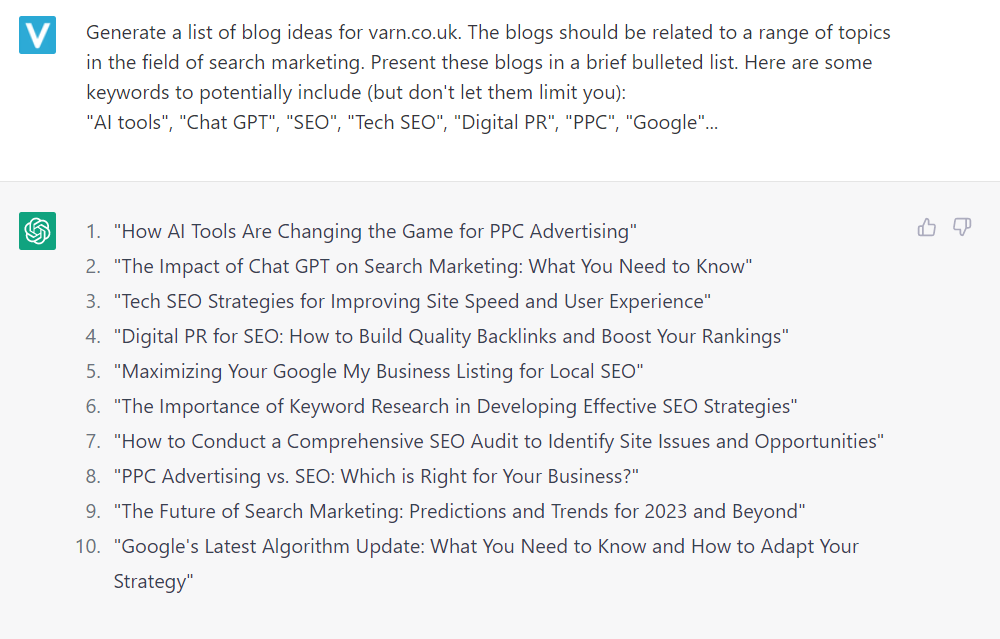
Here is an example of where we have used Chat GPT to assist in the ideation of new blogs on the Varn website.
Here you can see that as a result of our request, we have been provided with a bulleted list of ideas for potential blogs on the Varn site. It is important to remember to give a very descriptive prompt for chat GPT – In this example, we found that we needed to specifically state that we wanted the answers in a bulleted list. Otherwise, we were presented with completed blogs, rather than blog ideas. We also provided a list of keywords that we could potentially use, but needed to make it clear that using these keywords was optional. Otherwise, GPT would just cram as many keywords as possible into each bullet point. This extreme level of specificity is vital if you want to unlock the true power of chat GPT.
There are a range of ideas in this list of potential blog posts (some of which are better than others), but overall this list could be a valuable resource when coming up with new blog topics. For example, the 8th blog in the list brings up an interesting idea about deciding when to reach for PPC or SEO for your web promotion. There are some ideas in this list that are too broad, or which lack a certain context, but overall there are many good prompts that you could use when creating a future post; They may just need some work to progress them into a workable blog title.
Writing Metadata and headings with SEO in mind can be time-consuming, but Chat GPT can help streamline this process.
In the previous section, we showed how we have been using chat GPT to assist in generating blog ideas. However, we can also use Chat GPT to create content for these blogs.
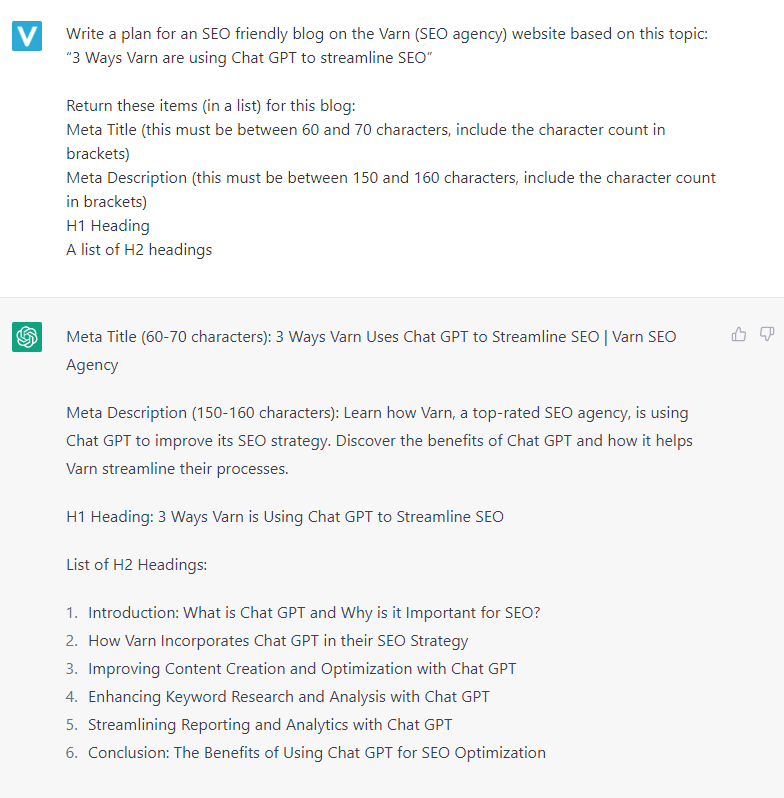
Here is an example of how you can generate metadata and headings using Chat GPT.
Once again within this section, we found it was very important to be hyper-specific with our prompts to Chat GPT, even going so far as to state the desired length of the metadata we wanted. The results are very interesting, the meta and headings are all well related to the blog topic we gave, and they do a good job of including keywords we might want to optimise for. In addition to this, the content reads well and tells a good story of what kind of content the rest of the blog might include.
Despite the fantastic quality of this AI-generated content, there are some problems. Firstly, the metadata actually exceeded the character limit we provided, this is because GPT cannot directly count the number of characters it is generating. For this reason, the character counts are often not what we asked for, even if it’s usually not off by much.
The biggest limitation preventing us from using Chat GPT to generate content like this is the risk of search engines picking up on our use of AI-generated content. Historically, Google has explicitly given guidance to avoid the use of “automatically generated content”, and this is what makes us so cautious about using AI-generated content on websites.
However, over the past year, Google has been slowly changing their guidance on AI content to appear more in favour of its use. Last month, the company properly clarified their stance on AI-generated content, essentially saying that it doesn’t matter how the content is produced, it will be judged based on the content’s quality. This suggests that AI content could be usable in SEO, provided it is user-friendly and meets the E-E-A-T guidelines set out by Google. Despite this statement by Google, we still tend to air on the side of caution and remember that AI-generated content is not perfect. It is also important to remember that as SEO experts, we have a fully formed understanding of the specifics and will be able to produce higher-quality content than a chat bot. For this reason, we tend to use AI generation as a tool to help inform our own content and will never copy and paste anything directly from Chat GPT.
So far chat GPT has had an extremely positive impact on our SEO work at Varn. It has allowed us to speed up some tedious technical tasks and allows us to put more time into other areas of our work. Even now, we still believe we could find other uses of the technology to better improve our workflow, and we are excited to explore these possibilities.
However, we also believe that it is best to think of Chat GPT as an (albeit very powerful) tool in our toolbox, not a superpower that will do all of our work for us. This means it is still important to have a good understanding of the task you are trying to accomplish, so that you can review the quality of the response and provide Chat GPT with accurate information and context.
ChatGPT has gained a lot of coverage in the news over the past month and for good reason. This new language model chatbot developed by OpenAI has the chance to revolutionise SEO and digital marketing.
ChatGPT’s growth has been phenomenal, hitting 1 million users in just 5 days, (according to Greg Brockman, President and Co-Founder of OpenAI). It’s fascinating to compare this adoption rate to other revolutionary technologies (which you can see below), for example Instagram, took 2.5 months to get to the same user level.
We thought it would be useful to share some of the team’s thoughts on the new software and what our approach will be to using it in 2023. We will cover its full impact on search marketing covering Varn’s 4 key service lines for delivering ‘full service SEO’.
Before we get into its impact on search marketing, let’s provide a bit of background on the software and why it is causing such a stir.
ChatGPT has taken the digital marketing world by storm over the last month and many have started to incorporate it into their content development strategy, using it to contribute to articles and other forms of content be it writing video scripts and coming up with blog ideas.
So what is ChatGPT? Well let’s see what the software has to say for itself….
“ChatGPT is a language model developed by OpenAI that uses deep learning to generate human-like text. It is trained on a large dataset of text and can be fine-tuned for specific tasks such as language translation, question answering, and text summarization. ChatGPT can generate text that is similar to that written by a human and is often used in chatbots and other natural language processing applications.”
As far as Technical SEO goes, ChatGPT could potentially help streamline the process of optimising websites.
One important element of Technical SEO is a website’s navigation. It is important that the navigation makes sense to users and has a clear hierarchy. Historically this has always been something that takes a reasonable amount of time to manually review. However, an advanced machine learning algorithm like GPT should be able to think similarly to a human and predict what a user of a website would expect from the site’s navigation. For example, it is possible that GPT would be able to review your site navigation, and suggest which content should be moved to make more sense from a user and hierarchical point of view. The resulting recommendations are still something that should be manually reviewed by an SEO professional, but it could potentially save a reasonable amount of time.
Another much more dubious technique, (one that we would not recommend), is that people could use ChatGPT for Tech SEO in order to create content related to your target keywords. In order to get a page to rank on Google, it helps to have a decent amount of body copy on the page, copy which is focused on the keywords you want to rank for. Using ChatGPT to generate this content could potentially help to get a site ranking more quickly, whilst making content creation easier for your website admin. However, there are a number of problems with this approach. Firstly, AI generated content goes against Google’s guidelines. This means that if Google were to identify your content as AI generated then they could potentially penalise your rankings.
It’s interesting to note that ChatGPT has been working to add a watermark to its generated content so that AI generated copy can be identified more easily. This watermark would be difficult to remove as it is a statistical pattern that is embedded into individual words or even punctuation marks within the generated content. This watermark is another potential way for Google to recognise that the copy hasn’t been manually produced, which again could lead to penalisation. There is also no guarantee that another user will never be presented with the same AI generated content, thus also leading to potential issues with duplicate content.
When it comes to digital PR and content, the software seems to have a lot of potential applications, but for now at least, human insights, input and creativity will be needed to create content that gets cut through online.
Some of the potential applications when it comes to content assistance include:
The above is not an exhaustive list, but it is an exciting time for those in content marketing and digital as we see more sophisticated AI tools come to market which should get better over time.
It’s vital not to forget that from an SEO perspective, Google states on it’s website that when a user enters a query, their machines search the index for matching pages and return the results they believe are the highest quality and most relevant to the user’s query.
The big question is whether Google thinks bot created content is the highest quality, and we would suggest that it probably isn’t yet. Therefore we have a note of caution – be careful of any agency who says they are going to use ChatGPT to get you to the top of Google. They are most likely seeing ChatGPT as a shortcut/cheat to generating content, rather than a legitimate way to create ‘the highest quality content’. This may obviously change in time though.
Under it’s ‘Google Search Essentials’ page, Google states under its ‘Key best practice’:
“While there are many things you can do to improve your site’s SEO, there are a few core practices that can have the most impact on your web content’s ranking and appearance on Google Search.”
The first is ‘Create helpful, reliable, people-first content.’ When expanding on this Google states:
‘Google’s automated ranking systems are designed to present helpful, reliable information that’s primarily created to benefit people, not to gain search engine rankings, in the top Search results.’
Our recommendation if you are involved in Search Marketing, keep up to date with the latest developments and trends emerging with ChatGPT, but importantly spend time making sure you comply with the advice from Google about content which you can find here.
We’ve been here before, haven’t we? Automated Bidding, Smart Shopping, Performance Max. It’s been proven that we can combine a strategic human touch with the power of automation to enhance performance marketing.
Two areas of research needed before running a paid campaign are the keywords you choose to bid on and the messaging you put in your ads. This will determine who sees your ads and the likelihood of them clicking and converting. ChatGPT can be very useful as a starting point for both of these areas. It can offer up fresh ideas in an unbiased way.
Keyword Research
Ad Copy Research
Whilst ChatGPT does provide really high quality content to use for campaigns, it may not be as high quality and personal as a person writing that copy, with a touch of human insight and copywriting flair. As a human, and not an AI, we are able to factor in elements such as USPs, brand knowledge, target demographics and audience that you would want to appeal to in the ad copy. However, ChatGPT is certainly a good starting point for generating ad copy and keyword research.
Data Analytics and Reporting is one of the most important areas of search marketing. If you don’t have adequate reporting setup, you are not able to evaluate how your strategies are performing and which strategies you should push for going forward.
One way a machine learning service like ChatGPT could be useful for Data Analytics is as a provider of information. Not only can you ask GPT questions and get a concise answer, you can also add a correction or modifier to that question after the fact, and GPT is smart enough to understand. For example, here we asked about how to track a certain metric in Looker Studio, and after not being satisfied with the answer, were able to quickly modify our request without retyping the original question.
Varn: How do I track average page views in Looker Studio
GPT: To track average page views in Looker Studio, you will need to use a score card. First, create a blank report from the Looker Studio home screen. Then, use the formula box to type in ‘Views/Sessions’ and save the calculated field. Finally, add the score card to your report. You will then be able to track your average page views.
Varn: No, I meant as a graph
GPT: To create a graph of average page views in Looker Studio, you will need to use a line chart. First, create a blank report from the Looker Studio home screen. Then, use the formula box to type in ‘Views/Sessions’ and save the calculated field. Next, select your metrics and dimensions and add a new chart. Finally, add the line chart to your report. You will then be able to track your average page views in a visual graph format.
This ability for ChatGPT to condense complex information into simple text format allows us to treat the service like a co-pilot when working out tricky problems in analytics software.
Our view is that ChatGPT has the potential to revolutionise the way we approach search marketing, but at the moment it should be seen as a useful place to start to help you to quickly and conveniently curate information. We think it’s critical to remember that whilst ChatGPT is a great tool, (and will only get better), you need to use it as a starting point or springboard for creating content.
The value of excellence in search marketing deliverables, will always come by adding in the human touch.
Having an understanding of your company’s tone of voice, what works with the audience and an in-depth understanding of what you are looking to achieve is essential. This is the human bit that AI and robots simply can’t replicate.
ChatGPT will be unable to grasp the intricacies and nuances of human behaviour and responses. As people we can inherently tap into the very unique asset of our 5 senses, to ensure any AI generated content is then made relevant, engaging and meaningful. Our view is that the human power of creativity, innovative ideas and strategic understanding make content, ads and SEO insights impactful and actionable, and will always trump a ‘cut and paste’ of AI generated content. In addition, we know that for successful long-term SEO strategy, it’s critical to understand your competition and to have a clear strategy. ChatGPT will only be helpful up to a point for this… we liken it to having a football-playing robot. They’ll only be helpful if they are told what team to play on!
Our recommendation is to now let’s carefully watch this space. The search marketing landscape may well evolve and change quickly and with Microsoft reportedly to add ChatGPT to it’s Bing search engine, it’s worth keeping your eyes out for what happens to Bing market share, and Google’s response to this immediate challenge
Finally, if you are interested ChatGPT’s opinion about how it will influence search marketing, this is what it ‘thinks’….
“Its advanced natural language processing capabilities can help businesses to create high-quality, unique content and improve their search engine rankings. Additionally, ChatGPT can also be used to create chatbots that can provide faster and more efficient customer service, helping businesses to improve the user experience and increase customer satisfaction. As the capabilities of ChatGPT continue to evolve, it is likely that we will see even more ways in which it can be used to improve search marketing and other areas of business.”
The Technical SEO team here at Varn have spent the past few years getting to grips with Google Analytics 4, the new website data analysis system which will shortly be taking the place of Universal Analytics. This is going to be a hugely important tool for anyone working in digital marketing in the coming years, so we have dedicated our time and brain-power to understanding how metrics and reporting have changed, as well as how to get the most from GA4 by setting up event and ecommerce tracking. Not to mention pulling data into custom dashboards to put the most important stats at our client’s fingertips.
Our Technical SEO experts recently put together a short presentation covering the basics of Google Analytics 4 to introduce the wider team to the ins-and-outs of the tool. We thought this presentation would also make useful and interesting reading for anyone else who may be making the move from the old familiar Universal Analytics to the somewhat intimidating new version. So we’ve added it here for free, to sit alongside our previous posts on how to get the most from GA4 and the GA4 timeline.
This short presentation covers the following questions and topics:
View our presentation here.
Ready to dive into Google Analytics 4? The Varn team can help you get the system set up for your website, pull data into custom dashboards in Google Data Studio, or replicate the reporting you currently use. Get in touch to find out how we can help.
Getting traction online can be tricky without the right approach, but with a bit of creative thinking, generating online awareness can be done for even the most seemingly ‘stuffy’ brands.
Digital PR is very important when it comes to SEO, links are crucial to the algorithm for Google, and other metrics like social mentions and branded mentions are great for building your brand online.
Digital PR and creative content outreach is one of the key pillars of Varn’s full service approach to SEO, and covers a wide range of tactics and strategies around research and competitor analysis, content creation, and digital PR/link building.
Here we take a closer look at digital PR and why it is crucial if you weren’t your business to succeed online and your website to rank well in search engines.
There are a few key differences between digital PR and traditional PR even though they are often two complimentary channels.
Digital PR is a term which typically applies to more online activities and covers but is not limited to the following:
Traditional PR can often work as a stand-alone push and in many instances targets traditional media like print and television advertisements and placements. The ways that you measure success are also more apparent than with traditional PR.
Whereas a television campaign or print media advert may have reached a certain target demographic, tracking the actual numbers of people that saw it can be difficult and tracking the revenue impact is often even more challenging.
Whilst the tracking and right KPIs need to be set up in advance, measuring success is often easier with digital PR.
Brand mentions social media interactions and link coverage are all easier to track and set key performance indicators against. Other follow-on metrics can also be used like ranking increases when looking at SEO and the potential increased revenue impact from these increases in SERP performance.
Once you have content to reach out with (be it survey data, products, commentary or infographics) it is time to put together the target publication list. We work with the client to understand their ideal placements and tie it in with data on sites that we know move the needle when it comes to SEO value.
Before we start with the outreach, we ensure we have a list of ideal target rankings that we want to improve. You need to drive the right keywords to the right pages, which is why developing a proper keyword map is crucial, this is typically done as part of the Technical SEO onboarding process in the form of an audit.
Once we have developed the list we work through it in our quality control process then start with the outreach. Leveraging a tool like Buzzstream is great as you can scale the outreach and gain better insights into how each campaign is performing.
After that comes the outreach, email scheduling software helps you greatly scale up the efforts, from that we can then get a more targeted plan together to get placements on sites depending on the individual publications content guidelines and tone of writing.
After the outreach, we report on the links attained and over time are able to measure the impact on rankings. If we are working on an ongoing campaign, then these reports are more regular and can help build up a better picture when it comes to the digital PR impact on SEO in terms of rankings.
The diagram below shows one of the key differences in the method of outreach for digital and traditional PR. Whereas with traditional PR you want to get the content in front of the right audience straight away, with digital PR you are just as concerned with getting coverage on high-authority websites and increasing your rankings within Google. This way you are able to interact with potential customers when they are browsing content, but more importantly when they are seeking out relevant services that you want to rank for.
When it comes to measuring success with digital PR, the following metrics are great to have within your reporting toolkit:
All of the above are great ways to measure the success of campaigns, of course the ultimate aim is to build revenue and grow the business in a profitable way, but with more top of the funnel activities like digital PR having the above metrics to benchmark against is a great way to show the value of campaigns to clients and senior management.
Digital PR is a great way to create noise in your industry whilst also benefiting your SEO, at Varn our approach to digital PR is as transparent as it is effective. We always report on campaigns, and some get amazing results, others a slightly more muted, but we are always up front with performance.
Some of our favourite case studies include the Thought Clothing Black Friday survey push and the Festival Bag from Paper Bag Co. These are examples of two great digital PR tactics:
The above tactics are great for getting a large hit of links from news relevant sites and also consistent links to support your SEO over the long run.
Digital PR is a growing industry and is a very important part of a strong ongoing SEO strategy. If you would like to learn more about digital PR and the benefits it could bring to your business then get in touch with a member of the Varn team.
We have put together campaigns in the past which have driven great results for clients both in terms of coverage and impact on SEO. Our campaigns are set up with performance in mind, which is why we are trusted to deliver on our promises.
Our latest survey has found that most people (68.2%) do not recognise a Google Ad in their search results. This means that almost a third of us DO recognise the Adverts in our search results and almost 80% of those people (78.6%) will then refuse to click on the Ads.
Over the past six years , Varn have conducted research every six months to measure the degree to which people can recognise the Adverts within the Google Search results.
We work with our clients to hypothesise and evaluate holistic click through rates with and without the presence of a paid ads in the SERPs. Where possible we review the revenue per click generated by each channel in the context of search competition to identify the best search strategy. We are often reviewing data about click through rates on Adverts vs Organic listings, and we have always wondered who actually recognises a Google Ad when they search and what do they do then?
We all know how important advertising revenue is to Google. In 2021, Google’s ad revenue reached a staggering $148.9 billion. Add in YouTube advertising revenue and Google Networks advertising revenue, we have a total of £208.7 billion. This amounts to 81% of Google’s total revenue so, perhaps unsurprisingly, advertising and paid search is vital to Google. But how much do people recognise it’s advertising they see when they do a Google search?
We have been curious about this for some time and for the last 6 years, every six months in the UK, we have conducted a survey online asking over 1000 people across all age groups:
“Do you know which links on the Google search results page are paid adverts?”
Our research has highlighted that the majority of searchers (68.2%) still do not realise it is an Advert that is appearing at the top of their Google search results.

This is good news for advertisers, as this large proportion of searchers won’t be put off by anti-advertising perceptions, before clicking on your website. However, it does pose the question that if 68.2% don’t realise they are looking at an Advert, then 31.8% do recognise they are seeing Adverts in their SERPs.
Well, based on our latest findings, 25% of people do recognise it’s an Ad. They will then refuse to click on it. Only 6.8% of the people that recognise a Google Advert will then actually go on to click.
This means that 78.6% of the people that recognise Google Adverts, refuse to click on them!
This implies there is a large chunk of your potential market deliberately choosing to ignore your advert. With an estimated 3.5 billion searches per day in the UK alone, based on our findings, 31.8% of those searches, (1.1 billion) will know that there are Ads in their search results. Of those 1.1 billion searches, almost 80% of those searchers could be actively choosing not to click on your Ad. This is a large amount of people searching and making a conscious choice to ignore your Advert, precisely because it is an Ad.
Given we know these searchers will knowingly refuse to even look at your paid Ad, this means your business will need to try and engage with these people with other ‘search’ tactics. You simply can’t just throw budget at a paid media strategy alone, instead organic search will have an important role to play and a combined or hybrid search marketing strategy is needed.
From Google’s perspective they state that:
“Google’s first responsibility is to provide Search users with the most relevant possible results. If businesses were able to pay for higher rankings in the search results, users wouldn’t be getting the information they’re looking for.”
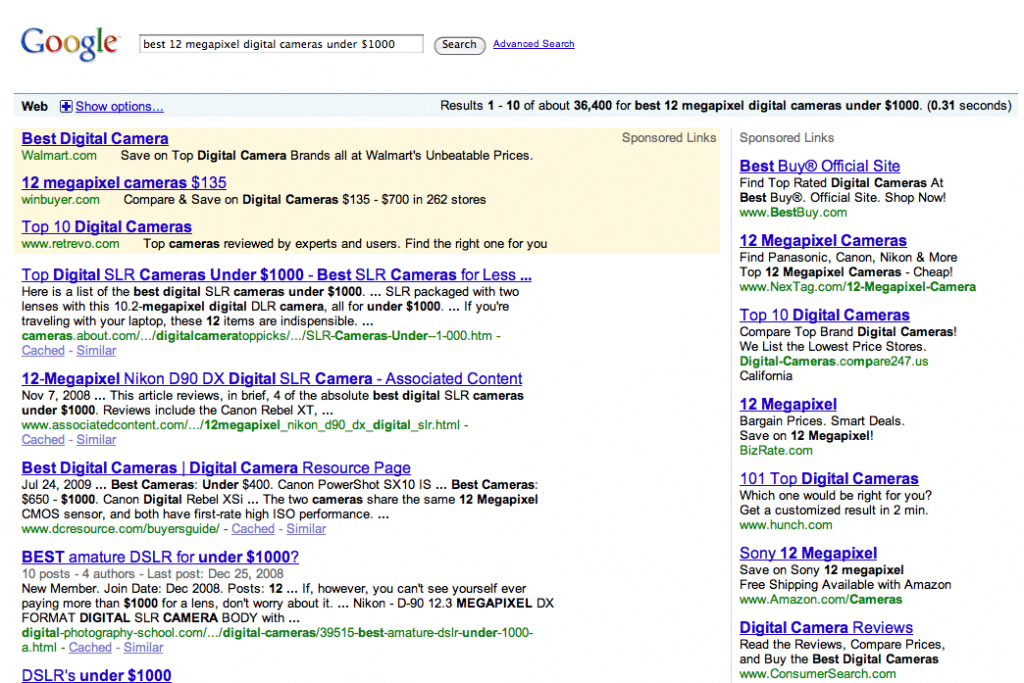
We examined how Google have presented Adverts to the searcher over time. Interestingly, since 2013, Google has changed it’s adverts over time to be less obvious. In the graphic below you can see how Google search Ads have evolved. The format and styling change frequently and it could be suggested that the graphic signposting of Adverts has become much more subtle over time and more in line with a standard organic listing.

When we look at our Varn research over the last 6 years, the ability to recognise an Advert hasn’t changed a great deal, even though theoretically people are getting wiser to how search engines work. It has remained between about 57% and 65% since 2017 and you can see how this may be influenced by the design of the Google Ad labelling which has since transformed to look more like regular Google listings. This year we see that figure at 68.2%, at a time when the Ad design really is very similar to an organic search listing.
Can you spot the difference…?
It really is not surprising that the majority (68.2%) of people still don’t recognise Ads, as if you line up a paid Advert and an organic search result and see how they actually look to a searcher, you can see there is not much difference at all:
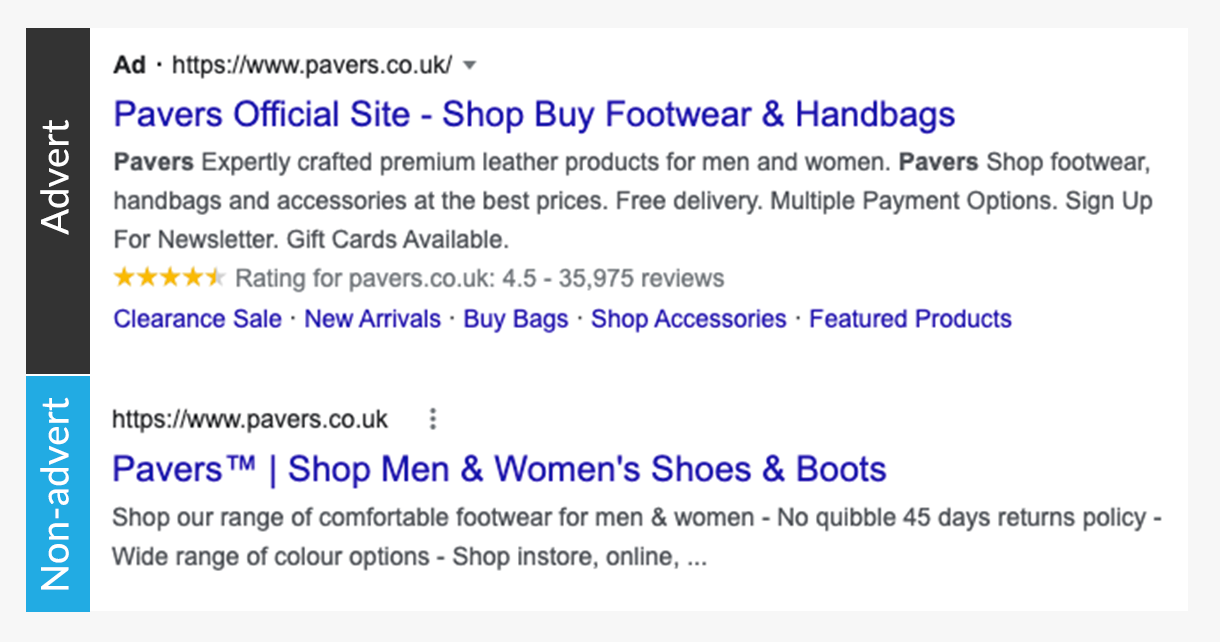
We have also seen that Ads can often take up most of the page of a search result. Combine this with the subtle design cues used to indicate the Advert status, you can see why people may not understand they are looking at just Ads rather than organic search results.
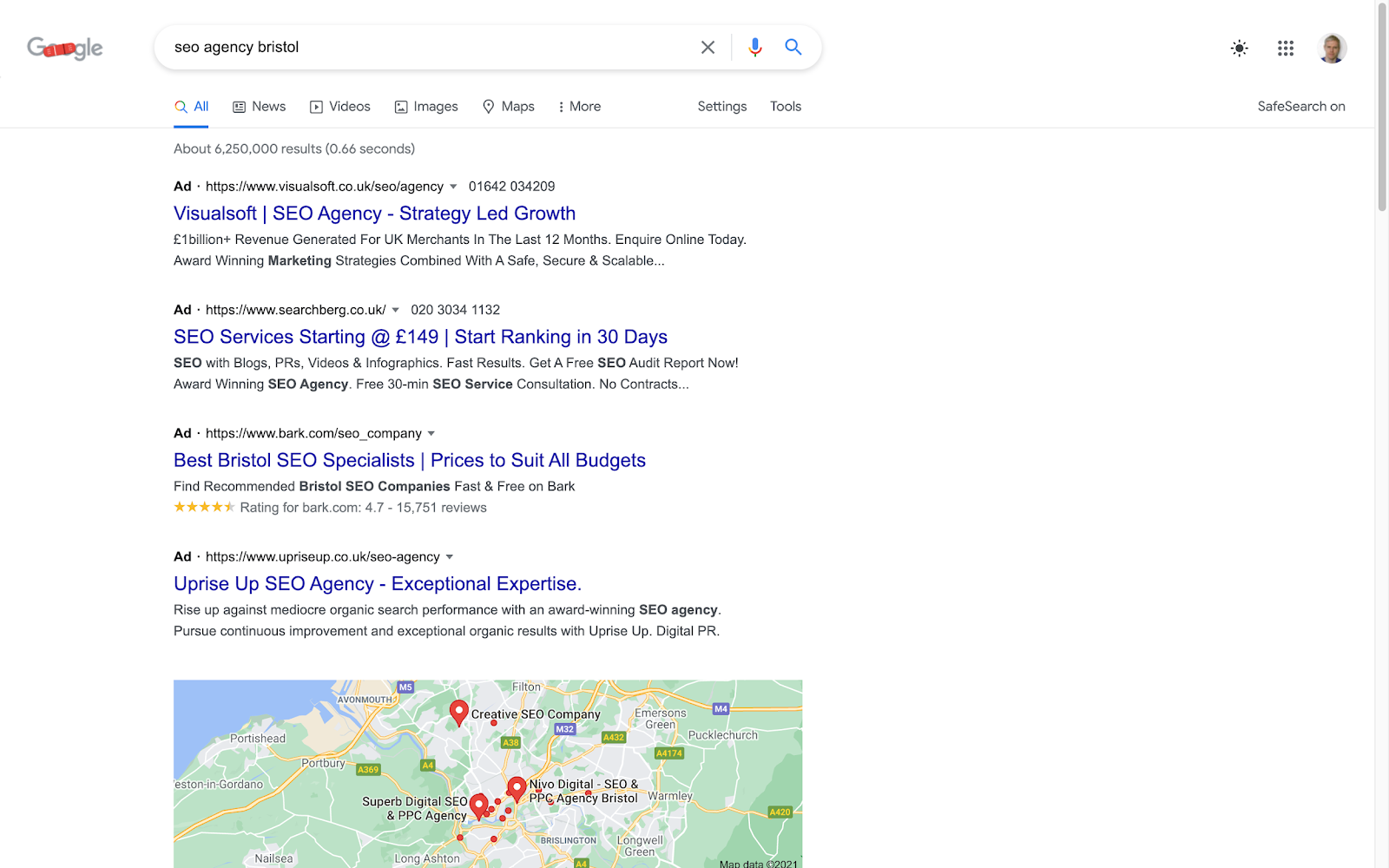
A good example is, if you search something close to our heart…. ‘SEO agency Bristol’. As you will see the paid Ads take up your whole screen when you initially search and you have to actively scroll down to get to the first organic search results. Given that 75% of people don’t scroll past page 1, those Adverts can really take up people’s attention and clicks.
When we compare that back to 2009, these were the sorts of results you would see. It is really quite noticeable the the ‘Sponsored links’ are very clearly labelled.
In order to make sure your website is visible to the biggest search audience possible, it really is vital to make sure you have a search marketing strategy that embraces both SEO (organic search results) and PPC (paid search advertising).
We know from our ongoing research that the majority of the search market will not even recognise the Ad, and we can see from the examples of how Advert styling has evolved over time, why that has remained high. However, we know that we can’t ignore the large proportion of a target market who do know an Ad when they see one, especially as almost 80% of these searchers will then decide not to click. Therefore, it is critical to execute both SEO and PPC in the most optimal way possible, to ensure you are not missing out on potential clients.
Data suggests that approximately 53% of all website traffic comes from organic search and 27% from paid media,so it really is a sensible idea to not put all your eggs in one search basket. Neither organic nor paid search is inherently superior to each other and whilst paid ads do have a cost, you should be trying and testing both paid search and SEO, (with organic search optimisation, you’ll have to test for at least six months). By testing, reiterating and learning from both paid media and SEO, you can see what works for you and your business, short and long term, ensuring you capture all the possible clicks out there.
Given our latest research findings combined with the need to have a strategy that ensures you speak to the widest possible target search audience we have a clear recommendation. The best way to optimise reach and drive rankings and clicks, is to adopt both SEO and PPC strategies and tactics and to ensure you carefully plan and structure both for optimal results.
And Google seems to agree so we will leave the last word to them…
“Using SEO and Google Ads together may give you the best chance of bringing traffic to your site in the short term, and enhancing your business’s presence online for long-term success.”
Get in touch here to find out more about how to perfect your own hybrid model of optimised organic SEO combined with paid search media.
We have been helping our clients to prepare to transition from Google’s Universal Analytics to their newer platform Google Analytics 4 for the past couple of years. And, as we move through summer 2022, the need to make the switch to GA4 is becoming increasingly time critical.
Google’s friendly and familiar web stats platform Universal Analytics is going to be switched off in just over a year. If you’re a digital marketeer who uses Google Analytics to track website performance, you will need to make the switch to GA4 sooner rather than later.
We recommend turning on Google Analytics 4 asap so that when Universal Analytics becomes redundant in July 2023, you will already have collected a year’s worth of data in GA4. That’s why now is the time to make the move!
We’ve put together an overview of the key dates you need to be aware of, to help you plan the transition. Not sure how to get up and running on GA4? Take a look at our guide to setting up Google Analytics 4 to get you started.
The new analytics reporting platform was announced two years ago, shortly followed by the news that Google would eventually turn off Universal Analytics completely. At this point, the team here at Varn set ourselves the challenge to learn all we could about Google Analytics 4 in preparation.
We think switching on GA4 in summer 2022 is the most logical timeframe for all businesses who rely on monitoring website traffic, conversions and user behaviour. This will mean that you will have year-on-year data available when Universal Analytics gets switched off the following summer.
Setting up Google Analytics 4 in July 2022 will mean that you can run both UA and GA4 in parallel for a year while you get trained up on how to use the new platform and move your regular reporting to GA4.
At this point, you will still be able to access historic data in your old Universal Analytics account. However, no new data will be received. So it will be essential to have GA4 fully configured, with all your necessary reporting set up by this point.
From the start of 2024, you will no longer be able to access Universal Analytics, and all historic data will be deleted. We would recommend you export all historic data from your account before this date. Not sure how to do that? With a little bit of Varn magic and technical know-how, we can help you to pull your historic web data into a useful Google Data Studio report.
It’s time to start getting to grips with GA4. The new interface can be intimidating, as there are less out-of-the-box reporting options available and more custom configuration is required. However, Google Analytics 4 is the future of website analytics, so it is important not to be caught by surprise or left behind!
Feel free to contact the Varn team for help and support setting up your account, learning how to use GA4, and creating any custom reporting solutions you need.
At Varn we have had so many questions and queries related to the importance of using video as a marketing tool from our clients, we thought it would be useful to share some of the latest thinking on why video is so vital in 2022 and the powerful role video can play to optimise your SEO efforts.
We have brought in the experts from Bristol-based video agency Life Media UK to explain why video is such a key player in your marketing mix (and not just for SEO either!)…
At Life Media UK, we understand that with a strong video strategy and a high level of execution, video can achieve incredible results. The potential for video to connect you with your ideal client becomes even more powerful when you optimise it with the SEO tactics that Varn will explain to you shortly… but first…
Here’s why video is your best bet when it comes to marketing in 2022.
Fortunately for us and our clients, video shows no sign of slowing down; the average consumer now watches 19 hours of online video per week, with YouTube reaching more viewers than any TV channel on the planet. All of these video-hungry eyeballs gives you, as a business, the perfect opportunity to reach people exactly where their focus is.
While we’d all love to give each of our potential customers a face-to-face sales pitch, it’s not always possible; but video can be the next best thing. Communicating with every single one of your prospective buyers on-demand, answering their questions, delivering compelling social proof and engaging product demos can only be done through the power of a great video.
88% of people would like to see more videos from brands in 2022. Simply put, you should be marketing with video because that’s exactly how your customers want (and expect) to be marketed to.
The real value of video comes from its ability to drive sales like nothing else. We’ll let Varn explain the SEO value in a second, but in addition to turbo-charging your organic traffic, video can also boost sales from your paid campaigns by as much as 100%!
Once you’ve got users to your site, embedded video content can also increase sales by up to 144%, making conversions easier and campaigns more impactful.
Social media was built for video, and it’s now the most popular form of content by a country mile. Engagement with videos on Facebook is almost double that of text or image-based posts, and 1 in 4 Instagram users have made a purchase after seeing an Instagram story.
It’s not just your website and social media that feel the benefit of video marketing – 71% of sales professionals confirm that video emails outperforms text-based emails, as video gets your message across in a quick, succinct and engaging way.
We know how important return on investment is. With 87% of marketers who use video seeing a positive ROI, video is becoming one of the most reliable forms of marketing around, as well as the most impactful.
We know that 75% of searchers don’t scroll past page 1 of a SERP (Search Engine Results Page) so making sure you are up there in the rankings, on page 1 is really important. Without a doubt, creating video for your website can dramatically improve your ranking results on Google and positively affect your SEO efforts. We know that the search engines love video and that’s because people searching love video and are increasingly consuming more and more video.
Creating video is a fantastic tool to target keywords in the search engines. With an engaging video it is likely that people will spend more time on your website and this can increase something we call ‘dwell time’. According to Search Engine Journal dwell time is defined as
We know that increased dwell time will mean the Google bots will identify your video as valuable content and this means better rankings for your website.
There is some interesting data on the value of video from Wordstream and here are a few stand out stats for us:
You need to load content from reCAPTCHA to submit the form. Please note that doing so will share data with third-party providers.
More Information