If you’re struggling to write content that ranks well on Google, you aren’t alone. Business owners, content creators, and marketers often face this challenge. They struggle to find a starting point for writing content that not only meets Google’s high standards but also ranks well in SERPs, and drive conversions. For years, SEO techniques have been designed for search engines, rather than users. However, the SEO landscape has been changing, with algorithm updates, innovative AI, and SERP feature updates / changes. This has led to a shift in the industry and the need to reassess strategies to align with Google’s request for user-first content; accessible and helpful.

At Varn, we take a holistic approach taking into account the wider aspects of technical SEO, AI-driven analytics and content optimisation, that align with the latest user experience principles. This helps to guide our clients through an ever-evolving and increasingly complex digital landscape.
Google’s E-E-A-T Principle is a cornerstone in raising your website’s SERP profile and rising through the ranking to the first position. By producing consistent useful and helpful content, a steady stream of traffic and conversions will follow. This article outlines the techniques to write quality content that both users and search engines value and ensuring you are writing with E-E-A-T at the core of your content strategy.
E-E-A-T stands for Experience, Expertise, Authoritativeness, and Trustworthiness. E-E-A-T content should be part of any long-term SEO strategy to boost your website’s credibility and ranking. These guidelines are used by Google’s algorithms to help to evaluate the quality of the content on websites and in 2022 Google announced they were adding an extra E to the original EAT Guidelines.
So what does EEAT stand for?
This refers to the first-hand or personal experience of the content creator.
This identifies the creator’s knowledge and skill in the subject matter.
Assesses the credibility and recognition of the creator or website.
This evaluates the reliability and integrity of the content.
You may be thinking, what does all of this actually mean? In short, it means creating helpful and people-centric content.
E-E-A-T factors help to keep high-quality, reliable and relevant information available to users on the SERP. A content strategy that keeps ahead of keyword opportunities, utilises cross-functional teams, and produces organic content ensures your website’s content matches the high quality that Google is looking for. It’s also important to update existing content with contemporary research and updates so that this becomes evergreen content. Evergreen content refers to high-quality, valuable content that is relevant and useful to readers over a long period of time and unlike news articles or trend-based content that can quickly become outdated, evergreen content is designed to provide long-term value, attract ongoing traffic and continually engage audiences.
Organic SEO-first content is something we specialise in at Varn, whether for our client’s on-page content, blogs and product landing pages, through to off-page data-driven articles, guest blogs or PPC landing pages.
When creating or updating content for your website, we recommend you incorporate the elements explored below, into your overall SEO strategy to match E-E-A-T guidelines. Ultimately it’s about ensuring your content is as attractive as possible for the search engines to find, understand and rank.
Experience, Expertise, Authoritativeness, and Trustworthiness can be shown in various ways. For example, you can include detailed author bios on your website when someone writes and shares an article demonstrating your expertise. It’s vital to produce high-quality and well-researched content, cite credible sources and engage with the industry.
Social-proof your content with reviews or client testimonials, accreditations or awards you’ve achieved. Help the reader understand why they should listen to you. If you don’t have credentials to be speaking about a certain topic, be sure to collaborate with someone who does. Industry partners, influencers, and expert quotes featured in your content will help you to create user-first E-E-A-T content.
Include a brief section about your business, explaining your expertise, the areas you serve, and the scope of your services. Why should people listen to you? Remind users why they should choose you for a service or trust your advice on a subject. A ‘Why choose Us?’ section or a succinct ‘About Us’ that mentions the years you’ve been in business, and partners you have worked with, will help to position yourself as a credible expert.
An internal link is the hyperlink on your website that takes the user to another page within your website. Contextual internal linking extends the user journey and helps search engines understand your website’s hierarchy structure and the importance of content. It doesn’t just add SEO value, it also aligns with improved user experience and conversion. Internal links add context to the relationship between pages in your website and shares page authority to important pages. Before diving into creating an internal linking strategy, make sure you understand why internal linking is important.
Anchor text is the clickable text in a hyperlink. Rather than using generic phrases like “click here”, use descriptive anchor text that aligns with your destination page’s keyword mapping strategy. Build on a page’s keyword authority with descriptive anchor text. This will help users and search engines understand your content’s purpose.
You can align the anchor text with keywords informed by Google’s perception of keyword authority for a page with Google Search Console. If you haven’t set up Google Search Console, take a look below at these helpful tips.
Make sure your call to actions (CTAs) for a page match the page’s intent. If you’re unsure of a user’s intent, understanding search keyword intent will help. Use CTAs to encourage users to take specific actions, they can be particularly effective at the end of your introduction and content. If in doubt, prompt users with your company’s credentials and offer to get in touch or speak to experts.
It’s vital to think of the user journey, so for example, if you have a blog about the benefits of a service or product, you would expect to see the service or the product page linked. Understand where in the marketing funnel your user is, if they are looking at a blog that is an introduction to a product or service, then they have just started their journey. Therefore you can make them aware of problems with the solutions that you offer, speaking to their pain points, challenges and desires. To do this effectively, you will need to know your audience inside out.
Focus on high-quality, informative content. You and your team are experts, real people with a breadth of valuable first-hand experience that people want to learn from. Your team’s first-hand experiences are invaluable. They match the Experience part of the E-E-A-T guidelines. Share them to create authentic, informative content.
Here are some helpful tips how to write user first E-E-A-T content:
Write for your audience first, then tweak and structure for SEO. Google is discouraging SEOs from writing content just for search engines. And rightly so, we’ve all clicked on a result in the SERP and been met with AI-generated nonsense. Google asks us to provide ‘Helpful, Reliable, People-First content.’ The days of writing content based on search volume alone are over. Search engines are now flooded with AI content – Google struggles to find the most helpful content to rank. In this new age of SEO, business owners, experts and SEOs must work together to find a middle ground, that is both helpful for users and optimised correctly for the search engines.
Work with a marketing/ SEO expert to perform user research. This should consist of understanding pain points, desires and the audience’s buying journey. For example, in the decision stage of the buying journey, we need to catch users when they are in the consideration stage of that journey. So think about your blog content, and capture solutions to help solve their pain points, queries, worries, wants, and needs. It’s vital to capture your audience’s attention by writing content that resonates with their experiences and aspirations.
Reflect on the next steps you want users to take and use internal links to support their decision-making process. Think about what makes sense for them, and explore this around aligning the actions you want taken which are based on your business goals and the user journey you want them to experience? Is it a brochure download, to get in contact or book an appointment?
You can use existing data from Google Analytics to help inform your decision making. The GA4 Page Path explorer can tell you which blog pages were part of the converting/purchasing users’ journey. Use this information to guide your internal linking, and take your user on a journey through the buying funnel. You can take this a step further with natural placements where a related topic is introduced. It’s important to remember that there is no need to add links for the sake of it, it must be natural, and these links need to add value.
It’s vital to ensure your content is accessible and engaging. One element to consider is the readability of your content or article on a desktop, compared to when people may be scanning the content when using a mobile. Additionally without good content structure, even the most insightful/helpful information can be dismissed as untrustworthy or irrelevant by search engines.
Structuring E-E-A-T content with keyword-rich headings doesn’t just have SEO value, it also improves user experience. These headings make it easier for users to navigate the content, find the information they need and hence perceive the content as authoritative and trustworthy. Clear, relevant headings also help the search engines understand the content’s topic, making it more discoverable and likely to rank higher.
Eye tracking research can be used to help understand how users interact with headings on webpages, revealing their role in capturing initial attention and guiding navigation. This data informs effective design decisions to enhance readability, user engagement plus overall user experience. Eye-tracking research studies found that when people read on the web, their approach depends on what they are doing, what they expect based on their past internet use, how the page looks, and the type of content it has, like text or pictures.
The most common scanning patterns are:
The F theory – where the user will mainly look on the left side of the webpage and examine the top of the page.
Spotted pattern – where the user will jump around to the most interesting spots – often influenced by effective website design and UX.
The layer-cake pattern – where the user will focus on headings and subheadings as they act as signposts for information.
Incorporating FAQ sections into a website’s content strategy aligns well with E-E-A-T principles, as this helps to create content that is not only informative and reliable but also highly valued by both users and search engines. You can use Google Search Console, to help you uncover long-tail keyword opportunities to feed into your FAQs.
If you want to find FAQ opportunities in Search Console you can do the following;
Don’t forget to structure your FAQ content to appear as snippets in search results with schema mark up optimisation, to help increase click-through rates.
On a final note, user-first content that adheres to E-E-A-T principles isn’t just about chasing low-hanging fruit or seeking quick wins. It’s about building a foundation of trust and authority for your brand and business that will continuously fuel organic search growth over the long term.
Still not sure where to start? Our team of innovative SEO experts can support you to develop a robust E-E-A-T content strategy that will drive traffic and conversions. Contact our expert SEO team to discuss your E-E-A-T challenges, we would love to help.
When speaking to potential clients and business partners, we often get asked, ‘what are the quick SEO wins?’ This is often a result of people suddenly needing more clients or their new website has taken a dive in rankings and they are seeking a ‘quick fix’.
In reality, whilst there are often ‘quick wins’ to be found these will never replace a thorough and well crafted long term SEO strategy. The clients that we have worked with and kept at the top of the search rankings for over ten years.

A long-term SEO strategy focuses on building a strong foundation for your website, which means understanding your audience and target market, creating high-quality content that is helpful and interesting to that audience, whilst simultaneously establishing your brand as a brand of choice and an authority in your sector.
By investing time and resources into a comprehensive long-term SEO plan, you will benefit from the following wins:
Increased organic traffic
A well-executed long-term SEO strategy will help your website rank consistently higher in the search engine results pages (SERPs), which leads to a steady increase in organic traffic over time.
Improved user experience
By focusing on creating helpful, valuable content and optimising your website for users, you’ll provide a better overall website experience which will mean increased engagement and conversions.
Secure sustainable rankings
Short-term SEO tactics may provide temporary boosts in your rankings on the SERPs, but a long-term strategy ensures that your website maintains its position in the SERPs, even as algorithms evolve.
Establish brand authority
Often massively undervalued, but consistently producing high-quality thought leadership content (articles, talks and videos) will earn high-quality backlinks and will, therefore, establish your brand as an authority in your sector, which in turn will build trust with both the search engines and your audience.
In conversations with our clients we emphasise the importance of planning SEO strategies that help build for long-term, impactful results in their search marketing efforts. These are our top five tips that will help plan for SEO success for the long-term.
The foundation of any successful SEO strategy is to conduct thorough keyword research, which means identifying the keywords and phrases your target audience uses when searching for products or services like yours. At Varn we use a method we call ‘search intent modelling’ which encapsulates the real motivation behind a user’s search query on search engines. It’s a critical concept in SEO, as understanding and catering to the specific reason a user has for searching ensures content is relevant, satisfies user needs, and enhances the likelihood of achieving higher rankings in search engine results pages (SERPs).
Invest in creating high-quality, evergreen content that provides value to your target audience. This type of content remains relevant and useful over time, helping you attract organic traffic and build brand authority. Regularly update and refresh your content to ensure it remains accurate and engaging. This can be from running events, giving talks, and writing thought leadership articles to video guides. Either way, we have found that well-curated content has generated good links and website traffic for our clients, years after its initial creation. This is obviously not short-term, but does have a compound effect, which is priceless.
Search engines prioritise websites that provide a positive user experience, and this means ensuring your website is mobile-friendly, has a clear navigation structure and loads quickly. Always optimise your content for readability and engagement, using headings, subheadings, and multimedia elements like video to break up text and keep your users interested.
A long-term SEO strategy requires continuous monitoring and adaptation. So do regularly analyse your website’s performance using tools like Google Analytics. It’s also vital to keep an eye on your competitors’ strategies and I did a talk a few years ago at Brighton SEO, on why it’s so critical to understand your competitors and their SEO strategies. Make sure you also stay up-to-date with the latest SEO trends and algorithm updates, and be prepared to adjust your strategy as needed to maintain your search engine rankings.
In summary, in the fast-paced world of digital marketing, it’s easy to get caught up in the pursuit of quick wins. However, when it comes to SEO, a long-term strategy is always the better choice for sustainable growth and lasting success. We have been working with some of our clients for over a decade.
If you have any questions about our tips to shift your SEO thinking to more long-term thinking, and you think our expert team can help, then please do contact us, we would love to hear from you.
Scroll the FYP (For You Page) of any Gen Z TikTok account and you’ll find an infinite amount of personalised content, from product reviews, dating advice, adverts for multi-pack toilet rolls, and a twenty-something woman inviting us to ‘GRWM’ (Get Ready With Me) for a day in London. It may not be obvious at first, but the reviews, advice, adverts and OOTDs (Outfit of the Day) all have one thing in common: They have been searched by users on the hunt for information.
A new study from the people over at Adobe claims over 64% of Gen Z Americans use TikTok as a search engine, with “nearly 1-in-10 stating they were more likely to rely on TikTok than Google as a search engine.” The study found that 19% of all consumers are looking for new restaurants amongst other content types, with new recipes coming top at 36%. So, where will the average Gen Zer turn to find the best place to eat lunch in London? It isn’t Google.

Compared to other social platforms such as Facebook, X (formally Twitter), Snapchat, and Instagram, TikTok’s rise to fame amongst its competitors has been stratospheric. According to BackLinko.com, TikTok hit 1 billion monthly active users in September 2021, which made the app one of the fastest-growing apps ever in terms of market hold since 2016. However, TikTok’s quick ascension hasn’t come without controversies and legal challenges.
As of writing, the US House of Representatives has voted to force a nationwide ban on the app, unless the Chinese parent company, ByteDance, sell their controlling stake within six months, over fears of national security and data handling. TikTok has also faced scrutiny from the EU, with them launching a formal investigation into potential breaches of the Digital Services Act, including the safeguarding of children. Only time can tell the outcomes of these legal challenges and their wider impact on TikTok’s future and its place in modern society.
None of the legal actions and possible law changes appear to have slowed down the progression of TikTok becoming a tool to search for information and quick answers. TikTok Search now shows users familiar features such as auto-suggest, featured snippets with AI-generated text summarising videos, TikTok traffic analytics for creators and more.
TikTok SEO is not like traditional SEO in its performance. However, there are crossovers in features, methods and techniques. TikTok is unique in the sense that its algorithm relies less on how many followers an account has, and how many views, likes or comments a video has; however, these elements certainly do help push the algorithm. Other indicators are considered more, such as video watch time, video engagement, what your peers are viewing, your previous searches, etc.
For creators such as businesses and brands, this means that quality content is key to getting your videos out there. Even though there are fewer clear ranking factors than other search engines like Google, a TikTok SEO strategy and best practice is invaluable.
With Google now posting TikTok content in the SERPs with featured snippets, as well as Google SGE, we are at the beginning of a search engine revolution, seeking to change completely how we consume information. Alongside legal challenges, TikTok’s biggest threat may be one of its inevitable outcomes: misinformation.
With TikTok search and For You Pages being driven by user engagements, rather than something such as E-E-A-T, there is a glaring question surrounding the future of trusted news sources and reliable sources. All it takes is a small number of accounts to create content suggesting fake news about a celebrity, and the algorithm pushes false headlines, and AI-generated auto-suggest queries, building an avalanche of click-bait lies.
If you looking for advice on reaching a wider audience on TikTok and other social media platforms, then do not hesitate to reach out to our expert team.
Are you trying to make your ecommerce business’ website stand out in a crowded digital space?
Do you feel lost when it comes to getting your Shopify noticed by Google? You are not alone. In this article, we will share how to make the most of Shopify for SEO, explore its benefits and help you to avoid common mistakes.

Nothing is more frustrating than putting effort into setting up an online store, for no one to visit. As an ecommerce business owner, you know how important it is for your store to show up in search results. It’s important to understand how to improve your Shopify store’s visibility in search results, so you can attract more customers and grow your business.
Shopify’s tools can also be tricky to understand, especially if you’re not sure where to start.
We have listed some of the most useful benefits and avoidable mistakes to help you understand what works and what doesn’t in SEO for Shopify stores.
Whether your ecommerce site is grappling with fierce competition, battling low rankings in the search results or you are keen to broaden your knowledge with ecommerce SEO to become more confident, the Varn team have put together this article to help you understand how Shopify can be used to follow SEO best practices.
Shopify’s CMS makes it easy to create and manage content for ecommerce websites, with simple monthly plans to sell products. The platform has over 600,000 merchants across the world. Shopify regularly updates their platform with new features and integrations. The recent, tap to pay on iPhone, and twitter sales channels are efforts to improve user experience, increase traffic and attract more customers.
Any online purchases made via your ecommerce site need to be secure. A user expects an ecommerce site to protect their sensitive data. Shopify’s secure hosting includes a free SSL (Secure Sockets Layer) certificate, which enables HTTPS encryption, for all their hosted websites.
This HTTPS protocol signals to search engines that the website is secure. Google highlights security as criteria for a good page experience and gives preference to secure websites. This core aspect of technical SEO is not overlooked for ecommerce websites that use Shopify.
Without it, your site won’t rank well in searches.
Structured data, also known as schema markup, translates page details to search engines to suggest which product details to show in the SERP. The Shopify platform has an easy way to add structured data markup.
Ecommerce websites are no longer bound to the format of page title, meta description and URL. Rich snippets are a fast track to the top of the SERP. As manager of a team that’s rooted in Technical SEO, I’m no stranger to the opportunities schema provides that ecommerce businesses to benefit from.

Rich snippets your business can rank for using Shopify
Google updates and adds features to the Search Results Page (SERP) more than ever before. One of the most recent is Google’s recent SERP feature, specifically designed for cruises. Additionally, Google’s new Search Generative Experience (SGE) plans to introduce AI in the SERP, some of the most recent updates we’ve noticed is Shop with Google AI feature.

A non-negotiable of a website’s technical SEO set up, is a well-organised sitemap. An XML sitemap is a file that lists all the pages on your website, in a structure that reflects their relevance and importance. It should be easy for search engine crawlers to navigate, understand site structure and index the pages on your ecommerce site. If Google can’t reach a page easily, how will it rank it?
Without a crawlable site, Google cannot and will not rank anything. To create an XML sitemap manually may be a challenge if you’re new to SEO and can take a long time. Whereas, with Shopify, a sitemap for your ecommerce website is automatically generated.
Canonical tags help search engines understand the preferred version of a page, especially handy if there are multiple pages with similar content. Canonical tags are especially useful for ecommerce sites with product variants, filters, pagination, and cross-selling pages. The Shopify platform anticipates this dilemma with automatically generated canonical tags.
This feature simplifies the technical aspects of SEO for business owners, but also helps to prevent issues like duplicate content penalties. With Shopify’s automated generation of canonical tags, businesses can focus on their products and content.
Whilst Shopify auto generates canonical tags they should be strategised, monitored and planned. An organised structure helps people and search engines to find what they are looking for, without being overwhelmed or confused with lots of similar products.
Hubspot’s 2023 Web Traffic & Analytics Report found that:
“54% of consumers primarily use phones to search.”
Google announced, via their Google Search Central Blog, that “We will be expanding our use of mobile-friendliness as a ranking signal.” As mobile searches continue to dominate, Google has made mobile-friendliness a crucial ranking factor.
81% of Shopify traffic comes from mobile devices. So it’s no surprise that Shopify themes are made for mobile users, with mobile-friendliness and integrations. A responsive theme helps avoid user’s bouncing off the page because a page hasn’t loaded correctly.
Page speed, sometimes called ‘load speed’ measures how fast the content on a page loads. The speed of a website is a crucial factor in SEO.
When someone uses your ecommerce store, the user has a specific purpose, they expect to find the information, or a specific product or service quickly otherwise they will leave.
The average adult attention span is 8 seconds. Waiting 4-5 seconds for a page to load isn’t good enough. Each second the user is waiting for your ecommerce site to load is a second that they not only lose interest, but your business loses credibility. There’s a correlation between conversion rate and load speed. For ecommerce businesses, this shouldn’t be overlooked. A page’s load speed can be the difference between a sale and a user leaving your site.

Shopify has built-in speed optimisation features into its platform. One such feature is the integration of a content delivery network (CDN), which considerably enhances page loading times. This, in turn, not only improves the user experience but also provides preferential treatment to faster-loading pages in search engine algorithms, resulting in higher rankings.
Shopify’s app store drives the number of ecommerce sales made with online businesses. A large collection of apps and plugins are available to be integrated into your e-commerce site. They can help businesses to meet their digital marketing goals such as email marketing or post purchase surveys.
The apps can help with improving SEO to the extent of compressing images and keyword optimisation. SEO apps on Shopify may seem tempting, they offer a one-click answer. But in reality, as with anything complicated, anything that offers a quick solution needs to be treated sceptically. An app alone can’t provide the quality that’s necessary for real SEO, but these tools can be used strategically to enhance or enable your organic search tactics.
Think of the blog section of your ecommerce store as an organic space where users can learn more about your products, services, industry, and company culture. An opportunity to focus on your niche, build a relationship with a user, and hone in on expertise.
Explore and address your ideal customers’ pain points and desires, and answer their questions. Journalists and writers for online publications might quote your expertise and feature in publications. This proactive approach to display industry expertise on an ecommerce site’s blog could pay off with links.
If your business already has a proactive ecommerce strategy, creating content doesn’t have to be laborious. An ecommerce business can boost rankings, attract more visitors, and sales with a content strategy that is informed by a customer journey mapping.
The human brain processes images faster than text, don’t neglect visuals with your blog posts, show information using visual formats like infographics. Embed social posts and videos to keep users engaged. Map each blog post to a stage of customer journey and align with internal links to your products and services.
A blog section for your ecommerce business gives you the power to rank for long tail keywords. If you are actively making social media content, this can be repurposed. You don’t need to spend a long time on content.
Turn snippets of your blog posts into a newsletter for email marketing, X or LinkedIn posts. Turn these snippets into infographics for Pinterest. The blog you’ve written can be turned into the script for a YouTube video or live broadcast. Snappy takeaways from your long form content can be turned into a reel or TikTok.
If you’d like to learn more about the process included in how to create a content strategy for your business. We have created guides to help you get started with a content strategy plan and you can learn how to build a strong foundation in how to plan a content strategy and can also explore how to write SEO friendly content.
If you are feeling overwhelmed with setting up your store, tired of not understanding Shopify jargon or it feels like every time you learn a concept, there are new roadblocks that come with it, then Shopify’s learning resources are one of the simplest ways discovering how to set up your store. They also share useful tutorials, online webinars, guides and courses.
Maybe you are new to the ecommerce or SEO space, or you’re in the process of migrating over from another platform but don’t know where to start? Shopify’s Help Centre has a large collection of webinar videos, blogs and guides suited to help all levels of expertise, so you can form a foundation of understanding that ecommerce business owners need to implement SEO on their websites.
Shopify is brilliant for beginners and smaller brands, it is not as competitive as other ecommerce platforms like Amazon. The ecommerce platform makes setting up online and navigating the backend simple so you can focus on your business at hand. With Shopify, you get an easy-to-use platform as well as a large support network due to the large number of business owners that use it. An easily customisable shop front, lots of customer support, more features than other platforms down to the app integrations.
You’ve probably gathered from this article, we love working with Shopify. It is a useful ecommerce platform that allows users to scale their business and take multi-currency payments. If you are looking for a CMS Platform with powerful marketing and SEO abilities such as analytics, abandoned cart and email notifications, Shopify is easy to use.
We have shared the most common mistakes that we encounter when optimising ecommerce business owners Shopify for SEO.
Stay ahead of the curve, allow Google to make the most of your website, by implementing structured data. Schema markup needs to be planned, as if you fail to plan, mistakes can happen. For example, you might end up with conflicting information on the same page or miss out on using certain types of schema that could help your site rank.
As Shopify is primarily used for ecommerce sites and products tend to have a number of variations, this ends up creating a lot of different page URLs containing very similar content.
Not correctly implementing canonicalisation not only creates potential issues with duplicate content but also results in keyword cannibalisation. Neither of which are great for SEO.
We have also recognised Shopify’s innate limitations surrounding page URLs. When creating sites in other content management systems such as WordPress, you have quite a lot of control over URLs, URL strings, parent vs. child pages and so on.
However with Shopify, these URL structures are very limited and most URLs are /pages/page-title, /collections/collection-title, or /product/product-title. This limitation can be avoided with keyword mapping.
Final Thoughts on Shopify SEO
A clear vision and well thought out marketing strategy is core to keep a competitive edge for ecommerce websites. As an ecommerce business owner, it’s important to recognise that Shopify is a user friendly platform. However, without a strategy that includes all aspects of SEO – technical, on-page and user experience as well as aligning with your business goals you run the risk of missing out on sales, organic search traffic, potential customers and being surpassed by competition.
Has your website outgrown Shopify’s built-in SEO?
Are you keen to avoid mistakes or adopt these strategies but unsure how to?
Shopify’s SEO tools are a great start, but for explosive growth, you need expert innovation.
Varn’s data-driven approach goes beyond built-in tools. We conduct a deep SEO audit, fix technical issues, and unearth high-value keywords your competitors have missed. We then use that data to create a custom strategy for your business.
Get in touch with our expert team at Varn, we’re obsessed with SEO and search, keen to look at your Shopify website and help you succeed online.
Bibliography
CloudFlare.com – infographic page speed / conversion correlation
As your website grows and evolves over time with loads of new content it can be easy to neglect some of your past blogs and content pieces, in favour of new shiny ones; this is a big mistake for SEO. Often, older blogs and content can be a gold mine, (or rather ‘linkmine’), when it comes to driving organic search results over time.
Here we look at refreshing old content and how you can do it to drive more organic links over time through off-page SEO, which will help all of your SEO efforts.
To find the potential content that you want to drive backlinks to, take a look at your blog content through a tool like SEMRush, (other search engine optimisation tools available), to find ones that have a bit of website traffic and are getting some traction when it comes to backlinks. It could be that there are good candidates there that with a bit of TLC can be pushed higher up the rankings.
Depending on the site set-up, you can look via sub-folder or root domain to find the blogs:

The snapshot above shows some of the top performing pages for our own blog content at Varn, ordered by referring domains:

A deeper dive reveals where the opportunity lies. The blogs above have got a handful of backlinks, and we can examine some of the key terms that they rank for and the links they are getting. If we look at the following URL we can work through a case study:
https://varn.co.uk/05/05/why-search-keyword-intent-modelling-is-important
We can see from SEMRush that this URL ranks in the top 100 for terms like “keyword intent” “what is search intent” and “search intent” terms, that get 110, 70 and 390 monthly UK searches respectively.
We can also see that this blog has 4 backlinks, 1 of which is an important one:
https://seobase.com/what-is-semantic-search
This matches the key checklist for an ideal content improvement candidate:

If the answer to the above is yes, then we have a candidate for improvement and we can begin the optimisation process.
Once you have your content outlined the next step is to start the updating process, this will stem from the keyword research conducted prior to the optimisation process, in the case of the search intent modelling blog, we outlined the following key terms to go after:
With that confirmed, we went on our optimisation journey.
The next step is to look for who the big players are when it comes to the content you are looking to get ranking, in our case we looked at the backlinks of this backlinks of article amongst other high ranking pages:
https://backlinko.com/hub/seo/search-intent
From this you can develop an outreach list of people who have written about similar content in the past and who may well be grateful for an updated version of what they want to cover, the following template can be used to reach out to these websites and let them know that you have you updated your content, and that you think it’s a bit better than the one they have referenced already.
Once you have the content written and updated, resubmitted to Google Search Console and outreach underway to let interested websites know that there is some new content out there worth revisiting, benchmark the following KPIs so that you know where you were and can set some targets on where you want to go.
The above process can be really rewarding, as getting the most out of your content means working smarter and not harder. Optimising past content can bring some great results. Here is an example from our client HSE Network.
Our client HSE Network wants to rank well for safety software based terms so they can drive relevant traffic for would-be advertisers, driver safety software is one of these pillars.
They had a great article with a mix of written and video content from 2021 that was performing, but not spectacularly. For 2024, we worked with them to update the content and just two weeks on from the update, we have seen an increase in the core rankings. They went from the bottom of page one to top for the term ‘driver safety software benefits’.

Last month we optimised our core search intent modelling page.
We built it out with a link to a useful video, more general content around search intent and also brought it up to speed with recommendations on the use of AI in search. It’s early days, but since the optimisation we have seen a nice uptick in impressions which will turn into more clicks over time.

Whilst this is not driving new links or improving the optimisation of the high-value commercial pages within your site, it will help you drive deeper links which can support the SEO of the whole site. If you want to drive even more SEO equity to the higher value pages, place (where relevant) internal links to these within the content that you have updated.
If you would like any help with updating old and past content on your website, then do not hesitate to get in touch with our expert team at Varn who would be more than happy to help.
In order to comply with new legislation surrounding rising expectations with user privacy, Google is now moving towards degrading cookies and shifting measurement and tracking to aggregation models instead. To support this shift to cookieless tracking, Google is now rolling out Consent Mode V2, offering more granular control of data tracking to businesses.
Consent Mode V2 is a feature that enables Google to model for gaps in conversions when people decline cookies on a site. It works by communicating the consent status of a user and automatically updating Google Tags accordingly.
Google has recently revealed that on average, Consent Mode V2 recovers around 50% of ad-click-to-conversion journeys lost due to users declining cookie requests on websites.
If you are primarily using Google ads, you must have the new consent mode implemented to allow for lost conversion modelling and compliance simplification. If you do not have Consent Mode V2 implemented by March 6th 2024, your Ads may no longer be eligible to show in the EEA.
If you’re primarily using Google Analytics for conversion tracking, Consent Mode will still simplify compliance for optional GA4 functions (like remarketing) prior to consent. If requiring consent for Analytics, Consent Mode will allow modelling for lost conversions and pre-enable customers for GA cookieless mode.
In order for the Consent Mode V2 to know what data to send to Google, you need a cookie banner on your site. A cookie banner is also needed to comply with GDPR regulations requiring you to share how you use, handle and process user data on your site.
Besides, a cookie banner is a great way to build trust with your website visitors – by improving user experience, protecting user privacy, and ensuring compliance with global privacy regulations, all while maintaining the ability to collect valuable data – which can help increase your website’s performance.
In order to stay compliant when serving ads, and to ensure that their ads remain eligible, You need to integrate a Consent Management Platform (CMP) into your site.
Step 1: Update Your Google Tag Management Setup
If you’re using GTM, you’ll need to update your container to include the Consent Mode API. This involves adding a new tag configuration for Consent Mode that sets the default consent state for analytics and ads (e.g., analytics_storage: ‘denied’, ad_storage: ‘denied’).
Update your Consent Management Platform (CMP):
You must be using a Google certified CMP. A list of approved CMPs can be found here.
Not using Google Tag Manager or need support in implementing Enhanced Consent Mode V2?
Varn is here to support you if needed. Get in touch today to see how we can support your change over to the new system. Implement the change now to ensure your ads stay live.
Summary
Google Consent Mode v2 is designed with the future in mind, offering a framework that is adaptable to evolving privacy laws and regulations. By allowing businesses to easily adjust their data collection strategies as new laws come into effect, Google provides a proactive tool for maintaining compliance and protecting user privacy. Implementing Google Consent Mode is a proactive step towards respecting user privacy while maintaining legislative compliance.
We are excited to share the news that Aimee Talbot will be taking on the newly created role at Varn, Head of Innovation.
As we start to see AI technologies transforming how we all live and work, it’s vital to acknowledge that the landscape of search and SEO will be impacted and will constantly be evolving. We wanted to ensure that Varn remains at the forefront of what’s ahead for our industry and for our clients. This new in-house role is designed to help us and our clients to stay ahead of the AI & innovation curve.

We asked Aimee a few questions, so that we can share what her new role will focus on, and to explore how this will help Varn to shape the future success of our clients. From understanding what’s next, as well as the need to adopt new tools, techniques & processes in order to have visibility online, Aimee shares her thoughts as Varn’s new Head of Innovation…
Absolutely! I’m so excited by my new role, which came about as a result of the many recent developments in search. I’ve been working at Varn heading up the Technical SEO team for over a decade now, during which time SEO has evolved considerably. Some of the more significant transformations in SEO have taken place over the past three or four years, necessitating extensive research and ongoing training in order to stay abreast of industry developments. With the emergence of Google SGE, and an increasing focus being placed on AI, a role dedicated to this innovation in search became imperative. With almost 15 years of experience in Technical SEO and a passion for all things Varn, I was thrilled to be offered this new responsibility.
The role of Head of Innovation at Varn aligns with a fundamental objective outlined in the Varn Vision Statement, emphasising our commitment to spearheading advancements in search technology and leading search innovation. Alongside the introduction of this pivotal role and ongoing efforts to build an internal team dedicated to innovation, we are strategically directing our resources towards four key pillars within this workspace, steadfastly maintaining our focus on these aspects throughout 2024. These main pillars of innovation include the following:
1. Search Innovation: The face of search is ever-developing and has been for many years – but with AI becoming a key driver behind search algorithms and generative search results starting to appear, we’re expecting to see many more changes throughout Search Engine Results Pages in the coming months. Our commitment lies in staying ahead of these forthcoming changes to SERPs. By gaining a profound understanding of these developments, we can strategically assess their potential impact on Google search results and, consequently, on our clients. This proactive approach enables us to align client websites with the latest search advancements and critical ranking factors, ensuring their compliance and optimising their performance in the evolving digital landscape.
2. Technical SEO Innovation: A vital part of our innovation initiative involves the enhancement of our Technical SEO service offerings, internal tools, and the ongoing development of our incredibly talented Tech SEO team. For instance, our commitment to excellence is exemplified through our tailored SEO audits. These audits are meticulously crafted to form a comprehensive search strategy for each of our clients. In alignment with the latest trends in SEO, we consistently refine and expand these audits, allowing us to remain abreast of the latest developments, and promptly adapt to any changes in the dynamic landscape of search engine optimisation – for instance, we have recently added sections to these audits for AI, web accessibility, and more.
3. Market Innovation: Another key focus for the innovation team lies within the wider digital marketing landscape. As an example, we are currently researching and developing new PPC scripts to help our Paid Search team surface additional data from PMAX campaigns. We are also researching and training in new market developments pertaining to automation, AI, machine learning(ML), natural language processing, LLMs and generative AI, to name just a few areas.
4. Ways of Working Innovation: We are continuing to develop our own Python scripts and GPTs here at Varn, in order to streamline and automate internal processes – and not just for small sites that are relatively easy to crawl, we also work with clients whose websites contain 100,000+ pages. This strategic automation empowers our team to allocate more time to SEO tasks demanding a nuanced, manual approach. Simultaneously, we are crafting a suite of internal tools that conduct automated reviews of key SEO elements. These tools are meticulously designed upon a bespoke knowledge base, granting us full control over their analytical processes and scoring mechanisms. Leveraging our extensive expertise, we can evaluate critical SEO factors, expediting data collection without compromising on the quality and depth of insights. This dual approach ensures efficiency without impacting the integrity and inherent value of our insights and experiences.
Remaining at the forefront of industry trends and embracing state-of-the-art technologies is imperative in the world of SEO, particularly in light of recent advancements. With global internet access reaching unprecedented levels, it is prudent to capitalise on this expansive audience potential by leveraging the opportunities presented through search. According to DemandSage, there are currently over 5.3 billion internet users throughout the world (more than 65% of the world’s population) – this number is expected to reach 6.54 billion by 2025. Therefore, expanding your outreach to encompass online users presents a significant opportunity for substantial growth in your potential audience. Remaining at the forefront of search innovation is crucial in unlocking access to this audience, as it plays a pivotal role in sustaining and optimising online rankings and visibility, and is a key part of outperforming your competition.
At Varn, we are passionate about the work that we do, and about delivering results for our clients. By consistently staying ahead of the curve and staying abreast of evolving search trends and patterns, we can expertly craft customised SEO strategies for our clients, ensuring successful and measurable outcomes.
One of the main updates our innovation team are currently focusing on is the development of Google SGE. We have been researching and testing SGE since mid-2023, in order to understand how it works, and how it might impact search results. SGE has been in beta testing since May 2023 and has been live in the U.S. since last August. It isn’t yet live in the UK, although it is expected to be launched here at some point in 2024. This is something we’re really going to be spending a lot of time looking into, and a development that we recommend all clients monitor, as this will undoubtedly change the face of search.
SGE is poised not only to significantly influence the visual landscape of SERPs but also to revolutionise the approach to content creation and optimisation for SEO. The emergence of AI-generated results seems to be pushing traditional organic rankings down these results pages, occupying more prominent space and thereby impacting organic impressions and click-through rates. Acknowledging the transformative impact of SGE, we are investing significant time and effort to fully understand its implications for both current and future clients. Our primary objective is to tailor and adjust our SEO strategies, ensuring clients can optimise their visibility within the dynamic and evolving SGE landscape.
There are a number of key SEO areas related to SGE that I would recommend placing focus on this year, in order to help you stay ahead of the curve. Here’s a sneak peak into the areas I would suggest prioritising over the coming months:
Aside from SGE, AI in general is another key area we all need to monitor throughout 2024. I posted a blog back in November about AI and the future of search, which is worth a read. We are also expecting to see key developments this year in Sustainability, and even more demand on GPTs – Not only out of the box GPTs such as Bard and Chat GPT, but also custom GPTs built on a bespoke knowledge base.
As part of our innovation goals and research efforts, we plan to keep clients and followers in the loop in regards to our latest discoveries. You can keep up to date with our latest innovation developments and find out more about what we’re working on by checking out the Varn Insights and by signing up to our monthly newsletter.
If you have any questions or concerns about innovation developments, or have a topic you think we should dive into as part of our innovation efforts, we would love to hear from you.
Google’s Search Generative Experience (SGE) transforms users’ search experience through generative AI. SGE enables users to ask more detailed questions in search, receive concise summaries of their queries, and have the option to engage in conversational follow-up queries. Currently, SGE is still in Beta and is being rolled out in multiple countries through Google Search Labs.
This article will look at how SGE is trained, focusing mainly on Google’s “Generative Summaries for Search Results” patent. This patent appears to describe the underpinning of SGE and provides insights into how it works.
Google’s SGE is trained on several large language models (LLMs) and has also been specifically trained for search-related tasks. For instance, identifying high-quality web results with associated sources that confirm the information provided in the output. These models work alongside Google’s core ranking systems to deliver helpful and reliable results that are relevant to search-user queries.
LLMs are machine learning (ML) models that excel at understanding and generating human language. LLMs are something that people have now become accustomed to interacting with on a day-to-day basis. Key examples include Chat GPT and Google’s Bard, which are underpinned by powerful LLMs.
LLMs are a form of Generative AI, meaning the AI model can generate something new. They can perform numerous tasks, including summarising, translating, and rendering text.
An LLM is made up of three key components: data, architecture (a neural network transformer) and training. The transformer architecture allows the model to handle data sequences, for example, lines of code or text sentences. Training is where the model learns to predict the next word in a sentence. The model will keep iterating and improving its predictions until it is reliable for generating sentences. Fine-tuning an LLM allows the model to excel at a specific task.
LLMs learn about patterns and language from the extensive data sets they are trained on. They can then create outputs for inputs. For instance, if we give it a string of text “can’t judge a book by its”, it will predict the next word and likely output “cover”.
SGE utilises a number of LLMs, including an advanced version of Multitask Unified Model (MUM), PaLM2, LaMDA and more. All of the LLMs are trained on vast amounts of data. Google uses multiple LLMs in SGE as it enables them to fine-tune the models to users’ unique needs, enhancing the search experience.
Google’s Multitask Unified Model (MUM) has been trained across 75 languages and has already been deployed on Google Search to improve the search experience. For instance, this model has been used to identify related topics in video content even when the topics aren’t directly mentioned.
PaLM 2 is a language model that excels in multilingualism, reasoning and coding. This is because it is trained heavily on multilingual text, large numbers of scientific pages containing mathematical expressions, and many publicly available source code datasets. Like all the others, this model is not limited to use in SGE. Google has also employed this LLM in Bard to enhance its language capabilities.
SGE is also employing Gemini to make it faster for users. Gemini was announced at the end of 2023 and is natively multimodal. Multimodal AI means it can understand and generate data across various modalities, including text, imagery and audio. Google noted they achieved a 40% reduction in latency for users in SGE.
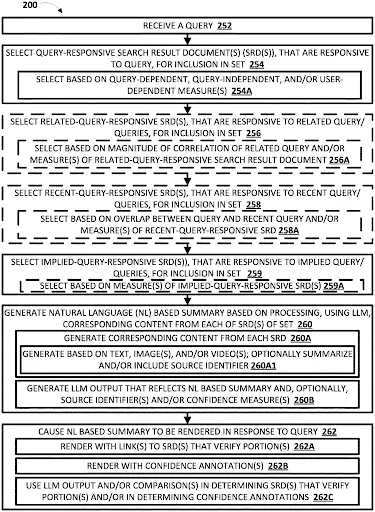
The patent filed by Google in March 2023, named “Generative summaries for search results” was approved on the 26th of September 2023. It appears to be the patent underpinning Google’s SGE. This patent details an approach to using large language models (LLMs) to generate a natural language (NL) summary in response to a query. Meaning that the summaries are created in a way that is easy for a user to understand. The processes outlined in the patent are key to SGE. It covers not only how LLMs are utilised, but also where information could be pulled from to generate these NL summaries.
The patent also outlines how additional context will be considered for each query. This means there will be variability depending on the specific way a query is submitted or the context in which it’s asked. This explains why so many people researching and collecting data on SGE are finding so much variability in what shows up for them on different days or locations.
Additional information stated in the patent that could be utilised:
Google has stated that SGE may have knowledge gaps in certain areas and has, therefore, been designed only sometimes to produce a result if it concludes that it needs more knowledge to answer the query confidently.
Additionally, the patent describes a system where the generated summaries will be evaluated based on the probability that they are both reliable and accurate. Confidence measures will be used to assess the natural language summaries to determine whether or not to produce a summary for a specific query. For instance, Figure 2 from the patent outlines the method and illustrates how confidence measures are implemented.
Furthermore, it is essential to recognise bias when it comes to generative AI. Google has acknowledged that SGE could produce biassed results. Google have stated the following:
“The data that SGE is trained on is based on high-quality web extracted data that can exhibit narrow representations of people or potentially negative contextual associations.” – Google
Google has implemented multiple measures to try to mitigate biased results. For instance, they use adversarial testing in SGE. Adversarial testing “involves proactively trying to “break” an application by providing it with data most likely to elicit problematic output.” (Google). This aims to identify bias and safety concerns in the model and use this information to improve the model.
The SGE Google experiment is an exciting time for generative AI and SEO. At Varn we are constantly monitoring and testing the updates to SGE to ensure our clients can appear within AI generated results. We have recently looked at the overlap between SGE and organic search results and we are continuing to collect and analyse data as SGE evolves.
If you have any questions about SGE, how it works and how it appears to be impacting SEO, please get in touch with the SEO Experts at Varn. We would love to hear from you.
Do you know if your SEO activity is working? SEO strategies can be complex to create and implement – and even more difficult to monitor and measure. If you are spending time, resources and money on improving your website for organic search, you need to understand the impact of your activity. Rather than focusing on a single performance indicator, we recommend a weighted approach which considers multiple metrics to give you a broader understanding of whether you are seeing SEO success.
For a clear idea of your SEO performance, consider these seven key metrics side-by-side: domain authority, number of ranking keywords, keyword ranking position, SERP impressions, organic search traffic, engagement rate and conversion rate. Below we explain each in more detail to help you develop a strategic understanding of your organic search performance. But first, it is helpful to have an overview of the process you would expect to go through when improving your website for search engines…

As you make optimisations (whether technical, onsite or offsite) your content will be more likely to be discovered and indexed by Google and other search engines. Indexed content can then begin to rank in Search Engine Results Pages for relevant keywords. If your website is considered by the search engines to be of good quality – for example, having a strong Domain Authority – you will see both the number of keywords being ranked increase as well as those ranking keywords move upwards to higher ranking positions. The quantity of SERP impressions will naturally also increase, as more people begin to see your content within the Search Engine Results Pages. This in turn will lead to higher numbers of clicks through to your website, directly providing higher volumes of organic search traffic. Providing this is high-quality and relevant traffic, you can expect to see the visitors here engage with your website and ultimately go on to complete your chosen conversions, such as making a purchase.
From this overview, you can see why it can take months for optimisations to translate to business KPIs like increased revenue. But once you reach that point, you can expect to receive high-quality and useful traffic. And that is why it is important to track progress indicators throughout the whole process. Now let’s look at our top SEO metrics and key performance indicators in more detail:
Domain Authority is a metric developed by MOZ which gives an insight into the quality of a website, and is helpful for understanding whether your content is likely to rank well for relevant keywords. But it is not the only option; other SEO software’s provide similar metrics which will also give you a sense of how trustworthy your site is considered by Google. For example, “Trust Flow” and “Citation Flow” from Majestic or “Domain Rating” from Ahrefs. Use one or all of these metrics to understand whether your site is considered to be authoritative and good-quality, especially in comparison to your SEO competitors. If you are lagging behind other competitors, improving your Domain Authority should be a key focus to help facilitate further SEO wins. To do this, work on making sure your content fits Google’s EEAT guidelines, and create an offsite content and outreach strategy to attract links from other quality websites.
This is a very useful early leading indicator for SEO activity. As with many of these indicative metrics, the number of ranking keywords does not give you the full picture when viewed alone. Afterall, some keywords may not relate to your most relevant site visitors. Or the rankings for each keyword could be languishing far below the all-important top 10 SERP positions. However, if you are working on a programme of content optimisations on your site and targeting a strategically mapped keyword landscape, an increase in the number of keywords you are ranking for will be one of the very first indicators that your efforts are having a positive impact, as your content begins to be considered by Google for a wider range of relevant topics and terms.
Once your online content is ranking for a good selection of relevant search terms, you can then focus on helping your landing pages to climb through the SERPs to reach higher places. The top spot in Google’s organic search listings will most often receive the highest share of clicks, with positions 2 and 3 also performing well. Remember that exact positions will fluctuate even for individual keywords – however, keeping an eye on the performance of your most important terms and watching these rise through the rankings will help give you a sense of your SEO success. This is also a useful metric to alert you to site issues – if you suddenly see some of your established top ranking positions drop, you will know to start investigating.
Use Google Search Console to check how the number of impressions your content receives changes over time. As your pages climb the rankings for a wider range of terms, you can expect to see more SERP impressions. That is to say, your listings are being seen within Search Engine Results Pages more frequently. This is an important step towards more people clicking through to your content, especially when combined with metadata optimisations to increase CTRs. We recommend looking at impressions from both a site-wide perspective and for specific important landing pages and search queries.
For many people, traffic is the only metric used to analyse the success of a specific digital marketing channel. And that’s because it is important! Use Google Analytics 4 to track the organic search traffic to your website (or to specific key landing pages) to get quick and easy top-level insights into SEO performance. However, it is worth remembering that SEO is a longer-term marketing strategy which can take a while to begin to send traffic to a website, which is why we recommend looking at metrics around keywords and SERP performance as useful lead-indicators when you first embark on search engine optimisation work. Finally, bear in mind that not all traffic is equal – if visitors are landing on your site before immediately bouncing away, or are unable to find the content they are looking for, there is further work to be done!
A useful metric to understand the quality of traffic that is being sent to your website, Engagement Rate in GA4 will tell you the percentage of visitors who arrive on your site and then actually interact with it. This could mean looking at additional pages, triggering a ‘conversion’ event, or spending a significant amount of time looking at content. Engagement Rate is therefore an extremely helpful metric to help you understand whether the visitors you are attracting via organic search are high-quality. This can help you to identify instances where there are mismatches between a visitor’s search intent and the content you are providing. It can also give an indication of the kinds of SEO content that perform best and should therefore be a focus in the future.
Similar to Engagement Rate, looking at Conversion Rate will provide useful information about the quality of the SEO traffic you are achieving. Within GA4, you can choose to allocate specific events as ‘conversions’. Depending on your business priorities, conversions are likely to be purchases, sign-ups or enquiries. Consider Conversion Rate in tandem with Engagement Rate to ensure that your SEO performance is driving high-quality visitors to your website who go on to take the actions which are most important to you.
Having trouble effectively understanding the impact of your SEO strategy? Not seeing the improvements you had hoped for in your organic search metrics? The expert team at Varn can help. Please get in touch to find out what we can do to support your ongoing organic search strategy. We would love to hear from you!
In the ever evolving world of technology, Google stands as a towering titan, shaping the way we navigate the digital universe. Synonymous with search, information and connectivity, there is a reason Google reigns supreme – beneath the surface of its user-friendly interface and instantaneous results lies a complex web of algorithms and artificial intelligence that drives the heart of the technological giant. In this blog, we will take a closer look at how Google is utilising AI to improve upon these algorithms – and the implications such advancements hold for the future landscape of search.
Google has been incorporating elements of AI into its products and services for quite some time. Back in 2014 Google notably acquired DeepMind Technologies, a British Artificial Intelligence company. Doing so brought an array of advanced machine learning capabilities to the search engine giant, who have since infused AI into a wide range of applications, including search algorithms, language processing, image recognition, and more. The company continues to leverage AI to enhance user experiences, improve efficiency, and explore new frontiers in technology. As such, the relationship between Google and AI is one that we expect to see continue and develop for many years to come.
During Google I/O 2023, Google announced that they are striving to make AI “even more helpful for people, for businesses, for communities, for everyone”. Whilst they have been focusing on being an AI-first company for the past 7+ years, 2023 signalled a turning point of sorts in the relationship between Google and Artificial Intelligence. All thanks to the introduction of generative AI.
An example of this is the introduction of “Help me write” in Gmail. Smart Reply (launched in 2017) offered users a range of short responses that you could select with just one click – this was followed by Smart Compose, which offers writing suggestions as you type. In the past year alone, these two tools alone were used over 180 billion times. Now, with a much more powerful generative model of AI, we have Gmail’s “Help me write”. For example, when responding to an email, simply submit a prompt related to the desired email content, and a fully crafted draft will emerge. This sophisticated system adeptly references pertinent details from the initial email where relevant, and provides a comprehensive foundation for your response. This not only constitutes a significant time-saving resource for any professional setting but also underscores the continuous refinement inherent in generative AI. The capacity for improvement over time positions this tool as an invaluable asset in enhancing productivity and communication efficiency within the workplace.
“Help me write” was rolled out in 2023 as part of Google’s Workspace updates – as were a number of other AI driven tools, including a new immersive view for routes in maps, and a new magic editor experience in Google Photos (as well as much more). You can read more about these updates within the Google Workspace Product Announcements.
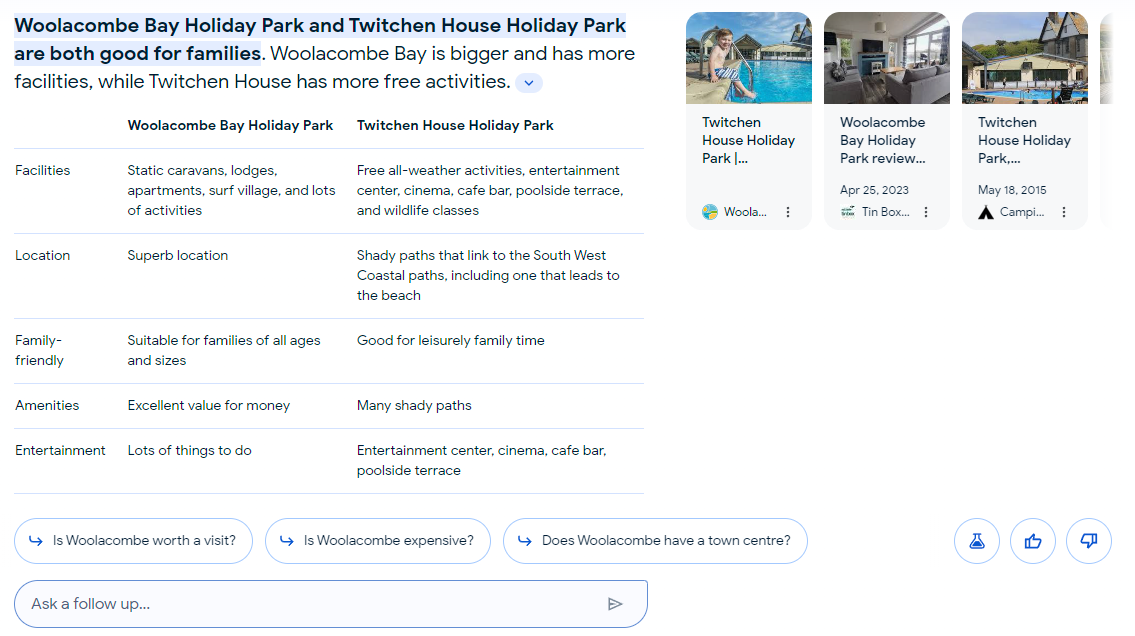
2023 has also seen one of the biggest visual updates to Google SERPs that we’ve seen in some time – with Google’s Generative AI-powered Search Experience (SGE). You may be inquisitive about the limited information or absence of firsthand encounters with SGE. This could be attributed to the fact that SGE has not yet been officially launched in the United Kingdom. Google SGE was released in May of 2023, but is currently only available in the US on Google Labs (correct at the time of writing, November 2023). So what exactly is Google SGE, you may ask? SGE is a new feature being developed by Google, which will display information in response to a Google search, at the top of SERPs. Whilst you might naturally think that it sounds similar to Featured Snippets, it is much more advanced. Thanks to generative AI, Google SGE has been built to help make searching easier – so you have to do less of the heavy lifting. As google puts it, SGE allows you to “understand a topic faster, to uncover new viewpoints and insights, and to get things done more easily”. Not only can you use Google for searches containing more variants and information, the result you are provided will also be more informative, more descriptive and will even suggest relevant follow-up questions. You can see an example of this, below:
Search query: “If I am travelling to Woolacombe for a holiday with two children, is it best I stay at Woolacombe Bay or Twitchen House?”
Context will be carried over from question to question, to help you more naturally continue your exploration. You’ll also find helpful jumping-off points to web content and a range of perspectives that you can dig into. Whilst this functionality and these AI generated search results are very different from what we’re used to seeing, we only expect more growth and development within SGE, over the coming months and years.
Aside from the developments within Google SGE, another area of AI being discussed near the end of 2023 and most likely to be a popular topic of discussion in 2024 is cybersecurity. Last month, Google Cloud Security Talks took place, marking the 20th anniversary of Cybersecurity Awareness Month. A key discussion as part of these talks surrounds the Google Cloud Security AI Workbench and Duet AI – two tools with the ability to help address pervasive and fundamental security challenges: the exponential growth in threats, the toil it takes for security teams to achieve desired outcomes, and the chronic shortage of security talent. It is incredibly interesting to see Google increase the use of AI in combating cybersecurity threats, as they have also warned of the potential for cyber criminals to significantly enhance the effectiveness and scale of cyber attacks in 2024, using AI. So whilst AI appears to be part of the solution, according to Google it could also be part of the problem.
In terms of SEO, Google Bard is also likely to see massive developments in 2024. Bard is Google’s own AI language model, created to hold an informative conversation with the end user. Whilst early adopters of these language models appeared to prefer ChatGPT, Bard is becoming increasingly popular in the world of SEO – and planned developments for the coming months such as integration with Google Assistant only add to the buzz and excitement surrounding the AI tool.
In order to stay up to date with the latest developments, and to monitor the impact of Google SGE in 2024, make sure you regularly check out our Varn Insights. In an upcoming post, we will be exploring SGE in more detail, as well as looking at how it impacts Google Shopping, Google Ads and more. We will also take a closer look at the specific data being pulled into SGE SERPs by Google, uncovering the potential of generative AI in search before it reaches the UK (hopefully by some time in 2024). Keep an eye on our blog or sign up to our newsletter today, to stay in the loop.
You need to load content from reCAPTCHA to submit the form. Please note that doing so will share data with third-party providers.
More Information