
For the past five years BeOnBoard operated as a project under TBIT, making significant strides in their mission to ensure that businesses in the South West are reflective of the diversity of the teams, their clients and the communities they serve.
Founded by the inspirational Kalpna Woolf, who also leads the charity; 91 ways to build a global city, the charity was being incorporated to realise the ambitious growth plans.
Through the research we conducted what became clear was that if leaders with the same background make decisions through the same lens, they will get the same outcomes. Where are the fresh ideas? The different outlooks? The challenges to tradition? Where’s the change? BeOnBoard brings the diverse talent they’ve coached and nurtured to boardroom tables.
The proposition: BeOnBoard connect businesses who are ready to embrace new ideas with the people who have them. Those who have a hunger for growth and innovation. And they do it not just from an equitable standpoint, but from a commercial one. It’s just better business.
Our programme of work included:
To see how we can help, visit talismansparro.com
Talisman Sparro have completed the rebrand of Vertree, a global carbon finance consultancy. Vertree work with corporates, institutions, investors, governments and project developers to provide access to carbon markets and make impactful investments that deliver value and contribute to global climate and sustainability goals.
The programme of work involved extensive stakeholder engagement, strategy, messaging development and a new visual identity. The new positioning sets Vertree up for sustained growth, aligning the internal team behind a clear strategy whilst the new identity provides a broader, more flexible suite of assets giving the brand an authentic but distinctive look and feel.
In a world of increasingly sophisticated wrongdoing, investigative platforms need to do more than just keep pace. They need to keep investigators ahead.
Built on ever-evolving technology, Clue Software makes connections and shapes cases to help shift momentum in the favour of investigators. Forever moving safeguarding operations forward.
Clue Software was created to enable continuous progress in one place. From data analysis and reporting to referrals and outcome management, it provides a single application to manage knowledge.
Initially trusted by Frog Capital to conduct due diligence, as part of the Series A investment round our role then transferred into that of an interim CMO post-investment. During this time we conducted a thorough repositioning of the brand to support the growth ambitions of the business and new investors, whilst helping to build the team and recruit a permanent CMO.
Support included:
Brand Strategy
Stakeholder Engagement
Brand Identity
Brand Guidelines
Collateral Development
Marketing Strategy
For more information, visit Talisman Sparro.
Global leaders in procurement and supply chain management, Efficio are the largest independent consultancy in the world. With this sole focus for more than 20 years, their specialist consultants are equipped with the expertise and technology to dig deeper, innovate faster, and deliver greater efficiencies for clients.
Talisman Sparro has played a critical role in Efficio Consulting’s repositioning and rebrand programme, delivering an impact that has helped the company stand out as the only remaining independent, specialist consultancy in the procurement and supply chain consultancy marketplace. With Efficio’s unique approach to delivering sustained client success at the core, Talisman Sparro has helped to shape a comprehensive strategy that has driven internal engagement and reflected Efficio’s ambitious growth plans.
The “Partners in Progress” brand platform developed has resonated with both clients and employees, driving engagement and building a strong internal culture. The rebranding programme delivered has overhauled Efficio’s branding, messaging, and positioning to be more contemporary, modern, and appealing to a broader audience.
Our support included:
Initially trusted by Frog Capital to conduct due diligence, as part of the Series A investment round our role then transferred into that of an interim CMO post-investment. During this time we conducted a thorough repositioning of the brand to support the growth ambitions of the business and new investors, whilst helping to build the team and recruit a permanent CMO.
“We’ve been working with Talisman Sparro for over a year now, and they have become an integral part of the Clue team. Initial engagement was to develop a high level marketing strategy to support us through our investment round and prepare for the scale up journey. The output highlighted the potential for Clue, swiftly progressing into a brand programme and a series of workstreams which included an interim CMO role. I have personally enjoyed building a positive relationship with the team and it’s been a really collaborative and productive process that has bought the whole business together and gives us a fantastic platform for global growth.”
Clare Elford – CEO
Brand Strategy
Stakeholder Engagement
Brand Identity
Brand Guidelines
Collateral Development
Marketing Strategy
Advanced SEO techniques. SEO optimisation. How to rank where it counts. The pressure really is on businesses to prioritise SEO when it comes to their content marketing strategy or apparently risk disappearing forever into the black hole of – gasp – page 6 of Google Search results.
Don’t get me wrong, yes, SEO is an important element of any strategy and there are plenty of technical on-page steps you can and should be taking to make sure your website and online content is performing well. But to anyone who still believes that SEO just means peppering your website and blog with keywords in every other sentence, you’re forgetting something crucial. Google Search isn’t your target audience. It’s a channel to reach your target audience. If you’re a slave to the SEO keyword, you may tick a few of Google’s boxes (actually not as many as you think, more on that below) but you will undoubtedly alienate your prospective customers because your content will read so badly that they’re unlikely to then trust you with their business.
When it comes to content marketing, the not-so-secret ticket to success is quality. In today’s world of keywords, topics and featured snippets, it’s easy to forget that Google actually places far greater emphasis now than ever before on content that is well written, and rewards said content with a higher ranking in search results. In fact, unintelligible content that’s been written for an algorithm rather than a human will now actively count against you.
But don’t panic if you’re finding that your content isn’t performing as it should or not driving quite the interest that you thought it would.
Here are three tips to improve your content marketing:
1. Quality is king. That means that your blogs, whitepapers, e-books, case studies and the like need to be well written, error-free, no typos or dodgy grammar, no keyword gibberish. But they also need to be on the right topic and engaging for the reader, and that means content which helps or educates is far more likely to perform better than a brochure which sells your product directly. It sounds like some sort of paradox, but content marketing is at its very best when it raises awareness of your business without pushing your services directly. Good content should position you as the go-to expert for your particular specialism, ensuring that you spring to mind first when the reader, a prospective customer, needs your services. It should drive loyalty which in turn drives purchase consideration. But we’ll say it until we’re blue in the face – quality, quality, quality.
2. Keywords should be treated like seasoning – a light sprinkling of the right ones leaves a much better taste than a dredging with every word possibly associated with your business. It’s very easy to find yourself down a keyword rabbit hole when deciding what to hook your content on, particularly with so many online tools available, but I guarantee you’ll be left with more questions than answers: should I include longer tail keywords with a lower MSV, or a shorter keyword with broader reach but fierce competition? What even is a long tail keyword anyway? Keywords are important as they do after all ensure that your content will pop up when people are searching for that subject, but we really want to avoid keyword soup at all costs. We suggest you keep it simple, particularly as an SEO beginner: start by thinking about what you want to be famous for as a business – content marketing, for example – and then consider the key questions that prospective customers may have when searching for help on that subject – Should I write a company blog? How do I start an e-newsletter? What is the difference between a whitepaper and an e-book? Turning each of those questions into a blog post or how-to guide will make sure you’ve got the most important keywords covered. We’re not big-headed enough to suggest that this is the only way to work with keywords, but it will at least start you on the right track. Keep it tightly linked to the services that you offer to make sure it’s relevant (Google takes this VERY seriously), and don’t forget to link back to your website.
3. So, you’ve written a brilliantly engaging, insightful blog post with just the right number of relevant keywords. But there’s little point in getting this far and then have the blog sit on your website with no eyes on it. The final consideration then when it comes to content marketing should be how to disseminate your content properly. Here it helps to think first about the channels that you already own, such as your social media, an e-newsletter out to your customer database or internal comms to your own employees and then out to their own networks. And then you can think about other people’s channels that you can piggyback on. Can your content sit as a guest blog on someone else’s company site? Can you do some simple PR outreach to target media and see if they’re interested in running the piece? Can you repurpose an older blog that has already run by turning it into new shorter ‘how to’ social media posts?
If you’ve made it this far and would love to know more about how to improve your existing content marketing or take the leap into content for the first time, we’re happy to chat.
www.sparrohouse.co.uk
Over the last year, we’ve learnt the hard way that businesses who can react, pivot and adapt are far more likely to survive than those who rigidly remain on a single-track traditional strategy. In the current climate, this means that significantly more pressure now lies on business teams who are responsible for effective use of budget and creativity. There is a need for them to pull off greater impact for less budget, or an entirely new commercial direction with a leaner team.
It is a huge challenge and now more than ever, we’re seeing the true value of experience coming into play. You’ve no doubt heard the phrase ‘nobody ever got fired for buying IBM’, it’s been bandied around the business world since the 1970s and has numerous different interpretations. But what it essentially comes down to is the importance of choosing the safe pair of hands when bad things happen, the value of going with the established choice that’s less likely to fail because it’s been around for longer and has been thoroughly tested.
The original saying obviously referred to software (and is since horribly outdated) but it does still ring true today for people in the creative industry. Quite simply, in these difficult social and economic circumstances, now is the time to be working with seasoned experts, those with many years of creative and commercial experience to draw upon to solve the challenges faced by businesses.
So here are our three core reasons for choosing experience right now to move your business forward:
1. Speaking the same language
Senior creatives have been around the block enough times to speak the same language as any client. They can demonstrate empathy for how work needs to be sold in, the challenges they might face and can help manage stakeholders. That’s not to say, of course, that more junior members of team don’t bring huge benefits to the table – knowledge, enthusiasm, a valuable different perspective that comes with youth, to name just a few. But when times are tough, you just can’t underestimate the power of being able to draw on previous experiences and turn that understanding into action.
2. Fewer and faster
Experience means there’s no need to layer teams when working on a project, which is vital when dealing with reduced budgets or rapidly changing projects or timescales. Teams can be kept really lean with senior team members doing the work rather than overseeing it. This delivers cost and time efficiencies to clients that they will really appreciate. In most creative agencies, the senior members of the team tend to be light touch with clients – there if you need them, but not directly involved on a day-to-day basis. At Sparro House, ours are hands on – no bloated hierarchy, just experience put to good use.
3. Flexible innovative thinking
Experienced industry veterans can and should, at the right time, challenge the thinking of clients and inspire them to take a different direction if it’s the right thing for the business. Don’t make the mistake of confusing experience with outdated thinking or a safe pair of hands with a boring or traditional approach. The right seasoned veteran can uniquely combine agile out-of-the-box thinking with the confidence to act that only comes with years of experience. Now is the time for innovation to flourish as businesses try a new direction but any risks can be tempered by placing creative responsibility into the hands of those who’ve been there and done that.
This article was written at the outset of COVID-19.
Having gone through the set-up of home offices, and the adoption of new business practices, processes, and tools, many now can’t wait to get back into the office. Why is this?
It is because the choice to do so was taken away.
According to recent research by Forbes, millennials in particular have struggled to adapt to working from home, which is hardly surprising given that they had no choice in the matter. What is absolutely critical here, though, is that this is not a struggle to adapt to remote working, it is a struggle to adapt to isolation. The opportunity to go to the gym, see friends, eat out, visit family, or indulge in any of the escape mechanisms that life usually affords us has been curtailed, and this is a struggle that I’d guess most of us are feeling.
Despite running a creative agency specifically set up to work remotely, I too am desperate for a change of environment, and that is because this is not really remote working. However, there has been a shift in working practices which is unlikely to be completely undone even upon the return to the office, so how can we make the most of this moving forward?
If the role of the office is likely to change, along with greater flexibility and working practices what is the key to remote working success?
The difference between those organisations that have been forced into adopting new working practices and those already set up to operate remotely is choice. Do not underestimate how important a factor this is, and it works on two levels. Recently, the Harvard Business Review investigated the link between levels of motivation and working location, finding working from home to generally be less motivating. Critically, though, they also determined that this suffered a huge plunge when the option to choose the environment is taken away; being forced to work from home is the worst possible option. Human beings react negatively when their freedom to make a choice is removed, and this ‘psychological reactance’ generates such negative feeling that it’s unsurprising motivation dwindles as a consequence.
This leads me into the second branch of why choice is so important. As I mentioned previously, being forced to work from home is not true remote working. The effect on all of our lives has been drastic, and our psychological reaction has been one of stress and anxiety. But let me be clear, we must break the cognitive link that has been formed between forced isolation and remote working, because it is false. However unintentionally, we now associate it with this sense of cabin fever and lowered productivity that we are feeling, and this damages the true potential of authentic remote working.
98% want to work remotely at least some of the time for the rest of their careers.
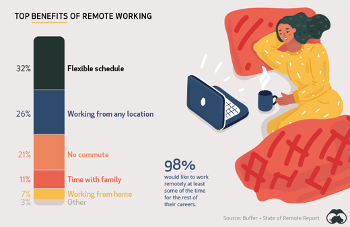
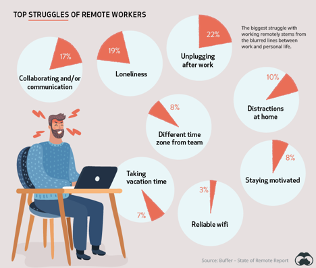
Source: Buffer – State of remote report.
For many that have chosen to forge their own path away from permanent employment and the office, the choice to do so has been made accessible to them as a consequence of their level of experience and expertise. Their years within industry enable them to both perform their roles with a greater degree of autonomy, and fit this around other aspects of their lives; family, exercise, hobbies, personal projects etc. The difference here is that, whilst traditional agencies may well be ‘pivoting’ (sorry I know that word belongs in a box with ‘Agile’) away from the office, they do not benefit from the intrinsic culture of an organization comprised of people that have chosen to work this way. Well before the Covid-19 crisis, which has confused the reality of remote working with forced home working, the majority of companies had flexible working policies in place, and an investigation by Vodafone back in 2016 found that 61% of respondents reported increased profits, and 83% reported increased productivity.
Setting up Sparro House Creative, flexibility and wellbeing have been at the forefront of my mind, and it’s clear to me that these are inextricably linked not only with each other, but with improved output and increased value. With the level of experience in my teams, it benefits neither myself nor them to impose a work routine that fails to take into consideration both the other important things in their life, and the fact that they may well do their best and most creative work at 5am, perhaps before their children have woken up (hopefully!), or at their local coffee shop, in our clients offices or collaborating in shared spaces. This is true remote working – the option to choose how the work thread weaves into the rest of your life. It’s important this message is clear, this freedom reduces workplace stress and increases productivity.
Of course, this structure is dependent on trust between team members, including myself, that the work will be completed efficiently and to the highest standard. In turn, this trust is reliant on industry experience. It is the senior team members who have the expertise that allows them to work in this way and make effective and timely decisions. With the acceleration of decision-making caused by the current crisis, this is vital.
Janine Woodcock; professional coach, speaker and author of The Power of Choices discusses ‘Conscious Leadership’ with Sparro House MD, Paul Kirkcaldy.
Where to start when planning a digital project can be extremely confusing. You might well need a new website, but there is also effective ways to improve your existing site using data and limited investment.
We talk to Piers Tincknell, from Atomic Smash, about Iterative Design, something they just happen to specialise in.
You need to load content from reCAPTCHA to submit the form. Please note that doing so will share data with third-party providers.
More Information