
At Spark AI we are big believers in continuous market research – for us its to make sure our AI literacy and AI business transformation programmes are exactly on point to what the industry needs right now. Understanding where agencies really are – not where they think they are – helps us build the right support.
That’s why a couple of months ago we set out to research the future of skills and hiring in the age of AI alongside The Industry Club, and what we found reveals an intriguing dynamic playing out across UK agencies right now.
There’s a growing confidence-capability gap, and understanding it could be the key to unlocking your agency’s next phase of AI adoption.
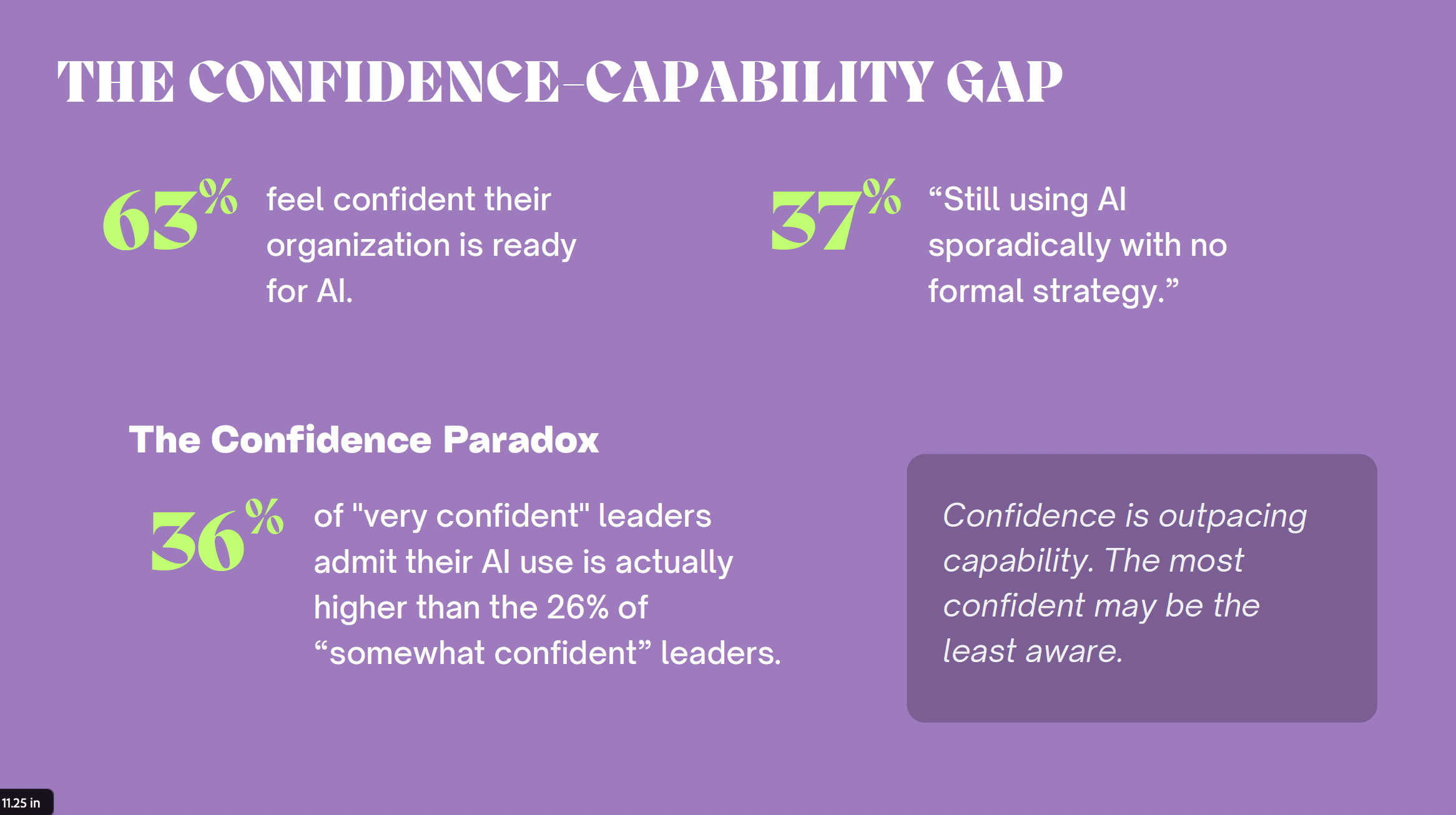
Our report surveyed 149 MDs, CEOs, founders and department heads to understand how AI is reshaping agency capability, hiring and culture. Whilst 63% of agency leaders feel confident their organisation is ready for AI, 37% admit their use remains sporadic with no formal strategy.
Here’s the paradox: amongst those who describe themselves as “very confident”, 36% admit their AI use is actually unstructured – a higher proportion than the 26% amongst “somewhat confident” leaders. Confidence is outpacing capability, and sometimes the most confident may be the least aware of what structured AI adoption actually requires. But this isn’t a problem – it’s simply different stages of the same journey.
The research shows agencies splitting into two camps: 37% are still experimenting ad hoc, whilst 19% are building structured programmes with measurable outcomes. The good news? Moving from experimentation to structure is entirely achievable with the right approach.
Laura Jackson, Board Director at Not Actual Size, saw this transition firsthand: “Before, everyone was experimenting on their own, one person on ChatGPT, another on Midjourney. It felt exciting but chaotic. Having a plan, even a light one, made it much more manageable.”
The confidence-capability gap isn’t a problem to fear – it’s simply about recognising that feeling ready and being structurally ready are different stages of the same journey.
Here’s where the picture becomes genuinely encouraging: AI literacy has become a core business investment, and those who are committing to it are seeing real results.
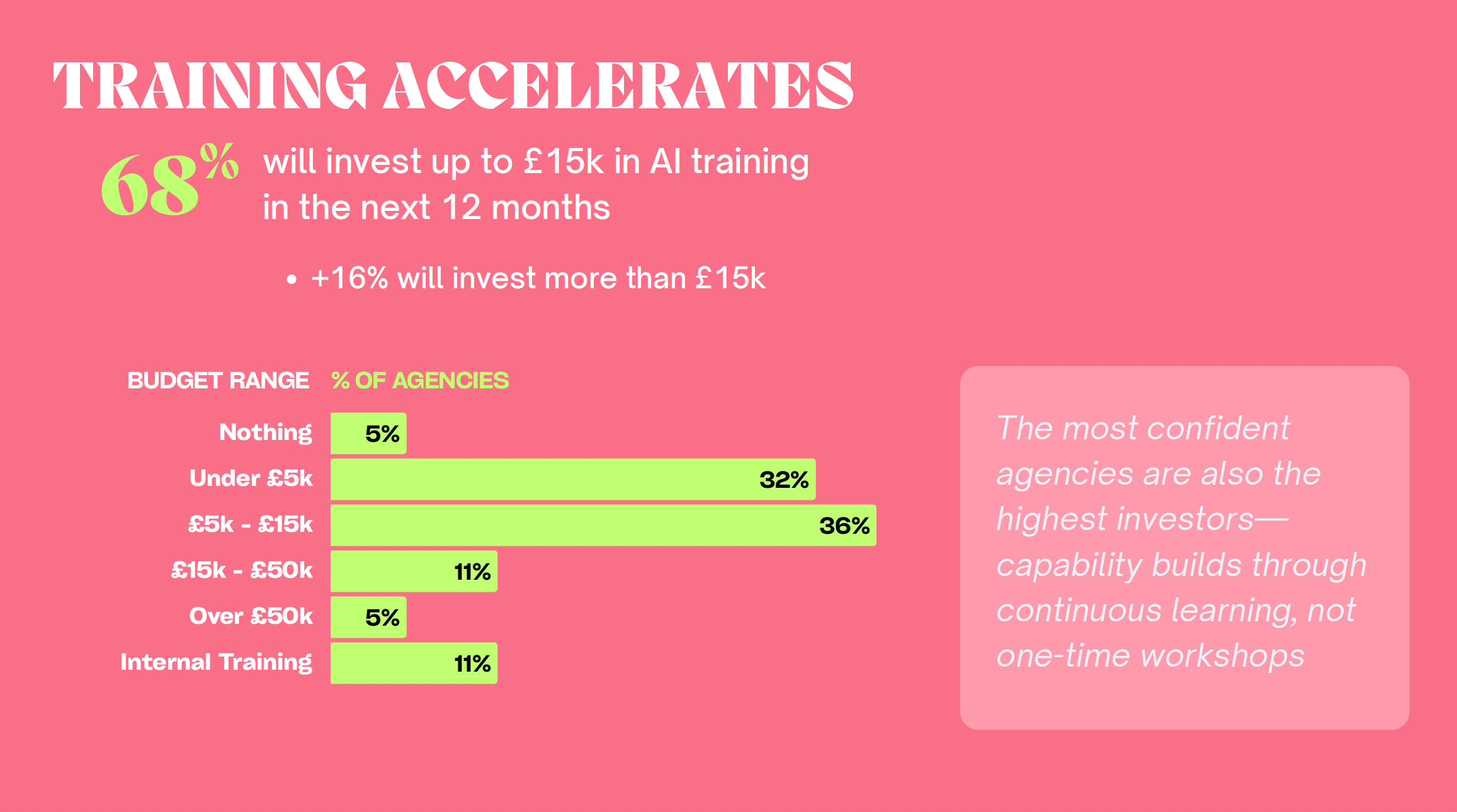
Two-thirds (68%) of agencies anticipate spending up to £15k on AI-related training in the next 12 months, with only 5% planning to spend nothing. Perhaps most tellingly, a further 16% are investing over £15k, with 11% in the £15k–£50k range and 5% investing over £50k.
The data reveals an important insight behind these spend figures: the most confident agencies are also the highest investors. Capability builds through continuous learning, not one-time workshops. These organisations are spending more because they understand that maintaining fluency requires ongoing development, and because they’re clear on how that learning links to client and commercial outcomes.
As one Head of Production at an independent agency puts it: “Getting (and understanding) the balance between the different types of AI applications and how they work together is more critical than ever. The consistent pace of application updates can make training ‘programmes’ hard to implement, so it needs to be a company-wide commitment to consistent, continuous learning opportunities.”
AI isn’t triggering a hiring boom, but it is reshaping whom agencies hire and why – and the findings here are genuinely positive for agencies.
Whilst 71% say AI hasn’t changed headcount, 46% have already hired or plan to hire specifically for AI capabilities. Here’s the encouraging part: when they do hire, 65% prioritise curiosity, adaptability and problem-solving over fixed expertise. Only 6% actively recruit for specific AI skills.
The detailed breakdown reveals a clear shift in priorities: 43% consider AI skills “nice to have, but not essential” at point of hire, whilst 22% say they’re “not important – we hire for aptitude”. A further 25% seek a mix of both aptitude and specific skills, with just 6% viewing specific AI expertise as “very important”.
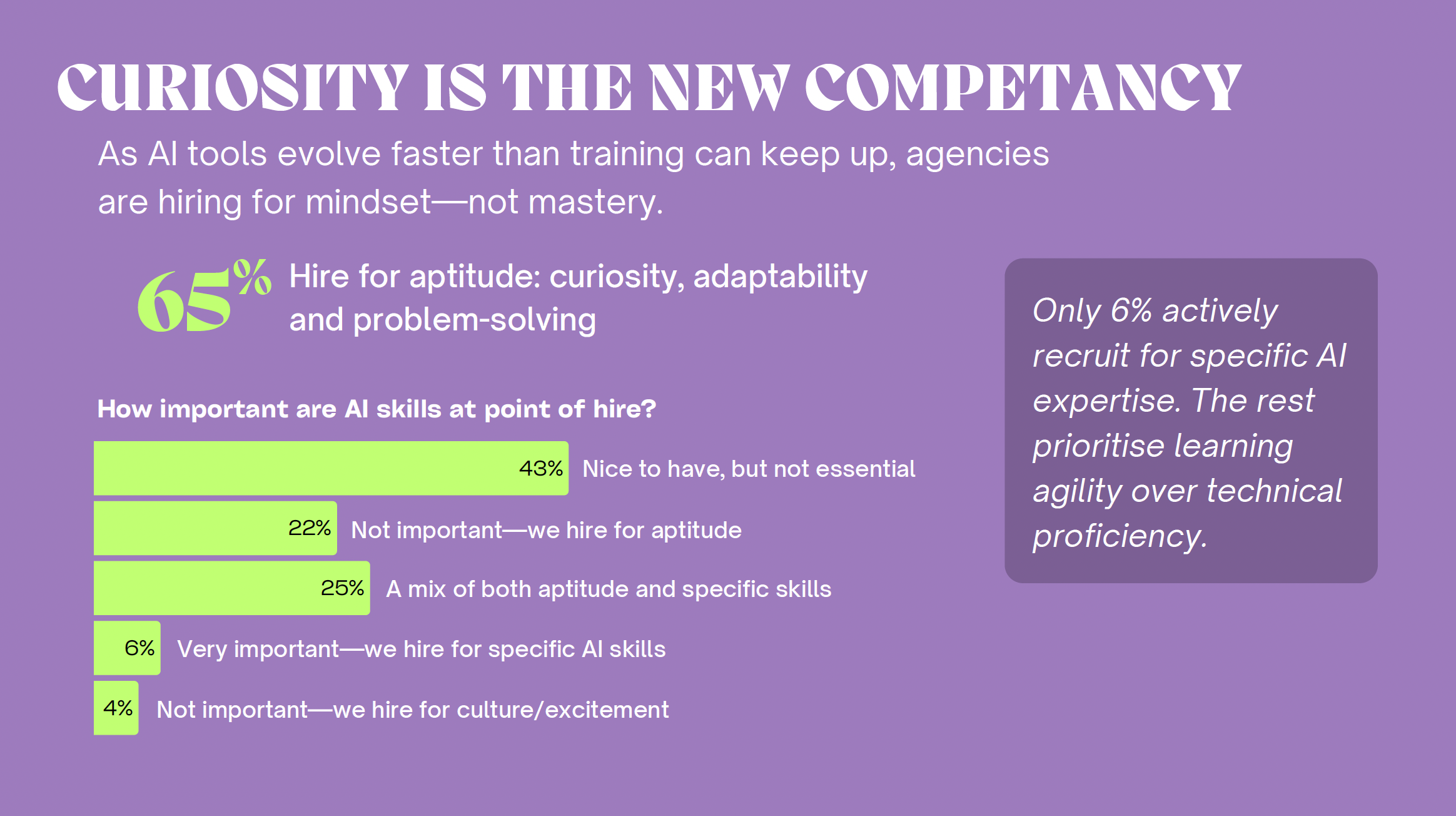
As AI tools evolve faster than people can keep up, agencies are recognising that mindset trumps mastery. Learning agility matters more than technical proficiency.
Vix Jagger, Head of Creative Innovation & AI at Droga5, captures this perfectly: “My 63-year-old retired mum got into AI, she’s proof curiosity beats credentials. AI is for people who learn faster not the ones who aren’t scared to break things.”
The real opportunities for growth lie in mindset and approach, not technical proficiency. This has important implications for how agencies can approach AI readiness. You don’t need to hire data scientists or machine learning engineers – you need to cultivate curiosity, adaptability and strategic thinking across your existing team. Like it’s always been – success is down to how engaged your people are and the behaviours that underpin your culture.
Whilst AI’s current impact is most visible in creative work – with strategy (13%), creative (13%), and design (12%) leading today – the research reveals that agency leaders are looking to operational areas next, transforming how agencies scope, price, and deliver work.
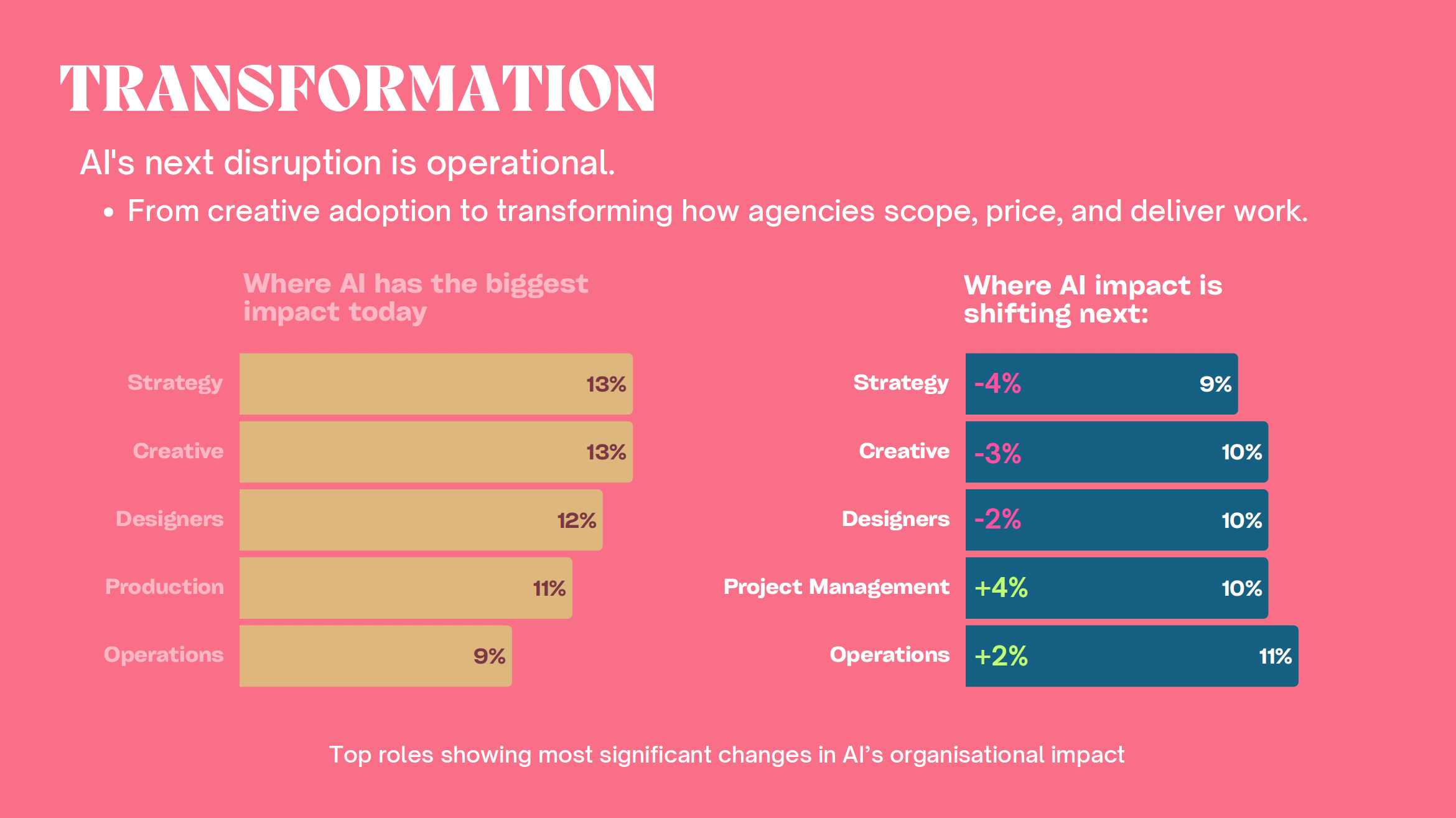
This evolution is particularly relevant for independent agencies with leaner teams and tighter margins. AI is becoming a competitive equaliser, helping smaller agencies deliver more strategic value per person and close the capability gap with larger network agencies.
The agencies making the most headway with AI aren’t necessarily those with the most expertise today – they’re the ones building structured approaches, measuring outcomes, and prioritising learning mindsets.
If you’re feeling confident about your AI readiness, the next step is ensuring that confidence translates into structured implementation. When hiring for AI capabilities, focusing on adaptability and curiosity over specific technical skills will serve you far better in the long term.
The confidence-capability gap isn’t permanent, and with honest assessment and deliberate action, it’s entirely bridgeable.
Explore all the findings and see where your agency sits using the Spark AI Maturity Model framework: https://www.wearespark.ai/future-of-skills-hiring-ai-agencies
—
About Spark AI
Spark AI helps creative and brand leaders turn AI curiosity into confidence through structured training and business transformation. We have worked with 60+ agencies running AI Fundamentals workshops and AI Accelerator programmes based on our # 1 bestselling book in the UK and US Shift – AI for Agencies. Trusted by Oxford University Saïd Business School and backed by Innovate UK. https://www.wearespark.ai/
About The Industry Club
The Industry Club is one of the most trusted creative talent partners in London, specialising in matching the right talent to the right teams and helping the industry prepare for the future. https://www.theindustryclub.co.uk/
By Jules Love, Co-Founder of Spark AI
I started work in the late 1990s with Andersen Consulting, just as the internet was beginning to seriously disrupt business. Amazon was founded in 1994 and Google in 1998. Back then, we were asking ourselves whether we were better off using Netscape Navigator or Internet Explorer. Looking back, that was completely missing the point. The browser didn’t matter. What mattered was that the entire business model of how companies reached customers was being fundamentally rewritten.
Now, having worked with more than 50 agencies over the past 18 months through Spark AI, the company I co-founded, I’m watching the same thing happen again. Only this time, it’s moving faster.
That’s why I wrote Shift – AI for Agencies. Not because I had all the answers, but because after 18 months on the frontline of AI adoption with agencies, I certainly knew most of the questions.
Here are the 5 lessons agencies need to take on board:
When digital arrived, agencies had years to adapt. Broadband took 10 years to roll out. The iPhone didn’t appear until 2007, and the App Store didn’t open until 2008. Influencer marketing took a decade to become the juggernaut it is today. Agencies had two decades to experiment, learn, pivot, and rebuild their capabilities.
AI is different. More money is being poured into generative AI than any technology in human history. As a share of US GDP, it’s more than double what was spent on the Apollo moon missions in the 1960s. This level of investment means the rate of improvement we’ve seen since ChatGPT launched in late 2022 shows no sign of slowing down.
The models improve every few months. New capabilities arrive constantly. What seemed impossible last year is standard this year. And unlike the digital transition – which required new infrastructure and new devices – AI tools are immediately accessible to anyone with a laptop and a £20 monthly subscription.
But here’s what catches most agencies off guard: AI tools don’t work like the software you’re used to.
When you learned Photoshop or InDesign, you learned specific commands. Click this button, use this tool, apply this effect. The software did exactly what you told it to do, the same way, every time. Mastery meant knowing which buttons to press.
AI doesn’t work that way. The same prompt gives you different results each time. There are no buttons to press, just conversations to have. You don’t learn commands—you learn how to communicate intent, how to refine outputs, how to work iteratively with something that’s part tool, part collaborator.
This means agencies need to develop completely new capabilities. Not just “how to use ChatGPT” but how to prompt effectively, how to evaluate AI outputs, how to combine multiple AI tools into workflows, how to know when to use AI and when not to.
If AI was just about learning new tools, agencies would adapt fine. They’ve done it before. From desktop publishing to digital design to social media, the industry has consistently upskilled as new technology arrived.
But AI is different. It doesn’t just change your toolkit—it changes how creative work happens.
Think about the traditional creative process. You brief a team. They go away for days or weeks. They come back with three concepts. The client picks one. You refine it. You iterate. Eventually you have a finished brand or campaign that goes live.
Now imagine this: your strategist uses AI to analyse thousands of customer reviews in a few hours, identifying patterns that would have taken weeks to surface manually. Your creative team generates 20 concept directions in a day instead of three in a week. Your designers create 200 variations of each concept to test against different audiences. Your account team runs simulations of client presentations to anticipate objections before the meeting.
The work itself is different. It’s not about executing specific creative visions anymore—it’s about designing frameworks and parameters within which AI can generate brand-appropriate content. You become the architect of creative possibility rather than the executor of individual ideas.
This is where most agencies are missing the real story. AI doesn’t just make existing tasks faster. It redistributes where time gets spent and where value lives.
Junior creatives used to spend weeks creating multiple concept directions. Now they spend hours generating hundreds of options with AI. Their value shifts from execution to curation and refinement.
Your senior creatives used to spend days perfecting a single visual. Now they spend their time designing the guardrails and parameters that guide AI generation at scale.
Your strategists used to spend weeks doing desk research and analysis. Now they spend that time on higher-order thinking—interpreting patterns, making connections, developing insights that AI can’t.
And here’s the critical bit: the traditional pricing model begins to break.
When creating 100 variations doesn’t cost much more than creating one, how do you charge for that work? When a task that took three days now takes three hours, why would clients pay the same rate? When work that seems – even if only from the client’s perspective – increasingly automated, why pay agency rates at all?
Any time you save through AI efficiency will eventually be passed to clients. The market will force your hand. If you try to pocket those gains as margin, someone else will undercut you.
So the agencies that are getting ahead are redefining where value comes from. They’re moving from selling deliverables to selling ongoing creative capability. From project-based pricing to outcome-based models. From “time × rate = fee” to “impact × expertise = value.”
One agency director told us: “AI hasn’t made our work cheaper, but it has made it better. Now we’re exploring more territories, testing more ideas, and then refining them more.” The agencies succeeding aren’t trying to work faster at the same things. They’re doing fundamentally different work.
Many agencies come to us asking: “What’s the best AI tool for creating social content?” Or “What’s a great prompt for writing headlines?” Or “Should we use ChatGPT or Claude?”
They are treating AI like they treated Adobe Creative Suite, just another piece of software to master. Learn the tools, get certified, move on.
But that’s like asking in 1998 whether you should use Netscape Navigator or Internet Explorer. The browser didn’t matter. What mattered was that the entire business model of how companies reached customers was being rewritten.
The agencies getting this right are asking completely different questions:
These aren’t questions about tools or prompts. They’re questions about business transformation.
Our research revealed something striking: about 20% of agencies were deliberately moving forwards with AI—building adoption programmes, implementing policies, training their teams. Meanwhile, 50% were stuck at the experimental stage, where AI use was down to individual initiative with little support to move beyond it. And 20% still aren’t really doing anything at all – just letting their teams do what they want.
Shift – AI for Agencies captures everything we’ve learned in the last 18 months about how to transform your agency with AI.
It’s built around what we call the AI Maturity Model—a four-stage framework from
The book walks you through:
I studied Applied Generative AI at MIT, then co-founded Spark AI to help agencies navigate this future. We were supported by Innovate UK to build our AI Accelerator programme, and Shift contains everything we’ve learned from the frontline of AI adoption. Many of the concepts in this book I teach as part of the ‘Advanced Diploma for AI in Business’ at Oxford University’s Saïd Business School.
The agencies that will thrive aren’t the ones with the biggest budgets or the most advanced technical resources—they’re the ones that understand they’re not just adopting new technology, they’re rebuilding what an agency is, what it does, and how it creates value.
Get the book
Order ‘Shift – AI for Agencies’ to transform your business for the AI era. To celebrate it’s launch on 4th November, BCI members will be able to buy the Kindle edition for 99p for the first 48 hours.
About Spark AI
Spark is an AI training, coaching and consultancy working with agencies and brands. We help leaders upskill their teams, build AI workflows and reconfigure their businesses. We have been supported by Innovate UK and teach our AI for Leaders programme at Oxford University’s Said Business School. 👉 https://www.wearespark.ai/
About the Author
Jules Love is a co-founder of Spark AI. He studied Applied Generative AI at MIT, regularly speaks about AI on the global stage, and is one of BIMA’s 100 for 2025.
Having just completed our third six-monthly benchmark on AI in creative agencies, I’m fascinated by what we’re seeing emerge across the industry. We spoke to 60+ agencies and did an extensive review of all the recent industry studies, and whilst we found that 80% of creative agencies now actively use AI, only approximately 5% are genuinely innovating with it – building proprietary IP, launching new services, and completely transforming how they work.
The conversation has definitely shifted since our last report in the spring of 2025. Six months ago, agencies were asking “Should we use AI?” Now it’s “How do we transform client value with AI?” But whilst the questions have evolved, most agencies still feel stuck in what we’re calling “the experimentation trap.”
Through our work with creative agency clients, we’ve identified a four-stage AI maturity model that the most successful agencies follow:
Experiment – scattered dabbling with various tools
Adopt – structured training and AI taskforces
Optimise – automation and reshaped roles
Innovate – proprietary tools and new client services
What we’re finding is that it’s really easy to get stuck between stages one and two. Meanwhile, the 5% who’ve reached stage four are building capabilities that genuinely set them apart.
Some of these innovation-stage agencies are doing remarkable things. Brave Bison’s AudienceGPT creates synthetic audiences with award-winning accuracy, effectively replacing traditional focus groups. Eight&Four has built Platform12, a complete proprietary ecosystem. OLIVER’s Seance achieves 85% correlation with human focus groups, whilst Monks.Flow reports 97% cost savings through agentic AI workflows.
One agency leader we spoke to put it perfectly: “AI hasn’t made our work cheaper, but it has made it better. Now we are exploring more territories, testing more ideas, and then refining them more.”
The barriers have shifted quite a bit since the first edition of this 6 monthly benchmark research 12 months ago. Early on, it was all about tool overwhelm – there were just too many options and people didn’t know where to start. Now it’s more fundamental: 43% cite lack of proper training, whilst 48% point to privacy and IP concerns.
The thing is, the ROI on structured training is genuinely compelling. Our research shows that just 4 hours of training can save each person 3-5 hours weekly. For a 50-person agency, that works out to 7,800-13,000 hours freed up annually – that’s huge.
Perhaps more telling is what happens when agencies get their governance right. Those with proper frameworks report 40% fewer client concerns, 60% more pricing confidence, and 80% stronger internal alignment. We’re seeing client conversations shift completely – from “Do you use AI?” to “What’s your governance framework?”
One of the most interesting shifts we’ve tracked is in expectations around AI’s role. 95% of agencies now expect AI to enhance creativity rather than simply improve efficiency, with 85% expecting higher quality outputs. That’s a massive change in mindset from simply focussing on doing things faster and cheaper.
The agencies that are succeeding are reinvesting any time they save through AI into exploration and strategy. Instead of producing one polished pitch, they’re analysing thousands of data points and exploring 20 concepts in a day.
On the employment side, we’re seeing role evolution rather than job displacement. Demand seems to be growing for creative problem-solving, emotional intelligence, and strategy, whilst completely new hybrid roles are emerging: AI creative directors, prompt engineers, and creative technologists.
Through our research, we’re seeing the early emergency three distinct competitive categories forming:
Pricing models are evolving too. The old “time × rate = fee” approach is giving way to “impact × expertise = value.” Some agencies like Dept are experimenting with hybrid retainers and revenue share, whilst others like Pod London are moving to efficiency-based pricing.
This research raises some interesting questions for creative agencies. As the ~5% continue to build proprietary capabilities that competitors can’t easily replicate, what happens to traditional agency partnerships? When volume production becomes AI-driven and innovation requires significant investment in new capabilities, where does this leave full-service agencies?
What we might be witnessing is the emergence of a new agency landscape – one where the winners aren’t necessarily the largest or most established, but those who’ve successfully transformed their business models for the AI era.
If our findings are accurate, this is the window for competitive advantage, but it won’t stay open forever. Agencies need to move beyond experimentation to systematic skill development, with proper governance frameworks and structured AI adoption programmes becoming key differentiators to enable real innovation.
What’s your take on all this? Do these findings match your experience of how agencies are approaching AI? Are you seeing this kind of divide, or does the reality feel different from where you sit?
The Spark Report: AI in Creative Agencies A/W 2025/26 is available to download and includes the full AI Maturity Model, detailed case studies, and practical frameworks for agencies looking to move beyond experimentation. Download The Spark Report.
Working closely with agencies every day, we’ve had a front-row seat to the start of one of the most significant transformations our industry has ever experienced – the transition to a world with AI. Through our recent research holding detailed interviews with 30 creative agency leaders, and working alongside more than 20 agencies in their AI journey in 2024, we’ve seen firsthand how AI is reshaping not just how we work, but what’s creatively possible.
Let’s be honest – when generative AI first emerged as a serious tool for creative work 2 years ago, many of us had concerns. Would it diminish the value of human creativity? Could it compromise the quality of our work? Will it make our hard won skills redundant? These were natural reactions. But what we’ve discovered through our research and hands-on experience is something far more nuanced: while the potential for semi-automating some tasks is there, the more impactful use of AI is as a powerful creative amplifier.
The most inspiring moments in our research came from agencies that have moved past the experimental phase. These AI Pioneers – about 20% of the agencies we studied – are building new ways of working that combine human creativity with AI’s ability to condense and recombine huge amounts of information to deliver more impactful results for their clients.
One agency leader put it perfectly when they described how AI allows creatives to “more easily access their creativity.” We’re seeing teams explore more creative directions, push boundaries further, and deliver higher quality work – not because AI is doing the creative thinking, but because it’s removing barriers to expression and expanding what’s possible.
The efficiency gains for certain tasks are real (think content localisation, for example). But the real win for agencies is using AI to help them what they do best – strategic thinking and creative innovation. When creatives can quickly explore multiple directions and “get all of their crap ideas out quickly,” as one leader put it, they have more time and mental space for the kind of deep creative thinking that leads to breakthrough ideas.
From our conversations we’ve learned that successful AI integration isn’t just about having the right tools – it’s about having the right approach. Here’s what’s working:
The agencies seeing the best results are those investing heavily in their people. They’re equipping their teams not just with AI tools, but with the skills and confidence to work with AI as it evolves.
Rather than making AI a point solution for doing a handful of identified tasks, the AI Pioneers are weaving it throughout their core processes. They’re rethinking workflows, team structures, and even their business models to leverage AI’s strengths.
The most forward-thinking agencies are bringing their clients along on the journey, having open conversations about how AI enhances their creative options and encouraging their clients to take advantage of them.
We are at the beginning of the AI transition. The agencies that will thrive aren’t those using AI to simply work faster – they’re the ones using it to push creative boundaries and deliver ideas that were previously too complex, too expensive, or too time consuming to be possible.
The future we’re seeing emerge is one where:
To our fellow agency leaders: this is our moment. The technology is ready and the opportunity is clear. Yes, there are challenges to navigate – from skill development and agency growth, to client education to data privacy. But the rewards for those who get this right are many.
As the creative industry embraces AI, we’re constantly finding new ways to augment creativity and increase the value we can add to brands. But it’s not enough to just give people the tools – it’s about equipping people with the skills and confidence to work with AI as it evolves.
The question isn’t whether AI will transform our industry – it’s already happening. The real question is how will you integrate AI in a way that augments the value to bring to your clients, and aligns with your agency’s creative vision? Every agency’s journey will be unique, shaped by their particular strengths.
For those ready to embrace this change, the path forward is about building teams that are confident with AI, developing processes that leverage its strengths, and creating work that shows clients the enhanced value we can deliver.
The future of creativity is human + AI, and for those of us willing to embrace this change, the creative possibilities are exciting..
To dive deeper into how creative agencies are successfully navigating the AI transition, download our full report. Drawing on conversations with 30 creative agency leaders and our experience helping over 20 agencies embrace AI throughout 2024, it offers practical insights on everything from building AI-confident teams to developing new client service models. Whether you’re just starting your AI journey or looking to accelerate your adoption, you’ll find actionable strategies and real-world examples to guide your next steps.
Visit wearespark.ai to access the complete research and join the conversation about the future of creative work.
You need to load content from reCAPTCHA to submit the form. Please note that doing so will share data with third-party providers.
More Information