
Janusz Stabik from Digital Agency Coach here!
I recently caught up with Brad Farris of Anchor Advisors to chat about the links between your confidence and the performance of your digital agency.
We spent a little over half an hour unpacking how, as the owner of the business, your confidence influences the performance of your agency.
I’ve plucked out six key take-homes from our conversation to get you on your way to boosting your confidence, winning more leads, and growing your agency.
The first area you can practice improving your self-confidence is within the pitch room. The majority of agencies who win their sales pitches understand that their prospective clients are buying results, rather than processes, and as such — their pitches always lead with a direct, measurable benefit to the client.
“No one cares about how you do something unless they know it’s going to make a difference for them.” — Brad Farris
They deliver this claim with confidence and support it with facts and evidence in their ability to deliver exactly what the client needs to grow their business. This power and confidence resonates with the client and leaves no room for doubt and the deal closes more easily.
Brad summarised this idea nicely when he said — “We have to lead with the transformation that we’re going to make, and then people might care about how we’re going to do it.”
The actionable item? Start your pitch with an Executive Summary that illustrates what you do, the results you deliver and the investment required. Deliver this Executive Summary with confidence and watch your win rate grow.
At Digital Agency Coach, I see some digital agencies within the UK that serve local businesses and are charging less than the average living wage for their expertise. This is particularly common in start-ups, where new agency owners are suffering from a combination of imposter syndrome and price competition.
As the founder of a new firm, it’s not uncommon to be daunted by what you see in the marketplace. When you’re up against established agencies with a portfolio of big-name clients and an impressive team, it’s easy to think the only way to compete has to be on price, and you end up charging next to nothing.
Most agencies start off from this position of low confidence and wait for a moment of validation where they earn the merit that will allow them to charge an appropriate fee.
Ask yourself how you can take that leap sooner rather than later, and price your services and your products as a reflection on the value they offer.
Most agencies who consistently pitch well and regularly land new clients have taken proactive action before they’re even in the pitch room.
If your digital agency is tightly positioned and you’re only targeting clients within your niche, you have the opportunity to deliver your insights and expertise with confidence and ask your prospective clients smart, leading questions that demonstrate your domain expertise.
“If there are (services) that people are asking for that’s not really in their wheelhouse, they’re saying no to that. Because they know they can’t walk in there with that same, ‘knock it out of the park every time’ kind of voice.”— Brad Farris
If you’re not playing within your niche, you’re speaking to a broad spectrum of clients and you’re unable to offer that same level of confidence and conviction within your pitch, and nothing seems to stick.
Positioning your agency correctly begins with asking where your expertise and passion are. Once you have this cemented, all else falls into place and your knowledge and enthusiasm is conveyed in the quality of your work.
In this episode, we talk about building confidence in your expertise, for both your personal brand and your agency’s brand.
When you’re confident in your expertise and you’re pitching within your niche, you’re able to listen to your customer in a different way. If you know the market, the industry trends, best practices and benchmarks like the back of your hand, you can respond to those unspoken fears and unknowns from your client.
If you’re confident in your knowledge and understanding, you’re able to be present in the room to listen and ask deeper, more insightful questions which demonstrate you know your client’s industry as well as they do.
This forms a deep connection and level of trust between you and your client, and they’re likely to pay a premium for your service because they know you have the level of expertise required.
Alternatively, having confidence in your expertise could mean building your own personal brand and sharing your opinions, perspectives and insights. This could be as simple as publishing regular thought leadership pieces on your blog or creating a monthly newsletter to open up opportunities for conversation.
Brad and I spoke about the importance of understanding and respecting the limitations of both your agency and yourself.
If a prospective client makes it known that they’re looking for an agency partner with specific expertise that you don’t have, be honest and say you’re not the right fit for them. If you know you won’t be able to deliver what the client needs, then it’s best not to continue the conversation.
The client will appreciate your transparency and the confidence you have in where your expertise lies. They might decide to change tack and go on to buy a different service from you as a result of your honesty, confidence and willingness to say no will change the power dynamic.
Put simply, don’t sign your agency up to deliver something you’re not good at.
When it comes to building confidence within yourself, you have to understand your own strengths and weaknesses. Know where you can add value to your own business and where outsourcing or delegating certain tasks will improve your productivity.
If you know you’re not great at managing your calendar and you have a fear of letting people down as a result of a potential mishap, allocate your diary management tasks to someone else and eliminate the chances of you making mistakes. By doing so, you’ll eliminate feeling discouraged and unconfident as a result.
Outsourcing tasks that aren’t within your remit, gives you the space to do more of what you love and what you’re good at, giving you a better sense of job satisfaction and self-confidence.
If you’re the agency owner, chances are you’re not the one working on the deliverables — you’re working with an exceptionally skilled team to get the job done.
If you’re pitching to a prospective client, understanding your team’s capabilities and being confident in their ability to deliver on your promises once you’re back at the office is key to building trust and repeat custom from your clients.
Make sure you invest in your team and equip them with the best resources, training and skills to deliver the projects you’re promising to your clients. Avoid the pain of making a commitment to your clients and then being fearful of the ability or capability of your team to get the job done.
1 — Practice making big promises to yourself.
Even outside the office, if you’re committing to rising early and working out each day — you’re boosting your confidence levels, just from achieving something and accomplishing a challenging task before the day’s begun.
2 — Take existing clients and start making bigger promises to them. Use these comfortable, established relationships to practice making your big, bold promises. Identify a metric from within the current service that can be improved and make a commitment to your client. Regularly achieving these ‘little wins’ will give you the confidence to make similar promises and commitments to prospective clients.
3 — Practise Ikigai — Ikigai is a Japanese concept combining your Passion, Mission, Vocation and Profession to create a real sense of purpose or direction. If you’re happy and fulfilled in your work and you’re skilled and passionate about what you do, this will shine through in the quality of your work. If you genuinely love what you do, your clients will buy into this authenticity.
Your self-confidence can influence the performance of your digital marketing agency and if you’d like to find out more about how you could improve yours, Watch The Full Video or Get In Touch with the team at Digital Agency Coach and one of our consultations would be delighted to help.
If you take a look around Digital Agency Coach’s website you’ll see the two core services we offer to digital agency owners: Mastermind Groups and Coaching & Mentoring Programs.
Digital Agency Coach’s bi-monthly Mastermind Groups provide a peer-to-peer learning and networking environment for agency owners and are a brilliant way to share ideas, learning and insights with other like-minded professionals. Watch our Mastermind Group Explainer Video (1min) for a detailed look at how this service benefits busy digital agency owners.
Our Coaching & Mentoring Program is by far our most comprehensive and rewarding service, where our agency owners benefit from extensive 1:1 consultancy and expertise guaranteed to scale and grow their digital marketing agencies.
In this article, we share how our Coaching & Mentoring Programs work and what you, as an agency owner, will experience both during and as a result of the program.
1:1 coaching provides a dedicated space to solve problems, gain accountability, design and execute business plans through external, expert advice. You’ll make decisions faster, build better teams, deliver higher quality work and your digital agency will grow, and you’ll enjoy the journey.
All Digital Agency Coach Mentee’s have the opportunity to become one of our successful agency owners who:
Grew Their Revenue & Profit
You’ll achieve significant growth in both your revenue and your profit within the first 12 months of working with us.
Won More Leads, Clients & Awards
You’ll develop the skills to convert more leads, grow your client base and win noteworthy, genuine industry awards as part of your recognition.
Bought, Merged Or Sold Businesses
Want to grow quickly through Mergers & Acquisitions? We’ll guide you through the processes and purpose behind these growth strategies so you can benefit from the results faster.
Gained Freedom And/Or Early Retirement
You’ll be able to spend less time in your business and start working on it. Our mentees now have more time and freedom to do the things they enjoy, and many have been able to reap the rewards of their lifetime’s work and step into retirement.
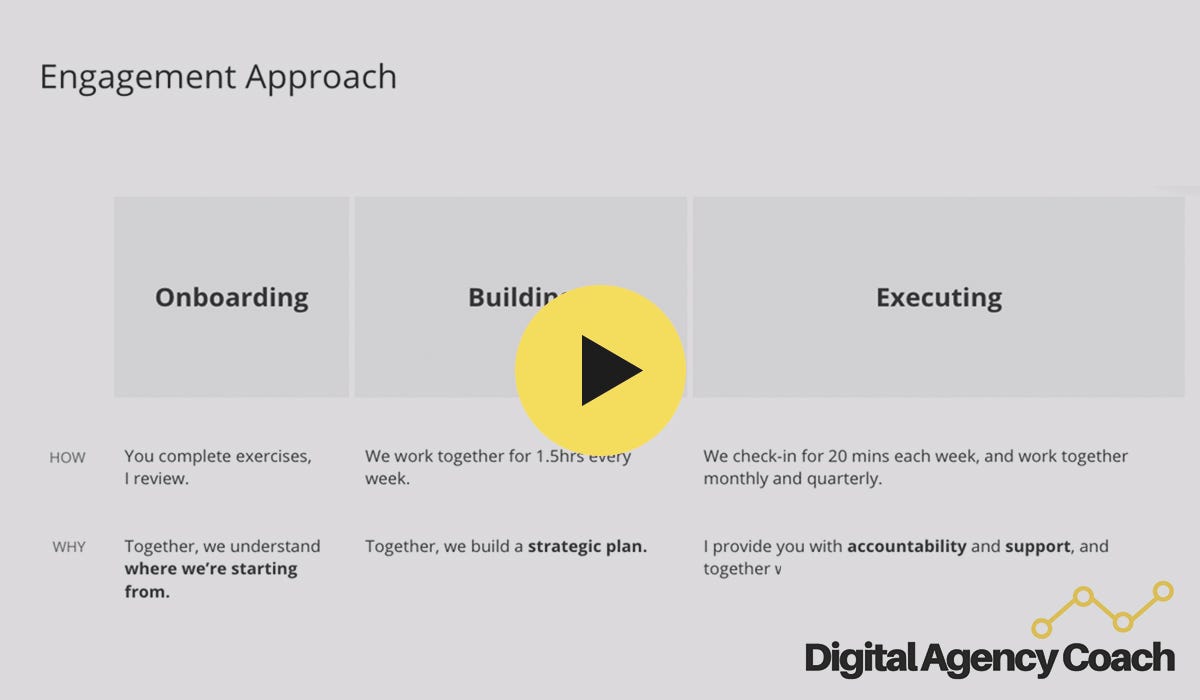
Participating in our Coaching & Mentoring program generally follows this engagement process:
Onboarding — This where the scope of work is agreed and all our reciprocal learning and understanding is carried out.
Building — Together, we put together a strategy and a plan based on our learnings from Step One
Execution — As the name suggests, Stage Three is where we execute the plan and start to grow your agency.
This is where we get to know each other. We’ll begin with a discovery session, where our consultant will ask you to share details and insights about your agency’s current status and any plans, aspirations and goals you have for the future.
This then is reviewed, packaged and shared with you. We’ll put together a presentation that summarises your goals, business position and the strengths, weaknesses and opportunities for your agency. We’ll also detail a top-level roadmap and a handful of quick wins for you to implement then and there which are guaranteed to have an immediate effect on your business from day one.
This onboarding phase usually takes about a month to complete and once we have this understanding we can put together a plan and roadmap for us to move forward with.
This is where we put together your growth strategy. We’ll use our Agency Accelerator Canvas to break down your business plan into achievable, bite-sized objectives, milestones and KPI’s for you and your team.
Our consultants will work with you to formulate a plan and share insight, context, benchmarks and tactics from our portfolio of the 250 digital agencies we’ve worked with. Creating these objectives and key results and writing your business strategy usually takes about 6–8 weeks to complete.
Stage three – execution, makes up around 75–85% of our program. This is where we put our planning into practice and start to make big, impactful changes to your agency’s operations.
You’ll chat with your consultant weekly for 10–15 minute accountability meetings to check in and make sure things are running smoothly. Between these sessions and our ongoing, ‘always-on’, ad-hoc support, you’ll execute the daily and weekly tasks in your business plan.
Every four weeks we’ll set aside a few hours to plan for the coming month and set the KPI’s to make sure the overarching plan is still in sight. Then each quarter, we’ll orchestrate a full review of the work completed and the work ahead and make any necessary changes to the master plan.
At Digital Agency Coach, we work deeply with a small roster of agencies at any one time as our Coaching & Mentoring Programs are long-term relationships that deliver long-term, long-lasting results. The average timeline for these programs is anywhere between 12 to 18 months, depending on your capacity.
Now that we’ve unpacked our Coaching & Mentoring Program and how our services can help you achieve stratospheric growth for your marketing agency — it’s time to ask yourself if this is the right fit for you and how you like to work.
If the answer is yes, please get in touch and Arrange A Free Consultation with one of our friendly consultants. We’ll be happy to answer any questions you might have and get you on the path to success.
Is your digital marketing agency profitable on purpose, or by accident? At Digital Agency Coach we’ve worked with hundreds of agency owners over the years, some of whom were unaware of their profitability stats.
Many agencies end up being profitable by accident, as a positive consequence of the year’s work. In this article, we share our insights on turning an intentional and deliberate profit.
As a busy agency owner, it can be easy to prioritise managing the day-to-day operations and allowing your profitability to become an afterthought. With this mindset, it’s difficult for you as an owner, to have that profit-oriented, strategic mindset that is key to growing your agency.
At Digital Agency Coach, we always recommend approaching profitability with intention and purpose. This approach can feel foreign and a little acquisitive at first, but it’s important to remind yourself that it’s completely genuine and moral to design your business in such a way that it earns you money.
Having a profit-driven mindset enables you to reinvest into your business, enhance the quality of your service and grow your agency.
When it comes to an agency’s profitability, there are typically three different degrees of intent and three defined profit groups as an outcome.
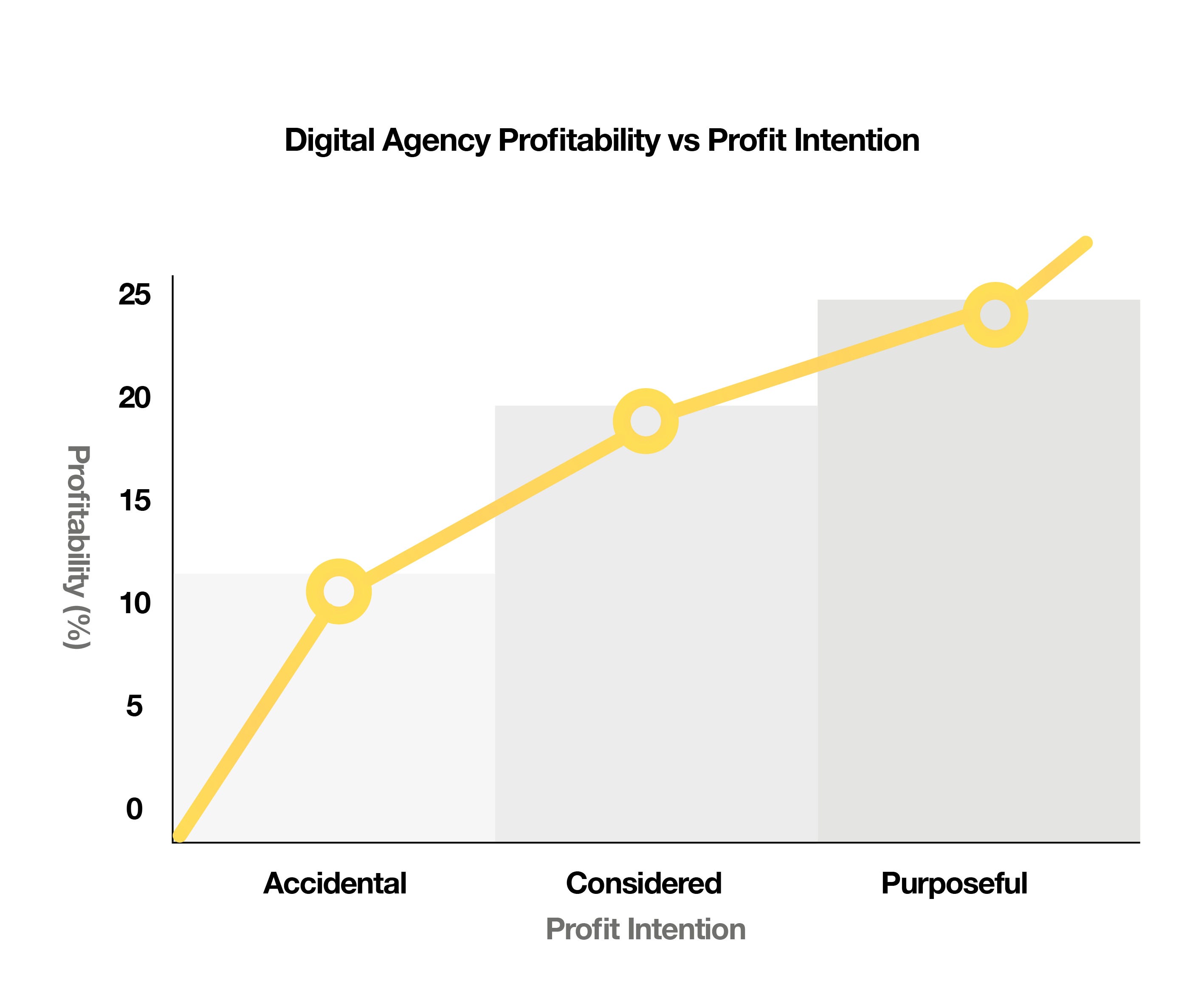
Agencies who generate anywhere from 0–12%* profit are generally doing so by accident. These agencies usually no profit strategy in place and the year-end results are unpredictable and often speak for themselves.
Those digital agencies turning anywhere between 13–22%* profit, are almost always doing it on purpose. The closer the number lies to 22%, the more deliberate and considered the profit is. The lower the number, the less intentional their outcomes have been.
And as for those generating a profit percentage anywhere north of 22%*, we classify those guys as purposeful, profit machines. These digital agencies know their services, their clients, their team, and their business like the back of their hand. Their sales pipeline and financial systems are geared toward driving high volume, quality leads which convert.
*These figures are general only, actual profit margins will depend on the agency size. Large organisations with substantial overheads typically will have tighter margins.
Address these six top-line areas and improve your agency’s profitability today.
Take a close look at your gross margins. If they’re outside the range of 50–60%, unfortunately, you’re not profitable enough. Your gross margins are calculated by taking the overall revenue of your agency, less the sum of those direct salaries and/or contractor and freelance fees required to deliver your particular service.
As a service-based business, your agency sells time — utilisation looks at how many billable hours you have available to your clients. If you are operating at less than 72% capacity, there is scope to improve your profitability by maximising your utilisation.
These can be either your employees or clients. If you attract and retain poor performers, this will lead to inefficiency and low profits within your agency. It might be that you need to address some of those long-standing, legacy clients from your start-up days, or certain team members who are less efficient than others. The solution? Try raising your fees or developing the skills and/or expertise of your employees.
Usually, those agencies who fall into the 0–12% profitability category, have no insight or oversight on their financial or sales reports and forecasts. Having a robust sales pipeline and reporting structure in place will allow you to understand when, where and how you can maximise your revenue and minimise your expenses — which we know will lead to a direct increase in your profitability.
For digital marketing agencies within the UK, it’s recommended you charge £90 per hour as an absolute minimum for your services. At Digital Agency Coach, we advocate charging anywhere between £100 — £150 an hour and ensuring you bill all for those all hours at your full rate in order to maximise your profitability.
Is the service you provide right for the current market? This is a big question for web design agencies who are competing against the likes of Wix and Squarespace. These ‘done-for-you’ website builders have significantly devalued the product to where it’s now within the reach of many small businesses and small budgets. As a specialist agency with a highly skilled team, you need to be bold and honest with yourself and ask if there is a future within your market. If the answer is no —you have to innovate and change with the times.
Remember, it’s perfectly moral and genuine to gear your agency to become a profitable, money-making business. As a business owner, you are doing your customers, employees, and your market a disservice if you are unable to reinvest your profits back into your industry.
Ready to begin? Start by asking determining which of the three levels of profit and intention describes your agency. If you’re turning a profit anywhere south of 20%, it’s time to change your mindset and address these six ways to increase your profitability.
Watch Our Free Video Class: Profit On Purpose (7min) & kickstart your journey toward profitability
Of course, if you have any questions or would like to chat with one of our Digital Agency Coach Consultants, please Get In Touch — they’d love to help.
Enter, Digital Agency Coach’s Agency Accelerator Canvas, or AAC, for short.
Put simply, the Agency Accelerator Canvas is a template for designing your very own growth strategy. Designed to help you and your digital marketing agency create a considered, thorough and actionable roadmap for stratospheric growth.
The AAC prompts thinking and understanding across ten core elements of your agency growth strategy; Purpose, Customer, Value Proposition, Services, Vision, Goals, Strategy, Objective, Milestones & KPIs.
With handy guiding questions along the way, the AAC is easy to follow and easy to complete.
Our Agency Accelerator Canvas demands focus, defines your vision, establishes what it is your agency is trying to achieve, but most valuable of all – it produces an actionable roadmap to get you there.
Free from business school jargon and written in plain English – the AAC is designed to be helpful, straightforward, and easy to follow. At each of the ten stages, you’re offered a handful of guiding questions to formulate thorough and rounded definitions for each component.
While it all sounds so simple and straightforward, the results that populate from the AAC are powerful. At the end of your AAC strategy workshop, you will have defined objectives and measurable KPIs to drive your digital marketing agency forward and measure your success along the way.
Finally – a business strategy document that you can take action on!
The Digital Agency Coach consultants recommend hosting a workshop with your fellow directors or senior management teams to complete the AAC as a group.
Once you have defined your strategy, share it with your employees and wider team – print and mount it within the studio to encourage daily interaction from your cohort.
If there is anything the last two years have taught us, it’s that our world can change in an instant and we, as business owners, must be nimble and adapt our strategy accordingly.
While your AAC will be right for the time, as the seasons change, your strategy will require regular revision. We recommend reviewing your AAC quarterly, asking if any changes need to be made and if you and your team are meeting the objectives.
Use these quarterly reviews to nudge your agency’s strategy back in the right direction, then host a full review workshop and overhaul the overall strategy annually.
First things first, print out the blank AAC template and supporting documents and begin your workshop with our short explainer video to get your meeting off to a productive start.
The AAC is then separated into two focus areas;
We start by defining your digital agency’s purpose. There’s no right or wrong answer here, but it’s important your purpose aligns with your passion – so keep it true to yourself.
Secondly, the AAC takes a look at your customers. You’ll define a specific and targeted niche that your digital agency can approach and service.
Then, we ask about your value proposition. Which problems and pain points do you solve for your clients?
Then finally, – you’ll define your services. This is super important, as this defines your agency’s skill set and the work you agree and disagree to take on.
Then, we move on to…
The AAC then asks you to define your digital agency’s vision and articulate top-level, measurable goals.
Next, strategy. You’re encouraged to think about how you are going to achieve these goals? What are the big moves you’re going to make this year?
Once the big moves are defined, it’s all about the objectives. What daily tactics and functions will your team carry out in order to make the strategy happen.
Then you define growth milestones, or success indicators. What will illustrate that you’re on your way to success?
And then finally, what are the KPIs? How will you measure success and keep your team accountable? We’ll help you define realistic, aspirational and measurable Key Performance Indicators to pull your entire AAC together and ensure it’s the actionable document we promised.
Now you know how it works, it’s time to download the template and start formulating your growth strategy.
Each download includes a ready-to-complete AAC template, a supporting document with key questions to kick-start your thinking and a link to a short explainer video to walk you through the process.
Of course, if you need any help or guidance or you would like a Digital Agency Coach consultant to host an AAC workshop for you and your marketing agency please get in touch via our website.
The number one challenge digital marketing agencies face when it comes to scaling their business is attracting and signing more, high-quality clients.
Digital agencies, on average, win only 13% of their sales-qualified leads.
That’s a pretty low number and a fairly serious problem when you’re trying to scale your agency and grow your clientele base.
As a digital agency owner, you believe in the quality of your work and you know your team can deliver great work for your clients — so why is it so hard to articulate this to a prospective client?
The number one question our Digital Agency Coach clients ask is ‘How do we win more, better clients?’ The answer, it’s all about your pitch.
Over the years, we’ve asked over 250 agencies ‘’Why should I buy from your agency and not from anyone else’? Almost every single one had the same response.
What does your pitch sound like? Is it full of jargon and buzzwords, like ‘Creative Thinkers’ and ‘Trusted Advisors’? Or maybe you differentiate your marketing agency as being ‘Full Service’ or ‘Not Full Service’? We’ve heard it all, and to be frank, so have your clients.
When a client is scouting for a new digital agency, they often interviewing 3–5 simultaneously, before they sign just one. They’re sitting through pitches and wading through phrases like ‘Partners Not Clients’ and ‘Open. Honest. Transparent.’ to find a true connection with the agency they think is the right fit.
Put yourself in the client’s shoes. If all the presentations and offerings look and sound the same, and are filled with cheesy buzz words, it’s hard to tell each agency apart. Chances are, the client will simply choose an agency they feel they have chemistry with. Or, more likely, they’ll make their decision based on price.
So, how can you create a sales pitch that’s guaranteed to win clients? We’ve looked at the work of Doug Hall — a chap who analysed over 4000 propositions and discovered three key common denominators in an agency’s sales pitch that increased the likelihood of landing a sale by up to 40%.
Understand your customer in detail. Get to know their niche, their industry and their product, and then offer a measurable and overt business benefit as part of your pitch. Make sure your value proposition meets their needs.
Pull together two or three dramatic points of difference your marketing agency has against your competitors. Avoid overused agency jargon and make sure these differences will genuinely separate you from the rest. Most importantly, tailor your differences to the pain points of the client and their business.
Agencies are typically really good at this bit. Wrap up your pitch with evidence that you are able to deliver on your promise. This is where you use your awards, case studies and testimonials to prove you are the team for the job.
Now you know what makes a good sales pitch — it’s time to implement these changes and start growing your digital agency!
If you need support or guidance growing your agency and would like personalised, 1:1 help achieving your goals; Digital Agency Coach offers bi-monthly Mastermind Groups.
You’ll collaborate with a team of like-minded professionals, access powerful resources and templates, and benefit from 1:1 coaching sessions, all designed and guaranteed to scale your agency.
You need to load content from reCAPTCHA to submit the form. Please note that doing so will share data with third-party providers.
More Information