Bristol agency Fanatic has acquired Studio Kin, combining brand and creative expertise with established digital, technical and performance capability.
The move marks the next stage of growth for Fanatic and supports its ambition to build a more connected model for what an agency can be. Founded by partners Ian and Milly Collis-Smith in 2001, Fanatic has spent the past 25 years working across brand and digital. Today, it is a team of 32, with capabilities spanning creative, technology, search, marketing, data and performance.
The agency works locally, nationally and internationally in the hospitality, technology and environmental sectors, with brands including Benihana, Gordon Ramsay, Wessex Water, Truespeed
and British Solar Renewables.
Studio Kin brings further depth to the creative side of the business, particularly in brand strategy and identity. Founded by James Ratcliffe and Simon Day, Kin followed eight years spent building and leading Bristol agency Rhombus Studio to a team of 10. The senior-led studio built around the belief that the best brands are created through deep collaboration between teams and clients.
Studio Kin has focused heavily on purpose-led organisations and businesses looking to make a positive impact. The studio created the identity for Western Forest, the first new national forest in 30 years, helped evolve Bristol Beer Factory into the brand it is today and worked with Housing Matters, Caring in Bristol, Shelter and a range of other partners on the Renter’s Rights Campaign.
That shared belief in collaboration was a major part of what brought the two businesses together, with a clear opportunity to reconnect Fanatic with its design roots, bring its services closer together and give creativity a bigger role across the agency.
The ambition is to raise the creative bar across every touchpoint, so wherever someone experiences a client’s brand, from a website to an email, a social post or a campaign, it feels beautifully designed, unmistakably on brand and emotionally engaging.
By bringing teams closer together and building deeper relationships with the businesses they work with, Fanatic can look at challenges from different perspectives, find better answers and create new opportunities for growth.
Fanatic and Kin worked together on We Back Bristol, the city-wide giving movement co-founded with Bristol Beer Factory, Team Love, Pony Group and Bianchis to help charities and grassroots
organisations thrive.
Kin led the brand and creative direction, while Fanatic brought the digital and technical expertise to build an experience that combined strong UX with an engaging visual identity. It offered an early glimpse of what the combined team could achieve.
“What excited us about Fanatic was never just the breadth of what it can do. It was how connected everything could be. A great brand is more valuable when the website, UX, search and marketing around it are all working with it. And all of that becomes more valuable again when you know the client’s business well enough to understand what they actually need. That’s where the real opportunity is.”
James Ratcliffe, Creative Director
The move strengthens Fanatic’s creative offer while supporting its wider growth plans, connecting brand and creative thinking more closely with its established digital, technical and performance
expertise.
“The best client relationships we have are the ones where we become integral to the business. We understand what they’re trying to achieve, we know the challenges and we’re trusted to say what we think will make the biggest difference. Bringing Kin into Fanatic gives us even more expertise to put behind those relationships. For me, that’s what Agency 4.0 is about. Not selling more services, but connecting the right people around the problem and helping the
client perform better.”
Ian, Director
The combined team will operate as Fanatic, with James Ratcliffe and Simon Day joining the agency’s senior leadership as Creative Director and Client Director respectively. The acquisition forms part of Fanatic’s wider growth plans, while retaining the close client relationships, specialist expertise and collaborative culture on which the business has been built.
About Fanatic
Fanatic is an independent Bristol agency built around the idea that great work happens when creative, digital, technology and performance are connected. Founded in 2001 by Ian and Milly Collis-Smith, the 32-strong team works with ambitious brands locally, nationally and internationally, including Hawksmoor, Gordon Ramsay, Artfarm and Benihana. Fanatic combines specialist expertise with close client relationships to help businesses solve problems, find opportunities and grow.
About Studio Kin
Studio Kin was founded by James Ratcliffe and Simon Day as a senior-led brand and creative studio, built on the belief that the best brands are created through deep collaboration. Its work has focused
on purpose-led organisations and businesses looking to make a positive impact, including Western Forest, Bristol Beer Factory, Housing Matters, Caring in Bristol and the Renter’s Rights Campaign. Kin now joins Fanatic to bring greater brand and creative depth across the agency.
A website that takes digital accessibility features seriously reaches a wider customer base, performs better for SEO and reduces legal risks for the business. Recognising this, world-famous restaurant chain Benihana asked us to deliver a fully up-to-date website that adheres to WCAG 2.1 guidelines.
A website that takes digital accessibility features seriously reaches a wider customer base, performs better for SEO and reduces legal risks for the business. Recognising this, world-famous restaurant chain Benihana asked us to deliver a fully up-to-date website that adheres to WCAG 2.1 guidelines.
Our extensive accessibility work on the Benihana website helped improve its overall accessibility score.
We reduced instances of vague and ineffective link text, replacing them with clear and descriptive alternatives to make navigation more intuitive for users.
Identified and replaced ineffective alt text with accurate descriptions, ensuring that information is accurately conveyed to those using screen readers.
The work we conducted on the new Benihana site significantly improved accessibility, ensuring compliance with WCAG 2.1 AA standards. The changes allowed Benihana to reach a wider proportion of its customer base, providing excellent user experience features for those with accessibility needs.
The accessibility improvements also strengthened SEO. By adding features that enhance usability, such as semantic HTML, clear navigation, and descriptive links, Benihana’s fully accessible website achieved a noticeable boost in overall SEO performance.
Over the last year Meta has been gradually rolling out their new algorithm called ‘Andromeda’. As of October this should be fully deployed to all active advertisers across Meta.
Over the last year Meta has been gradually rolling out their new algorithm called ‘Andromeda’. As of October this should be fully deployed to all active advertisers across Meta.
Described in Meta’s own terms as “A personalized ads retrieval engine that leverages the NVIDIA Grace Hopper Superchip, to enable cutting edge innovation in the Ads retrieval stage to drive efficiency and advertiser performance.”
The Andromeda upgrade has improved efficiency by 10,000x compared to its predecessor. This allows it to process far more ad creative data and make much more sophisticated decisions about which creative will resonate with each individual.
Meta also mentions sequence learning which “enables our ads systems to consider the sequence of actions a person takes before and after seeing an ad.” This means the system can understand where someone is in the purchase journey, such as (awareness, consideration or conversion).
In practice, this is likely to mean a fundamental shift in Meta’s ad selection process. Rather than selecting a specific winner from a shortlist of ads, the new algorithm offers the potential to serve ads sequentially to lead to a conversion.

This shift is a move from audience targeting to “creative diversification”. This is a new buzzword for the Meta Ads space and refers to “the practice of creating a wide range of ad creatives with different themes, messages, and visuals to cater to diverse audience segments.”
For advertisers, this means moving away from targeting specific demographics, interests and behaviours, and instead focusing ads on different target audiences leveraging Meta’s AI/advantage+ campaign* types to do so. There is still the feature to add traditional audiences such as “interest”and 1st party data into these campaigns as a “suggestion”, but adding audience constraints can prevent learning and hinder performance.
The ultimate aim of this new approach is that advertisers will be able to access broader, more relevant audiences, including potential customers that the previous algorithm may have ignored. This will be delivered through a combination of allowing Meta to control the audience, testing different sorts of creative, with Andromeda being the tool connecting these to the right person at the right time.
*Advantage+ sales campaigns use Meta’s AI to automatically find and target the most relevant audiences, eliminating the need for manual audience setup. The system learns and optimises based on who actually converts.
With Meta Andromeda representing a fundamental change in how ads are delivered across Meta, advertisers need to consider the following.
With Meta claiming real-world results of an 8% improvement in ad quality there are real benefits to be had. However, performance still relies on the quality of your ads and this should remain a primary focus to create audience engagement.
The shift to creative-led Meta advertising requires new skills and strategic thinking. If your Meta performance has declined or you’re unsure how to adapt, get in touch with Fanatic and we’ll have a conversation on how to update your Meta Ads strategy.
Sources:
AI doesn’t mean the same thing to everyone. AI isn’t a single tool or website and it’s not even a single piece of technology. So it’s not surprising that there are as many opinions about AI as there are AI tools on the market.
Every leap in technology has come with its detractors. The mechanisation of farming led to a huge increase in the efficiency of food production which helped reduce commercial food costs but there were significant jobs losses and, in some cases, the destruction of supporting industries. Likewise, the machine-breaking Luddites of the 19th-century whose violence against automated factory practices became so impactful that it created a whole new term for the technologically adverse. Social media, mobile phones, 5G, electric cars; every advance in technology comes with its cynics and rightly so.
Progression doesn’t stop, it’s simply a matter of working out how emerging technology can be a benefit for you, your tasks, projects or processes with the correct diligence and caution for its potential downsides.
If you aren’t a naturally good writer or need to improve the pace of research, AI can help. Likewise, for the huge majority of people without design skills or access to premium Adobe subscriptions, AI will improve the quality of creative output for non-specialists. Access to higher levels of creative output is suddenly democratised with free or low cost AI tools. This, in turn, raises the quality of the lower end of written, coded or visual work. In time, this also helps push industries forwards, helping to raise the standards of work across all participants.
Taking a step away from Generative AI, there is a huge scope to improve the access businesses of all sizes have to high volume data processing tools to enhance predictive modelling, productivity and automation.
AI uses vast data sets to generate its outputs, whether that’s an answer to a question or designing a logo. Most commonly, that data set is created by crawling accessible content and data of all types from across the internet. An AI model will pull from all its available data and reference points, weighing up the authority and trustworthiness of its sources and returning an answer or output to you. AI isn’t creating anything from scratch, really it’s just aggregating and combining what already exists online.
That comes with its downsides.
Early roll-outs of Google AI overviews led to many single posts on Reddit being used as a source for questions asked via Google search. Citing a single anonymous personal opinion as a definitive answer comes with an enormous amount of risk. McDonalds tested AI driven voice orders for nearly 6 years before decommissioning it in 2024 because of misinterpreted orders.
If you are a top level designer, copywriter or developer, AI can still offer you productivity improvements but it’s likely its creative output isn’t going to match what you are already doing. Also when it comes to various factors such as ownership, compliance and brand impact, there are some further risks that come from aggregated work.
In most jurisdictions, AI output is in the public domain, and isn’t owned by the user or company using the AI tool. When it comes to branding or other high value work this can cause serious issues in the long term. In many regions, including the EU, AI generated content has to be labelled as such. For many users, this may discredit the work and reflect badly on the brand. Equally, nothing risks long-term damage to brand perception than if brand copy, statements or assets are too similar to the competition. This is a risk created by using the aggregated information which AI tools rely on.
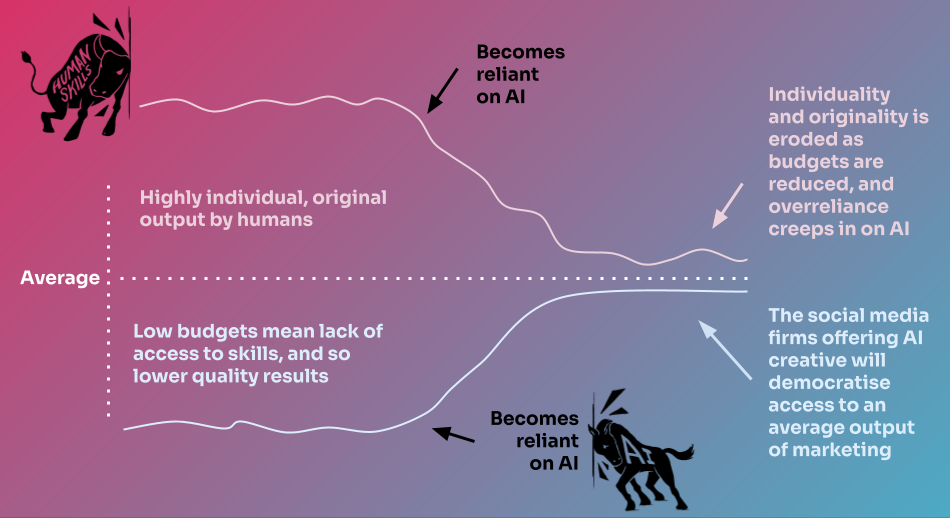
As indicated in the chart above, Generative AI can make the average more achievable than ever before. For most businesses being average isn’t good enough. The use of AI thus becomes a question of how it can add the most value to you, from where you are now. If you are a great designer, don’t compromise by leaving critical design decision-making to AI. However, if you have to make one poster a year for the Christmas party, congratulations! AI is here to help.
Pick your battles, know where you outperform the average and double down on skills which set you apart from AI.
From 18th-century hoaxes like The Mechanical Turk to today’s over-hyped “AI automation,” history shows our fascination with machines that seem smarter than they are. This post explores how illusions of intelligence—from chess computers to chatbots—reveal both the progress and persistent limitations of artificial intelligence, and why skepticism remains essential.
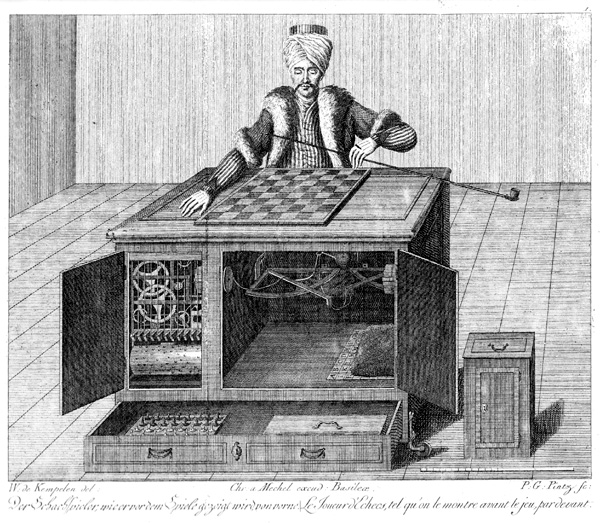
In 1770, the world’s first chess-playing machine was created. Known as “The Mechanical Turk”, it toured the world for almost 90 years before being destroyed in a fire in 1854. A few years later, it was revealed by the inventor’s son that the machine was a hoax. Instead of being operated by some form of mechanical computer, it was in fact a man sitting inside a box playing chess.
With the benefit of hindsight, this should have been obvious to everyone at the time, but the allure of seemingly impossible technology continues to blind us today. Amazon Fresh’s “Just Walk Out” technology, which appeared to use AI to track shoppers automatically, relied heavily on human reviewers in India to process transactions. Similarly, Builder.ai promised automated code generation but employed teams of human developers behind the scenes. Like the chess-playing automation of centuries past, these modern “AI Turks” demonstrate how easily we can be deceived by the promise of technological magic.
As we move into the modern era, chess computers have become a useful benchmark for measuring technological progress. The turning point came in 1996 when IBM’s Deep Blue managed to win 2 out of 6 games against World Champion Garry Kasparov. The following year, an improved Deep Blue won the rematch 3.5 to 2.5, marking the end of competitive human-versus-computer chess. The gap has only widened since then. The processing power that IBM needed an entire room to house in 1997 now fits into everyday devices. Any computer, smartphone or even smart appliance can now outplay the world’s best human players. Even the great Magnus Carlsen, who held the world number one ranking for over a decade, has said his iPhone consistently beats him at chess.
Chess makes an excellent benchmark for technological progress due to several key factors. For this article, we’ll focus on four main advantages:
Chess also benefits from a remarkably efficient notation system. An entire game can be condensed into a single paragraph that captures every move. Take the decisive final game from the 1997 Deep Blue versus Kasparov match:
1.e4 c6 2.d4 d5 3.Nc3 dxe4 4.Nxe4 Nd7 5.Ng5 Ngf6 6.Bd3 e6 7.N1f3 h6 8.Nxe6 Qe7 9.0-0 fxe6 10.Bg6+ Kd8 11.Bf4 b5 12.a4 Bb7 13.Re1 Nd5 14.Bg3 Kc8 15.axb5 cxb5 16.Qd3 Bc6 17.Bf5 exf5 18.Rxe7 Bxe7 19.c4 1–0 (Resignation)
You don’t need to visualise the board position, but loading this notation into any chess program reveals how the game unfolded. Modern chess engines show that when Kasparov resigned, he was trailing by approximately 5.1 pawns’ worth of material and positional advantage. This was a crushing disadvantage that the 1997-era computers had correctly identified.
Deep Blue was a specialised computer designed for a single purpose: winning games of chess. Over the decades that followed, chess algorithms became more efficient whilst computational power increased dramatically. We eventually reached the point where, as mentioned before, an iPhone can defeat the world number one chess player at the very game that earns him millions.
When ChatGPT was released in November 2022, after spending a week recreating rap songs in the style of Shakespeare, the internet quickly discovered something interesting. ChatGPT was terrible at chess. Despite chess being the perfect game for a computer, and despite millions of chess games being part of its training data, ChatGPT failed at a fundamental level. The AI couldn’t follow basic rules, often creating new pieces from thin air or jumping over defences to capture pieces illegally. Its strategic play was equally poor, regularly leaving queens undefended for easy capture.
This reveals a fundamental limitation: despite their impressive language capabilities, Large Language Models lack basic logical reasoning. They cannot consistently follow rule-based systems or systematically evaluate multiple options. Remarkably, despite being trained on vastly more data and computational power than any previous AI system, LLMs struggle with logical problems that were solved decades ago by much simpler algorithms.
Having limitations within a system is perfectly acceptable. I don’t expect Excel to help me edit videos, nor do I use After Effects for expense tracking. The problem with LLMs isn’t that they have limitations, but that the companies promoting them oversell their capabilities whilst the models themselves confidently attempt tasks they cannot actually perform.
I tested this by playing chess against Claude Sonnet 4. The model broke the rules within 2 moves by making an illegal bishop move, then from move 8 onwards kept using a queen to capture my pieces despite the fact that I had already captured that queen. When I tried Claude Opus 4.1, another model from the same company, it performed better initially but still eventually violated the rules later in the game.
Some developers have achieved better results by essentially rebuilding chess logic through prompting. This involves re-stating the complete board position after every move and explicitly listing legal moves for the model to choose from. But this isn’t the LLM playing chess independently; it’s the human prompt engineer providing extensive scaffolding at every step. Without this constant intervention, the underlying model still cannot maintain basic game state, such as remembering which pieces remain on the board.
The most dangerous aspect isn’t that these tools fail; it’s that they fail whilst appearing successful. A calculator that occasionally returns 2+2=5 would be quickly discarded. But wrap that same error in an eloquent explanation about mathematical theory, and people might question their own understanding rather than the tool’s accuracy. The Mechanical Turk fooled audiences because they wanted to believe in the magic. Today’s AI LLMs can fool us because they speak with such conviction that we assume competence.
This confident incorrectness has already caused real problems. Multiple US newspapers published AI-generated “Summer reading lists for 2025” that included entirely fictional books with plausible-sounding titles and authors. The articles read professionally, referenced current literary trends, and seemed thoroughly researched. Only when readers tried to purchase these non-existent books did the fabrication become apparent.
The lesson isn’t to avoid these tools entirely, but to understand their proper role. LLMs excel at reviewing and refining existing content, catching grammatical errors, suggesting alternative phrasings, and identifying inconsistencies in documents. They’re powerful assistants for discrete, well-defined tasks where their output can be easily verified. But when asked to build systems, maintain logical consistency across complex problems, or generate factual information without verification, they become unreliable narrators of their own limitations. The tools work best when we use them to check our work, not when we’re checking theirs.
Ever wondered if those dramatic peaks and troughs in your GA4 data are part of a wider industry trend or just unique to your site? You can now know for sure with GA4’s recently upgraded Benchmarking feature that, for the first time, allows you to compare absolute metrics like New Users and Total Revenue – not just percentages and ratios.
GA4’s Benchmarking feature received a game-changing upgrade this October – letting you compare absolute metrics like Sessions, New Users, and Total Revenue against your peers. Previously limited to normalised metrics like bounce rates and percentages, this update finally lets you see how your actual numbers stack up against the competition.
This is a great new feature that our team absolutely loves (pun very much intended). Before benchmarking, you either had to wait until the end of the year to see rough industry averages from various whitepapers, or manually compare data between clients in the same industry. Neither option was reliable – whitepapers covered too broad a timeframe to spot real trends, whilst client comparisons only gave you a limited sample size rather than true industry insights.
In comparison, with GA4 Benchmarking data updating every 24 hours, we finally have near real-time industry comparisons at our fingertips.
Why we love GA4 Benchmarking
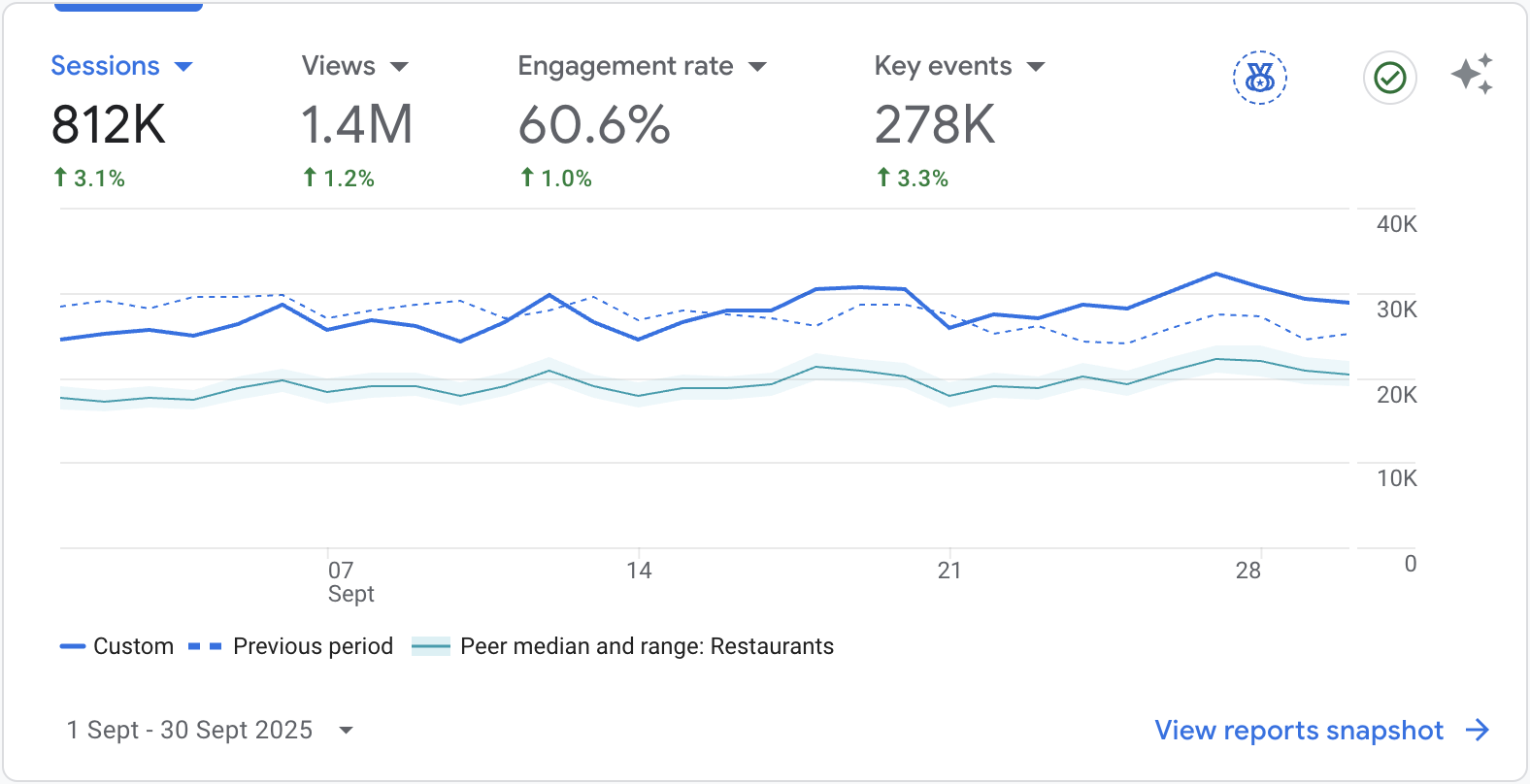
GA4’s benchmarking feature provides reference metrics in percentiles (median, 25th, and 75th) based on peer groups of similar businesses. It offers two types of benchmark metrics – normalised metrics (like percentages and ratios) and unnormalised metrics(absolute numbers like “Total Revenue” or “Active Users”).
According to Google’s official benchmarking documentation, for absolute numbers, GA4 estimates a performance range based on your property’s number of active users by multiplying the peer group’s normalised metric by your property’s active user count.
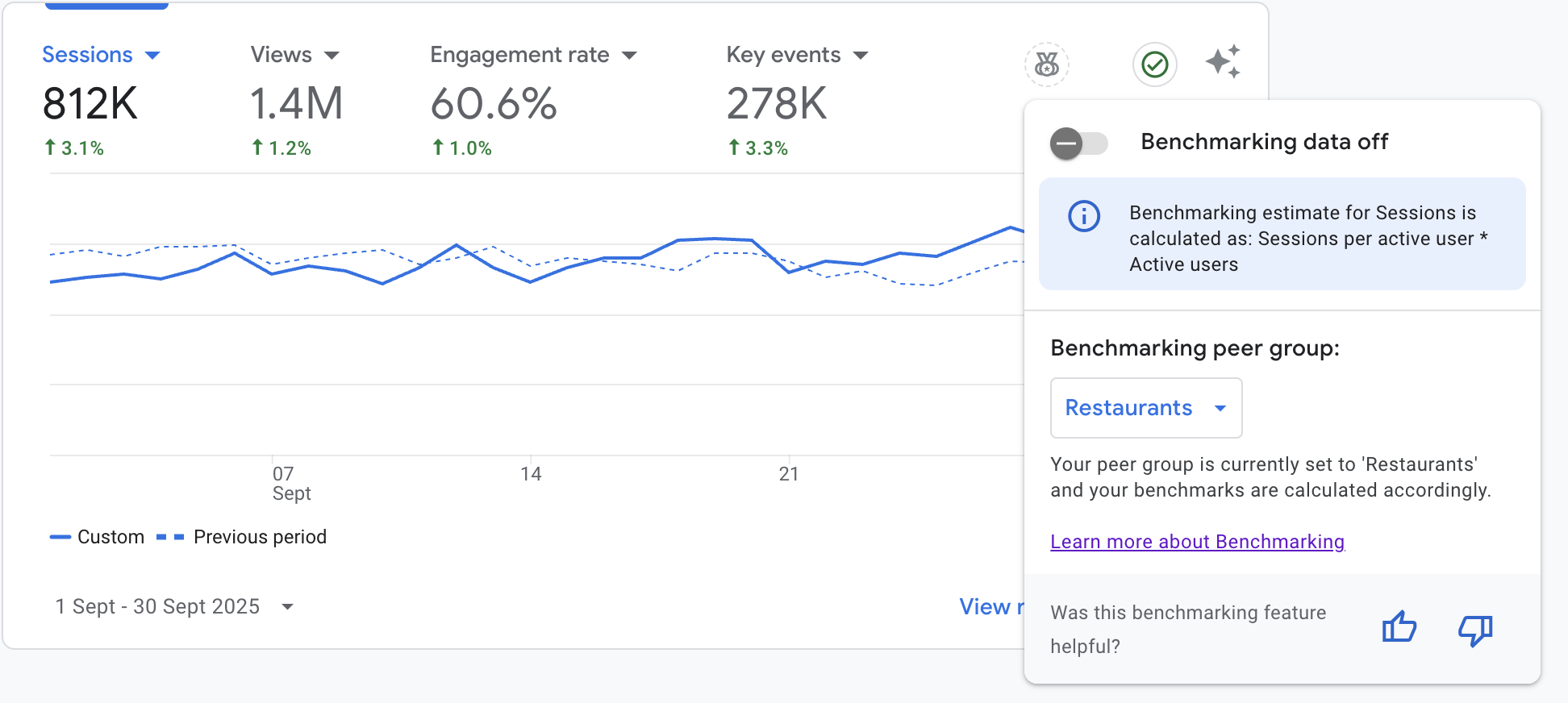
For example, the benchmark for Sessions is calculated as: Peers’ sessions per active user × Your active users
This ensures you’re comparing apples to apples, even when businesses have vastly different traffic volumes.
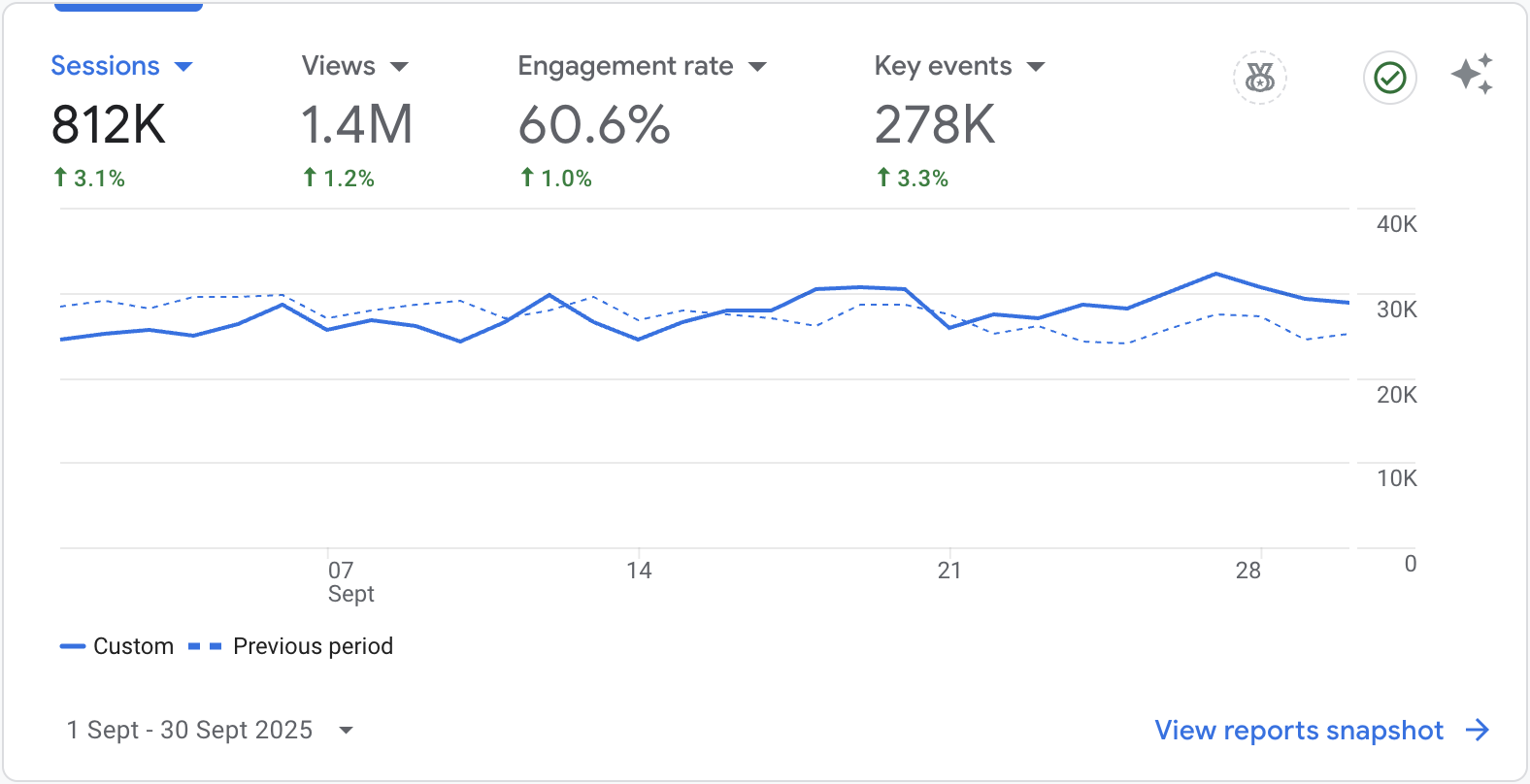
Step 1: Open Google Analytics and select the account then the property as usual. In the Home view, you can see the overview card with the four metrics you viewed last time and the Benchmarking icon.
Step 2: Click on the Benchmarking icon, then on the dropdown of industries to select your peer group.
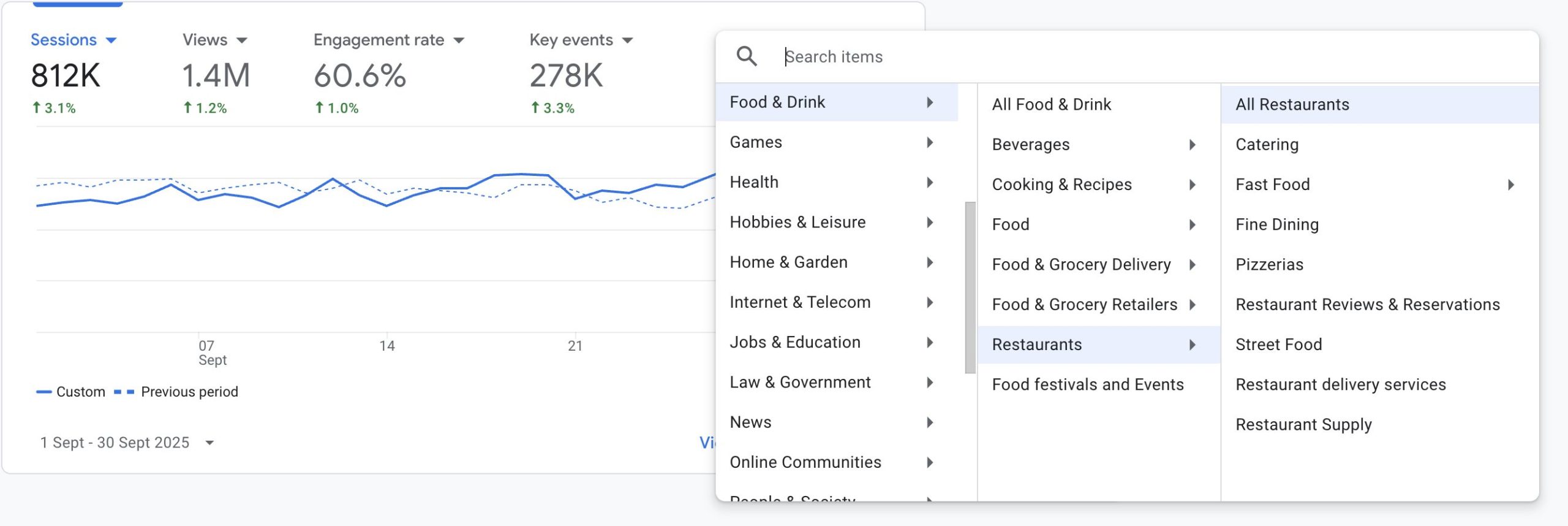
Step 3: Find the peer category that describes your industry most accurately.
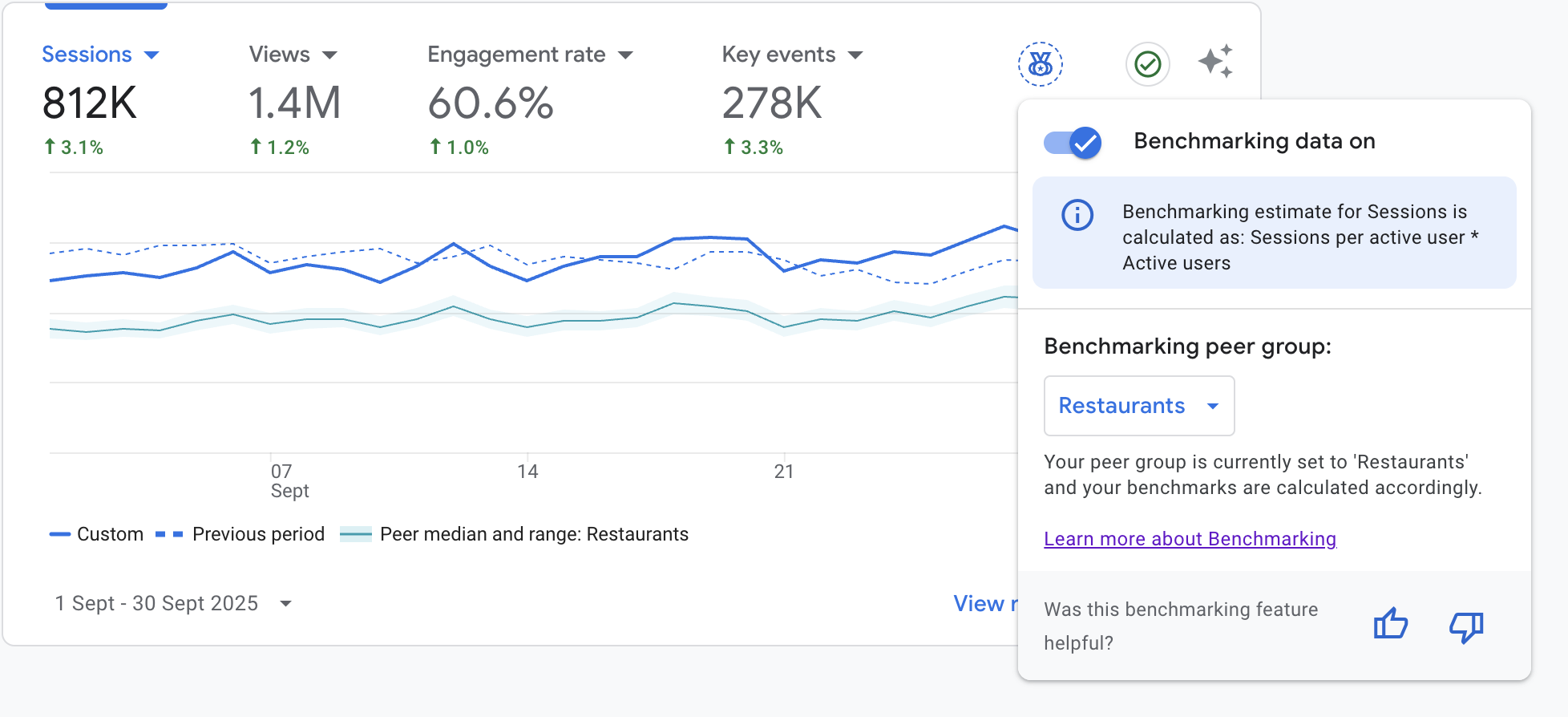
Step 4: Turn on Benchmarking to see the peer median (solid turquoise line) and peer range (light turquoise shaded area) for a quick visual comparison.
If you’re one of our clients, we’ve most likely already set this up for you. But as always, we encourage you to explore different features yourself. In this case, you could switch between different peer groups – for example, Restaurant → Fine Dining or even Cooking → Cuisines → Cuisine Type – to understand the overall interest in specific aspects of your industry.
If you’re a fellow digital marketing specialist, you’ll appreciate how this feature transforms client reporting. We now have realistic and comparable industry data. No more awkward conversations explaining why a 10% drop in traffic might actually be an industry-wide trend, or defending why a 15% increase isn’t as impressive as it sounds when competitors are seeing 30% growth. The data speaks for itself, adding invaluable context to every report and strategy discussion.
Benchmarking in GA4 is one of those features that once you start using, you’ll wonder how you ever managed without it. It adds context to every spike and dip in your data, turning guesswork into informed strategy. Give it a try – your next report will thank you for it.
AI is a controversial topic across many industries, but particularly among those whose work involves creative output. The rise of generative AI tools such as ChatGPT, Midjourney, and Claude has enabled creators, marketers, and businesses to produce content at an alarmingly fast and cost-efficient rate.
Ownership of AI-generated content remains a legal grey area. Unlike traditional work created by humans, content produced solely by AI does not qualify for copyright protection. The U.S. Copyright Office maintains that only works with substantial human authorship are eligible for copyright Reference. However, content that blends AI generation with meaningful human creative input may qualify, depending on the extent of the contribution and your location. In the UK, there may be more flexibility, with some protection granted to the individual directing the AI tool Reference.
If you’re considering creating content entirely with AI and minimal human involvement, it is likely to be considered part of the public domain. This means other businesses could legally reuse, repurpose, or monetise it without your permission.
Another consideration is the training data behind many AI tools. If your AI-generated content closely resembles existing copyrighted material, you could face infringement claims, even if you were unaware of the similarity.
AI offers significant benefits for brand content strategies. It accelerates the production of written, visual, and audio assets, allowing brands to maintain consistent output and stay competitive. However, there are risks. Audiences may perceive AI-generated content as impersonal or low-effort.
Errors or misinformation can erode trust, and irresponsible use of these tools may lead to legal disputes. Content that lacks human refinement often feels generic. This can weaken your brand’s distinctiveness within the industry.
AI is transforming the content creation landscape, but legal protections are still evolving. The Fanatic Creative Team treats AI tools as creative assistants, not standalone creators. By combining the efficiency of AI (for tasks such as removing image backgrounds) with our human creativity, your brand can remain protected, distinctive, and trustworthy in an increasingly automated and visually homogenised world.
You need to load content from reCAPTCHA to submit the form. Please note that doing so will share data with third-party providers.
More Information